

Introduction
Structure and properties of undoped strontium ferrite SrFeO3−δ (SF) have been the focus of numerous scientific investigations over the last several decades. This oxide is stable over the wide range of oxygen content, from (3 − δ) = 2.5 to 3.0. The oxygen nonstoichiometry (δ) in SF is governed by the equilibrium temperature (T) and oxygen partial pressure ( ${p_{{{\rm{O}}_{\rm{2}}}}}$). It is known that various ordered phases with different δ, such as Sr8Fe8O23 (space group I4/mmm), Sr4Fe4O11 (Cmmm) and Sr2Fe2O5 (Ibm2), can be formed in SF system depending on the particular T and
 ${p_{{{\rm{O}}_{\rm{2}}}}}$ [Reference Takeda, Kanno, Takada, Yamamoto, Takano, Nakayama and Bando1, Reference Mizusaki, Okayasu, Yamauchi and Fueki2, Reference Hodges, Short, Jorgensen, Xiong, Dabrowski, Mini and Kimball3, Reference Schmidt and Campbell4]. However, such ordered phases and their transformations are interesting mainly from the fundamental point of view. It can be said that the disordered-cubic-perovskite-like structure
 $\left( {Pm\bar{3}m} \right)$ is the most important for the practical applications because its stability limits with respect to T and
 ${p_{{{\rm{O}}_{\rm{2}}}}}$ overlap the working conditions of many state-of-the-art electrochemical devices including solid oxide fuel cells (SOFC) and oxygen permeation membranes [Reference Jacobson5, Reference Sunarso, Baumann, Serra, Meulenberg, Liu, Lin and Diniz da Costa6]. Additionally, the number of publications on substituted SF (Sr1−xAxFe1−yByO3−δ where A is a rare-earth metal and B—3d-transition metal) grows steadily—and such substitutions are usually aimed not only at enhancing the properties of the parent compound, but also at stabilizing its perovskite-type structure.
A lot of potential high-temperature applications of perovskite-type oxides, such as sensors, membranes and SOFC components, are related to the oxygen exchange phenomena. Understanding the redox energetics could provide useful insights into the defect chemistry [Reference Bakken, Stølen, Norby, Glenne and Budd7] and even the microstructure [Reference Cheng, Navrotsky, Zhou and Anderson8] of the oxide in question. In this regard, an extensive calorimetric study of different phases in SF system was made by Haavik et al. [Reference Haavik, Atake, Kawaji and Stølen9, Reference Haavik, Atake and Stølen10, Reference Haavik, Bakken, Norby, Stølen, Atake and Tojo11]. However, their direct heat capacity (C p) measurements on cubic SrFeO2.83 were made only up to around 700 K [Reference Haavik, Bakken, Norby, Stølen, Atake and Tojo11], where little oxygen exchange of this sample with ambient atmosphere (air) actually occurs. In the paper on enthalpy contribution to the redox thermodynamics of SF [Reference Haavik, Atake and Stølen10] they report temperature-dependent oxidation enthalpies,  $\Delta H_{{\rm{ox}}}^{\rm{0}}$, of perovskite-type SF for T in range 800–1200 K. Lacking the actual high-temperature experimental data, rather questionable procedure was employed for obtaining these dependences. Two-phase samples with general formula SrFeO2.54, consisting of brownmillerite-type Sr2Fe2O5 with unknown amount of Sr4Fe4O11-type impurity, were taken as initial (reduced) strontium ferrite. Then these samples were heated in air in the adiabatic calorimeter up to approximately 700 K, resulting in their oxidation at around 600 K accompanied by transformation into cubic SF and corresponding heat effects. The oxygen content in resulting oxide was found to be close to 2.83. Strictly speaking, in order to calculate the high-temperature heats of oxidation of perovskite-type SF using the results of such experiment, a lot of additional reliable data are needed: the quantitative phase composition of initial SrFeO2.54 oxides, the heats of
 $Ibm2 \to Pm\bar{3}m$ and
 $Cmmm \to Pm\bar{3}m$ phase transitions, and the enthalpy increments of all the phases in question. In fact, Haavik et al. [Reference Haavik, Atake and Stølen10] neglected the impurities in reduced SF, assuming that SrFeO2.54 consisted of single-phase brownmillerite. The values of order-disorder
 $Ibm2 \to Pm\bar{3}m$ transition enthalpy in SrFeO2.5, used in calculations by Haavik et al. [Reference Haavik, Atake and Stølen10], differed by 2.5 kJ/mol oxide. This led to the additional ambiguity in the reported
 $\Delta H_{{\rm{ox}}}^{\rm{0}}$ of 7.5 kJ/mol O, which is comparable to the uncertainty of their calorimetric measurements. Moreover, the enthalpy increments for orthorhombic SrFeO2.5 and cubic SrFeO2.83 were calculated using extrapolated and not experimental C p(T) dependences [Reference Haavik, Atake, Kawaji and Stølen9]. The said extrapolation was done on the basis of Neumann–Kopp rule. As the lattice-dynamic behavior is expected to be quite different for SrFeO2.5, SrFeO2.83, SrO, and Fe2O3 if only because their crystal structure differs significantly, Neumann–Kopp rule is expected to give erroneous temperature dependences of specific heat of either SrFeO2.5 or SrFeO2.83.
Cheng et al. [Reference Cheng, Navrotsky, Zhou and Anderson8] reported  $\Delta H_{{\rm{ox}}}^{\rm{0}}$ of SF to be −70 ± 15 kJ/mol O. Though this value is extrapolated from compositional dependences,
 $\Delta H_{{\rm{ox}}}^{\rm{0}}\left( {{\rm{L}}{{\rm{a}}_{1 - x}}{\rm{S}}{{\rm{r}}_x}{\rm{Fe}}{{\rm{O}}_{3 - \delta }}} \right) = f\left( x \right)$, the values of
 $\Delta H_{{\rm{ox}}}^{\rm{0}}$ reported by Cheng et al. [Reference Cheng, Navrotsky, Zhou and Anderson8] and Haavik et al. [Reference Haavik, Atake and Stølen10] are well within the error margins of each other.
The recent ab initio calculations of heat capacity of SF made by Jia et al. [Reference Jia, Zeng, Lin, Duan and Ohodnicki12] differ from the experimental results [Reference Haavik, Bakken, Norby, Stølen, Atake and Tojo11] in almost all aspects—from the absence of any signs of phase transitions on C p(T) dependences to the C p values.
Several studies reported equilibrium oxygen partial pressure–composition–temperature  $\left( {{p_{{{\rm{O}}_{\rm{2}}}}} - T - \delta } \right)$ data for SF [Reference Mizusaki, Okayasu, Yamauchi and Fueki2, Reference Bakken, Stølen, Norby, Glenne and Budd7, Reference Holt, Norby and Glenne13, Reference Diethelm, Closset, Van Herle and Nisancioglu14, Reference Vashuk, Kokhanovskii and Yushkevich15, Reference Patrakeev, Shilova, Mitberg, Lakhtin, Leonidov, Kozhevnikov, Julien, Pereira-Ramos and Momchilov16, Reference Starkov, Bychkov, Matvienko and Nemudry17, Reference Merkulov, Naumovich, Patrakeev, Markov, Bouwmeester, Leonidov and Kozhevnikov18, Reference Yoo, Yoo, Yu and Jacobson19, Reference Vieten, Bulfin, Senholdt, Roeb, Sattler and Schmücker20]. These data can be used to calculate partial molar enthalpy, Δh O, and entropy, Δs O, of oxygen according to the well-known relations. Existing significant scatter in published
 ${p_{{{\rm{O}}_{\rm{2}}}}} - T - \delta$ data [Reference Haavik, Atake and Stølen10] inevitably leads to considerable discrepancies in as-estimated partial molar properties. However, the issues of oxygen nonstoichiometry of SF and partial molar thermodynamics of oxygen are closely related to the defect structure. This complex subject is fully addressed in another study [Reference Sereda, Tsvetkov, Ivanov and Zuev21]. For the purpose of the present work and in order to point up existing disagreements, it would be sufficient to say that Δh O ranges from −65 to −110 kJ/mol O depending on particular data set used for its evaluation [Reference Sereda, Tsvetkov, Ivanov and Zuev21].
Thereby, in this study we aimed to address the lack of high-temperature thermodynamic data for cubic SF by measuring its enthalpy increments in the broad temperature range (373–1273 K) in air atmosphere and to discuss the oxygen exchange energetics for cubic SF on the basis of the as-obtained in situ calorimetric data.
Results and discussion
Phase transition in SF in air
It is known from the previous studies that the lattice of SF slowly cooled to room temperature in air is tetragonal (I4/mmm), and that it undergoes first-order phase transition to cubic  $\left( {Pm\bar{3}m} \right)$ upon heating in air [Reference Takeda, Kanno, Takada, Yamamoto, Takano, Nakayama and Bando1, Reference Schmidt and Campbell4, Reference Haavik, Atake, Kawaji and Stølen9]. The latent heat of this phase transition,
 $\Delta H_{{\rm{tr}}}^{\rm{0}}$, should be taken into account in the present discussion of drop calorimetry results. In order to verify the temperature of
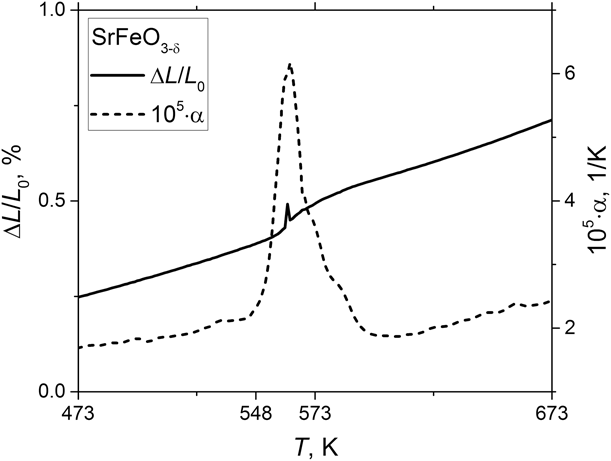
 ${{I4} / {mmm}} \to Pm\bar{3}m$ phase transition independently, dilatometry experiment was carried out. As seen in Fig. 1, the onset of the peak on thermal expansion coefficient (TEC) dependence is observed at around 548 K. It is in good agreement with some of the earlier reported phase transformation temperatures, T tr, 558 K4 and 560 K [Reference Haavik, Atake, Kawaji and Stølen9]. Though, according to Takeda et al. [Reference Takeda, Kanno, Takada, Yamamoto, Takano, Nakayama and Bando1], the said phase transition occurs at slightly lower temperature (523 K), we suppose that direct heat capacity measurements [Reference Haavik, Atake, Kawaji and Stølen9] should be given higher priority in correct T tr determination. Thus, at 523 K SF sample in equilibrium with ambient air apparently possesses tetragonal symmetry. In accordance with our in situ X-ray diffraction (XRD) experiment and structural studies of Schmidt and Campbell [Reference Schmidt and Campbell4], cubic SF is stable in air at temperatures of 573 K and higher.
Relative thermal expansion (ΔL/L 0) and TEC (α) of SF in air.

Enthalpy increments
During the drop calorimetric experiments, we obtained some values of  $\Delta _{T\;{\rm{low}}}^{T\;{\rm{high}}}{H^0}$, where T low and T high are the initial and final temperatures of the sample, respectively. As the initial sample temperature, T low, differed slightly from the desired 298 K (see Experimental for details), our experimental points were adjusted using the following expression:
 $$\eqalign{\Delta _{298}^T{H^0} = \Delta _{T\;{\rm{low}}}^{T\;{\rm{high}}}{H^0} + \Delta _{298}^{T\;{\rm{low}}}{H^0} \cr= \Delta _{T\;{\rm{low}}}^{T\;{\rm{high}}}{H^0} + \int_{298}^{T\;{\rm{low}}} {C_p^{{\rm{tetr}}}{\rm{d}}T} \quad ,$$
where  $C_{\rm{p}}^{{\rm{tetr}}}\left( T \right)$ dependence was obtained using the near-room-temperature heat capacity data measured by Haavik et al. [Reference Haavik, Bakken, Norby, Stølen, Atake and Tojo11] for SrFeO2.833, because the oxygen content, 3 − δ, in the slowly cooled SF used in the present work was found to be 2.82(4), which is almost the same as in the samples used by Haavik et al. [Reference Haavik, Bakken, Norby, Stølen, Atake and Tojo11] for heat capacity measurements. Values of
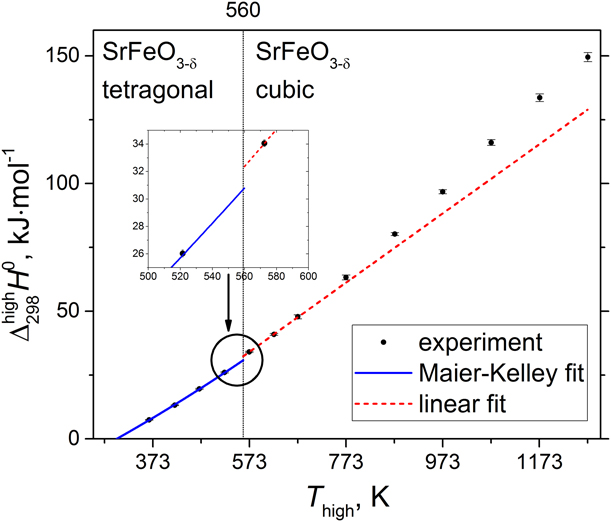
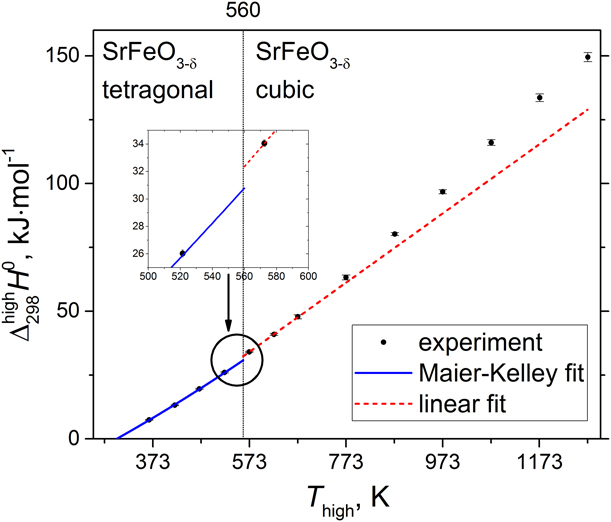
 $\Delta _{298}^T{H^0}$ calculated accordingly are presented in Fig. 2 with the corresponding error margins, and are listed along with experimental data in Table I.
Enthalpy increments for SF: experimental data points and smoothed lines.
Experimental enthalpy increments  $\Delta _{T\;{\rm{low}}}^{T\;{\rm{high}}}{H^0}$ and
 $\Delta _{298}^T{H^0}$. Expanded uncertainties reported correspond to a level of confidence of ca 95%. Estimated expanded uncertainties of T low and T high determination are 0.2 K.

a calculated using  $\Delta _{T\;{\rm{low}}}^{T\;{\rm{high}}}{H^0}$ and the low-temperature C p data reported by Haavik et al. [Reference Haavik, Bakken, Norby, Stølen, Atake and Tojo11].
Let us first discuss the lower-temperature region, T ≤ 523 K, where the heat consumed by the SF sample during the drop experiment is determined solely by the heat capacity of tetragonal SF:
 $$\Delta _{298}^T{H^0} = \Delta _{298}^TH_{{\rm{tetr}}}^0 = \int_{298}^T {C_{\rm{p}}^{{\rm{tetr}}}{\rm{d}}T} \quad .$$
Note that at such low temperatures the oxygen exchange can be safely neglected (see section “Oxygen nonstoichiometry and redox thermodynamics” for details). Then, a simple Maier–Kelley function
 $$\Delta _{298}^T{H^0} = aT + b{T^2} + c{T^{ - 1}} + d\quad ,$$
can be used to approximate the enthalpy increments for tetragonal SF. The heat capacity data available [Reference Haavik, Bakken, Norby, Stølen, Atake and Tojo11] and the application of Shomate method [Reference Shomate22] allow reducing the number of unknowns in Eq. (3):
 $$\left\{ {\matrix{ {a = {C_{\rm{p}}} - 596.3b + {c / {{{298.15}^2}}}} \hfill \cr {d = - 298.15a - {{298.15}^2}b - {c / {298.15}}} \hfill \cr} } \right.\quad ,$$
where C p(298.15) = 106.47 J/(mol K) [Reference Haavik, Bakken, Norby, Stølen, Atake and Tojo11]. Substitution of Eq. (4) into Eq. (3) yields  $\Delta _{298}^T{H^0}\left( {b,c,T} \right)$ function, which was fitted to the experimental enthalpy increments of SF at T ≤ 523 K. It was found that fixing the value of c coefficient as 0 influences the goodness of fit insignificantly while leaving the only unknown (b) in the model function. Consequently, the value of b obtained as a result of the nonlinear fitting is (4.23 ± 0.89)·10−2 J/(mol K2), and the enthalpy increments for tetragonal SF can be determined using the following expression
 $$\eqalign{\Delta _{298}^T{H^0}\left( {{{\rm{J}} / {{\rm{mol}}}}} \right) \cr= - 27983.32 + 81.24305 \cdot T + 0.0423058 \cdot {T^2}\quad .$$
It should be emphasized that, in order to avoid the rounding errors, increased number of significant digits for coefficients is presented in Eq. (5).
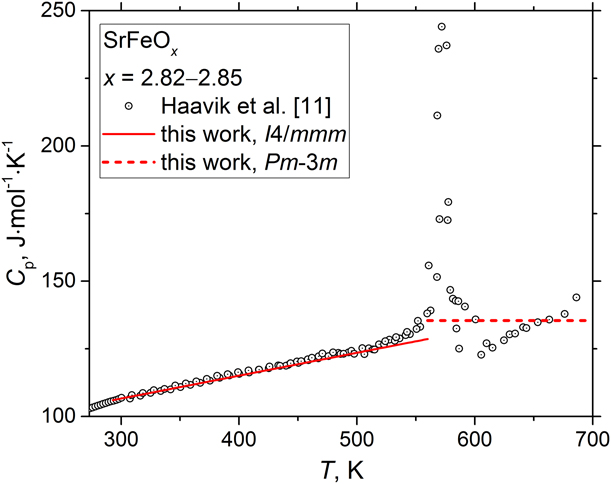
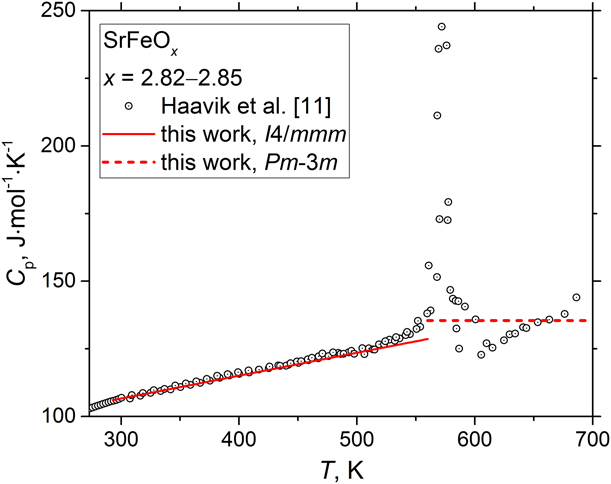
Eq. (5) is plotted in Fig. 2 along with the experimental enthalpy increments, showing the good coincidence between fitted function and experimental points. Additionally, C p(T) dependence for tetragonal SF, calculated by differentiating Eq. (5), is presented in Fig. 3 alongside the experimental data, measured by Haavik et al. [Reference Haavik, Bakken, Norby, Stølen, Atake and Tojo11] As seen, there is a perfect agreement between the two experimental heat capacity dependences.
Specific heat of SF: points—data of Haavik et al. [Reference Haavik, Bakken, Norby, Stølen, Atake and Tojo11], line calculated using Maier–Kelley function Eq. (5).
In contrast with the lower-temperature region, at T ≥ 573 K the enthalpy increments have several contributions:
 $$\Delta _{298}^T{H^0} = \Delta _{298}^{T\;{\rm{tr}}}H_{{\rm{tetr}}}^0 + \Delta H_{{\rm{tr}}}^0 + \Delta _{T\;{\rm{tr}}}^TH_{{\rm{cub}}}^0 + \Delta H_{{\rm{red}}}^0 \cdot \Delta \delta \quad ,$$
namely, the low-temperature enthalpy increment  $\Delta _{298}^{T\;{\rm{tr}}}H_{{\rm{tetr}}}^0$, the latent heat of
 ${{I4} / {mmm}} \to Pm\bar{3}m$ phase transformation
 $\Delta H_{{\rm{tr}}}^{\rm{0}}$, the “pure” (i.e., without the oxygen exchange contribution) enthalpy increment for cubic SF
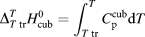 $\Delta _{T\;{\rm{tr}}}^TH_{{\rm{cub}}}^{\rm{0}} = \int_{T\;{\rm{tr}}}^T {C_{\rm{p}}^{{\rm{cub}}}{\rm{d}}T}$, and the reduction enthalpy per mole of oxygen atoms
 $\Delta H_{{\rm{red}}}^{\rm{0}}$, multiplied by the change in oxygen stoichiometry during the sample heating Δδ. As the oxygen nonstoichiometry in SF changes significantly upon heating at high temperatures, the last term in Eq. (6) cannot be ignored outright. Besides, the knowledge of Δδ(T) dependence is required for the correct experimental data evaluation.
Oxygen nonstoichiometry and redox thermodynamics
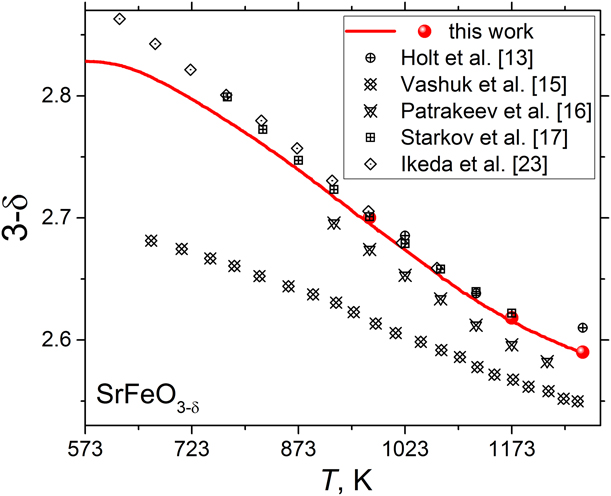
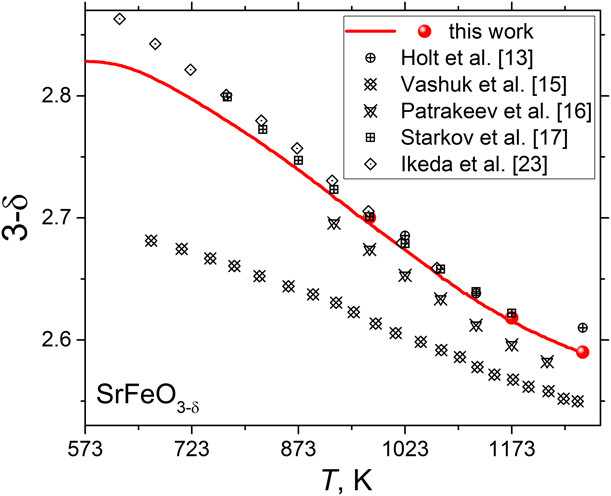
The oxygen nonstoichiometry of SF in air is presented in Fig. 4, where solid line was obtained as a result of a dynamic TG experiment in a slow cooling mode (100 K/h), in comparison with the literature data. It can be seen in Fig. 4 that almost no oxygen exchange occurs up to around 623 K. The lower-temperature (T < 873 K) discrepancies between the oxygen content curve measured in dynamic mode in the present work and the data of Ikeda et al. [Reference Ikeda, Nikata, Hirakawa, Tsuchida and Miura23] and Starkov et al. [Reference Starkov, Bychkov, Matvienko and Nemudry17] may be caused by some kinetic limitations at such low temperatures. However, most of the δ(T) data, both our and those reported in literature [Reference Holt, Norby and Glenne13, Reference Starkov, Bychkov, Matvienko and Nemudry17, Reference Ikeda, Nikata, Hirakawa, Tsuchida and Miura23], agree with each other quite well at T ≥ 873 K, with maximum discrepancies up to Δδ = 0.01. While the shape of the δ(T) dependence measured by Patrakeev et al. [Reference Patrakeev, Shilova, Mitberg, Lakhtin, Leonidov, Kozhevnikov, Julien, Pereira-Ramos and Momchilov16] is similar, the absolute δ values exceed those of others by around 0.02. Presumably, it can be attributed to the differences in the absolute reference δ values used by Patrakeev et al. [Reference Patrakeev, Shilova, Mitberg, Lakhtin, Leonidov, Kozhevnikov, Julien, Pereira-Ramos and Momchilov16] and the others. Indeed, the difficulties in the absolute δ determination for SF were pointed out earlier [Reference Bakken, Stølen, Norby, Glenne and Budd7]. Interestingly, the data reported by Vashuk et al. [Reference Vashuk, Kokhanovskii and Yushkevich15] differ strongly from those of others [Reference Holt, Norby and Glenne13, Reference Patrakeev, Shilova, Mitberg, Lakhtin, Leonidov, Kozhevnikov, Julien, Pereira-Ramos and Momchilov16, Reference Starkov, Bychkov, Matvienko and Nemudry17, Reference Ikeda, Nikata, Hirakawa, Tsuchida and Miura23] both in shape and values. Therefore, we have to assume some experimental error on their part.
Oxygen content in SF in air as a function of temperature: line—dynamic experiment, points—static measurements.
In course of the drop calorimetric experiment SrFeO2.82(4) sample loses oxygen, attaining the oxygen content of (2.82(4) − Δδ). Even at temperature as high as 673 K, where Δδ ≅ 0.01, the total heat effect associated with the oxygen exchange,  $\Delta H_{{\rm{red}}}^{\rm{0}} \cdot \Delta \delta$, is expected to be less than the measurement uncertainty. Therefore, for the purpose of calorimetric data evaluation, we can treat the enthalpy increments for SF between 573 and 673 K as belonging to the constant-composition sample. Assuming that high-temperature C p of SF is nearly constant, a linear fit, the results of which are plotted as dashed red line in Fig. 2, was used to estimate a trend in the high-temperature enthalpy increments of cubic SF with constant composition:
 $$\eqalign{\Delta _{298}^TH_{\delta = 0.18}^0\left( {{{\rm{J}} / {{\rm{mol}}}}} \right) \cr= \Delta _{298}^T{H^0} - \Delta H_{{\rm{red}}}^0 \cdot \Delta \delta = - 43497 + 135.44\Delta T\quad .$$
In the inset in Fig. 2, the magnified plot of  $\Delta _{298}^T{H^0}\left( T \right)$ dependence around the temperature of
 ${{I4} / {mmm}} \to Pm\bar{3}m$ phase transition is shown. A very small but distinct vertical gap is seen between the
 $\Delta _{298}^T{H^0}\left( T \right)$ functions for tetragonal [Eq. (5)] and cubic [Eq. (7)] SF at the phase transformation temperature. This gap corresponds to the phase transition enthalpy
 $\Delta H_{{\rm{tr}}}^0$, the value of which can be found by subtracting Eq. (5) from Eq. (7) assuming T = T tr = 560 K (see section “Phase transition in SF in air” for the discussion of T tr). As-calculated in the present work
 $\Delta H_{{\rm{tr}}}^0$ = 1.57 kJ/mol is close to the value of 2.07 kJ/mol reported by Haavik et al. [Reference Haavik, Atake, Kawaji and Stølen9], especially taking into account corresponding uncertainties that, however, are hard to estimate in both cases.
Extrapolated to higher temperatures linear dependence  $\Delta _{298}^TH_{\delta = {\rm{const}}}^0\left( T \right)$, expressed by Eq. (7), can be subtracted from the experimental enthalpy increments and then divided by the corresponding Δδ to calculate the temperature-dependent values of the reduction enthalpy for cubic SF. Obtained accordingly
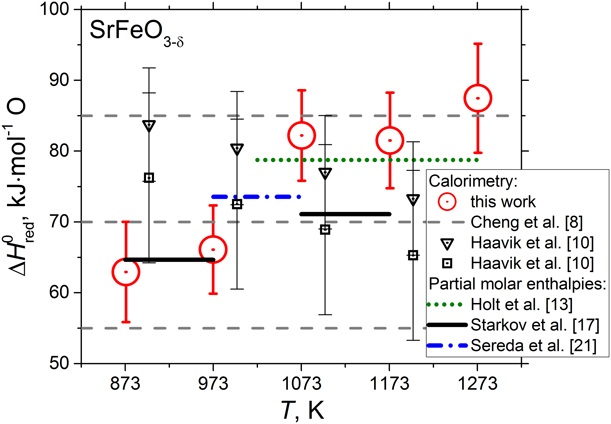
 $\Delta H_{{\rm{red}}}^{\rm{0}}\left( T \right)$ points are presented as circles in Fig. 5. The average
 $\Delta H_{{\rm{red}}}^{\rm{0}}$ value between 873 and 1273 is 76 ± 7 kJ/mol O, which is close to 70 ± 15 kJ/mol O, extrapolated by Cheng et al. [Reference Cheng, Navrotsky, Zhou and Anderson8] (plotted as a gray dashed line in Fig. 5).
Reduction enthalpies per mol of oxygen atoms for SF, legend explained in the main text.
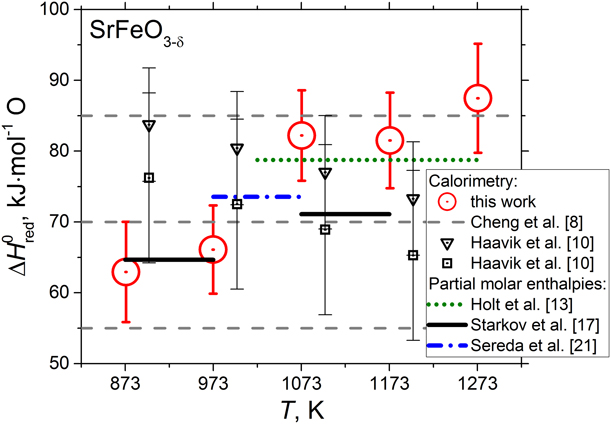
The values of  $\Delta H_{{\rm{red}}}^{\rm{0}}$ evaluated by Haavik et al. [Reference Haavik, Atake and Stølen10] are also shown in Fig. 5. The difference between triangles and squares results from the difference in reported values of
 $Ibm2 \to Pm\bar{3}m$ transition enthalpy in SrFeO2.5, taken by Haavik et al. [Reference Haavik, Atake and Stølen10] for their calculations. Taking into consideration corresponding error margins, our values of
 $\Delta H_{{\rm{red}}}^0$ are close to those calculated by Haavik et al. [Reference Haavik, Atake and Stølen10] However, the slight downward trend in
 $\Delta H_{{\rm{red}}}^{\rm{0}}\left( T \right)$ reported by Haavik et al. [Reference Haavik, Atake and Stølen10] is not supported by our study, which is likely caused by some of the concerns we raised regarding their methodology (see Introduction).
It is seen in Fig. 5 that at temperatures between 973 and 1073 K a noticeable increase in  $\Delta H_{{\rm{red}}}^{\rm{0}}$ occurs, from 65 ± 7 kJ/mol O at 873–973 K to 84 ± 7 kJ/mol O at 1073–1273 K. In this respect, an interesting comparison can be made between calorimetrically determined
 $\Delta H_{{\rm{red}}}^{\rm{0}}$ and partial molar enthalpies of oxygen evaluated using the equilibrium
 ${p_{{{\rm{O}}_{\rm{2}}}}} - T - \delta$ data. As it has already been mentioned, these data reported by different authors scatter significantly [Reference Haavik, Atake and Stølen10, Reference Sereda, Tsvetkov, Ivanov and Zuev21], resulting in the large discrepancies in the Δh O values. Surprisingly, most of the nonstoichiometry data for SF [Reference Mizusaki, Okayasu, Yamauchi and Fueki2, Reference Bakken, Stølen, Norby, Glenne and Budd7, Reference Patrakeev, Shilova, Mitberg, Lakhtin, Leonidov, Kozhevnikov, Julien, Pereira-Ramos and Momchilov16, Reference Merkulov, Naumovich, Patrakeev, Markov, Bouwmeester, Leonidov and Kozhevnikov18, Reference Yoo, Yoo, Yu and Jacobson19] yield unreasonably high Δh O—more than 100 kJ/mol O [Reference Sereda, Tsvetkov, Ivanov and Zuev21]—which clearly falls out of the tolerance interval of
 $\Delta H_{{\rm{red}}}^{\rm{0}}$ (see Fig. 5). The values of Δh O which are inside the error margins of
 $\Delta H_{{\rm{red}}}^{\rm{0}}$ can be calculated using the data of Holt et al. [Reference Holt, Norby and Glenne13], Starkov et al. [Reference Starkov, Bychkov, Matvienko and Nemudry17] and Sereda et al. [Reference Sereda, Tsvetkov, Ivanov and Zuev21] Besides, the nonstoichiometry of SF was measured by Starkov et al. [Reference Starkov, Bychkov, Matvienko and Nemudry17] in broad temperature range, which allowed evaluating Δh O from their data in two separate temperature intervals, 873–973 K and 1073–1173 K. As-computed Δh O are presented in Fig. 5 as horizontal line segments reflecting the particular temperature ranges of
 ${p_{{{\rm{O}}_{\rm{2}}}}} - T - \delta$ data used for calculations. It should be mentioned that we do not consider Δh O(δ) dependence in the present work as Δh O of SF was found to be nearly independent of composition in broad δ range [Reference Bakken, Stølen, Norby, Glenne and Budd7, Reference Haavik, Atake and Stølen10, Reference Sereda, Tsvetkov, Ivanov and Zuev21].
Notably, the increase in  $\Delta H_{{\rm{red}}}^{\rm{0}}$ with temperature, shown in Fig. 5, is evident in both our
 $\Delta H_{{\rm{red}}}^{\rm{0}}\left( T \right)$ data and, to some extent, in Δh O(T) dependences. It might have been anticipated that, as the increase in temperature causes the expansion of crystal lattice, the Fe–O bond energy should decrease. It should lead to the easing of the oxygen release and result in the decrease in
 $\Delta H_{{\rm{red}}}^{\rm{0}}$, which is in apparent contradiction with trends shown in Fig. 5.
In fact, the most plausible explanation of the observed  $\Delta H_{{\rm{red}}}^{\rm{0}}\left( T \right)$ dependence can be obtained assuming that not only temperature but some other factors related to the defect chemistry of SF influence its redox energetics. It is known that the charge disproportionation in perovskite-type ferrites is unfavorable, especially when δ is not very close to 0.5 [Reference Bakken, Stølen, Norby, Glenne and Budd7, Reference Sereda, Tsvetkov, Ivanov and Zuev21, Reference Mizusaki, Yoshihiro, Yamauchi and Fueki24], and that various types of the oxygen vacancy ordering are characteristic of undoped strontium ferrite [Reference Takeda, Kanno, Takada, Yamamoto, Takano, Nakayama and Bando1, Reference Bakken, Stølen, Norby, Glenne and Budd7, Reference Cheng, Navrotsky, Zhou and Anderson8, Reference Haavik, Atake, Kawaji and Stølen9, Reference Yoo, Yoo, Yu and Jacobson19, Reference Sereda, Tsvetkov, Ivanov and Zuev21]. As it was shown in our previous work [Reference Sereda, Tsvetkov, Ivanov and Zuev21], even at fairly high temperatures the reduction of SF sample can be described by the single defect reaction
 $$\eqalign{2{\rm{Fe}}_{{\rm{Fe}}}^ \times + {\rm{O}}_{\rm{O}}^ \times \mathbin{\lower.3ex\hbox{$\buildrel\textstyle\rightarrow\over{\smash{\leftarrow}\vphantom{_{\vbox to.5ex{\vss}}}}$}} {\left( {{\rm{V}}_{\rm{O}}^{{\rm{ \bullet \bullet }}}{\rm{Fe}}_{{\rm{Fe}}}^\prime } \right)^ \bullet } + {\rm{Fe}}_{{\rm{Fe}}}^\prime + {1 \over 2}{{\rm{O}}_2},\cr\;{K_8} = {{\left[ {{\rm{Fe}}_{{\rm{Fe}}}^\prime } \right]\left[ {{{\left( {{\rm{V}}_{\rm{O}}^{ \bullet \bullet }{\rm{Fe}}_{{\rm{Fe}}}^\prime } \right)}^ \bullet }} \right]p_{{{\rm{O}}_{\rm{2}}}}^{0.5}} \over {{{\left[ {{\rm{Fe}}_{{\rm{Fe}}}^{\rm{ \times }}} \right]}^2}\left[ {{\rm{O}}_{\rm{O}}^{\rm{ \times }}} \right]}}\quad ,$$
reflecting the simultaneous oxygen release and the oxygen vacancy cluster formation. The relative charges in reaction (8) correspond to the choice of stoichiometric SrFeO3 as a reference crystal in the Kröger–Vink notation.
In case when the only process (8) is responsible for the SF reduction,  $\Delta H_{{\rm{red}}}^{\rm{0}}$ is by definition equivalent to its enthalpy
 $\Delta H_8^0$. However, the latter is expected to be temperature-independent in broad temperature range because of the linearity of ln K 8(1/T) dependence [Reference Mizusaki, Yoshihiro, Yamauchi and Fueki24]. As seen in Fig. 5,
 $\Delta H_{{\rm{red}}}^{\rm{0}}$ is nearly constant above 1073 K, but not at lower T where it was found to decrease significantly. Consequently, low-temperature defect chemistry of cubic SF should differ from the high-temperature one.
Various degrees of short-range ordering are beneficial for the retaining of the oxygen vacancies [Reference Cheng, Navrotsky, Zhou and Anderson8], and are expected to promote the oxygen vacancy formation (i.e., the reduction) of the oxide, effectively lowering the  $\Delta H_{{\rm{red}}}^{\rm{0}}$. These effects are more prominent at lower temperatures where the ordering processes are less inhibited. In other words, if the ordering in form of the simple vacancy cluster formation expressed as reaction (8) is characteristic of SF at higher temperatures [Reference Mizusaki, Yoshihiro, Yamauchi and Fueki24], one can expect other types of short-range ordering to arise at lower T resulting in the further decrease in the value of
 $\Delta H_{{\rm{red}}}^{\rm{0}}$. And vice versa—the increase in temperature should cause the distribution of defects to become more random, making the formation of ordered vacancies energetically less favorable. It results inevitably in the higher values of
 $\Delta H_{{\rm{red}}}^{\rm{0}}$ at higher temperatures, which is consistent with our observations presented in Fig. 5.
Conclusions
The broad temperature range from 373 to 1273 K in which the enthalpy increments for SF were measured in air atmosphere can be divided into three regions. The lower-temperature region up to the  ${{I4} / {mmm}} \to Pm\bar{3}m$ phase transition temperature of 560 K corresponds to the tetragonal SF which does not release oxygen upon heating. For such constant-composition sample, the simple Maier–Kelley function is adequate for approximating
 $\Delta _{298}^T{H^0}\left( T \right)$ dependence.
The second region between 573 and 673 K, where SF is cubic, but the oxygen exchange is negligible, was used for estimating the  $\Delta _{298}^T{H^0}\left( T \right)$ function for constant-composition SF with
 $Pm\bar{3}m$ space group.
At even higher temperatures cubic SF loses considerable amount of oxygen upon heating. This process is accompanied by corresponding heat effects, i.e. the reduction enthalpy  $\Delta H_{{\rm{red}}}^{\rm{0}}$. Thus, subtracting
 $\Delta _{298}^T{H^0}\left( T \right)$ dependence for constant-composition cubic SF from high-temperature enthalpy increments allowed evaluating the
 $\Delta H_{{\rm{red}}}^{\rm{0}}$ directly from the calorimetric measurements.
The average  $\Delta H_{{\rm{red}}}^{\rm{0}}$ value between 873 and 1273 was determined to be 76 ± 7 kJ/mol O, which is close to 70 ± 15 kJ/mol O estimated by Cheng et al. [Reference Cheng, Navrotsky, Zhou and Anderson8] by extrapolating
 $\Delta H_{{\rm{red}}}^{\rm{0}}\left( {{\rm{L}}{{\rm{a}}_{1 - x}}{\rm{S}}{{\rm{r}}_x}{\rm{Fe}}{{\rm{O}}_{3 - \delta }}} \right) = f\left( x \right)$ dependence. Besides, a pronounced increase in
 $\Delta H_{{\rm{red}}}^0$ with temperature, from 65 ± 7 kJ/mol O at 873–973 K to 84 ± 7 kJ/mol O at 1073–1273 K, should be mentioned. The overall tendency of
 $\Delta H_{{\rm{red}}}^{\rm{0}}$ to increase with T was corroborated by observing the similar behavior of partial molar enthalpies of oxygen, calculated from equilibrium oxygen partial pressure–composition–temperature data reported for SF earlier [Reference Holt, Norby and Glenne13, Reference Starkov, Bychkov, Matvienko and Nemudry17, Reference Sereda, Tsvetkov, Ivanov and Zuev21]. Such trend in
 $\Delta H_{{\rm{red}}}^{\rm{0}}$ of SF was presumed to be caused by the temperature acting as a “disordering force,” making the reduction of the sample accompanied by the formation of short-range ordered oxygen vacancies energetically less favorable.
Experimental procedures
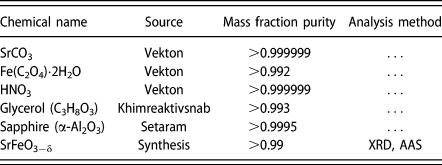
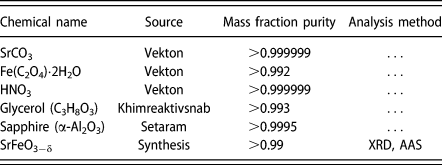
Powdered samples of SF were prepared using the glycerol-nitrate technique. A stoichiometric mixture of high-purity SrCO3 and Fe(C2O4)·2H2O was dissolved in nitric acid. Then a slight excess of glycerol was added, and the resulting solution was heated on a hot plate until the complete evaporation of water followed by self-combustion occurred. Resulting ash was sintered in air at 1073–1373 K for 12 h with intermediate regrindings. X-ray diffraction (XRD) with XRD 7000S (Shimadzu, Kyoto, Japan) using Cu Kα radiation showed that the as-prepared SF powder was single-phase. The exact chemical composition of the SF sample was verified by the inductive coupled plasma (ICP) spectrometer ICAP 6500 DUO and the atomic absorption spectrometer (AAS) Solaar M6 (Thermo Scientific, Waltham, Massachusetts). Chemical compounds used in this work and their estimated purity are listed in Table II.
Chemical compounds used in the present work.
For calorimetric measurements, small dense pieces of SF were obtained by shattering the SF ceramic pellet, which had been uniaxially pressed and then calcined in air at 1473 K for 12 h. Rectangular bar used for the dilatometry measurements was cut from the as-prepared pellet.
Oxygen content in SF as a function of temperature in air was measured by thermogravimetric technique (TG) using DynTHERM LP ST (Rubotherm, Bochum, Germany) thermobalances. Absolute oxygen content was determined by the sample reduction in the TG setup in a flow of H2 at 1273 K. Both experimental techniques are described in detail elsewhere [Reference Zuev, Tsvetkov, Bishop, Perry, Marrocchelli and Sheldon25].
In order to determine the phase transition temperature, dilatometric measurements with DIL 402 C (Netzsch, Selb, Germany) and in situ XRD using XRD 7000S (Shimadzu, Japan), the latter equipped with HTK 1200N (Anton Paar, Graz, Austria) high-temperature oven, were employed. Dilatometric experiment was performed with 2 K/min heating/cooling rate, and during XRD measurements the sample was equilibrated at a target temperature for at least 12 h [Reference Zuev, Tsvetkov, Bishop, Perry, Marrocchelli and Sheldon25].
An MHTC 96 (Setaram, Lyon, France) drop calorimeter was used for the enthalpy increments’ measurements. Sample pieces and small cylinders of reference material (NIST SRM720 monocrystalline sapphire) were alternately dropped from the autosampler at low temperature, T low, to the calorimetric cell, which had been pre-heated to the temperature T high in the range 373–1273 K. In that way, corresponding sensitivity coefficients were obtained during each experimental run [Reference Sereda, Tsvetkov, Sednev, Druzhinina, Malyshkin and Zuev26].
Because the radiative heat transfer from the calorimeter oven to the autosampler, influencing the temperature of the latter, is unavoidable, the autosampler temperature was measured using factory-calibrated digital sensors. Almost linear correlation between the oven and autosampler temperature (T high and T low, respectively) was recorded. T low was found to vary from 294 to 301 K depending on T high, whereas the ambient room temperature was held at around 293 K.
At least 10 drops of both sample and reference were made at each temperature. The reproducibility was found to be within 2.5% even at lowest temperature where the scatter in the increments measured is expected to be the worst. The overall accuracy of the values measured is expected to be ±3%.
In order to return the nonstoichiometry of SF to its initial state, the samples were slowly (100 K per h) cooled along with the calorimetric cell after each experimental run.
All calorimetric and thermogravimetric measurements were performed in ambient air  $\left( {{p_{{{\rm{O}}_{\rm{2}}}}} = 0.21\;{\rm{atm}}} \right)$ with average atmospheric pressure 1015 ± 5 mbar.
Acknowledgments
Authors are grateful for financial support to Russian Foundation for Basic Research (RFBR grant No. 18-33-20243\18) and to the Ministry of Education and Science of Russian Federation (State Task No. 4.2288.2017/PCh).