Introduction
Mummified seals and their skeletons have been reported in numerous ice-free areas of Antarctica since the earliest expeditions in the 20th century. Specifically the McMurdo Dry Valleys (Péwé et al. Reference Péwé, Rivard and Llano1959, Banks et al. Reference Banks, Ross and Smith2010), Victoria Land (Mabin Reference Mabin1985), the James Ross Island (JRI) archipelago (Björck et al. Reference Björck, Olsson, Ellis-Evans, Håkansson, Humlum and deLirio1996, Nelson et al. Reference Nelson, Smellie, Williams and Moreton2008, Negrete et al. Reference Negrete, Soibelzon, Tonni, Carlini, Soibelzon, Poljak, Huarte and Carbonari2011), the South Shetland Islands (Gordon & Harkness Reference Gordon and Harkness1992), and the sub-Antarctic islands (Gordon & Harkness Reference Gordon and Harkness1992). The mummified seals from the McMurdo Dry Valleys and Victoria Land are permanently frozen, but the others melt seasonally and are, therefore, partially decayed. The most common seal remains found in Antarctica are those of crabeater seals (Lobodon carcinophaga (Hombron & Jacquinot)). However, skeletons and mummified remains of Weddell seals (Leptonychotes weddellii (Lesson)) and leopard seals (Hydrurga leptonyx (de Blainville)) have also been reported (e.g. Péwé et al. Reference Péwé, Rivard and Llano1959, Banks et al. Reference Banks, Ross and Smith2010). The predominance of crabeater seals corresponds to the abundance of individual pinnipeds within the Southern Ocean (80–95% of all Antarctic seals are crabeaters). Furthermore, the largest population of crabeater seals is within the Weddell Sea, and crabeater seals can live for up to 40 years (Laws et al. Reference Laws, Baird and Bryden2002), which is longer than other Antarctic phocid species. Crabeater seals sometimes clump in large groups (tens to hundreds of individuals) and move over very large distances in the Southern Ocean (Laws & Taylor Reference Laws and Taylor1957, Siniff et al. Reference Siniff, Stirling, Bengtson and Reichle1979).
Nelson et al. (Reference Nelson, Smellie, Williams and Moreton2008) mapped 154 crabeater seal carcasses in the Abernethy Flats area of northern Ulu Peninsula, JRI, and discussed their spatial distribution, taphonomy and the possible reasons for this unusual occurrence. However, Nelson et al. (Reference Nelson, Smellie, Williams and Moreton2008) failed to present the spatial distribution of individual seal carcasses in cartographic form and without the use of geospatial analyses.
In this study, a holistic approach was employed to investigate the origin and nature of seal carcasses from the Ulu Peninsula. This holistic approach included field mapping between 2004 and 2014, which provided additional evidence of seal carcasses from the ice-free areas north of the Abernethy Flats. In addition, we focussed on the age and season of death, and the taphonomic preservation state of the individual seal carcasses. Most of the deglaciated mineral soils of JRI have low nutrient contents, and nutrient-enriched ‘oases’ are largely restricted to the sparse occurrences of bird nesting sites, and the slowly decomposing bodies of seals. These are important sources of organic nitrogen and phosphorus. Therefore, colonization of seal carcasses by lichens and mosses (Lewis Smith Reference Lewis Smith1997, Ochyra et al. Reference Ochyra, Lewis Smith and Bednarek-Ochyra2008), especially in the more advanced states of decay represent further important taphonomic features presented in this study. Results of these analyses, supported by new radiocarbon dating and changes to the sea ice extent in the northern Prince Gustav Channel over recent decades, has provided new evidence, which allows for a more detailed and robust multidisciplinary interpretation of the unusual occurrence of seal carcasses on the ice-free areas of Ulu Peninsula.
Study site
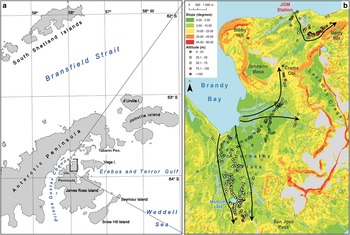
The northern part of Ulu Peninsula (Fig. 1a) represents one of the largest ice-free areas in Antarctica (Nedbalová et al. Reference Nedbalová, Nývlt, Kopáček, Šobr and Elster2013). It is located close to the boundary of Maritime and Continental Antarctica (Kopalová et al. Reference Kopalová, Nedbalová, Nývlt, Elster and van de Vijver2013). Weddell seals, Antarctic fur seals (Arctocephalus gazelle (Peters)), elephant seals (Mirounga leonine (L.)) and crabeater seals (Lobodon carcinophaga) are occasionally present (in descending order of occurrence) along the coast of Ulu Peninsula during the summer. However, during the winter the most common pinniped species are crabeater seals. There were no observations of leopard seals on land during the period of this study (2004–14); although leopard seals are frequently seen on ice floes within the Prince Gustav Channel during the summer, or as carcasses on the Ulu Peninsula. Northern Prince Gustav Channel has not been covered by an ice shelf for at least the last century. The southern part of the Prince Gustav ice shelf collapsed in 1995 (Cook & Vaughan Reference Cook and Vaughan2010). The coast of the northern Ulu Peninsula has mostly remained free of sea ice from December to March during the last two decades, but the extent and duration of sea ice cover varies between years.
Spatial distribution of seal carcasses in study area. a. Location of northern ice-free Ulu Peninsula, James Ross Island at the eastern coast of the northern Antarctic Peninsula. b. Northern Ulu Peninsula with the elevation of individual seal carcasses indicated by circle colour and slope gradient shown by polygonal colours. Interpreted main seal migrating paths indicated by black arrows. Topographical data from Czech Geological Survey (2009).

Local climatic conditions are important for preservation of seal carcasses. The mean annual air temperature measured at sea level by an automatic weather station at Johann Gregor Mendel (JGM) Station on Ulu Peninsula for 2006–11 was -6.8°C (Láska et al. Reference Láska, Nývlt, Engel and Budík2012). The entire area of Ulu Peninsula is located in a precipitation shadow on the leeward side of the northern Antarctic Peninsula, which provides an effective barrier to relatively warm air masses moving across the Bellingshausen Sea along the western coast of the peninsula (Martin & Peel Reference Martin and Peel1978). However, there are no representative or accurate measurements of precipitation along the eastern coast of the Antarctic Peninsula due to its solid form and high wind speed making a standard rain gauge measurement impossible. Hence, precipitation, sublimation and snowdrift modelling by a regional atmospheric model give estimates of mean annual precipitation in the range of 400–500 mm of water equivalent along the coast of Ulu Peninsula (van Lipzig et al. Reference Van Lipzig, King, Lachlan-Cope and van den Broeke2004). The prevailing winds on Ulu Peninsula are from the south-western sector, and these affect snow drift and depositions at lower elevations (van Lipzig et al. Reference Van Lipzig, King, Lachlan-Cope and van den Broeke2004, Zvěřina et al. Reference Zvěřina, Láska, Červenka, Kuta, Coufalík and Komárek2014). Low-lying areas of Ulu Peninsula were ice-free for most of the Holocene (Nývlt et al. Reference Nývlt, Braucher, Engel and Mlčoch2014) and only hanging, valley and piedmont glaciers and small ice domes persisted here (Engel et al. Reference Engel, Nývlt and Láska2012, Davies et al. Reference Davies, Glasser, Carrivick, Hambrey, Smellie and Nývlt2013). The recent equilibrium line altitude is at ~460 m (Engel et al. Reference Engel, Nývlt and Láska2012); therefore, most of the Ulu Peninsula area is ice- and snow-free for most of the summer. The prevailing dry conditions coupled with the fact that most snow tends to be blown away from the generally porous sandy to gravely surface permits good preservation of organic tissues, such as seal carcasses.
Material and methods
The methods applied within this study focus on i) spatial analyses, ii) radiocarbon dating of seal carcasses, iii) age and season at death, iv) taphonomic state and v) colonization, as well as the determination of vi) sea ice break-up in the northern Prince Gustav Channel.
A total of 401 individual seal carcasses (Fig. 1b) were recorded between 2004 and 2014 in Abernethy Flats and in the area surrounding the JGM Station. For each individual seal carcass, the data recorded within a geodatabase included: author of the record, date of the record, position (GPS co-ordinates), taphonomic state, availability of photography, species determination (if possible) and any additional notes. Use of a geodatabase permitted subsequent spatial analyses, performed in ArcGIS software and including spatial density, distance from a coastline and the association of position to elevation and slope gradient. This spatial analysis was performed for all carcass records combined and for single taphonomic categories.
The bones of four crabeater seals and one Weddell seal were dated at the Department of Geography, Swansea University by means of liquid scintillation counting. The results have been corrected by δ13C measured for individual samples. Radiocarbon ages have not been calibrated, but were corrected for the Southern Ocean radiocarbon reservoir, which is more applicable to seal bone/teeth dating around Antarctica. The reservoir age of 1300 years proposed by Björck et al. (Reference Björck, Hjort, Ingólfsson and Skog1991) and successfully applied by Gordon & Harkness (Reference Gordon and Harkness1992), Nelson et al. (Reference Nelson, Smellie, Williams and Moreton2008) and Negrete et al. (Reference Negrete, Soibelzon, Tonni, Carlini, Soibelzon, Poljak, Huarte and Carbonari2011) for mummified seal carcasses or recently deceased seals in this area have been used for this study.
Moreover, 25 canine and post-canine teeth from 14 individual carcasses of crabeater and Weddell seal skeletons were sampled to determine the age and season of death. The preparation of teeth samples involves making a cross-section from the tooth in the upper third of the root. The sections are then studied under a polarizing microscope with crossed nicols and the resulting image is photographed with a digital camera (see Nývltová Fišáková Reference Nývltová Fišáková2013 for further details). Dentine makes up the bulk of the tooth root, followed by a layer of tooth cement, which consists of sets of two increment lines of different opacity and varying thickness and accretes during an animal’s lifetime (Hillson Reference Hillson2005, Nývltová Fišáková Reference Nývltová Fišáková2013). The speed at which the cement increment forms varies during the course of the year. It is faster during summer, when there is an abundance of food. During winter the cement accretes more slowly, as the range of available food is more limited. The annual increment consists of a light translucent summer layer and the dark opaque winter layer, which are the product of cementoblasts and are influenced by the diet, the relative percentage of mineral and organic constituents, and hormonal cycles (Hillson Reference Hillson2005). The winter increment layer of crabeater seals begins to form in June and ends in October (Laws et al. Reference Laws, Baird and Bryden2002). The summer increment layer begins to form in November and probably ends in March/April. For the purposes of analysing the season of death it is necessary to ascertain the thickness of the individual winter and summer layers. Based on this information, it is possible to determine the time that has passed from the point when the last incremental layers began to form, i.e. from June or November. The months in which the animals died are given in Roman numerals (e.g. I=January, XII=December).
Seal pups are born between late September and early November, peaking in mid-October (Laws et al. Reference Laws, Baird and Bryden2003). Crabeater seals give birth on sea ice some distance from the land, while Weddell seals have their pups on sea ice in sheltered bays close to the shore. The calculation of age-at-death of a carcass is based on the middle of the first opaque layer, which marks the completion of the annual increment (Laws et al. Reference Laws, Baird and Bryden2002). The increment layers are not always preserved or clearly visible; thus, the age obtained for an individual tooth represents the minimum age-at-death of the animal. To obtain more reliable results both the roots of post-canine teeth are examined and the maximum number of incremental pairs obtained is closest to the real age-at-death of the animal. Growth layers are also present in dentine, but Laws et al. (Reference Laws, Baird and Bryden2002) clearly showed that the age estimates based on cement increments are more reliable. Counting dentinal layers can be used for younger seals, where cement layers are incomplete or difficult to interpret. For seals older than ~10 years, estimates from dentine become unreliable as the tooth roots close at a relatively young age (Laws et al. Reference Laws, Baird and Bryden2002). This method has been successfully applied to recent marine (Laws Reference Laws1952, Laws et al. Reference Laws, Baird and Bryden2002) and terrestrial mammals, as well as to fossil terrestrial mammals from palaeontological or archaeological sites (see Nývltová Fišáková Reference Nývltová Fišáková2013 for further references).
Additionally, the taphonomic state of all of the seal carcasses was classified into five categories according to their preservation state. Group T1 contains well-preserved complete mummified seals, group T2 includes partially preserved or incomplete mummified seals, group T3 includes fully articulated seal skeletons with partial skin presence, group T4 includes disarticulating seal skeletons with possible skin pieces, and group T5 contains individual bones or a group of bones, or pieces of seal skin. Proportions of individual group numbers have been evaluated, as well as the decay of some carcasses during the field survey.
Colonization of seal carcasses and/or their close surroundings by lichens and mosses was evaluated for 114 randomly selected individuals according to the following classification with relative shares calculated for each category: C1 with no mosses and lichens present over the skin, body tissues or soil surface near the carcass, C2 with random lichen thalli over the skin, no mosses apparent, C3 with substantial cover of lichens over skin (10–50%), mosses either present or absent, C4 with a rich cover of lichens and/or mosses over the remnant body (50–100%), C5 with skin and soft tissues missing, lichens on bones, no mosses, and C6 with bones without seal skin with no lichens or mosses.
Available Moderate Resolution Imaging Spectroradiometer (MODIS) satellite images have been evaluated to determine the sea ice break-up in the sector of the northern Prince Gustav Channel in Brandy Bay and the northernmost coast of the Ulu Peninsula between 1998 and 2012. This has been complemented by the visual observations of sea ice break-up in front of the JGM Station in 2013 and 2014.
Results
Spatial distribution of seal carcasses
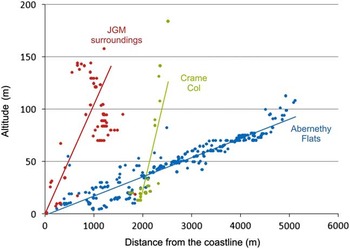
The seal carcasses were distributed unevenly across the Ulu Peninsula. Of the seal carcasses, 81% were observed on the Abernethy Flats, 18% in the area surrounding the JGM Station and only 1% outside these two areas. The highest density, with ~70 individuals per square kilometre, occurred around Monolith Lake, Abernethy Flats. The majority (92%) of seal carcasses were found up to 100 m a.s.l. and 91% were found on level surfaces with a slope <5°. In the area surrounding the JGM Station, the seal carcasses were found up to 1.5 km from the shore, while on Abernethy Flats some were >5 km inland (Fig. 2). The distance of the carcasses from the coastline correlates with the different topography and gradients of the two areas (Fig. 1b), as the degree of steepness influences the direction of travel by seals.
Covariant plot of distance from the coastline and elevation for all studied seal carcasses split into the two main concentrations with best fitting linear regression trend. Individuals from Abernethy Flats are shown in blue, Crame Col in green, and the area surrounding Johann Gregor Mendel (JGM) Station in red.

The carcasses scattered around the northern Ulu Peninsula were not only crabeater seals. Weddell seal (~2% of all seal carcasses) and leopard seal (only one carcass from the 2012/2013 summer) carcasses were also identified in this area. Crabeater seals are known to wander long distances inland. Three fresh dead seals were observed in the ice-free area of northern Ulu Peninsula during the summer of 2012/2013 when the sea ice persisted in the northern Prince Gustav Channel until early February (see below).
Radiocarbon chronology of seal carcasses
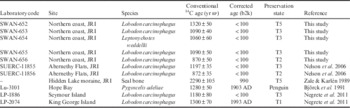
The conventional radiocarbon ages range from 870±50 to 1320±50 14C yr bp (Table I). These lie within three age clusters based on the chi-square test. The dated seal skeletal carcasses can be ranked within different preservation state categories from T2 to T5. Corrected ages were obtained by applying a reservoir correction of 1300 years; all but one of which are <100 years old. Unfortunately, a more precise age assessment was not possible. The only age greater than the Southern Ocean radiocarbon reservoir is that of sample SWAN-652 (Table I).
Radiocarbon ages of seal and penguin bones from the northern Antarctic Peninsula area.

JRI=James Ross Island.
Sea ice break-up in northern Prince Gustav Channel
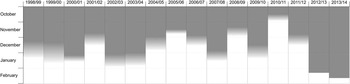
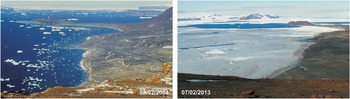
Sea ice break-up in the sector of the northern Prince Gustav Channel in Brandy Bay and the northernmost coast of the Ulu Peninsula occurred mostly between mid-November and mid-January between 1999 and 2014 (Fig. 3). The earliest break-up of sea ice in this sector happened in the second half of October 2010 based on satellite imagery. In the summer of 2012/2013, the sea ice persisted in northern Prince Gustav Channel until 9 February 2013 with only some pools of open water (Fig. 4). Numerous seals have been observed on the sea ice around these pools. The same situation was repeated in the summer of 2013/2014, when the sea ice persisted in northern Prince Gustav Channel until the 18 February 2014. These two years represent extraordinary cases compared to the previous summer (Fig. 3).
Sea ice break-up time in the sector of the northern Prince Gustav Channel between Brandy Bay and Cape Lachman between 1998 and 2014. 1998–2011 are based on satellite images with time uncertainty shown by greyed transition, and 2012–14 are based on direct field observations.

Comparison of sea ice extent in the Prince Gustav Channel in front of the Johann Gregor Mendel (JGM) Station between 8 February 2004 (left) and 7 February 2013 (right). The JGM Station is visible in the middle of Ulu Peninsula coast.

Seal age and season of death
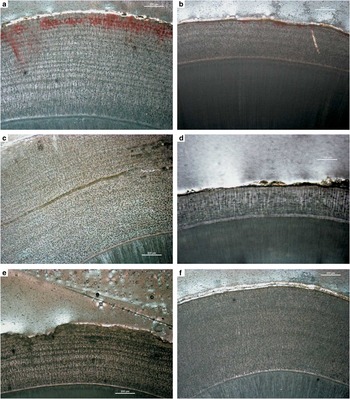
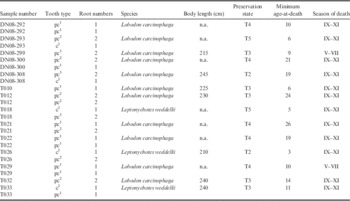
The age-at-death spectrum of the 14 individuals studied is variable (Table II). It comprises young sexually immature (<5 years, two individuals), sexually mature growing adults (5–10 years, five individuals), adults (10–20 years, four individuals) and mature individuals (>20 years, three individuals). Counting dental cement layers clearly shows that animals of all ages were present as carcasses on the northern Ulu Peninsula. The sexual immaturity of studied individuals has been tested on cement increment layers. The opaque cement layers are broader, irregular and more diffuse before attaining sexual maturity. This transition zone, where broad, irregular and more diffuse layers of young animal changes into narrower, more regular and dense cement increments of the sexually mature animal is between 4 and 6 years for our 14 seals (Fig. 5a & e). Of the 14 individuals, 12 died at the end of winter or during the spring (Table II), i.e. September to November (IX–XI), as they have the outermost (nearly) finished dark cement layer. The other two individuals died during early winter, i.e. between May and July (V–VII), as they have the outermost completed light summer cement layer and the dark increment has not begun to form (Fig. 5a–f).
Seal tooth thin sections with well-preserved dental cement increments photographed with crossed nicols. a. Crabeater seal T022, b. crabeater seal DN08-293, c. crabeater seal T021 with strongly developed dark increment (oldest studied individual), d. young Weddell seal T026, e. crabeater seal T029, and f. Weddell seal T033.

Minimum age-at-death and season of death by dental cement layers of crabeater and Weddell seals from the northern Ulu Peninsula, James Ross Island.

Taphonomical changes of seal carcasses
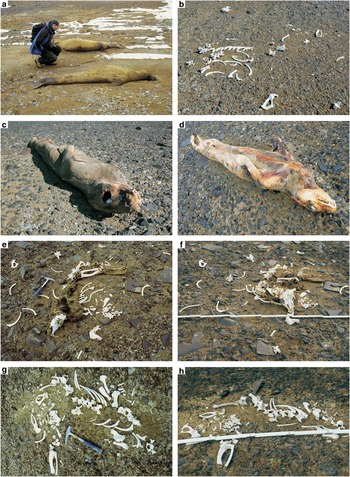
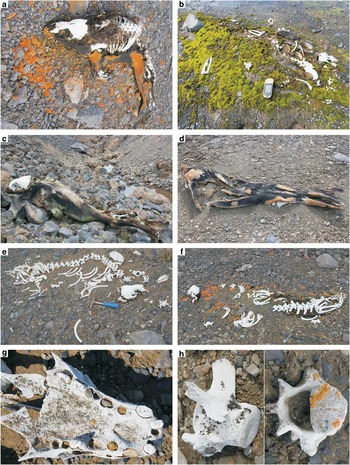
The range in taphonomic state of the seal carcasses was very wide. Ranging from fresh carcasses from the current (2014) or previous year (Fig. 6a) to isolated bones (Fig. 6b). More than 50% of the evaluated seal carcasses exist in the most advanced state of decay (T5) as individual bones or aggregations of bones, as well as pieces of skin. Specimens ranked as groups T2 or T3 were less frequent (both<9%), while well-preserved carcasses (T1, 17%) and disarticulating carcasses (T4, 14%) were slightly more common.
Different taphonomic states of seal carcasses found at Ulu Peninsula, James Ross Island. a. Two recently deceased seal carcasses from Abernethy Flats. b. Individual scattered bones ranked in the most advanced decay state (T5). c. Well-preserved mummified seal near Johann Gregor Mendel (JGM) Station (T1) photographed in 2005. d. Well-preserved mummified seal near JGM Station (T1) photographed in 2014. Note the surface abrasion due to wind-blown sand between 2005 and 2014. e. Mostly articulated seal skeleton (T3) SWAN-654 photographed in 2004. f. Disarticulating seal skeletons (T4) SWAN-654 photographed in 2008. Note the removal of seal skin from the frontal part of the body and its lateral shift due to vertebrae disarticulation between 2004 and 2008. g. Disintegrated seal skeleton (T5) SWAN-652 photographed in 2004. h. Disintegrated seal skeleton (T5) SWAN-652 photographed in 2008.

Continuous decay of some of the seal carcasses was observed during the study period (2004–14). Some of the least preserved carcasses changed by one or two taphonomical group(s) (mostly from T2 or T3 towards T3 to T5) during a few years (Fig. 6c & d). However, disintegrated seal skeletons ranked as T5 (Fig. 6e & f), and well-preserved carcasses (T1; Fig. 6g & h) remained mostly unchanged during the ten-year survey. For example, a well-preserved seal carcass in a dry location very close to the JGM Station remained almost unchanged over ten years (Fig. 6g & h).
Colonization of seal carcasses
A subset of 114 seal carcasses was randomly selected and classified according to the extent of lichen/moss colonization. Skinless skeletons with partial lichen cover were the most frequent category (>30%), demonstrating that the majority of the carcasses had been decaying for more than a couple of decades. In such cases, soft tissues and/or visible organic substrate were missing and lichens formed only individual spots differing in size and total number on bone surfaces. Carcasses exhibiting a wide extent of colonization ranging from poor (C2) to partial (C3) and rich (C4) were found in similar numbers (<15 individuals in each category), which represented relative frequencies of ~16%. The relative numbers of uncolonized mummies (C1) as well as partial skeletons with no lichens or mosses (C5, C6) were the same (7%). Two mechanisms may explain the presence of uncolonized seal carcasses: wind abrasion (see below and Fig. 6g & h) and long-term snow cover of the whole seal body. In the latter, the presence of green algae and/or cyanobacteria on the upper skin surface is indicative. The extent and size of the spots formed by these autotrophic microorganisms on the seal skin may be attributed to the time for which liquid water and sunlight are available in sufficient quantities for a positive carbon budget.
There are several typical domains for colonization by lichens in relation to dead seals: i) skin, ii) slowly decaying soft tissues, iii) bones, and iv) the area surrounding the carcasses. Since skin represents the most slowly decaying tissue, with the exception of bones, the majority of crustose lichens colonize the skin surface. Caloplaca sp. and Xanthoria sp. to a minor extent represent the most frequent species identified (Fig. 7a & f). Similarly, Candelariella sp. was quite frequent on skin and organomineral substrates formed in close vicinity to the carcasses. The occurrence of these species is favoured by nutrients gradually released from the skin. In contrast, their occurrence might be limited by mechanical stress caused by wind-transported mineral grains. Such phenomena cause heavy abrasion of the skin and bone surfaces by the wind resulting in mechanical injury to lichen thalli, and eventually, the loss of lichens from the skin. If a dead body is oriented perpendicular to the prevailing wind direction, absence of thalli appeared at the windward side only, while lichen and moss flora remained unaffected on the leeward (sheltered) side. Nutrients released from decaying soft tissues represent another factor affecting vegetation growth. Skuas preferentially consume soft tissues, as their remnants represent a nutrient-rich substrate mainly for moss growth as well. Therefore, moss species could be found mainly in the enterocele cavity and close to a seal carcass, where released nutrients and water from accumulated snow are available. Outside a body, rich lichen and moss flora could be found at the leeward side as well (Fig. 7a & b). The species richness and spatial patterns of community structure have been studied recently at such places. Here we only report the major species forming the community. The most frequent moss species determined from collections close to the seal carcasses were Bryum pseudotriquetrum (Hedw.) Gaertn., Meyer et Scherb., and B. subrotundifolium A.Jaeger. In addition to the two Bryum species, Hypnum revolutum (Mitt.) Lindb. was found in the most developed moss cover in close proximity to the seal carcasses.
Different types and extent of colonization of seal carcasses at Ulu Peninsula, James Ross Island. a. Richly developed lichen (Xanthoria elegans) cover of seal skin (T2, C4) and surrounding the carcass. Mosses are located in decaying soft tissues. b. Rich moss flora with predominant Bryum pseudotriquetrum located on the decaying seal carcass (T4, C4) and in its wider surroundings. c. Algal/cyanobacterial colonization of seal skin (T2, C1), as well as skua access to the skull. d. Effect of wind abrasion on seal skin (T2, C1). e. Vegetation-free partly disarticulated seal skeleton (T3 in 2008, C1). f. Lichens (Xanthoria elegans) apparent along disarticulated seal carcass borders, moss and algal colonization on sealskin remnants (T4, C3). g. Preferential colonization of tooth cavities of the upper jaw (T4, C5). h. Vertebrae colonized by lichens, with periosteum and osteon serving as suitable surfaces for successful lichen growth (T5, C5).

At the final stage of seal carcass decay, only disarticulated bones remain (Fig. 7e). These bones were colonized mainly by nitrophilous lichens, e.g. Caloplaca, and a great variety of microlichens thriving well in spongious bone tissue (Fig. 7g & h). The presence of cavities and/or small cracks in the bone tissue are essential for snow and ice accumulation that supply lichens with liquid water after thawing; such an advantage does not occur on flat surfaces. Thus, numerous small-in-size microcolonies of lichens can be found over a single bone, on vertebra in particular. Such a modus vivendi of lichens can be well documented in the edentulous lower jaw (Fig. 7g), where gaps remaining after tooth loss provide a microniche for lichen colonization.
Interpretation and discussion
Spatial clustering data demonstrated topographical slope to be a key factor associated with the spatial distribution of seal carcasses. The coastal lowlands or gentle slopes of Abernethy Flats and around JGM Station with drainage networks for the main streams (Algal, Monolith and Seal streams, and the Abernethy River) appear to be the inland routes of the seals. Deeply incised stream valleys may be snow- or ice-covered throughout the year, while wide valleys are generally snow-covered until early in the summer. There is a distinct difference in the number of seal carcasses found in the middle and upper catchment parts of Bohemian and Algal streams, respectively. There are few seal carcasses in the Bohemian Stream valley, which is parallel to the prevailing south-western winds and is generally snow-free. Conversely, the deeply incised lower reaches of the Algal Stream are at right angles to the prevailing wind and snow accumulates, remaining all year round. Algal Stream valley appears to be a commonly used route from the northern depression around JGM Station to the area below the north-western slopes of Lachman Crags and Berry Hill, where there is another concentration of carcasses.
Seals may mistake the snow-covered areas of northern Ulu Peninsula for sea ice, lose their sense of direction and migrate inland. However, the disorientation of seals on flat snow-covered areas of northern Ulu Peninsula for adolescent seals proposed by Nelson et al. (Reference Nelson, Smellie, Williams and Moreton2008) is not confirmed by our dental cement-based age-at-death results. We found not only adolescent seals, which could become disoriented and perish from starvation and exhaustion as claimed by Nelson et al. (Reference Nelson, Smellie, Williams and Moreton2008), but also very old seals, which may intentionally venture inland to die, also as claimed by Nelson et al. (Reference Nelson, Smellie, Williams and Moreton2008). Additionally, adult individuals in their prime reproductive years are present as well. Generally, carcasses of animals of all ages are present on the northern Ulu Peninsula. Seals are able to maintain pools of open water for breathing by gnawing and rasping the ice upwards from the water with their incisors and canines (Harcourt Reference Harcourt2007), but they are unable to bite down through the thick ice.
Our dental cement data indicates that most seal deaths appear to occur in late winter or early spring when they are at the peak of their breeding, shortly before the sea ice breaks up in the northern Prince Gustav Channel when pools of water or tide cracks rapidly open and close between large sheets of fast ice. The seals that died in the early spring may have become trapped by freeze-up, and whilst trying to locate open water the seals may have become disoriented by snow-covered flat land and wandered randomly (Caughley Reference Caughley1960). In many cases the seals would have died from starvation and exhaustion (Nelson et al. Reference Nelson, Smellie, Williams and Moreton2008). This behaviour could be applied to crabeater seals of all ages, but is less apparent for Weddell and leopard seals. The season of death based on dental cement correspond with the records of sea ice break-up in the northern Prince Gustav Channel between 1998 and 2012 (Fig. 3). In 2013 and 2014, sea ice persisted until mid-February; Simmonds (Reference Simmonds2015) showed that the last five months of 2013 had the greatest extent of Antarctic sea ice since 1979. Sea ice cover and the appearance of pools or cracks of open water during its late winter thinning before break-up have been found to be an important factor for the seasonal inland movement of seals. These findings contradict the theory proposed by Nelson et al. (Reference Nelson, Smellie, Williams and Moreton2008), who assumed the season of death to be connected to the autumn freezing of the Prince Gustav Channel.
Péwé et al. (Reference Péwé, Rivard and Llano1959) suggested that seals may occasionally migrate inland to freshwater lakes, where they are unable to find food and perish from starvation. This might be partially true for seal carcasses in the vicinity of Monolith Lake where there is a large concentration of seal carcasses. Most of these seal carcasses are close to the lake and along the streams entering the lake rather than in the upper part of the Seal Stream catchment originating below the San José Pass. This might support the hypothesis of freshwater lake attraction proposed by Péwé et al. (Reference Péwé, Rivard and Llano1959) also in the Abernethy Flats area. Alternatively, the lakes are generally frozen in late winter/early spring season when the seals predominantly wandered inland and are probably not even detectable by seals.
There may be a significant relationship between the large number of seal carcasses on the northern part of Ulu Peninsula and a documented occurrence of mass seal deaths in 1955 in northern Prince Gustav Channel when 90% of the 2500 seals counted died (Laws & Taylor Reference Laws and Taylor1957). It was found that the seals did not die of starvation as most of them had a thick coat of blubber and open water was available in the spring months. The most likely explanation was disease, probably a virus (Laws & Taylor Reference Laws and Taylor1957). Nelson et al. (Reference Nelson, Smellie, Williams and Moreton2008) speculate on a phocine distemper virus as a probable cause for this mass dying event and that some of the individuals wandered inland before dying. Unfortunately, our data could neither support nor disprove this hypothesis. A mass dying event involving a number of the seals found at the northern Ulu Peninsula, which would account for the complete age range of animals, should not be excluded; however, as discussed below, seals die continually on the northern Ulu Peninsula.
Our radiocarbon ages correspond well with ages presented by Nelson et al. (Reference Nelson, Smellie, Williams and Moreton2008) and Negrete et al. (Reference Negrete, Soibelzon, Tonni, Carlini, Soibelzon, Poljak, Huarte and Carbonari2011), and indicate that the seal carcasses found around the northern coast of JRI originated during the last century, rather than during the past millennia as was reported by Zale & Karlén (Reference Zale and Karlén1989) for a buried seal in a large moraine north-west of Hidden Lake, western JRI, or by Péwé et al. (Reference Péwé, Rivard and Llano1959) for mummified seals in the McMurdo Sound region. The corrected radiocarbon data may be separated into three age clusters centred on ~870, ~1130 and ~1300 14C yr bp based on the chi-square test, which correspond to the decay states of individual seal carcasses (Table I). It is possible, that the oldest sample (1320±50 14C yr bp) represents a seal deceased in the pre-bomb period (possibly in the early 20th century), which corresponds also to the most advanced state of its decay (T5 group). This can be compared to the radiocarbon age of a bone from a penguin killed in Hope Bay in 1903 with a conventional age of 1280±50 14C yr bp (Björck et al. Reference Björck, Hjort, Ingólfsson and Skog1991). However, this contradicts the age of a seal that died in 1993 on King George Island dated as 1300±70 14C yr bp by Negrete et al. (Reference Negrete, Soibelzon, Tonni, Carlini, Soibelzon, Poljak, Huarte and Carbonari2011). Berkman & Forman (Reference Berkman and Forman1996) showed that the Antarctic marine radiocarbon reservoir has been altered by ~500 years during the 20th century due to nuclear explosions and fossil fuel combustion. From this point of view, both younger radiocarbon age clusters centred at ~1130 and ~870 14C yr bp would be post-bomb. The predominant group centred at ~1130 14C yr bp may coincide with the largest known seal extinction in Prince Gustav Channel in 1955 (Laws & Taylor Reference Laws and Taylor1957). Individuals giving this radiocarbon age are mostly preserved as fully articulated seal skeletons mostly without skin (group T3). The youngest radiocarbon age cluster centred at ~870 14C yr bp represents the youngest post-bomb group of seals, which is also supported by the preservation state, as these carcasses are represented by partially preserved or incomplete mummified seals (T2), which could be no more than a few decades old. However, new seal carcasses have been found every year on northern Ulu Peninsula during the last decade.
The predominance of the most decayed seal carcasses (T5) may be expected, as this group represents the final decay state. However, the rate of decaying is generally slow and rather variable, as only few seal carcasses decayed significantly during the 10 years of our survey. The decay rate of the soft and hard tissues of the carcasses, together with their colonization, is affected by environmental factors (availability of water, reasonably long snow cover, nutrient availability, mechanical stress caused by strong winds). However, their particular importance is site-dependent. Local topography strongly controls the precipitation distribution and snow drifting. Elevation on the other hand controls the snow persistence, as the highest located seal carcasses were found at nearly 200 m a.s.l. Snow accumulation could be found on both the windward and leeward sides of the seal carcasses. Predominant south–west winds cause enhanced north–east leeward accumulation via snow drifting (Carrivick et al. Reference Carrivick, Davies, Glasser, Nývlt and Hambrey2012, Láska et al. Reference Láska, Nývlt, Engel and Budík2012). The NW–NE sides of seal carcasses cause, on the contrary, a more rapid snow melting, sublimation and surface drying on summer days with clear skies. Snow accumulated on the NE–E side of the carcass persists for the longest time and this side also decays most rapidly, representing the best place for colonization by lichens and mosses due to nutrient release and a water source during thawing periods (periodically from November to February). If a carcass is partly or fully covered by a snow for a long time (even for several consecutive seasons), then the occurrence of lichens and mosses decreases in favour of algae that may dominate and grow over the skin even under limited solar radiation intensity (Fig. 7c). Therefore, wind direction may represent an influential factor for promoting colonization around seal carcasses (Láska et al. Reference Láska, Barták, Hájek, Prošek and Bohuslavová2011).
Seal carcass decay is also accelerated by aeolian corrasion. Wind-transported mineral grains during episodic summer storm events can be >1 mm. However, medium and fine sand predominates in accumulations on snowfields and ice or on the lee sides of elevations (Davies et al. Reference Davies, Glasser, Carrivick, Hambrey, Smellie and Nývlt2013, Stachoň et al. Reference Stachoň, Russnák, Nývlt and Hrbáček2014). Wind flow may, on the contrary, represent a limiting factor for colonization since it mechanically disturbs the skin surface on windward sites. This results in lichen- and moss-free carcass surfaces (Fig. 7d), especially at the sites with wind speeds >5 m s-1, e.g. on elevated convex landforms with a thin snow cover (Láska et al. Reference Láska, Nývlt, Engel and Budík2012, Zvěřina et al. Reference Zvěřina, Láska, Červenka, Kuta, Coufalík and Komárek2014).
The humidity in the areas surrounding the seal carcasses is determined by the permeability of the bedrock surfaces. Mummified carcasses were often located on flat permeable surfaces, such as marine terraces (Davies et al. Reference Davies, Glasser, Carrivick, Hambrey, Smellie and Nývlt2013), or at locations composed of Cretaceous Prince Gustav Group sediments (Whitham et al. Reference Whitham, Ineson and Pirrie2006). The most rapidly decaying carcasses were found in the Abernethy Flats area with calcareous sandstone to siltstone of the Santa Marta Formation (Olivero et al. Reference Olivero, Scasso and Rinaldi1986), or on the surface of Mendel Formation (Nývlt et al. Reference Nývlt, Košler, Mlčoch, Mixa, Lisá, Bubík and Hendriks2011) north-west of Lachman Crags and Berry Hill where muddy to intermediate diamictite units crop out.
Most of the seal carcasses are located on flat or gently sloping surfaces (<5°). However, some of them were found on gently inclined slopes with a dip of ~10°, where especially disarticulated skeletons are strongly affected by creep and gelifluction, and the disarticulated bones are scattered over a distance >20 m in a maximum dip direction. In carcasses that are located in braidplains or short-term ponds, freezing episodes cause ice formation followed by thawing in seal bodies, which may induce more rapid disintegration than in the carcasses from drier sites. They may also be rapidly covered by fluvial sediments or quickly destroyed by flow action. Thus, seal carcasses may be broken into several smaller parts that could be blown away or moved by scavengers (predominantly skuas) and thus lost for further colonization. If skuas succeed in accessing soft tissues (mainly through the rectum), an enterocele cavity is open to air access and is then more susceptible for decay and nutrient release (Fig. 7a & b). Generally, the loss of skin and soft tissue limits the amount of nutrients available for colonization. Therefore, carcasses classified as C5 and C6 typically have only a few spots of lichens on the remnants of bones with no apparent moss flora (Fig. 7d).
The moss and lichen species identified from the samples collected close to the seal carcasses are common in moist parts of Santa Martha Cove, Brandy Bay area of JRI (Lewis Smith Reference Lewis Smith1997, Ochyra et al. Reference Ochyra, Lewis Smith and Bednarek-Ochyra2008), or in Lagoons Mesa (Kopalová et al. Reference Kopalová, Ochyra, Nedbalová and van de Vijver2014).
Conclusions
The spatial distribution of >400 crabeater (~98%), Weddell (~2%) and leopard seal (0.2%) carcasses has been mapped and analysed on the ice-free area of northern Ulu Peninsula, JRI. This mapping has shown that the largest proportion (>90%) of carcasses is found at low elevations (<100 m a.s.l.) and low slope gradients (<5°), whilst the distance from the coastline was not found to be important for spatial distribution. The highest density of seal carcasses (up to 70 individuals per km2) is around the Monolith Lake in Abernethy Flats. Flat and low-angled stream valleys with prevalent snow cover are thought to be the main paths of seal inland movement. Sea ice cover, the appearance of pools and cracks, and sea ice break-up in the sector of the northern Prince Gustav Channel were found to be important in seasonality of seal inland movement and subsequent seal deaths because most (~86%) of the evaluated individuals died at the end of winter or during the spring and only few of them during early winter, based on dental cement increments. Individuals from the whole age range (3–26 years) have been found, which contradicts theories that only inexperienced adolescent or old seals migrate inland. A mass dying event (such as that of 1955) involving a number of the seal carcasses found at the northern Ulu Peninsula should not be excluded. Generally, after being trapped by a freeze-up in late winter/early spring the seals might have become disoriented on the snow-covered flat land and whilst trying to locate open water continued in their chosen direction and, in many cases, died from exhaustion. This behaviour could be applied to the crabeater seals of all ages. It is less notable for Weddell and leopard seals.
Corrected radiocarbon ages indicate that the seals have died throughout the last century on the northern coast of Ulu Peninsula. However, uncorrected radiocarbon ages cluster in three age categories, corresponding to the taphonomical state of the carcass preservation. Most of the seal carcasses remained unchanged during the 10 years (2004–14) of our study, only a small proportion (<5%) of seal carcasses changed during this period. This has been enabled by the prevalent cold and dry conditions in this area, which may be different from place to place due to specific site-related conditions connected with snow accumulation, consequent redistribution by wind and melting. Decaying seal carcasses represent one of the few spots of nutrient release in the generally nutrient deficient polar environment of northern ice-free area of Ulu Peninsula making the features excellent sites for colonization by algae, cyanobacteria, lichens and mosses. Seal skin is predominantly colonized by Caloplaca, Xanthoria and Candelariella lichen species, spongious bone tissue is colonized by microlichens and opened enterocele cavities are predominantly colonized by mosses. The surroundings of progressively decaying seal carcasses, where released nutrients and sufficient water are available, might be extensively colonized by lichens and B. pseudotriquetrum, B. subrotundifolium or H. revolutum moss species.
The holistic approach used to study these seal carcasses has brought about new evidence for a more robust multidisciplinary interpretation of the origin and nature of abundant seal carcasses scattered around the Ulu Peninsula. However, individual elements of our research have suggested further detailed investigations which are planned for the near future.
Acknowledgements
The authors thank the Czech Antarctic Research Infrastructure and the crew of the Johann Gregor Mendel Station during summer expeditions between 2007 and 2014 for the help in the field and companionship. DN’s, VP’s and BM’s fieldwork between 2004 and 2011 was funded by the Czech Geological Survey through the R & D projects VaV/660/1/03 and VaV SP II 1a9/23/07 of the Ministry of the Environment of the Czech Republic. DN’s final expedition and the work on this paper has been supported by the project ‘Employment of Best Young Scientists for International Cooperation Empowerment’ (CZ.1.07/2.3.00/30.0037) co-financed by the European Social Fund and the state budget of the Czech Republic, and supervised by MB. ZS’s and KL’s work has been supported by the project of Masaryk University MUNI/A/0952/2013 ‘Analysis, evaluation, and visualization of global environmental changes in the landscape sphere (AVIGLEZ)’. Constructive comments by Jonathan Carrivick, Ron Lewis Smith and an anonymous reviewer helped to improve the paper significantly. Ron Lewis Smith is also acknowledged for sharing the field data from his research on James Ross Island in 1989.
Author contribution
Daniel Nývlt: research design, part of the fieldwork, interpretation and conclusions, project co-ordination; Miriam Nývltová Fišáková: dental cement increment analysis; Miloš Barták: part of the fieldwork, colonization of seal carcasses; Zdeněk Stachoň: part of the fieldwork, spatial analyses; Václav Pavel: part of the fieldwork, taphonomical analyses; Bedřich Mlčoch: part of the fieldwork; Kamil Láska: acquisition and interpretation of meteorological data.