Specific language impairment (SLI) is characterized by below normal language proficiency in the presence of preserved general cognitive development that cannot be explained as caused by other factors such as autism, neurological impairment, or lack of linguistically relevant input (Leonard, Reference Leonard1998). Children with SLI have difficulty producing inflected verbs, among others. Although patterns vary across languages and across morphemes within languages, the research consistently reports difficulties with this aspect of acquisition and processing (see below). A number of linguistically motivated theories have been put forward to explain why children with SLI present these inflectional difficulties. Rice and colleagues (Rice, Noll, & Grimm, Reference Rice, Noll and Grimm1997; Rice & Wexler, Reference Rice and Wexler1996; Rice, Wexler, & Cleave, Reference Rice, Wexler and Cleave1995) proposed that children with SLI show an acquisition pattern called the extended optional infinitive (EOI). According to the EOI hypothesis, children with SLI show protracted development of tense-marking operations, such that they produce them optionally. Young children acquiring English normally go through an OI stage, where both finite and nonfinite root sentences are used optionally in contexts requiring finite tense marking (Wexler, Reference Wexler, Horenstein and Lightfoot1994, Reference Wexler1998) and infinitives or bare stems (kick) are produced instead of appropriately inflected forms (kicked or kicks) in contexts like *He kick the ball. When this pattern is found in older children with SLI, it is interpreted as an extension of the OI period into later ages, at a time when normally developing children have assimilated the obligatory nature of TENSE. Paradis and Crago (Reference Paradis and Crago2001) adapted this theory to French acquisition data. They propose that SLI be characterized as a stage of extended optional default (EOD). Error types observed in French-speaking children with SLI are the production of verb stems (use of the present in a past or future context) and bare participles (without the auxiliary). Both patterns are found in SLI and language-matched (younger) control children. Paradis and Crago (Reference Paradis and Crago2001) conclude that the production of verb stems (with no overt inflection) and bare participles are the French equivalent of the OI stage in English. An alternative syntactic account of French SLI, proposed by Jakubovicz (Reference Jakubovicz2003), explains verb production difficulties in French children as a processing overload caused by the computational complexity (CC) of inflecting verbs for tense, especially when auxiliaries with past participles or infinitives are involved.
Gopnik and colleagues (Gopnik, Dalalakis, Fukuda, Fukuda, & Kehayia, Reference Gopnik, Dalalakis, Fukuda, Fukuda, Kehayia, Runciman and Maynard1997; Ullman & Gopnik, 1994) proposed an SLI model based on dual-route language processing theories. Dual-route theories postulate that at least two different processes are involved in language processing, one rule based and language dedicated, and the other memory based and domain general (Marcus et al., Reference Marcus, Pinker, Ullman, Hollander, Rosen and Xu1992; Pinker, Reference Pinker1999). According to Gopnik and colleagues, general cognitive processes are not impaired in people with SLI. However, language-specific modules are impaired, more particularly the productive morphosyntactic rules such as tense marking. Thus, people with SLI can learn and memorize words in the same way that young children do, without internal morphological structure (see, e.g., Kim, Marcus, Pinker, Hollander, & Coppola, Reference Kim, Marcus, Pinker, Hollander and Coppola1994; Marcus et al., Reference Marcus, Pinker, Ullman, Hollander, Rosen and Xu1992). Difficulties arise when morphosyntactic rules do not kick in to reduce the associative-based processing load and upgrade it with a rule-based system. Children with language deficits have to learn each and every past tense form for all the verbs they use. An important factor mediating the learning of specific forms is token frequency. The higher the frequency is in the child's language, the more likely the production of an appropriate form. (This strategy could backfire, however, as overreliance on the most frequent forms in a verbal paradigm inevitably leads to variable and erroneous production in the absence of a grammar to verify contextual appropriateness.)
Other language-processing hypotheses have been proposed to account for SLI. According to the surface account (Leonard, Reference Leonard1998; Leonard, Bortolini, Caselli, McGregor, & Sabbadini, Reference Leonard, Bortolini, Caselli, McGregor and Sabbadini1992; Leonard, Eyer, Bedore, & Grela, Reference Leonard, Eyer, Bedore and Grela1997), the structural properties of the morphemes and their linguistic environments influence the child's ability to process them. In addition, children with SLI are believed to have limited processing capacities. For example, English morphemes are typically found in unstressed positions and are not syllabic. They are therefore not highlighted in the sound stream. Because of processing limitations (reduced processing speed), less salient morphemes are processed with more difficulty. These difficulties result in weak representations of inflectional morphemes and their omission in the output. However, this account cannot be generalized across different languages and morphemes (Gopnik et al., Reference Gopnik, Dalalakis, Fukuda, Fukuda, Kehayia, Runciman and Maynard1997). Leonard's own research on Italian has shown that children with SLI tend to produce less salient morphemes (cant-a “sing-3s.f”) instead of more salient ones (cant-ano “sing-3p.f”) in spontaneous speech (Leonard et al., Reference Leonard, Bortolini, Caselli, McGregor and Sabbadini1992). In French, because morphemes are often vocalic (e.g., past participle suffix -é), syllabic (usually containing a vowel) and stressed (word final stress falls on the suffix), they should pose no saliency problems during processing. Auxiliaries are separate lexical items that carry word stress. However, they are also monosyllabic and therefore unstressed within the inflectional phrase. French children and adults with SLI show difficulty producing inflected verb forms during elicitation tasks (Jakubovicz, Reference Jakubovicz2003; Rose & Royle, Reference Rose and Royle1999) and in spontaneous speech output (Paradis & Crago, Reference Paradis and Crago2001; see, however, Thordardottir & Namazi, Reference Thordardottir and Namazi2007), although spontaneous speech errors are less commonly seen in French than in English. The surface hypothesis is therefore difficult to maintain in light of the crosslinguistic data. More recently, Leonard and colleagues (Leonard, Reference Leonard1998; Leonard, Dromi, Adam, & Zadunaisky-Ehrlich, Reference Leonard, Dromi, Adam and Zadunaisky-Ehrlich2000) proposed that a language's morphological richness can explain crosslinguistic differences in the abilities of children with SLI. If the language has a rich morphology (e.g., Hebrew or Italian), children focus their energies on this aspect, because it is structurally important. If the language has a sparse morphology (e.g., English), children focus their energies on other structural aspects, such as word order. However, this explanation does not account for the obligatory versus optional nature of morphological marking across different languages. For example, Hebrew verbs are obligatorily marked for person, number and tense, whereas English verbs can be bare (stem forms). Children never hear an uninflected form in Hebrew, whereas they do in English. We should therefore expect to observe more stem forms in spontaneous speech samples of English-speaking children with SLI compared to their Hebrew-speaking counterparts, as these forms are part of the English input and grammatically correct in certain configurations.
PREVIOUS RESEARCH ON VERB ACQUISITION IN FRENCH
The research on French acquisition in unimpaired speakers reveals acquisition patterns that differ from those in English. From the outset, unimpaired French-speaking children produce inflected verb forms for person, number, and tense. Optional infinitives are quite rare in the spontaneous speech of young children (see Thordardottir, Reference Thordardottir2005). In early spontaneous speech, French-speaking children produce the present indicative (je roule [jə rul] “I roll”),Footnote 1 the imperative (roule! [rul] “roll!”), the infinitive (rouler [rule] “to roll”), and bare past participles (without the auxiliary, e.g., *roulé [rule] “rolled”). This stage is followed by the appearance of auxiliaries and modals in syntactic constructions (e.g., the passé composé, j'ai roulé “I have rolled,” the periphrastic future, je vais rouler “I will roll,” and modal structures je veux manger “I want to eat”) in addition to other syntactically complex structures (e.g., verb + prepositional phrase + infinitive, c'est pour rouler “it's for rolling”). Only after these stages, usually during the third year, are tense-marking suffixes produced (e.g., imperfect, je roulais “I rolled”; Bassano, Reference Bassano1998; Bassano, Maillochon, Klampfer, & Dressler, Reference Bassano, Maillochon, Klampfer and Dressler2001; Grégoire, Reference Grégoire1937; Kilani-Schoch, Reference Kilani-Schoch, Bittner, Dressler and Kilani-Schoch2003; Legendre, Hagstrom, Vainikka, & Todorova, Reference Legendre, Hagstrom, Vainikka and Todorova2002; Thordardottir, Reference Thordardottir2005). Finally, auxiliary and modal-based inflection is the most frequent mode of inflecting the past tense in all modern varieties of spoken French, and remains so throughout all age strata after 4 years.
French children produce overregularizations of the passé composé, infinitive forms and past participles in spontaneous speech (Grégoire, Reference Grégoire1937) and during elicitation tasks (Hiriarteborde, 1972). This occurs when a child inflects an irregular verb form using a regular (-er) or subregular (-ir) pattern (e.g., *il a voulé for il a voulu “he AUX want-PP” or *il a ouvri for il a ouvert “he AUX open-PP”). (See below for a discussion of conjugation groups.) Children overregularize less frequently in spontaneous early French than in spontaneous early English (Royle, Reference Royle2007; Thordardottir, Reference Thordardottir, Gagné, Levy, Kehayia, Lessard and Sutton2005).
The passé composé is the first syntactically complex (i.e., auxiliary-based) structure used by French children (Kilani-Schoch, Reference Kilani-Schoch, Bittner, Dressler and Kilani-Schoch2003; Thordardottir, Reference Thordardottir, Gagné, Levy, Kehayia, Lessard and Sutton2005). They produce it using a present tense auxiliary form (j'ai “I have” or je suis “I am”) in conjunction with the past participle of the main verb (j'ai bu “I drank/have drunk”). As mentioned above, children who have not fully acquired this structure produce the bare past participle without the auxiliary, which is ungrammatical in adult French. The French passé composé is the rough equivalent of the English preterit in terms of meaning (perfective event), timing of acquisition and type frequency in everyday use. By studying this structure, we can uncover crosslinguistic evidence on the acquisition of inflection in emerging grammars. In addition, we can measure the relative effect of verb regularity on linguistic productivity in acquisition patterns in languages other than English. A number of differences exist between English and French verbs. First, most irregular French forms have identifiable suffixes (e.g., buv-ait “drink-past”), whereas English irregulars are more often portmanteau morphs, with a blurred distinction between stem and affix (e.g., drank = drink-past). Thus, overregularization patterns can be observed either in the stem (i.e., use of inappropriate stem) or the suffix, in French. A second important difference is that the structure of the French passé composé is more syntactically complex than the English past tense. However, this does not seem to pose a problem in terms of acquisition, because French children produce it at early stages of acquisition. Finally, and more importantly, the French verbal system is made up of distinct conjugation patterns.
French verbs are divided into verb conjugation groups. The first conjugation is regular and productive, and contains the overwhelming majority of French verbs. All verbs in this class end in -er [e] in the infinitive, with the verbal paradigms preserving a constant stem throughout (see Example 1a). The second conjugation contains regular verbs ending in -ir [ir] in the infinitive, and can be described as subregular, as it contains forms with constant stems throughout the paradigm, novel forms are occasionally coined into it, and children can overregularize verbs using this pattern (see Royle, Reference Royle2007, for a discussion of the subregular status of this conjugation group). Approximately 300 verbs are found in this class (see Example 1b). A number of French verbs ending in -ir can also be irregular, and thus belong to the third conjugation, which also contains verbs ending in -dre, -re, and -oir(e) in the infinitive. Irregular French verbs exhibit stem changes on vowel(s) or consonant(s). Some irregular verbs (auxiliaries, semiauxiliaries and modals) are suppletive. Examples of irregular verbs are shown in Examples 1c (-ir irregular), and 1d (other irregular).
1.


When discussing verb regularity in French, we use the notion of stem consistency throughout the paradigm. As illustrated above, regular -er and sub-regular -ir verbs have a constant stem in all forms. Irregular verbs show stem changes that modify vowels, consonants, or both.
PREVIOUS RESEARCH ON VERB USE IN FRENCH SPEAKERS WITH SLI
Studies on SLI in French-speaking populations are relatively sparse. However, several studies have shown that children with SLI who are learning French present difficulties with inflection, particularly verb inflection (Jakubovicz & Nash, Reference Jakubovicz and Nash2001), but also with subject–verb agreement (Franck et al., Reference Franck, Cronel-Ohayon, Chillier, Frauenfelder, Hamann and Rizzi2004). Paradis and Crago (Reference Paradis and Crago2001) studied the acquisition of tense marking in spontaneous-speech samples of French speakers with SLI. They showed that children with SLI used fewer past and future than present tense forms (which are equivalent to stem forms without a suffix, except in the second person plural) compared to control children, but that this difference was less marked in French than English children with SLI. Thordardottir and Namazi (Reference Thordardottir and Namazi2007) point out that most studies showing verb-morphology deficits in French-speaking children with SLI have focused on school-aged children. They found that inflectional errors are even less prevalent in the spontaneous speech samples of French preschool children with SLI (age 3 years, 1 month [3;1] to 4;6, mean length of utterance in words [MLUW] = 2;12).
A number of researchers have elicited past tense production in children with and without linguistic impairments to determine which factors play a role in verb processing. In 1994, Kim and colleagues showed that English-speaking children were sensitive to the distinction between regular and irregular verbs, and that this distinction could not be explained solely by phonological structure (Kim et al., Reference Kim, Marcus, Pinker, Hollander and Coppola1994). In particular, they showed that children between 3;2 and 5;2 years are sensitive to word-internal structure and that they overregularize denominal verbs (I flied the board, meaning “to cover with flies”) more readily than extended meanings of homophonous irregular verbs (he flew/flied down the road, meaning “he drove fast”). A possible explanation for this difference is that children are sensitive to the verb's internal structure (in this case, zero-marked noun–verb derivation). In a study eliciting past tense in English-speaking children with and without language impairment, van der Lely and Ullman (Reference van der Lely and Ullman2001) controlled for both verb conjugation class (regular/irregular) and frequency. Twelve children aged 9;3 to 12;10 with grammatical SLI participated in the study (van der Lely & Stollwerck, Reference van der Lely and Stollwerck1996). They were matched with three control groups for morphological production, expressive vocabulary, and vocabulary comprehension. Ages ranged between 5;5 and 8;9 in control groups. It was found that children without language impairment responded differently to regular and irregular verbs, showing frequency effects (more errors and overregularizations) on irregulars only, whereas they appropriately inflected regular verbs regardless of frequency (except in young children, who showed an inconsistent frequency effect on these items). The authors also found that impaired speakers were not sensitive to verb conjugation class, did not produce overregularizations and were sensitive to verb frequency only. This corroborates previous studies by Ullman and Gopnik (1994) and Clahsen and Almazan (Reference Clahsen and Almazan1998), which verified past tense production of real and novel verbs in English-speaking patients with familial language impairment and SLI. Results obtained by Rose and Royle (Reference Rose and Royle1999) show that French speakers with familial language impairment aged 8 to 45 had persistent difficulties producing appropriate past and present forms of real and novel verbs in an elicitation task, and showed high sensitivity to verb frequency (see also Royle, Jarema, & Kehayia Reference Royle, Jarema and Kehayia2002a, Reference Royle, Jarema and Kehayia2002b, Reference Royle, Jarema and Kehayia2003, for frequency effects found in online studies of verb processing in French speakers with familial language impairment). Jakubovicz and Nash (Reference Jakubovicz and Nash2001) showed that French school-aged children with SLI, especially younger cohorts (mean ages 6;8 and 8;2), had more difficulties producing passé composé versus present tense forms, whereas control children showed full mastery of present and passé composé production after age 6 (mean age 6;7). Young speakers with SLI also had difficulties in a sentence–picture-matching task for passé composé comprehension (below 65% correct), whereas control children as young as 3 years of age scored over 85% correct on this measure. A subsequent elicitation study comparing the production of the passé composé and the pluperfect (il avait bu, “he had drunk”) in children with SLI (mean age 6;10) and two control groups (mean ages 3;5 and 4;5) revealed that language-impaired children had significant difficulties producing the passé composé along with complete inability to produce the pluperfect (Jakubovicz, Reference Jakubovicz2003). Although some children were able to produce a number of appropriate responses, they performed inconsistently across items. Errors noted include responding with present tense forms or bare past participles and refusal to respond. In sum, school-aged children and adults with language impairment have difficulties producing inflected verb forms in elicitation tasks and seem to be insensitive to verb internal structures (conjugation group), while remaining sensitive to verb frequency.
To date, verb conjugation group effects on production abilities in children with SLI have not been systematically studied in preschool children learning French. In her study of school-aged children, Jakubovicz (Reference Jakubovicz2003) includes regular and irregular verbs in her design but does not consider verb conjugation group effects. Rose and Royle (Reference Rose and Royle1999) observed no verb conjugation effects on their task, but had not developed stimuli to specifically address this issue. The present study aimed to identify early linguistic markers of language impairment in French-speaking preschoolers. We addressed children's ability to produce regular and irregular verbs in French while controlling stimuli for age of acquisition. The idea was to verify whether French-speaking children with SLI are sensitive to the morphological properties of verbs. We developed an experiment in which French-speaking preschool children with SLI were prompted to produce passé composé forms of frequent regular and irregular verbs. Other measures of linguistic maturity such as MLU, verb and overall vocabulary size, and spontaneous use of inflected forms were included to control for factors previously correlated with emerging linguistic ability in children. We used an elicitation task for a number of reasons. First, it allowed us to control stimuli for factors such as age of acquisition and conjugation group. Second, although children with SLI can produce morphosyntactically appropriate forms in spontaneous speech output, they often have difficulty extending their linguistic abilities to novel forms and less well-known verbs (Rose & Royle, Reference Rose and Royle1999; van der Lely & Ullman, Reference van der Lely and Ullman2001). This suggests that they do not have a productive rule for inflection. The use of an elicitation task allowed us to address this issue. In addition, when morphophonological features are controlled for in the stimuli, results often reveal an absence of productive linguistic rules (see, e.g., Goad, Reference Goad1998, and her analysis of allomorphic variation on English plurals produced by the KE family). Therefore, an elicitation task can be quite useful in revealing linguistic abilities and limitations in children with SLI.
PREDICTIONS
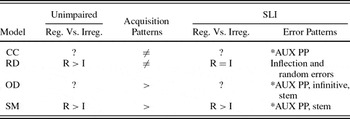
A number of specific predictions for expected output can be made under the different language acquisition models in the presence of SLI (Table 1). According to the implicit rule deficit (RD) theory of SLI, neither rule-generating nor grammatical-checking processes are available to children with SLI. These children would be expected to have great difficulty performing this task. A number of specific patterns should arise in the responses of children with impairment. First, they would show a lack of sensitivity to the verbal conjugation group. Regular and irregular verbs of similar frequency should be equally difficult (or easy) to produce in the presence of a language deficit.Footnote 2 Second, children with SLI should not produce overregularizations, as these are believed to be linked to the acquisition of a productive rule for inflection (at least in dual-route language acquisition models). Third and finally, they would be expected to make more random errors in their output, for example, producing inappropriate verb tenses and ungrammatical structures (including bare past participles) instead of target responses, because they are unable to check for grammatical appropriateness.
Overview of predictions based on SLI theories

Note: *AUX, no auxiliary produced.
According to the optional default (OD) theory, children with SLI should exhibit patterns similar to those of control children, but with protracted acquisition. Expected error patterns would be past participles produced without the auxiliary and infinitive and present (stem) forms produced in contexts requiring other tenses, as seen in all children acquiring French (Paradis & Crago, Reference Paradis and Crago2001). This theory does not specifically relate to the issue addressed here, that is, a potential distinction between regular and irregular inflection. Nor is the notion of default related to this distinction.
According to the CC account, children with SLI should exhibit different patterns than controls (rather than protracted patterns), production of bare past participles only, with few syntactically complex structures. Again, no link is made between verb conjugation group and production pattern. In other words, no differences should be found between regular and irregular verbs. Finally, according to the surface/sparse morphology (SM) account, we expect to observe generally good production of the passé composé, because French is an inflecting language with salient morphemes, provided the children have reached a level of linguistic development appropriate for the emergence of this form. Similar to the OD account, the linguistic behavior of children with SLI should be protracted but similar to that of children without language difficulties. However, children with a language disorder would be expected to be sensitive to morphological structure and to produce overregularizations (if these are also found in children without a disorder), in addition to stem (present) forms and past participle forms without auxiliaries, because they are unstressed. According to this hypothesis, neither random errors nor morphologically and syntactically more complex structures would be expected.
METHODS
Participants
The children in this study had participated in a larger study on SLI in French-speaking children (Thordardottir & Namazi, Reference Thordardottir and Namazi2007). Participants with SLI (9 boys, 2 girls, ages 37–52 months, mean = 45;5) were recruited from a hospital clinic and a pediatrician's office. Some children had a previous diagnosis of language impairment or severe language delay, and some of them had received intervention. The remaining children were on a waiting list for language evaluation for late speech onset or poor language development. Language-impairment status for this study was verified by a certified speech–language pathologist, based on history and language scores. MLU scores were compared to a database of preliminary norms for Quebec French (Thordardottir, Reference Thordardottir2005; Thordardottir et al., 2005). Presence of language impairment was confirmed in 12 out of a total of 17 children who were referred for the SLI group. The remaining 5 children were excluded from the study. One of the 12 children refused to participate in the verb elicitation task. An age-matched control group was included (7 boys, 4 girls, ages 36–52 months, mean = 44;4). The two groups did not differ significantly in age, t (20) = .55, p > .1, but differed significantly in MLU, t (20) = −.596, p < .001. Children were matched for age rather than MLU or vocabulary size because they were at very early stages of language development. Normally developing children matched for MLU would have been too young to perform the elicitation task. However, we performed post hoc comparisons on results between certain children from both groups that showed overlaps on MLU or vocabulary measures. All children underwent a hearing screening on the day of testing. A detailed description of the participants is provided in Thordardottir and Namazi (Reference Thordardottir and Namazi2007).
Procedure
Children were asked to perform a verb-production task prompting use of the passé composé form for specific verbs. Verbs were controlled for conjugation group and age of acquisition (see below in Materials). Children also participated in individual play sessions designed to gather spontaneous speech samples. Measures obtained from the spontaneous speech samples included overregularization errors, MLU in morphemes, MLUW, and ability to use the passé composé (see Thordardottir, Reference Thordardottir2005, for a description of transcription procedures). Parents were asked to fill out a questionnaire on their child's language history and the Quebec French version of the MacArthur Communicative Development Inventory parental checklist for language (Trudeau, Frank, & Poulin-Dubois, Reference Trudeau, Frank and Poulin-Dubois1999). Measures extracted from this list included vocabulary size, verb vocabulary size, and vocabulary sizes for regular and irregular verbs.
Past-tense elicitation task
During the task, the experimenters prompted the participants to produce past forms by acting out verbs using props: two dolls and a puppet (Zobo). One of the dolls would comment on the other doll's actions, using the targeted verb in the third person singular present tense (e.g., Isabelle: Regarde, il boit du jus, “Look, he is drinking juice”). The puppet commented on the activity using the second person plural present form of the verb (e.g., Zobo: Vous buvez du jus tous les jours, “You.pl drink juice every day”). The doll acting out the verb then mentioned how s/he liked performing the activity, using the infinitive form of the verb (e.g., Nicolas: Moi j'aime boire du jus, “Me, I like to drink juice”). Finally, the first doll asked Zobo what the other doll just did. Zobo always forgot, as much as he might try to remember, and had to ask the child for help in answering the question. We held the child's attention throughout testing by using the puppet as an interlocutor and by introducing the props one at a time. We presumed that, after hearing the three forms produced, (a) Infinitive (e.g., boire [bwar] “to drink”), (b) third person singular present (e.g., bois [bwa]), and (c) second person plural present (e.g., buvez [byve]), the child would realize whether the verb was regular or irregular and then produce the appropriate passé composé form. A training session with four frequent regular and irregular verbs preceded the testing session proper. The task included 16 high-frequency verbs (8 regular, 8 irregular).Footnote 3 In all trials, children were scored correct for producing the full passé composé with the target verb in the first utterance. All responses were recorded and error types were compiled. In the error analysis, all multiple answers on the same item were analyzed. Responses included (a) target (full passé composé with the auxiliaryFootnote 4 and past participle; pronouns were not scored), (b) overregularization (e.g., il a ouvré [uvʁe] for il a ouvert [uveʁ] “opened”), (c) bare past participle (no auxiliary, e.g., *mangé for il a mangé), (d) production of another tense (e.g., present), (e) production of another verb in the appropriate tense, (f) production of another verb with overregularization, (g) production of another verb with a bare past participle, (h) production of another verb in another tense (e.g., il mange “he is eating”), (i) production of a noun (e.g., jus “juice”), (j) no response or refusal to respond, and (k) uninterpretable/other (onomatopoeia, prepositional phrases and adverbs, e.g., tatata; dedans le sable “in the sand”; en haut en bas “up down”).
Materials
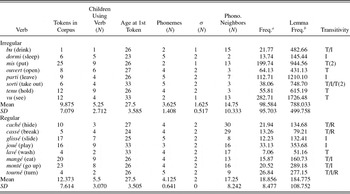
Regular (first conjugation) and irregular (third conjugation) verbs (see Appen-dix A) were selected based on age of acquisition, as determined by a spontaneous speech corpus of 28 normally developing monolingual French-speaking children ages 21–46 months (Thordardottir, Reference Thordardottir2005). All verbs were produced at or before 30 months of age by at least one child, and they were produced by at least two children in the sample (except boire, “to drink”). We matched items on the number of a given verb's tokens used in the corpus, number of children using the verb, age at first production, number of graphemes, syllable length, and thematic structure. Neighborhood density, surface frequency, and lemma frequency were verified for all past participle forms in the Frantexte database (New, Pallier, Ferrand, & Matos, Reference New, Pallier, Ferrand and Matos2001). On most measures, both verb groups were roughly equivalent, with irregular verbs having fewer tokens on average in the corpus than regular verbs, but with higher surface and lemma frequencies in the Frantexte database. On average, irregular verbs were also slightly shorter and had more phonological neighbors than regular verbs.
RESULTS
The percentage of correct responses on the verb elicitation task was used as the dependent variable and entered into a repeated-measures analysis of variance, with verb conjugation group as the within-subject variable (regular, irregular) and participant group as the between-subject variable (SLI, control). A significant main effect of participant group was observed, F (1, 20) = 37.41, p < .001, confirming that children with SLI had difficulty producing appropriate inflected forms (M = 5.58%, SD = 5.9) compared to controls (M = 45.45%, SD = 20.75). A significant main effect of verb conjugation group was found, F (1, 1) 48, p < .001, with target regular verbs produced (M = 35.8%, SD = 35.21) more often than irregular verbs (M = 15.34%, SD = 17.22). These main effects were subsumed by a significant participant group by verb conjugation group interaction, F (1, 20) = 37.93, p < .001. Only the control group showed a significant difference in ability to inflect regular (M = 64.77%, SD = 26.11) over irregular verbs (M = 26.14%, SD = 18.08), whereas children with SLI did not show this pattern (regular: M = 5.68%, SD = 18.18; irregular: M = 4.55%, SD = 5.9). However, these results should be interpreted with caution, as children with SLI evidenced floor levels for target responses on this task.
Response patterns
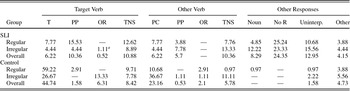
Because participants with SLI and, to a certain extent, typically developing children had difficulties producing target verb forms, an error analysis was performed. Multiple responses to items were included in the analysis. This added 32 responses to our data (18 for the SLI group and 14 for controls, including 2 target responses for the SLI group and 4 for the control group). Three of the additional responses (all from children with SLI) were not verbs. Errors were coded for each verb conjugation group and participant group. Response types are presented in Table 2. As shown, error types included overregularization, bare past participle production, production of another tense (present stems accounted for 72% of these), production of another verb in the target or other tense (again, usually the present, at 84%), noun production, refusal to respond and uninterpretable response.
Mean percentage of response types for each verb group in both participant groups
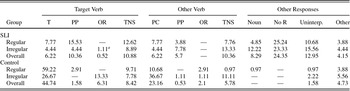
Note: T, target; PP, past participle without AUX; OR, overregularization; TNS, other tense; PC, passé composé; No R, no response; Uninterp., uninterpretable; Other, other response.
aBare past participle.
Focusing on types found in each group (the two overall rows), it is clear that patterns differ widely depending on the presence or absence of a language disorder. Apart from the observation that control children produced more correct responses, we can see that children with SLI produced more bare past participles (on target and other verbs) than control children. In addition, although both groups substituted other verbs for target verbs, control children generally produced the target structure (the passé composé; 2d), whereas children with SLI tended to produce the bare past participle and other tenses, usually the present, more often than the target tense. Examples of present (2a), periphrastic future (2b), and modal structures (2c) are given below.Footnote 5 Inflection production patterns are illustrated in Figure 1.
2.
Children with SLI also produced nouns instead of verbs over 8% of the time (see Example 3). Control children almost never did this (one child aged 36 months produced one token coco papa “egg daddy” for il a cassé l'oeuf “he broke the egg”). Only children with SLI overtly refused to respond (see Example 4) or occasionally ignored the experimenter's requests for a response. This was the most commonly found response type in children with SLI. The Uninterpretable response category (see Example 5) accounted for close to 13% of responses in children with SLI, but was quite rare in the control group. “Other” responses accounted for less than 5% of responses in both groups, including onomatopoeia (Examples 6a, 6b) and the production of other syntactic structures or categories (not including nouns) such as (Examples 6c–6e).
3.
4. Je ne sais pas “I don't know” or Non! “No!”
5.
6.
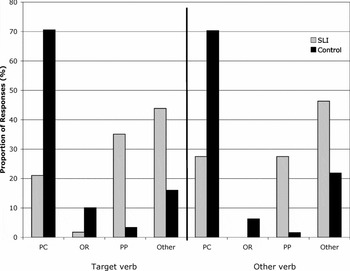
The proportion of response types on target and nontarget verbs in both participant groups. PC, passé compose; OR, overregularization; PP, bare past participle.

Taking a closer look at verb production patterns, Figure 1 highlights verb forms produced as a proportion of all verbs produced (other response types were excluded from these metrics). As can be seen, 70% of target and nontarget verbs produced by controls are in the passé composé. This behavior is the dominant pattern in control children. Children with SLI produced the bare past participle and other tenses (usually the present) for approximately 80% of target verbs and the passé composé for only 21% of target verbs. On nontarget verbs, they produced other tenses for more than 40% of forms, whereas bare past participles and the passé composé account for 28% each of nontarget verb production. Clearly, verb production patterns differ substantially between the two groups of children.
With respect to response types for the different verb conjugation groups, we observe that control children produced regular forms more accurately than irregular forms, even though we took great care to match our items for age of acquisition. A second pattern that emerges is that control children commonly substituted a known (Example 7), a semantically similar (Example 8a), or an underspecified verb (Example 8b) in the passé composé for irregular targets. Control children were almost three times as likely to replace irregular than regular verbs (regular = 16, irregular = 47), whereas SLI children were equally likely to replace regular and irregular verbs with nontarget lexemes (regular = 18, irregular = 22). Replacement verbs tended to be irregular in both groups, although this trend was more marked in the SLI group (regular = 13, irregular = 27) than in controls (regular = 25, irregular = 37).
7.
8.
Fourth, control children overregularized irregular verbs, not only into the first conjugation group (Example 9a) but also into the subregular -ir conjugation (Example 9b).
9.
Children with SLI did not produce overregularizations into either of the regular conjugations. One child with SLI (SLI, 44) produced the form ouvé Footnote 7 for ouvert “opened.” However, because ouv- is not a possible stem for the verb ouvrir, this is not an entirely legitimate example of overregularization. Finally, a pattern that emerged in the SLI children was a more frequent production of the bare past participle of regular versus irregular verbs. Control children showed this behavior quite rarely (only four responses by three participants).
Our results show that production abilities and patterns differ strongly between the two groups of children. Differences were observed in number of target responses, use of target tense versus other forms, sensitivity to verb conjugation class and production of grammatically appropriate forms (e.g., verbs versus other response types).
Correlation analyses
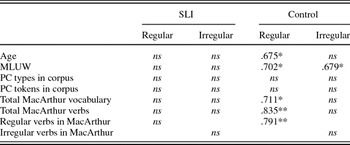
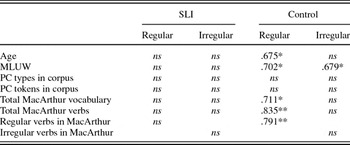
The question remains as to how and when children develop the ability to produce inflected verbs. Recall that Hiriarteborde (Reference Hiriarteborde1973) proposed that the production of four tokens of the passé composé in a spontaneous speech corpus signifies the emergence of productive rule use for this inflection in French-speaking children from France. This underscores the difficulties in detecting rule acquisition based on spontaneous speech samples. For example, children with SLI who participated in our study did not produce many passé composé forms in their spontaneous speech data, but neither did controls, and no errors were observed in these forms (see Thordardottir & Namazi, Reference Thordardottir and Namazi2007, for a discussion of the spontaneous speech data in 12 children with SLI, 11 of whom participated in our study). It is therefore difficult to infer certain structural language production abilities from spontaneous speech alone. We wanted to verify potential correlations between previously proposed measures of the emergence of productive use of tense and our results. More recent proposals linking vocabulary acquisition to productive rule use in children have been put forward by Bates and colleagues (see, e.g., Bates & Godham, Reference Bates and Godham1997; Bybee, Reference Bybee1995). Following Marchman and Bates (Reference Marchman and Bates1994), we ran correlations between vocabulary measures taken from parental vocabulary checklists and correct verb production. In addition, we ran correlations between age, MLUW, and correct productions. Finally, following Hiriarteborde (1972), we ran correlations between the use of the passé composé in the spontaneous speech corpus and the ability to produce the passé composé in the task. Correlations are presented in Table 3.
Correlations between age, MLUW, PC types and tokens in corpus, vocabulary measures, and produced target responses by verb group for participants with SLI and controls
*p < .05 (two-tailed Pearson correlation).
**p < .01 (two-tailed Pearson correlation).
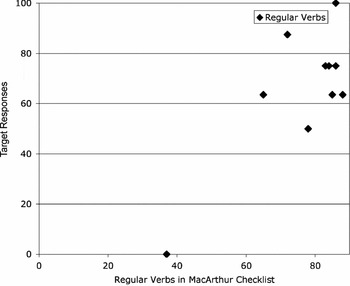
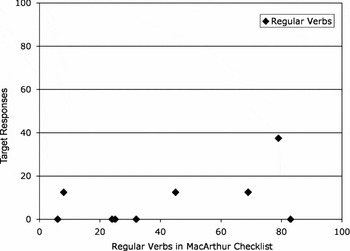
First, no correlations were found between measures in participants with SLI, whereas a number of correlations are present for controls. After a Bonferroni adjustment (α = .05, p = .0036), only two significant correlations were found: between production of the passé composé of regular verbs and MacArthur verb vocabulary size, and between production of the passé composé of regular verbs and MacArthur regular verb vocabulary size. These correlations seem to be the result of regular verb acquisition, because irregular verb acquisition, as measured by the MacArthur checklist, does not correlate with the correct production of irregular targets. Figures 2 and 3 illustrate the correlation for control children and lack of same for SLI participants.
The correlation between regular verb vocabulary in the MacArthur checklist and target regular verb production in control children.

The correlation between regular verb vocabulary in the MacArthur checklist and target regular verb production in participants with specific language impairment.

These results show that control children start producing target inflected regular verb forms some time after they have acquired a vocabulary of approximately 40 regular verbs and can reliably produce correct responses on our task when they have acquired over 65 regular verb items in the parental checklist. The data from the three SLI children with regular verb vocabulary sizes over 69 does not follow this pattern, with only one producing regular verbs in the passé compose, and at lower accuracy than control children. These results may indicate differential acquisition patterns between the two participant groups. The lack of significant correlations in the SLI group must be interpreted with great caution, however, because of the uniformly low scores on the elicitation probe. It remains to be seen whether a group of SLI children with larger vocabularies would show patterns similar to the control children or to the three children with SLI discussed here. In contrast, these results support the importance of a system for the acquisition of morphology that is sensitive to regular patterns in unimpaired language acquisition, because there is no apparent correlation between irregular verb acquisition and correct passé compose inflection in control children. Again, this result must be interpreted with caution, as there were fewer irregular (n = 23) than regular (n = 86) verbs in the parental checklist, which could explain the stronger correlations observed.
The strong correlations between the ability to inflect regular verbs and verb vocabulary size supports the contention of Marchman and Bates that vocabulary size is an important factor in the emergence of overregularization patterns in the English past tense (1994), while refining it somewhat. Because of the effect found for regular verbs only, it seems that, at least in French, the acquisition of productive rules is sensitive to morphological structure.
Age, MLUW, and total MacArthur vocabulary were significantly correlated with target production in control children, although not as strongly as the verb vocabulary measures, and after Bonferroni adjustment, correlations were not significant. However, MLUW was the only measure that correlated significantly with target production of irregular verbs in controls. At an MLUW of approximately 2.6, each control child was already producing passé composé forms of regular verbs at 50% correct or more (in elicitation), whereas irregular forms were produced at this level by only one child, at an MLUW of 4.09. The SLI group did not show these trends: target responses on regular verbs did not exceed 37.5%, even at MLUWs above 2.6 (two children in the SLI group).Footnote 8 These results indicate that passé composé developmental patterns are delayed compared to MLU development in children with SLI.
DISCUSSION
We found that children with SLI had the expected difficulties producing passé composé forms. They produced significantly fewer target forms than control children. We could argue that the children with SLI had not yet acquired inflectional rules, because they did not produce these forms in spontaneous speech. However, two children with SLI respectively produced three and two types of the full passé composé and four tokens each in the spontaneous speech sessions. These same children produced only one target response each in our task. All control child-ren produced passé composé forms in their spontaneous speech (1–8 types, 2–14 tokens), and only one, the youngest, scored below 50% on regular verbs during elicitation. We may conclude that the early spontaneous use of inflected forms by young children with SLI does not necessarily signal the existence of a productive rule for the passé composé. In addition, control children produced more correct responses on regular verbs and overregularized irregular verbs. Better production of regular and overregularized subregular patterns (see Example 9b) suggests that French-speaking children are sensitive to morphological patterns with low type frequencies in the input, can extract them and can productively use them to inflect verbs (see Royle, Reference Royle2007, for a detailed discussion). Based on the RD account of SLI, it was expected that typically developing children, and not children with SLI, would produce overregularizations on irregular verb prompts. Similarly, we did not expect to find sensitivity to morphological patterns in children with SLI. Based on previous research (Rose & Royle, Reference Rose and Royle1999), we expected that they would produce more random erroneous outputs than control children.
We also observed that, although some production patterns were found in all the children, both groups showed distinct performance patterns. In particular, we found that French-speaking children with SLI did not produce the passé composé in linguistically constrained contexts and tended to produce other tenses (usually the present) and bare past participles, in addition to nouns and other incongruous structures. Control children tended to produce the passé composé, either with the target verb or another form, but showed better performance on regular verbs. Relating these results to the hypotheses, we see first that production patterns differed between the control and SLI groups, which provides little support for the argument that children with SLI have protracted but normal acquisition patterns (OD and SM hypotheses). However, because there was no control group of children matched for language abilities, these hypotheses cannot be fully evaluated in light of our data. The lack of sensitivity to verb conjugation group also goes against the SM hypothesis, because if linguistic typology affects language acquisition, we would expect better results on regular and recurring patterns in children with SLI. Focusing on error patterns, the OD and RD accounts are both supported by the data, particularly in terms of production of past participle and present (or stem) forms. However, infinitives were rarely produced (n = 3), and by only one child with SLI during the task (see Examples 10a and 10b for infinitives and 10c for an infinitive used for the past participle). According to the OD hypothesis, we expected more of these forms. Recall, however, that past participles of regular verbs are homophonous with the infinitive, and that only irregulars can be used for this type of comparison. Even so, although there were many opportunities to produce infinitives, they did not appear.
10.
Noun production is not predicted under any account of SLI. However, under the RD account, based on the notion of operations over variables (Marcus, Reference Marcus2001; Pinker, Reference Pinker1999), the grammatical abilities of children with SLI can be affected in spheres other than inflection. Here, the choice of a different variable (noun, etc.), albeit semantically close to the target (the child is talking about an event containing a reference to an object), would be inappropriate. Under this account, children with SLI are expected to err outside the normal cluster of appropriate responses (i.e., verb) to a given question. Alternatively, the use of nouns instead of verbs may indicate an early developmental pattern that control children have outgrown.Footnote 9 Future studies including children matched for language level could explore this issue.
The production of more regular than irregular past participles in children with SLI could be construed as support for the hypothesis that passé composé forms are computationally complex to produce, and that a child with a language disorder produces a form as close as possible to the output, while eliminating some structure. Alternatively, the child could be producing an OD form. However, this interpretation does not explain the difference we found between regular and irregular verbs for this response type (17 regular tokens vs. 4 irregular ones). We argue instead that the child most probably echoes the input. Because the past participle, infinitive, and 2pp present forms of regular French verbs are homophonous and were provided as input, it is likely that the child produced this phonological form following activation in the child's lexicon, not realizing that it was ungrammatical in the absence of an auxiliary. Finally, because children with SLI showed no correlations between vocabulary (and other measures) and task scores, and because a number of children with SLI with vocabulary and MLU levels similar to controls produced fewer passé composé forms than their peers, we can take this as an indication that the SLI children were less able to extract a rule from a recurrent pattern, and that they needed more information than the control group to perform the task correctly.
SUMMARY AND CONCLUSION
We found differences between SLI and control groups on a number of linguistic measures. In particular, they differed in their abilities to produce regular and irregular verbs and in the relation of these abilities to MLUW and vocabulary scores. Response patterns on the passé composé elicitation task also differed between the two groups, not only in the production of target outputs, but also in response type. Control children showed emerging productive rule use, sensitivity to word-internal structures (conjugation patterns) and sensitivity to grammatical constraints. This was seen in their emerging ability to produce appropriate responses and overregularization patterns. The SLI participants seemed not to have developed the same grammatical abilities or sensitivity as controls. They produced target forms with difficulty, omitted auxiliaries, and produced inappropriate responses after prompting. It also appears that French-speaking children with SLI had disproportionate problems producing verb inflections. Even when their vocabulary or MLU was larger, children with SLI showed dissimilar acquisition patterns to controls. This may reflect a deficit in productive rule use resulting from a grammar unable to perform operations over variables, or it might reflect a lesser ability than typically developing children to extract patterns from input. To further investigate this effect, SLI children with more advanced language skills should be studied.
Results on the elicitation task in this study should be interpreted with caution, as the participants were quite young. However, some children with SLI overlapped with controls on either MLUW or verb vocabulary measures. They showed no evidence of comparable linguistic ability with matched controls. In a number of children with SLI, we observed a distinction between the ability to produce the passé composé in spontaneous speech and to use it as a response to prompting. Given their performance on spontaneous speech (see Thordardottir & Namazi, Reference Thordardottir and Namazi2007), this indicates that spontaneous speech corpora and elicitation tasks can produce conflicting results for language abilities in French-speaking children with SLI. Elicitation and spontaneous production differ in several ways, including the child's control over what is said and the “naturalness” of the interaction. The children in this study performed more poorly on elicitation than spontaneous language tasks. We could conclude that the two contexts provide different information on the children's abilities and that early use of forms such as the passé composé in spontaneous language may not reflect the emergence of a fully productive inflectional rule. Alternatively, the contrived nature of the elicitation task may have taxed these young children, and they might have performed better in a more natural setting.
The elicitation results do not clearly determine whether children with SLI are sensitive to the distinction between different verb conjugation groups, because they produced few correct responses for both target types. However, in contrast to the control group, there were no significant differences between the strategies they used to produce responses on regular and irregular verbs. Error analyses revealed that the only effect of verb conjugation pattern observed in SLI participants was the production of more forms resembling the past participles of regular targets. This might be due to the repetition of the homophonous (infinitive and 2ppl) form in the input. Other patterns unseen or unusual in control children were the production of nouns instead of verbs and refusals to respond. These are similar to patterns observed by Rose and Royle (Reference Rose and Royle1999) in a real- and novel-verb elicitation task in older French-speaking participants with familial language impairment, and by Jakubovicz (Reference Jakubovicz2003) in older children with SLI. Faced with a verb elicitation task, participants with SLI have enormous difficulties producing appropriate responses, even after many years of exposure to their mother tongue. The absence of overregularization and the observed insensitivity to obligatory tense marking, even at comparable MLU levels, points to disproportionate difficulties in this area.
Thordardottir and Namazi (Reference Thordardottir and Namazi2007) analyzed the spontaneous use of verb inflection in the children with SLI that participated in this study and compared them with a control group matched for MLU. Overall, accuracy rates were similar (and high) in both groups. However, the use of bare past participles or infinitives, albeit quite uncommon, was more characteristic of children with SLI than age-matched or MLU-matched controls. Because the children in our study were very young, a control group matched for linguistic measures such as MLU was not included, as such a group would be too young to complete the elicitation task. It would be worthwhile to pursue this experiment with older cohorts matched for MLU measures. It is likely that older children with SLI would perform better on the elicitation task than the young children in this study. Further studies could explore how older children with SLI compare with MLU-matched controls on accuracy and error patterns, and would enable more meaningful conclusions on the nature of the deficit. However, based on previous studies by Jakubovicz (Reference Jakubovicz2003) and Rose and Royle (Reference Rose and Royle1999), we would expect SLI participants to produce different patterns of correct responses and errors from controls.
With regard to the correlations on the results, the control children showed correlations between vocabulary measures, MLUW measures, and age and linguistic development (i.e., productive use of the passé compose). These results are consistent with those by Marchman and Bates (Reference Marchman and Bates1994), and they underscore the importance of linguistic input for language development, especially concerning the differential effects of regular and irregular verbs. The children with SLI did not show these correlations. However, given their floor results on the elicitation task, it is unclear whether this noncorrelation was caused by the absence of productive rules or simply by a delayed language acquisition process.
A first step to avoid floor effects in the future would be to study children at a slightly older age. A closer look at children without language disorders would be useful. Royle (Reference Royle2007) analyzed the inflectional ability of 15 French-speaking children (11 of whom were controls in this study) to produce the passé composé. She found that children under the age of 38 months were unable to perform the task. She also observed that, although older children could reliably inflect high-frequency regular and irregular verbs, they were not necessarily able to inflect low frequency (regular and irregular) verbs. Only a subset of older children could provide the passé composé on low-frequency verbs. Based on Royle's data, we propose that French-speaking children develop the ability to productively inflect verbs between 44 and 48 months. Therefore, this task should not be run on children with or without language disorder before that age, as the results would presumably not offer useful data. However, this leaves us with the problem of identifying language disorders in young children. One solution would be to elicit structures that are produced by all children at the initial stages of French language acquisition. The complex noun phrase, with its attributive adjectives and determiners that agree with the noun (including gender features), is a structure produced at the beginning of the two-word stage. Results of pilot studies eliciting the complex noun phrase are promising: French-speaking 30-month-old children can reliably produce simple structures containing adjectives such as la petite maison “the.fem small.fem house” or le cheval vert “the.masc horse green.masc” (Royle, Vial, & Valois, in press). A spontaneous-speech study of Spanish-speaking children with SLI revealed agreement errors in attributive adjectives (Bedore & Leonard, Reference Bedore and Leonard2001), and we also found this in a French-speaking child with SLI in our elicitation task (Bouffard & Royle, Reference Bouffard and Royle2007; Royle, 2005–2007). An adjective elicitation task could therefore identify language difficulties in very young children with suspected language disorders, while verb elicitation tasks could confirm a language disorder diagnosis in older preschoolers.
In conclusion, our results suggest that the acquisition of productive verb inflection in French is disrupted in children with SLI, in terms of more than just acquisition timing. Some linguistic behaviors in the SLI children were atypical of normal development. Lack of sensitivity to verb conjugation group and the production of inappropriate structures, even when presented with early acquired verbs, set the children with SLI apart. Our data also show that different data gathering techniques can bias our understanding of a child's linguistic abilities. We should thus use them with a clear understanding of their purpose and limitations.
Verbs used for the elicitation task

aGrapheme (surface) frequency per million (New et al., Reference New, Pallier, Ferrand and Matos2001).
bCumulative frequency per million (New et al., Reference New, Pallier, Ferrand and Matos2001).
ACKNOWLEDGMENTS
This research was made possible by a postdoctoral fellowship (SSHRC ref. 756-2002-0338) awarded to the first author and an FCAR research grant (2002-NC-727222) awarded to the second author. Marie-Eve Rivard participated in the data collection and transcription. We thank all of the children and family members who volunteered to participate in this research, as well as Peter Gordon and three anonymous reviewers for their comments.