Introduction
Unplanned pregnancy is defined as a pregnancy that is poorly timed or unwanted at the time of discovery. Globally, 40% of all pregnancies were reported to be unplanned in 2012. Of these, 50% resulted in elective termination of the pregnancy, and 38% ended in an unplanned birth (Sedgh et al., Reference Sedgh, Singh and Hussain2014). No contraceptive method is 100% effective. Furthermore, even reliable contraceptive methods providing high levels of efficacy may be affected by human error in usage or compliance, contributing to contraceptive failures and unplanned pregnancies (Polis et al., Reference Polis, Bradley, Bankole, Onda, Croft and Singh2016). Unplanned pregnancy is one of the most challenging reproductive health issues in countries that adhere to restrictive abortion laws. Due to this, women residing in these countries may be forced to resort to clandestine or illegal care resulting in unsafe abortions (Erfani, Reference Erfani2011).
Women’s decision-making regarding continuation or termination of an unplanned pregnancy is influenced by a broad range of contextual and cognitive factors (Finer et al., Reference Finer, Frohwirth, Dauphinee, Singh and Moore2005; Santelli et al., Reference Santelli, Speizer, Avery and Kendall2006; Tilahun et al., Reference Tilahun, Dadi and Shiferaw2017). Acknowledging women’s perceptions of unplanned pregnancy is essential for health care providers to provide non-judgmental supportive care and appropriate counselling. Existing instruments, such as the Cambridge Worry Scale, the Tilburg Pregnancy Distress Scale, the Pregnancy-Related Anxiety Questionnaire and the Pregnancy Worry and Stress Questionnaire, are specific to planned pregnancies (Green et al., Reference Green, Kafetsios, Statham and Snowdon2003; Pop et al., Reference Pop, Pommer, Pop-Purceleanu, Wijnen, Bergink and Pouwer2011; Huizink et al., Reference Huizink, Delforterie, Scheinin, Tolvanen, Karlsson and Karlsson2016; Navidpour et al., Reference Navidpour, Dolatian, Shishehgar, Yaghmaei, Alavi Majd and Hashemi2016). No specific instrument to measure women’s perceptions of unplanned pregnancy has been identified by the authors in the current literature. The aim of this study was to develop such an instrument. A clearer understanding of women’s perceptions of unplanned pregnancy, and how these perceptions influence the decision-making process, may enhance reproductive services and interventions and decrease the seeking of unsafe abortions.
Methods
Instrument design
An instrument to measure women’s perceptions of unplanned pregnancy was developed using a methodological framework guided by Waltz et al. (Reference Waltz, Strickland and Lenz2010). Essential steps in the design of such a norm-referenced measure are: (a) selection of a conceptual model to determine the dimensions of the measurement process; (b) explication of the objectives; (c) determine domains; and (d) standardized administration of procedures, item setting, scoring criteria and psychometric testing. The conceptual model of the designed instrument was based on the findings of a previous qualitative study that used a content analysis approach conducted in Tabriz, Iran by Mohammadi et al. (Reference Mohammadi, Nourizadeh and Simbar2015). Accordingly, two contradictory worries and fears commonly experienced while facing an unplanned pregnancy were identified, including worries and fears about continuing with an unplanned pregnancy and worries and fears surrounding induced abortion. These worries or fears may be influenced by a variety of life circumstances, religion affiliation, health policies and access to health care services. The main function of this definition included the orientation of women’s worries and fears regarding the termination and continuation of pregnancy (step 2 of instrument development).
The third step of the instrument development categorized women’s worries and fears towards continuing with an unplanned pregnancy into six domains: violation of childbearing norms (eight items); life difficulties and instability (nine items); social restrictions and deprivations (four items); negative maternal and neonatal consequences (eight items); negative physical and emotional consequences (four items); and inability to fulfil parental commitments (six items).
Conversely, women’s worries and fears surrounding induced abortion were categorized into two domains: the infringement of individual belief and value systems (six items); and difficulty and adverse effects of abortion (two items). The initial instrument contained eight domains encompassing 47 items. To understand the severity of the unplanned pregnant women’s worries and fears, respondents were asked to respond to the items by indicating their level of agreement using a four-point Likert scale (not at all=0, a little=1, quite a bit=2 and very much=3). The instrument did not contain any negative or reversed items.
Participants and sampling
Participants were recruited, using convenience sampling, between June 2016 and July 2017. The study settings included public health clinics and private obstetrician and midwifery offices located in Tabriz, Iran. Participants were a sample of married Iranian women between the ages of 15 and 49 who had experienced an unplanned pregnancy, either unwanted or mistimed, within the last 3 months. Women with an established diagnosis of a psychological disorder were excluded from the study. All eligible women were invited to participate. The goals and method of the study were explained and written informed consent was obtained from all participants. The researchers guaranteed confidentiality of the participants’ information. The study was approved by the Ethics Committee of Shahid Beheheshti University of Medical Sciences (sbmu2.rec.1394.129).
Validation of the instrument
The psychometric properties of the instrument were assessed using face, content, concurrent and construct validations. To determine face validity, qualitative and quantitative methods were used. For qualitative face validity, ten women with unplanned pregnancies were asked to evaluate each item for clearness and ease of readability. Quantitative face validity was evaluated by calculating the impact score of each item. To measure the importance of items, an impact score was used. The same unplanned pregnant women were asked to score each item on a 5-point Likert scale ranging from 1=unimportant to 5=very important. An impact score of items was calculated using the following formula:
Item Impact Score=frequency (percentage of participants who scored 4 or 5 on item importance)×Importance (the mean importance score of each item).
As recommended by Juniper et al. (Reference Juniper, Guyott, Streiner and King1997), items with scores of less than 1.5 were deleted, so all impact scores were above 1.5. Accordingly, all items were retained during the quantitative face validity phase.
The content validity of the instrument was assessed using feedback from fifteen experts, including reproductive health professionals and researchers with expertise in instrument development. During the process of qualitative content validity, some items were modified to improve readability, and duplicated items were excluded. Following the merger and elimination of overlapping and duplicate items during the qualitative content validity, 36 of the initial 47 items remained in the questionnaire. Content Validity Ratios (CVRs) and Content Validity Indexes (CVIs) were used for the quantitative analysis of content validity. Experts were asked to determine the necessity of each item, using a three-point Likert scale, indicating: (1) unnecessary, (2) useful but unnecessary and (3) necessary. According to the values presented by Lawshe (Reference Lawshe1975), the minimum suggested value of the CVR was ≥0.49 when assessed by fifteen experts. To determine the CVI, experts were asked to comment on the ‘relevance, simplicity and clearness’ of each item using a four-point Likert scale. According to Polit et al. (Reference Polit, Beck and Owan2007), items demonstrating a CVI relevancy of >0.7 should be retained. Five items were removed from the study due to the CVR being less than 0.49 and the CVI less than 0.7. As a result, and based on the panel’s consensus, 31 items remained. The average CVI of the total scale was calculated to be 0.92. The concurrent validity of the Women’s Perceptions of Unplanned Pregnancy Questionnaire was tested by comparing it with the Persian version of the Cambridge Worry Scale and the Spielberger State-Trait Anxiety Inventory (Spielberger et al., Reference Spielberger, Gorsuch, Lushene, Vagg and Jacobs1983; Mortazavi & Akaberi, Reference Mortazavi and Akaberi2016).
The construct validity was assessed by Exploratory Factor Analysis (EFA). According to Nunnally (Reference Nunnally1978), there should be at least ten cases per item in the designed questionnaire. So, the sample size for construct validity was calculated by multiplying the number of items by ten. Accordingly, 310 questionnaires with 31 items were completed by face-to face interview (Fig. 1). The interviews were conducted in Turkish. The data were analysed using IBM SPSS for Windows (Version 24).
Development and psychometric evaluation of the Women’s Perceptions of Unplanned Pregnancy Questionnaire.

The data were screened for factorability using the Kaiser–Myer–Olkin (KMO) measure of sample adequacy, and Bartlett’s test of sphericity. The KMO value was 0.76 with a significant Bartlett’s test of sphericity (p<0.001). The number of factors retained was determined using eigenvalues and a scree plot. There were nine factors with eigen values greater than one; however, six factors were taken into account based on the scree plot. In a scree plot, the point where the slope of the curve is clearly levelling off indicates the number of factors that should be generated by the analysis. In addition, principal axis factoring with varimax rotation of items was used. The factor loading was conducted for different cut-off points from 0.3 to 0.5 (Munro, Reference Munro2006; Tabachnick & Fidell, Reference Tabachnick and Fidell2007). Using a cut-off of 0.3, at least three items were placed in each factor.
Reliability of the instrument
In order to assess the reliability of the instrument, internal consistency and Intraclass Correlation Coefficients (ICCs) were calculated. Following the completion of the questionnaire by 20 randomly selected women, aged 15–49 who reported an unplanned pregnancy, Cronbach’s alpha coefficient was calculated. Newly developed measures can be accepted with an alpha value of 0.70 (Pallant, Reference Pallant2007; Polit & Beck, Reference Polit and Beck2010). The ICC was used to assess the temporal stability of the instrument by distributing the questionnaire to 20 participants twice with a 14-day interval. A period of 2 weeks to a month between test–retest is recommended (Aday & Cornelius, Reference Aday and Cornelius2006; Waltz et al., Reference Waltz, Strickland and Lenz2010).
Results
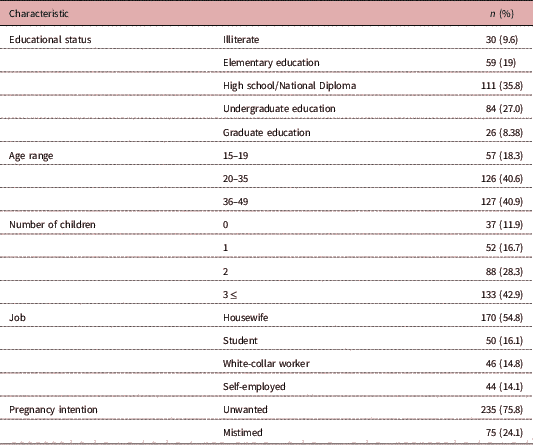
Table 1 shows the socio-demographic characteristics of the 310 female participants. The mean age of the women was 36.8 years (SD=7.2). One-third (35.8%) had completed high school or earned a high school diploma. More than half (54.8%) self-identified as housewives. Forty-two per cent reported a history of at least three or more pregnancies in the past. Most (75.8%) had reported the recent unplanned pregnancy as unwanted, with the remainder being mistimed.
Background characteristics of study participants: married women aged 15–49 with an unwanted pregnancy in last 3 months, Tabriz, Iran

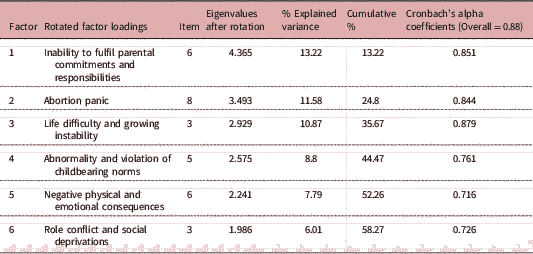
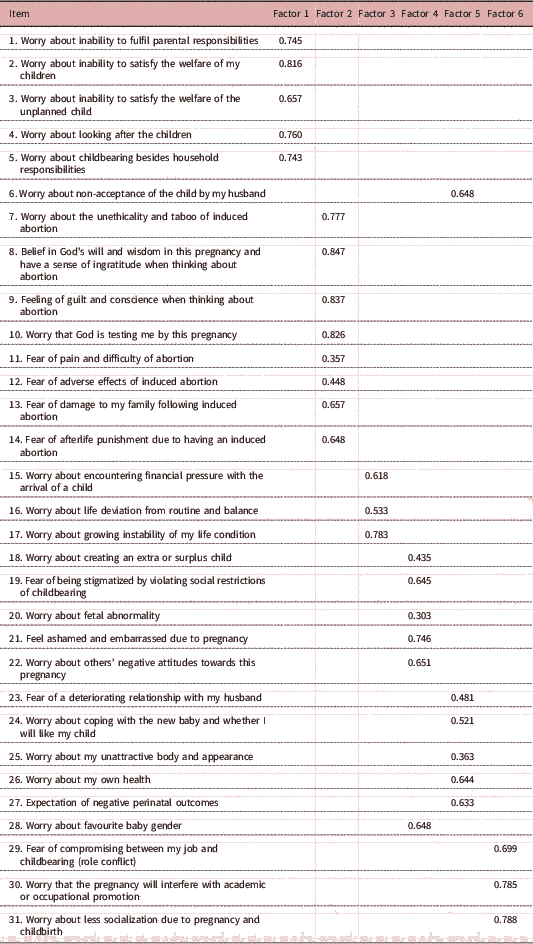
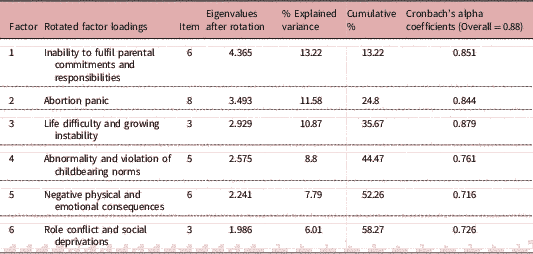
No items were removed during the Explanatory Factor Analysis and 31 items were found to contribute to six factors with a total explained variance of 58.27% (Table 2). Extracted factors included: inability to fulfil parental commitments and responsibilities (items 1–5), abortion panic (items 7–14), life difficulty and growing instability (items 15–17), abnormality and violating childbearing norms (items 18–22, 28), negative physical and emotional consequences (items 6, 23–27) and social deprivations and role conflict (items 29–31) (Table 3).
Rotated factor loadings and Cronbach’s α of Women’s Perceptions of Unplanned Pregnancy Questionnaire
Extracted factors and factor loading of Women’s Perceptions of Unplanned Pregnancy Questionnaire after exploratory factor analysis

The Pearson correlation coefficients between the Women’s Perceptions of Unplanned Pregnancy Questionnaire and the Spielberger Anxiety Inventory-State, Spielberger Anxiety Inventory-Trait and Persian version of the Cambridge Worry Scale were 0.54, 0.51 and 0.56, respectively (p<0.05), confirming concurrent validity.
Cronbach’s alpha for the Women’s Perceptions of Unplanned Pregnancy Questionnaire was 0.88 and above 0.7 for each of the subscales (Table 2). Thus, the resulting 31 items indicated good internal consistency. The ICC of 0.89 indicated that the instrument had an overall high stability. Details of the development and psychometric evaluation of the Women’s Perceptions of Unplanned Pregnancy Questionnaire are shown in Fig. 1.
Discussion
The Women’s Perceptions of Unplanned Pregnancy Questionnaire created in this study has been shown to be a valid and reliable instrument for the measurement of pregnant women’s perceptions of unplanned pregnancy, assessing their worries and fears when faced with an unplanned pregnancy, excluding adoption-related worries. The questionnaire consisted of 31 items in a six-factor structure, namely: inability to fulfil parental commitments and responsibilities, abortion panic, life difficulty and growing instability, abnormality and violation of childbearing norms, negative physical and emotional consequences and role conflict and social deprivations.
In comparison to other instruments designed to measure distress, anxiety and worry about planned pregnancy, including the Cambridge Worry Scale, the Tilburg Pregnancy Distress Scale, the Pregnancy-Related Anxiety Questionnaire and the Pregnancy Worry and Stress Questionnaire, abortion panic and violation of childbearing norms were found to be specific worries of unplanned pregnancy (Green et al., Reference Green, Kafetsios, Statham and Snowdon2003; Pop et al., Reference Pop, Pommer, Pop-Purceleanu, Wijnen, Bergink and Pouwer2011; Huizink et al., Reference Huizink, Delforterie, Scheinin, Tolvanen, Karlsson and Karlsson2016; Navidpour et al., Reference Navidpour, Dolatian, Shishehgar, Yaghmaei, Alavi Majd and Hashemi2016). This implies that the social restrictions of childbearing and abortion play an important role in women’s perceptions of unplanned pregnancy.
Differences between the Women’s Perceptions of Unplanned Pregnancy Questionnaire and other scales pertained to maternal worries surrounding spontaneous miscarriage and fetal deaths, more commonly noted in planned pregnancies, while maternal worries regarding fetus anomaly were more commonly reported in unplanned pregnancies. Due to the nature of unplanned pregnancies that occur while using contraception or prescribed medications, fetal anomaly is one of the most common concerns of women with unplanned pregnancies (Mohammadi et al., Reference Mohammadi, Nourizadeh and Simbar2015).
Another difference between the newly developed instrument and similar scales is related to maternal worries about labour and childbirth. It is noteworthy that the Women’s Perceptions of Unplanned Pregnancy Questionnaire was developed to identify the women’s worries and fears during the early stages of an unplanned pregnancy, whereas childbirth-related worries are more evident in women during the second or third trimester of pregnancy.
Overall, the Women’s Perceptions of Unplanned Pregnancy Questionnaire could be used by health care professionals to develop or enhance supportive counselling interventions for women who are dealing with the complexities of an unplanned pregnancy. Maternal worries and fears regarding either the continuation of an unplanned pregnancy or its termination depend on a variety of life circumstances. These include religious affiliations, legal regulations, reproductive health policies and access to health care services. Future confirmatory factor analysis of the Women’s Perceptions of Unplanned Pregnancy Questionnaire is necessary to confirm the constructs are reliable and consistent in diverse populations and settings.
Acknowledgments
The authors would like to acknowledge the support of Shahid Beheshti and Tabriz Universities of Medical Sciences, Iran, and the volunteer participants for their willingness to contribute to this project. The authors would also like to thank Ms Roza Mobayen, a medical student from University College London, for editing this article.
Ethical Approval
All procedures performed in studies involving human participants were in accordance with the ethical standards of national research committee and with the 1964 Helsinki Declaration and its later amendments or comparable ethical standards. Informed consent was obtained from all individual participants included in the study. The study was approved by the Ethics Committee of Shahid Beheshti University of Medical Sciences, Iran (sbmu2.rec.1394.129). Participants were well informed about the participatory nature of the study and their right to withdraw from the study at any time. Confidentiality was guaranteed and a written informed consent was obtained from all participants.
Conflicts of Interest
The authors declare that they have no conflict of interest.
Funding
No funding was received for this study.