Introduction
Simulation-based training has a fundamental role in medical education as it allows the learner to gain experience managing emergencies in a safe and controlled environment. The military and aviation industries are long-term advocates of simulation training to test individuals’ performance in high-risk situations. However, it has only been over the last 20 years that the full benefits of simulation-based training in healthcare have been recognised.Reference Ziv, Small and Wolpe1
Root cause analysis of adverse clinical events in healthcare has revealed that the underlying cause of many events can be attributed to non-technical skills or human factors, rather than a lack of technical knowledge.Reference Paver-Erzen and Cimerman2, Reference Riley, Stanley, Miller, Hansen, Sainfort and Sweet3 Non-technical skills include communication skills, teamwork, leadership, situational awareness and decision making. In 2006, The Royal College of Surgeons of Edinburgh highlighted the importance of non-technical skills by developing the Non-Technical Skills for Surgeons course, which examines the role of non-technical skills in surgery.4
The European Working Time Directive has significantly reduced the clinical exposure time experienced by surgical trainees.Reference Parsons, Blencowe, Hollowood and Grant5 In addition, given the unpredictable nature in which emergency situations arise, doctors are increasingly unlikely to have been exposed to every emergency during their training. Trainees do not want to be confronted with an emergency situation that they may only have previously read about in a textbook and do not feel adequately trained to manage because of a lack of experience. Simulation-based training is one approach to allow trainees to gain experience in managing these emergencies without posing a risk to patient safety.Reference Bradley6 In 2011, the Association of Surgeons in Training endorsed the role of high-quality simulation in surgical training, and it has since been incorporated into the Intercollegiate Surgical Curriculum Programme Core Surgical Training curriculum.7, 8
High-fidelity simulation involves recreating the entire clinical environment, allowing multiple participants to perform tasks on a life-sized mannequin that responds physiologically as if it was a human being.Reference Cooper and Taqueti9 Unlike in the real clinical environment, the simulation mannequin can be programmed to produce a pre-defined response that allows all learners to experience the same standardised scenario and enable an individual to practise performing the same task until they become competent.
Materials and methods
Course
This 1-day course was designed to provide ENT trainees with the opportunity to gain experience managing a number of ENT and head and neck emergencies in a high-fidelity simulated environment. The scenarios were designed to cover both common emergencies and rare critical incidents that occur in clinical practice in adults.
The cost of the course was £195 per candidate and there were eight candidates on each course. This covered the cost of hiring the simulation suite (which included three simulation faculty members) for 1 day.
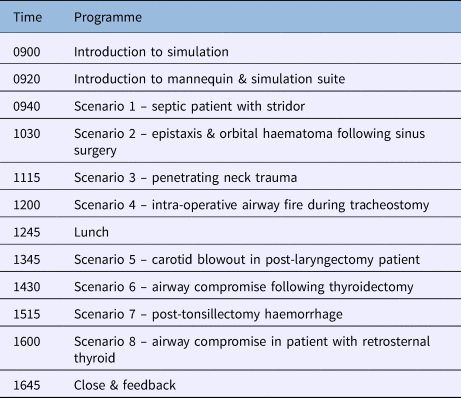
Table 1 outlines the structure of the course. At the start of the course, participants were provided with: a brief introduction of the role of non-technical skills in surgery, a tour of the simulation suite, and information on the functions and limitations of the simulation mannequin.
Course programme

Times are approximate. Each scenario typically lasted 45 minutes, and consisted of a high-fidelity simulation scenario followed by a video-assisted debrief.
Scenarios
Each course consisted of eight simulation scenarios. All scenarios were recorded, with prior consent from the candidates, and lasted approximately 20 minutes. They were live-streamed to a viewing room so that they could be watched in real time by the other candidates on the course.
Each scenario had specific learning objectives that had been mapped to the Intercollegiate Surgical Curriculum Programme ENT curriculum.10 In addition, learning objectives common to all of the scenarios included: effective teamwork, leadership, task delegation, situational awareness, effective communication, and safe handover whilst managing a critically unwell patient. The course consisted of the following scenarios: (1) septic patient with stridor; (2) epistaxis and orbital haematoma following sinus surgery; (3) penetrating neck trauma; (4) intra-operative airway fire during a tracheostomy; (5) carotid blowout in a post-laryngectomy patient; (6) airway compromise following a thyroidectomy; (7) post-tonsillectomy haemorrhage; and (8) airway compromise in a patient with a retrosternal thyroid.
Each scenario involved two participants: the first participant carried out the initial assessment and the second participant attended partway through the scenario. This provided the opportunity for handover and task delegation. The roles of staff nurses, relatives, radiographers and other healthcare professionals were provided by members of the faculty to maximise course fidelity. A member of the faculty was present in the simulation suite throughout each scenario.
Each scenario had a set point at which the scenario ended; this was commonly the point when a formal handover was taken by a senior colleague. For example, the ‘airway compromise following a thyroidectomy’ scenario ended once the participant had opened the neck wound on the mannequin and contacted their senior colleague, who then attended to allow a formal handover to take place. It was noted that some candidates opened the neck wound independently prior to discussing the patient with a senior colleague, whereas others opened the neck wound following discussion with a senior colleague. This depended on a candidate's level of experience.
All participants were expected to perform at the level that they would normally work at on a day-to-day basis; they were not expected to practise at a level beyond their competence. All candidates completed a pre-and post-course questionnaire.
Debrief
Each scenario was followed by a video-assisted debrief lasting approximately 25 minutes, which focused on the technical and non-technical aspects of each emergency. This was led by a human factors expert from the simulation centre and a subject matter expert who was an ENT consultant. Multimedia and other resources such as clinical guidelines were used to assist in the debrief process. For example, following the ‘septic patient with stridor’ scenario, a video of Martin Bromiley discussing the role that non-technical skills played in the death of Elaine Bromiley was shown, and the Difficult Airway Society guidelines for the management of an unanticipated difficult intubation were discussed.11
Faculty
The course faculty consisted of: the simulation team, who controlled and voiced the mannequin, set up the simulation suite for each scenario, facilitated the running of each scenario, and assisted in the post-scenario debrief; and two subject matter experts, who were ENT consultants. The ENT consultants provided telephone advice to candidates and assisted in the post-scenario debrief.
Simulation suite
The course was held at the Centre for Simulation and Patient Safety, Aintree University Hospital, Liverpool, UK. Each scenario took place in the simulation suite and was live-streamed to a viewing room. A one-way mirror allowed members of the faculty to observe participants from the control room. A telephone was available for candidates to use during the scenario and this was answered by a member of the faculty.
A SimMan 3G advanced patient simulator (Laerdal Medical, Orpington, UK) was used. The mannequin had the ability to speak, breathe and produce breath sounds; it allowed the administration of medications; and it displayed physiological parameters, including heart rate, blood pressure, temperature, respiratory rate and oxygen saturation in real time on a monitor. The mannequin was controlled wirelessly from a laptop in the control room. The voice of the mannequin was operated by a member of the faculty. Each scenario took place in real time.
Ethical considerations
All candidates signed a form consenting to being observed by other course participants and to the recording of scenarios. In addition, they agreed to keeping the content of the scenarios and information about individuals’ performances confidential.
Results
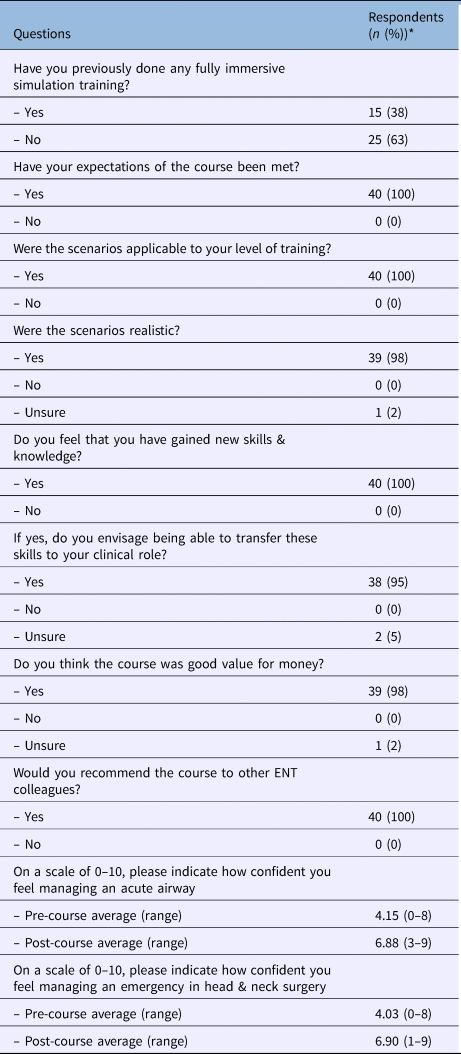
The course was first delivered in June 2014 and since then there have been a total of eight courses. The course has been attended by 62 participants. Pre- and post-course questionnaires have been completed by 100 per cent of participants (40 participants) at the five most recent courses. The results from these 40 participants will be discussed in this paper.
Participants ranged from foundation year 2 to specialist trainee year 7, and included 7 ENT advanced nurse practitioners. Fifty per cent of candidates were core surgical trainees, years 1 or 2. The average duration of participants’ experience in ENT was 39 months, with a range of 2–288 months. Thirty-eight per cent of participants had prior experience of a fully immersive simulation.
Table 2 provides an overview of the pre- and post-course questionnaire results. Overall, the course was very well received. Post-course questionnaires demonstrated that 100 per cent of participants found that the course met their expectations, and they gained new knowledge and skills. All participants would recommend the course to an ENT colleague.
Pre- and post-course questionnaire results

* Total n = 40
Participants were asked to rate, on a scale of 0–10, how confident they would feel managing an acute airway emergency, and managing an emergency in head and neck surgery. A paired t-test was used to compare pre- and post-course questionnaire scores. The average pre-course score for confidence in managing an acute airway emergency was 4.15 (range, 0–8). There was a statistically significant (p < 0.0001) increase in the average score to 6.88 (range, 3–9) following completion of the course. The average pre-course score for candidates’ confidence in managing an emergency in head and neck surgery was 4.03 (range, 0–8). This increased to 6.90 (range, 1–9) following completion of the course (p < 0.0001).
• Simulation-based training has a fundamental role in medical education
• Given the unpredictable nature of emergency situations, doctors are unlikely to have been exposed to every emergency during training
• This high-fidelity, fully immersive simulation course allowed candidates to gain experience managing ENT and head and neck emergencies
• The course was well received, and increased candidates’ scores for confidence in managing airway and head and neck emergencies
Discussion
This course allowed candidates the opportunity to develop their technical and non-technical skills in managing ENT and head and neck emergencies in a safe and controlled simulated clinical environment. The scenarios were designed to fulfil learning objectives in the Intercollegiate Surgical Curriculum Programme ENT curriculum10 and provide candidates with experience in managing emergencies that they may have previously only read about in a textbook. It also provided candidates with the opportunity to complete workplace-based assessments for the scenarios that they had participated in.
It is recognised that managing an emergency is a very stressful situation, where communication skills, teamwork, leadership, situational awareness and decision making play an important role. The course had a clear focus on the role of human factors, achieved by a human factors expert who facilitated the debrief of each scenario. Thus, this course aimed to provide candidates with a practice-run at managing emergencies without posing a risk to patient safety.
The course received positive feedback, with candidates’ self-rated confidence scores in managing an acute airway emergency and head and neck emergency demonstrating a statistically significant increase following course completion (p < 0.0001). Although it is recognised that the course did not objectively test the candidates’ competence in managing the emergencies, the management of each scenario was discussed during the debrief by an ENT subject matter expert, and this was supported by reference to current clinical guidelines.
This was the first high-fidelity, fully immersive simulation course developed in the North West region to focus on the technical and non-technical aspects of managing ENT and head and neck emergencies. Feedback from the course indicated a demand to continue providing this style of training in the future, which has led to its inclusion into the training calendar for North West Deanery ENT core surgical trainees.
Acknowledgement
The authors would like to thank the staff at the Centre for Simulation and Patient Safety, Aintree University Hospital, Liverpool, UK, for their support in running the course.
Competing interests
None declared