I. INTRODUCTION
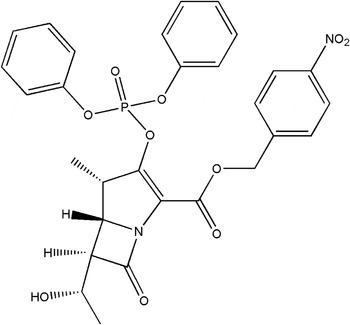
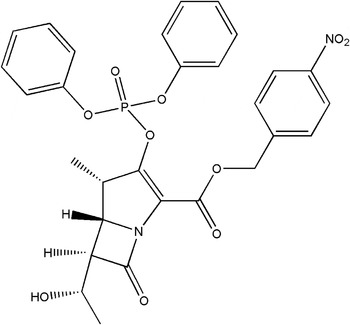
Meropenem is a carbapenem antibiotic with broad antibacterial spectrum, ranging from gram-positive bacteria to gram-negative bacteria, including Staphylococcus aureus, Streptococcus pneumonia, Haemophilus influenza, Klebsiella oxytoca, Enterobacter cloacae, Proteus vulgaris, etc (Edwards et al., Reference Edwards, Turner, Wannop, Withnell, Grindey and Nairn1989; Kitzis et al., Reference Kitzis, Acar and Gutmann1989). The title compound beta-methyl vinyl phosphate (Figure 1), C29H27N2O10P, systematic name 4-Nitrobenzyl (4R, 5R, 6S)-3-[(diphenylphosphono) oxy]-6-[(R)-1-hydroxyethyl]-4-methyl-7-oxo-1-azabicyclo[3.2.0] hept-2-ene-2-carboxylate, with the CAS register number of 90776-59-3 is an intermediate of meropenem and is also used as the original material in semi-synthesis of meropenem.
Structural formula of beta-methyl vinyl phosphate.
Presently, the crystal structure of beta-methyl vinyl phosphate has not been reported in the literature.
II. EXPERIMENTAL
A. Sample preparation
The title compound beta-methyl vinyl phosphate, with the purity of more than 98%, was obtained from Qilu Pharmacy Co., Ltd. Jinan, Shandong, China. It was re-crystallized in our Lab. The structure of beta-methyl vinyl phosphate was characterized by infra-red, ultra-violet, and high-performance liquid chromatography.
B. Diffraction data collection and reduction
The diffraction pattern for the title compound was collected at room temperature using an X'Pert PRO diffractometer (PANalytical) with an X'celerator detector and CuKα 1 radiation (λ = 1.54 056 Å, generator setting: 40 kV, 40 mA). The diffraction data (supplementary material for raw data) were collected over the angular range from 5 to 50°2θ with a step size of 0.01 313°2θ and a counting time of 30 ms step−1. Data evaluation was performed using the software package Material Studio 4.2(Accelrys Co. Ltd, USA).
The structure determination involves the task named “indexing” the powder XRD pattern, which assigning the Miller indices (h, k, l) to each observed peak in the experimental powder XRD pattern (Harris, Reference Harris2012). Indexing was carried out using peak positions obtained from the powder diffraction profiles by the X-Cell method and then the indexing result was refined using Pawley-type refinement (Pan et al., Reference Pan, Guo, Duan, Cheng and Li2012). The final R wp and R p of the structure were 7.78 and 5.75%, respectively.
In order to reduce the difference between the calculated and the measured diffraction data, MC/SA search algorithm in Powder Solve package (Engel et al., Reference Engel, Wilke, Konig, Harris and Leusen1999) was used to constantly adjust the conformation, position, and orientation of the trial model in the unit cell of beta-methyl vinyl phosphate. Based on the experimental X-ray powder diffraction pattern, the result of Powder Solve was subsequently refined by Rietveld refinement (Young, Reference Young1995) techniques. Variables defining the structural model and the powder diffraction profile were adjusted by least-squares methods in order to obtain an optimal fit in the Rietveld refinement.
III. RESULTS
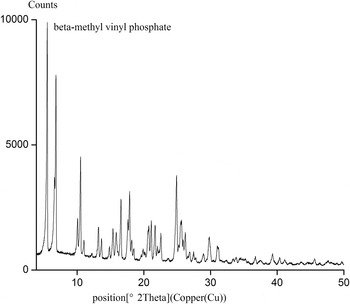
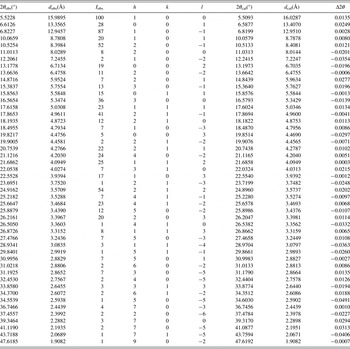
The experimental powder diffraction pattern is depicted in Figure 2. Indexing results show that beta-methyl vinyl phosphate is monoclinic with the space group P21 and unit-cell parameters: a = 17.293(4) Å, b = 6.142(6) Å, c = 14.464(8) Å, α = γ = 90°, β = 112.048(0)°, unit-cell volume V = 1424.19 Å3, Z = 2. The values of 2θ obs, d obs, I obs, h, k, l, 2θ cal, d cal, I cal, Δ2θ are listed in Table I.
X-ray powder diffraction pattern of beta-methyl vinyl phosphate, using CuKα 1 radiation (λ = 1.54 056 Å).

Indexed X-ray powder diffraction data of beta-methyl vinyl phosphate. Only the peaks with I rel of 1 or greater are presented reported. [a = 17.293(4) Å, b = 6.142(6) Å, c = 14.464(8) Å, α = γ = 90°, β = 112.048(0)°, unit-cell volume V = 1424.19 Å3, Z = 2, and space group P21]. All measured lines were indexed and are consistent with the P21 space group. The d-values were calculated using CuKα 1 radiation (λ = 1.54 056 Å).

ACKNOWLEDGEMENTS
We acknowledge financial support by the National Development and Reform Commission and Education of China (Grant No. 2014BW011).
SUPPLEMENTARY MATERIALS AND METHODS
The supplementary material for this article can be found at http://www.journals.cambridge.org/PDJ.