Introduction
Pearl millet (Pennisetum glaucum (L.) R. Br.) is the hardy crop and has great potential because of its suitability to the extreme limits of agriculture. It is an important food and forage crop in Africa and Asia, and as a forage crop in the Americas. It is primarily grown for grain (food and feed), but is also valued for fodder (both stover and green fodder). Pearl millet grains have protein ranging from 5.8 to 20.9% (Rai et al., Reference Rai, Appa Rao and Reddy1997). Traditionally, pearl millet grains are usually used in the preparation of conventional foods such as unleavened flat breads (chapatti), fermented breads (kisra, injera, dosa, etc.), porridge, dumplings, biscuits, snacks, malt and opaque beer.
Pearl millet stover is also used for fencing and roofing (Rachie and Majumdar, Reference Rachie and Majumdar1980). Pearl millet is mainly cultivated in Niger, Nigeria, Burkina Faso, Togo, Ghana, Mali, Senegal, the Central African Republic, Cameroon, Sudan, Botswana, Namibia, Zambia, Zimbabwe and South Africa in the African continent and India, Pakistan and Yemen in Asia. The importance of pearl millet is increasing because it grows well in less fertile, dry land and sandy soils with few inputs, has high water-use efficiency and can be grown in more than one season with low production costs (Lane et al., Reference Lane, Jarvis and Atta-Krah2007).
Plant genetic resources (PGR) are the heritage of humankind to be preserved and made available freely for current and future utilization in crop improvement for sustainable development and food security. Landraces and wild relatives are the best sources of resistance to biotic and abiotic stresses and contribute towards food security, poverty alleviation, environmental protection and sustainable development. PGR are finite and vulnerable and erosion of PGR severely threatens food security in the world. Therefore, there is an urgent need to assemble and conserve such valuable material before its erosion due to replacement of landraces/traditional cultivars by modern varieties, natural catastrophes such as droughts, floods, fire hazards, urbanization and industrialization, habitat loss due to irrigation projects, overgrazing, mining and climate change (Upadhyaya and Gowda, Reference Upadhyaya and Gowda2009).
The genebank at the International Crops Research Institute for the Semi-Arid Tropics (ICRISAT), Patancheru, India holds the world's largest collection of 22,211 pearl millet germplasm accessions from 50 countries. Considerable pearl millet germplasm (4645 accessions) has also been assembled from East and Southern African (ESA) countries, mainly from Zimbabwe, Namibia, Sudan, Tanzania, Malawi, South Africa, Zambia, Uganda, Kenya, Botswana and Mozambique. However, in view of the fast erosion of crop diversity, there is a need for critical assessment of existing collections, identifying taxonomic, geographical and trait diversity gaps and launching germplasm collection missions in unexplored and under-explored areas. Several reports have indicated geographical and taxonomic gaps and the occurrence of wild relatives of pearl millet in ESA countries (Appa Rao, Reference Appa Rao1979; Ramanatha Rao, Reference Ramanatha Rao1981; Remanandan and Mengesha, Reference Remanandan and Mengesha1981; Appa Rao et al., Reference Appa Rao, Monyo, House, Mengesha and Negumbo1991). Therefore, in the present study, geographical distribution and diversity in existing pearl millet germplasm at the ICRISAT genebank from ESA countries was mapped and geographical and trait diversity gaps were identified for possible exploration before the valuable germplasm material is lost forever.
Materials and methods
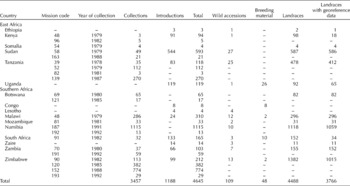
Passport information of the world collection of pearl millet germplasm conserved at the ICRISAT genebank was used in the present study. The collection includes 4645 accessions from 16 ESA countries. Biological status of the collection from ESA countries indicates 4488 landraces, 48 breeding materials, 109 wild species accessions belonging to 16 species of the genus Pennisetum (Table 1). Passport data of landraces from ESA countries, particularly for information on the precise location of the collecting site and corresponding geographic coordinates, were updated by referring back to all the related records, collection reports and catalogues. Using Microsoft Encarta®, an electronic atlas (MS Encarta® Interactive World Atlas, 2000), geographic coordinates were retrieved for landraces having location information. Accuracy of the coordinates was verified by plotting all accessions on the political map of each country. Landraces from Namibia (1059 accessions), Zimbabwe (1015 accessions), Sudan (586 accessions), Tanzania (412 accessions), Malawi (296 accessions), Zambia (152 accessions), Botswana (82 accessions), Uganda (65 accessions), South Africa (34 accessions), Mozambique (31 accessions) and Kenya (18 accessions) with latitude and longitude information were used in the present study to identify the gaps in collections from these countries. Landraces from Ethiopia (1 accession), Somalia (4 accessions) and Zaire (11 accessions) with georeference data were less in number and therefore not considered for identifying the gaps in these countries. The final set of 3750 landraces from 11 countries with geographic coordinates was used to identify the gaps in collections.
Pearl millet germplasm from East and Southern Africa assembled at the ICRISAT genebank, Patancheru, India

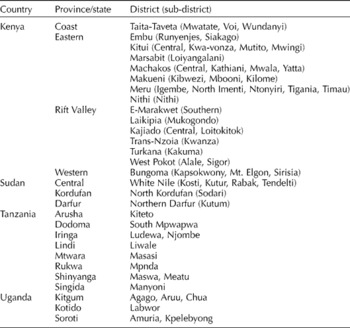
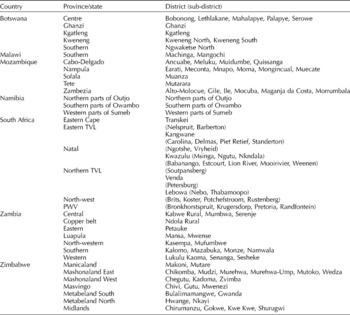
FloraMap, a Geographic Information Systems (GIS) tool developed at the Centro Internacional de Agricultura Tropical (Jones and Gladkov, Reference Jones and Gladkov1999), was used to predict the probability of pearl millet occurrence. Basic input in FloraMap software is the geographic coordinates (latitude and longitude) of collection sites with a unique identifier (accession number). The FloraMap system functions by calculating the probability of species occurrence. With its user-friendly software linked to a gridded agroclimatic database, one can create maps showing the most probable distribution of any particular species in nature. FloraMap provide climate data (monthly rainfall, minimum and maximum temperature, diurnal range in temperature) from the database to each of the collection sites, which fall in a grid cell. Principal component (PC) analysis was used to reduce the dimensionality of this 36 dimensional dataset (a set of 12 for each month of the three variables) for each collection site and to select the first few components, which contributed a maximum variation in climatic characteristics. Also, these few components were uncorrelated or orthogonal. Weights were allocated to each of the three variables depending on the climate of a country/region. A probability density function was calculated on these few uncorrelated variables to find out the probability of finding a similar location for the population. While working on the passport dataset, depending on the country, weights were allocated ranging from 0.70 to 1.5 for rainfall, from 0.75 to 1.50 for temperature and from 0.75 to 1.05 for diurnal temperature, and an exponential transformation with a power of 0.3 was applied to the monthly rainfall data. More than 95% of the total variation was explained by the first five PCs. To achieve a higher precision in predicting the probability of pearl millet occurrence, FloraMap was run for each country separately. While estimating the probability of pearl millet occurrence, multiple accessions with the same coordinates were treated as a single collection site. Collection sites or sampled sites were overlaid on the probability map of each country. Provinces/states (name 1) and districts/administrative units (name 2) and sub-districts (name 3) with a high probability (>75%) and with no collection and/or few collection sites were recorded as gaps. All districts and sub-districts identified (shaded area) as gaps along with the collection sites of already collected landraces are shown in Fig. 1 and Tables 2 and 3.
Geographical distribution and the gaps (districts/sub-districts shaded) identified in pearl millet germplasm from ESA countries.

Geographical gaps identified in pearl millet germplasm from East African countries, assembled at the ICRISAT genebank, Patancheru, India

Geographical gaps identified in pearl millet germplasm from Southern Africa, assembled at the ICRISAT genebank, Patancheru, India

Using the characterization data of pearl millet germplasm from ESA countries and DIVA-GIS, a GIS software, gaps in diversity were identified for days to 50% flowering, plant height, number of total and productive tillers, panicle length and width, 1000-seed weight, seed colour and green fodder yield potential (IBPGR and ICRISAT, 1993; Hijmans et al., Reference Hijmans Robert, Gaurino and Rojas2005). The accessions were evaluated in batches of 500–1000 during 1977–2010, at the ICRISAT, Patancheru, India (17°25′N latitude, 78°00′E longitude and 545 m.a.s.l.) in alfisols, in the rainy season (June–November) and the post-rainy season (December–March). Each accession was sown in two, 4-m-long rows with a spacing of 75 cm between the rows and 10 cm between the plants, accommodating about 80 plants in two rows. Life-saving irrigation was provided. Fertilizers were applied at the rate of 100 kg N/ha and 40 kg P2O5/ha. The crop was protected from weeds, pests and diseases. The rainy season at Patancheru is characterized by long (13.1 h in June to 11.4 h in November) and warm (mean minimum temperature: 20.8°C; mean maximum temperature: 30.6°C) days during the crop growth. In the post-rainy season, day length varies from 11.10 h in December to 12.00 h in March. The monthly mean minimum temperature varies from 12.9°C (in December) to 19.3°C (in March) and the mean maximum temperature varies from 27.9°C in December to 35.2°C in March. The mean annual rainfall at the Patancheru location was 908 mm. Observations on days to 50% flowering, plant height, total and productive tillers, panicle length and width and green fodder yield potential were recorded in the rainy season, whereas 1000-seed weight and seed colour were recorded in the post-rainy season.
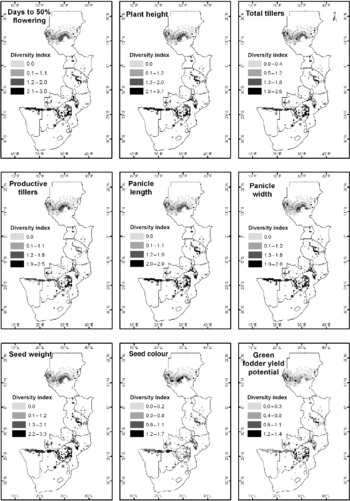
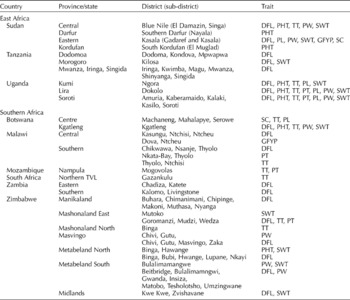
The basic input in DIVA-GIS software is the geographic coordinates (latitude and longitude) of the collecting site with a unique identifier (accession number). DIVA-GIS was run for each trait separately to assess the geographical distribution of diversity in ESA countries. Diversity grids were mapped using the Shannon–Weaver method (Shannon and Weaver, Reference Shannon and Weaver1949). Collection sites were overlaid on diversity grids in ESA countries. Districts and sub-districts with high diversity cells/grids with relatively few collection sites were identified as gaps in diversity for each trait and are shown in Fig. 2. Due to the large number of collection sites, the diversity maps for important traits do not depict the collection sites to avoid possible clutter. Country-wise gaps (districts and sub-districts) in diversity for the different traits are summarized in Table 4. The United States Geological Survey (USGS) land cover map for Africa was used to know the type of vegetation and land cover in the districts identified and excluded lakes, forests and other areas where crop cultivation is not known (USGS EROS Center, 2005).
High diversity areas (grids) for the different traits of pearl millet landraces from ESA countries.

Gaps (districts/sub-districts) identified in diversity for the different traits of pearl millet germplasm from East and Southern Africa, assembled at the ICRISAT genebank, Patancheru, India

DFL, days to 50% flowering; PHT, plant height; TT, total tillers; PW, panicle width; SWT, 1000-seed weight; PL, panicle length; GFYP, green fodder yield potential; SC, seed colour; PT, productive tillers.
Results
Germplasm assembly
The analysis of the passport data from the world collection of pearl millet germplasm revealed that a total of 4645 accessions were assembled from 16 ESA countries including Zimbabwe (1397 accessions), Namibia (1128 accessions), Sudan (614 accessions), Tanzania (503 accessions), Malawi (310 accessions), South Africa (165 accessions), Zambia (162 accessions), Uganda (119 accessions), Kenya (99 accessions), Botswana (82 accessions), Mozambique (33 accessions), Zaire (14 accessions), Congo (8 accessions), Lesotho (4 accessions), Somalia (4 accessions) and Ethiopia (3 accessions) (Table 1). Germplasm originating from the ESA countries was assembled by introducing already collected germplasm from various organizations located in different countries and by launching systematic germplasm collection missions in ESA countries in partnership with national and international institutes, National Agricultural Systems (NARS), universities and Non-Governmental Organisations (NGOs).
Germplasm introduced
A total of 16 organizations located in 14 countries donated 1188 accessions originating from 12 ESA countries. Among these organizations, the following were the major donors of pearl millet germplasm donating more than 50 accessions to the ICRISAT genebank: Ministry of Agriculture, Sudan (482 accessions); International Board for Plant Genetic Resources (IBPGR, now called Bioversity International), Rome, Italy (226 accessions); Rockefeller Foundation, New Delhi, India (122 accessions); Ministry of Agriculture, Zanzibar, Tanzania (67 accessions); Ministry of Agricultural and Water Development, Lusaka, Zambia (56 accessions); Ministry of Agriculture, Harare Research Station, Harare, Zimbabwe (55 accessions); and ARS Plant Introduction Laboratory, USDA, Griffin, USA (51 accessions). The nine other organizations located in nine countries (France, Kenya, Malawi, Niger, Singapore, South Africa, Uganda, the USA, Zimbabwe) donated less than 40 accessions. Among the introductions, Sudan was the origin for a maximum of 544 landraces followed by South Africa for 133 landraces and Uganda for 119 landraces. All the other ESA countries were found to be the source for less than 100 landraces (Table 1). All accessions from Ethiopia (3), Uganda (119), Congo (8), Lesotho (4) and Zaire (14) are introductions in the ICRISAT genebank.
Germplasm collected
The ICRISAT in partnership, mostly with the IBPGR (now Bioversity International), NARS, networks and universities, identified priority areas and launched 216 collection missions in 62 countries for all its mandate crops, and collected 33,373 seed samples including 10,830 pearl millet germplasm samples during 76 collection missions in 28 countries. During 1978–92, the ICRISAT and its partners had launched 21 collection missions in 11 ESA countries (five in East Africa and 16 in Southern Africa) and collected a total of 3457 samples (Table 1). Four germplasm collection missions each in Tanzania and Zimbabwe were launched between 1978 and 1992. Maximum samples were collected in Zimbabwe (1298 accessions) followed by Namibia (1128 accessions) and Tanzania (420 accessions).
The ICRISAT had collaboration with 20 organizations in ESA countries for collecting pearl millet germplasm. Important collaborators in East Africa include: FAO and National Dryland Farming Research Station, Katumani in Kenya (Remanandan et al., Reference Remanandan, Shakoor and Ngugi1982); IBPGR, Italy, Ministry of Agriculture, Sudan and Institut Francais de Recherche Scientifique pour le Développement en Coopération (ORSTOM), Paris in Sudan; and FAO and Agricultural Research Station, Bonka/Central in Somalia (Ramanatha Rao, Reference Ramanatha Rao1979); and IBPGR, Italy, University of Dar es Salaam, Tanzania, IITA/USAID, Dar es Salaam, Ministry of Agriculture, Zanzibar, Tanzania and Tanzanian Agricultural Research Institute, Ilonga, in Tanzania (Prasada Rao and Mengesha, Reference Prasada Rao and Mengesha1979).
In Southern Africa, important organizations collaborated with the ICRISAT for collecting pearl millet germplasm are as follows: Directorate of Agricultural Research, Gaborone in Botswana (Prasada Rao, Reference Prasada Rao1980); IBPGR, Italy and Ministry of Agriculture and Natural Resources in Malawi (Appa Rao, Reference Appa Rao1979); IBPGR, Italy and University of Eduard Mondlane, Maputo in Mozambique (Ramanatha Rao, Reference Ramanatha Rao1981); Ministry of Agriculture Water and Rural Development Community (SADC) regional genebank, Lusaka, Zambia in Namibia (Appa Rao et al., Reference Appa Rao, Monyo, House, Mengesha and Negumbo1991); Grain Crops Research Institute, Potchefstroom in South Africa (Van der Maesen, Reference Van der Maesen1982); IBPGR, Italy, Ministry of Agricultural and Water Development and SADC regional genebank, Lusaka in Zambia; and IBPGR/FAO, Italy, Ministry of Agriculture, Harare and SADC regional genebank, Lusaka, Zambia in Zimbabwe.
Among the provinces in different countries, the following are the important source regions for pearl millet germplasm: Kavango (430 accessions), Owambo (374 accessions) and Caprivi (188 accessions) in Namibia; Southern (186 accessions) in Malawi; Kordufan (257 accessions) and Darfur (229 accessions) in Sudan; Dodoma (147 accessions) and Singida (130 accessions) in Tanzania; and Metabeland North (364 accessions), Metabeland South (185 accessions), Manicaland (158 accessions) and Masvingo (103 accessions) in Zimbabwe. Among the named landraces, the following are important in the collection from ESA countries: Uwele (80 accessions) from Tanzania; Dukhun (10 accessions) from Sudan; Halale (28 accessions) and Sifumbata (26 accessions) from Zimbabwe; Mexioera (14 accessions) from Mozambique; and Raa (12 accessions) from Uganda.
Biological status of collection
The biological status of the entire pearl millet collection at the ICRISAT genebank revealed 19,063 landraces, 2269 breeding materials, 129 improved cultivars and 750 accessions of 24 wild species. The collection from ESA countries revealed a total of 4488 landraces, 48 breeding materials and 109 wild species accessions belonging to 16 species of the genus Pennisetum. The landraces were from Zimbabwe (1382 accessions), Namibia (1118 accessions), Sudan (587 accessions), Tanzania (478 accessions), Malawi (296 accessions), Zambia (155 accessions), South Africa (152 accessions), Kenya (98 accessions), Uganda (92 accessions), Botswana (82 accessions), Mozambique (31 accessions), Zaire (11 accessions), Somalia (4 accessions) and Ethiopia (2 accessions). All accessions from Congo were breeding materials and those from Lesotho were wild relatives of pearl millet.
Wild relatives
A total of 109 accessions belonging to 16 species of the genus Pennisetum were assembled from the ESA countries including 34 introductions and 75 collections from 13 countries. The wild species assembled from the ESA countries include P. polystachion (39 accessions), P. violaceum (18 accessions), P. purpureum (12 accessions), P. ciliare (8 accessions), P. setaceum (7 accessions), P. mollissimum (6 accessions), P. cenchroides (4 accessions), P. schweinfurthii (3 accessions), P. thunburgii (3 accessions), P. mezianum (2 accessions), P. ramosum (2 accessions), P. lanatum (1 accession), P. orientale (1 accession), P. pedicellatum (1 accession), P. squamulatum (1 accession) and P. villosum (1 accession). A maximum of seven species were assembled from Tanzania followed by six species from Zimbabwe, four species each from Namibia and Sudan and two species each from Lesotho and South Africa. Overall, seven countries represented with one species each. The maximum wild accessions are from Sudan (27) followed by Tanzania (25). All the other countries were found to be the source for less than 15 accessions. The important source provinces for wild relative germplasm are as follows: Darfur province (22 accessions) in Sudan; Mashonaland central (7 accessions) in Zimbabwe; and Tabora (7 accessions), Morogora (6 accessions), and Shinyanga (6 accessions) in Tanzania. Of the 88 accessions of P. palystachion, a source of immunity against downy mildew, assembled at the ICRISAT genebank, 39 are from the ESA countries, and Malawi (12 accessions) and Tanzania (13 accessions) are the major sources. Sudan with 16 accessions of P. violaceum, the progenitor of pearl millet and a source for the new cytoplasm, was found to be the important source country for this species.
Intensity of collection
Since multiple accessions having the same coordinates are considered as a single collection site, the number of actual geographical sites with an area of 18 × 18 km2 in the present study is less than the number of the sampled sites. Accessions having georeference data represent a total of 884 geographical sites of germplasm collection in Kenya (10), Sudan (323), Tanzania (99), Uganda (11), Botswana (19), Malawi (78), Mozambique (10), Namibia (90), South Africa (15), Zambia (86) and Zimbabwe (143). The average number of samples per collection site was 4.3 in the entire collection from East and Southern Africa. The average number of samples per collection site was 12 in Namibia, 7 in Zimbabwe, 6 in Uganda, 4 in Botswana, Malawi and Tanzania, 3 in Mozambique and 2 in Kenya, Sudan and South Africa, indicating the intensity of germplasm collection in these countries.
Geographical gaps
A high probability (>75%) area with less and/or no collection (districts and sub-districts) identified in the present study showed 34 districts and 40 sub-districts located in 18 provinces of four East African countries as major geographical gaps (Fig. 1 and Table 2). Maximum districts (15) and sub-districts (34) belonging to Coast, Eastern, Rift Valley and Western provinces were identified as gaps in Kenya. Rift Valley and Western provinces in Kenya, Shinyanga, Lindi, Mtwara and Rukwa in Tanzania and Kotido in Uganda were not explored during the past collection missions launched by the ICRISAT. A total of 76 districts and 27 sub-districts located in 34 provinces of seven Southern African countries were identified as important geographical gaps in pearl millet collection from Southern Africa. Ghanzi in Botswana, Sofala and Tete in Mozambique, Eastern TVL and PWV in South Africa and Copper belt in Zambia are the provinces found unexplored in the past for pearl millet germplasm (Fig. 1 and Table 3).
Gaps in diversity
Eleven districts and six sub-districts located in seven provinces of Sudan (4) Tangania (5) and Uganda (3) were found as gaps in diversity for almost all traits under study. On the other hand, 58 districts located in 20 provinces of seven Southern African countries were identified as gaps in diversity for one or the other trait (Fig. 2 and Table 4). A maximum of 19 provinces represented as gaps in diversity for days to 50% flowering followed by 11 provinces each for total tillers and seed weight, eight provinces each for plant height and panicle width, five provinces each for panicle length and productive tillers and two provinces each for seed colour and green fodder yield potential (Fig. 2 and Table 4). The following districts were identified as gaps common to geographic area and diversity for one or more traits: Amuria district in Soroti province in Uganda; Mpwapwa in Dodoma province of Tanzania; Mahalapye in Centre province and Kgatleng in Kgatleng province in Botswana; Lalomo in Southern province in Zambia and Motoko, Mudzi and Wedza in Mashonaland; East, Makoni in Manikaland; Gutu and Chivi in Masvingo; Gwanda and Bulalimamangwe in Metabeland south; Hwange and Nkayi in Metabeland north; and Kwe Kwe in Midlands of Zimbabwe.
Discussion
In view of climate change resulting in the loss of biodiversity, there is a need to analyse the existing collections, identify gaps in the collections and collect as much variability as possible before it is eroded forever. The GIS has facilitated a better understanding of species distribution and the representation of collections and gaps in collections. The success of gap analysis depends on the quality of input data. In many genebanks, most of the older germplasm collections do not have complete passport information, particularly the georeference data (latitude and longitude) of the collecting sites, posing a problem in assessing the geographical completeness of collections (Upadhyaya et al., Reference Upadhyaya, Reddy, Irshad Ahmed and Gowda2010). The geographical gaps identified using predicted probability layers developed with the help of FloraMap, and the gaps identified in diversity using DIVA-GIS will provide valuable information (Marilia et al., Reference Marilia, Celia, Jaime, Palhares de Melo, Rosa de Belem das and Tabare2003; Upadhyaya et al., 2010). With ESA being the secondary centre of diversity for pearl millet, the gaps (districts/sub-districts) identified can be considered as the potential areas for exploration (Harlan et al., Reference Harlan, de Wet and Stemler1975). Some of the districts/sub-districts identified in this study were also explored partly in the past, but require further exploration.
Based on studies using pearl millet germplasm conserved at the ICRISAT genebank, Rai et al. (Reference Rai, Appa Rao and Reddy1997) reported that the landraces from Kenya and Uganda for high productive tillers, those from Botswana for early maturity and those from Namibia, South Africa, Tanzania and Zimbabwe for long and thick panicles are considered as promising sources, suggesting the exploration of gaps identified in these countries to increase the variability for these traits. Halale, a known landrace collected around the Lupane village (240 km north-west of Bulawayo) in Zimbabwe, was the source material in developing a pearl millet variety, Okoa (TSPM 91,018), released for general cultivation in Tanzania in 1994 (Obilana et al., Reference Obilana, Monyo and Gupta1997). So, the areas around the Lupane village may also be considered for collecting germplasm. Ramanatha Rao (Reference Ramanatha Rao1981) reported the predominance of pearl millet cultivation in Gaza, Inhambane and Tete provinces, which were not explored in the past in Mozambique. Pearl millet is believed to house greater genetic diversity in Eretria and Ethiopia. Therefore, it is suggested that greater representation should be from these countries to capture the allelic variation for important agronomic traits.
Crop wild relatives are important components of agroecosystems as potential gene contributors to breeding programmes. When the levels of resistance to various biotic and abiotic stresses in cultivated germplasm are low or the range of genetic variability is narrow and selection pressure results in virulent biotypes of pests and diseases, the discovery and incorporation of additional genes for resistance from wild species becomes key to sustain crop productivity. Similar to other genebanks in different countries, the ICRISAT had launched a few collection missions exclusively for wild relatives of pearl millet and conserves only a fraction of total genetic variability that exists in wild relatives (Jarvis et al., Reference Jarvis, Lane and Hijmans Robert2008; Upadhyaya et al., 2010). Wild species are more important when they possess resistance to biotic and/or abiotic stresses in addition to traits of agronomic importance. For example, P. polystachion is a high tillering grass of short duration and fits well in the small period left in between two arable crops and also considered as an important source for higher levels of downy mildew (Sclerospora graminicola (Sacc.) J. Schröt) resistance. Singh and Navi (Reference Singh and Navi2000) screened 68 accessions of P. polystachion for resistance to downy mildew at the ICRISAT, Patancheru, India, and reported 66 accessions including those from ESA countries to be completely free from the disease. In the present study, of the 109 wild accessions from ESA countries, 39 were P. polystachion, indicating ESA countries to be a good source region. Out of more than 140 species reported in the genus Pennisetum, only 16 species were assembled from ESA countries. Being the secondary centre of diversity for pearl millet, ESA could also be a good source for many other Pennisetum species (Clayton, Reference Clayton1972). Therefore, there is a need to launch collection missions in ESA countries exclusively for Pennisetum species to fill the taxonomic gaps. Remanandan and Mengesha (1981) reported the abundance of P. palystachion in the Ruvuma region of Tanzania. Appa Rao (Reference Appa Rao1979) reported that P. purpureum, the Napier grass, is widely distributed throughout lower Shire Valley, Shire highlands, Phalombo plains, Manaochi and Salima regions in Malawi, and most commonly found on the river banks, road sides and black fertile soils and stands out among other grasses. Ramanatha Rao (Reference Ramanatha Rao1981) reported the occurrence of P. polystachion and P. purpureum in Mozambique. Appa Rao et al. (Reference Appa Rao, Monyo, House, Mengesha and Negumbo1991) reported the occurrence of P. purpureum, P. polystachion, P. orientale, P. foermeranum, P. setaceum and C. ciliaris in Namibia.
In view of changing cropping patterns, habitat loss, food habits, etc., in different parts of ESA, it is suggested that the area for exploration in the districts/sub-districts identified in the present study should be decided prior to the launch of the collection mission in consultation with local government officials, NARS scientists, extension officers and non-governmental organizations, who will have the knowledge about the extent of pearl millet cultivation in the districts. It is also suggested that the exploration team leader should review all reports and publications of past collections and high diversity areas, to prepare collection plans for districts/sub-districts (gaps) identified in this study and collect complete information including georeference data while collecting germplasm. The gaps identified in the present study may be prioritized depending on the threat to the diversity. Remanandan and Mengesha (1981) reported that the main land in Tanzania has been adequately covered and fairly represented in pearl millet collection and the island of Zanzibar needs to be considered for collection in future.
Climate change and variability are among the most important challenges that are being faced by many developing countries because of their strong economic reliance on natural resources and rain-fed agriculture (FAO, 2007). A wide variation in latitude (from − 33.00°S in South Africa to 16.23°E in Sudan) and longitude (from 13.50°E in Namibia to 44.08° in Somalia) of collection sites indicates that the landraces from ESA countries are from diverse climates and can adapt to changing climate. Therefore, it is suggested to increase the variability in adaptive traits by filling gaps in the pearl millet collection from ESA countries. A successful germplasm collection mission largely depends on advanced planning and careful organization. Well-planned missions are less likely to fail even if it faces sudden and unforeseen difficulties. The success of a mission can be ensured if it can be planned and implemented jointly between the international institutes and national organizations.
Acknowledgements
We sincerely acknowledge the contribution of all former and present staff of Genetic Resources Unit (GRU), ICRISAT to the collection, assembly and conservation of pearl millet genetic resources. We also highly appreciate D. Bapa Rao, G. Ram Reddy and G. Dasaratha Rao, Senior Research Technicians, Genetic Resources Unit, for their help in processing and documentation of the data for this study.