1. Introduction
One of the central questions in research on second-language (L2) acquisition is whether it is possible for late L2 learners to reach native-like ultimate attainment in the L2. Early studies addressed this question by investigating whether L2 speakers could reach native-speaker performance in general L2 proficiency (e.g. Scovel, Reference Scovel1988; Johnson and Newport, Reference Johnson and Newport1989; DeKeyser, Reference DeKeyser2000; Birdsong and Molis, Reference Birdsong and Molis2001), yielding mixed results. Some studies report that late L2 learners do not fall within the range of native performance (e.g. Johnson and Newport, Reference Johnson and Newport1989; DeKeyser, Reference DeKeyser2000), whereas others find at least a subset of late L2 learners scoring within the native range (e.g. McDonald, Reference McDonald2000; Birdsong and Molis, Reference Birdsong and Molis2001). The inconclusive results may arise because these studies do not systematically consider how L2 performance differs across particular grammatical phenomena and to what extent it depends on the L1 of the L2 learner.
Recent generative research on L2 ultimate attainment has attempted to identify (a) the grammatical domains in which interlanguage (IL) grammars are particularly prone to persistent non-convergence, and (b) whether the L1 affects the extent of native-likeness attainable by L2 learners. The general picture that emerges from these studies is that there is a disjunction between convergence in target-language (TL) syntax, on the one hand, and protracted problems at the interfaces of syntax with inflectional morphology and with discourse, on the other. Whereas near-native L2 speakers of different L1 backgrounds demonstrate target knowledge of the TL syntax (e.g. van Boxtel, Reference van Boxtel2005; White and Genesee, Reference White and Genesee1996), only L2 learners whose L1 matches the TL in the realization of grammatical features perform within the native-speaker range on inflectional morphology, e.g. gender (Franceschina, Reference Franceschina2005), and on discourse-driven word order optionality, e.g. focus constraints on postverbal subjects in Italian (e.g. Sorace and Filiaci, Reference Sorace and Filiaci2006; Belletti, Bennati and Sorace, Reference Belletti, Bennati and Sorace2007). In contrast, L2 speakers of L1s which do not correspond to the TL fail to perform to criterion at the interfaces of syntax and morphology and syntax and discourse. These studies suggest that the L1 constrains L2 ultimate attainment in that native-likeness on these aspects of the TL is possible only for L2 learners whose L1 matches the TL in the relevant grammatical properties.
In consequence, several approaches to L2 acquisition argue that L1–TL correspondence in the realization of morphosyntactic features (e.g. Hawkins and Chan, Reference Hawkins and Chan1997; Tsimpli, Reference Tsimpli2003) or discourse-to-syntax mappings (e.g. Sorace, Reference Sorace2003) are a prerequisite for convergence. These approaches highlight representational deficits in submodules of interlanguage (IL) grammars as the cause of protracted non-convergence at the interfaces. In the following, I refer to this family of approaches as representational deficit approaches.
In contrast, computational approaches point to L2 processing difficulties in handling multiple types of grammatical information in real time as the cause of non-convergence at the interfaces. For instance, Sorace (Reference Sorace, Cornips and Corrigan2005) suggests that problems at the syntax–discourse interface may follow from processing complexity: Identifying the discourse-relatedness of syntax is inherently more complex than computing syntax on its own. For the syntax–morphology interface, Prévost and White (Reference Prévost and White2000), in their Missing Surface Inflection Hypothesis, similarly argue that problems in the suppliance of target inflection among adult L2 speakers are due to the computational effort required in lexical access to inflectional forms and the mapping of forms onto syntactic functions (see also Haznedar and Schwartz, Reference Haznedar, Schwartz, Hughes, Hughes and Greenhill1997). Common to these approaches is the idea that non-convergence in L2 production and L2 comprehension is owing to processing load of computing interface mappings, i.e. using and integrating multiple information types on-line.
In this vein, the nascent field of L2 processing research has documented differences in real-time (on-line) sentence processing between advanced L2 speakers and native speakers. On the assumption that the processor recruits grammatical knowledge in real-time comprehension (transparency) in addition to mechanisms specific to processing, research explores how and whether grammatical knowledge is used in L2 processing system and whether the same processing mechanisms operate in the L2 as in native processing (e.g. Clahsen and Felser, Reference Clahsen and Felser2006; Desmet and Duyck, Reference Desmet and Duyck2007). Several studies suggest that L2 sentence comprehension might differ from native processing due to a shortage of computational resources for integrating different types of grammatical information on-line (e.g. Hahne, Reference Hahne2001; Hopp, Reference Hopp2006; McDonald, Reference McDonald2006) rather than due to fundamentally different linguistic representations or processing mechanisms in L2 parsing (e.g. Clahsen and Felser, Reference Clahsen and Felser2006). These studies indicate that computational difficulties in L2 processing of grammar cause L2 ultimate attainment to fall short of native-likeness, even though the grammatical representations and processing mechanisms of L2 learners may be fully native-like.
The present paper aims to test representational deficit and computational difficulty approaches. To this end, I report a study on knowledge and processing at the syntax–discourse interface in advanced-to-near-native L2 acquisition. Different L1 groups are tested in off-line and on-line comprehension. Specifically, the paper focusses on the acquisition of German scrambling by L1 English, L1 Dutch and L1 Russian advanced-to-near-native L2 learners. The first languages of the participants demonstrate systematic differences: English does not have scrambling and its associated discourse effects at all. Dutch allows scrambling, yet the particular type of scrambling under consideration has different discourse effects, and Russian has scrambling options and discourse effects analogous to German. These systematic L1 differences, first, allow for differentiating general L2 effects from L1 effects, and, second, make it possible to identify the particular L1–TL relations that present difficulties at L2 ultimate attainment. Moreover, comparisons between off-line judgements and on-line reading performance allow us to establish whether these problems are in grammatical knowledge and/or in on-line grammatical processing.
This paper is structured as follows: In section 2, I summarize previous research on the syntax–discourse interface in adult L2 acquisition. Section 3 describes the specifics of German scrambling in grammar and processing. Section 4 presents the research questions and hypotheses. The participants and the two experiments are reported in Section 5. Section 6 discusses the findings from both experiments and puts them into the perspective of previous research, and section 7 offers a brief conclusion.
2. The syntax–discourse interface in advanced L2 acquisition: off-line and on-line studies
The discourse-relatedness of syntax is typically encoded in terms of the information-structural status of constituents, e.g. topic–focus or theme–rheme structure. At the syntax–discourse interface, these information-structural notions impose constraints on syntax by restricting distributional options to particular discourse interpretations. An example is provided by null-subject languages, e.g. Italian and Spanish, where subjects can be covertly or overtly realized. Overt subjects can optionally surface in preverbal and in postverbal position for all verbs (Burzio, Reference Burzio1986); however, the syntactic base order varies according to verb type. Unaccusatives (e.g. “fall”) project a VS base order, as in (1), while unergative verbs (e.g. “run”) project an underlying SV order (see below). At the syntax–discourse interface, overt subjects in preverbal position are canonically interpreted as given information, denoting topics, whereas postverbal subjects receive focus, expressing new information (e.g. Belletti, Reference Belletti, Hulk and Pollock2001).
(1)

“The boy fell down.”
(adapted from Belletti et al., Reference Belletti, Bennati and Sorace2007, p. 7)

In addition, the selection of overt versus covert pronominal subjects is governed by discourse constraints. Covert anaphoric pronouns preferentially take the intrasentential subject or topic as their antecedents (e.g. Carminati, Reference Carminati2005), whereas overt pronouns preferentially resolve to extrasentential antecedents, hence indicating contrast or topic shift (2).
(2)
“The mother kisses her daughter, while she/pro is wearing her coat.”
(adapted from Sorace and Filiaci, Reference Sorace and Filiaci2006, p. 352)
These discourse conditions on the ordering of subjects and the anaphoric reference of subjects in null-subject languages have been found to present difficulty in different bilingual contexts, i.e. bilingual L1 acquisition (Müller and Hulk, Reference Müller and Hulk2001; Serratrice, Sorace and Paoli, Reference Sorace2003), L1 attrition (Gürel, Reference Gürel2004; Montrul, Reference Montrul2004; Tsimpli, Sorace, Heycock, Filiaci and Bouba, Reference Tsimpli, Sorace, Heycock, Filiaci, Bouba, Beachley, Brown and Conlin2003) and adult L2 acquisition, which are summarized next.
For L2 acquisition, Hertel (Reference Hertel2003) reports that lower-level intermediate English learners of Spanish differentiate between unaccusatives and unergatives in that they prefer the VS order in (1a) over SV in (1b) for unaccusatives, yet SV over VS for unergatives in written production tasks. However, they do not robustly establish a connection between focus and VS orders, because acceptance rates do not rise for VS orders with unergatives when the subject is new information, i.e. in focus, as in (1). Similarly, Lozano (Reference Lozano2006, Reference Lozano, Snape, Leung and Smith2009) finds in a contextualized judgement task that advanced L1 Greek and English learners of Spanish appropriately differentiate VS orders according to verb class but not according to focus (see also Belletti and Leonini, Reference Belletti, Leonini, Foster-Cohen, Sharwood Smith, Sorace and Ota2004, for French and German learners of Italian).
At the near-native level, Belletti et al. (Reference Belletti, Bennati and Sorace2007) report a series of experiments with 17 English near-native speakers of Italian, who are pre-screened for native-likeness. A spontaneous production task and two elicitation experiments test the contingency between word order and focus. In spontaneous production, there are no differences between near-natives and native controls in the production of null subjects (52% vs. 59%) or postverbal subjects (16% vs. 15%), which suggests that near-natives have come to acquire the syntactic expressions of subjecthood in null-subject languages. In elicited production, however, the near-natives produce significantly fewer postverbal subjects compared to the native controls. In particular, they do not exhibit a native-like preference for postverbal subjects to denote new, focussed discourse information. Belletti et al. (Reference Belletti, Bennati and Sorace2007) attribute the attested dissociation between target-like syntactic knowledge of postverbal subjects and failure to identify the discourse conditions of their use to residual effects of L1 discourse strategies (see also Valenzuela, Reference Valenzuela, Slabakova, Montrul and Prévost2006). They suggest that the canonical English SV order predominates in the L2 giving rise to SV orders in L2 Italian, irrespective of discourse contexts.
Other research reports that near-native L2 learners overuse overt pronouns in null-subject languages like Italian (Bini, Reference Bini and Liceras1993; Sorace and Filiaci, 2004). Moreover, in a truth-value judgement task, Sorace and Filiaci (Reference Sorace and Filiaci2006) find that near-native L1 English speakers of Italian allow overt pronouns to corefer to intrasentential topics (subjects) while native speakers prefer extrasentential non-topical referents. Near-native L2 learners thus appear to employ different pronoun resolution strategies in discourse compared to native speakers.
In the only cross-linguistic study to date on advanced, though not near-native, L2 speakers’ preferences in pronoun interpretation, Roberts, Gullberg and Indefrey (Reference Roberts, Gullberg and Indefrey2008) test intermediate-to-advanced learners of Dutch, a non-null-subject language, with a null-subject L1, Turkish, or with a non-null-subject L1, German. As discussed above, overt pronouns in null-subject languages are preferentially resolved to sentence-external referents, while null subjects are preferentially interpreted as coreferential with a sentence-internal subject/topic. In non-null-subject languages, however, overt pronouns are biassed towards a sentence-internal subject/topic antecedent, if available (Grosz, Joshi and Weinstein, Reference Grosz, Joshi and Weinstein1995; Järvikivi, van Gompel, Hyönä and Bertram, Reference Järvikivi, van Gompel, Hyönä and Bertram2005). Roberts et al. (Reference Roberts, Gullberg and Indefrey2008) designed three conditions, which offer different resolution possibilities for pronouns. The Local Resolution condition in (3a) and the Optional Resolution condition in (3c) offer sentence-internal antecedents for the personal pronoun “he”. In addition, (3c) also makes a sentence-external antecedent (“Hans”) optionally available. (3b) forces resolution of the pronoun to a sentence-external antecedent by virtue of number marking.
- (3)
a.
The workers are in the office. While Peter is working, he is eating a sandwich. It is a quiet day.
(LocalResolution)b.
The workers are in the office. While Peter is working, they are eating a sandwich. It is a quiet day.
(DisjointResolution)c.
Peter and Hans are in the office. While Peter is working, he is eating a sandwich. It is a quiet day.
(OptionalResolution)
Both the native Dutch and the L1 German participants are predicted to find (3a) and (3c) easiest to read and interpret, since the preceding sentence-internal subject Peter, forming the discourse topic, strongly biases pronoun resolution to the referent “Peter”. In contrast, (3b) is expected to present more difficulty, since the plural pronoun cannot be resolved to the sentence-internal subject/topic; rather, it needs to be interpreted as referring to the sentence-external plural referent “the workers”. In contrast, if L1 resolution preferences inform L2 pronoun interpretation, the L1 Turkish participants should favor the Disjoint condition (3b) over the Local condition (3a), in line with the extrasentential antecedent preference for overt subjects in null-subject languages.
All participants completed a comprehension task, an acceptability judgement task, and an eyetracking experiment. The off-line results from the acceptability judgement task show that all groups favor (3a) and (3c) over (3b). In the comprehension task, participants have to explicitly resolve the pronoun by completing the sentence A sandwich is eaten by ____. Here, L1 differences emerge for (3c): Only the native Dutch and the L1 German groups overwhelmingly resolve the pronoun to the sentence-internal subject in (3c). The L1 Turkish group chooses the sentence-internal subject only about half of the time in (3c), with 11 out of the 14 L1 Turkish participants opting for the sentence-external referent at least once in six trials. In off-line interpretation, then, the same preference is observed for sentence-internal antecedents when only sentence-internal referents are available (see also Diaconescu and Goodluck, Reference Diaconescu and Goodluck2004); yet, when a sentence-external referent is available, L1 Turkish speakers optionally resolve an ambiguous pronoun to a sentence-external referent, in line with their L1.
Interestingly, these L1-modulated interpretation preferences do not translate into on-line processing. In the eyetracking experiment on the sentence types in (3), native Dutch readers show lower fixation times on the pronoun in the Optional condition compared to the Local and Disjoint conditions. In contrast, both L2 groups demonstrated the inverse pattern, i.e. longer pronoun fixation times in the Optional condition vis à vis the other two conditions. Roberts et al. (Reference Roberts, Gullberg and Indefrey2008) argue that the syntactic ambiguity of the pronoun in the Optional condition likely causes processing difficulty for L2 learners, who experience difficulties integrating syntactic and discourse information to resolve the pronoun as efficiently as native speakers.
This interpretation ties in with other L2 processing studies reporting that even advanced-to-near-native L2 speakers have trouble integrating different types of grammatical information in real time (e.g. Kilborn, Reference Kilborn and Harris1992; Hahne, Reference Hahne2001; Hopp, Reference Hopp2006). Similarly, McDonald (Reference McDonald2006) claims that shortages in L2 processing capacity, e.g. in working memory, lexical decoding ability and speed, may in part underlie non-convergence even in off-line judgements. At advanced proficiency levels, these difficulties likely reflect general processing effects in the L2. The L2 invokes a higher cognitive load than the L1, since the degree of automaticity in comprehending the L2 at intermediate-to-advanced L2 proficiency levels falls short of L1 efficiency due to both comparatively less practice in processing the L2 and the effort devoted to the continuous suppression of the L1 in L2 processing. (Segalowitz, Reference Segalowitz2003; Cutler, Weber, Smits and Cooper, Reference Cutler, Weber, Smits and Cooper2004; Segalowitz and Hulstijn, Reference Segalowitz, Hulstijn, Kroll and de Groot2005; Birdsong, Reference Birdsong2006; McDonald, Reference McDonald2006). From this perspective, L1 differences in off-line tasks may not surface in L2 processing of morphosyntax Felser, Roberts, Marinis and Gross, Reference Felser, Roberts, Marinis and Gross2003; (Papadopoulou and Clahsen, Reference Papadopoulou and Clahsen2003; Marinis, Roberts, Felser and Clahsen, Reference Marinis, Roberts, Felser and Clahsen2005) because the general demands of L2 processing render the activation of L1-modulated grammatical representations in real-time comprehension impossible. Yet other L2 processing studies, however, do find L1 effects on the L2 processing of morphosyntax (see Frenck-Mestre, Reference Frenck-Mestre, Heredia and Altarriba2002; Hopp, Reference Hopp2006), suggesting that some L1 properties inform L2 processing.
In sum, in off-line judgements on discourse-related syntax, advanced and near-native adult L2 learners demonstrate L1 effects: Where L1 and the TL show analogous syntax-to-discourse mappings, L2 learners converge on native interpretations, while L1–TL differences in syntax-to-discourse mappings lead to non-convergence (Sorace and Filiaci, Reference Sorace and Filiaci2006; Belletti et al., Reference Belletti, Bennati and Sorace2007; Roberts et al., Reference Roberts, Gullberg and Indefrey2008). In on-line L2 processing, however, the Roberts et al. (Reference Roberts, Gullberg and Indefrey2008) study suggests that L1 effects may not surface because of reduced general processing efficiency in the L2.
Since these findings, like all research on L2 processing so far, come from non-endstate advanced L2 speakers, it is not clear, though, whether this null finding of L1 effects and the concomitant failure of L2 learners across L1s to converge on native performance are due to general insurmountable problems with information integration in the L2 or just an effect of proficiency. On top of L1 differences, it is hence important to consider the role of proficiency in the L2 processing of discourse information. To this end, the present study tests advanced as well as near-native endstate L2 learners of German of different L1s in order to be able to consider effects of proficiency in conjunction with L1 effects in off-line and on-line performance.
3. Scrambling in German: grammar and processing
3.1 Grammar
German has several types of discourse-driven syntactic phenomena. In addition to sentence-initial topicalization, German, an SOV language, as illustrated in (4a) below, allows objects to precede subjects in non-sentence-initial positions, in the so-called “Midfield”. Such object reordering is referred to as scrambling. In (4b), the scrambled object–subject (OS) order in the embedded clause is derived by fronting the object across the subject (e.g. Grewendorf and Sabel, Reference Grewendorf and Sabel1999; Haider and Rosengren, Reference Haider and Rosengren2003). In most sentences, morphological case marking on the definite determiners disambiguates syntactic order, e.g. in (4b) the accusative determiner den signals that the first embedded NP is the syntactic object of the clause.Footnote 1
(4)
However, syntactic reordering by scrambling is not completely optional. Scrambling is limited to certain discourse contexts, namely, those in which the scrambled (object) NP is defocussed and the preverbal subject carries focus (e.g. Lenerz, Reference Lenerz1977; Höhle, Reference Höhle and Abraham1982). Such focus assignment corresponds to an information structure (IS) where the scrambled NP denotes given information and the subject is new. In all other contexts, scrambling is distinctly marked. This is illustrated in (5) and (6), where the wh-word in the question targets the informationally new, focussed constituent in the answer. Focus is marked by capitalization and markedness again by “#”. In the “SUBJECT-Focus” context (5), where the subject is new and hence in focus, scrambling is felicitous, while the IS of the “OBJECT-Focus” context (6) is infelicitous for scrambling, because the scrambled object is new, hence bearing focus.
(5)
(6)
In other words, scrambling serves the discourse function of moving (given) constituents out of sentential focus to allow other constituents to bear focus (Neeleman and Reinhart, Reference Neeleman, Reinhart, Butt and Geuder1998). This can be seen in that scrambled OS orders have higher acceptability ratings (Keller, Reference Keller, Gleitman and Joshi2000) and lower processing costs if the scrambled item is defocused (IS–syntax match). In contrast, an infelicitous context such as (6) induces a mismatch in the IS between the context question and the answer (IS–syntax mismatch).
There are cross-linguistic differences in the syntax of scrambling and its association with IS. The morphosyntax and IS of Russian scrambling resembles the relevant properties of German scrambling (e.g. Bailyn, Reference Bailyn1995; Sekerina, Reference Sekerina and Karimi2003). Being a rich case-marking language, Russian allows object–subject orders. As in German, scrambled objects are obligatorily defocussed (7), i.e. restricted to given information.
(7)
Dutch has no syntactic scrambling option to front objects across subjects and no case marking on full NPs (8a, b). Scrambling is limited to object fronting across non-arguments, e.g. adverbs or negation, such as in (8c). In terms of IS, Dutch scrambling across adverbs also serves to move the object out of focus (see e.g. Zwart, Reference Zwart1997).
(8)
However, Dutch allows object–subject orders in embedded clauses for a restricted set of deictic NPs when they are used as contrastive topics. (9) illustrates this with a case of so-called focus scrambling (Neeleman, Reference Neeleman1994).
(9)
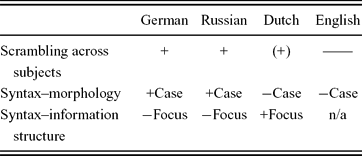
Although the Dutch OS order in (9) is distributionally similar to scrambling in German (cf. (4b) above), it is functionally different by forcing contrastive stress on the fronted object. In IS terms, it is thus the exact opposite of German and Russian scrambling, which requires the fronted object to be informationally given and destressed. Finally, English does not allow embedded OS orders in any discourse context. Table 1 summarizes the cross-linguistic differences for the languages under review (for details, see Hopp, Reference Hopp2007).
Cross-linguistic differences in scrambling.

3.2 Processing
Effects of the morphosyntax and the IS of scrambling also arise in on-line sentence comprehension. Scrambled OS orders incur additional processing effort compared to canonical SO orders (e.g. Hemforth and Konieczny, Reference Hemforth and Konieczny2000). This aligns with a general, cross-linguistically observed processing advantage of canonical SO orders over OS orders (e.g. Kaan, Reference Kaan1997; Sekerina, Reference Sekerina and Karimi2003; Bader and Bayer, Reference Bader and Bayer2006;). Such a processing disadvantage of OS orders is commonly related to universal parsing principles, as in (10), which dictate the parser to construct as parsimonious a phrase structure as possible.
(10) Minimal Chain Principle (DeVincenzi, Reference DeVincenzi1991, p. 13)
Avoid postulating unnecessary chain members at S-structure, but do not delay required chain members.
In accordance with (10), the parser incrementally attempts to build a default SO structure which contains minimal phrase structure. However, when the parser encounters the accusative-marked first NP in the embedded clause in (4b) above, i.e. den Onkel “the uncle”, the parser is forced to reanalyse the SO order to an OS order. Measurable garden-path effects, e.g. reading slowdowns, on the non-nominative marked first NP in OS orders reflect the processing costs of syntactic reanalysis (Bayer and Bader, 2006).
Meng, Bader and Bayer (Reference Bader and Meng1999) show that the processing costs of German scrambling are modulated by IS in that scrambling evokes reduced processing effort if it is embedded in a felicitous discourse context, such as in (5) (see also Weskott, Reference Weskott2003). Similar context effects on the processing of scrambling have been reported in ERP studies by e.g. Bornkessel, Schlesewsky and Friederici (Reference Bornkessel, Schlesewsky and Friederici2003), Stolterfoht (Reference Stolterfoht2005) and Bornkessel and Schlesewsky (Reference Bornkessel and Schlesewsky2006). They demonstrate that the processing difficulty of scrambling is mitigated in felicitous discourse contexts compared to null or infelicitous contexts. Further, these ERP studies indicate that the processing component of IS is neurophysiologically distinct from effects of syntactic reanalysis in scrambling.
Bader and Meng (Reference Bader and Meng1999) argue that these differential effects of processing scrambling in context arise as the consequence of the interaction of two types of reanalysis in the processing scrambling: (a) syntactic reanalysis from SO to OS order as per (10), and (b) IS reanalysis which shifts focus from the object to the subject. In a felicitous IS context such as in (5) above, the context designates the subject in the answer as bearing (narrow) focus, i.e. it establishes an IS that matches the IS associated with scrambling (IS–syntax match). Here, only syntactic reanalysis is necessary for OS orders. In contrast, in the infelicitous context in (6), both syntactic reanalysis and IS reanalysis are required because the OBJECT-Focus context induces narrow focus on the object (IS–syntax mismatch), which then needs to be revised to narrow focus on the subject. Analogously, in neutral contexts or for out-of-the-blue sentences, syntactic reanalysis and IS reanalysis are necessary as (default) wide focus must be revised to narrow focus on the subject.
In sum, additional processing effort for scrambling vis à vis the canonical SO order is traceable to two distinct, though interacting, reanalysis processes, namely, (a) syntactic reanalysis that is invoked by the revision of phrase- structure for scrambled orders, and (b) IS reanalysis that is invoked by the adjustment of the IS of the (null) context to fit the IS of scrambling, that is, narrow focus on the preverbal subject. Effects of IS on processing can thus be seen in varying processing costs for scrambled orders depending on whether they are embedded in felicitous or infelicitous IS contexts.
4. Research questions and hypotheses
In light of the interactions of syntax and IS in acceptability and processing cost of scrambling, the following research questions can be formulated in an L2 context:
• Do L2 learners acquire the IS constraints on German scrambling?
• If not, is non-convergence on the IS of scrambling in the L2 due to representational deficits in grammar or computational difficulties in L2 processing?
• Is there an effect of the L1?
• Is there an effect of proficiency?
With reference to these research questions, the following predictions can be put forward on the basis of the approaches outlined in the introduction.
If the mapping between syntax and discourse is subject to representational deficits in grammar, advanced and near-native L2 speakers are predicted not to demonstrate target-like sensitivity to IS effects on scrambling in either off-line and on-line tasks. On e.g. Sorace's (Reference Sorace2003) assumptions, the L1 should determine convergence: The match in L1–TL properties should entail convergence for the L1 Russian group, whereas mismatching L1–TL combinations should lead to non-convergence for the L1 English and L1 Dutch groups across tasks.
If the mapping between syntax and discourse is subject to computational difficulties, we expect to find differences between off-line and on-line performance. Specifically, if computational capacity limitations constrain the mapping between syntax and discourse at L2 ultimate attainment, the degree of target-like performance should correlate with task demands and proficiency level.
5. The experiments
5.1 Participants
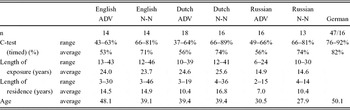
Groups of 29 L1 Russian, 28 L1 English and 34 L1 Dutch highly proficient speakers of German and native German controls were recruited. The participants in the L2 groups were not identical in Experiments 1 and 2, and only a subset of all participants took part in both experiments. However, there was a sizeable overlap in participants, with 29 L2 participants taking part in both experiments. An ANOVA with Proficiency Score as the dependent variable and Language and Experiment as independent variables shows neither significant effects of Experiment (F(1,114) = 0.004; p = .953), Language (F(2,114) = 0.651; p = .523) nor a significant interaction of Experiment and Language (F(2,114) = 0.111; p = .895). Therefore, any potential differences between Experiments 1 and 2 cannot be due to differences in general proficiency among the participants in the respective experiments. For the comparisons in this section, the participants were thus collapsed across Experiments 1 and 2. All L2 learners had started learning German after age 11 and were residents in Germany at the time of testing. All had normal or corrected-to-normal vision. Participant information is listed in Table 2.
Participant information by group.

ADV = advanced; N-N = near-native
For proficiency-matching, they all took part in two proficiency tests. They first completed a timed web-based C-test (Grotjahn, Reference Grotjahn2002) to estimate their proficiency in German and were then allocated to two groups according to their scores, i.e. advanced (ADV, < 66%) and near-native (N-N, ≥ 66%); the cut-off point was the median score in each group. Note that the near-natives did not all fall into the native range of C-test scores, although there was some overlap with three L1 English, four L1 Dutch and two L1 Russian subjects scoring within the native range.
Pairwise t-tests for independent samples (Bonferroni adjustment) on the proficiency scores demonstrate that there are no statistically significant differences either between any of the three advanced groups (p = 1) or between any of the near-native groups (p ≥ .938) across L1s. For the main experiments, these results indicate that differences between L1 groups, if found, cannot be due to general proficiency differences.
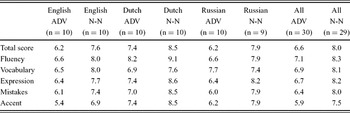
In addition to the C-test, all L2 participants completed an oral production task, based on picture description. The pictures were a copy of the “Cookie Theft” picture from the Boston Diagnostic Aphasia Examination (Goodglass and Kaplan, Reference Goodglass and Kaplan1983) and a cartoon strip. The speech samples of the subjects were digitally recorded and stored on a computer. Participants took between 45 seconds and 5 minutes 30 seconds for this task. Following the rationale in e.g. White and Genesee (Reference White and Genesee1996), all speech samples were rated by German native speakers on five dimensions: (a) fluency, (b) choice of vocabulary, (c) expression, (d) errors and (e) accent or pronunciation. Three native speakers of German listened to all non-native speech samples, which were randomly interspersed with speech samples from native German speakers, and rated the samples. The raters had no knowledge of the C-test score of a participant, nor did they know whether a particular sample was from a native or a non-native speaker. The raters scored each sample on the five dimensions using a ten-point rating scale; 10 was defined as the score for comprehensive native-likeness, and 0 was the score for most perceptible non-native-likeness. Interrater reliabiliy was high (Cronbach's α = 0.798). Table 3 lists the results for the five dimensions for each language and each proficiency group. There were no significant differences between the individual groups in Experiment 1 and 2 (for detailed comparisons, see Hopp, Reference Hopp2007). The rating gives an estimate of the degree of native-likeness of the L2 participants in speech production. The native speaker group scored 8.5 points or higher on each of the dimensions.
Ratings of speech samples (max = 10).

ADV = advanced; N-N = near-native
In order to establish the relation between the picture-description task and the C-test, a correlational analysis was run on the z-scores of total scores of each participant in each test. There is a moderate correlation r = 0.536 (p < .01) between the scores of the C-test and the rating of the speech samples.
In sum, both the C-test and the picture-description task point to substantial differences in L2 proficiency among the non-native participants. The results of the two tasks converge in yielding differences between a high-scoring “near-native” group and a lower-scoring “advanced” group, as defined by the C-test scores. Proficiency level is considered as a variable in both experiments.
5.2 Experiment 1: acceptability judgements
Experiment 1 tests for grammatical knowledge of German scrambling and its interaction with Information Structure. A web-based Magnitude Estimation judgement experiment (Bard, Robertson and Sorace, Reference Bard, Robertson and Sorace1996) was run using the software package WebExp (Keller, Corley, Corley, Konieczny and Todirascu, Reference Keller, Corley, Corley, Konieczny and Todirascu1998), adapting materials from Keller (Reference Keller, Gleitman and Joshi2000). In this task, participants judged the acceptability of the sentences embedded in wh-question contexts relative to an open-ended scale of their choosing. This way, maximally fine-grained judgements could be obtained, which is essential in probing subtle acceptability differences according to discourse context. The experiment included a wider set of materials which were used for a different study and are reported in Hopp (Reference Hopp2007). The factors in the materials relevant for present purposes were Context and Word Order.
The factor Context manipulated IS, and it had three levels: the neutral ALL-Focus context inducing wide focus (11a), the SUBJECT-Focus context that makes the object given information and induces narrow focus on the subject (11b), and the OBJECT-Focus context that renders the subject given and induces narrow focus on the object (11c). The IS of the SUBJECT-Focus context is felicitous for scrambling (IS–syntax match), while the OBJECT-Focus context is not (IS–syntax mismatch).
(11)
The factor Word Order also had three levels: the canonical SO order (12a), the scrambled OS order (12b), and an ungrammatical SO order that comprised two nominative-marked NPs (12c).
(12)
For all items, the NP subject was animate, and the NP object inanimate. All lexical items were familiar and matched for frequency (see Appendix 1 for all experimental items). In addition to the experimental items, the task included 25 fillers, thus yielding a total of 34 items. Overall, there were as many grammatical as ungrammatical items. The acceptability of the fillers ranged from ungrammatical word order violations to standard grammatical sentences. Like the experimental items, all fillers were embedded in wh-question contexts. Due to individual variability in judgement scales, the geometric means of judgements were rescaled to a scale from 0 to 100 for comparability.
The following target pattern was expected: In terms of morphosyntax, scrambling (12b) should be judged to be significantly better than morphosyntactic (case) violations in (12c); in terms of IS, scrambling should be judged to be significantly better in the felicitous SUBJECT-Focus context (IS–syntax match) than in the infelicitous OBJECT-Focus contect (IS–syntax mismatch).
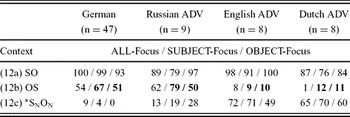
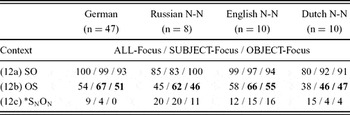
Tables 4 and 5 present the results for the advanced and the near-native groups, respectively.Footnote 2 The results for the contexts are listed horizontally in each cell (ALL-Focus/SUBJECT-Focus/OBJECT-Focus).
Results: advanced (ADV) groups (degree of acceptability).

Results: near-native (N-N) groups (degree of acceptability).

A Repeated Measures ANOVA with the within-subjects factors Order and Context and the between-subjects factors Language and Proficiency shows significant main effect of Order (F(2,92) = 92.000, p < .001) but no main effect of Context (F(2,92) = 0.810, p = .448). The interaction of Order and Context becomes significant (F(4,90) = 4.850, p = .001). This interaction attests that context affects specifically OS orders across groups. For the between-subjects factors, the following interactions were observed: Order and Language (F(4,186) = 3.435, p = .010) and Order and Proficiency (F(2,92) = 9.779, p < .001). Moreover, there is a significant interaction of Order, Language and Proficiency (F(4,186) = 4.652, p = .001). These interactions show that there are group differences across L1 and proficiency groups for morphosyntax. Further, there is a significant interaction of Order, Context, Language and Proficiency (F(8,182) = 2.267, p = .025), which suggests that there may be group differences with respect to the acceptability of OS orders depending on context. For these reasons, separate pairwise analyses for morphosyntax (Order) and context (Context) were carried out.
For morphosyntax, the native speakers make a distinction between the canonical SO order (12a) that is judged the highest across all contexts and the scrambled OS order (12b) that receives lower ratings reflecting its markedness. However, the scrambled OS order is rated significantly higher than SO orders containing case violations (12c) across contexts (ALL-Focus context: F1(1,46) = 7.58, p < .001; F2(1,7) = 9.415, p < .001). In other words, the scrambled order is marked, though acceptable, in German. As for effects of IS, the native speakers show a significant difference in the judgements of the OS order between the felicitous SUBJECT-Focus context and the infelicitous OBJECT-Focus context (F1(1,46) = 2.78, p = .008; F2(1,7) = 2.880, p = .024).
The non-natives' judgements differ according to proficiency and L1. Due to the small size of the individual non-native groups, I focus on the results of the within-subjects analysis. The L1 Russian groups make target-like distinctions on the morphosyntax of scrambling. Regardless of proficiency level, the L1 Russian group also demonstrates target-like sensitivity to context by making significant differences for OS orders between the SUBJECT-Focus and the OBJECT-Focus contexts (Advanced: F1(1,8) = 2.338, p = .048; F2(1,7) = 1.449, p = .191; Near-Native: F1(1,7) = 2.796, p = .027; F2(1,7) = −1.505, p = .176).
In contrast, the L1 English and L1 Dutch advanced groups show divergence on both the morphosyntax and the IS of scrambling. As for morphosyntax, these groups rule out the scrambled OS order (12b) and they are not sensitive to case violations (12c), accepting the latter at high rates. Their judgement patterns thus suggest that these groups use linear order and/or animacy to determine the syntactic function of NPs, but not case marking. As for IS effects, neither the L1 English advanced group (F1(1,7) = −0.093, p = .929; F2(1,7) = −0.127; p = .902), nor the L1 Dutch advanced group (F1(1,7) = 0.079, p = .939; F2(1,7) = 0.054, p = .958) makes a difference for OS orders depending on context.
As for the near-natives, the L1 English and L1 Dutch groups converge on the morphosyntax of scrambling ((12b) vs. (12c)), including case marking. L1 differences emerge in that the L1 English near-natives demonstrate a target-like effect of IS on scrambling (F1(1,9) = 2.329, p = .045; F2(1,7) = 0.653, p = .535), whereas the L1 Dutch near-natives make no distinction for OS orders between the SUBJECT-Focus and the OBJECT-Focus context (F1(1,9) = −0.196, p = .849; F2(1,7) = 0.143, p = .891).
Experiment 1 shows that convergence on the IS of scrambling is possible for L2 learners of different L1s. At the same time, it documents a pattern of non-convergence according to proficiency (L1 English group) and L1 (L1 Dutch group). In this regard, it is surprising that the L1 Dutch group does not demonstrate any evidence of interactions of word order and information structure. The null effect of context for the L1 Dutch group could mean either that the group identifies no relation between syntactic reordering by scrambling and IS or that the group applies a non-target-like IS-to-syntax mapping to scrambling.
Although a null finding does not allow for any firm conclusions, it may be the case that the L1 Dutch group associates German scrambling with the distributionally similar, though functionally different, option in Dutch, so-called focus scrambling, as in (9) above. In contrast with pre-subject scrambling in German or Russian that entails the defocusing of the scrambled phrase, focus scrambling applies to contrastive topics and thus incurs (contrastive) stress on the scrambled phrase. Bohnacker and Rosén (Reference Bohnacker and Rosén2008) identify a similar L1-governed mismatch for the information structure of the German “Vorfeld”, i.e. the CP region, in terms of given–new structure and topicalization for Swedish adult learners of German at different levels of proficiency. Although Swedish and German share the syntactic options in CP and thus the options for realizing non-subject material in CP, Swedish and German exploit these options for different discourse functions: According to a small-scale corpus study reported in Bohnacker and Rosén (Reference Bohnacker and Rosén2008), native Swedish speakers show lower ratios of topicalization and a higher incidence of phonologically light material in CP (see also Vallduví and Engdahl, Reference Vallduví and Engdahl1996) than native Germans do. Bohnacker and Rosén find evidence of the transfer of these information-structural preferences in oral and written production data of Swedish adult learners of German, which results in their L2 German being morphosyntactically well-formed, yet non-native-like in terms of information structure.
In sum, Experiment 1 reveals L1 effects in the mapping of IS onto syntax, yet it also attests that even learners with an L1 that does not instantiate syntactic or IS analogues of scrambling can attain target-like mappings between syntax and discourse. As the L1 English near-natives show, convergence at the syntax–discourse interface at L2 ultimate attainment is not per se constrained by the L1 in off-line judgements. Experiment 2 investigates whether the effects of proficiency and of L1 transfer equally characterise the on-line processing of scrambling.
Experiment 2: self-paced reading
Experiment 2 tests whether L2 speakers use IS information in on-line processing in a self-paced reading task. The rationale of this task is that locally increased processing efforts of syntactic and IS reanalysis (see section 3 above) can be detected in higher reading times on a given segment compared to the same segment in a control condition. More specifically, Experiment 2 investigates whether the increased processing costs of scrambling are mitigated if scrambling is embedded in a felicitous IS context (IS–syntax match), and, conversely, whether an infelicitous context leads to higher processing costs (IS–syntax mismatch). Finding such effects among L2 speakers would indicate that they map discourse information onto syntax when building phrase structure in real-time comprehension.
Materials and procedure
Quadruplets of experimental sentences were constructed (see Appendix 2). Half of the quadruplets were in SO order, the other half in OS order (Factor Order). Within each quadruple set, two versions of each sentence were constructed by reversing the position of the nouns (i.e. N1–N2 and N2–N1), so that any potential effect of lexical semantics or pragmatics of the SO and OS manipulation would be completely matched. All sentences were pre-tested in a separate plausibility-rating study to ensure N1–N2–V and N2–N1–V SO orders were equally plausible (for details, see Hopp Reference Hopp2007). None of the native participants in the plausibility rating took part in Experiment 2. All sentences were initiated by a matrix clause. Sentences were disambiguated by case, i.e. they contained two NPs, one unambiguously marked for nominative, the other unambiguously marked for accusative. In order to ensure that the NPs within and across conditions would be of similar length, NPs that were between seven and nine characters long were chosen; the verbs were also between seven and nine characters in length. The NPs were further matched for gender, number and animacy, such that neither of these types of information could be used to disambiguate the meaning of the sentences. Examples of a quadruplet of the experimental items are given in (13)–(16).
(13)
(14)
(15)
(16)
Further, triplets of contexts were designed for each quadruplet of sentences. The triplet consisted of an ALL-Focus context, a SUBJECT-Focus context and an OBJECT-Focus context (Factor Context). The context comprised a background sentence to set the scene and a wh-question to designate the focus structure of the experimental item. Examples of the contexts for the orders in (13)–(16) are given in (17).
(17) ALL-Focus: “In the factory, the machines ground to a standstill last Monday. What had happened?”
SUBJECT-Focus: “In the factory, the worker was distracted by someone last Monday. Who distracted the worker?”
OBJECT-Focus: “In the factory, the apprentice distracted someone last Monday. Who did the apprentice distract?”
The ALL-Focus context induced wide focus for the experimental item by providing (a) no information about the events expressed in the experimental item or their participants and (b) a maximally non-specific question. The SUBJECT-Focus context induced narrow focus on the subject by (a) establishing the verb and the object NP as given information in the background sentence and (b) designating the subject as the focus exponent of the answer by targeting it in the wh-question. Hence, the SUBJECT-Focus gave rise to felicitous IS conditions for scrambling (IS–syntax match). Conversely, the OBJECT-Focus context induced narrow focus on the object by (a) establishing the verb and the subject NP as given information in the background sentence and (b) designating the object as the focus exponent of the answer by targeting it in the wh-question. The IS of the OBJECT-Focus context thus conflicted with the IS structure required for felicitous scrambling (IS–syntax mismatch). The contexts were constructed such that a focus scrambling reading of the object (as in (9) above) in the experimental item is not supported.
Note that the different contexts create differential demands for the comprehension of subsequent sentences (see Table 6) in terms of the predictability of syntactic function assignment. Being the least specific, the ALL-Focus context does not give rise to any intersentential predictions; it thus closely resembles out-of-the-blue sentences. Hence, for subsequent sentences, (a) the syntactic function of arguments must be identified by case marking; (b) for OS orders, the default SO phrase-structure assumption must be revised to the OS order, and (c) the default wide focus structure needs to be revised to fit the information structure of scrambling with narrow focus on the subject.
Task demands for processing OS orders in the different contexts.

In contrast, the SUBJECT-Focus and the OBJECT-Focus contexts create several intersentential predictions: (a) The contexts introduce the verb of the subsequent sentence, (b) the contexts introduce one NP argument of the verb and (c) the context specifies the syntactic function of the NP argument mentioned in the context (i.e. the object in the SUBJECT-Focus context and the subject in the OBJECT-Focus context); in addition, the wh-question again designates the syntactic function of the NP targeted by the wh-phrase (i.e. the subject in the SUBJECT-Focus context and the object in the OBJECT-Focus context). Since the contexts thus disambiguate the syntactic functions of the verb's arguments in the subsequent sentence, these conditions tap the interaction of word order and information structure in the experimental item independently of the processing of case. Importantly, this means that even for groups who failed to use case marking in Experiment 1, the effects of context can be tested in on-line processing. The SUBJECT-Focus and OBJECT-Focus contexts differ from each other in that the SUBJECT-Focus context creates an information structure that fits the focus structure of OS orders (i.e. narrow focus on the subject; IS–syntax match), while the OBJECT-Focus context gives rise to an information structure that is in conflict with OS orders (IS–syntax mismatch), so that the information structure of the answer needs to be revised to accommodate the OS order. Although syntactic reanalysis from SO to OS is necessary for OS orders in all contexts, IS reanalysis differs across contexts. Table 6 summarizes the task demands in each of the contexts.
The quadruplets of the experimental sentences were divided into three groups of twelve each for each context. On the basis of these three groups, four subject lists were created. Each subject saw 36 items (plus 24 fillers), i.e. six per condition. The paradigm was a non-cumulative self-paced Moving Windows task (Just, Carpenter and Woolley, Reference Just, Carpenter and Woolley1982). The context sentence and the question were presented in toto, whereas the experimental sentences were presented in seven segments, S1–S7; see (18).
(18)
Each item was followed by a comprehension sentence to check if participants accurately understood the items. The participants had to judge whether the comprehension sentence expressed the same meaning as the experimental item. For half of the experimental stimuli and the fillers, the comprehension sentence expressed the same meaning as the experimental item. The comprehension questions for the filler items targeted properties of the context to ensure that subjects read the contexts attentively. Instructions and practice items preceded the task. All stimuli were presented in Courier New Font, font size 14, in white letters against a black background on a 15-inch TFT screen.
Analysis and results
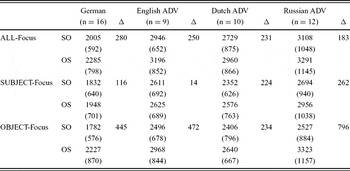
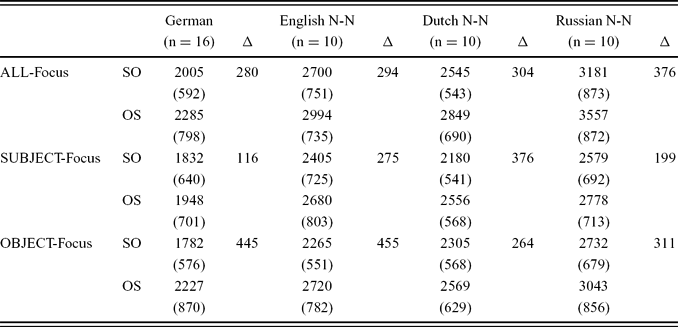
The target pattern for Experiment 2 is that reading slowdowns for OS orders vis à vis SO orders should be mitigated in IS contexts that match the IS of scrambling (IS–syntax match) compared to IS contexts that do not align with the IS of scrambling (IS–syntax mismatch). Hence, the target pattern surfaces in smaller differences in reading times between SO and OS orders for the SUBJECT-Focus context compared to the OBJECT-Focus context in Table 7. For the analysis of reading times, the sum of segments 3, 4 and 5 (from (18) above) was defined as the region of interest (Segment 3–5). Considering this region allows us to see whether there are incremental processing effects at the point where syntactic order is disambiguated. By choosing a collapsed segment that includes both NP arguments, it was ensured that no differences in IS status or previous mention of NPs obtain between the SUBJECT-Focus and the OBJECT-Focus context: In both contexts, Segment 3–5 contains one given and one new NP.Footnote 3 Reading times were analyzed for the segments of all items. Tables 7 and 8 list reading times for Segment 3–5 for the native speakers and the advanced (Table 7) and near-native (Table 8) L2 groups.
Reading times (in milliseconds) for Segment 3–5 (NP1–ADV–NP2): advanced (ADV) groups (standard deviations in parentheses). Δ indicates the difference in reading times (in milliseconds) between SO and OS orders.

Reading times (in milliseconds) for Segment 3–5 (NP1–ADV–NP2): near-native (N-N) groups (standard deviations in parentheses). Δ indicates the difference in reading times (in milliseconds) between SO and OS orders.
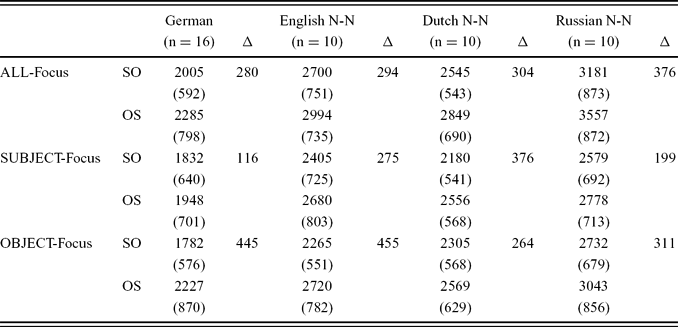
Mixed three-way Repeated Measures ANOVAs with Context as the within-subjects factors and with, respectively, Language (German, English, Dutch, Russian) and Proficiency (native, advanced L2 and near-native L2) as between-subjects factors were performed on the relative differences between reading times between SO and OS (i.e. RT[OS] minus RT[SO]). Note that the between-subjects factors are not fully factorial. Finding interactions with the factor Language would indicate that there are differences in processing according to L1; finding interactions with the factor Proficiency would indicate differences according to proficiency level. Planned post-hoc two-way analyses were computed to investigate the cause of potential interactions of the within-subject factor and Language or Proficiency.
The analysis of the reading time differences between SO and OS orders for Segment 3–5 yields a main effect of Context (F(2,67) = 8.259, p = .001). As for interactions with the between-subjects factors, there is an interaction of the factors Context and Language (F(4,136) = 2.757, p = .030); however, there is no significant interaction of Context and Proficiency (F(2,67) = 2.102, p = .130). The three-way comparison of Context, Language and Proficiency equally does not approach significance (F(4,136) = 0.858; p = .491). This pattern indicates that the on-line processing of scrambling in context varies according to L1, yet not according to L1.
Having established that context modulates the processing of scrambled OS orders compared to SO orders in general, planned pairwise comparisons for the SUBJECT-Focus and the OBJECT-Focus contexts were run to identify the specific effects of IS context for each group. Given the interactions with the factors Language, pairwise comparisons for the relative differences between the SO and OS orders were calculated for each language group. I concentrate on the SUBJECT-Focus and OBJECT-Focus contexts, since the ALL-Focus context differs from these in terms of intersentential predictions.Footnote 4
For the native speakers, Experiment 2 yields clear evidence that IS modulates the processing of scrambled orders incrementally. This modulation is expressed in significant relative differences of SO and OS orders between the felicitous SUBJECT-Focus context and the OBJECT-Focus context (F1(1,15) = 3.076, p = .008; F2(1,23) = −2.057, p = .051).
For the L2 groups, target distinctions in reading slowdowns on Segment 3–5 between the SUBJECT-Focus and OBJECT-Focus contexts can be observed for both the L1 Russian and the L1 English groups (at both proficiency levels).
The L1 Russians show a significant relative difference of SO and OS between SUBJECT-Focus and OBJECT-Focus contexts (F1(1,19) = 2.315, p = .032; F2(1,23) = −2.364, p = .027). The L1 English group also shows significant relative differences of SO and OS orders between contexts (F1(1,18) = 2.625, p = .017; F2(1,23) = −2.112, p = .046). In contrast, the L1 Dutch group does not manifest relative differences in reading times for SO and OS according to context (F1(1,19) = −0.898, p = .381; F2(1,23) = −0.414, p = .683).
Hence, for the native, the L1 Russian and the L1 English groups, the processing difficulty for OS orders is mitigated compared to SO orders when there is an IS–syntax match (SUBJECT-Focus). In contrast, an IS–syntax mismatch (OBJECT-Focus) results in significantly longer reading times for OS orders compared to SO orders. The L1 Dutch group shows no processing differences according to context.
6. Discussion
The aim of the present study was to investigate if adult L2 learners can acquire subtle discourse-pragmatic constraints on syntax. Specifically, it sought to gauge the extent to which acquisition depends on L1 and/or proficiency, and whether potential problems in acquisition reflect grammatical deficits or processing difficulty in near-native L2 acquisition. In the two experiments, the following results were found:
• In off-line judgements, proficiency and L1 effects are observed: The L1 Russian groups and the L1 English near-natives demonstrate target judgements on the morphosyntax and the IS constraints of scrambling. In contrast, the advanced L1 English and L1 Dutch groups neither demonstrate target knowledge of the morphosyntax of scrambling nor do they exhibit target IS constraints. The L1 Dutch near-natives acquire the morphosyntax yet not the IS of scrambling.
• In the on-line experiment, the L2 groups perform differently according to L1. Reading time differences for OS orders between the felicitous SUBJECT-Focus context and the infelicitous OBJECT-Focus context bear out that discourse context affects the real-time processing of German scrambling. These effects obtain incrementally, i.e. before the sentence has been processed in total. For the native, the L1 English and the L1 Russian groups, slowdowns for OS orders are mitigated in the SUBJECT-Focus context for Segment 3–5. The L1 Dutch group does not show any differences between the contexts.
6.1 L1 effects
In line with the native processing pattern, the L1 Russian and L1 English groups demonstrate significant processing differences of OS versus SO orders between the OBJECT-Focus context and the SUBJECT-Focus context. In other words, for processing scrambling, the L1 Russian and L1 English groups show facilitatory effects of the IS–syntax match in the SUBJECT-Focus context compared to the IS–syntax mismatch in the OBJECT-Focus context.
Experiment 2 attests that L1 English and L1 Russian speakers construct intersentential IS-to-syntax mappings and apply these rapidly in L2 sentence processing. More specifically, the interaction of information structure and syntax is borne out in that the congruency of the information structure of the context with the information structure of scrambled OS orders engenders less effortful processing of scrambled orders (SUBJECT-Focus context) while an incongruent information structure gives rise to strong reanalysis effects (OBJECT-Focus context).
As in off-line judgements (Experiment 1), the L1 Dutch group does not make any differences in the processing of OS orders across contexts. Since the experiment did not include a condition that induces a contrastive topic reading of the scrambled object akin to focus-scrambling in Dutch as in (9) above, it is unclear whether the null finding across contexts for the L1 Dutch group marks (a) divergence in IS-to-syntax correspondences because marginally available L1 mappings, i.e. focus scrambling, persevere in the L2, or (b) simply incompleteness in the sense that the L1 Dutch groups do not identify any contingency between IS and syntax for scrambling.
With respect to the causes of non-convergence, the present cross-linguistic findings are not compatible with accounts positing representational impairment at the syntax–discourse interface (e.g. Sorace, Reference Sorace2003), because L1 English near-natives are sensitive to the interaction of IS and word order in off-line and on-line tasks. Moreover, since convergence is possible for L1 English speakers, it is unlikely that the non-convergence of the L1 Dutch group is due to representational impairment; instead, the protracted divergence found for the L1 Dutch group appears to be due to learnability. Specifically, the marginal option in Dutch for contrastive topics to appear in the scrambled OS order, i.e. focus scrambling, might transfer to the L2. Accordingly, the cross-linguistic comparisons in Experiments 1 and 2 suggest that convergence may be constrained by asymmetries in L1–TL realization of IS mappings onto syntax. On the assumption that the initial state of L2 acquisition is equivalent to the full L1 grammar (e.g. Schwartz and Sprouse, Reference Schwartz and Sprouse1996), the association of scrambled OS orders with a contrastive topic IS might persevere in L2 acquisition. In fact, focus scrambling is also a marginal option in German (Haider and Rosengren, Reference Haider and Rosengren2003), such that the ambiguity of the TL input might prevent restructuring to the canonical IS association with scrambling. In other words, the L1 Dutch group might not converge on the TL because the L1 option is retained in IL grammars and processing, since it is compatible with (marginal) aspects of the TL input. At this point, this suggestion must remain tentative, since there is no positive evidence showing that the L1 Dutch group imposes a contrastive topic interpretation on German scrambling. Future experiments should include a condition that induces a contrastive topic interpretation of the scrambled object akin to focus scrambling in Dutch.
In sum, the two experiments find that convergence at the syntax–discourse interface is possible for L2 learners, irrespective of whether the L1 encodes identical IS-to-syntax mappings (Russian) or not (English). Hence, it is possible for L2 speakers to go beyond the discourse relations of syntax realized in their L1. Instead, the cross-linguistic comparisons in Experiments 1 and 2 (i.e. the L1 English vs. the L1 Dutch groups) suggest that convergence at the syntax–discourse interface may be constrained by asymmetries in L1–TL realization of IS mappings onto syntax which lead to the retention of L1 properties.
6.2 Computational difficulties
If the coordination of syntactic and discourse information is subject to computational difficulty in L2 acquisition, we expect to see differential performance according to task demands. In the present study, such task effects can be seen for the L1 English advanced group: This group does not show effects of context on the acceptability of OS orders, yet it does demonstrate target processing differences according to context on-line. These differences between tasks are unlikely to result from differences in participants across tasks since the majority of participants was the same in the off-line experiment and the on-line experiment; in fact, limiting the data analysis to the set of participants who completed both tasks yields the same result (for details, see Hopp, Reference Hopp2007). Furthermore, it is unlikely that the lack of an effect for the L1 English groups in the off-line task is due to some methodological factor in the design of the Magnitude Estimation judgement task, since other groups, i.e. the L1 Russians and L1 English near-natives, do show effects.
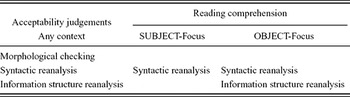
I suggest that the differences between the tasks reflect differences in task demands between off-line judgements and on-line reading. For sentences embedded in contexts, making an acceptability judgement necessitates additional processes compared to reading sentences for comprehension. Making an acceptability judgement for a sentence presented in context requires, among other things, (a) establishing the morphosyntactic well-formedness of the sentence, (b) establishing an information structure for the sentence and (c) matching the information structure of the sentence with the context in order to gauge its contextual fit. For reading in context, morphological checking is not necessary, since reading does not involve evaluations of well-formedness. Rather, reading proceeds on the assumption that the sentences to be read are well-formed to start with. Table 9 lists the differential demands for acceptability judgements and reading comprehension.
Task demands for OS orders in the different contexts.

Table 9 shows that making acceptability judgements of scrambling, like reading OS orders in isolation or a neutral (ALL-Focus) context, implicates more processes than reading OS orders in context. Crucially, even for sentences presented in discourse contexts, making an acceptability judgement requires morphological checking (in this instance, of case forms), since it is essential to first establish whether a sentence is morphosyntactically well-formed before this sentence can be related to the context.
Hence, the difficulties with morphological feature checking of case arguably prevent effects of information structure to surface in the off-line judgements. When the demands of morphological checking are removed as in Experiment 2, evidence of phrase-structural revision by information-structural cues emerges. These cross-task differences indicate that the mapping of morphological forms to syntactic function is particularly difficult even for advanced L2 learners in comprehension tasks (e.g. Jiang, Reference Jiang2004; Reference Jiang2007; McDonald, Reference McDonald2006), with inflectional morphology forming the “bottleneck” (Slabakova, Reference Slabakova2006) in adult L2 acquisition and L2 processing. In addition, the observed disjunction between off-line and on-line performance indicates that computational problems at the syntax–morphology interface mask convergence at other interfaces, e.g. the syntax–discourse interface. This particular interaction may be specific to discourse-related word orders that are marked by inflectional (case) morphology like scrambling. However, such linkages across interfaces suggest that problems at the syntax–discourse interface can at least in part be caused by the grammatical complexity of discourse-related word orders.
Discourse-related word orders involve two kinds of complexity: First, by definition, they require the mapping of discourse and syntactic information and are thus more complex than word orders that are not restricted to particular sets of discourse contexts. Once the relevant characteristics have been extracted from a discourse context, it is necessary to establish a correspondence between these discourse characteristics and the syntax. These correspondences are acquired late in child L1 development (e.g. Avrutin, Reference Avrutin1999; Krämer, Reference Krämer2000; Unsworth, Reference Unsworth2005), not least because they necessitate the integration of syntactic, morphological and pragmatic knowledge. As shown in e.g. Kilborn (Reference Kilborn and Harris1992), the integration of different types of grammatical information is subject to greater difficulty in L2 processing than it is in native-speaker processing.
Second, discourse-related word orders are typically non-canonical word orders, since canonical word orders constitute the unmarked syntactic option. For instance, SO orders are contextually neutral in German, while derived OS orders are contextually restricted to given objects. For Italian, SV orders with unergative verbs are unmarked, while derived VS orders are contextually restricted to information-structurally new subjects (Belletti et al., Reference Belletti, Bennati and Sorace2007). Computing derived syntax, e.g. for German OS and Italian VS orders, is associated with increased processing effort. As shown for scrambled OS orders in German in Experiment 1 and 2, advanced L2 speakers (unlike near-natives) fail to compute the syntax of these orders by instead applying a general Agent–Patient template to the stimuli (see also Hopp, Reference Hopp2006; Jackson, Reference Jackson2007). Given that these L2 learners do not or only incompletely compute the syntax of OS orders, they fail to evince appropriate discourse mappings associated with these orders as a consequence. On this account, L2 problems at the interfaces would be due to economy strategies that minimize processing resources rather than to problems specific to interfaces per se. Of course, both the computational requirements of integrating information types across interfaces and the increased computational effort needed for deriving the syntax of discourse-related word orders may show interactive or additive effects, such that both of these computational demands are likely to limit the application of convergent grammatical knowledge in L2 processing. These results thus add to prior findings that non-convergence even in off-line judgements is related to computational difficulties in using extant grammatical knowledge (McDonald, Reference McDonald2000, Reference McDonald2006; Sorace and Filiaci, Reference Sorace and Filiaci2006).
In general, for the L2 acquisition of grammatical knowledge, the findings from the present experiments are in line with previous studies attesting convergence for at least a subsample of L2 speakers tested (e.g. Birdsong, Reference Birdsong1992; White and Genesee, Reference White and Genesee1996; Birdsong and Molis, Reference Birdsong and Molis2001; Montrul and Slabakova, Reference Montrul and Slabakova2003; van Boxtel, Reference van Boxtel2005). The present study extends these findings to the syntax–discourse interface of German scrambling. For L2 grammatical processing, this study adds to processing studies of highly-proficient L2 learners (e.g. Frenck-Mestre, Reference Frenck-Mestre, Heredia and Altarriba2002; Rossi, Gugler, Friederici and Hahne, Reference Rossi, Gugler, Friederici and Hahne2006) that document qualitatively identical processing patterns. The current experiments show that native-like processing performance also holds for the L2 processing of information structure in the context of subject–object ambiguities. Both morphosyntax and information structure have been associated with particular difficulty in L2 processing (Clahsen and Felser, Reference Clahsen and Felser2006; Sorace and Filiaci, Reference Sorace and Filiaci2006). The results of the present experiments attest that native-like processing is within reach for high-proficient L2 speakers also in these areas.
7. Conclusion
In sum, this cross-linguistic study on advanced and near-native L2 endstate speakers accrues evidence that convergence on the syntax–discourse interface is not a priori constrained by L1 properties. Off-line and on-line comparisons further suggest that non-convergence on discourse-related aspects of syntax is partially due to increased computational demands in integrating information across grammatical modules. When IS-to-syntax mappings are isolated experimentally, clear evidence of convergence emerges. In fact, under such experimental conditions, even L2 speakers at lower proficiency levels show convergence at the syntax–discourse interface. These findings indicate that phenomena at the syntax–discourse interface may not present insurmountable difficulty in adult L2 acquisition, neither in off-line comprehension, nor in on-line processing, and, in consequence, that this particular area of L2 acquisition is not constrained by representational deficits.
Appendix 1. Experimental sentences for Experiment 1 (SO order)
(1) Maria glaubt, dass der Vater den Wagen kauft.
“Maria thinks that the father buys the car.”
(2) Petra weiss, dass der Junge den Brief schickt.
“Petra knows that the boy sends the letter.”
(3) Klara sagt, dass der Chef den Bericht liest.
“Klara says that the boss reads the report.”
(4) Sabine behauptet, dass der Journalist den Artikel schreibt.
“Sabine claims that the journalist writes the article.”
(5) Tanja denkt, dass der Regisseur den Film dreht.
“Tanja thinks that the director shoots the movie.”
(6) Gabi nimmt an, dass der Anwalt den Vertrag formuliert.
“Gabi assumes that the lawyer formulates the contract.”
(7) Julia vermutet, dass der Soldat den Auftrag ablehnt.
“Julia supposes that the soldier rejects the command.”
(8) Louise denkt, das der Lehrer den Bus fährt.
“Louise thinks that the teacher drives the bus.”
Appendix 2. Experimental sentences for Experiment 2 (SO order)
(1) Ich glaube, dass der Lehrling am Dienstag den Arbeiter abgelenkt hat.
“I think that the apprentice distracted the worker on Tuesday.”
(2) Ich glaube, dass der Einbrecher am Montag den Kommissar erschossen hat.
“I think the burglar shot the detective on Monday.”
(3) Ich glaube, dass der Chefarzt am Morgen den Oberarzt überredet hat.
“I think that the chief physician persuaded the senior physician in the morning.”
(4) Ich glaube, dass der Zahnarzt letzten Monat den Filmstar verlassen hat.
“I think that the dentist left the filmstar last month.”
(5) Ich glaube, dass der Politiker jeden Tag den Reporter gegrüsst hat.
“I think that the politician greeted the reporter every day.”
(6) Ich glaube, dass der Anführer seit kurzem den Schläger beschützt hat.
“I think that the gang leader has protected the thug since recently.”
(7) Ich glaube, dass der Vetreter letzte Woche den Einkäufer verpasst hat.
“I think that the salesman missed the purchasing agent last week.”
(8) Ich glaube, dass der Aufseher seit langem den Häftling verachtet hat.
“I think that the warden has despised the inmate for a long time.”
(9) Ich glaube, dass der Ankläger am Dienstag den Betrüger überzeugt hat.
“I think the prosecutor convinced the crook on Tuesday.”
(10) Ich glaube, dass der Fluggast am Abend den Showstar karikiert hat.
“I think that the passenger imitated the showstar in the evening.”
(11) Ich glaube, dass der Pförtner gestern früh den Müllmann beleidigt hat.
“I think that the porter insulted the garbage collector yesterday in the early morning.”
(12) Ich glaube, dass der Aktionär letztes Jahr den Investor betrogen hat.
“I think that the shareholder cheated the investor last year.”
(13) Ich glaube, dass der Torhüter am Freitag den Teamchef begleitet hat.
“I think that the goalkeeper accompanied the coach on Friday.”
(14) Ich glaube, dass der Gastwirt letzte Woche den Hotelier angeklagt hat.
“I think that the landlord sued the hotel owner last week.”
(15) Ich glaube, dass der Läufer am Sonntag den Trainer gefeiert hat.
“I think that the runner celebrated the coach on Sunday.”
(16) Ich glaube, dass der Platzwart am Dienstag den Sportler bestohlen hat.
“I think that the groundkeeper stole from the sportsman on Tuesday.”
(17) Ich glaube, dass der Offizier im Winter den Legionär gefährdet hat.
“I think that the officer put the legionnaire at risk in winter.”
(18) Ich glaube, dass der Sponsor am Samstag den Manager bestimmt hat.
“I think that the sponsor nominated the manager on Saturday.”
(19) Ich glaube, dass der Bewerber am Mittwoch den Direktor angelogen hat.
“I think that the applicant lied to the director on Wednesday.”
(20) Ich glaube, dass der Verleger am Samstag den Künstler blamiert hat.
“I think that the publisher embarrassed the artist on Saturday.”
(21) Ich glaube, dass der Landarzt am Dienstag den Apotheker gefahren hat.
“I think that the country doctor drove the pharmacist on Tuesday.”
(22) Ich glaube, dass der Landwirt letzte Woche den Gärtner angezeigt hat.
“I think that the farmer reported the gardener last week.”
(23) Ich glaube, dass der Monteur am Mittag den Zimmerer bemängelt hat.
“I think that the fitter criticized the carpenter at noon.”
(24) Ich glaube, dass der Hausarzt am Morgen den Schwager gezwickt hat.
“I think that the GP pinched the brother-in-law in the morning.”
(25) Ich glaube, dass der Förster letzten Monat den Angler umgebracht hat.
“I think that the forester killed the fisherman last month.”
(26) Ich glaube, dass der Erfinder seit langem den Forscher ignoriert hat.
“I think that the inventor has ignored the researcher for a long time.”
(27) Ich glaube, dass der Zauberer am Morgen den Dompteur veralbert hat.
“I think that the magician spoofed the tamer in the morning.”
(28) Ich glaube, dass der Scheich am Mittwoch den Premier fasziniert hat.
“I think that the sheikh fascinated the prime minister on Wednesday.”
(29) Ich glaube, dass der Tankwart am Abend den Tierarzt getreten hat.
“I think that the filling station attendant kicked the vet in the evening.”
(30) Ich glaube, dass der Konditor am Freitag den Fleischer geschlagen hat.
“I think that the confectioner beat the butcher on Friday.”
(31) Ich glaube, dass der Matrose letztes Jahr den Admiral gerettet hat.
“I think that the sailor rescued the admiral last year.”
(32) Ich glaube, dass der Gegner am Morgen den Kämpfer erwürgt hat.
“I think that the opponent strangled the fighter in the morning.”
(33) Ich glaube, dass der Intendant am Samstag den Regisseur erniedrigt hat.
“I think that the theatre-director humiliated the director on Saturday.”
(34) Ich glaube, dass der Bastler am Montag den Fachmann überrascht hat.
“I think that the tinkerer surpised the specialist on Monday.”
(35) Ich glaube, dass der Gewinner am Sonntag den Kinostar getroffen hat.
“I think that the winner met the filmstar on Sunday.”
(36) Ich glaube, dass der Bäcker seit langem den Metzger beliefert hat.
“I think that the baker has supplied the butcher for a long time.”