Introduction
Usnea Adans. is the second largest genus in Parmeliaceae, and is considered to comprise c. 350 taxa (Thell et al. Reference Thell, Crespo, Divakar, Kärnefelt, Leavitt, Lumbsch and Seaward2012; Lücking et al. Reference Lücking, Hodkinson and Leavitt2017). Usnea species are commonly known by the name ‘beard lichens’, referring to the appearance of the thallus. Characteristic features of Usnea are a fruticose thallus with radially symmetrical branches having an elastic central axis consisting of a cartilaginous strand of longitudinally orientated hyphae, and the presence of usnic acid in the cortex (Wirtz et al. Reference Wirtz, Printzen, Sancho and Lumbsch2006). The greatest challenge in this genus is the morphological plasticity of its members, which causes difficulties in species recognition (Clerc Reference Clerc1998). Whereas morphological characters and secondary metabolites have previously been used to characterize Usnea species (Swinscow & Krog Reference Swinscow and Krog1975, Reference Swinscow and Krog1988; Clerc Reference Clerc1998; Ohmura Reference Ohmura2001), species recognition using molecular data has been useful, for example, in the Usnea cornuta aggregate (Gerlach et al. Reference Gerlach, Toprak, Naciri, Caviró, da Silveira and Clerc2019).
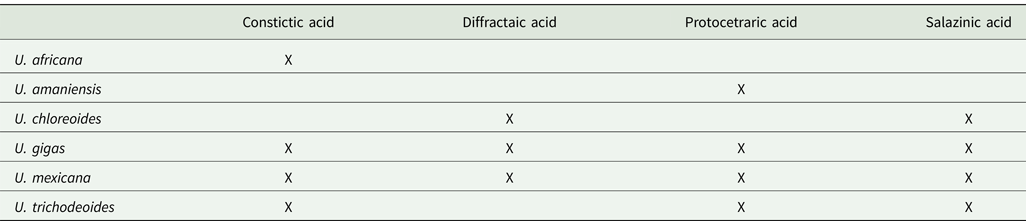
Usnea pectinata Taylor is a species in subgenus Eumitria and is characterized by having a pendent thallus with elongated terminal branches, a dark brown base, punctiform maculae on lateral branches, a non-pigmented central axis and the presence of stictic acid as a major substance (Ohmura Reference Ohmura2001). The inclusion of U. pectinata in Eumitria is mainly based on molecular support from the work of Ohmura (Reference Ohmura2002) and later works have also supported this (Articus Reference Articus2004; Nadel Reference Nadel2016; Temu et al. Reference Temu, Clerc, Tibell, Tibuhwa and Tibell2019). Stictic acid, however, was not reported in the recent work of the U. pectinata aggregate from Tanzania (Temu et al. Reference Temu, Clerc, Tibell, Tibuhwa and Tibell2019). In morphology and chemistry, African specimens of the aggregate show a strong resemblance to samples named Usnea mexicana Vain. (Herrera-Campos et al. Reference Herrera-Campos, Clerc and Nash1998). Interestingly, in an unpublished work by Velasquez (Reference Velasquez2012), Usnea mexicana is shown to be closely related to U. pectinata with two sequences of U. pectinata from Ohmura (Reference Ohmura2002) included in a group forming the sister clade of U. baileyi (Stirt.) Zahlbr. Species such as U. chloreoides Motyka, U. duriuscula Motyka, U. gigas Motyka and U. himantodes Stirt. are putative synonyms of U. mexicana (Swinscow & Krog Reference Swinscow and Krog1988; Herrera-Campos et al. Reference Herrera-Campos, Clerc and Nash1998; Ohmura Reference Ohmura2001; Truong et al. Reference Truong, Rodriguez and Clerc2013b; Nadel Reference Nadel2016; Lücking et al. Reference Lücking, Nadel, Araujo and Gerlach2020). Furthermore, species such as U. africana Motyka, U. amaniensis Dodge, U. bakongoensis P. A. Duvign., U. fernandiae P. A. Duvign., U. gigas and U. savanarum P. A. Duvign. are suspected to be closely related to U. mexicana (P. Clerc, unpublished data). The chemotypes of these species are similar to the chemotypes reported in the U. pectinata aggregate from Tanzania (Temu et al. Reference Temu, Clerc, Tibell, Tibuhwa and Tibell2019), as listed in Table 1. In Africa, the stictic acid chemotype of U. pectinata is currently known only from Madagascar, as represented by the type specimens of U. contorta Jatta, U. eburnea Motyka and U. indigena Motyka (P. Clerc, unpublished data).
A list of some of the species and their chemotypes putatively belonging to the U. pectinata aggregate (Swinscow & Krog Reference Swinscow and Krog1978; Herrera-Campos et al. Reference Herrera-Campos, Clerc and Nash1998; P. Clerc, unpublished data).

Here, we characterize the U. pectinata aggregate as having a pendulous thallus, distinct main branches with ±short lateral, perpendicular branches with or without small rounded soralia, a thin and glossy cortex, and a thick and compact medulla with a brittle, mostly brown-pigmented and thick central axis (> 50% of the branch thickness), which in part may be fistulose. It has a quite diverse chemistry (Table 1).
The high number of species described in this group is caused by the high morphological and chemical variability and suggests the existence of many poorly understood and closely related species collectively treated here as the U. pectinata aggregate, with U. pectinata as the oldest available name.
Molecular studies in the U. pectinata aggregate are few. Until recently, U. pectinata s. lat. had been included in only a small number of molecular investigations (Ohmura Reference Ohmura2002; Articus Reference Articus2004; Truong et al. Reference Truong, Yahr, Crespo and Clerc2013a; Nadel Reference Nadel2016; Temu et al. Reference Temu, Clerc, Tibell, Tibuhwa and Tibell2019; Lücking et al. Reference Lücking, Nadel, Araujo and Gerlach2020). However, these studies have paid greater attention to the genetic variation rather than morphological and chemical variability. In a recent molecular contribution on African material of the U. pectinata aggregate (under ‘U. pectinata’), a varied chemistry and morphology was revealed (Temu et al. Reference Temu, Clerc, Tibell, Tibuhwa and Tibell2019). African specimens of the U. pectinata aggregate are highly variable in secondary chemistry: some have protocetraric acid while others have constictic and diffractaic acids or constictic and salazinic acids as main substances (Temu et al. Reference Temu, Clerc, Tibell, Tibuhwa and Tibell2019; Table 1). Secondary chemistry is considered an important feature in species recognition, in particular when used in combination with other characters (Clerc Reference Clerc1998). In studies of the Usnea cornuta aggregate, the chemistry was found to correlate well with molecular data (Gerlach et al. Reference Gerlach, Toprak, Naciri, Caviró, da Silveira and Clerc2019). However, in Usnea, the occurrence of several chemotypes in a species has often been reported (Swinscow & Krog Reference Swinscow and Krog1979; Stevens Reference Stevens1990, Reference Stevens, McCarthy and Mallett2004; Clerc Reference Clerc, Nash, Gries and Bungartz2007; Truong et al. Reference Truong, Bungartz and Clerc2011, Reference Truong, Rodriguez and Clerc2013b; Herrera-Campos Reference Herrera-Campos2016).
In this study, we aimed to assess the molecular, morphological and secondary chemistry diversity among specimens of the U. pectinata aggregate, primarily from Tanzania and São Tomé and Príncipe. We try to answer the following: 1) do we have one very polymorphic taxon (a hypothesis originally developed primarily by Swinscow & Krog (Reference Swinscow and Krog1978)) or 2) do we have several small strongly supported genetic clades that correlate with morphology and secondary chemistry (see e.g. the Usnea cornuta aggregate (Gerlach et al. Reference Gerlach, Toprak, Naciri, Caviró, da Silveira and Clerc2019))?
Material and Methods
Sampling
This study was based mainly on material collected by the authors (SGT, LT and ST) in the West Usambara Mountains, north-eastern Tanzania, mostly in the Korogwe District of the Tanga Region. The forests are subject to frequent cloud mists and precipitation due to the high elevation and winds carrying humid air from the Indian Ocean. These forests are rich in rare and endemic species of plants and animals (Myers et al. Reference Myers, Mittermeier, Mittermeier, da Fonseca and Kent2000).
Voucher specimens collected during field trips have been deposited in UPS (SGT, LT and ST), with some duplicates in DSM and G.
Specimens examined
Tanzania: Tanga, Usambara Mountains, c. 16.4 km NEW of Korogwe, 5°03ʹ32.81ʺS, 38°23ʹ19.59ʺE, 1152 m, 2016 (SGT01); 5°03ʹ33.04ʺS, 38°23ʹ19.01ʺE, on twigs of Drypetes usambarica, Isoberlinia schefleri and Maesopsis eminii, 1153 m (SGT05, SGT06, SGT07, SGT08, SGT09, SGT10); 5°04ʹ24.42ʺS, 38°24ʹ24.37ʺE (SGT24, SGT25, SGT26, SGT42, SGT44); 5°04ʹ15ʺS, 38°24ʹ02″E, on twigs of Drypetes usambarica, Alablankia stomanii and Ficus soningiae, 1227 m, 2017 (SGT86, SGT87, SGT88); 5°04ʹ15″S, 38°24ʹ02ʺE, 1307 m (SGT106, SGT107, SGT109, SGT114, SGT115, SGT116, SGT117 (Temu et al. Reference Temu, Clerc, Tibell, Tibuhwa and Tibell2019)).
DNA samples from specimens collected on the islands of São Tomé and Príncipe (Nadel Reference Nadel2016; samples deposited in CAS) were also used for further study. São Tomé: MN0060, MN0063, MN0065, MN0068, MN0070b, MN0125, MN0163, MN0241, MN0556, MN0567, MN0575a, MN0578a, MN0583, MN0585, MN0597, MN0602. Príncipe: MN0481, MN0527, MN0540, MN0542 (Nadel Reference Nadel2016).
Morphological and chemical analyses
For each specimen, pigmentation of the axis and branch shape were recorded as observed on longitudinal sections of branches at ×10 magnification.
Chemical analyses of all the studied specimens were performed by thin-layer chromatography (TLC) in solvents A, B and C following Culberson & Ammann (Reference Culberson and Ammann1979), with solvent B modified according to Culberson & Johnson (Reference Culberson and Johnson1982). For each chemotype, main substances and accessory substances were recorded, with chemical substances present in high concentrations considered as ‘main substances’ while those present only in trace amounts as ‘accessory substances’.
Molecular analyses: DNA extraction, amplification and sequencing
Total DNA was extracted from freshly collected material within one month after storage at −20 °C, using the DNeasy Plant Mini Kit (Qiagen, Hilden, Germany) following the manufacturer's instructions. The material for extraction was selected carefully, with a part of the main branch, c. 1 cm in length, being used.
Total DNA was used for PCR amplifications of the entire ITS regions (internal transcribed spacer 1, 5.8S ribosomal RNA gene and internal transcribed spacer 2), the nuclear large subunit ribosomal RNA gene (nuLSU), and the protein-coding RNA polymerase II largest subunit (RPB1). The primers used were ITS1F (Gardes & Bruns Reference Gardes and Bruns1993) and ITS4 (White et al. Reference White, Bruns, Lee, Taylor, Innis, Gelfand, Sninsky and White1990); LROR and LR5 (Vilgalys & Hester Reference Vilgalys and Hester1990); gRPB1-A and gRPB1-C (Matheny et al. Reference Matheny, Liu, Ammirati and Hall2002). Amplifications were carried out using the AccuPower PCR PreMix (Bioneer, Daejeon, Korea), with the reaction mixture consisting of 3 μl diluted DNA, forward and reverse primers of each marker (10 mM), and water to a total volume of 20 μl. The thermal cycling parameters were: initial denaturation for 4 min at 95 °C, followed by 35 cycles of 1 min at 94 °C, 1 min at 54 °C, 45 s at 72 °C, and a final elongation for 5 min at 72 °C. The PCR products were visualized by electrophoresis on 1.5% agarose gels. Products were purified using the Illustra™ ExoStar buffer diluted 10×, following the manufacturer's protocol. Sequencing was carried out by Macrogen (www.macrogen.com).
Alignment and phylogenetic analyses
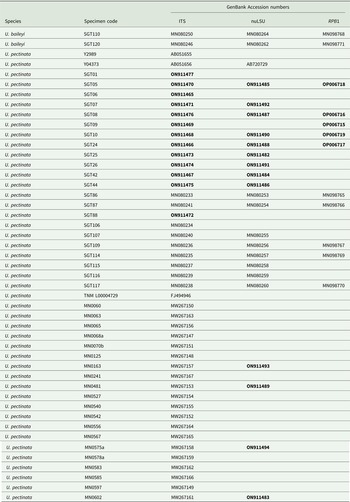
The alignments contained all DNA sequences of ITS, nuLSU and RPB1 of Usnea pectinata available at GenBank NCBI: txid2789761 (with one exception: MW267160.1, last accessed on 27 February 2022), together with newly produced sequences from Tanzania and four newly produced nuLSU from DNA supplied by M. Nadel (Table 2). Sequences of Usnea baileyi, a species in Eumitria close to U. pectinata (Temu et al. Reference Temu, Clerc, Tibell, Tibuhwa and Tibell2019), were chosen as outgroup for the phylogenetic analyses. The sequences were assembled and edited using AliView (Larsson Reference Larsson2014) and aligned with MAFFT v. 7 (https//mafft.cbrc.jp/alignment/server/).
Usnea species used in the DNA analyses, with specimen codes and GenBank Accession numbers of sequences. Newly produced sequences are in bold.

In this study two datasets were analyzed. The first consisted of a concatenated matrix of three markers (ITS, nuLSU and RPB1) whereas the second consisted of ITS sequences only. Phylogenetic relationships were inferred using a Bayesian approach, and additional support values were estimated using maximum likelihood bootstrap support (ML). A conflict among single-locus datasets was considered significant if a well-supported monophyletic group (posterior probability (PP) ≥ 0.95) was found to be non-monophyletic with good support when different loci were used.
For the Bayesian analyses, the most likely models of evolution were estimated using the Akaike Information Criterion (AIC) as implemented in MODELTEST v. 3.7 (Posada & Crandall Reference Posada and Crandall1998). The models employed for the first dataset were HKY + I for ITS and nuLSU, and HKY for the RPB1, whereas for the second dataset the GTR + G model was used. The Bayesian analysis was performed using MrBayes v. 3.2.6 (Ronquist et al. Reference Ronquist, Teslenko, van der Mark, Ayres, Darling, Höhna and Huelsenbeck2012), where two analyses of two parallel runs were carried out for 10 M generations. Each run included four chains and trees were sampled every 1000 generations, with 25% discarded as burn-in. All runs converged on the same average likelihood score and topology. Further analyses for a three-marker phylogeny were performed after concatenation using Sequence Matrix (Vaidya et al. Reference Vaidya, Lohman and Meier2011).
Additional support for each dataset was obtained using maximum likelihood estimates from RAxML v. 8.2.10, with the GTR + G model of site substitution (Stamatakis Reference Stamatakis2014). The branch support was acquired by maximum likelihood bootstrapping of 1000 replicates (Hillis & Bull Reference Hillis and Bull1993), and ML ≥ 70% were considered to be significant.
The trees were visualized in FigTree v. 1.3.1 (Rambaut & Drummond Reference Rambaut and Drummond2010) and edited using Adobe Illustrator CC 2017.0.2.
Results and Discussion
We produced 31 new sequences (13 ITS, 13 nuLSU and 5 RPB1; Table 2). The concatenated dataset comprised 24 terminals, with 19 representatives from Tanzania, four from São Tomé and Príncipe, and one from Indonesia; two Usnea baileyi sequences served as outgroup. Analyses were performed on each marker separately: 25 sequences for ITS, 24 sequences for nuLSU and 12 sequences for RPB1. No significant incongruence among single marker trees was detected, and so the three matrices were concatenated. In total, there were 1932 nucleotide positions (483 bp for ITS, 807 bp for nuLSU and 642 bp for RPB1). The second (ITS) dataset consisted of 47 terminals, including two as outgroup.
Three-marker phylogeny of the Usnea pectinata aggregate
A consensus phylogenetic tree of the U. pectinata aggregate based on three markers was produced (Fig. 1). In this ‘backbone’ phylogeny, the U. pectinata aggregate forms a well-supported monophyletic group, receiving maximum support from both Bayesian and maximum likelihood analyses. Six distinct subclades (A–F; Fig. 1) receive strong support, indicating considerable genetic variation in the dataset. Subclade A has maximum support (1.00 PP and 100% ML) and consists of three terminals, two from São Tomé and Príncipe and one from Tanzania. The subclades B–F are likewise well supported and contain exclusively representatives from Tanzania.
Consensus tree based on the Bayesian and maximum likelihood (ML) analyses of concatenated ITS, nuLSU and RPB1 of the Usnea pectinata aggregate. The tree was rooted using Usnea baileyi. The two support values associated with each internal branch correspond to posterior probability (PP) and bootstrap support (ML), respectively. Branches in bold indicate a support of PP ≥ 0.95 and ML ≥ 70%. An asterisk on a bold branch indicates that this node has maximum support in both analyses. Subclades A–F are highlighted by shaded boxes and further details for the specimens included are given in Table 2.

ITS phylogeny, and the phenotypic and chemical variation in the Usnea pectinata aggregate
An ITS tree of the U. pectinata aggregate, in which morphological, chemical and geographical features have been mapped, is presented in Fig. 2. The phylogeny includes all ITS sequences of the U. pectinata aggregate specimens in Fig. 1 and an additional 21, of which 13 are newly produced in this study and two represent U. pectinata s. str. downloaded from GenBank (Table 2). In the ITS phylogeny, the monophyly of the U. pectinata aggregate received maximum support from both Bayesian and maximum likelihood analyses.
ITS phylogeny based on Bayesian and ML analyses of the Usnea pectinata aggregate along with morphological and chemical data. The two support values associated with each internal branch correspond to posterior probability (PP) and bootstrap support (ML), respectively. Branches in bold indicate a support of PP ≥ 0.95 and ML ≥ 70%. An asterisk on a bold branch indicates that this node has maximum support in both analyses. Full square shade = main chemical substance; small coloured dot = accessory chemical substance; dash = unknown. Usnic acid is found in all specimens and is therefore not indicated. Axis pigmentation: pale brown circle = pale brown pigmentation; brown circle = brown; black circle = dark brown. Branch shape: white circle = terete; flattened white circle = flattened; triangles = alate; pentagon = ridged. Geography: I = Indonesia; J = Japan; S = São Tomé; P = Príncipe; Tw = Taiwan; T = Tanzania. Subclades A–F are indicated and, where necessary, highlighted by a shaded box. Further details for the specimens included are given in Table 2.

All well-supported subclades in Fig. 1 (concatenated analysis) are also well supported in Fig. 2 (ITS analysis). Subclade G (Fig. 2) contains two representatives from Asia and is well supported. Some of the subclades (B, C & F; Fig. 2) have quite a uniform chemistry and morphology. Some branches in Fig. 2 did not receive strong support, meaning that their position on the tree remains unclear.
Usnic acid was present in all specimens. A total of six chemotypes, according to the main substances, were observed (Fig. 2): 1) protocetraric acid; 2) constictic acid; 3) protocetraric and constictic acids; 4) salazinic and diffractaic acids; 5) constictic and diffractaic acids; 6) salazinic acid. The chemotype containing stictic, norstictic, cryptostictic, menegazziaic and constictic acids reported by Ohmura (Reference Ohmura2001) was not observed in this study. However, in Fig. 2 stictic acid is present only in specimens reported by Ohmura (Reference Ohmura2002) from Japan and Indonesia. Recently, these specimens (Y2989, Y04373), loaned by Y. Ohmura, were studied by PC and the material corresponds well with the type of Usnea pectinata.
The specimens studied here were found to mainly produce two secondary products: protocetraric acid as the only main substance was noted in 13 specimens, 11 from Tanzania and two from São Tomé and Príncipe; constictic acid as the only main substance was observed in 10 specimens (seven from Tanzania and three from São Tomé). Salazinic plus diffractaic acids, and protocetraric plus constictic acids, were recorded in four and six specimens respectively, all originating from São Tomé and Príncipe. Diffractaic and constictic acids were found in five specimens, three originating from Tanzania and two from São Tomé. Salazinic acid as the main substance was recorded in only one specimen from Tanzania. The chemistry of three of the specimens included in the molecular study remains unknown.
Usnea species are known to have a variable secondary chemistry. For example, four chemotypes were reported in U. gigas: fumarprotocetraric acid, psoromic acid, salazinic acid and diffractaic acid (see Table 1; Swinscow & Krog Reference Swinscow and Krog1978).
Axis pigmentation and branch shape are highly variable in the U. pectinata aggregate, as studied here (Fig. 3). The specimens displayed three morphotypes with respect to axis pigmentation and four in branch shape (Fig. 2). The variation in axis pigmentation is depicted in Fig. 3 (A–H), which includes a selection of eight representatives (out of 45 terminals; Fig. 2) for two morphotypes (light brown and black) from four subclades. The branch shapes were terete, ridged, and alate to flattened. Twenty specimens were found to have terete branches, while in 13 they were ridged. Both types of branch were found in specimens from Tanzania and São Tomé and Príncipe. The morphotype with flattened branches was represented by three specimens from São Tomé and Príncipe only. Terete/ridged and ridged/alate branches were found in Tanzanian specimens only, in one and five specimens respectively.
Images of the Usnea pectinata aggregate specimens (Table 2) showing a section of the central axis. The specimen code (bottom left) is usually followed by a slash (/) and a subclade indication, with the addition of a pale brown circle (pale brown pigmentation), or black circle (dark brown pigmentation). Scale = 0.1 mm.

The central axis was pale to dark brown and this variation is mapped among the features in Fig. 2. The axis colour of representatives of the subclades B, D, F and C (Fig. 2) was correlated with chemistry and morphology. In subclade A the specimens have a pale central axis (as in SGT86 and SGT06; Fig. 3A & B) and there are two chemotypes present: four specimens contain salazinic and diffractaic acids, while two have protocetraric acid. The branch shape (terete) is uniform. In subclade B the central axis is dark brown (SGT26 and SGT07; Fig. 3C & D) and correlates well with the chemistry (protocetraric acid) and branch shape (ridged/alate). In subclade C the central axis is likewise dark brown (Fig. 3E), and both chemistry (protocetraric acid) and branch shape (ridged) are uniform. Subclade D is uniform with respect to central axis pigmentation (dark brown) and chemistry (protocetraric acid), and the branch shape is ±uniform (ridged). In subclade E there is variation in both axis pigmentation (Fig. 2, SGT106; Fig. 3F) and chemistry. Out of the four specimens in this subclade, two have constictic acid and two have protocetraric acid as main substances. The branch shape is ±uniform (terete). Subclade F (three specimens from Tanzania) is uniform with respect to pigmentation (dark brown) and chemistry (constictic and diffractaic acid), while branch shape is ±uniform (ridged). Overall, the central axis displays considerable variation in colour and texture (Fig. 3A–H) in this preliminary investigation and further work on morphology with more material of the U. pectinata aggregate worldwide is called for.
In our results, a correlation between chemistry, morphology and molecular data was observed in the majority (4 out of 6) of the well-supported subclades. We have used the name U. pectinata aggregate as a place-holder for what we see as a species complex that requires extensive taxonomic work for its clarification. This view of the U. pectinata aggregate as a species complex might well be in line with the views of Ohmura (Reference Ohmura2008), Wirtz et al. (Reference Wirtz, Printzen and Lumbsch2008), Kelly et al. (Reference Kelly, Hollingsworth, Coppins, Ellis, Harrold, Tosh and Yahr2011), Saag et al. (Reference Saag, Torra, Saag, Del-Prado and Randlane2011), Truong et al. (Reference Truong, Yahr, Crespo and Clerc2013a) and Gerlach et al. (Reference Gerlach, Toprak, Naciri, Caviró, da Silveira and Clerc2019), who all reported that species described on morphological and chemical characters are usually monophyletic. More specimens from different parts of the world should be studied before making any taxonomic/nomenclatural decisions on this difficult group. Morphological features do warrant closer anatomical studies.
Conclusion
A total of 31 (13 ITS, 13 nuLSU and 5 RPB1) sequences for the U. pectinata aggregate were generated in this study as the basis for phylogenetic investigations of the group. A phylogeny based on three markers was supplemented by an ITS analysis revealing the occurrence of several well-supported subclades found in both phylogenies. These subclades were also often quite consistent in chemistry and morphology and may well represent separate species in the complex referred to here as the U. pectinata aggregate. Therefore, we support our second hypothesis that we do have several small, strongly supported genetic clades that correlate with morphology and secondary chemistry. This is in line with previous studies in the group (Gerlach et al. Reference Gerlach, Toprak, Naciri, Caviró, da Silveira and Clerc2019), where a clade that is uniform in chemistry and morphology was found to be a species. Here we suggest two sequences to represent Usnea pectinata s. str. (GenBank AB051655 and AB051656; Ohmura Reference Ohmura2002). We wish to emphasize that this study is a first step towards understanding the U. pectinata aggregate and that in order to connect already existing (‘historical’) species names with potential subclades in the group, comprehensive studies of a geographically wider sampling are needed, and eventually also the sequencing of the type materials.
Acknowledgements
Our gratitude goes to Ms Ana Palma de Figueiredo at the Conservatoire et Jardin Botanique de la Ville de Genève (CJBG), where the chemical studies were carried out, Mr Frank Mbago (UDSM) for his help in identifying host plants, and to local field guides and the local community for their cooperation throughout the study. We would like to sincerely thank two anonymous reviewers for their valuable comments.
Author ORCIDs
Stella G. Temu, 0000-0002-9590-578X; Philippe Clerc, 0000-0003-1453-0865; Miko R. A. Nadel, 0000-0001-8367-4139; Leif Tibell, 0000-0002-8629-7989; Sanja Tibell, 0000-0003-4143-9856.
Funding
This work was supported by the Swedish International Development Cooperation Agency (SIDA) – UDSM-SIDA, Project No. 2221.