The prevention of methicillin-resistant Staphylococcus aureus (MRSA) healthcare-associated infections has been a priority at many acute care hospitals. To this end, many hospitals routinely screen patients for nasal MRSA carriage and place identified carriers on contact precautions.Reference Chaberny, Schwab, Ziesing, Suerbaum and Gastmeier1–Reference Jain, Kralovic and Evans7 The rationale for these practices is that healthcare workers caring for MRSA-positive patients can contaminate their hands or clothing and thereby serve as vectors of MRSA transmission.Reference Boyce, Havill, Kohan, Dumigan and Ligi8, Reference Boyce, Potter-Bynoe, Chenevert and King9
Current screening and isolation techniques treat all MRSA nasal carriers equally even though some MRSA-carriers may be more likely sources of transmission than others. Among all MRSA nasal carriers, 60% are colonized in both the nose and at least one other body site.Reference Baker, Brecher, Robillard, Strymish, Lawler and Gupta10–Reference Shurland, Stine and Venezia12 Patients colonized at multiple body sites with S. aureus are at higher risk of transmitting S. aureus than patients colonized solely in the nares.Reference Ridley13, Reference Rohr, Kaminski, Wilhelm, Jurzik, Gatermann and Muhr14 Certain sites of MRSA colonization are associated with high rates of environmental contamination, particularly the urine, wounds, groin, and the gastrointestinal tract.Reference Boyce, Potter-Bynoe, Chenevert and King9, Reference Rohr, Kaminski, Wilhelm, Jurzik, Gatermann and Muhr14, Reference Boyce, Havill, Otter and Adams15 Environmental contamination is a predictor of bacterial transmission to the attire of healthcare workers.Reference Morgan, Rogawski and Thom16
A few studies have suggested that the burden of nasal colonization is also an important determinant of transmission. In an older report, carriers with <100,000 colonies of S. aureus in the nares were at no greater risk of dissemination than noncarriers.Reference White17 In a more recent study, a quantity of MRSA in the nares <500 colony-forming units was associated with less skin colonization and less environmental contamination.Reference Chang, Sethi, Stiefel, Cadnum and Donskey18 However, current MRSA nasal-screening techniques make no distinction between heavy and low bacterial burdens.
In this study, we sought to determine whether using the real-time polymerase chain reaction (PCR) in a quantitative manner and routinely assessing for extranasal colonization could help predict which MRSA nasal carriers were more likely to contaminate their hospital surroundings.
Methods
The Richard Roudebush Indianapolis Veterans Affairs Medical Center is a 200-bed, tertiary-care facility. As part of the MRSA Prevention Initiative, swabs from the anterior nares are collected from each patient upon admission, transfer, and discharge.19 These nasal samples are analyzed using the Lightcycler 2.0 (Roche Diagnostics, Indianapolis, IN). According to the manufacturer’s protocol, a positive result is produced with 95% confidence for a swab containing 240 colony-forming units. The laboratory routinely uses positive and negative controls supplied by the manufacturer when running this test.
Patients
Patients from any medical unit (except psychiatry) were eligible for inclusion within 72 hours of hospital admission or room transfer if the hospital’s MRSA nasal swab was positive at the time of room assignment. Patients were excluded if, at the time of screening, they were likely to have an active MRSA infection, as defined by a clinical culture growing (1) Gram-positive cocci in clusters, (2) S. aureus with susceptibilities pending, or (3) MRSA. Patients were also excluded if they had been treated with nasal mupirocin or chlorhexidine body wash within the past month.
Patients were enrolled by 1 of 2 investigators (S.A. or D.L.) between July 13, 2012, and August 19, 2013. Enrollment involved collection of culture samples, including a repeat nasal swab, and the completion of a short survey on hygiene habits at home. Each patient’s medical record was reviewed to extract pertinent information, including relevant comorbidities: diabetes mellitus, intravenous drug use, organ transplantation, hemodialysis, liver cirrhosis, skin disease, malignancy, or human immunodeficiency virus (HIV) infection. For the duration of this study, Environmental Services was not cleaning high-touch surfaces on a daily basis. Terminal cleaning of all rooms was performed with a standard disinfectant, Wexcide (Wexford Labs, Kirkwood, MO).
Sample Collection and Processing
Sterile, premoistened rayon swabs (bioMérieux SA, Marcy l’Etaile, France) were used to sample all body and environmental sites in a standardized fashion.
The nasal culture, which included 2 swabs, was processed as follows: the 2 swabs were rubbed against each other using a circular motion to ensure equal distribution of bacteria. One of these swabs was analyzed using the Roche Lightcycler (Indianapolis, IN), and the cycle threshold value (CT) was recorded. The CT value is the cycle number at which MRSA DNA is first detected; it is inversely proportional to the amount of MRSA on the sample.
The second nasal swab was resuspended in 1 mL of sterile water; 1-µL and 10-µL calibrated loops were used to inoculate separate ChromeID MRSA agar plates (bioMérieux SA). The second nasal swab was also suspended in 6.5% sodium chloride. Likewise, the swabs from all extranasal and environmental sites were cultured on ChromeID MRSA agar. All plates were incubated at 35°C for 48 hours. At 24 and 48 hours, plates were examined for the presence of green-colored colonies. An accurate colony count was only performed on the plates from the second nasal swab; a semi-quantitative count was performed for all other cultures. For each case, the nares isolate and one randomly chosen isolate from a body site and the environment, if positive, were typed by pulsed-field gel electrophoresis (PFGE) as previously described.Reference McDougal, Steward, Killgore, Chaitram, McAllister and Tenover20
Statistical Analysis
The continuous variables (eg, quantitative nares culture and CT values) were summarized using median and interquartile range (IQR). The categorical variables (eg, environmental contamination and extranasal colonization) were summarized using frequency and percentage. The association of environmental contamination and extranasal colonization with categorical and continuous covariates was evaluated through Fisher’s exact test and Wilcoxon rank sum test, respectively. Logistic regression was used to model environmental contamination in terms of log MRSA count, and threshold values were determined using a receiver operating characteristic (ROC) curve. All the statistical tests were 2-sided and were conducted using R statistical software, version 2.15.1 (http://cran.us.r-project.org) with a significance level of P<0.05.
The protocol and conduct of this study were reviewed and approved by the Indiana University Institutional Review Board.
Results
We enrolled 94 patients in this study. The median age of the 94 patients was 63 years (IQR, 57–71); 96% of the patients were men and 89% were white.
In 12 patients, the study nasal swab did not yield a positive PCR result for the following reasons: negative PCR test (8), no PCR result provided due to the presence of inhibitors on the swab (3), and loss of specimen (1). Therefore, 82 patients had a positive MRSA nasal swab by PCR at the time of enrollment.
In the 82 cases with a positive PCR test for MRSA nasal colonization, the median CT value was 29.8 (IQR, 26.7–32.2). The median colony count on nares quantitative culture was 200 (IQR, 10–40,000). In 11 patients (13%), the nares quantitative culture yielded a colony count >100,000. In 14 patients (17%), the colony count was 0. A negative correlation of moderate strength was observed between the CT value and the number of MRSA colonies in the nares (r=−0.61; P<0.01). A poor correlation was observed between CT values collected by the hospital nurse and the research team (r=0.34; P<0.01).
The CT value was not significantly different in patients with a prior history of MRSA infections (yes [30.2] vs no [29.0]; P=0.23) or in patients with or without comorbidities (29.8 vs 28.5; P=0.10).
At the time of study enrollment, 53 patients (65%) were on antibiotics. The degree of nasal colonization, as measured by the CT value, was lower in patients on antibiotics compared to those who were not (CT value, 30.5 vs 27.7; P<0.01). Notably, only 3 patients were on antibiotics traditionally thought to affect nasal carriage: doxycycline (2) and trimethoprim/sulfamethoxazole (1). A total of 26 patients were on antibiotics with anti-MRSA activity: vancomycin (23), clindamycin (2) and trimethoprim/sulfamethoxazole (1). Two of the patients on anti-MRSA antibiotics were also receiving doxycycline. Patients on an anti-MRSA antibiotics had higher CT values (ie, less nasal colonization) than those not receiving anti-MRSA antibiotics (CT value, 30.8 vs 28.6; P<0.01).
Extranasal MRSA Colonization
At least 1 body site was colonized in 58 (70.7%) patients. The most common body sites colonized were the groin (53.7%), chest wall (40.2%), abdominal wall (29.3%), axilla (28.0%), and forearm (20.7%). The urine culture was MRSA-positive in 3 (4.2%) of the 70 patients tested. In 14 patients with open wounds, 7 (50%) had wound colonization with MRSA.
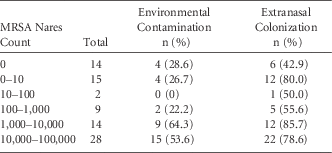
The median nares CT value in patients with extranasal colonization was comparable to that of patients without extranasal colonization (28.9 vs 29.8; P=0.60). The median log MRSA nares count in the patients with extranasal colonization was also comparable with that of those who did not (3.48 vs 2.30; P=0.06). We did not observe any association (Table 2; P=0.08) in the proportion of patients with extranasal colonization and different degrees of MRSA nares colonization.
Environmental Contamination with MRSA
At least 1 environmental surface was contaminated in 34 (41.5%) patients. The frequency of contamination was as follows: call button (23.2%), bedside table (22.0%), telephone (17.1%), and bedrail (14.6%). In 30 of 30 patients (100%) with environmental contamination whose isolates underwent PFGE typing, the environmental isolate had the same PFGE type to the nares and/or body-site isolate.
Table 1 shows the association between measured covariates and environmental contamination. Environmental contamination was significantly associated with extranasal colonization at certain body sites, including the abdominal wall (P<0.01), chest wall (P<0.01), forearm (P=0.01), and groin (P<0.01). The median nares CT value was lower in patients with environmental contamination than in patients without environmental contamination (27.5 vs 30.3; P<0.01). The median log MRSA nares count was also significantly higher in the patients with environmental contamination than those without (3.90 vs 2.45; P=0.01). The proportions of environmental contamination based on different levels of MRSA nares colonization are displayed in Table 2. The incidence of environmental contamination was significantly higher in patients with MRSA nares counts >1,000 (57.1% vs 25%; P<0.01).
Factors Associated with MRSA Contamination of the Hospital Environment in 82 Patients with Known MRSA Nasal Colonization
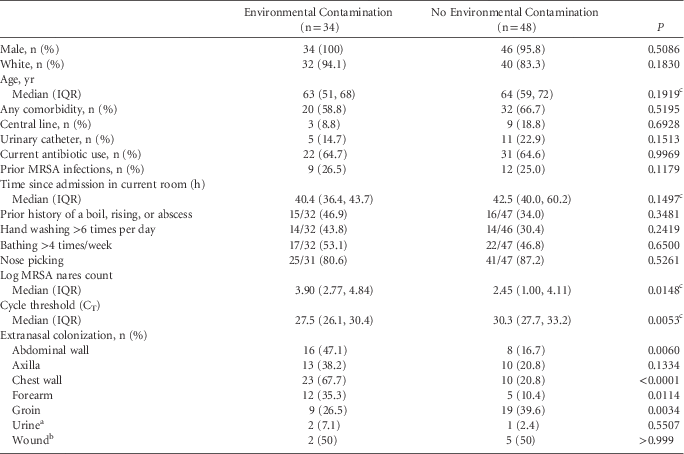
NOTE. MRSA, methicillin-resistant Staphylococcus aureus; IQR, interquartile range.
a Urine cultures were examined in 28 and 42 patients, respectively.
b Wound cultures were examined in 4 and 10 patients, respectively.
c P value based on Wilcoxon rank sum test. Otherwise, P is based on Fisher’s exact test.
Prevalence of Environmental Contamination and Extranasal Colonization Based on the MRSA Nares Bacterial Count
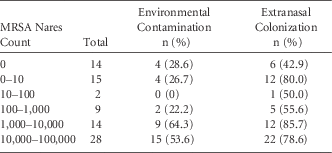
NOTE. MRSA, methicillin-resistant Staphylococcus aureus.
Using logistic regression, environmental contamination was modeled with log MRSA nares count as the only predictor. The associated ROC curve was not helpful in identifying environmental contamination. For example, using a cutoff of 13, the nares count can correctly identify 76% of the cases with environmental contamination, but its ability to identify patients without any environmental contamination is very poor (50%).
Discussion
Prior studies have demonstrated that the burden of S. aureus nasal colonization is predictive of extranasal colonizationReference Mermel, Cartony, Covington, Maxey and Morse21 and environmental contamination.Reference White17, Reference Chang, Sethi, Stiefel, Cadnum and Donskey18 Environmental contamination is a predictor of bacterial transmission to the attire of healthcare workers.Reference Morgan, Rogawski and Thom16 However, current methods for MRSA nasal screening make no distinction between heavy and low bacterial burdens.
In this study, patients who had higher nasal burdens of MRSA were more likely to contaminate the hospital environment with MRSA. This was true whether the nasal burden was measured by the CT value or by quantitative culture. However, this study was unable to identify a threshold level of MRSA nasal colonization that would reliably exclude any MRSA contamination of the hospital surroundings. It is tempting to speculate that low-level MRSA carriers may have only produced low-level environmental contamination, but this study was not designed to assess environmental contamination in a quantitative fashion.
Certain body sites were more likely to be associated with environmental contamination: abdominal wall, chest wall, forearm, and groin. These areas are in frequent contact with healthcare workers’ hands and other equipment, so the association with environmental contamination is biologically plausible. A prior report also found that groin colonization was a significant predictor of environmental contamination.Reference Rohr, Kaminski, Wilhelm, Jurzik, Gatermann and Muhr14
Higher MRSA nares count were not associated with more frequent extranasal colonization. In a study of 60 adults, there was a correlation between higher MRSA nares counts and the likelihood of extranasal colonization, but the use of systemic antibiotics was not reported, an important difference from the current project.Reference Mermel, Cartony, Covington, Maxey and Morse21 In addition, because some MRSA carriers are primarily colonized at an extranasal site, such as the groin,Reference Eveillard, de Lassence, Lancien, Barnaud, Ricard and Joly-Guillou22–Reference Matheson, Christie and Stari24 a positive correlation between nares colonization and extranasal carriage may not be expected.
In this study, antibiotic use was associated with less MRSA colonization of the nares. This association was seen even though very few patients were receiving systemic antibiotics used for decolonization of the nares. Furthermore, patients who were on antibiotics with anti-MRSA activity—primarily parenteral vancomycin—had lower colony counts than those who were not receiving anti-MRSA therapy. Although parenteral vancomycin is not thought to affect MRSA nasal colonization, prior studies have not assessed vancomycin’s effect on nasal colonization in a quantitative manner.Reference Yu, Goetz and Wagener25, Reference McConeghy, Mikolich and LaPlante26 Based on our findings, the effect of parenteral vancomycin on MRSA nasal colonization may be more complicated than previously described.
A standardized method for swabbing the nares is important to accurately assess the degree of MRSA nasal colonization. In agreement with a prior report, we found a negative correlation between the CT value and the number of MRSA colonies in the nares.Reference Stenehjem, Rimland, Crispell, Stafford, Gaynes and Satola27 We found a poor correlation between the CT value from the study’s nasal swabs and the nasal swabs collected by the hospital nurses. We believe this poor correlation reflects a wide variability in collection techniques. While all study swabs were collected by 1 of 2 investigators using a standardized approach, hundreds of different hospital nurses collected nasal swabs on behalf of the hospital’s MRSA program.
This study has several strengths. We used a consistent, standardized approach to assessing the degree of MRSA colonization and environmental contamination in a defined cohort of hospitalized patients. Other factors predictive of environmental contamination were assessed through a survey and chart review. PFGE was performed on nearly all environmental isolates to determine whether they originated from the patient. Even though the PFGE types matched, we cannot exclude the possibility that these isolates actually reflected contamination from prior room occupants.
Our study had some limitations. First, our cohort largely included elderly white men, so our findings may not be generalizable to other populations. Second, an insensitive technique (ie, swabbing) was used to test for environmental contamination. Because we used the same sampling technique for all patients’ rooms, it is doubtful that this would have introduced bias into our results. Third, although we assumed that rubbing the 2 nasal swabs together would equally distribute the bacteria, we did not validate this assumption. Fourth, the amount of time patients spent in their rooms prior to enrollment was not standardized, which may have introduced variability into our results. In our analysis, the amount of environmental contamination did not differ by time spent in the room. Fifth, the effect of prior nasal swabs on the current degree of MRSA colonization is unknown, and our study did not assess the day-to-day variability in MRSA burden. Eight patients found to be MRSA-positive on admission were no longer MRSA-positive at the time of enrollment, which suggests that there may have been intermittent nasal carriage of MRSA.Reference Wertheim, Melles and Vos28 Finally, behavioral factors were based on patient self-reporting, which may have been prone to bias. In addition, hygiene habits at home were assessed, but these may not reflect hygiene habits in the hospital.
In conclusion, patients with a higher burden of MRSA in their nares, as determined by CT value, are more likely to have environmental contamination with MRSA. However, contamination of the environment cannot be predicted solely by the degree of MRSA nasal colonization.
Acknowledgment
Financial support. This project was supported by a Project Development Team within the ICTSI NIH/NCRR Grant No. UL1TR001108.
Conflicts of interest. All authors report no conflicts of interest relevant to this article.