Introduction
Women's publishing experienced an unprecedented moment between the late 1960s and early 1990s, generally referred to as the second wave of feminism, that is yet to be experienced again on the same scale and with the same level of independence. With publishing epicentres located throughout the UK, the US, Canada, continental Europe and India, the development of women's publishing was international in its reach. Women's bookstores, publishers, periodicals, distributors, editors and printers acted as a foundational mechanism for feminist theory to circulate and develop during this period. Different strands of feminist thought and organizations connected through the circulation of periodicals contributed a significant communications network to the Women's Liberation Movement.
For media historian Lisa Gitelman the ‘specific moments in the expansion of the scriptural economy’ are important ‘less because of the technological innovations associated with them than because of the enlarged and enlarging constituencies that those innovations had a role in enabling.’Footnote 1 Second wave feminist networks developed not merely through the medium of circulated periodicals, but rather through the way the printed circulation of communication enabled the emergence of what critical theorist Nancy Fraser calls subaltern counterpublics.Footnote 2 The growing surge of feminist periodicals signalled that there were ‘parallel discursive arenas where members of subordinated social groups invent and circulate counterdiscourses.’Footnote 3
Here I argue that these parallel discursive arenas are most clearly manifested in the ‘letters’ sections of feminist periodicals, through which women could express their disagreements or appreciations of articles (and often of other letters) previously published.Footnote 4 These differences of temperament, or rather clashes of opinion, were made possible within feminist periodicals because they allowed readers to feel part of a much larger entity through the constant calls for contributions and participation. Casting the net widely meant that discord and disagreement was often at the heart of the letters pages. This paper focuses on these conflicts and debates in order to counter the retrospective representation of second wave feminism as a coherent, unified movement.
The letters pages of second wave feminist periodicals reveal the presence of rich and diverse areas of concern during the Women's Liberation Movement; without this disagreement and ideological conflict the ongoing development of feminist theory could not have progressed. First published in 1976, the small-press bestseller Constructive criticism: A handbook by Gracie Lyons emphasized that it is a mistake for activist movements to emphasize unity at all costs, often resulting in the smoothing over of differences. Instead of seeing struggle as bad, it should be understood as necessary to advance the movement and ideological thought. I use Lyons’ approach to consider conflicts within second wave feminist periodicals not as failures, but as evidence of a diverse, self-critical, and ever-evolving counterpublic that was enabled by, and remained connected through, a woman-controlled communications infrastructure.
In order to demonstrate this effectively, I use Social Network Analysis tools to visually map disagreements surrounding the 1982 Lebanon war in the second-wave periodicals Spare rib, Trouble & strife, Revolutionary/radical feminist newsletter and Outwrite. The war provoked important discussions about anti-Zionism and anti-Semitism within feminist communities. At the heart of my approach lies the emphasis on plurality of opinion, connected through autonomously controlled women's publishing networks. Not only can the visual mapping of these tensions and communications provide a nuanced and lively account of issues with which second wave feminists were grappling at the time, but it also shows how feminist periodicals allowed for their readers to understand themselves as writers and contributors. I argue that by unravelling the communication found in feminist periodicals, we can resist what Joan Scott calls a ‘fantasy echo’ in which versions of past movements are rooted more in imagination and desire than in historical evidence.Footnote 5 In this instance, the recirculation of communication between second wave feminists bolsters the potential of the periodical document as a historical source to evidence plurality, and the visual mapping of disagreement within feminist periodicals demonstrates the effectiveness of a printed and woman-controlled communications network for allowing the development of feminist theory.
Feminist periodicals and network thinking
By thinking of periodicals as connecting agents, they can offer insights into the way in which feminist discourse and theory has been shaped by the circulation of printed material. In Liberation in print (2017), Agatha Beins has noted that periodicals were instrumental in the formation of US feminism, that they ‘mattered not only because they provided information but also because they gave women a feeling of connection to others in a larger struggle.’Footnote 6 In The tyranny of structurelessness, Jo Freeman observes that the purpose of second wave feminist periodicals ‘was to reach any potential sympathizer in order to let her know that there were others who thought as she did and that she was not isolated or crazy.’Footnote 7 The development of a discursive counterpublic, and thus feminist theory itself, was made possible through the connection and communication offered by periodicals.
Rolling our own: Women as printers, publishers and distributors (1981) was one of the first UK studies of feminist publishing, while also illuminating the role of periodicals. The occasional periodical Catcall aimed to ‘encourage and stimulate the exchange of ideas and the development of theory within the Women's Liberation Movement.’Footnote 8Catcall’s goal was to be an internal discussion paper for the movement, creating
a place where women describe their politics and argue with one another, cutting across the lines between the groups talking only to their members or trying to convert everyone else.Footnote 9
Similar approaches could be found across most periodical titles as a by-product of having lenient editorial policies for the letters pages. Even Spare rib noted that they
sometimes feel women have tried hard, they're expressing a point of view that's important, or they're talking from an experience we haven't dealt with before, and we feel we must print it, even if the article isn't quite what we'd anticipated.Footnote 10
This deliberate inclusion of perhaps unexpected or unsolicited contributions can widen what Nancy Fraser calls discursive contestation, and thus can also enable counterpublics to partially offset participatory privileges of ideologically monolithic social groups.Footnote 11Rolling our own highlights the fact that commissioning articles or letters was rare for feminist periodicals, instead they relied on the reader to understand herself as belonging to the production and dissemination of the publication. The distinct categories of ‘publisher’, ‘reader’ and ‘contributor’ became blurred which allowed for responsive and active participation from all sides.
Reader's participation and contributions also heavily relied on a network of periodicals that would raise awareness about new publications and expand the readership of women. Martha Allen found that
more than 1,380 periodicals owned and operated by women as well as 375 other media forms emerged between 1968 and 1983. The development of this network has been unprecedented in women's history.Footnote 12
The networking characteristic of second wave print activity is the basis on which the dissemination of ideas was made possible. In Gyn/ecology, Mary Daly defines a network as a ‘tapestry of connections woven and re-woven by Spinsters and Websters’ and that this carries with it the possibility for a new kind of feminist space which is ‘created on the boundaries of patriarchal institutions where women create real alternatives and presence.’Footnote 13 Such transformative possibilities were particularly well served by print media of the 1970s and 1980s, as women with little or no experience could still make use of the low-barrier and inexpensive materials to start their own networking initiatives. This is evidenced in the Swindon women's network newsletter, for example, which was a humbly typed, duplicated and stapled newsletter that was produced in order to share articles from different local women's groups, letters, poems, stories, and drawings:
in this way, we hope to keep all women informed of the activities of the women's groups in Swindon, and to act as a forum for all women to air their views and ideas.Footnote 14
By regularly circulating such information among their readership, it ensured that women who were unable to attend the monthly meetings still felt connected and involved.
Similarly, Cait McKinney's research on the US lesbian feminist newsletter Matrices shows that the periodical medium facilitated a network that functioned both as a conceptual model in which ‘networked communication is articulated to the political goals of feminist print culture and of feminist historiography’,Footnote 15 as well as a practical model for uniting women through the actual creation of decentralized communication systems.
Case study
To repeat, I explore four foundational UK second wave feminist periodicals: Spare rib, Trouble & strife, Revolutionary/radical feminist newsletter and Outwrite - accessed at the Glasgow Women's Library archives. All four periodicals overlapped during the early-mid 1980s, leading to the joint coverage of the Lebanon War of 1982 and how it influenced and affected politics between Palestine and Israel. The war began when the Israel Defense Forces (IDF) invaded southern Lebanon in order to target the Syrian production of surface-to-air missiles as well as being a reaction to the bombing of northern Israel by the Palestine Liberation Organization (PLO) one year earlier. Feminists were invested in covering the political implications of this war because Palestinian, Lebanese, and Jewish women were involved with the women's movement in the UK, and many had opposing views on how the war was being reported.
By July 1982 the Lebanese war had become official and was covered as a centrespread in the fourth issue of Outwrite, featuring several articles written by ‘Palestinian, Lebanese and Israeli Anti-Zionist women.’Footnote 16 This included testimonials of Palestinian women who had been imprisoned and experienced violence by the Israeli government, in addition to a Jewish woman describing the Zionist views she was taught in school and that she had decided to leave the country to avoid serving in the Israeli army. The subsequent page featured two letters, collectively written by Jewish women who adopt slightly opposing arguments. While the first letter suggested that singling out Israel as the sole aggressor towards Palestine is an incomplete account and feeds into anti-Semitic biases; the second letter simply condemned the Israeli occupation. The issue over anti-Semitism and anti-Zionism became so contentious that Outwrite decided to publish a statement about their centrespread feature which, they said, had provoked threats of physical violence towards the collective. The statement clarifies that
OUTWRITE is not a liberal paper. It is consciously biased towards women, Black, “Third World” and working class women, and towards the issues relevant to them, to their existence and struggles. Therefore, in as much as we will never publish any letter that tries to defend apartheid or suggest that is has an “acceptable” face, we have decided not to publish any Zionist or pro-Zionist letters.
This editorial policy outraged some readers so much that the Outwrite collective ‘received bomb threats and individual threats’ and had been ‘likened to the Nazis’.Footnote 17
The issue of Zionism spilled over into Spare rib — perhaps the best-known of all feminist periodicals — in August 1982. Issue 121 featured an interview in which the author Roisín Boyd interviewed a Lebanese woman, a Palestinian woman and an Israeli woman under the headline ‘Women speak out against Zionism’. The Israeli woman, Aliza Khan, emphasized that ‘women must come out against [Zionism] because our sisters are being murdered’ and that ‘if a woman calls herself feminist she should consciously call herself anti-Zionist.’Footnote 18 Two months later in October 1982, issue 123 featured an article titled ‘About anti-Semitism’ written by the London Jewish Lesbian Feminist Group, which was the same group that wrote the first letter in the fourth issue of Outwrite, this time signed by three additional members. The article was introduced by Spare rib, explaining that ‘Women speak out against Zionism’ generated a flood of letters and merited further discussion. The article responded to claims that ‘unless we're “anti-Zionist” we're not feminists’ and contended that ‘as Jewish feminists the focus on “Zionism” seems to us in itself anti-Semitic and hardly feminist.’Footnote 19 The authors argued that the recent uptake in ‘anti-Zionism’ had legitimized anti-Semitism and made the experience of Jewish women invisible. Another two months later, in January 1983, issue 126 of Spare rib carried an editorial that suggests ways in which the diverging viewpoints can continue being discussed: ‘we have a responsibility to decide how to present struggles and differences between women.’Footnote 20
In May 1983, issue 130 began with another editorial referencing the controversy surrounding Spare rib's stance on Israel and Palestine, describing the difficulties of trying to mediate the division:
The Spare rib collective has been discussing the letters and the issues for months. We have considered various ideas and ways of publishing some of them. Our differences on how to react to and deal with letters which questioned our support of the Palestinian cause divided us then and divide us now, even though membership of the collective has changed by more than half during that time.Footnote 21
The collective went on to describe that they received around 40 letters in response to the article ‘Women speak out against Zionism’ from the previous year. Some members of Spare rib adamantly rejected publishing some of the letters that exhibited ‘extreme Zionism’, while other members of the collective wanted to publish letters that showed a wide array of opinions. The editorial explained that ‘after numerous and exhausting discussions we have decided (not unanimously) not to publish any of the letters we received.’Footnote 22 As a result of attempting to cover both distinct perspectives, they ‘have been attacked from both sides’, but Spare rib still aimed ‘to be open to a continuous dialogue between Jewish women and Palestinian and Arab women.’Footnote 23
The same year, the Revolutionary/radical feminist newsletter published an open letter by Judy Keiner in its 13th issue, which first appeared in the London women's liberation newsletter. It referenced the refusal by Spare rib to publish the ‘flood of letters’ by Jewish women as evidence of a growing anti-Semitic movement amongst feminists:
All the members of the London Jewish Feminist Group agreed that, regardless of their personal position on Zionism, the refusal to publish any of the letters received, many of which were from Jewish feminists, was antisemetic.Footnote 24
The letter went on to detail attempts made by the London Jewish Feminist Group to organize a meeting with Spare rib, which resulted in two formal meetings between the two groups ‘after six months of total silence on [Spare rib's] part’.Footnote 25 Keiner also mentioned the earlier articles published in Outwrite and criticized the ways in which the terms ‘Jew’ and ‘Zionist’ were used interchangeably. Keiner ended her open letter by urging women who write articles for Spare rib to demand that the ‘publication include a statement saying the author/artist protests against or does not condone Spare rib's silencing of Jewish women.’Footnote 26
The following month, June of 1983, a year after the start of the Lebanese war, Spare rib finally decided to publish several dissenting letters from its readers. The subsequent issue of July 1983 introduced the letters section in their table of contents as ‘the controversy rages on (guess which one)’, hinting through the satirical tone at the pervasive nature of the debate at the time. In response to what was surely an onslaught of diverging opinions, Spare rib published an article outlining the various differing views held by the collective itself, which were ‘too great on this issue to try and maintain consensus.’Footnote 27 The article detailed the reasoning behind deciding not to publish the ‘flood of letters’ and discussed censorship, racism, Zionism, anti-Zionism, anti-Semitism and what the implications of those politics are. One of the collective member's accounts ended by describing how Spare rib managed to navigate opposing politics:
[Spare rib] is the sort of magazine that can allow for those sorts of contradictions (that is the strength of the Women's movement and of Spare rib). I hope that in light of us publishing letters from various positions in the last two issues, and now writing ourselves, we can move out of what has felt to me like a deadlock.Footnote 28
One reader, Lesley, addressed the split in the Spare rib collective and, while she could not provide a solution, wrote that
somehow I want to express to you that what you are doing, and precisely the way you are doing it - is a tribute to the WLM's integrity. It has brought the issues into our own homes for women who have perhaps only skirted round the edges of racism before.Footnote 29
Another reader, Stella, attributed the level of discussion to the function of the letters pages themselves:
With letters, all who have something to say, whether generally agreed with or not by the collective and readers - can air their views and be heard, unlike in a public meeting where some women have louder voices, or are more articulate than others. Letters also make public the strength of feeling of opposing viewpoints, which I think we all need to know to even begin to fight what we feel is undesirable in the women's movement.Footnote 30
A third reader, Jane, identified a major problem as being that Spare rib posited itself as representing the women's movement in its entirety. Jane wrote:
Please stop feeling you as a collective can or should solve all the attendant problems of definition just because you run a magazine. Your problems are our problems, and maybe it would help if you were a bit less purist, a bit more materialist, and had less sense of carrying the can for the movement.Footnote 31
A year later, in 1984, the newly founded periodical Trouble & strife was challenged by its readers in a letter published in their fourth issue. Romi Bowen and Bernadette Manning, two women who had attended the Trouble & strife readers meeting earlier that year, criticized the collective for not taking seriously the issue of anti-Semitism during this meeting. A lengthy reply from the collective was published following directly after the critical letter, which was largely apologetic and notably mentioned the controversy which Outwrite and Spare rib experienced:
we accept that we should have been aware of these implications and the dangers of setting one woman against another, especially given the history of Spare rib and Outwrite in the past two years.Footnote 32
Mapping conflict
In order to get a better sense of how these complex debates were mediated through print, and what connections are potentially hidden in plain sight, I approach this research through the lens of Social Network Analysis (SNA). In its broadest definition, SNA is a method of modeling relationships between individuals. It is particularly useful in this case, as network-thinking was integral to the circulation of feminist periodicals to begin with. As mentioned earlier, Cait McKinney has traced how network thinking became a feature of feminist activism well before the Internet, not least through the newsletter Matrices: A lesbian/feminist research. Footnote 33 Such newsletters envisioned models of a networked communication infrastructure similar to the contemporary online ‘ListServ’. She then briefly explores a speculative history of networks through older forms of feminist print culture, in order to show that Matrices and similar newsletters, by formulating network thinking, were part of the conditions that made the Web possible.
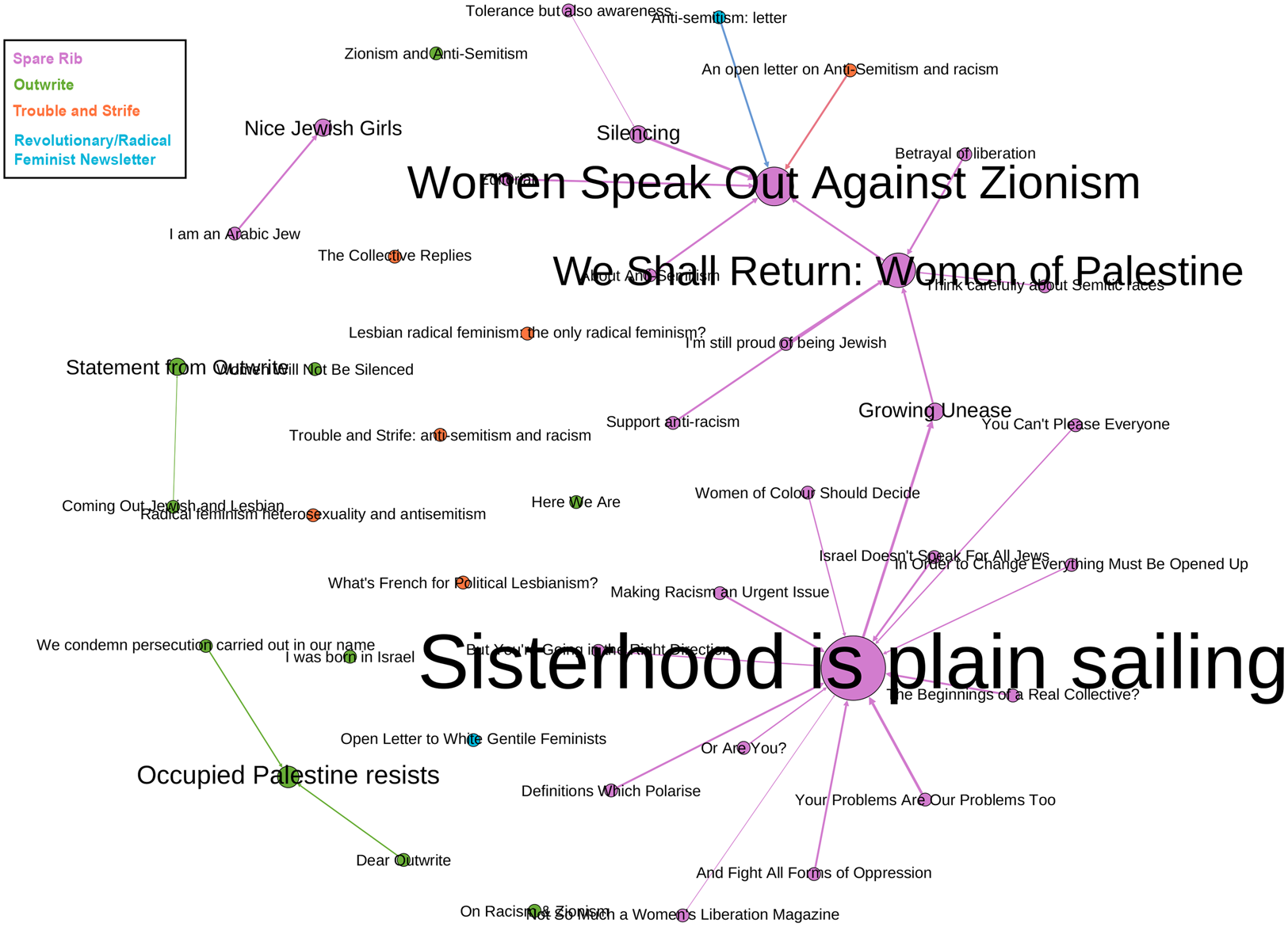
For this study of the above-mentioned four feminist periodicals, I use data visualization software to map articles and letters (‘nodes’), linked by their particular relationship (‘edge’). What results is a seemingly random layout of nodes, including a significant number that seem to be free-floating, isolated from the rest. The size of the nodes is determined by how many women responded to, or referenced, an article or letter.
Clearly, Spare rib dominated the conversation, and the article confessing to irreconcilable differences within the publishing collective received more participation than any other. Surrounding the arguments unfolding in Spare rib are several isolated nodes that represent articles and letters from Outwrite and Trouble & strife, and two letters from Revolutionary/radical feminist newsletter. This highlights that feminist periodicals were dealing with similar issues, perhaps informing each other, while also maintaining parameters of engagement through loyal readerships and regular contributors.
The graph visualizes how communication through circulation of the periodical enabled a webbed network of debate. The periodical format and its facilitation of a printed communications network clearly offered a quintessential forum for criticism and conflict to take place, as well as praise and appreciation. Sarah Schulman talks about conflict that makes sense in this context, as she says that ‘conflict, after all, is rooted in difference and people are and always will be different.’Footnote 34 She argues that failure to resolve conflict in organized groups often occurs because of stubbornness to integrate other points of view. This leads us to ‘often pretend, believe or claim that Conflict is Abuse and therefore deserves punishment.’Footnote 35 Periodicals as a format encourage a participatory readership in order for its circulation to take effect. Disagreement and conflict within the pages of feminist periodicals are therefore a possible indication of an engaged and invested reading public.
However, internal disagreement and conflict, say about the 1982 Lebanese war, do not easily fit into a neat and tidy account of feminist history. As shown by Victoria Bazin and Melanie Waters, ‘signal images’, such as the live protest at the 1970s Miss World contest in London, linger in the public consciousness as feminist victories, but also necessarily distort that which was a messy and dynamic political movement by isolating and generalizing a feminist historical timeline. The telling of feminist histories is acknowledged as a contentious activity due to the risk of confining interconnected discourses to a particular time, rather than tracing the ongoing, continuing and complex webs of debate. The authors state that ‘periodicals, as a form of print activism, militate against the homogenizing logic of “the final word” by creating multimodal spaces that can accommodate the voices of different and dissenting women.’Footnote 36 Indeed, reading periodicals offers methodological approaches to unsettle a neat chronology of distinct decades of feminist histories.
Graph visualisation of conflicting opinions on the 1982 Lebanese war in Spare rib, Trouble & strife, Revolutionary/radical feminist newsletter and Outwrite.

Conclusion: Hidden networks
I have shown that, within the periodical format, there is perhaps nothing that complicates dominant public memories more than the ‘letters to the editor’ pages. Filled with disagreement and conflict, the letters pages demonstrate how feminist periodicals enabled debates to take place over several issues, often publishing dissenting letters directed at the publication itself, and thereby encouraging differences instead of suppressing them. This is not to say that differences do not matter, or that they didn't have a lasting impact on the trajectory of particular feminist strategies; but it is to say that the forum of a feminist periodical acted as a mediating medium, aided by the analogue time of circulation which let various arguments sink in and resonate (or not) with women. Feminist periodicals offer insight into the hidden inner workings of the movement, particularly the ideological conflicts which enabled a rich variety of periodicals aimed at specific groups, even though such richness may have been the result of bitter disagreements. This is a crucial part of any feminist historical record which provides rich source material that may inform how subsequent generations of women decide to deal with internal conflict. These overlooked records of conflict and disagreement become discovered through their positioning as legitimate historical accounts. By looking specifically at the letters pages of these periodicals, the nuances and complexities of the second wave women's movement are better understood and may counter the temptation to romanticize an oversimplified uniformity, which characterizes the second wave in opposition to the present.
By detecting overarching themes of articles in feminist periodicals, one can get a sense of who active writers and thinkers were, what feminists were reading, and which issues were of most concern. However, by reading the communications and letters, one may get a more nuanced understanding of internal conflicts, contradictory strategies, and the various tensions which shaped the way women represented themselves in relation to each other, and in relation to the larger feminist project. Beins is also interested in this nuance and moves away from a rigid account of feminist history, particularly the grouping of the women's movement as distinct ‘waves.’ She writes that
the linearity of [the wave] model enables a narrative that at best depicts different waves as mutually exclusive (one wave follows the other, each signaling the end of the previous one) and at worst paints them as actively hostile toward each other (those in the current wave articulate their feminist identity in opposition to previous versions of feminism.)Footnote 37
Meaghan Morris writes that ‘the most dreadful condemnation stray feminists have to fear here is dismissal with the last dinosaurs of the late sixties.’Footnote 38 This is in response to the characterization of second wave feminism as white, heterosexist, racist, and without a sense of intersectionality. Founders of the Third Wave Foundation Vivien Labaton and Dawn Lundy Martin write in the 2004 anthology The fire this time that the second wave of feminism ‘placed a select few issues at the center of what is thought of as feminist activism, neglecting the full range of experiences that inform women's lives.’Footnote 39 What the periodical document can offer is a chance to re-narrate this generational stereotyping of an incredibly diverse and networked movement. It is then the responsibility of the researcher not to smooth over conflict in an otherwise supposedly uniform historicizing but rather consider them of great importance for how we may re-engage instead of starting from scratch.
The mapping and webbing of the letters in feminist periodicals also maps conflict, disagreement, but ultimately a sense of urgent engagement on emotionally and politically charged issues. I position letters as a legitimate and essential record in feminist history that must not be overlooked or hidden away. It shows that feminists were preoccupied with an exhausting amount of varying issues and were not shy to discuss their differences. The idiosyncrasy and diversity of varying publications indicates that there were many positions held, groups formed, and strategies conceived. The periodical as a medium, and particularly the forum of feminist letter writing, influenced the formulation of feminist theory and action and acted as a medium for conflict to be expressed. By drawing attention to the networking characteristic of periodicals, it becomes clear that feminist counterpublics were made possible through deliberate calls for a networked communications infrastructure and most importantly allowed for disagreement and conflict to take place. Without engaged conflict over the 1982 Lebanese war in the letters pages, issues of anti-Semitism and anti-Zionism would not have reached women's doorsteps, and in turn would not have been formulated through a feminist lens. Second wave feminist periodicals made possible the airing of conflict within letters pages and encouraged a sense of belonging to a counterpublic through calls for participation. In turn, periodicals make visible an underlying network philosophy that enabled a wide and diverse range of discourses to be circulated and debated, thus carrying the potential as historical documents to destabilize simplistic caricatures of distinct feminist waves and providing a more nuanced approach to unravelling the complexities of women's history.