Introduction
Strongyloidiasis is an infection caused by helminth Strongyloides stercoralis (Bavay, Reference Bavay1876) and considered to be neglected. It has heterogeneous worldwide distribution, mainly in tropical and subtropical regions (Olsen et al. Reference Olsen, van Lieshout, Marti, Polderman, Polman, Steinmann, Stothard, Thybo, Verweij and Magnussen2009; Paula and Costa-Cruz, Reference Paula and Costa-Cruz2011). Usually, strongyloidiasis evolves in an asymptomatic manner; however, in some cases, the presence of eggs, larvae and adult parasites in the mucosa of the small intestine can result in inflammatory reaction, malabsorption syndrome and, consequently, chronic diarrhoea with protein loss, abdominal pain and bleeding with development of hypoalbuminemia and anaemia (Grove, Reference Grove1996; Fardet et al. Reference Fardet, Généreau, Poirot, Guidet, Kettaneh and Cabane2007). In addition, in immunocompromised individuals, extra intestinal manifestations can promote severe clinical conditions, such as hyperinfection and potentially fatal conditions, such as disseminated infection (Da Silva et al. Reference Da Silva, de Carvalho, Levenhagen and Costa-Cruz2014; Levenhagen and Costa-Cruz, Reference Levenhagen and Costa-Cruz2014). These clinical conditions can cause mortality ranging from 15 to 87% when the disease is not diagnosed early (Agrawal et al. Reference Agrawal, Agarwal and Ghoshal2009).
The diagnosis of strongyloidiasis is based on the identification of larvae in fecal samples. However, the parasitological diagnosis becomes complex due to the low and irregular amount of larvae released in feces (Uparanukraw et al. Reference Uparanukraw, Phongsri and Morakote1999; Schär et al. Reference Schär, Trostdorf, Giardina, Khieu, Muth, Marti, Vounatsou and Odermatt2013; Mendes et al. Reference Mendes, Minori, Ueta, Miguel and Allegretti2017). In order to assist the parasitological diagnosis, immunological tests such as immunoenzymatic assay (ELISA) are indicated for the diagnosis of human strongyloidiasis due to their high sensitivity. These tests are considered useful in serological screening (Gonzaga et al. Reference Gonzaga, Ribeiro, Feliciano, Manhani, Silva, Ueta and Costa-Cruz2011; Gonçalves et al. Reference Gonçalves, Nunes, Gonçalves-Pires, Ueta and Costa-Cruz2012; Bosqui et al. Reference Bosqui, Gonçalves, Gonçalves-Pires, Custodio, de Menezes, Murad, de Paula, Pavanelli, Conchon-Costa, Costa-Cruz and Costa2015).
In addition to the use of conventional serum samples for immunological diagnosis of human strongyloidiasis, the recent years have been characterized by the gradual increase in the number of studies on specific salivary antibodies as biomarkers in epidemiology and toxicology (Kaufman and Lamster, Reference Kaufman and Lamster2002; Ribeiro et al. Reference Ribeiro, Feliciano, Gonzaga, Costa, Gonçalves-Pires, Ueta and Costa-Cruz2010). They represent an alternative tool in the diagnosis of different protozoa (Del Muro et al. Reference Del Muro, Acosta, Merino, Glender and Ortiz-Ortiz1990; Loyola et al. Reference Loyola, Durighetto, Silva and Mineo1997; Pinto et al. Reference Pinho, Pedrosa, Costa-Martins and Castello-Branco1999; Borges and Figueiredo, Reference Borges and Figueiredo2004) and also human strongyloidiasis (Costa et al. Reference Costa, Sopelete, Gonçalves-Pires and Costa-Cruz2003; Ribeiro et al. Reference Ribeiro, Feliciano, Gonzaga, Costa, Gonçalves-Pires, Ueta and Costa-Cruz2010; Bosqui et al. Reference Bosqui, Gonçalves, Gonçalves-Pires, Custodio, de Menezes, Murad, de Paula, Pavanelli, Conchon-Costa, Costa-Cruz and Costa2015). These studies have pointed out saliva as an alternative tool for assessing specific antibodies for diagnosis.
Infectious diseases result not only in the production of antibodies but also imply the formation of antigen-antibody complexes. These immune complexes are important because they bind to the phagocytic cells, where they are destroyed and eliminated. Moreover, they can be used as biomarkers in the course of the disease (Frank and Hester, Reference Frank and Hester2009; De Carvalho et al. Reference De Carvalho, Partata, Hiramoto, Borborema, Meireles, Nascimento and de Andrade2013). Therefore, the detection of antibodies and immune complexes through immunological assays contributes to the diagnosis in humans, especially when there is a high risk of developing severe forms of the disease (Gonçalves et al. Reference Gonçalves, de Araújo, Carvalho, Ueta and Costa-Cruz2016). In this context, the detection of immune complexes using saliva samples represents an innovative proposal for the diagnosis of strongyloidiasis in order to observe active forms of the disease.
Considering the severity of disseminated strongyloidiasis and the importance of identifying active infections, the present study proposes the detection of IgG immune complexes in the diagnosis of strongyloidiasis using conventional serum samples and alternative saliva samples. The procedure is carried out with the ELISA method using alkaline extracts of S. venezuelensis larvae as heterologous antigen. These are innovative approaches for the diagnosis of this potentially fatal infection when not detected and treated early in some cases.
Method
Subjects
Biological specimens were collected from 60 individuals divided into two groups: Group I: 30 apparently healthy individuals based on their clinical observation, without evidence of contact with S. stercoralis infection, no previous history of strongyloidiasis and three fecal samples tested negative. Group II: 30 patients attending the outpatient departments or admitted to the Clinical Hospital of the State University of Londrina, Paraná state, Brazil, harbouring S. stercoralis larvae, coprologically detected.
The study received approval from the Research Ethics Committee of the Universidade Estadual de Londrina, Paraná state, Brazil, n° 1494·2013-56.
Serum and saliva samples
Feces, blood and saliva samples were collected from all subjects. Three fecal samples were analysed according to Hoffmann et al. (Reference Hoffmann, Pons and Janer1934) and Rugai et al. (Reference Rugai, Mattos and Brisola1954). Serum was separated from blood and stored at −20 °C until use. Unstimulated whole saliva samples were collected by using clean cotton swabs after washing oral cavity with water; distributed in aliquots and conserved until use; slowly thawed and centrifuged at 12 400 g for 15 min.
Parasites
Infective third stage larvae (L3) of Strongyloides venezuelensis were obtained from cultures of rat feces coal Rattus norvegicus (Wistar). The cultures were stored at 28 °C for 48 h, the infective larvae were collected and concentrated using the method of Rugai et al. (Reference Rugai, Mattos and Brisola1954). The number of larvae recovered was washed 5 times with phosphate buffered saline (PBS, 0·01 mol L−1, pH 7·2) and stored at −20 °C in PBS until use.
Alkaline extract from S. venezuelensis
To alkaline extracts were prepared according to Machado et al. (Reference Machado, Ueta, Gonçalves-Pires, Alves de Oliveira, Faccioli and Costa-Cruz2003) 1 mL of 0·15 mol L−1 NaOH was added to 300 000 S. venezuelensis larvae and kept under gentle shaking for 6 h at 4 °C. Subsequently, 0·3 mol L−1 HCl was added until a pH of 7·0 was reached. These preparations were then centrifuged at 12 400 g for 30 min at 4 °C. Supernatants (alkaline extracts) were analysed for protein content according to Lowry et al. (Reference Lowry, Rosebrough, Farr and Randall1951), subdivided into aliquots and stored at −20 °C until use.
IgG-specific measurement in serum and saliva samples by ELISA
Preliminary experiments were carried out in order to determine the optimal conditions for ELISA through block titration of reagents (antigens, control serum and saliva samples, and conjugate). Briefly, polystyrene microplates (BioAgency Laboratories, São Paulo, Brazil) were coated overnight at 4 °C with 5 µg mL−1 of S. venezuelensis larvae (L3), in 0·06 mol L−1 carbonate-bicarbonate buffer (pH 9·6). Plates were washed 3 times with PBS containing 0·05% Tween 20 (PBST). After washing, plates were incubated with serum sample (50 µL well−1) with diluition 1 : 80 (for IgG detection) and incubated with saliva sample 50 (μL well−1) 1 : 20 (for IgG detection) for 45 min at 37 °C and subsequently with the secondary antibody consisting of peroxidase-labelled goat anti-human IgG conjugate (Sigma, St Louis, MO, USA) at the ideal dilution of 1 : 2000 for 45 min at 37 °C in low affinity plate for sera and high affinity plate in saliva. The reagents were used for a final assay volume of 50 µL well−1. The reaction was revealed by adding the enzyme substrate (5 µL 30% H2O2 Merck (Darmstadt, Germany) and 5 mg o-phenylenediamine [OPD] in 12·5 mL of 0·1 M citrate-phosphate buffer, pH 5·0) and incubation for 15 min at room temperature. Optical densities (OD) were determined at 492 nm in an ELISA reader (Titertek Plus, Flow Laboratories, USA).
Measurement of immune complex in serum and saliva samples
Preliminary experiments were carried out in order to determine the optimal conditions for ELISA through serial dilution of the reagents (antibody, control serum and saliva, and conjugate). Polystyrene microtitre plates were coated for 18 h at 4 °C with 50 µL well−1 of IgG obtained from immunized rabbits (40 µg mL−1) (Gonçalves et al. Reference Gonçalves, Rodrigues, Ueta and Costa-Cruz2010) in 0·06 M carbonate-bicarbonate buffer (pH 9·6). After three washes with PBST, 50 µL well−1 of serum samples (1 : 80) or saliva (pure) were added and incubated for 45 min at 37 °C. Positive and negative serum and saliva samples to the immune complex were used as a control. The positive serum and saliva samples consisted of a positive sample for IgG anti-S. venezuelensis. After incubation for 45 min at 37 °C and another three washes, the peroxidase – labelled goat anti-human IgG (Sigma, St Louis, MO, USA) was added (50 µL well−1) at the ideal dilution of 1 : 2000 for 45 min at 37 °C. The reaction was revealed by adding the enzyme substrate (5 µL 30% H2O2 Merck (Darmstadt, Germany) and 5 mg o-phenylenediamine [OPD] in 12·5 mL of 0·1 M citrate-phosphate buffer, pH 5·0) and incubation for 15 min at room temperature.
Statistical analysis
Analyses were performed using the GraphPad software package version 5.0. Optimum point for each condition of ELISA reaction and cut-off points were established using a 2-graph receiver operating characteristic curve (TG-ROC) combined with a ROC curve (Greiner et al. Reference Greiner, Sohr and Göbel1995). ELISA index (EI) was obtained by the ratio between OD and cut-off. Values of EI greater than the optimum point of reaction for each extract were considered positive. ROC curves were built to describe test indexes (Martinez et al. Reference Martinez, Louzada-Neto and Pereira2003). The area under the ROC curve (AUC), an index of diagnostic accuracy, was calculated and values close to 1 indicate an informative test and values close to 0·5 indicate an uninformative test (Hanley and McNeil, Reference Hanley and McNeil1982). Likelihood ratio, which indicates how likely patients with strongyloidiasis are going to have a specified test detection compared with patients not infected by the parasite, was estimated as Se/(1 − Sp). Correlations between levels of different diagnostic tests in each sample tested with S. stercoralis were determined using Spearman (r) or Spearman rank test (rs). The concordance of the results obtained between the serum and saliva samples was carried out analysis of Kappa coefficient (κ) (Landis and Koch, Reference Landis and Koch1977). Probability (P) values of <0·05 were regarded as significant.
Results
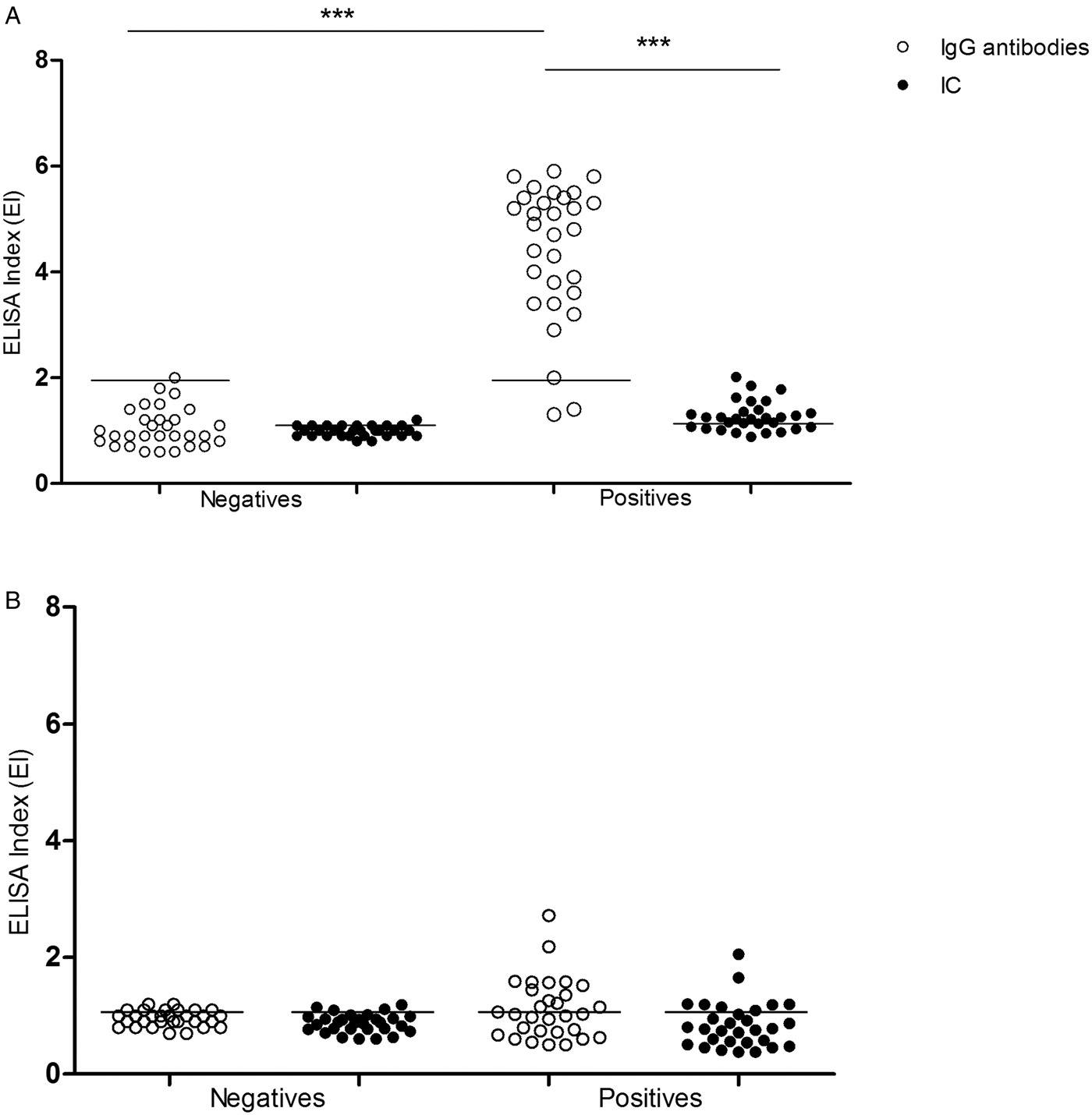
The detection of IgG antibodies and immune complexes in serum and saliva samples is illustrated in Fig. 1. The positivity rate of anti-S. stercoralis IgG in serum samples of individuals with negative parasitological results (Group I) was 3·3% (n = 1), whereas in individuals harbouring S. stercoralis larvae (copropositive) (Group II) was of 93·3% (n = 28). Regarding the detection of immune complexes in serum samples, positivity in group I was 3·3% (n = 1), whereas in group II it was 56·7% (n = 17) (Fig. 1A). The analysis of saliva samples for anti-S. stercoralis IgG indicated positivity of 26·7% (n = 8) in group I and 43·3% (n = 13) in group II. The detection levels of immune complexes in saliva samples were 20% (n = 6) for group I and 30% (n = 9) for group II (Fig. 1B).
IgG and immune complex anti-S. stercoralis in serum and saliva samples determined by immunoenzymatic assay using alkaline extract of S. venezuelensis L3 expressed in EI. The groups were divided into negative (control), apparently healthy individuals (Group 1; n = 30) and individuals harbouring S. stercoralis larvae (copropositive) (Group II; n = 30). (A) Detection of IgG and immune complexes in serum samples from the two groups. (B) Detection of IgG and immune complexes in saliva samples from the two groups. The dashed line represents the threshold for positivity (EI > 1·0); ***P < 0·001. EI, ELISA index.

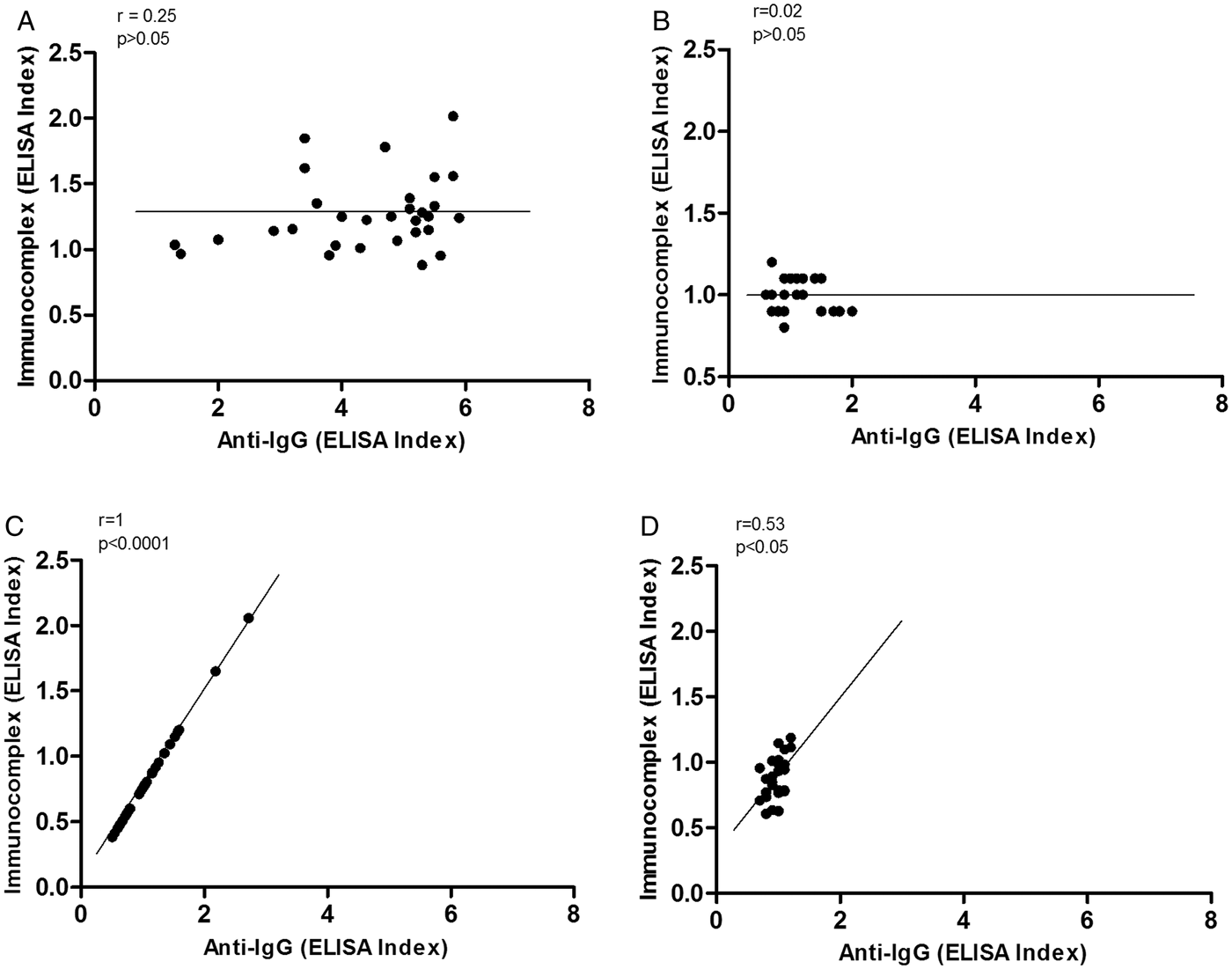
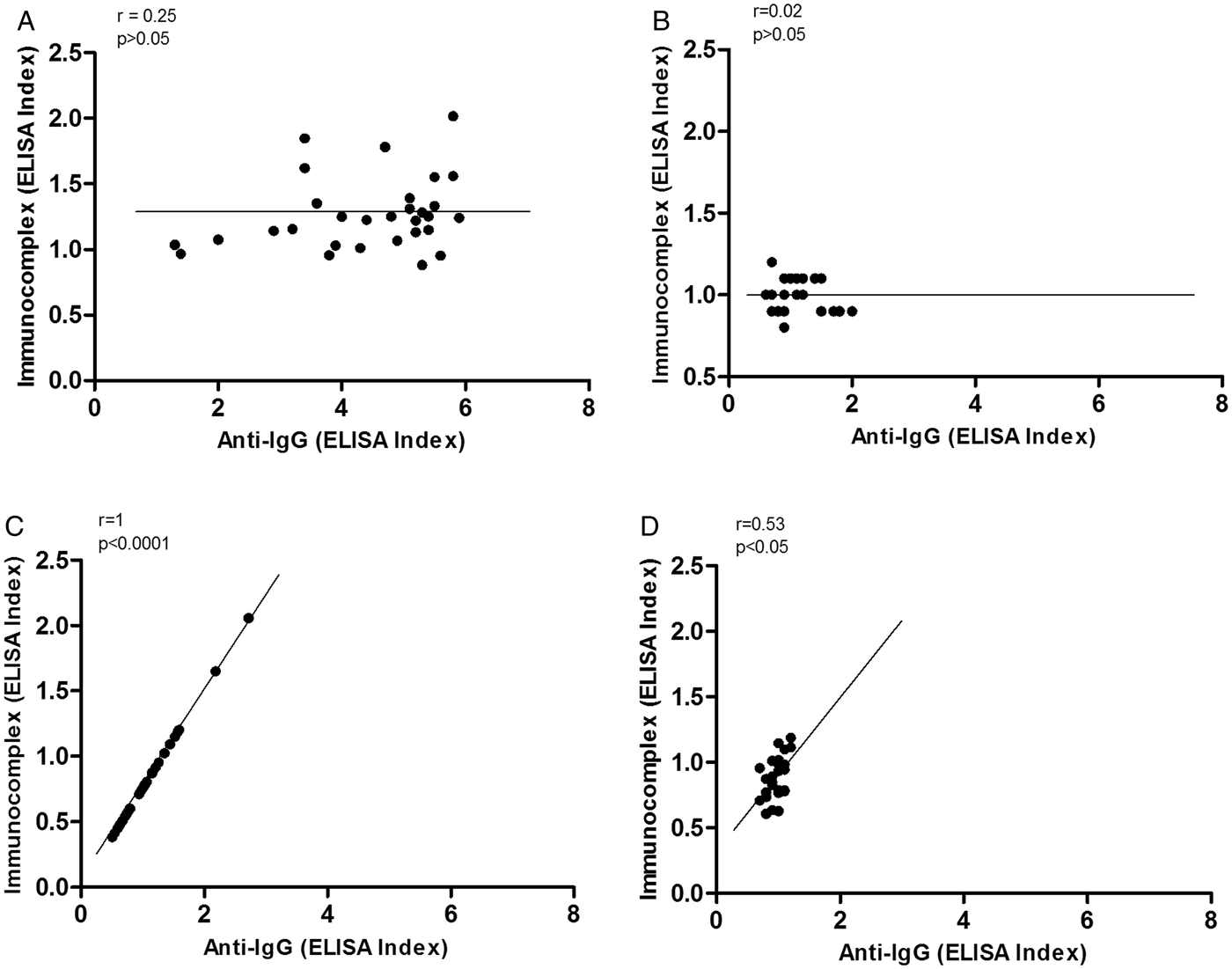
In order to observe the correlation between the results, we quantified the combination of data between human IgG antibodies and immune complexes in serum and saliva samples (Fig. 2). Figure 2A and C illustrate the diagnostic correlation between serum and saliva samples from the group with a positive coproparasitological diagnosis for S. stercoralis, respectively. Figure 2A shows that the correlation between the results was weak (r = 0·25; P > 0·05), whereas Fig. 2C shows that the correlation was significantly positive (r = 1; P < 0·05). On the other hand, positive correlation of the results obtained in the analysis of serum and saliva samples from the group of healthy individuals (Fig. 2B and D, respectively) can only be observed in Fig. 2D (r = 0·53; P < 0·05). This study showed excellent agreement in the detection of IgG (κ = 0·90) and moderate for IC (κ = 0·51) in serum.
Use of the correlation between human anti-IgG and immune complexes in paired samples for diagnosis. (A) and (C): correlation between circulating antibodies and antibodies complexed to antigen in serum and saliva samples, respectively, in patients with positive coproparasitological diagnosis for S. stercoralis; (B) and (D): correlation between circulating antibodies and antibodies complexed to antigen in serum and saliva samples, respectively, in patients with negative coproparasitological diagnosis for S. stercoralis.
Discussion
Currently, immunological diagnosis of strongyloidiasis is mainly performed detecting IgG antibodies, given that there is a predominance of a humoral response (Atkins et al. Reference Atkins, Lindo, Lee, Conway, Bailey, Robinson and Bundy1997; Bosqui et al. Reference Bosqui, Gonçalves, Gonçalves-Pires, Custodio, de Menezes, Murad, de Paula, Pavanelli, Conchon-Costa, Costa-Cruz and Costa2015).
In our study, it was possible to observe 93·3% of positive cases for IgG in serum samples. IgG antibodies are the largest class of serum immunoglobulins able to provide protective immunity and remain for a long period of time after the cure of the disease (Carvalho et al. Reference Carvalho, Andrade, Andrade and Rocha1983; Iriemenam et al. Reference Iriemenam, Sanyaolu, Oyibo and Fagbenro-Beyioku2010). In part, these characteristics are responsible for the success and advantages of the diagnosis of strongyloidiasis by means of detecting this class of antibodies in serum samples from infected individuals (Agrawal et al. Reference Agrawal, Agarwal and Ghoshal2009; Ribeiro et al. Reference Ribeiro, Feliciano, Gonzaga, Costa, Gonçalves-Pires, Ueta and Costa-Cruz2010; Bosqui et al. Reference Bosqui, Gonçalves, Gonçalves-Pires, Custodio, de Menezes, Murad, de Paula, Pavanelli, Conchon-Costa, Costa-Cruz and Costa2015). However, the high concentration of circulating antibodies and antigens in serum can result in the formation of immune complexes (Ohyama et al. Reference Ohyama, Huy, Yoshimi, Kishikawa, Nishizawa, Roca, Revollo Guzmán, Velarde, Kuroda and Hirayama2016).
Our study revealed that the detection of circulating IgG immune complexes in serum was significant (70%). Immune complexes play an important role in neutralizing the pathogenesis of the disease, being rapidly eliminated from the bloodstream by the innate immune system. In addition, circulating immune complexes have been reported with increased frequency in parasitic diseases (Ohyama et al. Reference Ohyama, Huy, Yoshimi, Kishikawa, Nishizawa, Roca, Revollo Guzmán, Velarde, Kuroda and Hirayama2016).
Our assay proved to be effective in the detection of IgG anti-Strongyloides spp., both in serum and saliva samples, showing acceptable levels of reliability and being able to minimize false positive results. The same result can be observed in different diagnoses, both experimental and in humans, given that the detection of immune complexes has also been used and the results were promising (Patil et al. Reference Patil, Gourie-Devi, Anand, Vijaya, Pratima, Neelam and Chandramuki1996; Nezlin, Reference Nezlin2009; Madhusudana et al. Reference Madhusudana, Muhamuda and Reeta2014; Gonçalves et al. Reference Gonçalves, de Araújo, Carvalho, Ueta and Costa-Cruz2016; Ohyama et al. Reference Ohyama, Huy, Yoshimi, Kishikawa, Nishizawa, Roca, Revollo Guzmán, Velarde, Kuroda and Hirayama2016).
The few positive cases for detecting immunocomplex in the negative group can be explained by the persistence of IgG in an undiagnosed infection due to low release of larvae in feces and/or individuals with prior exposure living in areas with high prevalence of strongyloidiasis (Santos et al. Reference Santos, Santos and Soares2007; Iriemenam et al. Reference Iriemenam, Sanyaolu, Oyibo and Fagbenro-Beyioku2010; Ahmad et al. Reference Ahmad, Hadip, Ngui, Lim and Mahmud2013).
The choice of an appropriate immunological method that complements the parasitological diagnosis is essential for an accurate estimate of strongyloidiasis. Therefore, detecting the levels of circulating immune complexes by an immunoenzymatic assay can be used as complementary screening in the diagnosis of strongyloidiasis. Immune complexes have an important participation in the physiopathology of the disease and, therefore, may reflect the immune response exerted by each individual, thus facilitating the control of this infection (Gonzaga et al. Reference Gonzaga, Ribeiro, Feliciano, Manhani, Silva, Ueta and Costa-Cruz2011; Gonçalves et al. Reference Gonçalves, Nunes, Gonçalves-Pires, Ueta and Costa-Cruz2012).
In addition to the use of serum samples for the immunological diagnosis of strongyloidiasis, saliva samples have been investigated in recent years as an alternative tool. These samples offer advantages such as easy obtainment, noninvasive sampling and low cost, playing an important role in the local and systemic assessment of the immune response against the parasite (Costa et al. Reference Costa, Sopelete, Gonçalves-Pires and Costa-Cruz2003; Ribeiro et al. Reference Ribeiro, Feliciano, Gonzaga, Costa, Gonçalves-Pires, Ueta and Costa-Cruz2010; Bosqui et al. Reference Bosqui, Gonçalves, Gonçalves-Pires, Custodio, de Menezes, Murad, de Paula, Pavanelli, Conchon-Costa, Costa-Cruz and Costa2015).
The analysis of saliva samples has become important to assess physiological and pathological conditions in humans (Sawangsoda et al. Reference Sawangsoda, Sithithaworn, Tesana, Pinlaor, Boonmars, Mairiang, Yongvanit, Duenngai and Sithithaworn2012). This is a pioneering study assessing patients with strongyloidiasis and presents an innovative proposal for using saliva samples to detect immune complexes.
Concluding remarks
In conclusion, the detection of IgG immune complexes in conventional serum samples and saliva the alternative samples can be considered a promising strategy for the diagnosis of active strongyloidiasis.
Acknowledgement
We acknowledge the patients and volunteers who agreed to participate in this study.
Financial Support
This study was supported by grants from the Coordenação de Aperfeiçoamento de Pessoal de Nível Superior (CAPES – Grant No. 40002012026M9 (L.R.B.) and Fundação de Amparo à Pesquisa do Estado de Minas Gerais (FAPEMIG – Grant No. CBB-PPM-00396-13) (J.M.C.C).
Conflict of Interest
The authors declare that there are no conflicts of interest.