Introduction
The introduction of domesticates and the adoption of an agro-pastoral food-producing economy in the Sudanese Nile Valley were associated with new forms of social complexity (Salvatori et al. Reference Salvatori, Usai and Lecointe2016). The first tangible evidence of this phenomenon dates to the early sixth millennium BC and is reflected most clearly in funerary contexts through a new and diverse set of material items for body ornamentation (e.g. beads, pendants, bracelets, lip-plugs), together with other grave goods, such as pottery and stone objects, apparently used to signal social status (Honegger Reference Honegger2004, Reference Honegger2005). Included amongst these artefacts are objects and raw materials acquired through long-distance trade or barter exchange. This new material assemblage suggests the development of ideologically orientated funerary practices intended to reproduce and renegotiate the identity and status of the buried individual within the wider social structure (Salvatori et al. Reference Salvatori, Usai and Lecointe2016).
The few Neolithic settlements that have been investigated in Sudan are poorly preserved due to post-depositional disturbance, such as by wind and water erosion (Arkell Reference Arkell1953; El-Anwar Reference El-Anwar1981; Caneva Reference Caneva1988; Fernández et al. Reference Fernández, Jimeno, Menendez and Trancho1989, Reference Fernández, Jimeno and Menéndez2003; Chłodnicki Reference Chłodnicki2011; Salvatori et al. Reference Savatori, Usai and Zerboni2011). Archaeologists are therefore forced to rely on funerary contexts—that are more protected against surface erosion—for evidence of emerging social complexity in Neolithic Sudan (Salvatori Reference Salvatori2012; Usai Reference Usai2014). Investigating the production of artefacts such as stone axes, mace-heads, stone palettes and personal ornaments is restricted to the analysis of a handful of excavated and published cemeteries (e.g. Caneva Reference Caneva1988; Reinold 2007; Salvatori & Usai Reference Salvatori and Usai2008a; Chłodnicki et al. Reference Chłodnicki, Kobusiewicz and Kroeper2011; Salvatori et al. Reference Salvatori, Usai and Lecointe2016). Further, any attempts to reconstruct wider supply and exchange processes are limited by a poor understanding of the distribution of sources of raw materials across Sudan and beyond.
Amazonite, both as finished objects (beads and pendants) and lumps of raw material, is one of the many interesting materials that appear frequently in North African and Levantine Neolithic settlements (Bar-Yosef Mayer & Porat Reference Bar-Yosef Mayer and Porat2008). Amazonite is a semi-precious green to blue-green variety of microcline with white veins. In Neolithic Sudan, it is found principally as carved beads and pendants. First discovered in the central Sudanese Neolithic settlement of Shaheinab, amazonite was thought to be a marker of an established exchange network with the Tibesti Mountains of the central Sahara—an area long regarded as the sole source of amazonite in North Africa (Arkell Reference Arkell1953; Monod Reference Monod1974; de Michele & Piacenza Reference de Michele and Piacenza1999; Zerboni et al. Reference Zerboni, Vignola, Gatto, Risplendente and Mori2017). Recent archaeometric investigations on North African green-coloured stone ornaments, however, have questioned this assumption and suggest a more intricate picture, including a variety of different sources (Zerboni et al. Reference Zerboni, Vignola, Gatto, Risplendente and Mori2017). Here, we investigate the geological source of a recently excavated set of amazonite stone beads from the Nubian Middle Neolithic cemetery of R12, together with control samples of raw materials from source areas in the Sahara, sub-Saharan Africa, the Egyptian Nile Valley, Ethiopia and Jordan. The aim is to identify the origin of the raw material employed in R12 ornament production, to infer the Neolithic trade trajectories for this exotic and possibly prestige material and, finally, to discuss the archaeological and anthropological implications.
Archaeological background
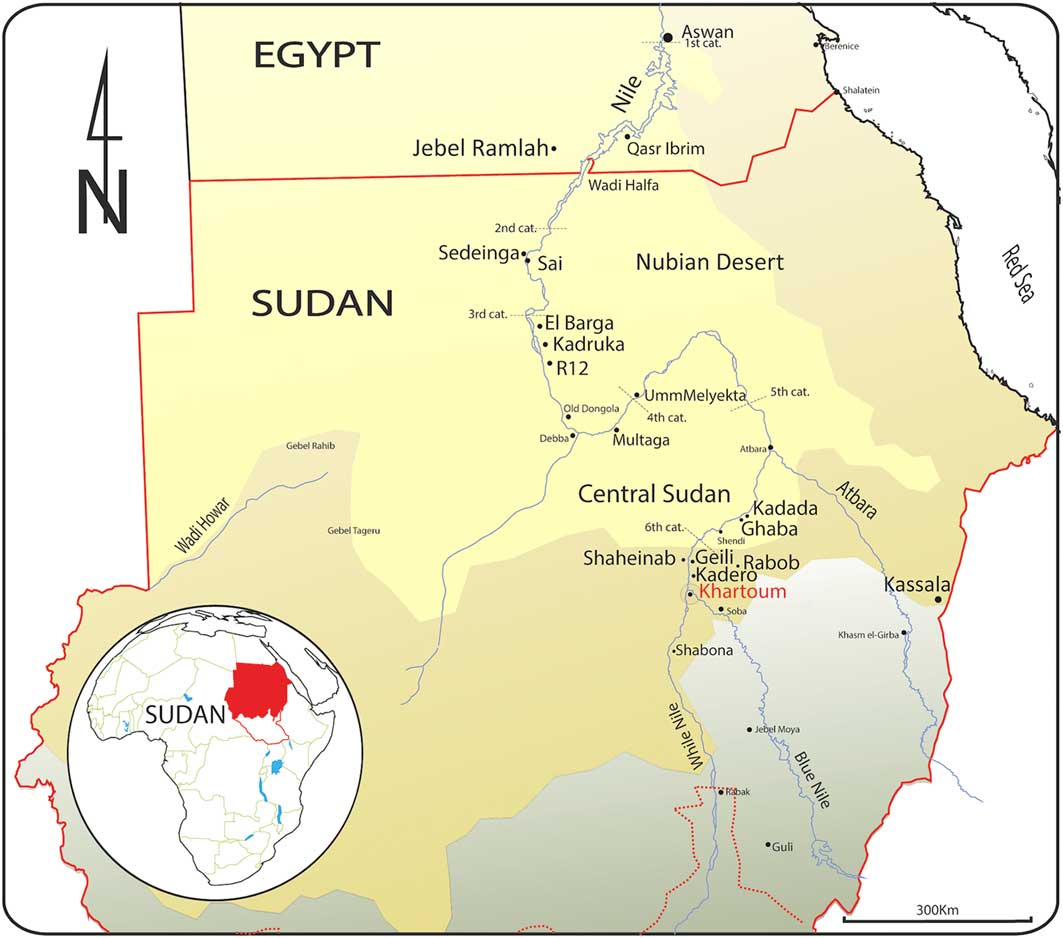
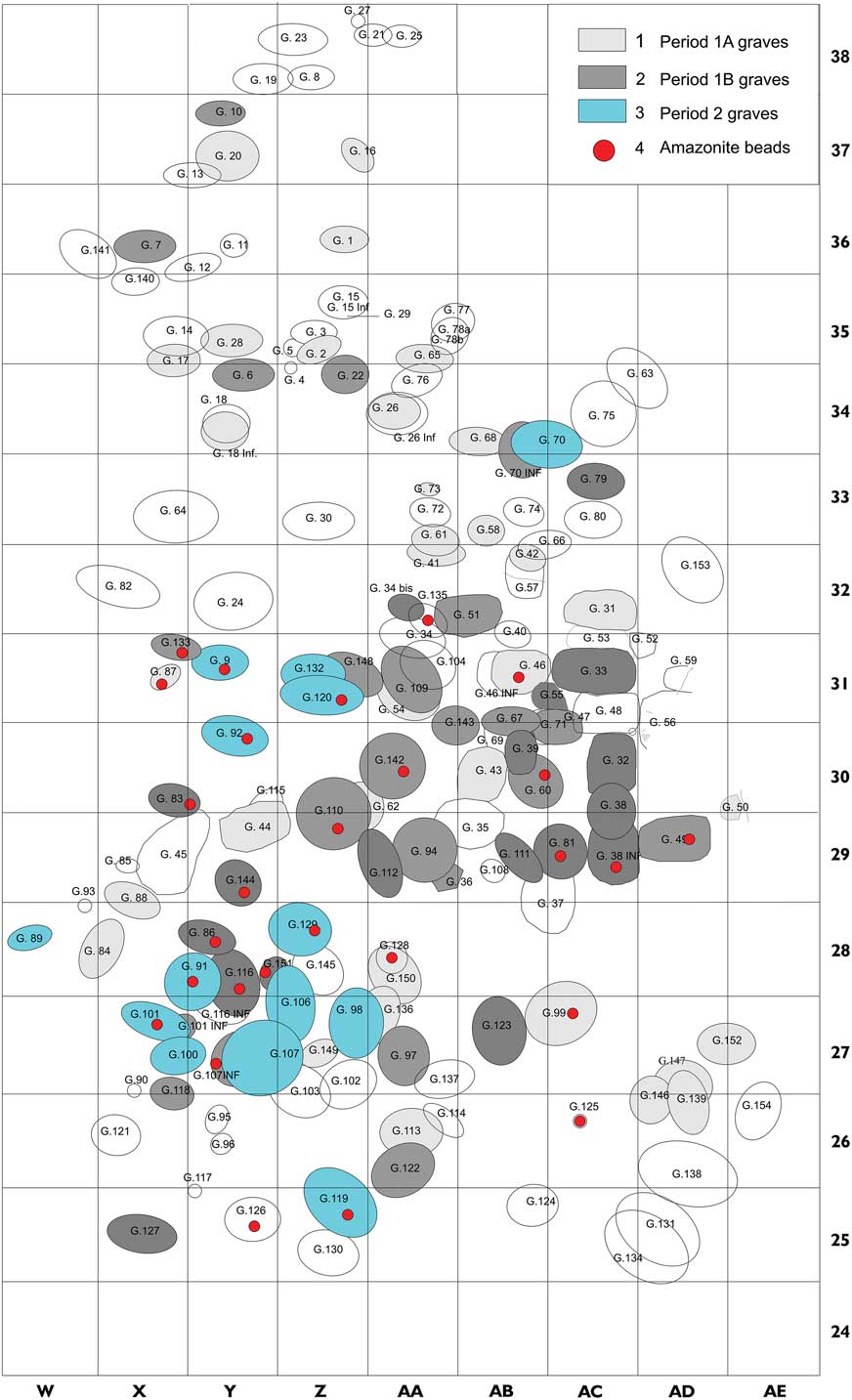
R12 is a Nubian Middle Neolithic cemetery located in the Seleim Basin in the Northern Dongola Reach, in northern Sudan (Figure 1). The cemetery was in use from the late sixth to the late fifth millennium BC, and has been divided—using pottery-seriation analysis supported by radiocarbon dating—into two distinct periods covering approximately the first and second half of the fifth millennium BC, respectively (Salvatori & Usai Reference Salvatori and Usai2008a). The cemetery is one among the many distributed across Upper Nubia (Welsby Reference Welsby2001; Reinold Reference Reinold2004). Excavation was carried out between 2000 and 2003, and identified 166 burials (Figure 2), most of which yielded grave goods; this evidence forms the basis of the first systematic assessment of the Neolithic in both this region and the Nile Valley (Salvatori & Usai Reference Salvatori and Usai2008a). The funerary material associated with many of the burials suggests a rich world of economic activities, demonstrated by evidence for cattle and sheep/goat breeding, agriculture (wheat and barley), stone beads, ivory and bone objects and pottery production. Given the lack of excavated settlements in the region, however, we cannot yet fully reconstruct this world (Usai Reference Usai2014). Although the graves have been affected by natural post-depositional episodes, such as groundwater infiltration and wind erosion, associated bone or ivory artefacts, tools, and other objects made of precious stones were well preserved.
Map of the region illustrating the position of the R12 cemetery and other Neolithic sites cited in the text.

Plan of the R12 cemetery.

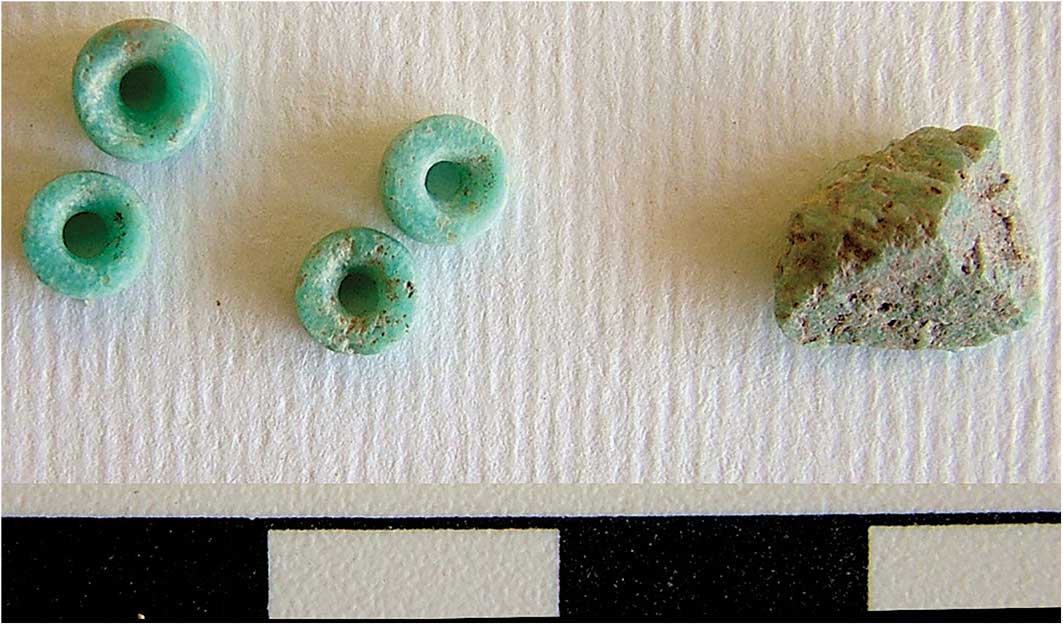
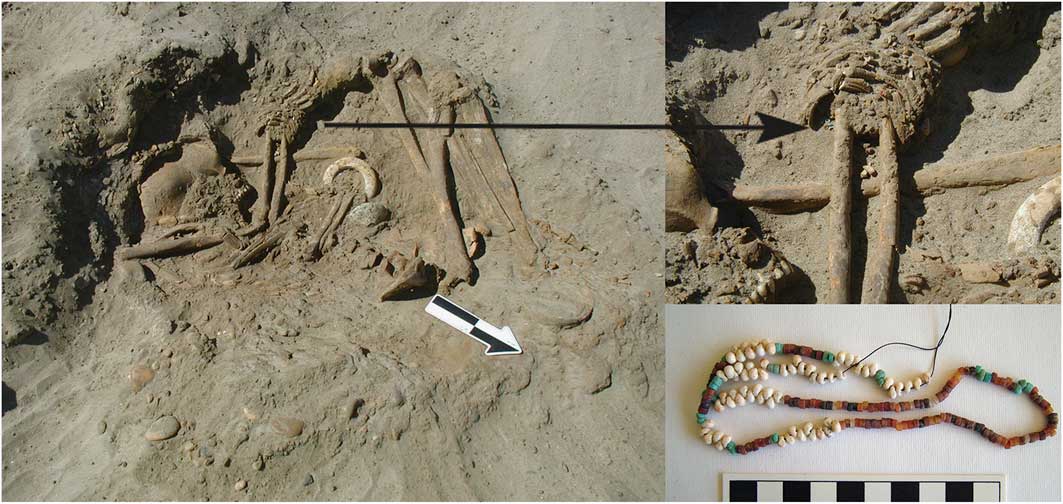
Body ornaments were recovered from 21.69 per cent of the excavated graves, and vary in shape and colour. They include bracelets and necklaces, stone or ivory pendants, stone or ivory bangles and lip/ear plugs (Salvatori & Usai 2008b). Most were found in child graves (38.89 per cent), followed by male (30.56 per cent) and female graves (25 per cent) (Salvatori & Usai 2008b). As well as ostrich eggshell, marine shells and packed ochre powder, stone beads of various shape and colour—green (amazonite; Figure 3), red (carnelian or burnt agate) and whitish (zeolite and quartz)—were found singly or, more frequently, in strings with elegant assemblages (Figure 4) (Salvatori & Usai 2008b; Usai Reference Usai2016).
Examples of amazonite beads (left) and a fragment of amazonite raw material (right) from the excavation at R12.

A) Picture of a tomb at R12; B–C) details of the same burial after excavation, illustrating a rich assemblage of precious goods including a necklace with amazonite beads.

Results of amazonite rock sample and bead analysis
To evaluate whether body ornaments constituted prestigious objects and played a role in the expression of status in Nubian Neolithic society, it is necessary to address the question of the provenance of the exotic raw materials used. We assume that raw material scarcity, non-local availability and difficulty in accessing a specific source represent one such parameter (Usai Reference Usai2016).
To assess this problem, nine amazonite beads recovered from the R12 cemetery and 18 samples of raw material from different African amazonite outcrops were subjected to microprobe analyses following the protocol of Zerboni and Vignola (Reference Zerboni and Vignola2013) and Zerboni et al. (Reference Zerboni, Vignola, Gatto, Risplendente and Mori2017). The set of samples and the analytical protocol are described in the online supplementary material (OSM). Analytical results are summarised in Table 1, and full results are provided in the OSM.
Averaged WDS electron-microprobe analyses of selected elements of amazonite samples (see full results in the OSM).

We used microprobe analysis to determine the orthoclase-albite-anorthite percentage of amazonite crystals and the concentration of elements. The geochemical trace element signature of single minerals of potassic microcline—such as amazonite—from a single source rock (a pegmatitic dike, in this case) closely reflects the composition of the whole granitic source (Martin et al. Reference Martin, de Vito and Pezzotta2008). The chemical composition obtained for each sample is generally representative of the mean geochemical character of the magmatic rocks, indicating its source; our analyses are thus suitable to trace the provenance of raw material. The chemical composition of all the beads and raw samples matched that of a perthitic orthoclase-microcline in the ternary plot used for the classification of feldspars (OSM), while the absence of calcium (Ca) confirms the attribution to amazonite (Fuhrman & Lindsley Reference Fuhrman and Lindsley1988; Deer et al. Reference Deer, Howi and Zussman1992; Wise Reference Wise1999; Simmons et al. Reference Simmons, Webber, Falster and Nizamoff2003; Černy & Ercit Reference Černý and Ercit2005).
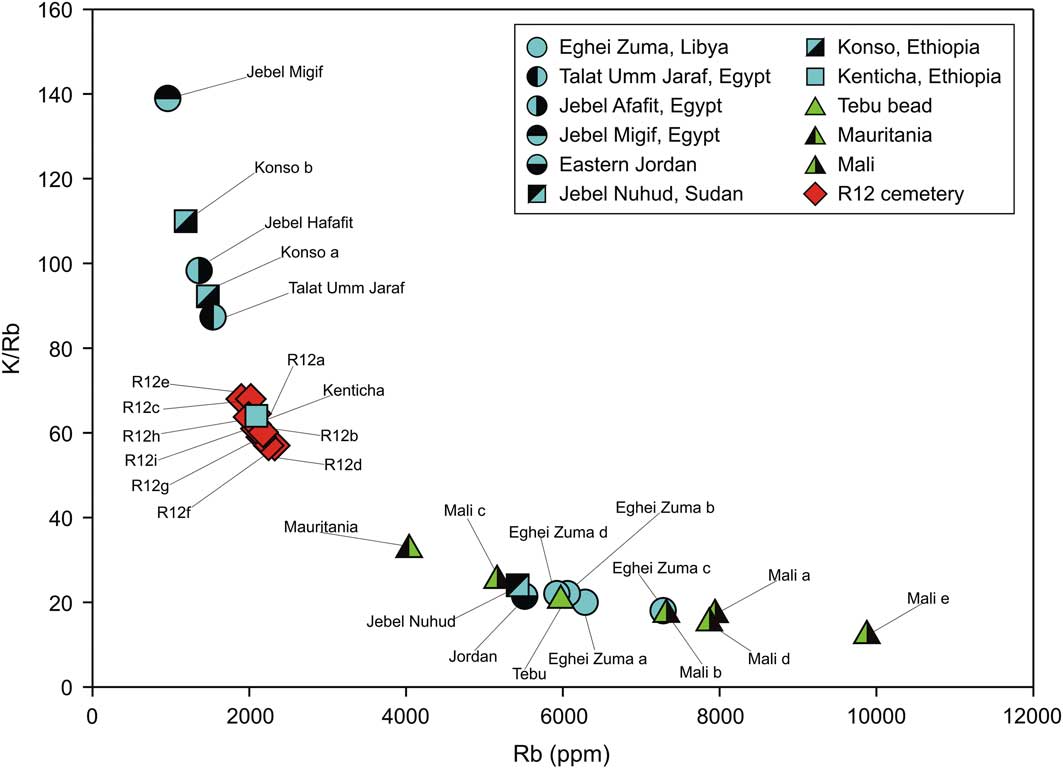
Analytical data are represented in Figure 5 as a potassium/rubidium vs rubidium (K/Rb vs Rb) diagram. Rubidium and potassium are the elements that most accurately differentiate the chemical composition of the pegmatite outcrops and, thus, describe the provenance of the amazonite crystals (Zerboni et al. Reference Zerboni, Vignola, Gatto, Risplendente and Mori2017). The potassium/rubidium vs rubidium diagram shows great variability in the distribution of the chemical composition of each analysed bead and raw material source. The samples are distributed along a wide range of chemical values, with rubidium content between 1000 and 10 000ppm, and the potassium/rubidium ratio between 10 and 140. This therefore implies different intrusive rocks of raw material provenances, but several clusters can be identified.
Potassium/rubidium vs rubidium diagram of the geochemical ratios of the elements considered to distinguish amazonite provenance.

Discussion
Amazonite provenance and bead production
Amazonite is a green to blue-green variety of microcline with white veins, and a common rock-forming mineral in the niobium-yttrium-fluorine geochemical type of granitic pegmatites that has reacted with deposits of massive sulphides containing lead (Pb) (Wise Reference Wise1999; Černý & Ercit Reference Černý and Ercit2005; Martin et al. Reference Martin, de Vito and Pezzotta2008). The occurrence of amazonite-bearing pegmatites in North and East Africa is illustrated in the OSM.
The potassium/rubidium vs rubidium diagram (Figure 5) discriminates the geochemical signature of each sample and helps discern the pegmatite source. Several clusters are evident. The first includes samples from the outcrop at Eghei Zuma in the Tibesti Region, as well as the beads from ethnographic collections from Sudan and Mali; this confirms historical exploitation of the quarry in southern Libya (de Michele & Piacenza Reference de Michele and Piacenza1999; Zerboni & Vignola Reference Zerboni and Vignola2013; Zerboni et al. Reference Zerboni, Vignola, Gatto, Risplendente and Mori2017). The second cluster includes all the beads from the R12 cemetery, and implies that the raw material used to produce them came from a single pegmatitic source.
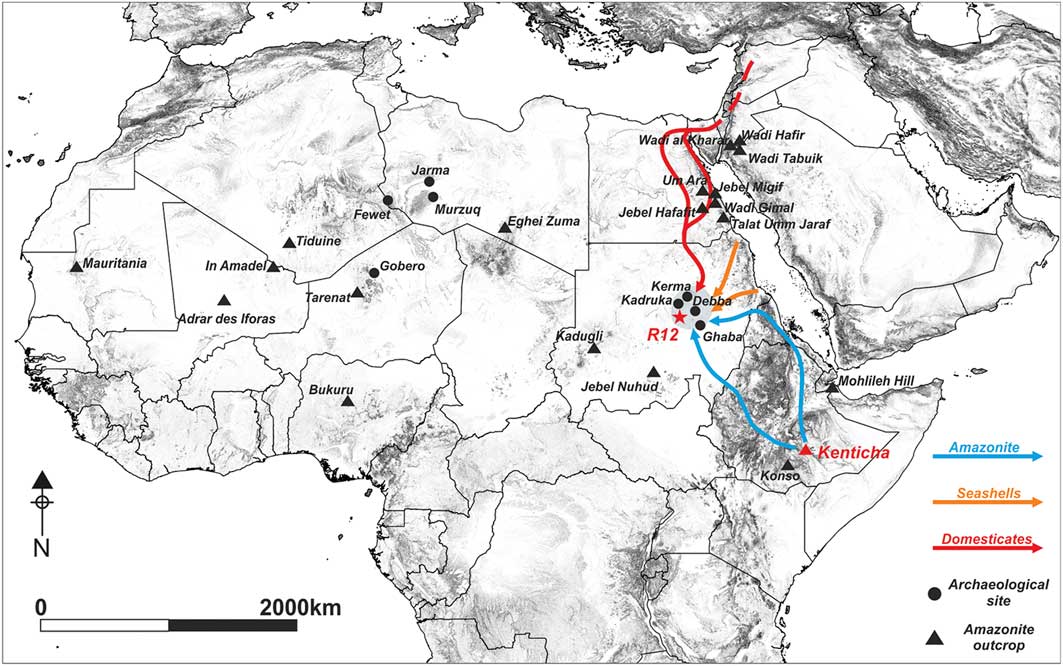
Many Neolithic graves from the Nile Valley include allochthonous or exotic prestige objects, such as those made from seashells (see Tables S2–3). Although the Red Sea coast is almost certainly a source for some of the shells, it is, at present, impossible to trace the trade routes or exchange mechanisms that brought them to the Sudanese Nile Valley during the Neolithic. The provenance of geological raw materials, however, can only be determined through geochemical analyses. Thus, we compared R12 amazonite beads with samples of amazonite raw material from many other possible procurement areas within North and East Africa and the Levant (Figure 6). The Tibesti Region has long been considered as the source area of Neolithic amazonite in the Nile Valley (Arkell Reference Arkell1953; Monod Reference Monod1974; de Michele & Piacenza Reference de Michele and Piacenza1999). This possibility must, however, be dismissed, at least for the R12 amazonite beads. Instead, chemical analysis shows that the composition of the R12 beads matches the sample from Kenticha in the southern Ethiopian Highlands.
Site location and sources with possible communication pathways established by Neolithic people living in Upper Nubia.

Neolithic exchange links between Ethiopia and Sudan have not previously been documented, partly due to the paucity of archaeological data for contemporaneous groups in Ethiopia (Brandt Reference Brandt1986; Finneran Reference Finneran2007; Hildebrand et al. Reference Hildebrand, Brandt and Lesur-Gebremariam2010). Furthermore, eastern Sudan—one of the possible bridges between the two areas—has been investigated unevenly (Shiner Reference Shiner1971; Fattovich et al. Reference Fattovich, Marks and Mohammed-Ali1984; Marks & Fattovich Reference Marks and Fattovich1989), with recent research in the region concentrating on the later third and second millennia BC (Manzo Reference Manzo2017). Nevertheless, the presence of marine shell beads (Tables S2–3) at R12, el Barga and other Neolithic sites along the Nile demonstrates that at least one route from Upper Nubia and central Sudan to the Red Sea coast was active from the early sixth to the fourth millennium BC. The transfer of raw material (amazonite and of other exotic materials) to sites along the Sudanese Nile may have taken a different route, but “whether prehistoric artefacts moved from source to destination by exchange from person to person or whether, on the other hand, individuals went directly to the source” (Hodder Reference Hodder1995: 108) cannot currently be proven.
Finally, it is important to establish whether Neolithic communities exchanged amazonite as a raw material or as finished beads, or both. The presence of unfinished amazonite beads in a Sudanese Neolithic context (Arkell Reference Arkell1953) and pieces of raw amazonite (Tables S2–3) would point to a local production of beads in association with that of carnelian, zeolite and ostrich-eggshell ornaments (Usai Reference Usai2016). This assumption, however, cannot be definitively confirmed by the data presently available.
Anthropological implications
While bead production dates back to the Palaeolithic (e.g. White Reference White1989; Bednarik Reference Bednarik2005; Derevianko et al. Reference Derevianko, Postnov, Rybin, Kuzmin and Keates2005; d’Errico et al. Reference d’Errico, HenshilWood, Vanhaeren and Van Niekerk2005; Vanhaeren & d’Errico Reference Vanhaeren and d’Errico2005; Bouzouggar et al. Reference Bouzouggar, Barton, Vanhaeren, D’errico, Collcutt, Higham, Hodge, Parfitt, Rhodes, Schwenninger, Stringer, Turner, Ward, Moutmir and Stambouli2007; Richter et al. Reference Richter, Garrard, Allock and Maher2011), brightly coloured specimens are more commonly found in Neolithic assemblages. For the Near East, Bar-Yosef Mayer and Porat (Reference Bar-Yosef Mayer and Porat2008) suggest that colour may have been used as a meta-language, linking the prevalence of Neolithic green stone beads directly to the onset of agriculture. The Neolithic societies of the Sudanese Nile Valley, however, have been described as being overwhelmingly pastoral (e.g. Caneva Reference Caneva1988, Reference Caneva1993; Marshall & Hildebrand Reference Marshall and Hildebrand2002; Gatto Reference Gatto2011; Wengrow et al. Reference Wengrow, Dee, Foster, Stevenson and Ramsey2014), although recent evidence for domestic cereal cultivation in Upper Nubia and central Sudan has been dated to the second half of the sixth millennium BC or earlier (Madella et al. Reference Madella, Garcia-Granero, Out, Ryan and Usai2014; Out et al. Reference Out, Ryan, García-Granero, Barastegui, Maritan, Madella and Usai2016). Either way, it is possible that changes in the socio-economic structures and symbolism of Sudanese Neolithic society prompted the search for more diverse and socially valuable materials (Salvatori & Usai Reference Salvatori and Usai2008a; Salvatori et al. Reference Salvatori, Usai and Lecointe2016).
As symbolism remains a contentious theme in archaeology (Hodder Reference Hodder2010), it seems more useful to establish the relationship between exotic materials and the emergence of complexity (e.g. Rosen et al. Reference Rosen, Tykot and Gottesman2005; Dillian & White Reference Dillian and White2010; Rosenberg et al. Reference Rosenberg, Getzov and Assaf2010). Here, understanding the distribution of raw material sources is essential. Many of the objects found at R12 are made of materials that differ from the local bedrock, which comprises serpentinite, syenite, amphibolite, gabbro-diorite, diorite and gneiss (Maritan & Santello pers. comm.). The Geological Map of Sudan (Ministry of Energy & Mining 2004) shows formations of these rocks present in the Nubian Desert and in other regions of Sudan. Detailed source-mapping in Sudan, however, is lacking and this seems to be mandatory for the reconstruction of the dynamics inherent in any prehistoric exchange networks (e.g. Nicholson & Shaw Reference Nicholson and Shaw2000).
The distribution of amazonite at archaeological sites across the Neolithic Sudan is variable. It is, for example, quite commonplace across northern Sudan, but much rarer in central Sudan. Furthermore, its frequency in the north varies, as it is not found in all cemeteries, and, in cemeteries where it is present, it is not present in all graves. The presence of amazonite in Sudanese Neolithic sites (Tables S2–3; Salvatori & Usai 2008b; Usai Reference Usai2016) suggests that it conveyed a specific meaning and symbolic value. Evidence for local bead production (Usai Reference Usai2016) suggests the existence of (semi-) specialist craftworkers, probably indicating a subsequent trend to a more structured Neolithic social organisation. Such a process of incipient specialisation can also be observed in late fifth-millennium BC pottery production (Dal Sasso et al. Reference Dal Sasso, Maritan, Salvatori, Mazzoli and Artioli2014; Salvatori & Usai 2016). In this context, access to non-local raw materials reflects wide networks of inter-community and/or interregional relationships. The type and number of exotic objects and raw materials can be an indicator of external relationships, of the extension of their geographic distribution and, possibly, of the continuous reworking of symbolic meaning in the negotiation of social status, identity and ideologies of Upper Nubian and central Sudanese Neolithic communities. This is also evidenced in many other Neolithic groups in the Near East and Europe (e.g. Cohen Reference Cohen1985; Perlès Reference Perlès2001; Bar-Yosef Mayer et al. Reference Bar-Yosef Mayer, Porat, Gal, Shalem and Smithline2004; Fogelin Reference Fogelin2007; Watkins Reference Watkins2008).
Amazonite and obsidian beads and Red Sea shells were present in early sixth-millennium BC graves at el-Barga in the Kerma area (Honegger Reference Honegger2004, Reference Honegger2005). At the R12 Middle Neolithic cemetery, amazonite beads, pendants and raw lumps (Figure 2), together with other exotic prestige items, such as malachite splinters and seashells from the Red Sea coast, were differently distributed in the graves; similar items are found at each of the excavated fifth- and fourth-millennium BC cemeteries listed in Tables S2 and 3. There is significant variability in the quantitative and qualitative presence of exotic materials across the different sites (Tables S2–3). More quantitative analyses are required, especially when approaching problems concerning the intra- and inter-community construction of identity and shared ideology.
Our new data on amazonite beads, together with the evidence reviewed in Tables S2 and 3, suggest that each fifth-millennium BC community conferred specific symbolic meanings to the different exotic materials used as body ornaments. The differential distribution of malachite powder and splinters between graves (Salvatori & Usai 2008b), along with variability in the use of amazonite beads, supports the hypothesis that each community had its own ideological construction and identity markers. Furthermore, from the mid fifth millennium BC, the production of other goods, such as pottery, reflects strong regional identities, as represented by the Multaga phase in Upper Nubia and the Shaheinab phase in central Sudan (Salvatori Reference Salvatori2008; Salvatori & Usai Reference Salvatori and Usai2008a, 2016; Salvatori et al. Reference Salvatori, Usai and Lecointe2016). At a more local level, communities—despite the indisputable process of socio-cultural consolidation in the late fifth millennium BC—retained clear differences in the use of material items in their funerary practices. Even if the use of exotic materials is a clear indicator of the owner’s prestige, it is still difficult to deduce the supply routes of such materials and the extent of contact between local communities. Amazonite beads are relatively common in necklaces worn by R12 individuals, but are extremely rare among ornaments worn by individuals at the Ghaba and Kadero cemeteries (Chłodnicki et al. Reference Chłodnicki, Kobusiewicz and Kroeper2011; Usai Reference Usai2016). While the Ghaba, Kadero and R12 communities are roughly contemporaneous, they exhibit important differences in social behaviour, as inferred from funerary practices (Salvatori & Usai 2016), and different levels of complexity. At R12, bead typology and the raw materials used to produce them are much more varied; the applied technology and stages of bead production are more elaborate, suggesting a form of specialised manufacturing (Salvatori & Usai 2008b; Usai Reference Usai2016).
Conclusion: an emerging Neolithic trade network
The distance between the identified source of amazonite in Ethiopia and the graves sites where the amazonite beads and other objects were deposited in the Northern Dongola Reach is considerable, reaching more than 1700km. Similar long-distance Neolithic exchanges are attested in other parts of the world, although the precise mechanisms involved sometimes remain unknown (Renfrew Reference Renfrew1977; Dillian et al. Reference Dillian, Bello and Shackley2010; Düring Reference Düring2014; Freund & Batist Reference Freund and Batist2014; Gibaja et al. Reference Gibaja, González, Martín, Palomo, Petit, Plasencia, Remolins and Terradas2014). Long-distance exchange to the Sudanese Nile Valley is further evidenced by the presence of Red Sea seashells (300–700km).
The possible route by which amazonite reached the Sudanese Nile Valley is currently unknown. Evidence from the R12 graves, however, suggests that some communities clearly regarded amazonite as having special meaning, and they may have had connections of some type with the amazonite sources. The data on amazonite beads and other exotic materials from R12 so far suggest a Neolithic exchange network encompassing the Red Sea coast and a south-east/north-west route, possibly along the Atbara and Gash Rivers into the Ethiopian Highlands (Figure 6). Further analysis on amazonite samples from other Neolithic sites and sources (quarries) along the Nile Valley would widen our understanding of the system of exchange from north to central Sudan. It would also highlight whether different sources were exploited by the individual communities, which would aid understanding of intra- and inter-community interaction, and the role played by exotic materials in the shaping of shared or diverging identities and ideologies. Certainly, material exchange formed the base of information sharing, as well as of social status acquisition and, possibly, transfer along a familial lines (Dillian & White (Reference Dillian and White2010: 7).
Acknowledgements
Excavation at the R12 cemetery was funded by the Italian Ministry of Foreign Affairs (DGSP) and Ce.Ve.S.C.O. Funds for geochemical analyses were provided by Università degli Studi di Milano—Linea B. The National Corporation for Antiquities and Museums of Sudan and the Italian Embassy in Khartoum are kindly thanked for their support. J. Harrel, P. Iacumin, M.E. Peroschi, F. Cambieri and N. Moroni are acknowledged for providing raw material samples. Many thanks to A. Risplendente for performing the microprobe analysis, and to E. Ducale and M. Marchesini for helping with sample preparation. J. Dunne is kindly acknowledged for revising the English language of the article. We also thank the two anonymous reviewers for their careful reading of our manuscript and their insightful comments and suggestions.
Supplementary material
To view supplementary material for this article, please visit https://doi.org/10.15184/aqy.2018.196