

Introduction
Thoroughbred racing is the largest of the three racing codes in New Zealand. During the 2006–07 season, 5566 horses, trained by 333 public trainers and 387 ‘permit to train’ holders, ran in 2863 races, of which 63 were solely for 2-year-old racehorses1. The ongoing success of the Thoroughbred racing industry relies on the production of horses for 2-year-old racing, which continue to race for a number of seasons; this ensures sufficient numbers of racehorses to optimize betting turnover and re-investment of turnover as stakes/prize money. One of the largest threats to the racing industry is the loss of horses from the training population due to a lack of talent or as a result of wastage.
Several prospective epidemiological studies of a large cohort of horses quantified wastage and risk factors relating to musculoskeletal injuryReference Perkins, Reid and Morris2–Reference Perkins, Reid and Morris5 and the effect of early exercise on the musculoskeletal system and training ability of racehorses within New ZealandReference Rogers, Firth, McIlwraith, Barneveld, Goodship and Kawcak6, Reference Rogers, Firth, McIlwraith, Barneveld, Goodship and Kawcak7. Early exercise apparently stimulates the development of the equine musculoskeletal systemReference van Weeren, Firth, Brommer, Rogers, DeGroot and Brama8, Reference Dykgraaf, Firth, Rogers and Kawcak9, and a previous Australian study indicated that horses which start as 2-year-olds have a longer and more successful career than horses which start racing at a later ageReference Bailey, Reid, Hodgson and Rose10. With the increasing evidence that early exercise and training of 2-year-olds have a positive effect and no evidence of harmReference Rogers, Firth, McIlwraith, Barneveld, Goodship and Kawcak6–Reference van Weeren, Firth, Brommer, Rogers, DeGroot and Brama8, Reference Nugent, Law, Wong, Temple, Bae and Chen11–Reference Stanley, Edwards, Goodship, Firth and Patterson-Kane13, it is important that current industry practices regarding 2-year-old training are quantified.
As part of a prospective study investigating training-related wastage in the New Zealand Thoroughbred, Perkins et al. Reference Perkins, Reid and Morris2, Reference Perkins, Reid and Morris4, Reference Perkins, Reid and Morris5, Reference Perkins, Reid and Morris14, Reference Perkins, Reid and Morris15 identified differences in preparation time between 2-year-old and older horse age categories, and apparent differences in racing focus and success between trainers based in the Waikato (Northern Districts) region and those in the Manawatu (Central Districts) region. Recent surveys have revealed that there are differences in the use of veterinary and alternative therapy between small, medium and large stablesReference Coleman, Rogers and Gee16 as well as differences in husbandry and nutritional managementReference Williamson, Rogers and Firth17. Although surveys that consider the nutritional management of the racing athlete have been conductedReference Williamson, Rogers and Firth17, Reference Richards, Hinch and Rowe18, there is a lack of scientific literature on the focus and training practices of trainers of 2-year-olds in New Zealand.
Features of workload, such as speed, distance, frequency and duration of training workouts, can presumably have an effect on the subsequent function of the musculoskeletal system. However, providing advice to the industry on the workload of 2-year-old horses is difficult, because the recording of workload is not practised often or consistentlyReference Rogers, Rivero, van Breda, Linder and Sloet van Oldruitenborgh-Oosterbaan19, and descriptive terms vary between countries and racing sectorsReference Rogers and Firth20. The increasing uptake of GPS (global positioning satellite) based systems for the recording of workload may mean that data capture and analysis will be easier and still cost-effective, but in the short term, it is important to identify whether, and what, trainers are recording. The aim and objectives of the current study were to describe the management practices of trainers of 2-year-old Thoroughbred racehorses, in different sizes and locations of training establishments, within the North Island of New Zealand.
Materials and methods
Sample
The target population for this survey was registered public trainers of 2-year-old Thoroughbred racehorses located in the North Island of New Zealand. The sample population was selected from a list of 291 registered public trainers across the North Island, published by New Zealand Thoroughbred Racing. Trainers in the Manawatu/Wanganui regions (Central Districts) and the South Auckland/Waikato regions (Northern Districts) with more than ten horses (of any age) in work were included in the sample population (n = 78). The sample was restricted to these regions to allow the interviewer to conduct the surveys face to face with the trainers within the time frame of the study. Trainers' contact details were obtained from a list published by New Zealand Thoroughbred Racing21, and trainers were contacted by telephone to request and arrange an interview; those who could not be contacted after four phone attempts were excluded from the survey.
Survey
A cross-sectional survey was conducted as a face-to-face interview to increase participation and minimize non-response bias. It took approximately 10 min to complete each interview. The survey consisted of 33 open and closed multiple-choice questions. The trainers were asked about the total number of horses and the number of 2-year-olds in training and the source of the 2-year-olds. Questions also relating to the breaking in of 2-year-olds were asked: when they were broken in, what influenced the age at which they were broken, who was responsible for breaking them in, and the activity of the 2-year-olds after breaking in. Additionally, questions were asked about the duration of spells (defined as breaks from training), when the decision to spell a horse was made, the structure of the training programme (number of weeks at canter, pace work, gallop, number of jump-outs and trials), the recording of workload during training (what and how often exercise is recorded and the method used), the decision to continue training 2-year-olds and the most important milestones for training 2-year-olds.
Data collection
The data were collected by one interviewer (LJR) during spring/summer 2007–08. Trainers' answers were recorded on a pro forma recording sheet, which was subsequently transposed into MS Excel (Microsoft Corporation, Redmond, WA, USA) for data manipulation.
Statistical analysis
Exposures of interest included the total number of horses a trainer had in work at one time (referred to as stable size), which was categorized into three groups based on divisions previously used by Williamson et al. Reference Williamson, Rogers and Firth17 and expert opinion; trainers with ≥ 40 horses in work were classed as group L, with 20–39 horses as group M and with 10–19 horses as group S. The dataset was also divided into the geographical location of the trainers' stables (either Northern Districts or Central Districts). Descriptive data are presented as proportions, means with range and medians with inter-quartile range (IQR) for non-normally distributed data. Associations between the exposure and the outcome variables were assessed using Pearson's χ2 test for the difference between proportions. Due to small sample sizes, some of the expected cell counts were < 5, and as a result, Fisher's exact test was applied. For contingency tables with degrees of freedom (df) = 1, Yates' continuity correction factor was used. Individual multinomial logistic regression models were used to assess for potential confounding between the exposure variables and each outcome of interest. Bonferroni's correction was applied to adjust for multiple comparisons, resulting in a significance level of P < 0.007. All analyses were performed in R for Windows (Version 2.7.1; Comprehensive R archive network).
Results
Of the 78 eligible trainers, 1 declined, 10 trainers were not able to be contacted and 11 had no 2-year-olds in training, resulting in 56 study entrants and a response rate of 72%. Upon interview with one trainer, it became apparent that the trainer had no 2-year-olds in training for the 2007–08 season, although this had been previously implied, and their data were excluded (55 study participants). The distribution of horses in training by stable size and location is given in Table 1.
Number of trainers and total and mean (range) number of horses in work by stable size (by number of horses) and location

2yo, 2-Year-old horses.
i Waikato and South Auckland.
ii Manawatu and Wanganui.
Trainers in group S had a higher median proportion of 2-year-olds sourced from owner/breeders (0.7, IQR 0.3–0.8) than both groups M (0.4, IQR 0.3–0.4) and L (0.4, IQR 0.3–0.5) (P = 0.01). Trainers in the Northern Districts had a higher proportion of 2-year-olds in work (0.31 vs. 0.22) than trainers in the Central Districts. The median proportion of horses sourced from yearling sales was 0.6 (IQR 0.5–0.8) and 0.5 (IQR 0.5–0.7) for trainers in groups M and L, respectively, compared with 0.3 (IQR 0–0.7) for trainers in group S (P = 0.001). Few 2-year-olds were leased (0.0, IRQ 0–0), and there was no significant difference between regions in the proportion of horses sourced from yearling sales (0.5, IQR 0–0.75).
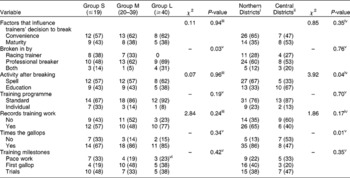
Associations between the two explanatory variables (stable size and trainer's location) with the training outcomes are given in Table 2. There was no association between groups L, M and S and the location of the trainer (Fisher's exact test, P = 1). Results showed that there was no confounding of either stable size or trainer's location on any of the associations (data not shown). The activity of horses immediately after being broken in was not significantly different between groups L, M and S (Table 2). Half the trainers were inclined to bring their horses straight into the stable for early education and assessment, while the other half spelled their horses at pasture after breaking in. However, there was a trend between post-breaking activity and location, with most trainers in Central Districts bringing their horses straight into work and most trainers in Northern Districts spelling their horses after breaking in (Table 2). The duration of spelling after being broken in was based on the physical maturity of the horse (35% of trainers) or a standard duration for all horses (16% of trainers). For spells that occurred between preparations, most trainers (51%) decided the duration of the spell before it began, while 49% decided after the horse was spelling.
Effect of stable size (by number of horses) and location on trainers' decisions regarding various training practices

Data are presented as number and proportion (%) of trainers.
i Waikato and South Auckland.
ii Manawatu and Wanganui.
iii P-value for Pearson's χ2 test.
iv P-value for Pearson's χ2 test with Yates' continuity correction for df = 1.
v P-value for Fisher's exact test for instances when expected cell counts are < 5.
vi Rounding leads to total 99%.
The median proportion of 2-year-olds in work for early education purposes was 0.5 (IQR 0–0.8), with fewer in work primarily for the purpose of racing as a 2-year-old (0.2, IQR 0–0.3) or for the purpose of sale (0, IQR 0–0.3). The median proportion of 2-year-olds in training for the purpose of racing as 3-year-olds was 0 (maximum 1).
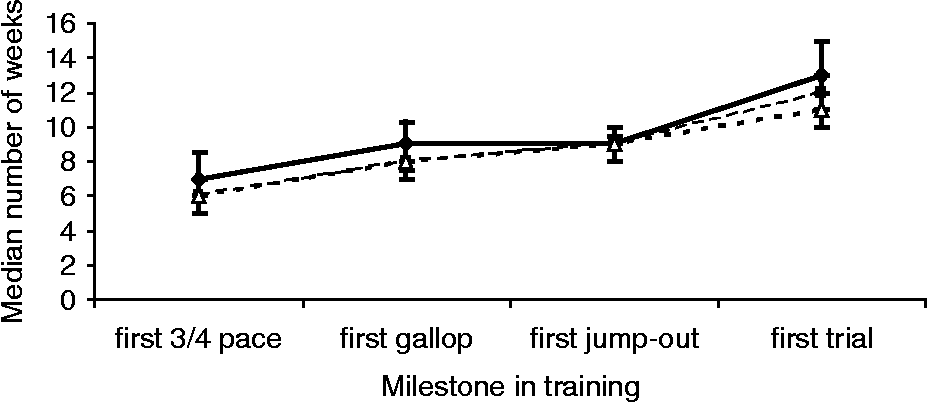
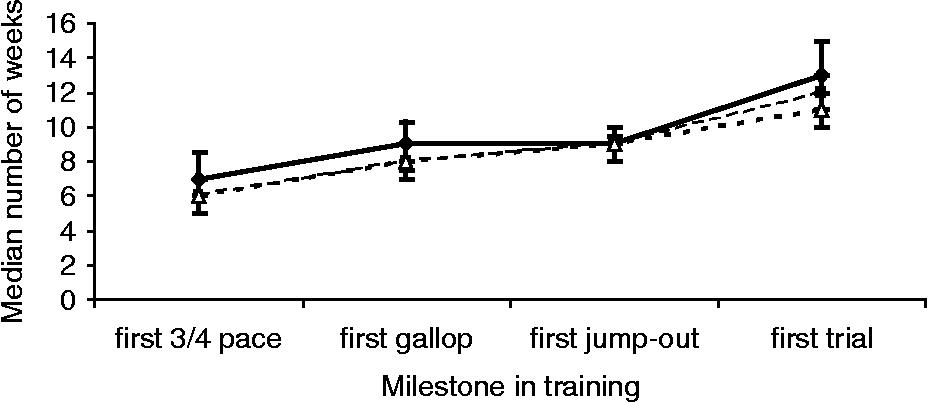
Whether a trainer used a standard or individual training programme for 2-year-old horses was not significantly different between groups or regions. Most trainers used a relatively standard training programme for all 2-year-old horses up to trialling (Table 2). The median number of weeks in training to four milestones (first 3/4 pace, gallop, jump-out and trial) for horses in groups L, M and S is shown in Fig. 1. The first gallop occurred 1 week earlier in the training programme for both groups L and M than for group S, while the first jump-out occurred at the same stage in the training programme. Trainers in group L typically had their horses ready for trial 2 weeks earlier than trainers in group S and 1 week earlier than trainers in group M. Across all trainers, the median number of training preparations, jump-outs and trials was 2 (IQR 2–2) for all 2-year-olds in training.
Median number of weeks to first 3/4 pace, first gallop, first jump-out and first trial for horses in groups S (♦), M (■) and L (△). Error bars represent the inter-quartile range.
The recording of slow and fast work during training was not associated with trainer's location or stable size (Table 2). Forty-eight per cent of trainers recorded all slow and fast work during training. There was a trend for more trainers in the Northern Districts than in the Central Districts to time only the gallops, whereas there was no association between stable size and whether a trainer timed the gallops. The stage of the training programme at which trainers decided to continue (or not) training an individual horse did not differ significantly between groups or with location. However, trainers in groups M and L and from the Northern Districts predominantly chose the first gallop stage, while trainers in group S and Central Districts waited until later in the training programme, usually after the first trial stage (Table 2). Most trainers (91%) said that the introduction of free racing (reduction or removal of entry fees for lower-grade races) would not induce them to enter horses in a 2-year-old race instead of trialling first.
Discussion
The aim of the study was to describe the management practices of trainers of 2-year-old Thoroughbred racehorses in New Zealand, and to establish whether these were influenced by the sizes and regional location of the training establishments. The sampling frame of this survey was limited to the Central and Northern Districts to allow the interviewer to conduct the survey face to face within the time frame. The sample was thus not random, and may not be representative of the entire population of New Zealand racehorse trainers. However, of the 291 registered public trainers in the North Island, 51% were concentrated in the Auckland/Waikato regions and 23% in the Manawatu/Wanganui regions22. Additionally, approximately 70% of the Thoroughbred racehorses trained in New Zealand were located within these areas22, and of the top five training centres, four were included in the sampling frame23. The sample population that was selected represented 27% of the registered public trainers in the North Island of New Zealand. While this figure is low, the calculation is based on the total number of registered trainers in the North Island and does not relate specifically to trainers of 2-year-olds. The survey was conducted face to face to reduce non-response bias and to enhance the accuracy of the responses. As a result, a high response rate was obtained, and the study population represented 72% of the sample population.
The current study showed that trainers in the Northern Districts had a higher proportion of 2-year-olds in work than trainers in the Central Districts, which may mean that they have a larger pool of 2-year-olds to source from, increasing their chances of success. Perkins et al. Reference Perkins, Reid and Morris15 found that trainers in the Matamata region (Northern Districts) were more successful and were more likely to have a horse start in a race and to have a horse finish in the first three places than those in the Central Districts. As trainers in the Northern Districts have a 1/3 higher expenditure associated with training racehorses than trainers in the Central Districts22, they may face greater pressure to have horses perform earlier. Trainers in the Northern Districts had a greater proportion of 2-year-olds sent away to professional breakers, leading to a shorter preparation time to begin training and getting to the trials. For most trainers, convenience was the primary factor influencing the age at which horses were broken in, but we could not show whether there was any pre-selection by trainers before a horse was broken in, or whether they assumed that all horses were at the same level of development.
The greater proportion of 2-year-olds sourced from yearling sales and aimed at 2-year-old races, typical of group L trainers, might be because they were under greater pressure from clients to have a horse entering races sooner. However, the effect of owner pressure on trainers' decisions was not considered in the current study, and it warrants further investigation. Boyle et al. Reference Boyle, Guthrie and Gorton24 suggested that trainers with large numbers of horses in work may be more dependent on outside clients, since a greater fraction of their income was derived from training services than trainers with fewer horses in work, who generate more of their income from non-training services.
The primary reason for entering 2-year-olds into race training was to provide the horses with an early education, with few trainers citing the primary reason being to race as 2-year-olds. The responses to this question may be a reflection of the demands of training 2-year-olds. Perkins et al. Reference Perkins, Reid and Morris5 identified that 2-year-olds had a greater interval from entering a racing stable until first trial or race start than did older horses, and spent more time at the lower training activity scores. They attributed this to the fact that 2-year-olds need to acquire a repertoire of skills necessary for them to be able to race, whereas older horses already posses these skills and the primary focus of training is the development of fitness. Many of the trainers indicated that the training milestones used to evaluate whether the horse remained in training were the first gallop and/or a trial start. Both these milestones are within a week or two of the time when a horse would in any case typically start in a raceReference Perkins, Reid and Morris5, indicating that many trainers aimed to have the horses as close as possible to being able to start in a race at the completion of their first training preparation.
Most trainers preferred a standard training programme for all their 2-year-olds. However, there were subtle differences in the timeline of the training activities. The median time to first trial stage was shorter for horses in the Northern Districts, and trainers in group L had a shorter median duration to the first trial by shortening the slow canter work by 1 week; it is known that extra canter work, as opposed to introducing gallop exercise, does not cause the adaptation within limb bones needed to withstand the forces of racingReference Firth25, Reference Verheyen and Wood26. However, this finding may also reflect the pressure from clients, as mentioned above. The lack of data regarding decisions about when, and for how long, trainers decide to spell horses has been discussed previously by Perkins et al. Reference Perkins, Reid and Morris5. The current study showed that for many trainers spells are of a pre-determined length of time, while others monitor the horse and adjust the duration accordingly.
Previous studiesReference Perkins, Reid and Morris3, Reference Cogger, Perkins, Hodgson, Reid and Evans27–Reference Verheyen, Newton, Price and Wood29 have identified the trainer as a risk factor for musculoskeletal injury during training and racing, accounting for a number of unmeasured variables. The current survey highlighted that there may be differences between training practices associated with the geographical location. These factors could therefore be considered as potential confounders, or effect modifiers, for future studies investigating risk factors associated with training and racing.
These differences may impact on the training programme of the horses and the pressure to start in trials and races, which in turn may contribute to wastage within this population. However, a limitation of this study and other cross-sectional surveys is the inability to collect detailed, prospective daily exercise data, and so we cannot quantify the impact these differences have on an individual horse in training. This information could be important, since subclinical effects of regimens that are too aggressiveReference Perkins, Reid and Morris4, Reference Cogger, Perkins, Hodgson, Reid and Evans27, Reference Verheyen, Henley, Price and Wood28, Reference Estberg, Gardner, Stover and Johnson30–Reference Estberg, Stover, Gardner, Johnson, Case and Ardans32 or too reservedReference Firth25, Reference Verheyen and Wood26, Reference Parkin, Clegg, French, Proudman, Riggs and Singer33, Reference Cohen, Berry, Peloso, Mundy and Howard34 could lead to problems in a clinically normal horse. It is worth considering, therefore, what effect these different training methods would have on horses with undetectable, early abnormalities.
The current study has provided baseline data on the training practices of 2-year-olds in New Zealand, which may be used in future studies that aim to identify modifiable risk factors for those horses that have an unsuccessful training and racing career, reducing wastage within the industry and maximizing the number of 2-year-old starters.
Acknowledgements
The authors gratefully acknowledge funding support for this project from the New Zealand Racing Board as part of the Equine Partnership for Excellence, and thank New Zealand's Thoroughbred racehorse trainers for generously giving their time and assistance.