


Interactionalist ontologies and viscous porosity
Relations between theory and practice in Environmental Education demands more relational thinking from day one. Theory is dependent on how it is used, and practice is decided by theory about how to do sustainability. But what consequences will such an analysis produce for what we do, how we speak, how we speak of and relate to what we do? Maybe we have not worked hard enough with the concepts of theory and practice, and maybe we have not worked hard enough with relations between what we do and what we say we do; the actual shortcomings of language that is, shortness of access to language that is. Relational thinking for sustainability demands building in modalities in language from day one. Is what I try.
There is no such thing as either man or nature now, only a process that produces the one within the other and couples the machines together. Producing-machines, desiring-machines everywhere, schizophrenic machines, all of species life: the self and the non-self, outside and inside, no longer have any meaning whatsoever (Deleuze & Guattari, Reference Deleuze and Guattari2004b, p. 2).
Given what I try, the overarching idea of this article is expansions of educational rationales for sustainability. Not as proposals to a teacher’s didactical toolbox; methods and interventions, or pupils’ instructions or learning techniques, but a view of deep learning seen in an inter-intragenerational perspective eschewing simplistic notions to any particular educational provision and models. I seek to situate a rich and complex view of environmental education between theory and practice moving from centred views of sustainability focussed on identity and individuality, to a decentred view with focus on collective interactionalist ontologies and becomings. Sustainability justifiable in its own right and constantly in the making. Environmental Education ultimately seen as a metadesigned space for cosmic citizenships.
Grounded in the Deleuze and Guattari (Reference Deleuze and Guattari2004a) notions of the rhizome and writing, the poet and the artisan, the form of environmental education between that I advocate for here involves working with ways to access a proto-subjective level of the affective power of X: connectivities or actualizations of affects possibilizing molecular interintrafactual and minded mattered languaging.Footnote 2 Language embedded in life containing life in its interior laying bare the connections between words and the world. Language as method hence writing as agentic acts of sustainability. Knowledges forced open and meaning-making processes that do not steal my powers away. Ultimately, knowledge processes of constant familiarisation and defamiliarization as a way of working with environmental education for sustainability.
I theorize the teacher role and pedagogue — read also the scientist and researcher — as a poet and artisan forwarding pedagogical practices that cannot be placed in any discourse. The poet being ‘one who lets loose molecular populations in hopes that this will sow the seeds of, or even engender, the people to come, that these populations will pass into a people to come, open cosmos’ (Deleuze & Guattari, Reference Deleuze and Guattari2004a, p. 381). It is a paradoxical or oxymoronic approach to research and pedagogical practices of critique and value-assessment. Not to abstract or isolate problems but to approach those in their real-world contexts as open thinking possibilities hence avoiding being caught up in an impasse between critique and transformation, theory and practice. Pedagogies and research hence seen as poetry in motion. It implies moving beyond current meaning making structures mobilizing more and other, mobilizing agencies for sustainability. Pedagogues and researchers who are able to act despite of the fear of meaningloss, becoming responsable that is without having a discourse to lean on.
As such, this is my attempt to write a planetary — more-than-human — differential activist pedagogy and science from within. The way I see this, it is a life science and studies in life-sustaining intrainteractions of humans and all other species and the physical environment. Entangling, swirling, diffracting, refracting and connecting all sorts of epistemological, ontological, matter and nonmatter, knowing and not knowing, thoughts, sensations, values and experiences … pedagogues, singers, pictures, poems … together in motion or flux. Deleuze and Guattari (Reference Deleuze and Guattari2004a) write:
We will therefore define the artisan as one who is determined in such a way as to follow a flow of matter, a machinic phylum. The artisan is the itinerant, the ambulant. To follow the flow of matter is to itinerate, to ambulate. It is intuition in action. (p. 452)
I will continue singing myself and methodologizing language. Every word and concept being simultaneously both method and performance. That is, I try to trace my autoethnographic affective and aesthetic responses to the dramas of adjustment that unfold amid talk of climate change, natural and social sustainability, learning, precarity, contingency, hope and even crisis. So, while I work with theory and practice in environmental education there is an autoethnography included. There is an educator and researcher experiencing thoughts in movement. I write it in a different style. Therefore, this is a layered account and I use poems, pictures, paintings, reflexivity multiple voices and introspection. I hope you as reader enters into the emergent experience of doing and writing research, doing and writing Environmental Education between theory and practice. Constructions of affective assemblages of becomings. My ordinary path is simultaneously nature culture revolutionary and evolutionary (Reinertsen, Reference Reinertsen2018). Any axiological – or value assessment and judgement never ever removed from someone’s subjective force.
It involves the risk of erasure but oxymoronically not. Rather, immanent processual, forceful, activist, constant and machinic imperceptible becomings. And to be absolutely clear: it expands on constructivist theories of learning, being and doing, dominated by thoughts on knowledge creation, rational goal-oriented meaning-making and visible learning theories (none mentioned, none forgotten). I ultimately ask how we can think adequately about the relation between ontology and language in societies that are governed by algorithmic (digital) systems and objects endowed with agency? The songs I sing and the poems I write make me humble and vulnerable together with you. They make me powerful together with you. I am nothing, nobody, everything and all. I try to write a nondualizing actualization of subjectivity, a kaleidoscopic displacement of the/my- self.
As we go along, I elaborate activist pedagogies as speculative ethics. With a view to theory-practice relationships and following up on the former question about adequate thinking ultimately also asking how we can think adequately about the relation between knowledge and ethics in societies that are governed by algorithmic (digital) systems and objects endowed with agency? Opening up the concept of problem and the concept of resistance both, as necessary thinking tools for other. Pedagogies and education forwarding interactionalist ontologies and/of viscous porosity, an educational process-philosophical readiness for sustainability. Pedagogies in which affective forces are actionalized and the effects of affect have become possible to evaluate. As teacher and educator, I do not facilitate, I do not motivate, I do not give gifts. I work with you. I follow you. I act on possibilities. I language for consilience and newness. I write, sing and paint myself grey on grey. Deleuze and Guattari (Reference Deleuze and Guattari2004a) write:
To become imperceptible oneself, to have dismantled love in order to become capable of loving. To have dismantled one’s self in order finally to be alone and meet the true double at the other end of the line. A clandestine passenger on a motionless voyage. To become like everybody else; but this, precisely, is a becoming only for one who knows how to be nobody, to no longer be anybody. To paint oneself gray on gray. (p. 218)
Finally, this is the stuff of collective reciprocity and responsibility in sustainability and environmental education for sustainability. Taking part in a plurivers of polysemantic ambiguity becomes attractive as condition to side with the child turning into a strong source of energy for learning and change, trans-scientific collaboration and sustainability. My aim is to affirm the existence of different ontologies and the exigence of learning how to think, an affirmation and a passion for difference. Difference conceptualized as democratic ontologies of knowledge simultaneously opening and closing, stopping and forwarding. Flattening conceptualized hierarchies, collapsing criteria, structure, tradition, categories and definitions. Leaving us with preliminary knowledges, which we through writing can continue to reveal and explore further as a constant activist interrogation of our subjective judgements and ethical onto-epistemic conducts. I also call it cosmic citizenships for sustainability. It is a constant de-authorized energy of doubtful rethinking. In this way, democratic interactionalist ontologies activate the ethical task in education, which demands that we/I approach other stories, the other stories, stories about the other and me and sustainability … riddles of being, singing and not, because we must.
I cede my place to a life a moment
a raw moment (Deleuze & Guattari, Reference Deleuze and Guattari2004a, p. 355)
of liminality
intensity
existence
reality
conquest
potential
capture
between
of value
Singing myself to a point of … : About methodologizing language and the risk of erasure
There is no subject of desire, any more than there is an object. There is no subject of enunciation. Fluxes are the only objectivity of desire itself. Desire is the system of a-signifying signs with which fluxes of the unconscious are produced in a social field. There is no blossoming of desire, wherever it happens — in an unremarkable family or a local school — which does not call established structures into question. Desire is revolutionary because it always wants more connections and assemblages. (Gilles Deleuze in Deleuze & Parnet, Reference Deleuze, Parnet, Tomlinson, Habberjam and Albert2002, pp. 78–79)
I am nothing. I am nobody. I am much. I am many. I am multiple, manifold. I am layer upon layer of stories, a network. I want to unfold. I want to fold out. Open up and let my mind shift place. Open up for something else than what I already know of and expect. Not lock myself up or be locked up in positive understandings. I also contain everything else. I want to live together spaciously, in diversity and fallibility. Turn away from constative definitions, criteria and frames to the more unknown but simultaneously very close. The effects of affects that I experience and sense without necessarily knowing what they are and their names. Praxis of learning in collaboration and that it is in the embodied I-thou intra- intersubjective relation that I establish with the singular child that I fail or succeed. The embodied is simultaneously immanent (linked to capacities and worlds it originates from), relational (touching/touched by its position to- and intra-interaction with other minds, bodies and objects), affective (formed by conscious or unconscious feelings or sensations) and situated (linked to specific real and virtual rooms, places, needs and circumstances). It is the notion of the immanent that troubles, breaks with-, pushes and pulls thoughts most radically: there is everything always, everything and nothing…. I wander off, I get lost, I lose my grip. But that is exactly the way it must be, and through this I create my own empiricism in provisional safety. I live, I am matter, I matter, I contain multitudes. I (am) agent. The child is.
The Scream, Edvard Munch (1893)

It is a misunderstanding that The Scream (1893) by the Norwegian painter Edvard Munch is depicting a human being in agony and fear.Footnote 3 Rather, The Scream is an expressionistic construction based on Munch’s actual experience of a scream piercing through nature while on a walk. At the top of one of the versions of this painting Munch himself wrote ‘Can only have been painted by a madman’ (National Gallery, Oslo) and he rarely again subjected a foreground figure to this kind of distortion by a subjectivized flow of nature. Man being part of nature, absorption into such a multiplicity of particulars unified into a totality or organic suggestion would liquidate the individual. The Scream could therefore be interpreted as expressing the agony of the obliteration of human personality hence destruction of human integrity by this unifying flow and force of nature. In the foreground of the picture unified nature has come close to crossing the fence, close enough to distort the form and personality of the protagonist. But the fence still protects it from total absorption into subjective madness.
Nothing is here. Nothing is life. Nothing is much. Nothing is manifold. Nothing is layer upon layer of stories, a network. Nothing wants to unfold. Nothing wants to fold out. Open up and let minds shift places. Open up for something else that what nothing already knows and expects. Not lock itself up or be locked up in negative understandings. Nothing also contains everything else. Nothing wants to live together spaciously, in diversity and fallibility. Turn away from constative definitions, criteria and frames to the more unknown but simultaneously very close. The effects of affects that nothing experiences and senses without necessarily knowing what they are and their names. Learning nothingness in collaboration, and knowledges as that which situated knowledges make collectively possible as productive connections and unexpected openings. Nothing is charged with forces; engendering, creative, manifold and undefined. Nothing is proper and not the opposite. Nothing is to not give up on oneself, but another way of thinking about oneself. Showing oneself, becoming materially identifiable… Nothing is to know oneself, manifold and plurivers. Nothing is dissolution of my subjectivity and my identity turns collective. Nothing is the word is the proper and not the opposite. Nothing, the word, matter and I contain multitudes.
Do I contradict myself?
Very well then I contradict myself,
(I am large, I contain multitudes.)
Walt Whitman’s (1819–1892) Song of Myself, 51Munch made a division between masculinity (the rational world of man) and femininity (the multiplicity of particulars unified into a totality of nature with feminine overtones), and continued by this the pre-Socratic philosophical problem and discussion about the One and the Many, whether reality is a unity or a plurality, or both, ultimately the nature/culture, subject/object and individual/collective divides. In Munch’s world, as we have seen, painted as the fear of liquidation of the individual, the obliteration of human personality hence destruction of human integrity. The Pre-Socratics were the first Greek philosophers.Footnote 4 They treated the entirety of the cosmos (including the self) as composed of matter, of objects. They engaged in elemental thinking — that is, identifying a single element (water, fire, earth, air) as the ultimate building block of the universe (Ralston, Reference Ralston2021). The element as the given and foundation of all things. This might seem rather foreign to a more modern way of thinking wherein the self and its relation to the world — and I add the question of consciousness, is what we constantly revolve around.
Elemental thinking however, is experiencing a bit of renaissance, but today the backcloth is modern science and technology which allow glimpses into the inner workings of the cosmos. Water, fire earth and air are broken down and can be studied at the subatomic size of Quarks, within protons, neutrons and electrons that is. The smallest living thing in the universe that we know of so far being Nanoarchaeum equitans.Footnote 5 It is mindboggling but the problem about the One and the Many continues. Coupled with the problem of consciousness and the constitutions of subjectivity for sustainability, I still therefore have to speculate just as the Pre-Socratics did. Further, I too have to move away from personal identity and individual perspectives, conceptualization processes through language. Such perspectives were largely irrelevant to the Pre-Socratics and I think they still must be. I therefore have to move away from language, break up with language (Reinertsen & Staal Hafstad, Reference Reinertsen and Staal Hafstad2021) to dissolve my subjectivity. But the word is here representing the fence I need. Dissolving me but not.
For the Pre-Socratics, the focus was on the object, not the self. Elemental thinking is both unselfish (in the sense of being unconcerned with the self) and objective (in the sense of orienting itself towards objects and matter, not selves): ‘Pre-Socratic philosophy centres around the external world, the Object, the not-self.’ (Copleston (1907–1994) in Ralston, Reference Ralston2021). In education in general, education for sustainability specifically, individual perspectives and identity policies dominate our thinking. This might also be why elemental thinking seems quite hostile to our current way of thinking.
An example of renaissance and a way to appreciate elemental thinking hence collapsing theory practice divides and what I try, is speculative metaphysics and philosophy offering decentred views of both man and nature, subject and object, concepts and words, the child and me. Not able to — nor interested in any ultimate element, offering no foundation or given. Speculation and thinking being all there is. Not as a series of perspectives and impetuous subjectivity but as constant ethical processes taking me to a point of self-criticism where:
the structure, beyond the images that fill it and the Symbolic that conditions it within representation, reveals its reverse side as a positive principle of nonconsistency that dissolves it: where desire is shifted into the order of production, related to its molecular elements, and where it lacks nothing, because it is defined as the natural and sensuous objective being, at the same time as the Real is defined as the objective being of desire. (Deleuze & Guattari, Reference Deleuze and Guattari2004b, p. 342, italics in the original)
While Ralston (Reference Ralston2021) refers to elemental thinking as UnSelfish Objectivity, I feel obliged to drop by philosopher Simone Weil (1909–1943) and novelist and philosopher Iris Murdoc (1919–1999) to expand, deepen and secure a quick swing with an ethical paintbrush hence moving between speculative philosophy and speculative ethics. From Weil, Murdoc borrowed the term ‘attention’ hence the idea of being attentive which means holding ‘a just and loving gaze directed upon an individual reality’. This just ‘vision’ further requires what Murdoc called ‘unselfing’, a sort of dismantling of oneself in a quantum space realizing that something other than oneself is real. Further, truth being the discovery of such realities, quantum probability and habits. Here this being about creating shifting subject positions as educator for sustainability within quantum flows of producing and processing information. Proposing an innovative view of languaging and texts as expression and action, and of writing as an act of sustainability. Turning my attention outward and away from myself and on to the world, the Good is what allows me to think about moral virtues as something whose reality is manifest in everyday educative encounters, in concrete cases of moral virtue — for instance, in acts of sustainability.
In speculative ethics, there are, as we shall see below, different operating conceptions and modalities of knowledge from those inherent in subject based learning. There are different operating conceptions of life, our world, our works, our being, reducing tensions between and within knowledges for accommodation of the needs of different subjects while preventing calls to separate structuring. Transgressing disciplines, I search for paths and patterns that may occur, finding ways to shape possible platforms for sustainability doing differences and diversity together. Exploring diversity in such detailed manners, we see mutual traits within, between and across knowledges in contextualized but cosmic perspectives.
The Polar bear group is out hiking. It is one of the first cold days this autumn. We sit down on a couple of benches to eat our food when several of the children say that their hands are cold. I agree and say that I am a bit cold too. Lina says, ‘My hands are warm’. I look at her and ask, ‘Oh, can you please warm my hands a little bit?’ Lina agrees immediately, comes over to me, and rubs my hands and hers’ together. After a while she asks, ‘Are you warmer now?’ I answer yes, and I tell her how nice it was and how happy I am that she could share her warmth. Lina walks around warming the other children’s’ hands before she sits down to eat her food (Reinertsen & Flatås, Reference Reinertsen and Flatås2017, p. 112)
Such thinking therefore leads to highflying speculation but always a return to our sensual worlds and everyday worries. Every moment being an ‘atom of eternity’ (Kierkegaard, Reference Kierkegaard1994).
I am simultaneously method and means. I am earthing as a translocal and postrepresentative heterotopology of virtual possibility (Van der Tuin, Reference Van der Tuin2019, p. 16). I follow, I drift (fr. dérive) along with pupils, colleagues and materials, subjects and objects in my classrooms. Every step I take remain in my body as a map in which I myself is the scale, with consistencies and smells, tastes, colours and noises, and the patterns that are formed gradually embrace more and more of the cosmic globe. My ordinary subjective path is my colloquially or daily life languages, concepts and philosophy. Such is the murdochian ‘two ways’ philosophical movement and ethics. It is a hugely challenging task but arguably what is needed today to think abstract enough to extend complex figurations of sustainability, the educator and child in contemporary educational systems and research. It implies an unlearning of me in me, a reconfiguration of me but no liquidation of me. No madness, no reduction into dust or particles but simultaneously dust and particles. Such is my rhizomatic writing machine and model for following the child. The child as matter and I. Affective ethics and intuition in action. I sing myself and the child is my refrain.
This is a criticism of the way language is used
because it’s a criticism of the way things are
(Christensen, Reference Christensen and Nied2006, p. 49)Following the child and/as matter: activist pedagogies as speculative ethics
Molecular-becomings in which the air, sound, water are grasped in their particles at the same time as their flux combines with mine. A whole world of micro-perceptions, which lead us to the imperceptible. Experiment, never interpret. (Gilles Deleuze in Deleuze & Parnet, Reference Deleuze, Parnet, Tomlinson, Habberjam and Albert2002, p. 48)
The word is here. The word is life. The word is much. The word is manifold. The word is layer upon layer of stories, a network. The word wants to unfold, be unfolded. The word wants to fold out. Open up and let minds shift places. Open up for something else than what the word already knows and expects. Not lock itself up or be locked up in understandings. The word also contains everything else. The word wants to live together spaciously, in diversity and fallibility. Turn away from constative definitions, criteria, grammar and frames to the more unknown but simultaneously very close. The effects of affects that the word experiences and senses without necessarily knowing what they are and their names. Learning words in collaboration and more than its defined meaning. Rather, as a sound of bells creating vibrations, associations and movements in order to bring life to texts creating extended effects. The word is therefore not an “order-word” (Deleuze & Guattari Reference Deleuze and Guattari2004a, p. 93), for fixed formulations and habits ultimately creating stops. The word is not just conscious compositions and/of stratification functioning as implicit conditions for meaning making with/in language. On the contrary, the word is always connected to the speech-act (that is what an utterance makes or does), rather than being thought of as an expression of underlying information. Language is therefore always only a form of ‘indirect discourse’ (Deleuze & Guattari, Reference Deleuze and Guattari2004a, p. 93), as collective assemblages of expressions in which every word- if there is one - is caught up or “trapped” in experience.
The word is a poem. I am the word. I ‘word’ (Pessoa, Reference Pessoa2013). I am poem. I poem. I write. It is a point that in a poem a thing can mean different things. Nothing can mean different things. I can mean different things. The word can mean different things. The poem is not an assemblage of signs in semiotic regimes. In the poem there is no arresting meta-language. No freezing of opinions. No definitions of knowledge. Poetic language or poetry- language is never boxed or compartmentalized. It cannot be captured, must not be captured, must not be defined. The core and proper in poetry-language is not about logics, causality or definitions. I am poem. I contain multitudes. A human being cannot be locked up in a definite meaning or opinion, a certain knowledge or definition. Definitions of humans, animals, things…. are dangerous and can be abusive. I am articulations and distinctions occurring simultaneously. I am simultaneously collapse and constellation of lines and points, arrows and circles popping up everywhere. They add fugitive inscriptions on stones and sticks, trees and skies, screens, papers, books, drawings — surfaces that act as canvasses for imagery and writing even with ephemeral materials like affects, words, thoughts, dreams and wishes. It takes shape at home, on the schoolgrounds, in forests, at sea, as well as behind our desks and computers in the processes of grasping for knowledge and learning trying to make sense of what we witness both in our educational institutions, our communities and natural surroundings. They are not all conscious but still give direction for the ‘I’, the ‘me’, the constitution of my subjectivity as dissolved and folding, unfolding. I poem. I write. Deleuze and Guattari (Reference Deleuze and Guattari2004a) wrote: ‘Write, form a rhizome, increase your territory by deterritorialization, extend the line of flights to the point where it becomes an abstract machine covering the entire plane of consistency (p. 12)’. I write education for sustainability between theory and practice. I try.
Graffiti
I dip my finger in heaven
And I write on the scorched earth:
JEGFootnote 6
Three letters, a tiny word – but still
The whole world crawls into it
As the snail into its house towards night
Lies there rolled up
And dreams about rain
Hans Børli (Reference Børli2004 p. 333 my translation)I, nothing, the word, and the poem is meaningless. I, nothing, the word, and the poem is meaninglessness. I, nothing, the word, and the poem are effects of collapsing events creating shockwaves. I, nothing, the word, and the poem create action. I, nothing, the word, and the poem is a productive force and necessary for thinking, create speech acts, confirm coincidences, differences, lack of convergence. There is no transmission — as in metaphors, from one series to another. But a production of meaning in an affirmative meaninglessness. Arbitrariness as a condition for necessity. Meaninglessness as a condition for meaning, or if you insist; non-thinking as a condition for thinking. It implies that ‘every word or concept is turned into an affirmative meaninglessness capable of producing meaning’ (Berge, Reference Berge2009, p. 72, My translation). Every word becoming methodological and performative. And with reference to the question of thinking abstract enough; language use or languaging becoming efforts of avoiding logos. Given the strength of metaphors; we alternatively need new metaphors that are non-binary, non-polarizing and non-exclusionary built by and through oxymorons. Oxymorons are self-contradicting or put together by incongruous words or group of words revealing a so called ‘condensed’ paradox therefor not a full statement of ideas. Figuratively but not literally true therefore, like in true fiction, unbiased opinion, guest host, historical present, impossible solution, joyful sadness, minor miracle and virtual reality. I contain multitudes, my paradoxically necessary subjectivity for being becoming objective.
Patricia Piccinini (2009) Balasana Footnote 7 Private photo

If a child comes to me with a dead insect in his hand to show me, I can respond many ways. I could of cause give a little lecture on the importance of insects for our natural environment. I could ponder with the child over the colours of its wings. We could arrange a funeral. We could compose a story about where it might come from and what had happened to it since it did not make it. There are lots of refugees traveling long distances today. Not everyone makes it. I would not know. ‘Illegal asylum seeker’ is an oxymoron. Everyone has the right to seek asylum. Am I a colour, an insect, a migrant or what? Becoming an us, earth. I try to language. Follow the child … Never take knowledge away. A/Ungrammatical MeToo … … … Our eternal, short life …
The rhizome is like the poem is simultaneous. The rhizome is the growth power of nature is writing is the possibilities of culture. The scope of the concept of rhizome is expanded to political bodies and includes subjectivity and thereby the concept of becoming/s which in addition to the concept of difference are consistent throughout the production of Deleuze and Guattari. Becomings with/in difference always, in other words, difference as life’s method. It implies a decentring of the subject or creating transitions between subjects and objects, between nouns and verbs, substances and processes. – let the mind shift place. Or creating variations in objects as in making an object into an objectile (Simondon, Reference Simondon2017) ultimately turning it- the object – into an event with consequences for- or affecting the subject. Materiality and objects however might take up too much space thus the role of the pedagogue might decrease. To let this not happen, and with reference to Whitehead (Reference Whitehead1938, Reference Whitehead1978). Deleuze (Reference Deleuze1993) claims that rather than dealing with sub-jects we deal with superjects: Just as the object becomes objectile, the subject becomes a superject (p. 21). This way my subjectivity dissolves and my identity become a collective in which I de facto create my own empiricism. My rhizomatic we become within an event together in which we engage one another. Or to continue within the Whiteheadian universe; my writing, my research and work become life, a fairy tale or grafitti. Not less, always more and my role as pedagogue increases, as a human being. I/We language I/We plurivers polysemantic ambiguity. I role up and dream about rain.
The rhizome is real and virtual and operates through variations, expansions, conquests, points, lines and flights. It is like a writing machine or machinic short memory that creates new movements and dynamic maps for (here) sustainability. The demarcation of consciousness against its object might be the most obvious structural element in the geometry of the universe. That something can function as an image or picture at all however is basic for the human consciousness. The consciousness sustains a picture of the environment and the universe, as a map under construction. In other words, fiction is necessary and generates or produces consciousness inclusive of function for difference. It is a form of constant imaginary and conceptual innovation. The rhizome through this seen as an image, as a machine, a picture, a model for sustainability. The rhizome as thinking-possibility and the fold as its basic formation. An endless production of folds that is. Multiple layers of consciousness, not just being becoming conscious or not, but variations and movements in and out of consciousness. Minds shifting place…mind shifting place… Imaging as potentials.
Relational algorithms…
This is a criticism of the power human beings have over language
because it’s a criticism of the power language has over human beings
(Christensen, Reference Christensen and Nied2006, p. 53).
Franqois Barraud (1899–1934) Le panier limousine (1930)(Public domain under Swiss copywrite law)
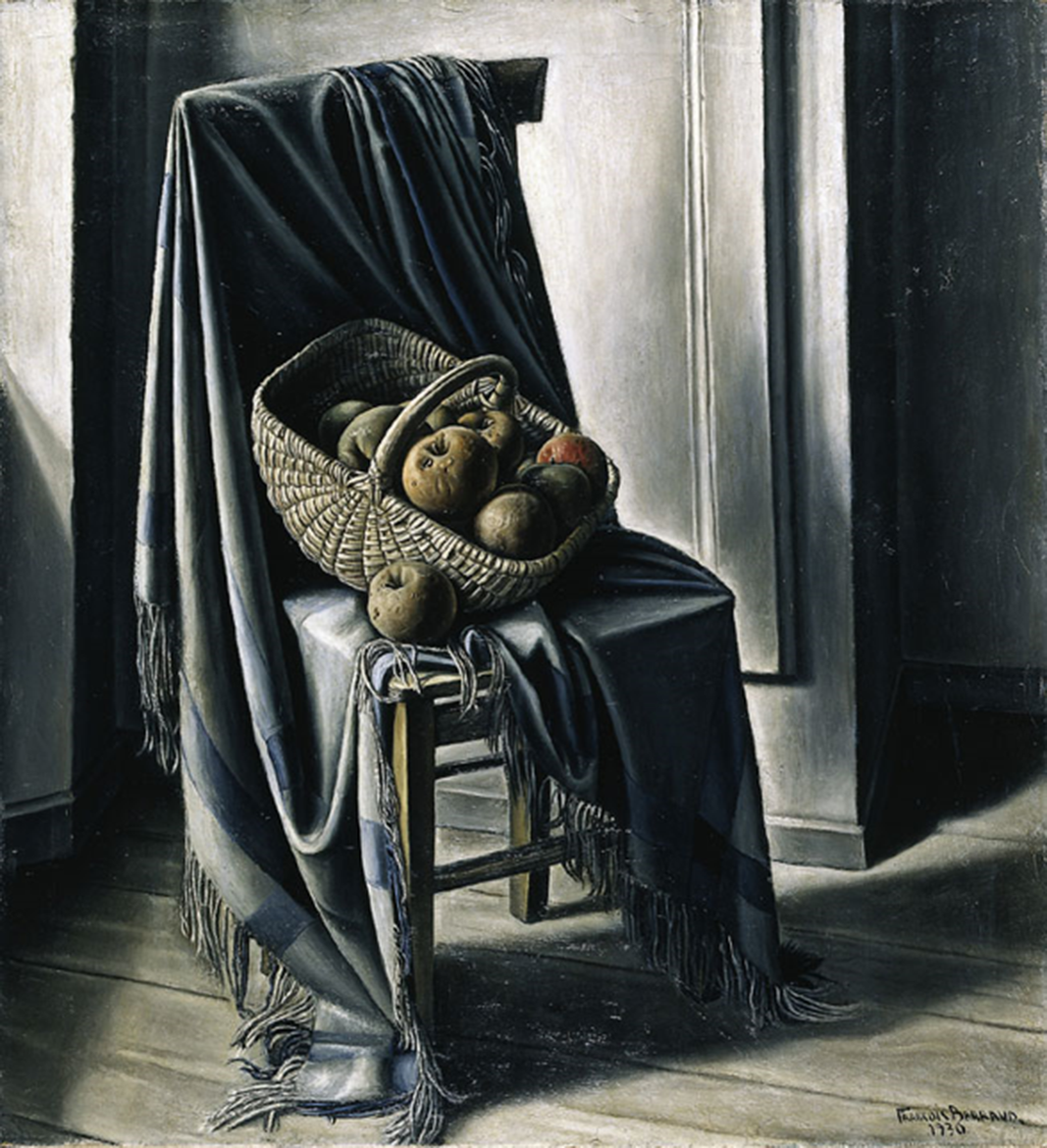
I language water, fire, earth, air, becoming water fire, earth, air, a body of water, fire, earth, air. I language sensations in hybrid and viscous porosity. I language scents and sounds that I can breathe and take in and breathe out with. I language closing my eyes and turn my face towards the sun and shut the world out. I language my cup of tea with honey and lemon, more taste, no milk. Try to clean a dishwasher with a lemon in it and see what happens. I think of acid and base. I gasp a work of art. I language waste and recycling, ecology, compost. I language dirt and plants and humans together. I indirectly language a Franqois Barraud stilleben painting for sustainability. Think about the fact that these are paintings of food, everyday objects … Nature Morte — dead nature … or as I prefer languaging living nature always already here.
I still think about it
I was 19 and on inter-rail in Europe
It was in Lisbon
I walked the streets
It was warm but the sun was setting
I was on my way back to the youth hostel I stayed in
The old man stood in front of the shop window
Looking in
I thought, what is he looking at?
I looked too
Food; bread, cheese, oil, fruits
A lemon
I thought, really! Looking at food!
What is looking at food?
… … …
In the rhizome every concept and word are a deterritorialized intensity forcing us to philosophize or think while they — the concepts — become modal and transpersonal. And while they move between different positions, contents and subjectmatter, theory and practice, they become transcurricular. This way, concepts and words become actions and practises reorienting thinking and open up for activist explorations, new possibilities and knowledges. The Other hence sustainability is composed of the possible, the existing and in real language, utterances are realized for each other. Modal concepts thus describe the organization of matter and function simultaneously as modal operators and modal variables. The modal being both evidence for X and generative of X. These are affective post-positivist oxymoroning knowledge practices comprising friction zones between actual multiplicities and virtual multiplicities that replace positioning, interests, linearity and top-down control with enfoldedness, relations between bodies and becomings. Affect being the ability to affect and be affected as a prepersonal intensity corresponding to the passage from one experiential state of the body to another and implying an augmentation or diminution in that body’s capacity to act (Massumi in Deleuze and Guattari, Reference Deleuze and Guattari2004a, p. xvii).
Through this, affect is an intensity thus this something/it/X that goes through my body without necessarily leading to any specific meaning, but makes me responsive, vulnerable perhaps, but in a productive way. It is something that is affecting me/us beyond emotions and beliefs hence beyond factual power-struggles over authority. Rather, it is something that is urging me to proceed by enquiry, and my attention and readiness is directed towards that which emerges and in turn contributes to un/consciousness about the situated meaning and value of knowledge for sustainability. It possibilizes an activist production of importance of knowledge sensed there and then, molecular vibrations as the only truth. Massumi (Reference Massumi2002) writes:
When you affect something, you are at the same time opening yourself up to being affected in turn, and in a slightly different way than you might have been the moment before. Affect is therefore, a threshold experience, or in my words, an affective entrance where a transition becomes possible in everyday life which is necessarily (em)bodied (p. 41, bold in original).
Affect is prelinguistic. Every act of language involves an expression of affect. Affect is thus seen as infra conditioning every determinate activity, including that of language. Again Massumi (Reference Massumi2015) writes:
The preferred prefix for affect is ‘infra-’. ‘Pre’ connotes time sequence. But affect always accompanies, on the parallel track of potential. ‘Intra-’ is also imprecise, connoting as it does space and containment (from interus, internal). ‘Infra-’ on the other hand connotes what actively lies below a certain threshold of appearance on an open-ended spectrum (as in ‘infrared’; from inferus, below). (p. 212 italics and quotation marks in original)
As is with theory and practice, affect and language are therefore not opposites: There is no antinomy between affect and language. There is accompaniment and becoming, always involving the full spectrum of the graded continuum of experience (Massumi, Reference Massumi2015, p. 212). Theory and practice, affect and language are infra connected and infra dependent. Teacher and child through this becoming ‘a motif for each other, both embedded in a transcoded passage’ (Semetsky, Reference Semetsky2013, p. 229) ultimately going through a shared deterritorialization (Deleuze & Guattari, Reference Deleuze and Guattari2004a, p. 324); immanent activist production of group — decentered subjectivities and rhizomatic writing.
Action is, through this seen as a fundamentally methodological quality. The methodologicity involved is emphatically experimental and comfortable with production of knowledge and learning for sustainability in uncertainty, multiplicity and friction. Thinking with, through and beyond concepts, activist pedagogues become activist in designing and developing their own methods and approaches, as they seek to navigate and explore the productive connections and reciprocal relationships between the activist theories and practices they engage with, and to develop conceptual analytical approaches for what these practices also work with, through or beyond. Guattari (Reference Guattari2008) writes:
A more gentle deterritorialization, […], might enable the assemblages to evolve in a constructive, processual fashion. At the heart of all ecological praxes there is an a-signifying rupture, in which the catalyst of existential change is close at hand, but lack expressive support from the assemblage of enunciation; they therefor remain passive and are in danger of losing their consistency — here are to be found the roots of anxiety, guilt and more generally, psychopathological repetitions ((réitérations). In the scenario of processual assemblages, the expressive a-signifying rupture summons forth a creative repetition that forges incorporeal objects, abstract machines and Universes of value that make their presence felt as though they had been always ‘already there’, although they are entirely dependent on the existential event that brings them into play”. (pp. 30–31)
(2021) Treestone eternals. Private photos

Deleuze and Guattari describe the machinic nature of desire as a desiring-machine functioning as a sort of wave breaker in a larger wave of different other machines with which it is tied together. Simultaneously the desiring machine produces a stream of desire from and within itself. Deleuze and Guattari (Reference Deleuze and Guattari2004b) envision a multi-functional universe put together by such machines which in their turn all are put together with each other:
There are no desiring-machines that exist outside the social machines that they form on a large scale; and no social machines without the desiring machines that inhabit them on a small scale. Production of desire is explosive: ‘there is no desiring-machine capable of being assembled without demolishing entire social sectors’ (p. 28).
My axiological (non)objective is to develop new modalities for accommodation of differences and deep learning. The broad goal is to establish dialogues between subject matter and disciplines based in emergent new forms of pedagogies and research driven by doings. Transdisciplinary shaped contemporary forms of pedagogies and pedagogical research positing practices that comes into being through the amalgamation of methods and practices across numerous disciplines. It is a notion of advanced practices being developed to respond, the way I see this, to two sets of urgencies: First, bringing in the missing people in pedagogy, pedagogical science and research; the working classes are missing, the precariat, the migrants …. The child … The manmachine, animalmanmachine, treestonemachine … Concepts like these being designed to deal with the complexity of the body in this processually extended sense (Massumi, Reference Massumi2015 p. 211).
Private photos
Patricia Piccinini (2017) The Struggle Footnote 8 Private photo

Second, developing a child post-humanities pedagogy and research for sustainability. Ever more complex natural and societal challenges demand constant new forms of knowledges, knowledge exchange and transfer, as new research forms are gaining ground and become increasingly prominent modes of research output. This requires new, multi- inter/intra and transdisciplinary and comprehensive methods for capturing and assessing both, their quality and their impact, while operating in advance rather than retrospectively. A research worthy of the present (Braidotti, Reference Braidotti2013, p. 52; Van der Tuin, Reference Van der Tuin2019). I try.
Pedagogues and researchers following the child, the child as matter, intuition in action
Cosmic citizenship thinking abstract enough
Skipping the standardized judgement phase means that new forms of Thirdness must be invented. Only an intervention of Thirdness can regulate becoming in any way, whether normatively for stability, or self-renewably for the existential flicker of reappearing potential. Because that’s what Thirdness is: regulated passage from one phase to another. (Massumi, Reference Massumi2013, pp. 102–103)
The rhizome is like the poem. The growth-power of nature and the possibilities of culture simultaneously and reciprocally. It stretches from biological cell- and level of particles to our universal dreams and thoughts about and with life. Body and mind are inseparable. Every DNA-RNA have the capacity to learn. Deleuze & Guattari (Reference Deleuze and Guattari2004a) write: ‘A new rhizome may form in the heart of a tree, the hollow of a root, the crook of a branch. Or else it is a microscopic element of the root-tree, a radicle, that gets rhizome production going (p. 16)’. The rhizome as poem becomes this way an image- and a picture of meaning, connections and movement; machinic productions of constant importance for each/other. We become each other’s motifs. In ecologic farming the key to good harvests and avoid plant disease is diversity, diversity, diversityFootnote 9
The picture breaks all patterns always and always creates new, as points and lines affectively collapsing into each/other for each/other. The rhizome as poem - and the consciousness about the preliminarity of processes across preliminary boundaries, opens up for translations and interpretations beyond known vocabularies and in unfinished channels. It possibilizes the realization of more - than - human concepts such as the dissolution of subjectivity turning my identity into a collective: I contain multitudes and sing myself. You are my refrain
Knowledge creation and meaning making are thus connected with what situated knowledges makes possible and mobilize, and is about community, not isolated individuals; it is about productive connections and unexpected openings. Openings in ‘indirect discourses’ as a presence of order-words implicit in every word, implicit conditions that create actions (Deleuze & Guattari, Reference Deleuze and Guattari2004a, p. 93). I word a rhizome. I write a rhizome. Self-organized and stochastic,Footnote 10 I write no utopias and perfect forms. I rehearse and try to sing and think the future different.
I think that such a foundational material linguistic grip can revive learning as an inclusive and sustainable natureculture machinic constant, our educational and our educational institutions as comprehensible and meaningful places for all. It implies that instead of working with concepts as a quest for definitions, work to keep concepts open for something unexpected, something we have not thought about before as a move from the constative to the unknown. The unknown however, through affect, being simultaneously very close, a gut feeling perhaps, and/as a dynamic ‘evaluation’ that is lived out in the situation (p. 338).
Through this, taking part in a plurivers of polysemantic ambiguity becomes attractive as condition to side with the child turning into a strong source of energy for learning and change, trans-scientific collaboration and sustainability. Ontological productions that is and modes of conceptualizations as perspectives of lives. Movements from matter to becoming materially identifiable for one another. Ultimately, this is about the concept as method and the pedagogy of the concept (Deleuze & Guattari, Reference Deleuze and Guattari1994). The collapse of theory practice divides or rather the importance and force of thinking with theory, nothing about us being without us.
Processes of staying political, keeping knowing in play and the importance of theory (-and/or philosophy), politically and ethically (Reinertsen, Reference Reinertsen2021). I ultimately conceive of this as a chaosmosis in which our problematic of chaosmosis and the schizoananlytic escape from the prison of signification is directed – […] – towards a necessary a-signifying deconstruction of their discursivity and towards placing their ontological efficacity into a pragmatic perspective (Guattari, Reference Guattari, Bains and Pefanis1995 p. 87). It includes my decentred, distributed and dispersed subjectivity, the knowledgeable rightfulness of us all. The rhizome ultimately as model for how the value of knowledge can be sustained and a de facto devaluation of education and knowledge stopped.
I think we need a decentralized educational system as in decentred, human and more than human, with strong hyperlocal control and professional (non-) autonomy opening up new knowledge opportunities for educational systems and sustainability. The open-end enigmatic plasticity of the brain always allows more. In addition, there is blindness both in seeing and not seeing. It is impossible to examine the complex synaptic wiring in a learning brain. -but I can follow the child and experiment more always. I can live poetry across curriculums. Act new methods of writing intensive pedagogies (Jacobs et al., Reference Jacobs, Kincaid and Travers2018). Educational institutions turned into heterotopias hence as countersites of enacted utopias through which reality is simultaneously represented, contested, and inverted. They are physical or mental spaces where, although norms of behaviours are suspended, there are connections with a plethora of other spaces (Charteris, Jones, Nye & Reyes, Reference Charteris, Jones, Nye and Reyes2016). Ultimately pedagogues as poets who create problems by producing tensions, which propels or trigger thoughts for constant innovation for sustainability. Any problem hence turned into an epistemic force and/as thinking-possibility only and experiential judgment is critical and clinical (Deleuze, Reference Deleuze, Tomlinson and Galeta1989). Any problem ultimately seen as a bringing into existence and not to judge (p. 135) Footnote 11 ; an opportunity to create interruptions or absences that allow difference to be reconciled. Valuing the necessity of difference — difference that can enable collaboration and connectedness. Deleuze continues:
What expert judgment, in art, could ever bear on the work to come? It is not a question of judging other existing beings, but of sensing whether they agree or disagree with us, that is, whether they bring forces to us, or whether they return us to the miseries of war, to the poverty of the dream, to the rigors of organization. As Spinoza had said, it is a problem of love and hate and not judgment; ‘my soul and body are one …. What my soul loves, I love. What my soul hates, I hate…. All the subtle sympathizing of the incalculable soul, from the bitterest hate to passionate love.’ This is not subjectivism, since to pose the problem in terms of force, and not in other terms, already surpasses all subjectivity. (p. 135)
I have been wanting to show that education, pedagogical theory, practice and research on pedagogy and learning for sustainability must be generated from everyday life and experience from living a rhizomatic life. Environmental education, pedagogies and research on pedagogies seen as life’s methodology in poetry. Poems about how the educator and pedagogue turns foreign to the world she criticises- often trough conceptualizations through words and focussing on problems, and then what she learns about the world from her efforts to change them. Writing as a simultaneously alienating and reshaping poetic and personal reflection and meditation. I forward the rhizome as image and model to strengthen ties between education, theory and practice, research and learning, living lives that give life its sustainability. This way the poetic educator, the educator who poems, increases in value. It is another view of education, education for life in life and writing as an ethics as warmth on paper. I try.
Close to where I work, there is a place called Breadless. Think about that, a place without bread. What is looking at food? I think sense and sensibility, affects and responsibilities and try to language it. Critical sustainability studies, water studies, plant studies, human studies, me studies. What is color? What is light? What is air? You go on. I am part. The particular and universal — here cosmic inter-intrarelationships between you, a word, a piece of bread and me. New stories constantly emerging and what we can learn from it. Teachers and pupils exploring and experimenting together towards futures not yet known. A/Every word turned into a pedagogy as two interlocked cogwheels producing an event and a quality hence value. Communicating about the in/comprehensible. Communicating joint environmental and social protection. Communicating connectivities and collectiveness as eco-justice heterotopic place making for sustainability for cosmic citizenship. I try.
Acknowledgements
Thank you to Peta White and Paul Hart for initiating this Special Issue and having me aboard.
Financial Support
This research received no specific grant from any funding agency, commercial, or not-for-profit sectors.
Conflicts of Interest
None.
Anne B. Reinertsen is professor in philosophy of education, qualitative research methodologies, knowledges of practice and evaluation research. She has worked as teacher, teacher educator and leader. Her research interests are subjective professionalism, leadership, materiality of language, new configurations of research methodologies and slow scholarship. She has been visiting scholar at Stanford University and University of Illinois, USA. Her publications include national and international books, journals and book chapters.



