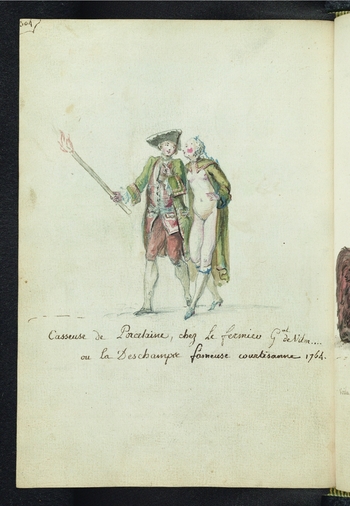
A woman, nearly naked, with heavily rouged cheeks, strolls alongside an elegantly dressed man (Figure 1). The man carries a long torch, set at an angle which would not have posed very much of an interpretative problem for good Dr Freud. The image comes from the unusual book of comic drawings, the Livre de caricatures tant bonnes que mauvaises, by the Parisian luxury embroiderer, Charles-Germain de Saint-Aubin, that provides a kind of visual chronicle of Parisian life in the middle decades of the eighteenth century. The caption reads: ‘breaker of porcelain at the home of the Farmer General, vilm . . ., or, la Deschamps, notorious courtesan’.Footnote 1
Charles-Germain de Saint-Aubin, Casseuse de Porcelaine, chez le fermier Gal de Vilm . . ., 1753–64?; watercolour, ink and graphite on paper; 187 × 132 mm; Waddesdon, The Rothschild Collection (The National Trust); acc. no. 675.304. Imaging Services Bodleian Library © The National Trust, Waddesdon Manor.

Using a report written by a police spy, we can clarify just what this incident involved.Footnote 2 In late March 1756, Deschamps and a female friend went to dine at the superb neo-classical residence on the north-western edge of the city owned by a wealthy farmer general (not Vilmorin in fact), one Gaillard de la Bouexière and a male friend.
The dinner was splendid and gay . . . The gentlemen got up to take a stroll in in the garden . . . To pass the time, the ladies amused themselves by breaking the porcelain, not only all that was left on the table but also what was on the fireplace . . . in the end there only remained two cups. Into these the ladies were saucy enough to deposit the digestion of their dinner.
On returning [from his walk], M. de la Bouexière was not long in noticing the charming action of these ladies, but pretending to be in no way put out he applauded it. In this he went one better than the demoiselle Deschamps who was dying to say that this was nothing for a millionaire like him. In short, they resumed at table and having got rid of the two cups, passed to liqueurs.
Later that evening, the two women were stripped naked, at which point ‘the gentlemen had their servants, carrying torches, lead the women to their carriage whence they returned to their homes’. Next morning, Madame Deschamps wrote to her host requesting that he return her clothes, jewels and diamonds. He acceded to the wish, with the exception of her clothes, notably an expensive satin dress with silver and chenille embroidery, of which he made a bonfire.
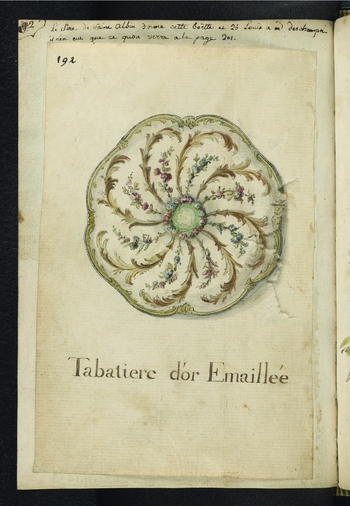
This gamey anecdote played to the scatological tastes of Charles-Germain de Saint-Aubin: shit in the coffee-cups was definitely his style of humour.Footnote 3 Madame Deschamps, ‘famous courtesan’, was, like many of her type, an actress in the Paris theatre, a topic for which Charles-Germain showed much interest too. She appears elsewhere in the book, notably in a snuffbox lid of his design which was given to her by one M. de Saint-Albin (Figure 2). Charles de Saint-Albin, archbishop of Cambrai, was the illegitimate son of the regent, the duke of Orleans, and an actress (appropriately enough), and he was notorious for leading a scandalous life. If we only knew more about the snuffbox transaction, we might have discovered what the bishop really did say to the actress. We do know, however, a good deal about Madame Deschamps, who was far less obscure to Parisian contemporaries than she is to us. She left traces, and not only in the porcelain.Footnote 4
Charles-Germain de Saint-Aubin, Tabatiere d'or Emaillée, c. 1740 – c. 1775; watercolour, ink and graphite on paper; 187 × 132 mm; Waddesdon, The Rothschild Collection (The National Trust); acc. no. 675.192. Imaging Services Bodleian Library © The National Trust, Waddesdon Manor.

Madame Marie-Anne Deschamps, née Pagès, was an actress, a courtesan and a prostitute. Born in 1730, she was the daughter of a Parisian lady's shoemaker, but left this humble background in her early teens to launch herself into the world of prostitution. By the time of her death in 1764, songs had been written about her and gossip retailed about her, while philosophes had puzzled over her, police spies had kept an eye on her and moralists and cultural commentators had proved more than willing to be shocked by her. A period as dancer at the Opéra-Comique in the 1740s had led to her becoming a member of an acting troupe attached to the French army in the War of Austrian Succession. Here, first, she married a ne'er-do-well actor Deschamps. Second, in swift succession, she became the lover of the French commander, the comte de Clermont. When the comte returned to his established mistress, Madame Deschamps returned to Paris, the chorus of the Opéra, and a life of sexual adventure and social climbing. By 1754, the Paris police was identifying her as one of the two ‘most dazzling whores in the whole of Paris’.Footnote 5
The comte de Clermont was one of no fewer than five princes of the royal blood to whom the shoemaker's daughter became lover. One of them, the raddled voluptuary, the prince de Conti, was said to have performed the act of love with her no fewer than twelve times in a single night. For the rest of his life, allegedly, Conti worshipped at the shrine of the number 12, which he had embroidered to his shirts, hats and handkerchiefs, embossed on his breeches’ buttons, and so on. As well as dipping into royalty, ‘La Deschamps’ also broke through into the world of the farmers-general, the billionnaires of the day, by allegedly spending a night with the high financier Villemur for 100 louis. But she soon moved – in the professional argot – from retail to wholesale, abandoning passing flings for establishment as a kept woman.Footnote 6
There would be some rocky moments for Madame Deschamps over the next decade or so, notably when she was between lovers, who besides princes and financiers included old nobles and strapping young army officers with the occasional Jewish banker, foreign aristocrat, English gentleman, ambassador and archbishop thrown in. Such was the demand for the services of this ‘veritable Messalina’ (as a police spy called her) that she was known to break off love-making half-way through and demand higher payment from clients she adjudged too ugly. Her taste for female partners, however, complicated and partly compromised her reputation.Footnote 7 This was also affected by spells of gonorrhoea, which were not brilliant for trade, and also involved the administration of a ghastly, mercury-based treatment. Spasmodically, too, her husband appeared on the scene to cramp her style, as financial leech or physical bully, and sometimes both.
In April 1760, she fell on particularly hard times.Footnote 8 The Seven Years War was damaging luxury spending in Paris and reducing the clientele for sexual services. Deschamps decided to sell off her porcelain (coincidentally enough): Vincennes, Sèvres, Meissen, the very finest international brands. (But she kept her carriage, which was one of the most ostentatiously luxurious vehicles to be seen in Paris, as well as her diamonds.) The queues of individuals and carriages at the sale of her effects stretched out from her hôtel and down the street. People lingered to ogle and some to buy the stupendous wealth on display, ‘fruit of debauchery and prostitution’, as one irate contemporary put it, in this ‘enchanted palace’ fit for a prince (that even boasted English water-closets). Two decades later, the literary chronicler Grimm still remembered with awe this occasion inspired by ‘one of the most illustrious courtesans of the age’.Footnote 9
The bubble burst. In 1762, with war still dragging on, Madame Deschamps, plagued by recurrent venereal disease, had fallen so deeply in debt that she fled the city for Italy to lie low. When she returned in 1763, it was incognito, sick, thin and frail, and with growths on her knees, a just reward for her vices, said the devout. In January 1764, the police reported the death of ‘La Deschamps’, ‘so notorious for her debauchery, her luxury and by the excessive price she set on her favours’.Footnote 10 She was thirty-four years old. In her final illness, she was said to have turned to a life of piety and repentance. William Hogarth could not have plotted it better.
This was a career spent crossing boundaries, social and sexual, that was so extraordinary that it prompted – and prompts – serious reflection. Deschamps was a ‘prodigy’, of whose wealth and independence any decent woman would be jealous, wrote one author. ‘One of the seven wonders of the [modern] world’, opined another. Women of bad morals like her, thought the Russian visitor Denis Fonvizine, covered in diamonds from head to toe, made Paris a city ‘which gives nothing away to either Sodom or Gomorrah’.Footnote 11 And some twenty years after the death of ‘la Deschamps’, the writer and dramatist Louis-Sébastien Mercier (whose father, coincidentally enough, had rented rooms to her for select dinner parties) pondered on her fate less in terms of divine retribution than of the swings and roundabouts of fortune:
Who can really tell why the late Mademoiselle Deschamps reached this level of opulence which permitted her the insolent luxury of putting paste jewels around her horses’ harnesses and edging her commode with English lace draft-excluders? Another girl from the Opéra dies leaving huge effects and a considerable estate. Was she more beautiful or witter than any other? No, issued from the lowest class of the people, she had in her support the favours of that ineffable destiny which raises, brings down, maintains and overthrows both ministers and whores (ministres et catins).Footnote 12
As historians, we are well used to following the fates and fortunes of statesmen – Mercier's ‘ministres’. We are less habituated to doing the same with catins. But sex and passion are as much within our remit as historians as politics and power. In this paper, my focus will be on catins.
I have organised my set of Presidential Addresses around the theme of ‘French Crossings’, and here is an identity, an identity (or, more correctly, a suite of interrelated identities – actress, courtesan, prostitute) which contemporaries called ‘libertine’, and whose very essence was crossing social and sexual boundaries.Footnote 13 Because human, sexual desire was involved, libertine identity frequently shuttled back and forth between fixed social roles and role-playing, between truth and fiction. With such a figure in the public imagination, one never knew where reality ended and fancy began. Finally, this is also a story in which, as Mercier devined, fate takes a role. There was much that was unpredictable and arbitrary about these crossings.
My first published article, in History Workshop Journal, was on prostitution in eighteenth-century Montpellier.Footnote 14 This was in 1978, a moment when the author of any article on the history of women felt that she or he was making a political statement and putting in place a contribution to a meta-narrative that had been hidden from History with a capital H.Footnote 15 A journal for socialist and feminist historians as History Workshop proclaimed itself seemed the obvious place. My main area of expertise at that time was the French Revolution. Yet if I look now at the textbooks on the Revolution that I used and that I recommended to my students at that time, there was simply no mention at all of the key themes of women's history. If women were even mentioned in textbooks on the French Revolution, it was Marie-Antoinette and Charlotte Corday who predominated (with the occasional walk-on part given to Madame Defarge, Charles Dickens's fictional tricoteuse from A Tale of Two Cities).
Go now to the textbooks, and things are very different. Now, the role that women played in the early stirrings of modern feminism in the Revolutionary decade is freely acknowledged. Now, no textbook worth its salt could not mention the figures most prominent in this development, sisters of England's Mary Wollstonecraft (author of the Vindication of the Rights of Women (1792)): Olympe de Gouges, author of the Declaration of the Rights of Women (1791), which sought to extend to women the rights outlined in the 1789 Declaration of the Rights of Man. Or Etta Palm, the Dutch feminist, author, activist and sometime diplomatic spy. Or Théroigne de Méricourt, frenzied cross-dressing street-fighter. Or Claire Lacombe, founder of the shortlived Society of Revolutionary Republican Women, arguably the first feminist political club in world history.Footnote 16
Yet there was no sort of victory for these militant women in the 1790s, or else only a very poignant and pyrrhic one. The bigger story for women in France in that decade was not these early stirrings of modern feminism but their ruthless suppression. Claire Lacombe merely disappeared from view following a period in gaol, but Olympe de Gouges and Etta Palm were guillotined and Théroigne de Méricourt was beaten up, went mad and ended her life in a lunatic asylum. The republican compact of the 1790s sidelined women; and the Napoleonic Code would confirm their enclosure within a ‘separate sphere’ that was set to last.Footnote 17 The cosy domesticity which Dickens's Charles Darnay and Lucy Manette return to after their trials in Paris under the Terror was clearly the best that women could hope for. For women, the Revolution was the best of times, the worst of times (more the latter than the former, in fact).Footnote 18
Neither of these emergent eighteenth-century narratives – stirrings of feminist modernity, imposition of separate sphere ideology – seems to have much of a place for the Madame Deschamps of this world. Historians train the spotlight in France on the salonnières, cultivated and well-connected (and very self-effacing) women who operated the salon sociability which helped power the Enlightenment, and who were very much the blood-sisters of the bluestockings, rational Dissenters and other femmes savantes prefiguring and overlapping with Mary Wollstoncraft on this side of the Channel.Footnote 19 A salonnière, or indeed, in England, a Mary Wollstonecraft, would have died of social mortification at the thought of allowing a Madame Deschamps into their homes. They would have seemed to have come from different planets. If one is searching for the origins of feminism and modernity, then, the assumption is that they will not be found among denizens of the world's oldest profession.Footnote 20
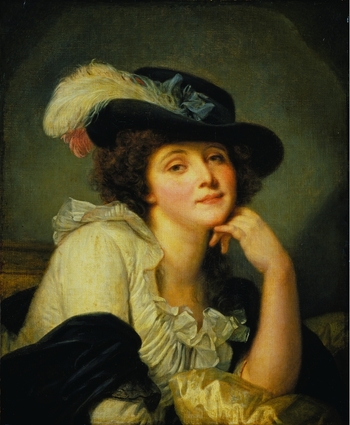
In this paper, I want to try to unsettle this consensual assumption, and to remedy this lack of interest in high-class courtesans and prostitutes by historians of feminism (and indeed historians tout court). In doing so, I shall not be drawing as heavily as I would have liked on the life of our Madame Deschamps. As historians, we can only get so far with Madame Deschamps. She exists as a phenomenon, a sexual meteor observed and remarked on with awe and wonder by Parisians and philosophes. Yet apart from some entanglements she had with the police and the law, it is difficult to get a real sense of what she was like and what she made of her position in life. How should we even interpret the episode with which I began? Shitting in a millionaire's coffee-cup might, I suppose, be seen as a playful if bizarre act of class resistance.Footnote 21 Or should we simply write it off as an aesthetic judgement of the quality of her host's china-ware? Sèvres does affect some people that kind of way. Who can tell? In order to explore her world and the identities her type embodied, I am choosing to look elsewhere, and to criss-cross her life story with that of a woman with a similar cultural identity and social profile, about whose life and thoughts we know far more, Sophie Arnould (Figure 3).
Jean-Baptiste Greuze, Portrait of a Lady, c. 1786. By kind permission of the Trustees of the Wallace Collection.

One of Sophie Arnould's contemporaries dubbed her ‘the doyenne of catins’ or whores. The Goncourt brothers, who wrote what is still the best study of her, were more sympathetic: ‘They are rare and scattered at long intervals across history, those women who while they are alive are the scandal of their age and who once dead are its smile’. The title of the present paper, ‘vagaries of Enlightenment passion and power’ fits Sophie Arnould like a glove.Footnote 22
Sophie Arnould, who was born in 1740, ten years after Deschamps, and who died in 1802, shared the same hybridic, composite, libertine identity. Deschamps was a dancer in first the Opéra-Comique and then the Opéra; Arnould was a singer, a star singer in fact, in the Opéra. They were both courtesans with a series of high-placed lovers. Deschamps was a brilliant success in this respect, notching up a great deal of blue blood; for Arnould it was more an ancillary role. Finally, they both had at least some part of a foot in the world of prostitution. As actresses (I will use the generic term), it was difficult not to. As philosophe Denis Diderot remarked, ‘an actress who is a respectable woman is such a rare phenomenon’. Jean-Jacques Rousseau was in full-throated agreement – the existence of actresses was a tissue of artifice. The talent of actors for Rousseau was ‘the art of counterfeiting oneself, of taking on another character from one's own, of appearing different from what one is’. The profession of acting, similarly, was ‘the trade of pretending to be someone else and in which one puts oneself publicly on sale’. In essence, an actress prostituted herself and should therefore be viewed as a prostitute. Like other ‘public women’ whom Rousseau had in his sights (prostitutes, female court instriguers, salonnières), the lack of transparency at the heart of an actress's being cut her off from both nature and virtue. The very few actresses who guarded their chastity were said to be preserving une vestalité miraculeuse (‘a miraculous vestality’).Footnote 23
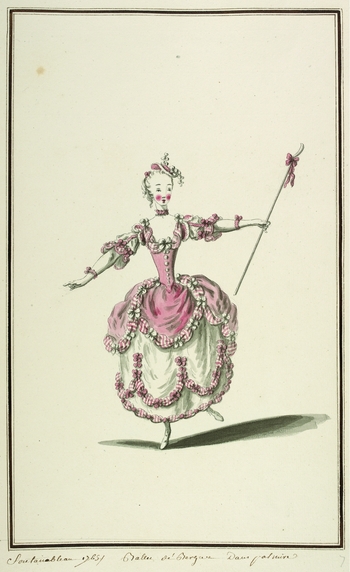
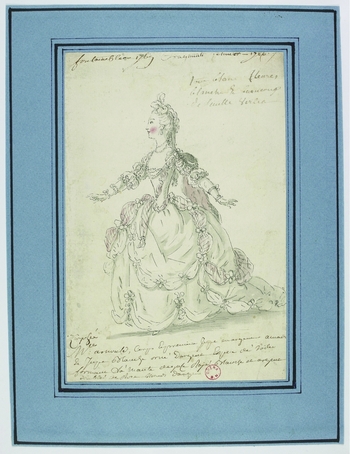
Madame Deschamps was a supernumerary dancer in the Opéra known at the time as a garde-cote – a coast-guard. The name came from the fact that she mainly stood at the back of the stage looking pretty against marine or nautical backdrops (Figure 4).Footnote 24 Sophie Arnould in contrast was one of the Opéra's most brilliant female soloists (Figure 5). After allegedly having her voice commended by Madame de Pompadour, Louis XV's mistress, Arnould entered the Paris Opéra company in 1757 and within a year had acceded to principal roles and was causing a sensation.Footnote 25 It was less the strength of her voice than its sweetness and purity that was praised, but most of all her qualities as a dramatic actress. The veteran dramatist Charles Collé remarked at the very start of her career, ‘I have never seen another actress who brought together as much grace, virtue, feeling, nobility of expression, and such fine posture, intelligence and warmth.’ Shortly after this, the visiting English actor, the great David Garrick, pronounced her the singer of her generation and the only cantatrice who touched his heart.Footnote 26
Louis-René Bouquet, costume of ‘begère’, from Chamfort, Palmire, 1765. © Bibliothèque nationale de France.

Louis-René Bouquet, costume from Montcrif, Zelindor, roi des Sylphes, 1766, 1769. © Bibliothèque nationale de France.

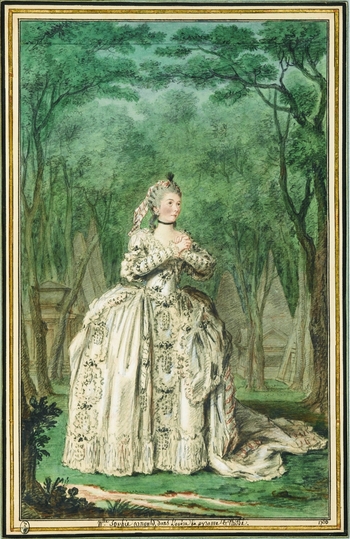
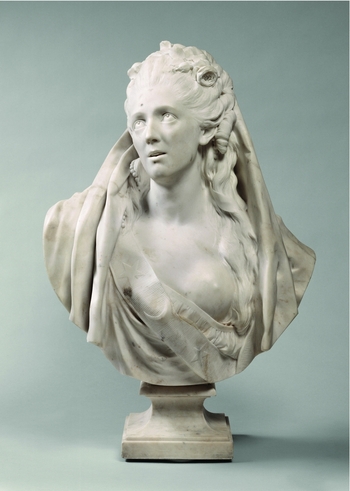
Arnould dominated the French stage through the 1760s. One of her finest roles was as Thisbe in Francoeur and Rebel's opera Pyrame et Thisbe which played in 1759 (coincidentally, Madame Deschamps also appeared in performances of this, as both an Asian woman and an aerial sprite) (Figure 6).Footnote 27 The artist Carmontelle painted Arnould in this role, at a moment of heightened pathos, which drew the audience's tears (Figure 5). The gesture of the uplifted eyes seems to have been picked up by the pastellist Quentin de La Tour in a portrait of her which has been lost but of which we have an engraving by Bourgeois de la Richardière. The great sculptor Houdon (Figure 7) drew on the same source in his bust of her in 1775, which evoked her role in one of the greatest final performances of her life in Gluck's Iphigénie en Aulide, which played in 1774, and which helped seal the acceptance of Gluck's operas in the city.Footnote 28
Portrait of Mademoiselle Sophie-Arnould in the opera Pyrame et Thisbe, by Carmontelle (Louis Carrogis). © RMN-Grand Palais (domaine de Chantilly)/Rene-Gabriel Ojéda.

Sophie Arnould in the role of Iphigénie, by Jean Antoine Houdon. © RMN-Grand Palais (Musée du Louvre)/Gérard Blot.

Arnould later recalled that a copy of the bust, standing on her mantelpiece, had saved her life when, during the reign of Terror in the 1790s, her home was raided by a group of radical sans-culottes wishing to interrogate a ci-devant who prior to 1789 had enjoyed strong aristocratic connections. She managed to overcome their suspicions when they spotted this statue – and took it to be a bust of the radical journalist Marat. The famous portrait of the death of Marat by David notwithstanding, Marat was notorious for being not just extremely ugly but also physically repulsive. So to be mistaken for him was, as she put it, ‘not galant’. But at least it had saved her life. Yes, she assured them as she waved them off and out, as an actress she had often been sans culotte under the Ancien Régime and as for the Rights of Man, she really knew them all by heart . . . Footnote 29
This exchange highlights a particular facet of Arnould's character that explains the reputation which contributed to her celebrity in the Ancien Régime: her wit. She was a diva all right – a singer acknowledged as among the most brilliant of the age, who was always threatening to walk out of the Opéra, who turned up late (or not at all) for rehearsals, who corpsed and went off-script at key moments so as to trigger audience laughter, who set her own, erratic tempi for her arias, and so on. But in an age of wit, her lightning verbal facility embellished her reputation. She was one of extremely few Enlightenment figures, male or female, to have a book of her witticisms published.Footnote 30 One has to confess, with some sadness, that the brilliant cerebral ingenuity there on show rarely raises a smile or a laugh in our own day.Footnote 31 Her humour was too often directed at specific targets in the theatre or the world of courtesans or else highlight puns and word-play that do not translate very easily. Her reputation, however, was very widely recognised as often sparkling, invariably direct and not infrequently quite filthy. The sans-culotte quip mentioned above is a case in point. Punning on the meaning of the term, it nominally referred to the radical Parisians who wore trousers rather than genteel breeches or culottes. But culottes also meant lady's knickers and these had been the subject of quite a storm at the Opéra under the Ancien Régime. The tendency for ballerinas to perform increasingly high jumps in skirts that became shorter and shorter instigated a police decree forbidding performers going on stage without wearing knickers.Footnote 32 The men in the front row were getting over-excited at this absence of women's culottes: public morality was under threat. Quondam sans culotte Sophie Arnould would have expected us to have understood all that, if we were to be up to her benchmark of wit. There are other examples of her direct and earthy humour where one can catch the drift more easily. Convened to speak to her fellow actresses in the Opéra about an order from Louis XV that threatened them all with disciplinary action if they failed to be less flagrant and ostentatious in their sexual liaisons in the future, Sophie's double-entendre was to the point, and a bit more: ‘Ah! mes amies. We're fucked.’Footnote 33
Arnould had established her reputation for wit, earthy and otherwise, early in her career. Her family had been desperately trying to keep their Sophie pure by making her live at home while she served her apprenticeship at the Opéra. One night, however, she ran off with a lodger. The lodger had been in disguise. He was the comte de Lauraguais, one of the most dashing and eccentric of Enlightenment intellectuals.Footnote 34 On the night of their elopement, Lauraguais revealed his identity to Sophie and explained that unfortunately he would not be able to marry her. He was of ducal rank: some boundaries in Ancien Régime France were simply uncrossable. Also, he was already married. This set the tone for the extraordinary vagaries of their relationship throughout the rest of her life. Three children emerged from a relationship quite as passionate as it was stormy. ‘Monsieur de Lauraguis has given me two million kisses’, she sighed towards the end of her life, ‘and made me shed four million tears’. ‘Ah! The good old days!’, she sighed with pathos and irony in her later years as she recollected her brilliant if star-crossed career. ‘I was so unhappy.’Footnote 35
After one huge row, in 1762, when Lauraguais had gone off to stay with Voltaire near Geneva, Sophie took spectacular action. In a letter that circulated widely through the Parisian news-sheets, she addressed him:
I do not understand what you are doing. You have left me alone and abandoned. I am using my liberty – that liberty so precious to the philosophes – to do without you. Don't take it ill that I am tired of living with a madman who has dissected his own coachman and wanted to be my accoucheur with the aim of dissecting me too. Forgive me if I protect myself from your encyclopaedic lancet.Footnote 36
The letter was placed in a coach, and sent round to his Parisian residence. On the back seat of the coach were all the diamonds that he had given her – plus the two children she had by then borne him. The latter gesture scandalised all of Paris. The presumption of a courtesan and actress brandishing claims to liberty as regards her illegitimate offspring was shocking in the extreme. Even Diderot, hardly the most prudish of the philosophes, adjudged her a ‘little tramp’ and ‘a little monkey’.Footnote 37 She had broken a sacramental relationship by abandoning her children. Lauraguais's put-upon wife had to tolerate three days of her husband sobbing on the sofa at being abandoned by his mistress, yet she actually looked after the children for a period of months. This motherly gesture by the wronged wife won far warmer public support.Footnote 38 In the end, Lauraguais returned to Arnould, set up an allowance for the children and their mother, she resumed maternal duties, and they even had another child together. But although their friendship remained, this began a period when, while retaining his friendship, she moved away from him and started to pass through a series of high-profile liaisons. They lived stormily ever after.
Lauraguais was a fascinating, impassioned character to be involved with. The scientific dabbling which Sophie's letter mentions was an inveterate characteristic. Elected to the Académie des Sciences in 1758, he remained an academician till his death in 1824, and boasted a long list of crazes and hobby-horses. Under the Ancien Régime, these included chemistry, porcelain manufacture, horticulture, medicine, as well as anatomy and midwifery (if we are to believe the note from Sophie). He defended smallpox inoculation against the university consensus, and was gaoled for his pains (Sophie helped to get him a royal pardon). His interests stretched widely beyond science too: he also had an anglophilic passion for horse-racing, collecting, political economy and theatre (he was credited with clearing the stage of public seating).
Their relationship was on and off, off and on. At one time when Lauraguais resented that Sophie was staying faithful to her current lover, the prince d'Hénin (‘the king of bores’, according to the baronne d'Oberkirch), he summoned a group of physicians from the Paris Medical Faculty, and put to them the theoretical proposition that it was medically possible to die of boredom. When they gave learned assent to the proposition, Lauraguais immediately tried to get the Paris police to arrest the poor prince for the attempted murder of his mistress.Footnote 39 Setting up a trial for murder by boredom. This was a characteristic Lauraguais stunt, that set the city talking.
Arnould's sexual availability and also her relationship with Lauraguais and others of his ilk gave her access to a wide gamut of intellectuals and theatre-goers from the social elite. In an autobiographical fragment, she highlighted the place of men of letters in the career that she had chosen.
I dedicated myself to the world, as soon as my existence ceased belonging to my family. I belonged to the king, sovereign protector of the theatre; I belonged to the public, passionate lover of frivolous pleasures; and I belonged above all to men of letters whose creative talent nurtures and sustains the theatre. We all know how much power these gentlemen wield in the coffee-houses, the newspapers and the salons.Footnote 40
Sophie was highly successful in playing men of letters to get her name in the papers. Indeed, she and the comte de Lauraguais were among the most frequently cited figures in Parisian cultural commentaries, far surpassing any of the philosophes.Footnote 41 A woman of her standing would neither dream of entering a coffee-house, nor stand much of a chance of being invited into Paris's classier salons. So, instead, she held court herself. Her residence on the cul de sac du Dauphin near the Louvre (the same street, coincidentally, where Madame Deschamps had been born) became a kind of breezy and bawdy meeting-point for writers and playwrights, wits and jokers, intellectuals and artists.Footnote 42 Figures from the leading ranks of the theatre and the philosophe movement such as Marmontel, Helvétius, Neufchateau, Linguet, Favart, Dorat and Beaumarchais were regulars (and, improbably, Jean-Jacques Rousseau an occasional guest).Footnote 43 Other figures from the intellectual world also attended, such as the brilliant young architect Bélanger (who became her lover in the early 1770s), plus a flotilla of up-and-coming marquis, including the prince de Ligne.Footnote 44 There were artists too: Greuze, who painted her portrait,Footnote 45 Carmontelle, Houdon and others. ‘People say’, reported a journalist, ‘that Mlle Arnould is not out of place in good company because in her home even bad company becomes good.’Footnote 46 Her quips and her repartee became stock items in the newspaper columns of the day. In 1778, she was honoured to receive a personal visit from Voltaire on the great man's swansong return to Paris, an extraordinary accolade from the patron saint of Enlightenment. Characteristically, she swapped quips with him.Footnote 47
Although Sophie Arnould's home never received the kind of public scrutiny that Madame Deschamps enjoyed, it is clear that it too was impressive. She was an avid visitor and purchaser at auction sales. Gabriel de Saint-Aubin (Charles-Germain's brother) captured her visually at one such event, characteristically cracking a joke.Footnote 48 She was a woman of taste who had a passion for collection. The sale of many of her possessions in 1778 would reveal paintings by Sébastien Ricci, Salvator Rosa, Boullogne and Boucher, Beauvais tapestries and enough cupboardsful of choice porcelain to rejoice the iconoclastic heart of a Madame Deschamps.Footnote 49
Sophie Arnould lived a life of extraordinary freedom and material pleasures compared with the fortunes of other women in this period. The protection and patronage of well-placed lovers counted for a lot in this, as did the care she took to cultivate a media image. So too did her status as what was called a fille du roi (a ‘king's girl’ might be one way of putting it). The women attached to the Paris Opéra enjoyed an important set of privileges. As Mercier regretfully noted, a young woman had only ‘to set her foot on the boards (planches) of the Opéra’ to escape paternal or marital authority or even normal policing procedures. A fille du roi received the privilège des planches, the liberty of the boards. The monarch stood in loco parentis, and their special royal protection was symbolised by the fact that they took orders from the (improbably named) Gentlemen of the Bedchamber.Footnote 50 As one of the indignant creditors of Arnould's former colleague, Madame Deschamps, expostulated, this was ‘a world like no other [in which] nature, and paternal and marital power have lost their rights’.Footnote 51
Royal protection allowed these women to engage in illicit sexual relationships without the kind of police repression that was the rule for normal Parisian prostitutes. In fact, the police gave them a wide berth so that they could concentrate on common prostitutes. Suspicious of too much boundary-crossing, the police also liked the idea that aristocratic vice could be kept segregated from plebeian virtue. The wider context probably counts for something here: from the middle decades of the century, King Louis XV was becoming a serial sexual predator, and from 1768 had as his official mistress a woman, Madame du Barry, who was widely believed once to have been a denizen of the finest brothels.Footnote 52 This set an example of loose morals that was eagerly followed by the Gentlemen of the Bedchamber, a louche crowd at the best of times. This may also help to explain that the usual rite of passage on entry to the Opéra, in many cases of girls in their early teens, was defloration. This was very often at the hands of the ballet-master of the institution – from 1748 to 1768, this was the famous dancer Jean-Barthélemy Lany, notorious for having sold his own sister into prostitution.Footnote 53 Sophie Arnould's parents, who tried to keep their daughter chaste, were easily thwarted by predatory aristocratic galants such as the comte de Lauragauais, and they had no recourse either against that daughter if she had the privilège des planches.
The plot of Beaumarchais's (and Mozart's) The Marriage of Figaro (1784), revolves, as we all know, around the wish of Count Almaviva to enjoy the feudal right of the first night with his servant Susannah before she can consummate her marriage with her Figaro. No historian takes seriously any more the idea that such a droit de seigneur, or droit de cuissage, existed as part of the feudal system in France in the late eighteenth century (or indeed probably ever). That was sheer fantasy.Footnote 54 But such a privilege of the first night was very precisely what was systematically claimed by the predatory managers of the Opéra.Footnote 55 A man of the theatre like Beaumarchais could simply not be unaware of the practice: he was a close friend of Sophie Arnould (and indeed an early lover of the precociously promiscuous daughter of her fellow artiste, Madame Deschamps).Footnote 56
One author, writing in 1752, set out how things worked once virginity had been disposed of:
A girl only has to be young to be presented to the eager eyes of the public dressed in the costume of the chorus or decked out by the wardrobe. They arrive on the stage, stay there two hours doing nothing and walk out covered in eulogies . . . This dumb [but beautiful] actress attracts the attention of a young foreigner or an old financier. She gathers she pleases him, she is offered rent for several months which she accepts; there are some discussions and haggling and a price is fixed; she becomes a kept woman.Footnote 57
This crucible of operatic talent thus became, as another author put it, ‘a sanctuary consecrated to the sons of Venus and an asylum for libertinage in which by means of royal privilege vice is shielded from the punishment it deserves’ or else ‘an inexhaustible pool of public incontinence, a harem, a bazaar in which the Empire's grandees procure their slaves’.Footnote 58 Effectively, the Opéra was a prostitute training ground and support group operating under royal protection.
The filles d'Opéra were thrust towards wealthy lovers by the economics of a career in theatre. A police enquiry in the early 1750s on the marital state of women attached to the Opéra revealed that, of those between the ages of seventeen and forty, all but two had a lover – and the two who did not, the police recorded, were ‘extremely ugly’.Footnote 59 Over the ten years of her rather erratic service in the chorus of the Opéra, Madame Deschamps earned wages amounting in total to 66 livres (three eighteenth-century pounds sterling). Yet, on one occasion when she needed to make an impression, she turned up for work with a dress covered in 100,000 livres of diamonds and shoe-buckles estimated at 20,000 livres.Footnote 60 Diamonds really were a girl's – that is, a catin's – best friend. Sophie Arnould was one of the stars of the company, but her annual salary was, with supplements, only around 4,000 livres, roughly that of a middling lawyer.Footnote 61 She too, needless to say, lived way beyond the station her salary commanded. In such cases, lovers filled the gap.
The singers of the Opéra were thus caught up in a spider's web of sexual libertinage dominated by the very wealthiest males in court and urban society, from princes of the Blood and old nobles to bankers and financiers through to members of the administrative, military and indeed ecclesiastical elites. Louis XV, who set the tone for this, did his best to keep his own sexual affairs private.Footnote 62 With the aristocracy, a quite different set of values obtained. No secrecy here. On the contrary. They lived a life of conspicuous consumption, in which the display of a mistress covered in diamonds from top to toe, living in splendour in her own apartment and riding about town in the fanciest of carriages redounded to the credit in which they were held by their peers and, allegedly, their inferiors too. In this distinctive sexual ecology, opera dancers and singers were prime meat. Realising that their asset was volatile, the men often allowed their mistresses to take ancillary lovers secretly and on the side so long as they themselves stayed the ‘Monsieur’, as it was called, the main man.Footnote 63 Even so, they did risk ridicule by being made a fool of by their mistresses (especially given the goldfish bowl atmosphere in which these relationships took place). One imagines that the financier Gaillard de La Bouexière and his soiled coffee-cups would say amen to that.Footnote 64 Although the cards were stacked against the women, they also retained leeway because the men involved often fell in love with their mistresses, and did the silly things that lovers do.
Having lost her chastity on entering their profession, a fille d'Opéra forewent any chance of a respectable life. Unsurprisingly, most had an eye on the main chance and used their status as sexual free agents to their advantage, often affecting a cynical and hard-headed approach to their sexual business. Physical attraction did not rule out the need for business sense: on the contrary in fact. Self-auctioning for favour between two rival male bidders was not uncommon, for example. The women would drag their lovers to the notary, to regularise establishment costs and monthly allowances and other perks.Footnote 65 This was all the more understandable in the context of the risks and dangers that were part of their working conditions. The fact that both Deschamps and Arnould were faced with bankruptcy on several occasions during their career shows that their situation involved living at the limit of or beyond their means. This left them highly exposed when relationships terminated and the money dried up.
Furthermore, although the status of opera singers as filles du roi spared them some of the indignities which were still routinely meted out to actresses, they were tarred with the same brush. The church formally held that actresses were living in a state of sin which precluded them from receiving the sacraments. ‘Any mother would prefer her daughter in the grave rather than on the stage’, had been Bishop Bossuet's cheerfully categorical statement – which was not so very far from the view of Jean-Jacques Rousseau in fact.Footnote 66 Unless they formally renounced their status, actresses could not marry either, or have their children baptised as normal offspring. If they died, they would not receive a proper burial nor be buried in consecrated soil. These archaic prohibitions were in some respects worse than the treatment meted out to African slaves in France's Caribbean colonies.Footnote 67 Yet they were fully upheld over the century. Archbishop de Saint-Albin, for example, one of Madame Deschamps's clients as we have seen, and on police files as a sexual voyeur, was an utter rigorist in this regard.Footnote 68
In addition, the filles d'Opéra had hovering over them the most ignominious and humiliating of disgraces. On one occasion, after refusing to perform at the royal court at Fontainebleau, Sophie Arnould was within a whit of being imprisoned by a lettre de cachet issued by Louis XV's mistress, Madame du Barry. She would have gone to La Salpêtrière, the grim section of the Paris Hôpital Général, where common street-walkers were sent for treatment for syphilis. We know from the traces of her correspondence that survive that she feared ending her days as a down-and-out within this hospital-cum-poorhouse for which, she ironised, ‘she did not have much esteem’.Footnote 69 Madame Deschamps, by the same token, only avoided imprisonment for debts in 1760 by fleeing Paris and she died in misery four years later in her mid-thirties. Those who flew so high always risked having their wings burned and crashing spectacularly to earth.
Having the privilège des planches offered women like Madame Deschamps and Sophie Arnould a degree of protection within the elite Parisian bubble where anything went in terms of sexual frolics; but not enough to avoid them having nightmares about being treated as common prostitutes rather than as high-class courtesans. Both Arnould and Deschamps may well have witnessed the traditional treatment meted out to the most ignominious Parisian prostitutes and procuresses: being paraded through the streets seated backwards on an ass with a crown of straw on their heads and placard round their necks.Footnote 70 Being led in a cart through Paris to be transported to a port city and thence banished to Louisiana was another means of deterrence. These traditions of exemplary punishment were dying out in fact, but were still there in the 1750s, and remained in the imagination much longer. And the practice of shaving the heads of imprisoned prostitutes was actually reimposed later in the century. Some of Paris's estimated 20,000–25,000 prostitutes spent their last days in the few magdalen shelters for repentant prostitutes. Some moved onwards and upwards – into management so to speak – and became procuresses or brothel-keepers. Most seem to have died in penury, however, many in the gutter, some in the final stages of syphilitic illness. Footnote 71
Sophie Arnould was shrewd enough to realise that the highlife had to end and that she had to take precautions against the day that it did. Even in the mid-1760s, critics were complaining that her voice had lost its strength, and that she produced a wheezy effect: ‘the most beautiful asthma I ever heard’ was the Abbé Galiani's still admiring comment on her singing.Footnote 72 She made a comeback in the 1770s and her Iphigénie in 1774, as mentioned, was one of her career highlights. By then, she was mistress of the up-and-coming architect Bélanger. But a few years later, not only had that affair had fallen through, Sophie Arnould was also losing control of the media image that had always won her a favourable reception among Parisian opinion. This was partly about diva rivalries within the Opéra and partly due to a battle between rival literary cabals. Also significant was the sexual relationship that she formed with a group of other singers in the Opéra, notably one of the new generation of Opéra stars, Mademoiselle de Raucourt, who became a rallying point for lesbianism. A wave of salacious and highly critical newspaper reports highlighted the scandal and damaged Sophie's reputation.Footnote 73
Partly too, however, Sophie Arnould was just getting old – old for life as a fille d'Opéra in any case. She was in her thirties, and her looks were fading faster than her voice. Women such as she, she admitted ‘were like weathercocks; they only stop when they get rusty’.Footnote 74 She was getting rusty. She stopped. Voltaire's visit to her home in 1778 was a crowning glory. She was already winding up her affairs for retirement with a sale of her finest possessions. She took formal retirement from the Opéra, with a royal pension of 4,000 livres a year. It was said she was occasionally called out for private performances at Versailles, where the new queen, Marie Antoinette, was a fan. Her louche salon-like gatherings continued. Her quips and one-liners were still quoted in the news-sheets. But she effectively retired from singing in public.Footnote 75
Private life proved hard for her. She was not in the gutter but in the final years of her life she came close to it. Her life was tough.Footnote 76 The Revolution of 1789 brought a massive reduction in her state pension due to political upheavals and monetary fiasco. She sent her sons to the Jacobin Club, of which she was an avowed enthusiast (though she later switched her sympathies to Bonaparte). One son went on to do well in the army, while the other became a government clerk.Footnote 77 But the break-up of her daughter's marriage and then her daughter's death meant that Sophie became a child-burdened single grandparent.
Artistic talent, good looks, sex and singing plus substantial media savvy had been the means by which Sophie Arnould had achieved glory, adoration, adulation and social promotion to celebrity level. These had gone; but the friendship networks that had supported them survived; and they proved vital. She proved adept at milking assistance out of ex-lovers. The prince d'Hénin died at the guillotine but remembered her in his will. Lauraguais was a constant support. So was Bélanger, with whom she remembered ‘happy days and happy nights’. ‘I can now no longer count on either your head or your cock’, she wrote to him on one occasion, with characteristically tender coarseness, ‘but I tell you that I do count and will count eternally on your heart’. Bélanger and his wife, ex-Opéra star Anne-Victoire Dervieux, were generous in her support too.Footnote 78
Fortunately, too, one of Sophie's young enthusiasts in the 1770s, François de Neufchâteau, became minister of the interior in the late 1790s and he fixed her up with an upgraded pension from the Opéra plus lodgings in central Paris.Footnote 79 But by then she was very ill, seemingly with cancer of the rectum. She bore her last bouts of illness with stoicism and dignity and some characteristic humour to boot. She now paid for men to look up her skirt, she complained after a visit from the doctors; it had been very different in earlier days. Now, ‘thin as a spider’, she could only ‘sit on my arse like an old monkey’ or walk ‘with all the elegance and speed of a tortoise’. As ‘poor as a church mouse’, she felt that ‘love, pleasure and springtime’ had all gone out of her life forever, and adjudged herself ‘too old for love, but too young to die’.Footnote 80 Yet die she did, in 1802, aged sixty-two. On her mantelpiece, fittingly enough considering this final chapter of her life, the executors of her will found ‘a small statue representing Love and Friendship’. It was, they noted, ‘slightly cracked’.Footnote 81
‘Let us hope we have no more tyrants [she was referring to Robespierre] and no more ministers to combat’ wrote, in one of her final letters, this rather extraordinary libertine whose life had combined the identities of actress, courtesan and prostitute. Mercier, as we noted above, had evoked the vagaries of fate and fortune for ministres et catins.Footnote 82 The ever-passionate doyenne des catins had been in terminal free-fall in the Revolutionary decade, victim of the political vagaries of ministres and tyrants. Ministres always tend to win out over catins.
The French Revolution was hard for single women. Olwen Hufton taught us this many years ago, although she also noted their resilience, which was certainly a feature of the last decades of Sophie Arnould's life.Footnote 83 It is tempting to leave the story there. Yet if this particular actress and courtesan hit the rocks in the Revolutionary maelstrom, far away from the sparks of proto-feminist action, other women with her kind of profile spectacularly did not. For let us go back to the four foundational French feminists of the 1790s that I highlighted earlier and scratch the surface of their pre-Revolutionary identities. In fact, although reading current historiography one would scarcely suspect the fact, these younger women were very similar to Sophie Arnould.Footnote 84 Olympe de Gouges, woman of the theatre to her finger-tips, was a published and performed dramatist who ran her own private company in which we can expect her to have acted. Etta Palm came to Paris in the 1780s and lived the life of as a courtesan. Théroigne de Méricourt was courtesan and concert cantatrice. Claire Lacombe was a provincial actress.Footnote 85
So, in other words, these founding parents of French feminism all had a libertine identity prior to the Revolution which echoed that of Sophie Arnould, the actress, cum courtesan, cum prostitute, who is at the heart of this paper. Maybe it is all a glorious coincidence, and certainly against these four women one could probably dredge up some dreary counter-examples. But my instinct as a historian is to say that it was more than coincidence. And that the experience of being an actress and courtesan in pre-Revolutionary France could – and emphatically, in these four high profile cases, did – predispose women in this position into an understanding of and then into a radical critique of the values of the system under which they lived. Such women might float voluptuously in the ether of their own celebrity, it is true, and buy into the values of their aristocratic patrons. But they did so while also being well aware that the conditions under which they operated were in some ways worse than that of Caribbean slaves, and in others more demeaning than that of Figaro's Susanna. And they also knew that if things went badly, their career trajectory would be like falling off a cliff and that they could end their days in a grim shaven-headed world of common street-walking that was treated roughly and toughly, brutally and expeditiously, by the Parisian police.Footnote 86
I am arguing that the contrast between the extremes of life as an eighteenth-century actress – the splendeurs et misères d'une courtisane if you like (to adopt the title of one of Balzac's novels)Footnote 87 – was instrumental in driving women like Olympe de Gouges, Etta Palm, Théroigne de Méricourt and Claire Lacombe into a radical position of proto-feminism. Furthermore, viewing these women as a kind of female libertine and proto-feminist wave goes broadly with the grain of much recent scholarship on libertinage. Instead of seeing this phenomenon as essentially male and focused on writings, libertinage is increasingly viewed as cross-gender, multiform and incorporating practices as well as discourses.Footnote 88 While women like Sophie Arnould had probably never read the pre-Revolutionary proto-feminist texts that in much of the current historiography provide the guidelines for contemporary analysis of the emergence of feminism, she would have felt more than at home in libertine company had she been in the prime of her life in the 1790s.
We have perhaps lost sight of this libertine strand within early Western feminism. Yet even if the reach of the notion of libertinage is expanding in the scholarship, the characteristics of feminism are if anything shrinking. Class and respectability still functioned as a block on communication on both sides of the Channel. The highly limited role in France of women even in the salons they ostensibly ran has been widely acknowledged. And recent scholarship has underlined how difficult it proved for proto-feminists in England to escape from the hegemony of politeness and the hardening of separate spheres ideology. Firmly embedded within the domestic sphere, English feminists seem also to have been disproportionately influenced by religion, which was more likely to prove a divisive rather than a unifying force. It certainly cut them off from their French sisters. The libertine French feminists I have identified would probably have struggled in the company of precious salonnières and femmes savantes. They would have been out of their depth with the pious bluestockings and rational Dissenters who crowd the present historiographical landscape of eighteenth-century English feminism.Footnote 89
The gap between the two sides was all the more difficult to bridge once the Revolution got under way. The putative excesses of feminist viragoes and tricoteuses were endlessly highlighted by English counter-revolutionary propagandists from Edmund Burke onwards.Footnote 90 This made it difficult for English feminists to hold on to support for revolutionary principles with which many at least sympathised. Mary Wollstonecraft for one was open to libertine views, but still in the 1790s saw the theatricality and sensuality of the French as the defects which made them unable to achieve the noble aims of their Revolution.Footnote 91 She was as tough on the play-acting of coquettish women as she was on what she saw as the false gallantry of polite males. She certainly would have found it strategically disastrous, in 1790s England, to be thought to be standing shoulder-to-shoulder with such passionate, theatrical, full-blooded libertine women as Sophie Arnould and her kind (and indeed she herself may have found the very prospect fairly horrifying anyway).
Accepting the existence of this largely unsuspected libertine strand within the early history of French feminism also, finally, helps to explain the venom which characterised the opponents of feminism, even on the radical Left in France throughout the 1790s. It counted massively against these arch-proponents of the feminist cause that they could be and were viewed as actresses and prostitutes. For after some deceptively benign and tolerant beginnings, the Revolution was kind to neither sort.
Prostitutes, first, were seen as an affront to the bourgeois domestic order which the Revolution wished to establish. An early, benign tendency to see them as victims of aristocratic lust soon shifted towards a harsher view and condemnations of sleeping with enemies of the Revolutionary cause, especially once war and terror were under way.Footnote 92 There were round-ups of Parisian prostitutes from autumn 1793 onwards. The one that occurred on the day before the overthrow of Robespierre (26 July 1794/8 Thermidor Year II in the Revolutionary Calendar) roundly declared that ‘Virtue is the order of the day’ – not the best banner for prostitution to flourish under.Footnote 93 Even after the fall of Robespierre, moreover, the prostitute's lot did not improve much. Indeed, such women were increasingly under attack for spreading venereal diseases within the Revolutionary armies.
The attack on prostitutes could only be an attack on courtesans and actresses as well, since the three identities had been so closely associated under the Ancien Régime. In some ways, theatre boomed in the Revolutionary decade: a thousand new plays were written, for example, and fifty new theatres were opened.Footnote 94 Yet the status and security of actors and actresses were highly fragile. Reflecting the long-standing religious prejudices against them, it remained unclear whether male actors even were justified to vote or have civil rights. In 1791, the great Revolutionary actor Talma chose to renounce his profession and declare himself of bourgeois status before marrying his mistress and allowing their children to have full civil rights and to be baptised (he resumed as an actor no sooner was the water on his babies’ heads dry).Footnote 95 As the Revolution became increasingly radical, moreover, just being an actor was problematic. Most of the celebrated actors of the Comédie-Française were imprisoned in late 1793, and only released after the fall of Robespierre.
What made the acting profession particularly suspect in the Terror was the acceptance within Jacobin ideology of the Rousseau-ist critique of theatre developed since the 1750s. Actors and actresses were seen as simply not conforming to the Revolutionary values of transparency. At some level, if one was performing a Revolutionary identity one was in essence a counter-Revolutionary. ‘The princesses of the theatre are no better then the princesses of Austria’, Robespierre had once proclaimed. ‘Both are equally depraved and both should be treated with equal severity.’Footnote 96 For performance signified insincerity and artificiality, not truth and virtue. Revolutionary sincerity was supposed to come from the heart. Jacobin ideology was fixated on rooting out evil intentions behind the masks of insincerity – and actors were viewed as suspect as counter-revolutionaries because they performed sincerity and revolutionary commitment. The kind of hybrid identity of performance – and performance of identity – that women like Sophie Arnould, Etta Palm, Olympe de Gouges or Claire Lacombe had had freedom to practise, and which allowed them to cross from courtesan to actress to prostitute, was profoundly un-Jacobin and ultimately un-Revolutionary. Sad to relate, the Revolution was for them the moment that this type of crossing of identities had to stop. Quite as much as their English counterparts, they and their kind were contained within a bourgeois domestic order where crossing was not an option. And in a series of lectures devoted to French crossings, what better moment at which to stop. As now I have.