Verb argument structure (VAS) involves the relationship between a given verb and the arguments (nominals, sentence complements, prepositional phrases) with which it can appear. Part of this relationship is purely a matter of number and position: Some verbs (i.e. intransitives) need appear with only a single argument, the subject of the sentence (e.g. Samantha fell/*Samantha fell the ball) while others (i.e. transitives) need appear with two arguments, such as the subject and direct object (e.g. Tristan took the ball/*Tristan took). During language acquisition, children must learn which argument(s) a verb takes as well as which are not permitted. Children use verbs with their correct arguments – and so in their correct sentence frames – quite early in development (Tomasello, Reference Tomasello1992; Naigles, Hoff & Vear, Reference Naigles, Hoff and Vear2009); however, their understanding of which frames and arguments are not permitted for a given verb emerges later (Naigles, Fowler & Helm, Reference Naigles, Fowler and Helm1992; Reference Naigles, Fowler, Helm, Tomasello and Merriman1995; Brooks & Tomasello, Reference Brooks and Tomasello1999). Most theories of the acquisition of VAS focus on children's developing syntactic and lexical knowledge; however, some recent theories have proposed a critical role for discourse context (e.g. Allen, Reference Allen, Bowerman and Brown2007; Schaeffer, Reference Schaeffer2000). This article investigates the extent to which young children's sensitivity to discourse can account for developments in their understanding of VAS.
Several previous studies investigating VAS acquisition have employed a task in which children act out intransitive verbs presented in transitive frames (e.g. *the zebra goes the lion) and transitive verbs presented in intransitive frames (e.g. *The lion takes;Lidz, Gleitman & Gleitman, Reference Lidz, Gleitman and Gleitman2003; Naigles Gleitman & Gleitman, Reference Naigles, Gleitman, Gleitman and Dromi1993; Naigles et al., Reference Naigles, Fowler and Helm1992). Naigles et al. (Reference Naigles, Gleitman, Gleitman and Dromi1993) found that younger children (aged 2;0–4;0) often enacted these sentences by changing the meaning of the verb to fit the frame (dubbed Frame Compliance). For example, *The lion takes was enacted by moving the lion by itself to a new location, akin to non-causative come or go. Not until age 5;0 did English learners consistently add the missing patient, making the lion take something and so ‘repairing’ the frame to fit the meaning of the verb (Verb Compliance; Naigles et al., Reference Naigles, Fowler and Helm1992). Thus, it appears to take English learners until the age of 5;0 to solidly learn that bring, take, push and put require patients and so direct objects (see also Braine, Brody, Fisch, Weisberger & Blum (Reference Braine, Brody, Fisch, Weisberger and Blum1990), Brooks & Tomasello (Reference Brooks and Tomasello1999) and Perez-Leroux, Pirvulescu & Roberge (Reference Perez-Leroux, Pirvulescu and Roberge2008) for similar findings with other tasks). The question is, what kinds of information do children use to accomplish this learning?
Most theories of children's acquisition of VAS have proposed processes involving the interaction of children's syntactic and lexical development. In very broad terms, the processes involve acquiring stable syntactic frame distinctions (e.g. transitive vs. intransitive), plus accruing knowledge of specific verb meanings and understanding of how specific verbs and frames are/are not compatible (e.g. Braine et al., Reference Braine, Brody, Fisch, Weisberger and Blum1990; Brooks & Tomasello, Reference Brooks and Tomasello1999; Naigles et al., Reference Naigles, Fowler and Helm1992; Reference Naigles, Fowler, Helm, Tomasello and Merriman1995; Perez-Leroux et al., Reference Perez-Leroux, Pirvulescu and Roberge2008; Pinker, Reference Pinker1989; Valian, Prasada & Scarpa, Reference Valian, Prasada and Scarpa2006). Such theories have not generally included a pragmatic component. More recently, though, suggestions have been made that discourse pragmatics also plays a role in children's acquisition of VAS. Most theoretical accounts have focused on languages that allow NP ellipsis, and have proposed (again, in broad terms) that children use discourse contexts to inform them about (a) whether an NP has been omitted and (b) what that NP refers to (Allen & Schroder, Reference Allen, Schroder, Du Bois, Kumpf and Ashby2003; Du Bois, Reference Du Bois, Du Bois, Kumpf and Ashby2003; Schaeffer, Reference Schaeffer2000; Skarabela, Reference Skarabela2007). The latter process has been studied more closely; the current consensus seems to be that children determine the referent of an omitted NP via joint attention with the speaker (Skarabela, Reference Skarabela2007) or by realizing that this referent was just mentioned in the discourse (Allen & Schroder, Reference Allen, Schroder, Du Bois, Kumpf and Ashby2003; Allen, Reference Allen and Bavin2009). For example, if the caregiver points to an object and says ‘Do you see your shoes?’ followed by ‘Bring’, the child may be able to infer that the caregiver wants him/her to bring the shoes to the caregiver (Allen, Reference Allen, Bowerman and Brown2007; Ratitamkul & Goldberg, Reference Ratitamkul and Goldberg2006; Skarabela, Reference Skarabela2007; Song & Fisher, Reference Song and Fisher2007).
The former process, of children using discourse contexts to determine that an object NP has in fact been omitted in the first place, is more complicated. As Allen (Reference Allen and Bavin2009: 234) acknowledges, previous studies ‘do not directly address whether children are able to use input to learn argument structure in argument omission languages’, but she conjectures that children ‘may well recognize the implicit presence of an argument in the input in situations where an argument would normally be required but is omitted for reasons of accessibility’. That is, arguments can be omitted when their referents are accessible or recoverable (Goldberg, Reference Goldberg2006); therefore, the presence of accessible referents in the situation might lead children to conjecture that a given verb in an intransitive construction is really transitive. However, there is still an element of circularity in this claim: What drives a child who frequently hears verbs produced without overt objects to consider the accessibility of the referents in the situation more for transitive verbs than for intransitive ones, unless s/he already knows which ones are transitive versus intransitive? Thus, consider again the situation where a caregiver points to an object and says ‘Do you see your shoes?’ If this question is followed by ‘Come’, the child may infer that the caregiver wants him/her to put on the shoes and go with the caregiver, but it would be incorrect for him/her to infer as well that come requires a direct object argument. Because the current study involves learners of child English rather than learners of argument omission languages, we will not be investigating this process directly. Instead, we will examine whether discourse context matters for children when they hear transitive verbs presented in intransitive (i.e. with objects omitted) sentences.
Considerable evidence exists that children use discourse contexts (i) to recover the referents of omitted or pronominal subject NPs in heard speech or (ii) to influence their own production of NPs. For example, Serratrice, Sorace & Paoli (Reference Serratrice, Sorace and Paoli2004) and Skarabela (Reference Skarabela2007) report that preschool-aged Italian and Inuktitut speakers (respectively) produced fewer lexical arguments (not distinguishing between subjects and objects) when engaged in joint attention with their addressees, and Matthews, Lieven, Theakston & Tomasello (Reference Matthews, Lieven, Theakston and Tomasello2006) found that three-year-old English speakers produced more lexical NP subjects in describing events when their addressees had not previously mentioned the protagonist of the event. Thus, children produce arguments more when they share less common ground with their addressees. Similarly, Song & Fisher (Reference Song and Fisher2007) have demonstrated that English speakers aged 2;6 can use the discourse prominence of previous NPs in a vignette to help interpret subsequent subject pronouns, and Ratitamkul & Goldberg (Reference Ratitamkul and Goldberg2006) have shown that English- and Thai-speaking five-year-olds can use discourse patterns to conjecture whether a novel verb is intransitive or transitive.
What is still unclear is the extent to which discourse pragmatics can account for the pattern of VAS acquisition found by Naigles et al. (Reference Naigles, Fowler and Helm1992; Reference Naigles, Fowler, Helm, Tomasello and Merriman1995); in particular, children's developing ability to add missing direct objects to enactments of sentences containing transitive verbs. Most previous research has focused on children's ability to recover or produce subjects, or has not distinguished the grammatical roles of overt NP arguments (Matthews et al., Reference Matthews, Lieven, Theakston and Tomasello2006; Serratrice et al., Reference Serratrice, Sorace and Paoli2004; Song & Fisher, Reference Song and Fisher2007). Moreover, this research has demonstrated capable use of discourse context by age 3;0, but much less ability in children younger than 3;0 (e.g. Matthews et al., Reference Matthews, Lieven, Theakston and Tomasello2006). The current study addresses these gaps, investigating the extent to which two- to four-year-old English learners use discourse to recover omitted object NPs. In this study, children were asked to enact transitive verbs presented in the (ungrammatical) NV frame. As discussed above, researchers have postulated that children would be better able to repair (i.e. add the missing object argument) if a potential referent were accessible/recoverable in the discourse context (Allen, Reference Allen and Bavin2009; Goldberg, Reference Goldberg2006). Therefore, discourse contexts comprised of short vignettes about three animals were presented prior to each test sentence. Moreover, strong and weak contexts were created by describing two of the three animals either in an agent/patient relationship (i.e. the zebra cleans the giraffe) or interacting near each other (i.e. the zebra is napping and the giraffe is reading a book). Comparison of the contexts could reveal whether an agent/patient relationship is necessary to facilitate adding the missing direct object. Moreover, any use of these contexts would be seen if the children repaired the ungrammatical sentences more than when they are presented in isolation (e.g. Naigles et al., Reference Naigles, Gleitman, Gleitman and Dromi1993).
METHOD
Participants
Forty-seven monolingual English-speaking children comprised the final sample of the experimental conditions, including sixteen four-year-olds (eleven girls and five boys, ranging in age from 4;2 to 5;0, with a mean age of 4;7), sixteen three-year-olds (six girls, ranging in age from 3;2 to 3;11, with a mean age of 3;7), and fifteen two-year olds (nine girls, ranging in age from 2;0 to 2;11, with a mean age of 2;6). An additional twenty-seven children participated in the control condition, including ten four-year-olds (five girls, ranging in age from 4;1 to 4;5, with a mean age of 4;3), nine three-year-olds (four girls, ranging in age from 3;1 to 3;11, with a mean age of 3;6), and eight two-year-olds (two girls, ranging in age from 2;2 to 2;11, with a mean age of 2;5). All children were attending preschools in northeastern Connecticut.
Materials
Stimuli
Each child in the experimental conditions enacted twenty-six test sentences over two sessions (see Appendix). Eighteen of the sentences were grammatical; these tested whether the children were able to distinguish transitive and intransitive frames with the appropriate verbs. They included four intransitive verbs (come, go, fall and stay) in the NV frame, four transitive verbs (push, bring, take, put) in the NVN frame, and two alternating verbs (move, drop) in both frames. To keep the sessions short, not all verbs were presented in both sessions. The eight ungrammatical sentences included the four transitive verbs (push, bring, take, put) in the NV frame. All four verbs were presented twice in this frame, once in the Strong Relation context and once in the Weak Relation context.
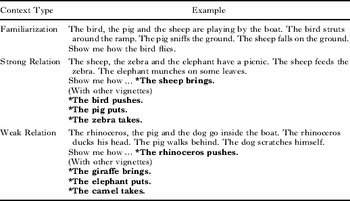
One of two 3-sentence discourse contexts preceded each test sentence (see Table 1). In the Weak contexts, three animals were presented, each engaged in its own distinct activities. In the Strong contexts, two of the animals were presented in an agent/patient relationship (e.g. the elephant cleans the giraffe) and only the third was described as acting alone. For both contexts, the subject of each test sentence was the first animal mentioned in the preceding vignette.
Discourse context types and test sentences

The children in the control condition enacted a total of sixteen sentences. Twelve of these were grammatical, and included the four intransitive verbs (come, go, fall and stay) in the NV frame, the four transitive verbs (push, bring, take, put) in the NVN frame, and the two alternating verbs (move, drop) in both frames. The other four were the ungrammatical sentences, in which the four transitive verbs were each presented once in the NV frame.
Apparatus
The test sentences were enacted using a toy ‘Noah's Ark’ set. The set included nine wooden animals of various colors that were familiar to the child and easily manipulated, plus a green piece of paper that served as the stage. The presence of the ark next to the stage enabled the straightforward enactment of the goals or sources for all of the sentences.
Procedure
Children were tested in a separate room at their preschool. In the experimental conditions, the Strong and Weak Relation contexts were presented in different sessions, counterbalanced for order across children. Each session lasted approximately 15 minutes. At the start of a session, children were asked to name each animal. This was followed by a ‘familiarization’ vignette and sentence (see Table 1). Children were encouraged at this time to move the animals and to use the whole stage. The three animals needed for each vignette were placed in close proximity on the stage, then the experimenter produced the vignette and the children were given the test sentence. While articulating the test sentence, the experimenter did not look at any of the animals. Children were praised after each enactment regardless of how they performed on the task. In the control condition, the sentences were all presented in a single session and no vignettes were provided before each sentence. In all other ways, the conditions were identical. Enactments were videotaped to allow for later coding.
Coding
The enactments of the grammatical sentences were coded for correctness. Only children who performed at least 80% of the grammatical sentences correctly were included in the analyses. The enactments of the ungrammatical sentences were coded as Frame Compliant, Verb Compliant or Other. Enactments were coded as Frame Compliant if the enactment showed the first NP moving alone (i.e. acting non-causatively). Enactments were coded as Verb Compliant if a second NP was introduced as the patient of the first NP (i.e. performing causatively). Enactments were labeled ‘Other’ if they used the wrong animals or an incorrect action. Because ‘Other’ enactments were so rare (1·6% of enactments of *NV sentences), they were omitted from further analysis. The enactments for all the sentences were initially described and coded by the experimenter (AM). A reliability coder described 10% of the enactments without knowledge of the sentence to which the child responded. These descriptions were in agreement with those of the experimenter 92·6% of the time (p<0·01).
RESULTS
Preliminary analyses including sex as an independent variable revealed no significant effects; therefore, we collapsed the groups by sex for all subsequent analyses.
We first consider the children's performance in the two experimental conditions. A 3×2×2 mixed effects ANOVA (age: two-, three- and four-year-olds; order: Strong first vs. second; and context type: Strong vs. Weak) was conducted with percent Verb Compliance (VC) as the dependent variable. This revealed a significant main effect of age (F(2, 41)=6·51, p<0·05; η2=0·241) and no other significant effects or interactions. A post-hoc Sheffé multiple comparisons test revealed that the two-year olds performed Verb Compliantly with significantly fewer verbs than the three- and four-year-olds (MD=0·17, p=0·04; MD=0·25, p=0·003, respectively); the three-year-olds' and four-year-olds' performance was not found to be significantly different. Additionally, although the children did not differ in their degree of VC when enacting *NV sentences after Strong contexts (M=77·1% VC, SD=21·3) versus after Weak ones (M=75·0% VC, SD=26·4), more detailed scrutiny of the children's enactments revealed that the choice of introduced object did vary by type of context. In the Strong Relation condition, children chose the patient mentioned in the vignette (e.g. the zebra in Table 1) as the patient in their enactment 67·6% of the time; they chose the third animal (e.g. the elephant) 23·9% of the time, and chose an animal that was not mentioned in only 8·5% of the enactments. In contrast, in the Weak Relation condition, children chose as their patient the second-mentioned animal 51·5% of the time, the third-mentioned animal 29·4% of the time, both animals 2·2% of the time, and chose an animal that was not mentioned on 16·9% of enactments. These patterns were significantly different by a chi-square test (χ2(3)=10·89, p=0·01). In other words, the type of context did not influence the children's tendency to add a missing direct object but did influence which animal was chosen to fill the role.
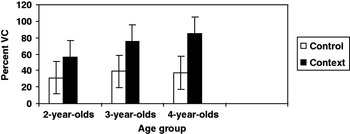
We next compared children's performance in the experimental (both contexts combined) and control conditions, as shown in Figure 1. A 3 (age)×2 (condition) ANOVA yielded a main effect of condition (F(1, 68)=45·68, p<0·001) and a significant interaction of age and condition (F(1, 68)=13·32, p<0·001). Planned t-tests revealed significant effects of condition for all three age groups (four-year-olds: t(24)=4·66, p<0·001, d=1·45; three-year-olds: t(23)=4·16, p=0·001, d=1·43; two-year-olds: t(33)=2·93, p=0·007, d=1·3); however, the effect of condition was significantly greater for the three- and four-year-olds than for the two-year-olds. In sum, presentation of a context enhanced the children's VC at all three ages, but especially so for the two older groups.
Percent verb compliance by age and condition.

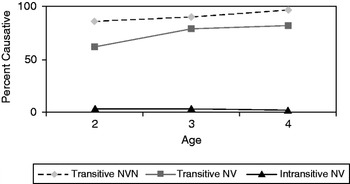
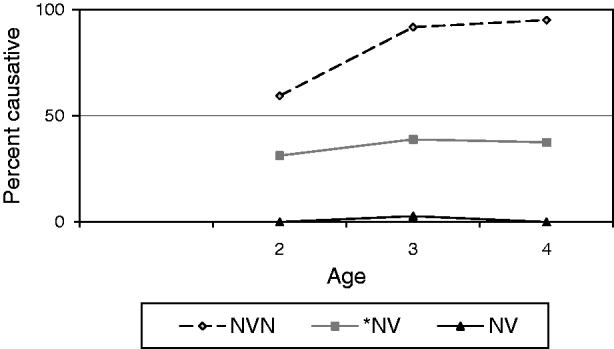
These analyses demonstrate that the children viewed the vignettes as relevant discourse contexts that provided information about the missing direct object in the *NV sentences. Our final analysis investigated whether the vignettes enabled the children to demonstrate complete VASs. To this end, the enactments of the NVN sentences with transitive verbs, the NV sentences with intransitive verbs, and the *NV sentences were all recoded as causative or non-causative. The findings are shown in Figures 2a and 2b. As expected, children across all ages performed the transitive verbs in the NVN frame causatively close to 100% of the time and the intransitive verbs in the NV frame causatively close to 0% of the time. Two 3 (age)×2 (condition)×2 (frame) ANOVAs were conducted, one comparing the children's performance on the NVN and *NV frames (i.e. comparing the same verbs in different frames), and the other comparing the children's performance on the *NV and NV frames (i.e. comparing the same frame with different verbs). The NVN/*NV ANOVA yielded a significant main effect of frame (F(1, 68)=45·68, p<0·001, η2=0·46), a significant 2-way interaction of condition and frame (F(1, 68)=20·73, p<0·001, η2=0·115), and a significant 3-way interaction of age, condition and frame (F(1, 68)=3·84, p=0·025, η2=0·004). Planned comparisons revealed that in the Context conditions, the NVN frame elicited significantly more causative enactments than the *NV frame for the two-year-olds; this did not reach significance for the older age groups (four-year-olds: t(15)=2·11, p=0·052; three-year-olds: t(15)=1·87, p=0·078; two-year-olds: t(14)=4·43, p=0·001). In the Control condition, the NVN frame elicited significantly more causative enactments than the *NV frame for all three age groups (four-year-olds: t(9)=5·12, p<0·001; three-year-olds: t(8)=4·64, p=0·001; two-year-olds: t(7)=2·34, p=0·05). The locus of the 3-way interaction, then, is that the NVN vs. *NV differential was greatest for the two-year-olds in the Context conditions, but smallest for the two-year-olds in the Control condition. In other words, the two-year-olds were the least Verb Compliant (i.e. least causative) overall, and the discourse contexts were the least effective in enabling the two-year-olds to demonstrate complete VAS understanding.
Percentage causative enactments by age and frame, Experimental conditions.

Percentage causative enactments by age and frame, Control condition.
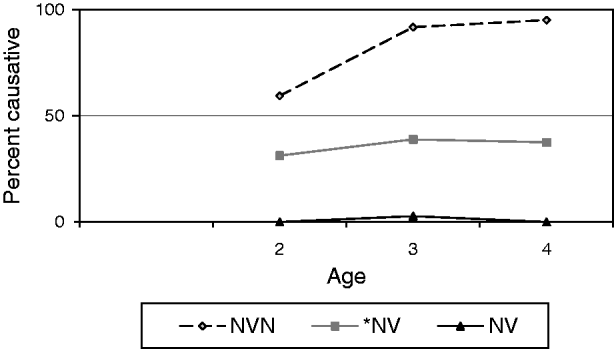
The NV/*NV ANOVA yielded a significant main effect of frame (F(1, 68)=355·85, p<0·001, η2=0·75), a significant interaction of age and frame (F(2, 68)=3·72, p=0·028, η2=0·015), and a significant interaction of condition and frame (F(1, 68)=39·32, p<0·001, η2=0·08). Essentially, children in all groups enacted the *NV sentences significantly more causatively than the NV sentences, but this effect was greater for the three- and four-year-olds than for the two-year-olds (MDs=54·25, 60·63 and 42·19, respectively); it was also greater in the Context conditions than in the Control condition (MDs=69·77 and 34·95, respectively). Thus, the presence of the vignettes had practically no effect on the enactment of the NV sentences. Hearing a story about animals' activities did not lead children to believe that the zebra goes should be enacted with anything more than the zebra, whereas hearing such a story led them to enact sentences like the zebra brings with an introduced patient between 62% and 82% of the time.
DISCUSSION
This study provides evidence that discourse context exerts an influence on children's interpretations of sentences with null arguments. Preschool-aged children repaired such ungrammatical sentences more (performed more Verb Compliantly) when the sentences were preceded by vignettes (Context conditions) than when they were presented in isolation (Control condition). Strong Relation contexts, in which characters were presented in agent/patient relationships, were no more effective than Weak Relation contexts in facilitating such repairs, although the contexts did yield differences in the children's choice of patient. However, the availability of context did not eliminate developmental effects: as in Naigles et al. (Reference Naigles, Gleitman, Gleitman and Dromi1993), the two-year-olds in this study performed less Verb Compliantly than the three- and four-year-olds.
Thus, the sheer presence of discourse context in the current study succeeded in eliciting more Verb Compliant (repairs) responses from children as young as two years of age. With Song & Fisher (Reference Song and Fisher2007), these are among the youngest children for whom such discourse effects have been shown, and they extend previous findings, for the first time, to recovering missing direct objects. These findings support Allen's (Reference Allen, Bowerman and Brown2007; Reference Allen and Bavin2009) prediction that just-mentioned NPs are good candidates for the referents of missing object arguments. Moreover, the finding that Strong contexts elicited more choices of the second NP in the vignette as the patient of the enactment than Weak contexts shows that these children had some understanding that given patient arguments of previous discourse were more likely to be repeated as patient arguments in subsequent sentences than given actor arguments (Du Bois, Reference Du Bois, Du Bois, Kumpf and Ashby2003). Finally, these findings are consistent with Goldberg's (Reference Goldberg2006) and Allen's (Reference Allen and Bavin2009) conjectures that the presence of the preceding discourse rendered the subsequent object-omitted sentences more pragmatically appropriate, hence enabling the children to repair them.
We had predicted that the Strong Relation context would elicit more repairs overall than the Weak Relation context; however, the only effect of context type we found was in the specific animal chosen as the patient of the enactment, not in the degree to which the sentence was repaired at all. It seems, then, that discourse contexts may exert separable effects on children's acquisition of argument structure: The sheer existence of NPs in the preceding discourse (and we do not know how many NPs are needed to enable this) may simply provide children with possible arguments with which to repair the object-omitted sentences; the organization of those NPs (i.e. in the Strong Relation context) may then provide children with pointers as to which NPs are the most felicitous for such repair. These findings indicate that the children were processing the preceding discourse at an integrative level (see also Rall & Harris (Reference Rall and Harris2000), who found similar sensitivity in three- and four-year olds' use of discourse context to repair errors of deixis).
It is important to point out, though, that the two-year-olds in the context conditions still performed less Verb Compliantly than the three- and four-year-olds: unlike these older children, they did not repair the ungrammatical sentences consistently, and in fact enacted the *NV sentences causatively significantly less frequently than the NVN sentences with the same verbs. These findings are consistent with two (non-exclusive) interpretations: first, it is possible that two-year-olds are not as good at using discourse context – and/or at realizing what is or is not pragmatically appropriate – as older children are. Children of this age seem to pay less attention to such contexts, and/or seem less sure about how to integrate the contexts with their language use (e.g. Matthews et al., Reference Matthews, Lieven, Theakston and Tomasello2006). Second, the two-year-olds' verb representations may not be as well formed as those of the older children, such that they might not fully realize that bring, take, push and put are obligatorily transitive. If there is still uncertainty about the transitivity status of the verb, then the children might consider it plausible that these verbs could have intransitive/non-causative variants (akin to drop and move), in which case the discourse context would not be deemed relevant for their enactments. Indeed, none of the children added patients to their enactments of come, go, fall and stay in the NV frame, even though the same Strong Relation and Weak Relation contexts preceded these sentences as well. Thus, the context was only used for the purpose of referent selection when a referent was deemed to be omitted, and so perhaps the lower rate of repair in the two-year-olds reflected their less-than-certain knowledge that referents were omitted in the sentences containing transitive verbs.
Distinguishing between these interpretations, or seeing how they interact, is work for future research. For example, it would be very informative to conduct this study with children learning languages in which object ellipsis is highly frequent, such as Mandarin Chinese, Turkish and Inuktitut. Previous research has already revealed that three-year-olds learning Turkish or Mandarin repair *NV sentences, presented without a discourse context, more frequently than do three-year-olds learning English (Göksun, Küntay & Naigles, Reference Göksun, Küntay and Naigles2008; Lee & Naigles, Reference Lee and Naigles2008; Naigles, Küntay, Göksun & Lee, Reference Naigles, Küntay, Göksun, Lee, Bamman, Magnitskaia and Zaller2006). Such earlier acquisition of VAS in Turkish or Mandarin could be partially attributed to the frequent NP ellipsis in these languages, because hearing transitive verbs both with and without objects in the input might direct relatively more attention to verb-specific rather than frame-specific properties of the situation. But because discourse context is needed to recover these frequently omitted objects in the real world, it is likely that Turkish and Mandarin child learners have greater – and possibly earlier – sensitivity to discourse context in experimental tasks as well.
In summary, English-learning children are able to exploit discourse context to recover missing direct objects. These findings render plausible the hypothesis that discourse context, particularly including accessible arguments, facilitates children's acquisition of verb argument structure. However, discourse information did not suffice to enable the complete acquisition of VAS. Two-year-old children still evidently need to learn more about specific verb meanings to establish, for example, that bring requires a direct object. Until the verb meaning is completely learned, the frame (e.g. NV) will continue to exert an influence on preschoolers' interpretations.
Appendix: Test sentences (not in the orders presented)