Introduction
Cuba's opening towards foreign capital since 1990 has aroused broad interest. For economists, the question of how far, and in what form, the Cuban economy is being integrated with the international capital market, can be seen as a test of the extent to which the state can control the insertion of a national economy into the global market.Footnote 1 The Cuban opening has also seized the attention of potential investors, but they have been wary and unsure of how to interpret it. The slow and halting nature of the opening in comparison with the liberal regimes in formerly socialist economies of Eastern Europe, China and Vietnam has provided relatively limited investment opportunities. The announcement of a new wave of reforms beginning in March 2008, including the expansion of private farming, liberalisation of some markets and decentralisation of administration, has raised expectations that the long-awaited ‘transition’ may be approaching and with it, a renewed expansion of the possibilities for foreign capital.
Economists observing developments from outside Cuba have shared the hopes and frustrations of potential investors. Ideology is perceived as an obstruction to progress on economic transition, one that restricts the degree of liberalisation of the treatment of foreign capital. According to this view, which has dominated foreign analysis of Cuban economic policymaking, the current signs of opening are part of a cyclical pattern of liberalisation and reversal: the ideological leadership is seeking to make sufficient concessions to ensure its survival, but eventually, after a period of several years, it will seek to reassert state control.Footnote 2 Therefore, the model suggests that the reforms initiated in March 2008 are no more than a temporary cyclical shift. Similarly, the opening to foreign capital is seen as a cyclical process, so that the space that has been made available for investors and lenders is likely to be temporary. But this article, by re-examining policy towards foreign capital since 1990, tests the policy cycle model and highlights its limitations. It suggests that Cuban policy towards foreign capital since 1990 might more usefully be characterised as part of an evolutionary, rather than cyclical, process.
A Model of Centralised Control, Obstruction and Cycles
The remarkably broad consensus about the nature of official policymaking that exists among economists observing Cuba from abroad has changed little since the early years of the ‘special period’. According to this view, Cuban government policy is driven from the centre, and progress and adaptation are blocked by an ideological leadership. Cardoso and HelwegeFootnote 3 describe a system in which tight central control ‘prevents Cuba from adjusting’. For RocaFootnote 4, Cuba has been led by an ideological leadership into an ‘economic labyrinth’. This view is supported by Mesa LagoFootnote 5 who, using extensive quotes from the speeches of Fidel Castro, argues that the president's ‘stubborn dogmatism’ and ‘aversion to market reform … [his] willingness to smash those who oppose him and to take the whole nation with him in his opposition’Footnote 6 have enshrined inflexibility on policy.
This perceived opposition between an ideological leadership and a path to economic progress that lies through liberalisation provides a framework for understanding the slow progress on Cuba's transition and its opening to foreign capital. It also informs much of the press commentary on the latest wave of economic reforms. It is modelled by Mesa Lago, who identifies a pattern of Cuban policy cycles that alternate between ‘ideological’ (centralising) and ‘pragmatic’ (liberalising) phases throughout the post-1959 period.Footnote 7 As evidence, he provides lists of policy measures adopted in each phase. In line with his underlying assumption that control of policy has been extremely concentrated at the top, this model identifies turning points in the cycle driven by decisions by leaders. The switch towards a ‘pragmatic’ cycle comes when the economic realities threaten political stability; the switch towards an ‘ideological’ swing happens when the economy has recovered. Confirming his view that Fidel Castro continues to drive the cycle, Mesa Lago explains:
The role of the maximum leader is crucial in the generation of cycles. Despite many changes over the past forty-three years and some degree of politico-economic institutionalization, Castro still concentrates considerable political power and makes the most important policy decisions. His customary preference for centralized decision-making, collectivization of the means of production, egalitarianism, and mobilization make him favor anti-market policies, but he has taken a pragmatist stand and reversed those preferences every time it has been necessary to save his regime.Footnote 8
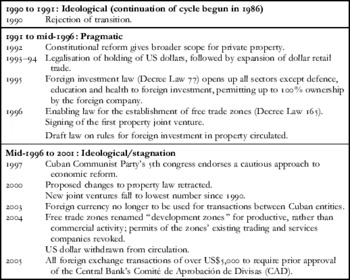
Mesa Lago argues that the cycles have continued since 1990, despite the collapse of the Soviet bloc and acute economic shock that followed. He characterises the government's initial response to the crisis in 1990 as the tail-end of an ideological cycle begun in 1986, then detects a pragmatic wave from 1991–96 followed by a renewed ideological period since 1996. According to this model, the pattern of cycles in terms of policies towards foreign investment can be discerned by simply listing the policy reforms during the period (see Table 1).
Cycles in policy towards foreign capital

A Weakening Cycle or a New Model?
Mesa Lago acknowledges that changes have occurred since 1990. He notes that the 1996–2001 cycle was weaker than previous ones as ‘the process of economic reform has been either halted or slowed down’ rather than reversed, as in earlier cycles.Footnote 9 He describes this as ‘a stagnation’.Footnote 10 The previously observed cyclical pattern is further undermined by the subsequent extension of the cycle: by 2007 a full decade had passed since the end of the last pragmatic phase, breaking with Mesa Lago's observation that generally the cycles last between five and seven years. This lack of reversal and extension of the post-1990 cycles weaken the explanatory and predictive power of the model. In this article, we focus on the case of policy towards foreign capital, where an opening that occurred at the start of the 1990s has remained in place.
To explain the apparent weakening of the cyclical policy pattern, Mesa Lago provides two explanations to accommodate the evidence by amending the model. The first concerns a break with the past due to external economic conditions: after losing the cushion provided by Comecon, Cuba was exposed to the global market, making reversals of periods of ‘pragmatism’ more difficult. The second rests on a more long-term trend arising from a generational shift. He suggests that by the 1990s the leaders faced a population ‘exhausted after more than four decades of experimentations and promises, sceptical of idealistic targets, and more resistant against another cycle of severe deprivation’.Footnote 11 Thus, the extension of the ideological cycle for an unusually long time is interpreted as further confirmation of the weakening of cycles, rather than as a challenge to the characterisation of policy itself as cyclical. In this view, the economic reforms introduced in the domestic economy launched under the presidency of Raúl Castro is interpreted as a new ‘pragmatic’ phase, providing renewed confirmation of the existence of such policy cycles, and confirming that the limits of the ideological phase have been reached as predicted, and that ideology is currently under retreat.
But the weakening of the cyclical pattern suggests that the model is in need of review. In order to sustain the model, it is necessary to show that there is still a pattern of cycles in policy, with phases of liberalisation followed by reversals, and that the cycles arise from periodic reassertion of the leadership's anti-market ideology which eventually gives way to concessions forced by economic necessity. A re-examination of the evidence of the post-1990 period casts doubt on these pillars of the model. Taking policy towards external capital as a case study, the following section accounts for the policy shift of 1990–91 in the context of the available data concerning the nature and depth of the changes in external economic circumstances arising from the collapse of Comecon. The evidence suggests a sharp break in policy towards foreign capital took place at that time in response to the transformation of external conditions, and that since then Cuban efforts to develop foreign direct investment (FDI) and integrate with the international financial markets have demonstrated substantial continuity. On the basis of this evidence, the usefulness of an evolutionary, rather than cyclical, model is considered as a framework to account for the process of change in Cuba today.
After Comecon: a Sharp Break in Policy Towards Foreign Capital
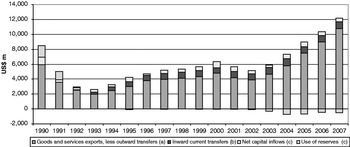
The idea of a cycle between ideological and pragmatic phases in policy rests on the assumption that policymakers, in this case the political leaders, have had the power to dictate policy. However, the available data for Cuba's external accounts indicate that policy towards foreign capital in the wake of the demise of the Soviet bloc in 1990–91 was driven by changes in international economic conditions rather than any domestic policy cycle.Footnote 12 The collapse in the availability of foreign exchange for imports – from around US$9 billion in 1989 to only US$2.6 billion by 1993 – created an imperative for policymakers to seek the restoration of access to foreign exchange.
Estimates of main contributions to import capacity: exports, current transfers and financing. (a) Official data show a net outflow of current transfers in 2005–2007. We assume this arises from a valuation of Cuban professional services donated under the agreements with Venezuela. In this chart the value attributed to these donated services is deducted from the reported earnings from professional services that were traded rather than donated. (b) Official data show only net current transfers. We assume that before 2004, when the large-scale sale of professional services under agreements with Venezuela began, the level of outward current transfers was negligible. (c) These estimates are based on ONE data for the current-account balance, 1990–2007. The balance is financed either by net capital inflows or by the use of (i.e. net reduction in) reserves. For 1993–2001 ONE data show a small annual increase in international reserves, and the estimate of net capital inflows is the sum of the current-account deficit and increase in reserves. For 1990–1992 and 2002–2007 there are no official data for either the annual increase in international reserves or net capital inflows. In 1990–1992 the narrowing current-account deficit and GDP contraction in 1990–1993 suggest a depletion of international reserves combined with a decline in capital inflows; in contrast, in 2004–2007 the current-account was close to balance while GDP growth strengthened, suggesting that capital inflows were maintained and international reserves rose (the latter shown here as negative ‘use of reserves’).

The loss of financial inflows accounted for a large proportion of the total collapse of foreign exchange following Comecon's demise. Balance of payments accounts show that of the total US$6.2 billion decline in import capacity between 1989 and 1993, the contraction in earnings from exports of goods and services accounted for around two-thirds (falling from US$6 billion to US$2 billion) and the disappearance in financing for the remaining third.
Within Comecon, Cuba had become dependent on generous supplies of Soviet loans and grants to cover its current-account deficit; capital inflows from other sources were negligible. When the Soviet support disappeared, Cuba's access to alternative sources of foreign finance was blocked by: (i) large debt arrears outstanding from the mid-1980s that deterred private lenders; (ii) US sanctions that barred official multilateral sources and also further deterred private lenders; (iii) its lack of political allies, resulting in minimal access to bilateral official support; and (iv) the collapse in export earnings and economic output, which quickly led to a poor payments record on trade credits, so that this source of financing too dried up; suppliers credits were available only when fully-backed by claims on Cuba's rapidly diminishing export earnings, and even then, only at very high cost.
The total net inflow on the capital account reported by Cuban official sources includes both net inflows and the use of foreign currency reserves. The level of reserves is an official secret, and no data were published on annual changes in their level until 1993. It is therefore impossible to know how much of the current-account deficit in 1990–1992 was externally financed, and how much was financed by using up reserves. But following the renegotiation of Comecon agreements to convert trade to hard currency at market prices in January 1990, efforts to maintain bilateral preferential trade and financing arrangements with the Soviet Union during that year finally collapsed in 1991Footnote 13, and as no financing was available from other sources at that time the current-account deficit in 1991–92 must have been financed by using up reserves. By 1993, the state was unable to guarantee the basic food needs of the population: strong evidence (in the absence of official reserves data) that international reserves had been exhausted. It is clear from OECD data that inflows of lending and grants from OECD countries were less than US$50 million in 1993, insufficient to match repayments on previous loans from OECD official sources, resulting in a small net outflow.Footnote 14 (The figure includes official funding from UN agencies and bilateral assistance as well as collections by non-government organisations.)
The lack of external finance sets Cuba apart from other transition economies, where the adjustment was assisted by initial availability of official financing from multilateral institutions. In such cases the IMF, World Bank and European Bank for Reconstruction and Development played an important role in the period before private capital inflows accelerated. The absence of official support meant that Cuba had the hardest budget constraint – that is, the strictest disciplining by its opening to the international market – of any country of the former socialist bloc.
The importance of this fact – that by 1993 the Cuban economy was brought to near-collapse by the lack of foreign exchange – cannot be overemphasised. In his 2004 account of the crisis, José Luis Rodríguez, an academic in 1990 who subsequently became minister of the economy, explained simply that ‘in 1990, the necessity to reform first the external economic policy seemed obvious, given the unfavourable changes in the international economic spheres. Reform was necessary to prevent a collapse’.Footnote 15 The urgency of the situation explains why, by 1991, when the Cuban authorities set out their first major statement of policy in the economic resolution of Cuban Communist Party's 4th Congress, the potential forms and sources of external finance had already been evaluated. With hardly any access to official sources, Cuba was forced to look to the private sector.
The 1991 4th Congress resolution refers to policy towards both foreign direct investment (FDI) and debt finance. With debt financing ruled out by both scarcity and cost, it was implicitly acknowledged that FDI would initially be the most important source of capital. Foreign capitalists would be more willing to provide equity financing than debt because their risk could be offset by claims on earnings or capital. Article 6 of the resolution called for the authorities to seek new forms of foreign investment where such investment would make a positive contribution to Cuba's development, while Article 17 accepted a longer-term process of restoring access to foreign borrowing, calling for Cuban official negotiators to begin efforts to open negotiations to reschedule debt and restore access. The relevant authorities were tasked with exploring ‘flexible and reasonable solutions’Footnote 16 to the problem of outstanding debt arrears.
Net external financing inflows are still well below the 1990 level and as a proportion of national income are also below comparable levels in emerging economies. However, the Cuban economy has remained open to foreign finance since the 1991 policy statement. The following sections examine how the nature of the opening has evolved.
The Evolution of FDI Policy Since 1991
The acceptance of FDI in 1991 was not completely new. The opening to FDI had been made in 1982, when foreign investment in joint ventures was legalised. Between 1988, when the first was inaugurated (Corporación Cubanacán), and 1991, 20 joint ventures had been agreed, but the 1991 4th Congress resolution marked a clear break in terms of the emphasis it gave to FDI expansion. Since then there have been no reversals of this policy; instead, a constant process of review and adjustment has been under way.
The increased opening to FDI was enshrined in the 1992 constitutionFootnote 17, and then codified in foreign investment legislation (Decree Law 77, September 1995).Footnote 18 These two developments are cited as evidence of Mesa Lago's ‘pragmatic’ cycle of 1991–96. However, it is not clear that they were entirely ‘pragmatic’ in the sense of representing a continuation of a liberalising process. The 1992 constitutional reform set out the opening to new forms of ownership, but also stressed that this would only take place within the constitutional framework of the socialist economy; while the 1995 law was as much a check on foreign investment as an encouragement since it confirmed the government's role as gatekeeper, with every application to be appraised at the highest level. This was clearly stated in Article 1 which stipulated that the aim of foreign investment was to ‘contribute to the country's economic capacity and sustainable development, on the basis of respect for the country's sovereignty and independence’.Footnote 19 Cuban negotiators were required to appraise each foreign investment proposal in terms of the new finance, new markets or new expertise that the investment would bring. This framework is still in place and continues to inform the periodic reviews of the priorities, regulations and licenses that have been carried out since its inception.
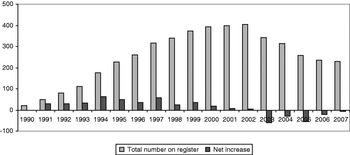
Moreover, data on the number of joint ventures with foreign capital over the 1990–97 period (Figure 2)Footnote 20 do not neatly fit the policy cycles as claimed, since the strongest net increase in the number of joint ventures registered in Cuba was recorded in 1994, a year before the foreign investment law was introduced, while in 1997, when reversal of the ‘pragmatic’ policy cycle would have been expected to narrow the opening to foreign investment, the number of new agreements actually rose.
Number of joint ventures with foreign partners in Cuba, 1990–2006.

The declining trend in the number of new joint ventures between 1997 and 2002 has been read as a sign of an ideological backlash, but it can also be seen as a response to changing market conditions. This distinction between the perceived ‘ideological’ cycle and the maintenance of the opening to foreign capital was apparent in interviews with Cuban officials responsible for negotiating agreements.Footnote 21 These officials, who were charged with implementing policy, tell of a constant process of review, in which the opening to foreign investors was adjusted in line with evolving economic conditions and Cuba's bargaining position as well as changes in strategic priorities. By 1997 import capacity had doubled from the 1993 level, and the worst of the crisis was over: food security had been restored and capital spending resumed. The Cuban state's need for foreign exchange was therefore less desperate, while negotiating experience had been accumulated. This increase in bargaining strength was reflected in the higher prices and more stringent conditions demanded of the foreign party in any new agreement or in renewals of existing agreements. Cuban negotiators described the review process in terms of investment appraisal techniques rather than ideology: foreign partners had to demonstrate that they would provide access to new capital, markets or expertise, and those that failed the test – generally the smaller concerns – had their licenses revoked. This shift was apparent to foreign business representatives interviewed.Footnote 22 In some cases, the expertise of foreign partners that had been useful when Cuba had first been re-establishing its place in global markets was no longer needed as Cuban managers had acquired it for themselves. Some foreign partners perceived the shift as a betrayal or lack of gratitude for services provided during the worst times; others regarded it as a less unwelcome sign that the Cuban partners were behaving in an economically rational way.
Political developments also played a part in the decline in the number of new joint ventures. The US Helms-Burton law, introduced in early 1996, threatened sanctions against, and possible prosecution of, investors from third countries taking a stake in assets on which claims had been registered in the US, thereby deterring potential business partners. This was the context in which debate on economic reform was suddenly curtailedFootnote 23, and in which the 1997 Cuban Communist Party 5th Congress reviewed economic development priorities. But while the 5th Congress endorsed a cautious approach to economic reform it also agreed to ‘allow space for the functioning of market mechanisms’ and confirmed the opening to foreign investments. Castro insisted in his opening speech that ‘la inversión extranjera no nos gustaba mucho’, but he conceded its necessity: ‘Si hay que buscar tecnologías nuevas, las tienen los capitalistas o las hacen accesibles los que poseen el capital necesario. Si hay que buscar mercados nuevos, si hay que buscar experiencias, las tienen muchos capitalistas; experiencia para producir, experiencia para administrar, la tienen. Es decir que las empresas mixtas o las asociaciones que hacemos con el capital extranjero, no solamente resuelven problemas de fondo económico, sino que resuelven otros importantes problemas para el desarrollo’.Footnote 24
The Congress reaffirmed the policy of selectivity in its approach to FDI, and decided that the most urgent need for foreign capital was to build (or rebuild) strategic capacity in capital-intensive sectors, including infrastructure, mining and energy. Negotiators were not prevented from using innovative approaches to securing new foreign investments, as illustrated by the 1999 agreement for the first 100 per cent foreign-owned joint venture, for a power plant in the Isla de la Juventud, while the number of joint ventures continued to rise until 2002. The radical reorganisation of the sugar sector that year included creation of a new, autonomous entity able to enter agreements with foreign partners for sugar trading.Footnote 25
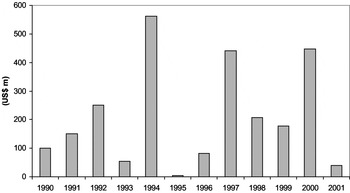
A shift in emphasis towards partnerships involving large financial commitments at the end of the 1990s is reflected in data for the net inflows of FDI (see Figure 3). Despite the declining trend in the number of new agreements, available data to 2001 suggest that the flow of new FDI continued, resulting in a steady rise in the total stock of FDI. Reported net inflows, figures for which are available only for 1993–2001, have clearly been heavily influenced by a few large contracts, resulting in a ‘lumpy’ pattern in terms of annual volumes. But if we take the totals for the two stages of the supposed policy cycle between 1991 and 2001, these suggest an acceleration rather than a deceleration for the 1997–2001 period – characterised as the ‘ideological/stagnation’ part of the cycle – as average annual net inflows rose from US$184 million in 1991–96 to US$263 million in 1997–2001.
Net FDI.

It should be noted, however, that the data are incomplete. Official sourcesFootnote 26 provide data on net FDI inflows only, and only up to 2001. In most developing economies, little difference exists between gross and net FDI inflows on the capital account, but in Cuba's case, a series of ventures involving Cuban investments abroad has been undertaken. These outflows, which are deducted to arrive at the net inflows figure, mean that the data shown in the figure in some years understate inflows. In some of the agreements – the nickel investment with Sherritt International (Canada) is the most important – the Cuban partner invested in physical capital in the partner's country. In others, the foreign partner sold Cuba a share of a marketing concern – as in the case of an agreement with a European partner for the marketing of Cuban cigars – thereby providing an entitlement to a share of future earnings.Footnote 27 Still other agreements have involved Cuban investments in manufacturing or service facilities abroad, mainly in healthcare and pharmaceuticals in non-OECD countries.Footnote 28 The data therefore provide an incomplete measure of trends in incoming FDI, although they confirm that the net inflow continued between 1996 and 2001.
No official data for FDI flows have been published since 2001. Although the narrowing of the current-account deficit from almost US$700 million in 2002 to US$300–350 million in 2003–04 might suggest a possible decline in net capital inflows, this is not certain as net flows include both debt repayments and any increase in international reserves as negative items. Interviews and press reports suggest that from 2002 to 2007, the focus of the Ministry of Foreign Investment and Economic Cooperation (Minvec) was on FDI in capital-intensive industries, which led a few large projects, including oil exploration, to dominate the flows. In reporting a net reduction in the number of joint venture agreements in 2003–06, with more terminated than initiated, Minvec claimed that the shift towards larger projects has meant that the volume of capital inflows has not declined in proportion.Footnote 29 The investment programme embarked on by Cuba and Venezuela under the auspices of the Alternativa Bolivariana para América Latina y El Caribe (ALBA) since 2004 appears to have made an important contribution to foreign investment. The largest of the joint ventures with Venezuela to date has been the upgrading of an oil refinery in the Caribbean port city of Cienfuegos. An agreement in principle was signed in April 2005 and a joint venture created a year later. The US$100 million first phase was completed on schedule in December 2007Footnote 30, and associated investments in the port and further expansion of petrochemicals processing are planned, with potential spending reported to total US$1 billion. Another important Cuban-Venezuelan project is a joint venture to link the two countries with a fibre-optic cable, planned for completion by early 2010.Footnote 31 Chinese investments have focused on participation in oil exploration and transport infrastructure. This latest wave of joint ventures with Venezuela and China has illustrated the importance of political alliances in driving investment, and has increased the share of FDI undertaken by foreign state-owned, rather than private, companies. However, new agreements with private investors from other countries have not been precluded.Footnote 32 Since 2004 the energy sector has been particularly active in attracting foreign investors, with companies from Canada, Spain, India and Norway becoming involved, and talks under way with Vietnamese and Brazilian partners.Footnote 33
Two Special Cases of FDI: Real Estate and Free Trade Zones
In the specific cases of foreign investment in real estate and the development of free trade zones, the picture is different. An apparent move towards liberalisation in the mid-1990s ended with a reversal. In the case of the proposed opening of real estate, a draft law was in the pipeline for half a decade before it was abandoned in 2000. During the period when the law was under discussion, negotiations with potential investors continued to take place and new joint ventures in property authorised under the 1995 foreign investment law were agreed. In that year the first property joint venture was signed, for the rehabilitation and development of the Lonja de Comercio office block in Old Havana. In 1996, agreements followed for the construction and sale of 600 residential units in three projects in Miramar, a suburb of Havana. By mid-1997, eight more agreements had been signed and 40 more were reported to be in the pipeline. The first time-share joint venture was signed in 1999.
When the announcement came in April 2000 that the proposed property law was to be abandoned, most existing joint ventures were dissolved and foreign partners compensated in accordance with contract terms; unsold properties were bought back by the Cuban state and projects not dissolved were renegotiated to allow the foreign partners leasehold rather than freehold ownership.
We do not have access to the proceedings of meetings in which the draft law was debated, but according to accounts of Cuban officials and academics who participated in them, sharp disagreements arose. Official negotiators, interviewed while the draft law was being debated, described the issues raised.Footnote 34 They highlighted the concerns: the political ‘sensitivity’ of property ownership given the severe shortage of adequate housing, the challenge of ‘the control of speculation’, the worries that Cuban émigrés would use third parties to buy homes, and a widely-held view that the ownership of Cuban real estate by foreigners would undermine the principle of ‘sovereignty’. From the beginning, it was perceived that any reform of the housing market would have to be undertaken with care in order to ‘preserve aspects of the revolution’ in terms of equality. One academic economist who strongly supported foreign investment in property as a means to fund much-needed infrastructure investment described, during an interview in August 1999 (by which time it was beginning to appear that the property law might be abandoned), that there had been hostility to the idea of foreign investment in property from ordinary members of the communist party and trade unions at local meetings.Footnote 35 He reported with dismay and frustration, having attended meetings where he had attempted to explain the benefits of property joint ventures, that objections had been raised against the conspicuous difference in the quality of new houses for foreigners compared with the poor conditions for Cubans. His testimony suggests that the rejection of foreign ownership of property might be explained as much by the weight of public opinion expressed at local meetings as by ideological resistance within the Cuban Communist Party leadership.
Although the new property law was abandoned in 2000, the opening to foreign investors in real estate has not been completely closed. A few foreign property investors remain in operation in Havana (including the Lonja del Comercio venture). In the wake of a decline in tourism in 2006–07, as the Ministry of Tourism has sought to develop a strategy for diversifying markets and shifting to higher-earning activities, the question of property rights for foreign investors has been raised once more in connection with a proposal to build golf resorts with condominiums for sale or lease.Footnote 36 This proposal is being assessed at the time of writing, illustrating the fact that policy continues to evolve.
In the case of the experiment with free trade zones, its abandonment appears to have been less contentious. Authorisation for the establishment of free trade zones was included in the 1995 foreign investment law, and in July 1996, the enabling legislation (Decree Law 165) was passed. In 1997, the first three free trade zones began operations; the fourth and final zone was established in 1998. The following year, Granma, the official Communist Party newspaper, reported that a Minvec study of the functioning of the zones noted that of 243 enterprises operating within them, 160 were trading companies, 49 in the services sector and only 39 in manufacturing. The 1995 law (Chapter XV, Article 50) stated that the aim of free trade zones was to foster manufacturing for export as a means of helping to diversify the export base and provide employment, so the low level of manufacturing activity was reported as a disappointment. After a further five years, the picture had not improved. Strict regulation of labour costsFootnote 37 and the absence of a US market for manufacturing exports resulted in the failure of the experiment. The overwhelming majority of enterprises enjoying the zones' special tax status continued to be foreign trading and services enterprises. In 2004, the free trade zones were redesignated as ‘development zones’ for the promotion of productive, rather than commercial, activity. The permits of trading and services companies in the zones were quietly revoked, and the businesses either closed or moved outside the zones.
In the cases of foreign investment in property and free trade zones, the opening in the mid-1990s was experimental, and the eventual closure followed a process of review. The piloting of policy initiatives has been a feature of the post-1990 adjustment. In both the real estate and free zone cases, the decision to abandon the experiment was influenced by US sanctions. For free trade zones, the absence of a US market was one of the main reasons for the experiment's failure, but for property joint ventures other difficulties and objections, both social and political, played a greater part in the decision to abandon the opening.
The Evolution of Policy Towards External Borrowing Since 1991
Policy towards external borrowing, like policy towards FDI, has evolved steadily since the initial break in 1991, with shifts in emphasis precipitated by changing circumstances. The Cuban government's ability to secure foreign lending has been restricted throughout the post-1990 period for reasons described above. In line with Article 17 of the 1991 PCC economic resolution, a continuous process of adjustment within the financial system has been undertaken in an effort to improve Cuba's access to short-term credits to facilitate trade and long-term lending to finance capital investment. There are no signs from the available data, or from interviews with policymakers or foreign creditorsFootnote 38, that this process of reinsertion into the global financial system has altered significantly since 1991.
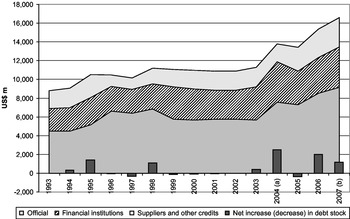
The data in this area are sparse, and deliberately so: sources of external financing and the level of international reserves are regarded as issues of national security, given the stated policy of the US to seek to weaken the Cuban economy. However, the available information provides evidence of the limited access to external borrowing until 2004. Debt figures for 1990–1993 are not available but the Central Bank has published data since 1993Footnote 39 (see Figure 4) that shows an average increase in the total foreign debt stock of just 2.5 per cent a year in 1993–2003. This is probably no more than the increase in interest arrears on the unserviced pre-1990 debt.Footnote 40 The year-on-year changes in total debt during this period show net inflows only in 1994, 1995, 1998 and 2003. In two of those years – 1994 and 2003 – the net inflows disappear if adjustments are made for increases in interest arrears on unserviced debt and currency movements.Footnote 41 This leaves only two years between 1993 and 2003 in which there was a net inflow of external financing.
Foreign debt stock by creditor type, and net annual increases in total stock. (a) Although CEPAL gives the Banco Central de Cuba as its source, there may be a break in the series in 2004. (b) Author's estimates, based on partial data published by the Banco Central de Cuba.

There are no published Central Bank reports that explain the increases in debt in 1995 and 1998, but both years followed a surge in FDI inflows. One of the three objectives of joint venture agreements, as noted above, was to obtain improved access to capital, and major projects involved finance packages involving foreign lenders, facilitated by the joint venture partner. In 1995, major investments in nickel mining will have drawn in much of the new capital and in 1998 energy and telecoms investment and hotel building accelerated.Footnote 42 In 1998 the debt was also pushed up by a US$500 million rise in outstanding suppliers' credits arising from a shortfall in sugar earnings, as both output and prices fell sharply.Footnote 43
In interviews, officials at the Central Bank describe a continuing effort to improve access to, and reduce the cost of, foreign credits. At the start of the special period, officials complained that the interest rates charged by the very few commercial lenders were among the highest in the world, hindering economic recovery. Representatives of foreign creditors argued that the interest rates reflected Cuba's restricted access to finance and payment delays, as the Cuban borrowers struggled to meet obligations amidst declining sugar earnings. As a result of the shortage of lending and high rates, Cuban buyers showed a strong preference for purchases of imports from those countries offering export credit guarantees, which improve availability and reduce the cost of credits. In 1990–1994, while total spending on goods imports fell by 73 per cent, the handful of countries that increased exports to Cuba – France, Mexico, Spain, Canada, Holland and Italy – were generally those that offered favourable, officially-backed credit terms.Footnote 44
The work by the Central Bank helped to restore access to credit and reduce its cost. Substantial and continuous effort was expended on negotiations with official and private creditors and an ongoing process of tightening control of external liabilities was undertaken. These efforts, together with rising foreign exchange earnings, helped to reduce payments delays, although the difficulties with sugar credits in 1998 were a setback.Footnote 45 Following its creation in 1997 under Decree Law 197, the Banco Central de Cuba (the Cuban Central Bank) increased supervision and risk management, and restricted the accumulation of foreign currency liabilities.Footnote 46 At the same time, Decree Law 198 established a new financial system, with a set of ‘autonomous’ state-owned banking corporations which are able to form joint ventures. The first joint venture in the sector was signed in 1998 between the Cuban Banco Popular de Ahorro and Caja Madrid (Spain). Pre-1990 foreign debt arrears were placed on the books of a separate bank, the Banco Nacional de Cuba, leaving the other banks with a fresh slate on which to build a clean credit history while negotiations for the rescheduling of the old debt continue. Both borrowers and lenders have been coy about the exact interest rates, but some reduction was reported between the early 1990s and early 2000s. However, by 2001 rates were still considered by interviewees on both sides to be high relative to the degree of risk. A representative of one of the lenders described Cuban business as highly profitable, or ‘very good business’ with ‘low risk relative to the high returns’ as the payments record on new credits improved, while an official at the Banco Central de Cuba bitterly described rates he considered to be usurious.
Cuba's access to foreign lending increased sharply from 2004, when Venezuela and China began to offer substantial credits on far better terms than those offered by their competitorsFootnote 47: total debt rose by around US$5.3 billion between 2003 and 2007Footnote 48, compared to US$2.5 billion in the previous decade. A breakdown between ‘immobilised’ debt, which refers to the principal and accumulated arrears on debt that has not been serviced since the 1980s, and ‘active’ debt, which is new debt that is being serviced, shows a US$3 billion net inflow of ‘active’ debt in 2005–07, while a decline in ‘immobilised’ debt (of around US$300 million) appears to be the result of rescheduling agreements. As before, the relatively low cost of credit provided by some creditor countries has been associated with a clear increase in those lenders' share of the Cuban market: between 2003 and 2006 Venezuela's share of Cuba's imports rose from 15 per cent to 23 per cent and China's share from ten per cent to 17 per cent. In contrast, the share of imports accounted for by the US (which has been able to export agricultural goods to Cuba since 2001, but without credit) fell from seven to five per cent over the period.
With improved access to external credit the Cuban monetary authorities have moved to integrate the financial system more closely with international financial markets. Joint ventures, the reorganisation of the banking system and improvements in credit record were followed in April 2006 by the first listing by the Central Bank, without fanfare, of €400 m of existing Cuban hard currency debt, in the form of one-year bonds with a 7% yield, on the London Stock Exchange (LSE).Footnote 49 A few weeks after the bonds matured in 2007, the Central Bank issued and listed a second tranche, this time amounting to €200 million with a maturity of two years.Footnote 50 Although Central Bank officials admit that none of these bonds have been traded, they have indicated that they regarded the listing through the LSE as an exercise in ‘testing the water’, and a dry run to practise the procedures and reporting requirements. The central aim, according to one of the Cuban negotiators,Footnote 51 is to improve access to external finance and reduce the cost: to ‘optimizar el trabajo financiero y ajustarlo más a los standards internacionales’ or, in the words of the Central Bank president, Francisco Soberón, to provide ‘una prueba irrefutable de la creciente confianza de parte de la comunidad económica internacional en la seriedad y honradez del gobierno cubano’.Footnote 52
Within this drive to improve access to international finance, the bond initiative was designed to provide an opportunity, as the negotiator reports, to ‘ganar experiencias y ajustar los procedimientos internos’. This refers not only to building links with the international market but also to restructuring the domestic financial system. The bond issue helped to clarify the separation of functions between Cuba's state-owned banks and the government. It also continued the process of tightening Central Bank control of the use of foreign exchange as part of the effort to improve supervision and prevent payments difficulties. In July 2003, foreign currency used for transactions between Cuban entities was replaced the Cuban convertible peso (CUC), and in 2004 the US dollar was withdrawn from circulation in the domestic retail sector. This was followed in 2005 by stipulation that all foreign exchange transactions of over US$5,000 would require prior approval of the Central Bank's Comité de Aprobación de Divisas (CAD).
The policies of the Central Bank towards the opening to foreign credits were essentially consistent throughout the post-1990 period. At the outset, Cuba's low credit rating, lack of allies and US sanctions barred access to international lending. Negotiations with creditors and the use of joint venture agreements started to restore some access and reduce the cost of borrowing by the mid-1990s. In the second half of the 1990s the reorganisation of the Cuban financial system provided the framework for further rescheduling and financing initiatives in the early 2000s. The listing of the Cuban bonds on the LSE illustrates an approach to policy development in which pilot schemes were used to allow review and assessment before further measures are introduced. In the event, the need to raise finance on international capital markets subsided from 2004 thanks to the surge in foreign exchange inflows from two political allies, Venezuela and China, but there has been no reversal of the opening represented by the bond issuance or of financial sector restructuring.
Conclusions
Although the economic policy of the Castro government since the advent of the ‘special period’ was a rejection of economic ‘transition’, the Cuban economy has undergone a profound reinsertion into the global market. Since the sharp break in policy in 1991, when opening to foreign capital was first declared, no fundamental policy reversals have occurred. This suggests that rather than a pattern of policy cycles, there has been a process of policy evolution, in which the rules of the opening may have been adjusted but negotiations have persisted. Foreign direct investment has been accepted as an important source of capital, as well as of technology transfer and market access. The stock of FDI has continued to grow, even though the number of joint ventures has diminished since 2002. Integration into global credit markets has been slower and more low-key, but the process of adjustment on the path to insertion has been continuous.
The characterisation of Cuban economic policy as a cyclical process suggests that policy is controlled tightly by the leadership, and in particular by the president, who is constrained only when his policy hits economic and political limits. However, observation of the evolution of policy towards foreign capital confirms that since 1991, far more actors have been involved than is suggested by the cyclical model. Negotiators, academic economists and participants in public meetings have all helped to inform and shape the way in which the opening to FDI has evolved and it has been technocrats at the Central Bank, rather than political leaders, that have engineered the gradual restructuring of the financial system and negotiations with creditors. From the start, legislation on FDI and financial restructuring was deliberately designed to allow room for evolution, rather than following a predetermined path. The scope of the opening and the terms upon which foreign investors and lenders have been granted access have been influenced by the accumulation of expertise on the part of the Cuban negotiators. Having created an opening to investors, vice president Carlos Lage explained in an interview in a Mexican paper, El Sol, in June 1993:
Para los próximos años, las formas y los mecanismos se irán enriqueciendo con nuevas ideas, con nuevas propuestas. Incluso, dada nuestra insuficiente experiencia y la novedad de esta política, no hemos querido trazar demasiadas regulaciones por anticipado, sino que éstas vayan acompañando el proceso. Eso nos permite mayor amplitud en la toma de decisiones.Footnote 53
The evolutionary characterisation therefore describes policy as a product of the changing international and domestic economic conditions rather than of the leadership's alternating ideological/pragmatic inclinations. The above account has highlighted the link between the initial collapse in Cuba's foreign exchange resources in the early 1990s and the policy towards FDI and foreign lending that has been in place since that time. As the recovery picked up strength, Cuba's FDI priorities altered and as international economic integration deepened, efforts were made to improve access to capital markets. The process of negotiations for access to both equity and loan capital was marked by continuous experimentation, review and learning. In response to the sudden leap in import capacity and economic growth since 2004 arising from expanding relations with Venezuela and China, the opening to foreign private investors narrowed, but it did not close. Similarly, borrowing from private financial institutions has diminished relative to new officially-backed credits, but the Cuban authorities remain keen to stay engaged with financial markets.
The differences between the cyclical and evolutionary model have implications for the interpretation of Cuban policy and for expectations about its likely future development. In the study of the ‘transition’ from centrally-planned to market economies, the ‘evolutionary’ or ‘evolutionary-institutionalist’Footnote 54 model has been used to explain why Chinese reformsFootnote 55 were relatively successful despite the comparatively slow progress with the liberalisation and privatisation considered to be essential to transition. Important to the relative success – despite the drawbacks of gradualism and partial reform – were the benefits of learning in the context of imperfect information and uncertainty, and of ‘dual-track’ pricing and enterprise reform that provided incentives to raise efficiency whilst minimising the costs of restructuring. Understood in this way, Cuba's opening to foreign investment and lending can be viewed as a pragmatic and measured response to specific conditions rather than merely as a restricted concession liable to ideological reversal.
A Cuban economist, Pedro Monreal, has complained that in economic policy there has been ‘no consensus vision, articulated in an explicit strategy of development’.Footnote 56 Like many other economists inside and outside the country, Monreal considers this to be a major shortcoming. But the case of the opening to foreign capital illustrates that the absence of an explicit strategy has allowed room for decisions to be made through a range of mechanisms of consultation, experiment and review. Ideological conservatism may have played a part in the hesitant pace of reform, but changing economic conditions, the accumulation of expertise through trial and error, and public opinion have also influenced the process. The resulting slow and halting opening has disappointed both investors looking for new opportunities and economists looking for signs of transition, and has certainly resulted in lower foreign capital inflows than full liberalisation would have allowed. But like China's evolutionary approach, it has also permitted policy to adjust in line with changing conditions and reduced the risk of ideological backlash. Cuba's integration with the international financial market remains underdeveloped and radical liberalisation remains off the agenda, but the model of an evolutionary process of opening suggests that, as institutions develop and the economy expands and diversifies, new spaces are likely to emerge for foreign capital.