INTRODUCTION
Still used today, Asian lacquers were first developed during the Holocene, approximately 7000 BC in Asian countries (Brommelle and Smith Reference Brommelle and Smith1988; Le Hô et al. Reference Le Hô, Duhamel and Daher2013; Matsumoto Reference Matsumoto2018; Niimura et al. Reference Niimura, Miyakoshi, Onodera and Higuchi1999), what is today part of the South and Southeast Asian continent (e.g. China, Japan, Vietnam, Myanmar, Thailand, Taiwan). Through time lacquers have been used to decorate a wide variety of objects such as containers, figurines, bows, various hair and clothing ornaments, combs, tools, armour, chariots, arrows, tableware, furniture, and musical instruments (Matsumoto Reference Matsumoto2018). Lacquers were and are still applied today on various types of materials such as wood, clay, nacre, stones, metals, fabrics, paper, ivory, leather, and tortoise shell to protect and/or to enhance the beauty of the objects (Kopplin Reference Kopplin2002).
Although lacquer is sensitive to sunlight and extreme temperature changes, the main structural qualities of Asian lacquers are their water, heat, and acid resistance, contributing to their outstanding durability. The lacquer properties allow to protect other structural but probably less durable materials to make household goods (e.g., wooden or woven bamboo utensils) from humidity and insects (Kopplin Reference Kopplin2002). Due to its adhesive and hardening qualities coupled to its protecting and aesthetic properties, lacquer can also be used as an adhesive (Matsumoto Reference Matsumoto2018).
Lacquer is a natural self-catalysing polymer produced from the sap of various tree species belonging to the Anacardiaceae family, which grow in temperate to subtropical zones of East and Southeast Asia (Kopplin Reference Kopplin2002; Webb Reference Webb2000). The sap is a unique material made of a complex water in oil emulsion containing polysaccharides, enzymes, glycoproteins and alkenyl substituted catechols (Kumanotani Reference Kumanotani1995; Le Hô et al. Reference Le Hô, Regert and Marescot2012; Lu and Miyakoshi Reference Lu and Miyakoshi2015). The sap used for lacquered objects comes from three main tree species, each with a distinctive composition and have been historically available in specific localities (Hiraoka et al. Reference Hiraoka, Tamaki and Watanabe2018; Tamburini Reference Tamburini2021; Webb Reference Webb2000). The three lacquer types show characteristic differences in the substituted catechol composition of the lacquer sap. Toxicodendron vernicifluum (Stokes) F.A. Barkely is found in China, Korea and Japan and is better known as urushi in Japan, shengqi in China or ottchil in Korea (Kopplin Reference Kopplin2002; Lu and Miyakoshi Reference Lu and Miyakoshi2015). The sap from T. vernicifluum is named after its main compounds, referred to as urushiol (Kumanotani Reference Kumanotani1995; Webb Reference Webb2000). Toxicodendron succedaneum (L.) Kuntze was historically native to China, Vietnam, and Taiwan. The T. succedaneum lacquer sap is often named Vietnamese lacquer or laccol (Kopplin Reference Kopplin2002; Lu et al. Reference Lu, Anzai, Phuc and Miyakoshi2015). The term laccol, however, is not used to refer to the lacquer sap but to its main molecular compounds, similarly to urushiol in the T. vernicifluum lacquer sap. The name Vietnamese lacquer can as well be confusing as in other countries, such as Taiwan and China, the same tree sap was also collected (McSharry et al. Reference McSharry, Faulkner, Rivers, Shaffer and Welton2007; Tamburini Reference Tamburini2021). Gluta usitata lacquer trees can be found in Thailand, Cambodia, Laos, and Myanmar. The sap is called thit-si in Myanmar, or namrak in Thailand (Webb Reference Webb2000; Kopplin Reference Kopplin2002; Le Hô et al. Reference Le Hô, Regert and Marescot2012; Lu and Miyakoshi Reference Lu and Miyakoshi2015). Even though the usage of botanical nomenclature is the most appropriate way to refer to the different types of Asian lacquers, we will use the names urushi, laccol and thitsi to perpetuate the older tradition, and because those names are still used in numerous publications (Han et al. Reference Han, Webb, Khanjian and Schilling2020; Heginbotham and Schilling Reference Heginbotham and Schilling2011; Webb et al. Reference Webb, Schilling and Chang2016; Yamashita and Rivers Reference Yamashita and Rivers2011).
The production of lacquered objects is a skilled task requiring a long apprenticeship to master the various lacquering techniques, involving also patience and conscientiousness on how to cure the many thin layers of lacquer (Kopplin Reference Kopplin2010; Webb et al. Reference Webb, Schilling and Chang2016). Depending on the quality of a specific lacquer layer on an object, the lacquer sap requires different processing methods, ranging from simple filtering to exhaustive methods where the liquid is gently warmed while being constantly stirred to evaporate excessive moisture and to homogenise the sap (Kumanotani Reference Kumanotani1978; Webb Reference Webb2000; Niimura and Miyakoshi Reference Niimura and Miyakoshi2006). In addition, Asian lacquer saps can be admixed with other organic materials to adjust their working properties or with inorganic and/or organic materials to change the color (Webb Reference Webb2000; Webb et al. Reference Webb, Schilling and Chang2016; Brunskog and Miyakoshi Reference Brunskog and Miyakoshi2021a).
The historic date of production for a lacquered object is generally defined by the style of decoration and/or the archaeological context. The style is determined depending on the type of decorations (geometric patterns, zoomorphic motifs, floral designs, landscapes, scenes, etc.), the lacquer technique, the pigment composition, the shape of the objects and possible inscriptions present on the objects (Kopplin Reference Kopplin2002; Impey and Jörg Reference Impey and Jörg2005).
From the authors’ knowledge, there are only few studies published in English dealing with the radiocarbon (14C) dating of Asian lacquer objects (Sato et al. Reference Sato, Sato, Otomori and Suzuki1969; Strahan Reference Strahan1993; Hodgins et al. Reference Hodgins, Farrell and Mowry2002; Beavan et al. Reference Beavan, Sokha and Zoppi2012; Sokha Reference Sokha2014; Orillaneda Reference Orillaneda2016; Sung et al. Reference Sung, Jung, Lu and Miyakoshi2016; Matsumoto Reference Matsumoto2018; Wu et al. Reference Wu, Zhang, Jiang, Wu and Sun2018; Grave et al. Reference Grave, Kealhofer, Beavan, Tep, Stark and Ea2019; Park and Lee Reference Park and Lee2019; Brunskog and Miyakoshi Reference Brunskog and Miyakoshi2021b; Durier et al. Reference Durier, Girard-Muscagorry, Hatté, Fabris, Foasso, Nowik and Vaiedelich2021). Of these studies, only some involved the direct dating of the lacquer, but pretreatment methods used were not always described. For others, the researchers performed 14C dating on other compounds taken from the lacquered objects, such as wood or textiles. When a pretreatment methodology on the lacquers was reported, it was usually an acid washing or an acid-alkali-acid (AAA) pretreatment, also called acid-base-acid (ABA) (Hodgins et al. Reference Hodgins, Farrell and Mowry2002; Grave et al. Reference Grave, Kealhofer, Beavan, Tep, Stark and Ea2019; Durier et al. Reference Durier, Girard-Muscagorry, Hatté, Fabris, Foasso, Nowik and Vaiedelich2021). Hence, due to incomplete information, there is a need to further explore 14C dating of Asian lacquer-based materials.
Imitations of Asian lacquers using other natural polymers were widespread during the 17th century (McSharry et al. Reference McSharry, Faulkner, Rivers, Shaffer and Welton2007; Heginbotham and Schilling Reference Heginbotham and Schilling2011; Le Hô et al. Reference Le Hô, Regert and Marescot2012; Andersson and Cattersel Reference Andersson and Cattersel2017; Decq et al. Reference Decq, Jones, Steyaert, Cattersel, Indekeu, Van Binnebeke, Fremout, Lynen and Saverwyns2019). To confirm the composition of the dated lacquer samples used for this study, thermal hydrolysis and methylation-pyrolysis-gas chromatography-mass spectrometry (THM-Py-GC-MS) and micro-Raman spectroscopy were employed. 14C dating was performed directly on samples taken from lacquer layers, and on the wooden substrates of several objects. The pretreatment method was assessed on a molecular level using THM-Py-GC-MS and micro-Raman spectroscopy.
MATERIAL AND METHODS
Samples
Photographs of the eight wooden lacquered objects studied, labelled from a to h, are presented in Figure 1. In Table 1, the details about the objects are listed with their stylistic dates and the results obtained from the procedure of 14C dating. All objects consisted of wooden bases covered by a thick red coat of multiple lacquer layers which had then been carved. Some of the sampled objects exhibited a thinner black lacquer layer on their undersides and/or on the inner parts of the boxes. The poly-lobed box (object C) had an additional layer of textile between the wood and the black lacquer located in the inner part of the box. The stylistic dates of the objects ranged from between the 14th and 17th centuries.
Photographs of the wooden objects covered by lacquers; A. round box, B. octagonal bowl, C. poly-lobed box, D. rectangular box, E. rectangular box birds, F. round box insects and flowers, G. double diamond shaped box and H. oval bowl. The scale bars represent 5 cm in each case.

List of objects and samples with their stylistic dates, pretreatment parameters and results obtained from the 14C dating procedure. In the pretreatement procedure raw, the numbers between brackets represent the time (in minutes) of immersion in each solution for the AAA pretreatment.

Micro-Raman Spectroscopy
The Raman analyses were performed on the black and/or red fragments of lacquer sampled from all the objects to determine the pigments and undercoating compounds added in these colored Asian lacquers. They also served to determine if some possible carbon containing materials were present in the analyzed samples which could distort the 14C dating. Knowing the sample compositions prior to 14C dating allowed to determine the proper pretreatment procedure to eliminate potential contaminants. A Renishaw inVia micro-Raman spectrometer with a diode laser from Innovative Photonic Solutions, set at 785 nm, and a Peltier-cooled detector, were used for these analyses. The spectra were recorded using a 50× long working distance objective, with a numerical aperture of 0.5, which gave a spatial resolution of 1.9 µm. The calibration of the instrument was executed before use with a silicon reference, and the spectral resolution with a 1200 l/mm grating was around 1 cm-1. The power at the sample was less than 20 µW to avoid any thermal degradation.
Thermal Hydrolysis and Methylation-Pyrolysis-Gas Chromatography-Mass Spectrometry
Compounds in Asian lacquer saps polymerise to cross-linked thermosetting macromolecules in which the covalent bonds, namely carbon to carbon (C-C) or carbon to oxygen to carbon (C-O-C), are irreversible in nature. Either dissolving the polymers or using of wet chemical pretreatments to degrade the polymer back to its monomeric parent molecules is thus complex. To date, this has not been performed successfully. This makes the analysis of these materials extremely difficult using chromatographical techniques coupled to mass spectrometry.
The use of pyrolysis coupled to gas chromatographic separation hyphenated with mass spectrometric detection is a proven analytical approach to analyze such thermosetting polymers (Schilling et al. Reference Schilling, Heginbotham, van Keulen and Szelewski2016). Pyrolysis allows to introduce solid samples by thermally degrading these to gas phase pyrolysates which are then separated using gas chromatography followed by online molecular elucidation using mass spectrometry. We used this approach to unambiguously identify the types of Asian lacquers used and to simultaneously detect any organic contaminant that could negatively impact the 14C dating outcome.
Chemicals and Reagents
A calibration standard consisting of C7-C40 alkanes was purchased at Sigma-Aldrich. Tridecanoic acid 98% and tetramethylammonium hydroxide (TMAH) 25 wt% in methanol were also purchased from Sigma Aldrich. Chromasolv™ methanol 99,9%, was obtained from Riedel-de Haën. The Alphagaz™ Helium with a purity of 5.0 used for Py-GC-MS analyses was sourced from Air Liquide, Belgium.
Sample Preparation
Small amounts of approximating 50–100 µg in weight were taken from each larger sample using a scalpel. The scalpel blade was thoroughly cleaned with methanol prior sampling to reduce the chances of sample contamination. The sample was then transferred directly to a pyrolysis cup (eco-Cup SF) supplied by Frontier Laboratories. For the online derivatisation of polar and less volatile compounds present in the Asian lacquer samples, we added 3 µL of a solution containing reagent and an internal standard (5 wt% TMAH in methanol containing 800 fg/µL tridecanoic acid as an internal standard).
Analytical Method
All analyses were performed on an EGA-PY-3030D multi-Shot pyrolyser from Frontier laboratories, hyphenated using a Trace 1310 gas chromatograph and an ISQ LT single quadrupole mass spectrometer, both from Thermo.
Pyrolysis
All of the analyses were executed in a helium saturated atmosphere, using ultrafast thermal degradation (UTD) with a rapid temperature gradient ranging from 350 to 668 °C in 0.98 min (Decq et al. Reference Decq, Lynen, Schilling, Fremout, Cattersel, Steyaert, Indekeu, Van Binnebeke and Saverwyns2016, Reference Decq, Stoffelen, Cattersel, Mazurek, Fremout, Vennhoven, Lynen, Saverwyns and Vandenabeele2021). The interface temperature of the pyrolyser was set at 290 °C. The pyrolysis unit was placed on top of an auxiliary heating inlet, programmed to 300 °C isothermal. The GC column was inserted through the heated interface and connected to the interface of the pyrolyser using an interface union (ITF union) supplied by Frontier Laboratories. The ITF union, and carrier gas lines of the pyrolyser were coupled to auxiliary direct pressure and flow controllers of the GC to regulate the column and split flow (Izzo et al. Reference Izzo, Van Keulen and Carrieri2022).
Gas Chromatography
Analytical separations were achieved in a fused silica SLB-5ms capillary column from Supelco with following dimensions: 20 m, 0.18 mm internal diameter and coated using a silphenylene polymer stationary phase consisting of a 0.18 μm film thickness. The initial GC oven temperature was 35°C for 1.50 min, followed by a 60°C/min gradient until 100°C was reached. The temperature of the GC oven was increased to 250°C using a gradient of 14°C/min. The temperature of the GC oven was finally raised by 6°C/min until 315°C was reached. This temperature was maintained for 1.50 min. To compensate for the difference in gas viscosity at variable low and high temperatures a programmed flow method was used to improve the chromatographic separation, especially at the beginning and at the end of the analytical GC run. The programmed flow method was operated in parallel with the same GC oven temperature gradients. Initial column flow was set at 0.66 mL/min for 1.50 min followed by a flow rate of 0.148 mL/min until 0.82 mL/min. The flow rate was subsequently increased at 0.021 mL/min to 1.040 mL/min and finally a 0.010 mL/min gradient was used until 1.13 mL/min and was maintained for 1.5 min. A split flow of 19.8 mL/min was used, itcorresponds to a split ratio of 1/30 for all the analyses.
Mass Spectrometry
The mass spectrometer (MS) transfer line was set at 270°C and ionisation was done in the ion source of a quadrupole MS, set in positive ion mode at 70 eV. The ion source temperature was 250°C. After a solvent delay of 1.25 min, the MS was scanned between 29-600 atomic mass units (amu) with a cycle time of 0.2 s.
Data Processing
Deconvolution of the mass spectral data was performed using the Automated Mass spectral Deconvolution and Identification System (AMDIS) v. 2.73. Molecular elucidation was performed next using the national institute for standards and technology mass spectral library 17 (NIST 17) v. 2.3 and spectra compiled within the Expert System for Characterization using AMDIS Plus Excel (ESCAPE). The ESCAPE system is a mass spectral interpretation tool developed by experts in the cultural heritage community (Heginbotham et al. Reference Heginbotham, Khanjian, Rivenc and Schilling2008; van Keulen and Schilling Reference van Keulen and Schilling2019).
14C Dating
Samples for dating were taken from the objects in areas where some damage was already present or from areas that would not be not highly visible, for example the undersides of the objects. This was done to preserve as much as possible the integrity of the sampled objects. The sampling was performed on representative areas using a scalpel on the lacquer and the wood. A piece of textile, present between the wooden substrate and the foundation layers of object C, was cut using a pair of scissors. The samples from each object were then subjected to pretreatments. The exact pretreatment methods used for each sample are listed in Table 1, it varied depending on the sample state and the progress of the research. The wood pieces (except for object B which quantity was too low to allow for any pre-treatment) and the textile sample were treated using the common acid-alkali-acid (AAA) method [43]; for some of the samples, the lacquer was still attached to the wood and thus it also underwent the AAA pretreatment. At the Royal Institute for Cultural Heritage (RICH), the AAA method consists of immersing a sample in a solution of 0.3 M HCl, heated to 90°C for 1 hr; then the sample is thoroughly rinsed using deionised ultrapure Milli-Q™ water, further referred to as ultrapure water. Next the sample is placed into a 0.25 M solution of NaOH at 90°C for 1 hr, rinsed again using ultrapure water, and placed once more in a 0.3 M HCl solution at 90°C for 1 hr. Finally, the sample is rinsed thoroughly a last time in ultrapure water and left to dry (Wojcieszak et al. Reference Wojcieszak, den Brande, Ligovich and Boudin2020). Sometimes, the first acid treatment was omitted since the objects had not been buried and were not expected to be highly contaminated with substances such as carbonates and/or fluvic acids (this is further discussed in the manuscript: as calcite was detected within the lacquer, we recommend to perform the first acid treatment even for the wooden samples). The pretreatment of the Asian lacquer samples consisted of immersing them in a series of organic solvents, followed by ultra-sonification: the samples were immersed twice in toluene for 15 min, twice in n–hexane for 15 min, twice for 15 min in acetone, twice for 15 min in absolute ethanol and finally, once for 15 min in Milli-Q™ water (Wojcieszak et al. Reference Wojcieszak, den Brande, Ligovich and Boudin2020). This procedure was performed to remove any contaminants present at the surface of the lacquers due to previous restoration, cleaning or handling of the objects. Some 14C dating tests on the lacquer samples were initially performed without carrying out the above described pretreatments, see Table 1. Prior to the solvent pretreatment, some of the lacquer samples were placed in a 2.4 M HCl solution at ∼80°C for 1 hr, thoroughly rinsed with ultrapure water and dried to eliminate carbonates or any possible carbon containing, contaminants, such as calcite and hydroxyapatite. Once the pretreatments were done, the samples were graphitised using an Automated Graphitisation Equipment (Nemec et al. Reference Nemec, Wacker and Gaggeler2010; Wacker et al. Reference Wacker, Němec and Bourquin2010; Boudin et al. Reference Boudin, Bonafini, Van Den Brande and Van Strydonck2019). The 14C concentrations were measured with accelerated mass spectrometry (AMS) at the RICH (Boudin et al. Reference Boudin, Van Strydonck, van den Brande, Synal and Wacker2015), and the 14C calibrations were performed using OxCal version 3.1 (Bronk Ramsey Reference Bronk Ramsey2009) with the IntCal20 calibration curve date (Reimer et al. Reference Reimer, Austin, Bard, Bayliss, Blackwell, Ramsey, Butzin, Cheng, Edwards and Friedrich2020).
RESULTS AND DISCUSSION
Micro-Raman Spectroscopy
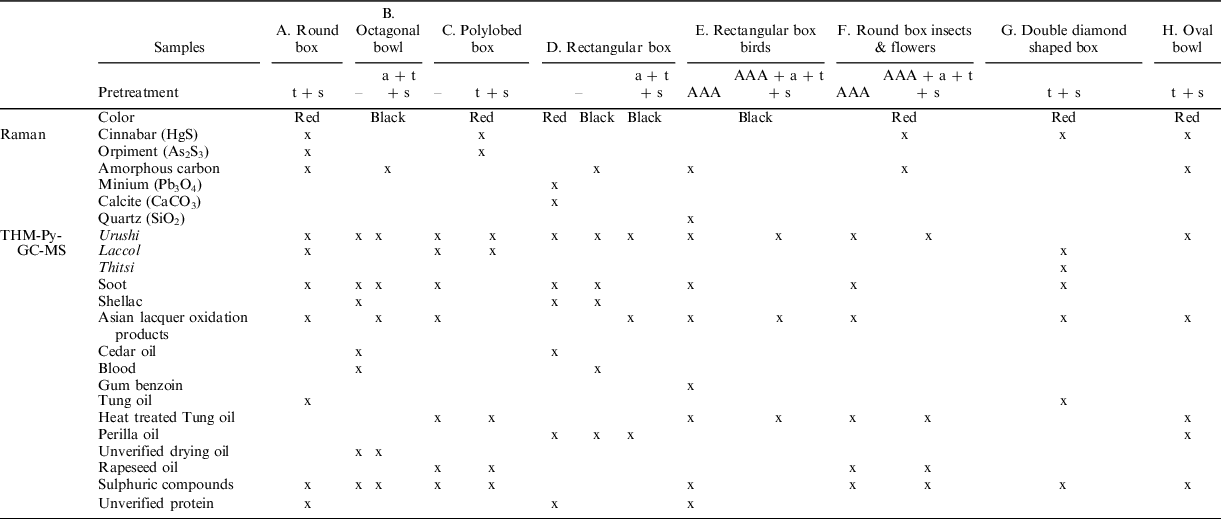
Raman spectra recorded on the lacquers are presented in Figure 2 and the results of the Raman analyses for each sample are given in Table 2. As explained, the goal of the Raman analyses was to determine the types of pigments and undercoating compounds used to support and enhance the aesthetic appeal of the lacquers. As is well known, pigments and undercoating compounds containing carbon can affect the accuracy of the 14C measurements for dating such, mostly biologically sourced objects (except if the carbon included in these compounds would be of the same age).
Characteristic Raman spectra obtained for the lacquer samples; a: mixture of amorphous carbon (1597 and 1325 cm-1) and quartz, b: minium, c: cinnabar; d: orpiment, the band at 254 cm-1 comes from the contribution of the cinnabar signal, and e: calcite.

Chemical compounds present in the lacquer samples determined using Raman micro-spectroscopy and THM-Py-GC-MS depending on the color of the lacquer and the sample pretreatment performed, a = acid; t + s = toluene + solvents; AAA = acid-alkali-acid.

Cinnabar, also called vermilion (HgS), was detected in most of the red lacquer fragments (Figure 2c) with its characteristic vibrational features around 108, 144, 255, 283, 289, 344, and 352 cm-1 (Gotoshia and Gotoshia Reference Gotoshia and Gotoshia2008). Cinnabar was the most common pigment used for red lacquers, and it originates from either the mineral or from an anthropic synthesis (Kopplin Reference Kopplin2002). Another red pigment was detected (Figure 2b), but only in the red lacquer of object D. The latter pigment was identified as minium (Pb3O4) with Raman features around 122, 153, 315, 390 and 549 cm-1 (Bouchard and Smith Reference Bouchard and Smith2003). Minium, a red oxide of lead, exists as a natural mineral but it can also be synthesised. A method of artificially producing minium was well known during the Han dynasty (202 BCE–220 CE) in China (Gettens et al. Reference Gettens, Feller and Chase1972; Jiang Reference Jiang1990). Orpiment (As2S3), which exhibits a yellow color with vibrational bands located around 137, 155, 180, 203, 292, 311, 354 and 384 cm-1 (Bell et al. Reference Bell, Clark and Gibbs1997), was found on a microscopic grain present in the cinnabar red lacquer of object A; and also on a brown layer located underneath the cinnabar red lacquer layer of object C (Figure 2d). Orpiment, or arsenic sulphide, has historically been used to create yellow lacquers (Kopplin Reference Kopplin2002); and the orpiment present in the red cinnabar lacquer layer could have been added to create a different shade of red or could be the result of contamination from the lacquer layers underneath. For the black lacquers, only amorphous carbon was detected (Figure 2a) with vibrational bands around 1597 and 1325 cm-1 (Bell et al. Reference Bell, Clark and Gibbs1997). These black lacquers were located on the underside of the objects (Figure 1a) or inside the boxes. The amorphous carbon signal detected using micro-Raman spectroscopy could be due to the presence of charcoal, used as a pigment, or it could be a remnant of charcoal used as a polishing agent. It might also be a result of the organic nature of the lacquer. If charcoal was used in the manufacturing process, it should generally date from the same period as the lacquer but its presence might be problematic for 14C dating an object, because of old wood effect. Fluorescence prevented to obtain a signal for the microscopic white/grey areas present among the black particles in the black lacquer fragment of object B. Amorphous carbon was detected mixed with quartz in the black lacquer of object E (Figure 2a) showing features around 128, 205, 266 and 465 cm-1 (Wojcieszak Reference Wojcieszak2018). Quartz has most probably been used for the undercoating process. The last compound found during the Raman analysis (Figure 2e) was calcite (CaCO3) with its characteristic bands around 157, 283, 713 and 1086 cm-1 (Bell et al. Reference Bell, Clark and Gibbs1997). It was detected on a white area underneath the red lacquer layer of the object D. Calcite is also most likely part of the foundation layers. The presence of calcite can have an impact on the 14C date obtained for a lacquered object since the carbon in its structure can be older than the carbon of the lacquer sap used to coat an object. In such a case, a pretreatment with acid should be performed to eliminate calcite-based carbon from the lacquer or wood before dating the samples. Hydroxyapatite was detected in a lacquer ash layer of a Chinese carved lacquer (Hao et al. Reference Hao, Schilling, Wang, Khanjian, Heginbotham, Han, Auffret, Wu, Fang and Tong2019), an acid pretreatment would also ensure to remove the carbonates from hydroxyapatite before dating a lacquer sample.
Thermal Hydrolysis and Methylation-Gas Chromatography-Mass Spectrometry
Organic analyses were performed on a number of lacquer samples to ensure the presence of Asian lacquers, and to verify whether other organic additives that could potentially influence the 14C dating outcome were present. The results are summarised in Table 2.
Homologous series of alkylcatechols with various side chain lengths were identified in all of the samples analyzed using m/z 151Footnote 1 extracted ion chromatograms (Figure 3). The maximum side chain length of the alkylcatechols was in most cases C15 (pentadecylcatechol), identified as 1,2-dimethoxy-3-pentadecylbenzene and indicative of urushi polymers.
Extracted ion chromatograms obtained from THM-Py-GCMS analysis for completely derivatised compounds. Compounds acronyms are named as follows: (Ct-C5:0) 1,2-dimethoxy-3-pentylbenzene, (Ct-C6:0) 1,2-dimethoxy-3-hexylbenzene, (Ct-C7:1) 1,2-dimethoxy-3-pentenylbenzene, (Ct-C7:0) 1,2-dimethoxy-3-pentylbenzene, (Ct-C8:0) 1,2-dimethoxy-3-octylbenzene, (Ct-C9:0) 1,2-dimethoxy-3-nonylbenzene, (Ct-15:1) 1,2-dimethoxy-3-pentadecenylbenzene, (Ct-15:0) 1,2-dimethoxy-3-pentadecylbenzene, (Ct-17:1) 1,2-dimethoxy-3-heptadecenylbenzene, (Ct-17:0) 1,2-dimethoxy-3-heptadecylbenzene, (AcidCt-C6) methyl-6-(1,2-dimethoxyphenyl)-hexanoate, (AcidCt-C7) methyl-7-(1,2-dimethoxyphenyl)-heptanoate, (AcidCt-C8) methyl-8-(1,2-dimethoxyphenyl)-octanoate, (AcidCt-C9) methyl-9-(1,2-dimethoxyphenyl)-nonanoate, (AcidCt-C10) methyl-10-(1,2-dimethoxyphenyl)-decanoate, (AcidCt-C11) methyl-11-(1,2-dimethoxyphenyl)-undecanoate, (Ct-dimer) 1-(7-(1,2-dimethoxyphenyl)-4-methoxyoctyl-3,4-dimethoxybenzene.

The red colored Asian lacquer composition of objects A and C contained laccol in addition to urushi. This was supported by identifying a 1,2-dimethoxy-3-heptadecylbenzenene, the derivatised form of heptadecylcatechol, which is a characteristic compound in laccol polymers and not found in urushi polymers. The laccol polymer can also contain small amounts of pentadecylcatechol, similarly to urushi. The analyses on urushi and laccol mixtures showed differences in the identification of aged alkenylcatechol compounds, referred to as acid catechols, allowing to identify the urushi/laccol mixture. Methyl-8-(1,2-dimethoxyphenyl)-octanoate was also identified, it is a typical compound found in aged urushi polymers (Schilling et al. Reference Schilling, Heginbotham, van Keulen and Szelewski2016). The identification of methyl-10-(2,3-dimethoxyphenyl)-decanoate points to the presence of aged laccol in the lacquer mixture taken from objects A and C.
Laccol was identified with a minor quantity of thitsi lacquer added to the red lacquer formulation of object G. The thitsi polymer contains alkylphenylcatechols and alkylphenylphenols with 10 or 12 carbons in the side chain (Du et al. Reference Du, Oshima, Yamauchi, Kumanotani and Miyakoshiji1986; Lu et al. Reference Lu, Kanamori and Miyakoshi2011). Pyrolysis of these compounds resulted in alkyl benzene pyrolysates after preferential pyrolytic cleavage of the side chains of the alkenylphenyl catechols and/or alkylphenylphenols (Niimura et al. Reference Niimura, Miyakoshi, Onodera and Higuchi1996). These compounds were found in the red lacquer of the object G. An alkylphenylketone degradation compound (1-phenyldodecan-1-one) was also identified in combination with a methyl-9-oxo-9-phenylnonanoate. Both of these compounds are degradation compounds of aged thitsi polymers (Schilling et al. Reference Schilling, Heginbotham, van Keulen and Szelewski2016; Tamburini et al. Reference Tamburini, Pescitelli, Colombini and Bonaduce2017).
The lacquer compositions of all the objects showed the presence of drying oils. The addition of drying oils to a lacquer mixture reduces its viscosity and improves the working properties of the liquid lacquer. The polymerised lacquer layers also become more elastic which makes lacquer easier to carve (Heginbotham and Schilling Reference Heginbotham and Schilling2011; Hao et al. Reference Hao, Schilling, Wang, Khanjian, Heginbotham, Han, Auffret, Wu, Fang and Tong2019). The lacquer gloss also tends to increase when oil is added, reducing production time for an object as this shortens the time needed for polishing (Tamburini et al. Reference Tamburini, Sardi and Spepi2016; Webb Reference Webb2000). The identification of drying oils was based on the detection of glycerol in combination with fatty acids and dicarboxylic acids. The ratio of palmitic acid (C16) to stearic acid (C18) was used to indicate the drying oil type (P/S ratio). The identification of drying oils using P/S ratios is not straightforward as it depends on various factors, such as natural variability of the oils. Multi material matrices can also influence the resulting P/S ratios (Heginbotham and Schilling Reference Heginbotham and Schilling2011). An unverified oil was found in the black lacquer of object B, with a P/S ratio of 2.50. Perilla oil (Perilla frutescens) was found with a P/S ratio of 3.60 in analyses of both the black and red lacquers of object D. The composition of object H included the addition of a mixture of perilla oil and heat treated tung oil (Vernicia fordii) with a P/S ratio of 4.10, in combination with the presence of alkylphenylalkanoates. Alkylphenylalkanoates are formed in tung oils from unsaturated linolenic acids or oleostearic acids resulting from heat treatment of the liquid oils (Schilling et al. Reference Schilling, Heginbotham, van Keulen and Szelewski2016). Heat treated tung oil was identified in the red lacquer of object C with a P/S ratio of 1.20, in the black lacquer of object E with a P/S ratio of 1.25 and in the red lacquer of object F with a P/S ratio of 0.90. The red lacquer of object G with P/S ratio of 1.50, and the red lacquer of object A with a P/S ratio of 1.35 also contained tung oil, but the oil did not undergo a heat treatment. The analyses of objects C and F showed the presence of rapeseed oil (Brassica spp.). In addition to common fatty acids found in oils such as palmitic (C16) and stearic acids (C18), the analyses also showed fatty acids with longer carbon chains (C22-C24). Dicarboxylic acids (C11-C13) were also detected, they are formed in rapeseed oil from unsaturated C22-C24 fatty acids after oxidation (van Keulen Reference van Keulen2014). Although rapeseed oil will not dry when pure, it is found occasionally as an additive in Chinese lacquer formulations (Heginbotham et al. Reference Heginbotham, Chang, Khanjian and Schilling2016).
Objects B and D contained cedar oil (Juniperus spp.) and shellac, a resinous exudate of Coccus insects (Heginbotham and Schilling Reference Heginbotham and Schilling2011). Cedar oil is a common additive found in Chinese export lacquer formulations, and it is used for a similar purpose as the use of drying oils described above (Heginbotham et al. Reference Heginbotham, Chang, Khanjian and Schilling2016). The identification of shellac is often associated with non-original western varnishes used as restoration layers on Asian lacquered objects. Heginbotham et.al suggest that the addition of shellac may be part of the original lacquer formulation having done a number of THM-Py-GC-MS analyses of individual lacquer layers from museum objects (Heginbotham and Schilling Reference Heginbotham and Schilling2011). As analyses were performed here on bulk samples, and not on samples taken from individual separated lacquer layers, the presence of shellac could not be attributed to any specific layer.
Analyses on the black lacquers of objects B and D showed protein compounds correlated to blood. Pig blood is a common component used in the foundation layers of Chinese lacquered objects and its use can be traced back to the Yuan dynasty (1271–1368) (Heginbotham et al. Reference Heginbotham, Chang, Khanjian and Schilling2016; Miklin-Kniefacz et al. Reference Miklin-Kniefacz, Pitthard and Parson2016). Blood was likely used as an isolation layer between the wooden base and the foundation layers or it could have been used as a binder material for the foundation layers. The red lacquer of object D showed unidentified protein compounds. The analyses on objects A and e also gave indications of proteins being used in the production of these objects.
14C Dating
Between 0.59 and 5.35 mg of lacquer samples were used for graphitisation before 14C dating (Table 1). The carbon content of the lacquer samples varied between 19.1 and 42.5% for the black lacquers and between 33.7 and 50.3% for the red. This high carbon content allows to sample only a few milligrams for dating. When sampling for 14C dating, the black lacquer samples were found to be composed of very thin lacquer layers and a part of the foundation layer was often attached to these samples. The foundation layers contained silicates which explains the lower amount of carbon found in the black samples. Most of the 14C dating results obtained on the lacquers (samples a, d, e, f, and g) correspond to the expected historical dates for their manufacture based on stylistic features (Table 1). Figure 4 shows a summary of all the calibrated dates obtained. In the case of object B, the black lacquer located underneath the bowl exhibited a younger date after pretreatment compared to the date obtained for the wood without pretreatment (the quantity of sample was too little and the object was not buried so the decision was made to date it as is over risking losing it), and to the historically estimated date. The THM-Py-GC-MS analyses showed that the pretreatments eliminated shellac, blood, and cedar oil but this does not explain why a younger date than expected was obtained. A first hypothesis can be considered: the white/grey particles that could not be identified using micro-Raman spectroscopy consisted of calcite and were, mostly, removed using the AAA pretreatment. The 14C dating of the wood, which was not pretreated and possibly mixed with lacquer was then compromised by the presence of calcite. The second hypothesis is that the black lacquer which contains shellac, was added as a later addition. For object C, the stylistic date was older than the 14C dating results obtained. All the components (including wood, textile, red and black lacquers), had a similar 14C content, a result in favour of reliable and consistent 14C dating. The average 14C age calculated using Oxcal was: 260 ± 12 BP, χ2-test: df=4 T=5.8 (5% 9.5). This suggests that an older style of lacquering was reproduced later on. The first date obtained on the black lacquer of object E, pretreated only with HCl and NaOH at a low concentration (0.3 M), was too young compared to its estimated date. After using our pretreatment protocol consisting of an acid washing (at 2.4 M) followed by immersion in toluene and other solvents, the date was within the range of the expected date, highlighting the need to take pretreatments into account. THM-Py-GC-MS analyses indicated the removal of soot, sulfuric compounds, an unidentified protein and gum benzoin after sample pretreatment. A later restoration product containing gum benzoin might have been applied to the object. The wood sample taken from object F was too old compared to the stylistic date, however, the dating of the lacquer corresponds well to the expected historical date. In this case the lacquer may have been applied on an upcycled piece of wood. Dating the different components of the lacquered objects can give clues about the history of the object, its components and any possible restoration processes that have been used on it. Lastly, for object H, neither the wood nor the lacquer dates corresponded to the historical dates ascribed to them. Both dates are within the same time frame (χ²-test: df=1 T=2.3 (5% 3.8) leading towards the hypothesis that an ancient style of lacquering was used in a more recent period.
Summary of the calibrated ages obtained for all the samples.

CONCLUSIONS
The THM-Py-GC-MS and micro-Raman spectroscopy techniques used in this study allowed to confirm that all of the objects were manufactured using Asian lacquers. The decorations of the wooden objects were made primarily of urushi or laccol polymers. Mixtures of urushi and laccol and mixtures of laccol and thitsi were also found for two objects. All samples contained drying oils, non-drying triglyceride-based rapeseed oil and/or essential oil (cedar oil), mixed with the lacquers. These chemical additions were occasionally complemented with other compounds, such as shellac. Proteinaceous materials (e.g., blood and an unidentified protein) were found in samples from most objects. These protein-based substances were likely used as binding materials in the mostly inorganic foundation layers of these objects. The lacquers were found to be colored with various types of compounds including cinnabar, orpiment, amorphous carbon, minium, calcite, and quartz.
Comparing the 14C dates obtained for the different materials (wood, textile, red and black lacquers) with the historical dates based on stylistic features, it can be concluded that reliable dates could only be obtained from the lacquer samples after pretreatments. In the case of wooden objects containing both a thick layer of red lacquer and a thin layer of black lacquer (present only on the underside or inside of the objects), it is recommended to sample the thick red lacquer rather than the thin black lacquer to reduce the sampling area and to avoid contamination with any carbon from inorganic compounds present in the foundation layers. It is also recommended that all samples undergo a pretreatment procedure involving an acid wash to eliminate any inorganic carbon followed by successive toluene, hexane, acetone, and ethanol immersions of the samples in an ultrasonic bath to remove any “modern” restoration materials or cleaning products that might have been used. In the case of wooden lacquered samples, to sample the wood of an object entirely covered by lacquer, it is first necessary to remove the lacquer. Dating the lacquer directly allows to decrease the sample sizes if no wood is visible on the object since only the lacquer is sampled. Other types of objects, metal, ceramic, etc., covered by lacquer can also be dated using this methodology.
However, restored objects can form a limitation for dating lacquers. Sometimes the whole lacquer surface has been removed and replaced by a new lacquer layer. In these cases, the wood from the structural form should also be dated. Other “restoration” practices consist of removing all the upper layers of the lacquer and to add new ones. Depending on the quantity of the old layers removed and new ones added, this might have some influence on the 14C dating result. Nevertheless, dating the different components allows gaining knowledge about the various restoration processes an object has possibly been subjected to.
ACKNOWLEDGMENTS
The authors would like to thank Michel Duchange for providing the samples. This work was partially made possible by the Belgian Science Policy Office (BELSPO) through grant number: BR//175/A3/PHySICAL (BRAIN-be project) and the Research Foundation Flanders, the Excellence Of Science (EOS) program, grant number: 30897864.