Introduction
Although postpartum depression (PPD) requires the presence of either depressed mood or anhedonia, far less attention has been spent on anhedonia v. depressed mood in the experience of depression (Sibitz et al. Reference Sibitz, Berger, Freidl, Topitz, Krautgartner, Spiegel and Katschnig2010). However, the distinction between depressed mood and anhedonia may be particularly important in clarifying the different PPD rates and our understanding of the different experiences faced by racial/ethnic minorities. Numerous studies that have examined PPD prevalence rates across racial and ethnic minority populations have shown African American and Hispanic women to have either higher (Howell et al. Reference Howell, Mora, Horowitz and Leventhal2005), lower (Wei et al. Reference Wei, Greaver, Marson, Herndon and Rogers2008), or similar (Yonkers et al. Reference Yonkers, Ramin, Rush, Navarrete, Carmody, March, Heartwell and Leveno2001) rates of PPD compared with Whites (Liu & Tronick, in press). These observed higher rates of PPD in African Americans and Hispanics compared with Whites may be due to socioeconomic status (SES) (Hobfoll et al. Reference Hobfoll, Ritter, Lavin, Hulsizer and Cameron1995; Beeghly et al. Reference Beeghly, Olson, Weinberg, Pierre, Downey and Tronick2003; Rich-Edwards et al. Reference Rich-Edwards, Kleinman, Abrams, Harlow, McLaughlin, Joffe and Gillman2006; Liu & Tronick, in press), given that SES and race/ethnicity are often correlated (e.g., African Americans and Hispanics are overrepresented among lower SES groups), although others have shown that SES does not account for these PPD prevalence rate differences (Howell et al. Reference Howell, Mora, Horowitz and Leventhal2005).
Cultural differences with respect to affect may also contribute to these differences in prevalence rates. Drawing from the psychological literature, depressed mood is thought to reflect high negative affect whereas anhedonia is often construed as low positive affect (Kanazawa et al. Reference Kanazawa, White and Hampson2007) and studies comparing affective norms across cultures have documented cultural differences in affective levels. For example, Asians show lower levels of positive affect (Iwata et al. Reference Iwata, Roberts and Kawakami1995; Yen et al. Reference Yen, Robins and Lin2000; Eid & Diener, Reference Eid and Diener2001; Iwata & Buka, Reference Iwata and Buka2002; Mesquita & Karasawa, Reference Mesquita and Karasawa2002; Tsai et al. Reference Tsai, Chentsova-Dutton, Freire-Bebeau and Przymus2002; Kanazawa et al. Reference Kanazawa, White and Hampson2007) and Mexican Americans show higher levels of positive affect compared with Whites (Ruby et al. Reference Ruby, Falk, Heine, Villa and Silberstein2012). Thus, it is possible that the varying prevalence rates across race/ethnicity may be due to differences in the cultural expressions of depression. Making the distinction between depressed mood and anhedonia when examining race/ethnic differences in prevalence rates of PPD may help us to better assess depression across race/ethnic groups. For instance, compared with an overt symptom such as depressed mood, anhedonia may be easily overlooked by clinicians (Sibitz et al. Reference Sibitz, Berger, Freidl, Topitz, Krautgartner, Spiegel and Katschnig2010), and may be particularly problematic for minority individuals where the reported anhedonia presents as a clinical issue.
Of additional interest is the potential difference in the association between risk factors with depressed mood and anhedonia depending on the racial/ethnic group. For instance, life stress during pregnancy and experiences specific to the pregnancy (e.g., unintended pregnancy) have been shown to be a risk factor for PPD symptoms in general (O'Hara & Swain, Reference O'Hara and Swain1996; Da Costa et al. Reference Da Costa, Larouche, Dritsa and Brender2000; Robertson et al. Reference Robertson, Grace, Wallington and Stewart2004), but it is unclear whether it is associated more strongly with depressed mood than with anhedonia, and whether it poses a similar risk across racial/ethnic groups. Determining the stressors would allow better identification of risk depending on the racial/ethnic group and the particular symptoms experienced.
We distinguish depressed mood from anhedonia by considering the possibility that these two items differ by their association of potential risk factors. To increase sensitivity to the possibility that the prevalence and risk factors for anhedonia might differ from depressed mood and across racial/ethnic groups, we examined depressed mood and anhedonia as separate outcomes. We sought to obtain the estimates of depressed mood and anhedonia and to explore risk factors of each symptom by race/ethnicity through the use of race-stratified analyses. We focused on mothers who recently gave birth, given the general vulnerability for depression during the postpartum period (O'Hara, Reference O'Hara2009), and recent increased attention on early detection of depression risk among this population (Joseph, Reference Joseph2009; Postpartum Depression Screening, 2006; Massachusetts, 2010).
Methods
Sample
This study used the 2007–2008 Massachusetts PRAMS (Pregnancy Risk Assessment Monitoring System), a population-based survey administered to postpartum women from Massachusetts. The PRAMS is a collaborative surveillance project of the Centers for Disease Control (CDC) and Prevention and state health departments that monitor maternal behaviours and experiences of women before, during and after live birth pregnancies. The Massachusetts Department of Public Health (MDPH) provided this dataset. Institutional Review Board (IRB) approvals from the relevant institutions were obtained to conduct both the data collection and analysis of this study.
The participants were part of an ongoing population-based random sampling of Massachusetts live births with birth certificates. Women who were 2–6 months postpartum were selected to receive up to three mailed paper surveys. Women who had not responded to the survey after the third mailing were contacted by telephone. A response rate of 71% was obtained for 2007 and 2008. The CDC recommends a response rate of at least 65% for public sharing of the data. The data were weighted using selected maternal demographics to account for non-response and adjusted for sampling probabilities and coverage to represent the Massachusetts birth population in 2007–2008.
Measures
Birth certificate
Nativity (i.e., US or non-US-born mothers), maternal age, education and race/ethnicity were obtained. Women were classified as Hispanic or non-Hispanic based on self-report. Non-Hispanic women were categorized in one of the following groups: White, African American, Asian/Pacific Islander (API) and American Indian/Alaskan Native. Mean infant age at the time of survey completion was 9.3 weeks; there were no significant differences in infant age across groups.
PRAMS survey
To obtain Household Income, women were asked to indicate ‘total household income before taxes in the 12 months before the new baby was born.’ Stressful events during pregnancy were obtained by ‘yes’ or ‘no’ responses to events that may have occurred during the last 12 months before the new baby was born (e.g., ‘I moved to a new address,’ ‘I had a lot of bills to pay,’ ‘I got separated or divorced from my husband or partner.’). Women indicated ‘yes’ or ‘no’ on following: Neonatal Intensive Care Unit (NICU) (‘After your baby was born, was he or she put in an intensive care unit?’), gestational diabetes (‘high blood sugar (diabetes) that started during this pregnancy’), pregnancy intention (‘When you got pregnant with your new baby, were you trying to get pregnant?’). Mothers were also asked to respond ‘always,’ ‘often,’ ‘sometimes,’ ‘rarely’ or ‘never,’ to a question on depressed mood (‘Since your new baby was born, how often have you felt down, depressed or hopeless?’) and loss of interest (‘Since your new baby was born, how often have you had little interest or little pleasure in doing things?’).
Statistical analyses
Responses with missing variables of interest for this study were eliminated. Variables with less than a 100% response rate included household income (90.0%), maternal education (99.7%), NICU (96.1%), gestational diabetes (66.3%), stress (98.2%), pregnancy intention (98.1%), depressed mood (65.9%) and loss of interest (65.6%) resulting in an unweighted study sample of 2423.
Covariates included maternal age, household income, maternal education and infant age at the time the mother completed the questionnaire. Variables considered as potential stressors included: nativity, gestational diabetes, infant gender, stressful events (summed), NICU and intention for pregnancy. Those who indicated either always or often were recoded as having ‘high depressed mood’ or ‘high loss of interest’, whereas those who responded with sometimes, rarely, or never were recoded as those with ‘low depressed mood’ or ‘low loss of interest.’
To account for the stratified and weighted sample, the data were analysed using the Complex Samples module of SPSS version 17.0 (SPSS Inc., Chicago, IL). Prevalence estimates within each group were generated according to predictors. A non-race stratified model was conducted to determine the likelihood of the two dependent variables endorsing high depressed mood and high loss of interest for each race/ethnic group, with Whites as the reference group. Two logistic regression models, one unadjusted and another adjusted for SES (maternal age, maternal education and household income), were employed for each of the dependent variables to the model to compare the likelihood of depressed mood and loss of interest in ethnic minorities compared with Whites. To compare the associations between predictors and the dependent variable across racial/ethnic groups, race-stratified logistic regressions incorporated all predictors, with SES variables as covariates to produce adjusted odds ratios for each predictor by race/ethnic group. This logistic regression was conducted for both dependent variables.
Results
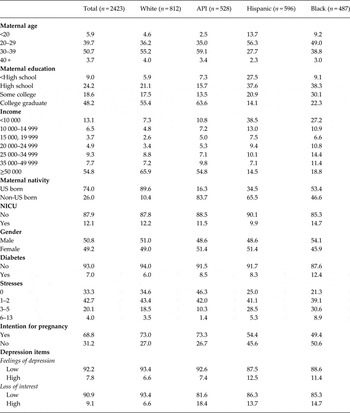
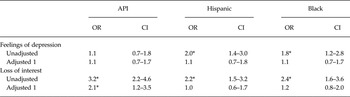
With regard to high depressed mood, Hispanics had the highest rates, followed by African Americans, APIs and Whites (Table 1). The unadjusted model showed Hispanics and African Americans to be nearly twice as likely to endorse depressed mood compared with Whites (Table 2). SES was controlled given that Whites and APIs were more likely to be older mothers, more educated and to have higher household incomes (Table 1). The full model adjusting for SES showed Hispanics, African Americans and APIs to be no more likely to endorse depressed mood compared with Whites (Table 2).
Weighted percentage of mothers who completed the MA PRAMS from 2007–2008, by characteristic according to race/ethnicity

Likelihood of ‘feelings of depression’ and ‘loss of interest’ endorsed as ‘often’ and ‘always’ among mothers who completed the MA PRAMS from 2007–2008, by race/ethnicity, Whites as reference

*p < 0.05.
Compared with other groups, APIs showed the highest rate for high loss of interest, followed by African Americans and Hispanics (Table 1). Whites had the lowest rate of loss of interest (Table 1). In the unadjusted model, APIs, Hispanics and African Americans were 2–3 times more likely than Whites to endorse high loss of interest (Table 2). In the model that adjusted for SES, the increased likelihood for endorsing loss of interest disappeared for Hispanics and African Americans. However, APIs were twice as more likely to endorse high loss of interest compared with White women, even after controlling for SES.
Other racial/ethnic differences among assessed variables are presented in Table 1.
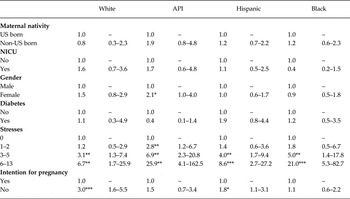
With regard to depressed mood, it was revealed that the number of stressors was associated with increased endorsement of depressed mood for all four racial/ethnic groups. Unintended pregnancy was associated with endorsements of depressed mood for only Whites and Hispanics. In addition, having a female infant was associated with increased endorsement of depressed mood only for APIs (Table 3).
Race/ethnicity stratified logistic regression showing adjusted odds of high depressed mood per predictor by race/ethnic group

*p < 0.05, **p < 0.01, ***p < 0.001.
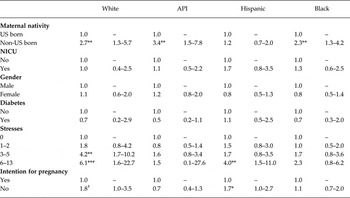
Race stratified models adjusted for SES showed different associations between proposed risk factors and loss of interest depending on the racial/ethnic group. Specifically, the number of stressors was associated with endorsement of high loss of interest for Whites and Hispanics only. Unintended pregnancy was also associated with slightly greater loss of interest for Whites and Hispanics only. Being non-US born appeared to be associated with greater endorsement of loss of interest for Whites, APIs and African Americans, but not for Hispanics (Table 4).
Race/ethnicity stratified logistic regression showing adjusted odds of high loss of interest per predictor by race/ethnic group

† p < 0.1, *p < 0.05, **p < 0.01, ***p < 0.001.
Discussion
The purpose of this study was to identify the prevalence and to explore the risk factors of two core depression symptoms, depressed mood and anhedonia, across race/ethnic groups using a population dataset on postpartum women. Determining these relations could be crucial for identifying differences in the depression experiences across racial and ethnic groups, and may point to potential areas of health disparities within PPD assessment.
We found that Hispanics and African Americans, but not APIs, were more likely to report higher levels of depressed mood compared with Whites; however, this difference was largely accounted by SES. This is similar to other comparable studies, which show that initial differences in PPD rates for African American and Hispanics do not maintain significance once SES is taken into account (Hobfoll et al. Reference Hobfoll, Ritter, Lavin, Hulsizer and Cameron1995; Beeghly et al. Reference Beeghly, Olson, Weinberg, Pierre, Downey and Tronick2003; Rich-Edwards et al. Reference Rich-Edwards, Kleinman, Abrams, Harlow, McLaughlin, Joffe and Gillman2006), although most of these studies combine reports of depressed mood and anhedonia. As argued by others, women from a lower SES may be more likely to experience PPD symptoms because they may have fewer financial resources and lower social support (Abrams et al. Reference Abrams, Dornig and Curran2009). If this is a mechanism that explains higher rates of PPD, financial concerns should be targeted in improving depressed mood among African Americans and Hispanics.
The study findings also point to the need to clarify the varying association between SES and PPD based on race/ethnicity. Our analyses also revealed a greater likelihood for Hispanics, African Americans and APIs to report anhedonia compared with Whites but that this greater likelihood for anhedonia remained only for APIs after controlling for SES, a pattern of results consistent with a previous study that looked at racial/ethnic differences in PPD prevalence (Liu & Tronick, in press). The associations between SES and anhedonia, in particular, vary by group highlight the possibility for cultural differences in psychosocial contexts underlying depression. Other studies that have examined cultural differences on positive affect may provide some explanation for the greater report of higher anhedonia among APIs. Specifically, Asian and Asian Americans have reported lower levels of pleasure and interest but comparable negative affect scores relative to European Americans (Iwata et al. Reference Iwata, Roberts and Kawakami1995, Reference Iwata, Turner and Lloyd2002; Yen et al. Reference Yen, Robins and Lin2000; Kanazawa et al. Reference Kanazawa, White and Hampson2007); these lower levels may or may not reflect a cultural tendency to mask or suppress expressions of high arousal positive emotions (Hsu et al. Reference Hsu, Tseng, Ashton, McDermott and Char1985; Gross & John, Reference Gross and John1998; Gross et al. Reference Gross, Richards, John, Snyder, Simpson and Hughes2006; Matsumoto & Fontaine, Reference Matsumoto and Fontaine2008) compared with European Americans (Markus & Kitayama, Reference Markus and Kitayama1991). Given the added emphasis on child rearing during the postpartum, loss of interest or pleasure may not only be normative but also a culturally desirable response for some Asians. Although APIs were more likely to endorse anhedonia in our dataset, it should be noted that our data were limited in that we were unable to distinguish whether the anhedonia confers psychological distress to the individual or whether it is normative for Asians to report anhedonia compared with other racial/ethnic groups. However, our results highlight the necessity for clinicians to carefully inquire about anhedonia and any distress with Asian American patients given the possibility of the various interpretations of reported anhedonia.
Rather than looking at risk factors for depression symptomatology across groups, this study adds to the literature by exploring risk factors separately for each race/ethnic group. Through this strategy, we confirmed that the number of stressors is highly associated with endorsements of depressed mood for all racial/ethnic groups. Indeed, several studies during the perinatal period show increased depression after stressful life experiences during pregnancy (O'Hara & Swain, Reference O'Hara and Swain1996; Da Costa et al. Reference Da Costa, Larouche, Dritsa and Brender2000; Robertson et al. Reference Robertson, Grace, Wallington and Stewart2004) and our findings indicate that this may be true for different racial/ethnic groups, at least with respect to depressed mood. In contrast, stressors were not similarly associated with anhedonia for all groups as they were with endorsements of depressed mood. Rather, the numbers of stressors were associated with anhedonia only for Whites and Hispanics. The relation between stress and anhedonia may differ across cultures. For instance, life stress has been associated with positive affect ratings in European Americans but not Japanese Americans (Kanazawa et al. Reference Kanazawa, White and Hampson2007), underscoring the possibility that lower positive affect may have different meanings across groups. If stress is predicted to confer depression across cultures, then assessing anhedonia as a symptom may not be particularly useful for African Americans or Asian Americans, according to these findings.
We also uncovered other risk factors unique to each group with respect to depressed mood. First, APIs with female infants were more likely to report high depressed mood. The preference for a male child exists in many cultures in South Asia, the Middle East and East Asia (Booth et al. Reference Booth, Verma and Beri1994; Nielsen et al. Reference Nielsen, Liljestrand, Hedegaard, Thilsted and Joseph1997; Chandran et al. Reference Chandran, Tharyan, Muliyil and Abraham2002; Patel et al. Reference Patel, Rodrigues and Desouza2002; Ekukluet al. 2004; Löfstedt et al. Reference Löfstedt, Shusheng and Johansson2004) and the gender outcome may play a role in postpartum mood. For instance, Chinese women who had a female infant were more likely to experience PPD (Xie et al. Reference Xie, He, Liu, Bradwejn, Walker and Wen2007, Reference Xie, He, Koszycki, Walker and Wen2009). In another study on Indian women, having a female infant increased the effects of other risk factors on PPD (Patel et al. Reference Patel, Rodrigues and Desouza2002). Our findings suggest that this may also be true for Asian women in the US and is consistent with findings from a recent study on diverse postpartum women from New York City (Liu & Tronick, in press).
Unintended pregnancy was a risk for depressed mood and anhedonia but only for Hispanics and Whites. In general, intended pregnancy has been shown to be associated with depression (Christensen et al. Reference Christensen, Stuart, Perry and Le2011). A previous study utilizing the PRAMS survey showed that women with unwanted births were nearly twice as likely to report feeling depressed during the postpartum period as women with intended births (Cheng et al. Reference Cheng, Schwarz, Douglas and Horon2009). However, identifying the reasons why unintended pregnancy was associated with depressed mood and anhedonia only for Whites and Hispanics in our study remains difficult without research that sheds light on the meaning of unintended pregnancy among race/ethnic groups. Very generally, our findings raise the possibility of group differences in the perception or attitudes (e.g., unintended pregnancy may be more normative and thus less stigmatizing) or consequences (e.g., some groups may experience greater burdens from the additional responsibility) of unintended pregnancy. For example, a previous qualitative study suggested that unintended pregnancy for Hispanic women hinder goals that they may have after immigration (e.g., working to send money home) (Howell et al. Reference Howell, Mora and Leventhal2006; Christensen et al. Reference Christensen, Stuart, Perry and Le2011). Our study findings point to the need for understanding the various interpretations of unintended pregnancy as a risk for PPD. Furthermore, rather than presuming unintended pregnancy as a risk across groups, clinicians may want to inquire about the circumstances and the attitudes regarding the unintended pregnancy to determine the level of risk it confers to PPD.
Finally, being non-US-born was the only characteristic associated with anhedonia for Whites, APIs and African Americans, even after controlling for SES. One interpretation is that non-US-born ethnic minorities tend to endure more stressful life experiences, which confer risk for depression symptomatology during the postpartum. For instance, the costs of immigration include the loss of immediate family members who traditionally play a role in postpartum support, which in turn may mitigate PPD symptomatology. It is also possible that anhedonia is much more of a normative experience for non-US-born individuals across racial/ethnic groups. Maintaining positive affect is often acknowledged to be an American value (Tsai et al. Reference Tsai, Knutson and Fung2006). Thus, non-US-born individuals may not necessarily uphold interest or pleasure to the extent shown among US-born individuals, nor might this be a reflection of distress. It is also particularly striking that nativity was not associated with anhedonia for Hispanics as was the case for the other racial/ethnic groups. Studies have consistently demonstrated greater positive mental health outcomes among non-US-born Hispanic women compared with US-born Hispanic women (Alegría et al. Reference Alegría, Canino, Shrout, Woo, Duan, Vila, Torres, Chen and Meng2008), raising the possibility that foreign nativity protects against psychiatric disorders, despite presumed stresses associated with immigration. Those non-US-born Hispanic women did not show a higher risk of anhedonia compared with US-born Hispanic women compared with other race/ethnic groups is consistent with this ‘immigrant paradox.’
It is important to mention the major limitations that accompany this study. First, broad categories were used in determining race/ethnic groups. Each of the groups is comprised heterogeneous sub-ethnic groups that may hold unique cultural norms and that may present risks with an effect on depression symptoms. Second, in using the PRAMS survey, we relied on a retrospective self-reported stress and risks from pregnancy, which may misrepresent some of the events that the women may have experienced. Third, our outcome variables were limited to one survey question for each of the two depression symptoms assessed through the PRAMS. Although this should also be considered study strength given that these core symptoms represent the core depression criteria in the Diagnostic and Statistical Manual (DSM), we do not have data on additional symptoms that could provide more information about the experience within the population. Fourth, in using the survey, we were not able to determine whether the depressed mood or anhedonia was equally distressing and problematic across racial/ethnic groups and across individuals. For example, although APIs were more likely to endorse anhedonia in our study, we cannot infer that Asian Americans show greater clinical impairment, nor can we conclude that anhedonia during the postpartum period is normative in Asian Americans compared with the other groups in this study. Our inclusion of anhedonia in a study on a diverse population dataset offers a first step in understanding symptomatology across groups. The actual meanings of these symptoms, whether distressing and problematic should be further determined in future research and within the clinical setting. Last, our examination of the risk factors for these depressive symptoms across race/ethnic groups is exploratory and demonstrates the variation in the association of risks according to symptom and racial/ethnic groups. Further work is required to disentangle the potential mechanisms that may underlie the risk factors for each group and their effect on depression symptoms.
Conclusions
A major strength in this study was the diverse sample and the availability of items that assessed depressed mood and anhedonia separately. Through this dataset, we believe that our study may be the first to highlight the racial/ethnic differences in the prevalence of depressed mood and anhedonia and to bring forth the possibility that common risk factors for these symptoms differ by racial/ethnic group. In particular, we found that anhedonia was more likely to be endorsed by APIs than African Americans, Hispanics and Whites, even after accounting for SES. Unlike the endorsements for depressed mood, endorsements of anhedonia was associated with non-US-born women but not with reported prenatal stress. Our findings underscore the need for clinicians to specifically inquire about anhedonia and to determine whether it is distressing and problematic to the patient. These findings further suggest that screeners using DSM-IV core criteria for depression, therefore relying on either an endorsement of depressed mood or anhedonia for diagnosis, may be limited in its utility especially with respect to racial/ethnic minorities, as it may produce a disproportionate rate of false positives or false negatives depending on race/ethnicity.
Acknowledgements
The authors would like to acknowledge the Massachusetts Department of Public Health PRAMS Team and the CDC PRAMS Team, Program Services and Development Branch, Division of Reproductive Health.
Financial Support
Support during the preparation of this manuscript was provided through a Health Disparities Postgraduate Fellowship from the Harvard Medical School Office of Diversity and Community Partnership.
Conflict of Interest
None.
Ethical Standards
The authors assert that all procedures contributing to this work comply with the standard of the relevant national and institutional committees on human experimentation and with the Helsinki Declaration of 1975, as revised in 2008.