





Introduction
While Evelyn Underhill (1875–1941)Footnote 1 is known for her contributions to Christian mysticism and Anglican spirituality,Footnote 2 modern scholarship has tended to approach her work through worship, spiritual formation, and, more recently, political theology, giving less attention to her engagement with Scripture.Footnote 3 Although Underhill’s extensive use of Scripture is acknowledged, it is rarely analysed as a significant part of her theological writing. This article focuses on the role Scripture plays within Underhill’s mature spiritual theology, attending to how biblical texts function within her accounts of prayer and transformation. Her writings in Abba: Meditations Based on the Lord’s Prayer (1934) and The Fruits of the Spirit (1936), a theological exploration of Gal. 5:22–23, provide a focused body of work for examining how Scripture shapes her practices of prayerFootnote 4 and theological reasoning.
I also ask whether early twentieth-century spiritual theology represents a retreat from doctrinal reasoning or instead a setting in which Scripture continues to shape theological understanding, even without an explicitly articulated hermeneutical theory. The analysis also helps specify Underhill’s place within her own time by describing the central role and operation of Scripture within her thought.Footnote 5
While Underhill does not articulate a formal doctrine of Scripture, her practice may be described as a form of scripturally governed theological reasoning. Biblical texts shape both what she says about God and how she understands the creature’s response to God.Footnote 6 Methodologically, this study proceeds by close attention to Underhill’s direct use of Scripture in her writing; attending to the governing theological work those texts perform rather than reconstructing a formal hermeneutical programme or evaluating her exegesis by historical-critical criteria. The central question is how scriptural language shapes judgement and agency within prayer.
Abba (1934) and The Fruits of the Spirit (1936) provide a manageable corpus for identifying features of Underhill’s scriptural use. I discuss three aspects. First, Scripture operates through a form of dense interrelation across Testaments and genres. By ‘dense interrelation’, I mean the gathering of biblical texts so that one illuminates another. Second, Scripture functions to reorder agency, shifting the centre of causality from effort or spiritual technique to divine initiative and christological participation. Third, Scripture shapes how God is addressed as both holy and present, holding divine transcendence and nearness together within prayer. Together, these patterns show how Scripture operates as a rule of formation that resists both moralismFootnote 7 and reducing sanctification to religious interiority.
Underhill’s scriptural practice also merits attention within the Anglican context of the same period. Early twentieth-century Anglican theology used Scripture in doctrinal, ecclesial and public theological argument, as seen, for example, in William Temple’s constructive work.Footnote 8 Underhill uses Scripture differently. In Abba and The Fruits of the Spirit, she gathers Scripture so that theological understanding emerges within the reflection of prayer and sanctification themselves rather than advanced through formal doctrinal argument. This is a difference of theological mode rather than theological commitment.
This article contributes to Anglican studies by showing how Underhill’s mature writings on prayer and formation are governed by Scripture, even without a formal hermeneutical theory. In addition, it also examines how scriptural language shapes Underhill’s understanding of divine–human agency in prayer. In doing so, it challenges accounts of modern theology that assume a disjunction between spiritual practice and doctrinal reasoning or that see modern spirituality as subjectivist.
Dense Scriptural Interrelation in Prayer and Formation
Underhill reads both the Lord’s Prayer and the Pauline fruit list through the Old and New Testaments, allowing one to illuminate the other. She gathers Scripture and uses it theologically as a resource within her spiritual practice and thought. Underhill’s use of Gal. 5:22–23 displays three patterns of dense interrelation: creation and growth imagery, cultic participation and narrative scenes of failure that function pedagogically within prayer and formation.
She views the fruit of the Spirit as a whole, as having an inherent quality of growth, echoing the Spirit’s presence at creation (Gen. 1). Underhill frames growth as inward transformation, where ‘new-creation’ language describes the anthropology of sanctification (2 Cor. 5:17), locating it within divine action. She draws on the parable of the seed (Mk. 4:26–34) as a biblical image that describes the hidden and gradual character of spiritual growth so that what is spiritually decisive is not immediately visible as ‘progress’.Footnote 9
Underhill’s account of the fruit of the Spirit clarifies how scriptural language relocates agency within divine growth:
Here we are confronted by something far greater, deeper and more mysterious than the individual quality of individual souls. The Fruits of the Spirit are those dispositions, those ways of thinking, speaking and acting, which are brought forth in us, gradually but inevitably, by the pressure of the Divine Love in our souls. They all spring from that one root.Footnote 10
Here, scriptural language drawn from creation and new-creation imagery governs sanctification. The fruit is not a list of moral attainments but the manifestation of a single divine life at work within the creature. By reading Pauline language alongside wider biblical images of growth, Underhill presents virtue as the result of divine action.
A second pattern emerges where Underhill interrelates biblical texts through cultic and figural sequences. When Underhill draws biblical figures and sites into figural relation, she shows surrender and response within prayer. A single example from her reading of the Lord’s Prayer (Mt. 6:9b) illustrates her approach. Reflecting on the petition ‘Hallowed be Thy Name’, Underhill draws on 1 Chr. 21:23, where Araunah offers David his threshing floor: ‘Take it! Let my lord the king do whatever he pleases’. For Underhill, this unconditional surrender becomes the heart of hallowing God’s name. The petition is an act of yielded worship, illuminated through a figural sequenceFootnote 11 that moves from surrender and sacrifice towards their christological fulfilment. The example shows how a single petition is illuminated through a dense network of biblical texts to form a theological understanding of surrender and worship.
A third and more explicitly pedagogical use of Scripture appears in Underhill’s appeal to narrative scenes of failure; moral collapse teaches dependence on God. She treats the ‘fruit’ as grace-formed character rather than human competence (Jn. 18; Mt. 26:35–36; Gal. 2). Faithfulness means more than reliability; it is steadfastness under divine pedagogy, including perseverance when spiritual ‘reward’ is absent. Underhill therefore frames fidelity as a form of communion sustained by God (Ps. 139:7; Exod. 3:15; Mt. 26).Footnote 12
An example of a single fruit is humility, which grows when creaturely smallness comes before divine majesty and when failure teaches dependence.Footnote 13 It is evident in the elders’ self-abasement before the Lamb in Revelation 5, where worship consists in relinquishing honour, and in contrast to Peter’s collapse under pressure, which exposes the limits of unformed resolve. Underhill treats humility and moderation, placed last in the sequence of the fruits, as marks of spiritual maturity formed through ongoing dependence on God. Together, these examples show how the dense interrelation of biblical texts consistently shapes prayer and virtue by locating formation within divine work.
In Abba, this dense scriptural interrelation is also evident. Underhill reads the Lord’s Prayer through a scriptural network of prayer scenes and titles, interpreting individual petitions within the broader Gospel portrayal of Jesus’ filial address (Lk. 22:42; Mt. 11:25–30; Jn. 17:1; 10:8). The effect is to read ‘hallowing’ as a posture of reverent surrender formed through prayer. She sees the kingdom as enacted in restoration and healing in and through Christ (Mt. 4:23–25), not as an ideal. Across the petitions, Underhill brings together obedience, dependence and doxology into a scriptural portrait that joins God’s action and the creature’s need within prayer.
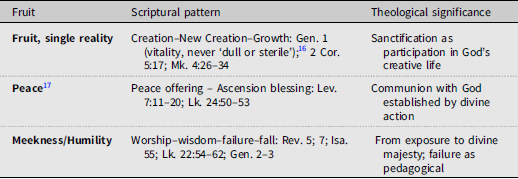
In Fruits and Abba, Underhill’s use of Scripture is consistent in that she joins biblical texts to form prayer and virtue, as opposed to resolving exegetical problems. Table 1Footnote 14 offers examples of this practice, indicating the range of biblical texts Underhill relies on within her spiritual theology.Footnote 15 It is not exhaustive of Underhill’s use of Scripture.
Representative patterns of scriptural interrelation in The Fruits of the Spirit (1936)

Table 1. Long description
A table with three columns and four rows. The columns are labeled ‘Fruit’, ‘Scriptural pattern’, and ‘Theological significance’. The rows are labeled with different fruits and their corresponding scriptural patterns and theological judgments. Row 1: Fruit, single reality, Creation–New Creation–Growth: Gen. 1 (vitality, never dull or sterile); 2 Cor. 5:17; Mk. 4:26-34, Sanctification as participation in God’s creative life. Row 2: Peace, Peace offering – Ascension blessing: Lev. 7:11-20; Lk. 24:50-53, Communion with God established by divine action. Row 3: Meekness/Humility, Worship-wisdom-failure-fall: Rev. 5; 7; Isa. 55; Lk. 22:54-62; Gen. 2-3, Worship–wisdom–failure–fall. Row 4: From exposure to divine majesty; failure as pedagogical.
Source: Compiled by the author from Underhill, Fruits/ABBA.
Agency Reordered: Scripture and Participation in Divine Life
The density traced above is theological: the many texts Underhill brings together reorient causality, with the source of transformation in the scriptural narrative itself. This relocation of agency bears upon broader theological debates concerning participation and modern accounts of selfhoodFootnote 18 and whether spiritual writing in modernity primarily intensifies expressive interiority, or whether it offers scriptural judgement that displaces the self as the centre. Much twentieth-century spirituality, particularly in some Protestant trajectories, has been read as centring religious experience on this interiority.Footnote 19 Underhill’s mature writings complicate this assumption. Although attentive to interior transformation, she refuses to describe sanctification as the unfolding of latent religious potential. In this respect, her account aligns more closely with participatory views of grace than with psychological accounts of spiritual development.Footnote 20 Scripture gives Underhill the language with which to describe God’s action. In both Abba and Fruits, Underhill frames transformation christologically and theocentrically, as a means of reordering agency; she understands prayer and virtue in participatory terms.
In Fruits, Underhill reads the list in Gal. 5:22–23 christologically so that the ‘fruit’ names the form of life manifested and accomplished in Christ. She views sanctification as participation in divine life, displacing effort as the primary agent of transformation.Footnote 21 The fruit list is embodied in the narrative of Christ’s life, where love culminates in the cry ‘It is finished’ (Jn. 19:30); peace is named through the Baptist’s confession, ‘Lamb of God who takes away the sin of the world’ (Jn. 1:29); gentleness and long-suffering appear in Christ’s healing ministry; faithfulness in his resolute turning towards Jerusalem; meekness and humility in the bearing of crucifixion; moderation in the restraint of divine power. The ‘fruit’ thus functions as a compressed christological portrait, anchoring virtue in Christ’s own form of life, so that virtue is participation in a life already enacted in Christ. The contrast with Peter is telling: where Peter is ‘defeated’ by fear and self-preservation, Christ is ‘victorious on the Cross’.Footnote 22 Underhill’s severity towards Peter is pedagogical in that the collapse of natural courage exposes the inadequacy of ‘safety-first’Footnote 23 ethics and shows the necessity of divine grace. The fruit therefore marks conformity to the cruciform obedience of the Son.
Christ speaks by the fruit of love as ‘the lowest of men’.Footnote 24 The purpose of the fruit is explicitly teleological, ‘the moulding [of the creature] to the pattern of Christ’.Footnote 25 Yet the christological framing does not eclipse theocentrism in that the fruit is ‘of the Spirit’ and therefore functions as evidence of God’s active presence. The fruit emerges through ‘the Creative life of God in our souls’Footnote 26 and is therefore truly ‘of God’.Footnote 27 The presence of fruit ultimately reflects communionFootnote 28 with God. Christ reveals the Father, and the Spirit draws the creature into participation in divine life, framing sanctification as relational and God-initiated, not a private achievement.
This christological focus becomes especially clear in Underhill’s treatment of faithfulness, where she sets Christ in deliberate contrast to the failures of discipleship. Peter’s passivity and fear by the charcoal fire are juxtaposed with Christ’s purposeful movement towards the cross, disclosing ‘faithfulness’ as cross-shaped obedience.Footnote 29 Underhill presses the contrast with characteristic severity: ‘The first step taken towards Calvary was the worst: but in the first step all was achieved’.Footnote 30 Here, Scripture shows faithfulness as the Spirit’s formation of the creature in Christ, while failure is pedagogical and exposes the necessity of divine grace.Footnote 31 Faithfulness acquires this stabilizing effect. It bears the quiet assurance of the Psalmist, ‘Where can I go from your Spirit?’ (Ps. 139:7), and is tested through affliction (Ps. 119:75). Underhill likens this nearness to a king moving disguised among his people at night (Mt. 25),Footnote 32 suggesting that divine action is often hidden yet decisive. The fruit of faithfulness stabilizes because God remains present.
Christ’s glory anchors meekness (which is ‘not showy’Footnote 33 ) in that the Incarnation and the footwashing (Jn. 13) display divine humility expressed in ordinary acts. The fruit is theocentric and arises when creaturely smallness is seen against divine greatness.Footnote 34 Meekness is formed through christological hiddenness and theocentric worship; obedienceFootnote 35 comes from awe before God rather than self-belittlement.
The same reordering governs Underhill’s exposition of the Lord’s Prayer (Mt. 6:9–13 and Lk. 11:2–4), which she reads as a liturgical act that centres desire in God. She warns that ‘the cheap business of anthropocentric life has invaded our religion’Footnote 36 and views prayer as a reordering of the self under divine priority. ‘Thy will be done’ names ‘subordination to the vast Divine action’, marking prayer as surrender.Footnote 37 For Underhill, however, this theocentric surrender is inseparable from Christ:the Lord’s Prayer is prayer in and by Christ, rather than only prayer about God (Heb. 8:2), which means prayer includes participation in Christ’s life.Footnote 38 To pray ‘Our Father’ is to pray ‘from the cross’, placing Christian identity within Christ’s filial obedience and making prayer a cruciform practice of formation.Footnote 39 The Lord’s Prayer as a whole functions as a transformative act, discipling the one who prays it into Christ’s posture of self-offering (Phil. 2:6–7). Underhill’s account resists simple reduction to spiritual psychology by locating transformation within divine action mediated through prayer.
Holiness as Address: Transcendence and Nearness in Prayer
Underhill repeatedly uses Scripture to show that divine transcendence and nearness are held together through forms of address learned in prayer; Scripture governs how God is named and approached.
In Fruits, the Spirit’s ‘fruit’ possesses an ‘inherent quality’Footnote 40 not reducible to social measure or temperament. They enter ‘the natural world on a natural scale’,Footnote 41 yet their source is not the natural scale. They are ‘Christ in you’,Footnote 42 rather than the projection of an ideal self. Underhill also differentiates the fruit by visibility: some are ‘hidden’ and inward (love, joy, peace), while others extend outward into social life (long-suffering/patience, gentleness, goodness, faithfulness, meekness and self-control/temperance).Footnote 43 The movement here is towards what is ‘less showy’Footnote 44 so that maturity means quiet restraint not spiritual display. Underhill often places divine nearness in what is hidden, connecting this pattern to the self-emptying found in Pauline theology (Phil. 2:6–7). Hence, the least ‘showy’ fruit may be the clearest evidence of indwelling grace. Joy, on this account, is tested under pressure, where nearness is known without reliance on affective intensity.Footnote 45
In Abba, the holiness–nearness pattern structures Underhill’s exposition of the Lord’s Prayer. She reads it as an ordered movement from divine majesty to creaturely need and articulates this double movement in her exposition of the opening of the Lord’s Prayer: ‘With one hand we touch the most secret intimacies of the spirit, our loving and childlike relation to God, with the other the creature’s unlimited awe before His mystery: a mystery which grows deeper, the nearer we approach’.Footnote 46 For Underhill, holiness does not mean distance; it shapes how God is approached in prayer. The address ‘Our Father’ joins intimacy with awe, refusing both familiarity and distance. Scripture here shapes how God is spoken to in prayer, and the deepening of prayer intensifies rather than resolves divine mystery.
Underhill resists reducing prayer to self-expression; prayer is first a theological act of surrender, where scriptural ways of addressing God bring reverence and intimacy together. ‘Thy kingdom come’ and ‘Thy will be done’ displace the self as interpretive centre with divine action, challenging anthropocentric models of prayer. The prayer is ‘a single act of communion of the spirit of man with the eternal God’.Footnote 47 In the prayer, the infinite God descends to the finite creation, which Underhill frames by comparison to Christ’s descent in the Incarnation,Footnote 48 so that it refuses to keep holiness at a distance. Prayer addresses divine majesty precisely in the midst of ‘untransformed and common life’,Footnote 49 sanctifying ordinary existence without diminishing divine transcendence.
Creaturely dependence (bread), moral vulnerability (temptation) and mercy (forgiveness) become sites where divine nearness meets human limitation.Footnote 50 Each petition becomes an occasion of formation: asking is itself a reconfiguration of desire under God.
Underhill explicitly contrasts ‘heavenly splendour’ with ‘earthly limitations’,Footnote 51 reading the prayer as a movement from petitions directed towards God to expressions of creaturely need.Footnote 52 The sequence enacts an ascent/descent pattern where divine priority precedes human request. This pattern reflects the work that enables creaturely response so that the ‘aspiration of the created order’ is towards God.Footnote 53 For Underhill, prayer is a concrete practice through which God forms the creature. Her interpretation emphasizes inhabitation: Scripture is meant to transform perception and desire. Underhill’s paraphrase condenses this focus on intimacy: ‘Our Father which art in heaven hallowed, revered, be thy mysterious name in my dim and fluctuating soul, to whom thou hast revealed thyself in such a degree as I can endure…’.Footnote 54
The same theological reasoning governs her exposition of ‘Give us our daily bread’. Underhill’s appeal to Melchizedek (Gen. 14:17–24; Heb. 5:10) reframes bread as sign of dependence rather than possession. In contrast to the kings’ contest over spoils, or the ‘animal life of self-assertion’, Melchizedek bears bread and wine, revealing what she calls the ‘primary truth of dependence’.Footnote 55 The Emmaus meal (Lk. 24:13–35) intensifies this pattern: recognition occurs precisely in the breaking of bread, so that creaturely need stands ‘at the very heart of prayer’.Footnote 56 Dependence is participation in divine generosity. Even the petitions on temptation and deliverance join weakness and protection (Ps. 80:1–2), while forgiveness exposes the downward pull of ‘original sin’.Footnote 57 Yet this only reinforces her insistence that grace precedes transformation. The centurion’s plea, ‘say only the word’ (Mt. 8:8),Footnote 58 gives Underhill a final example: divine speech accomplishes what human resolve cannot.
While Underhill is often associated with the Christian mystical tradition, Abba and The Fruits display a use of Scripture oriented towards formation rather than affective interiority alone. By rooting creaturely need in divine initiative, Underhill consistently describes spiritual practice as response, with grace preceding and reordering desire.Footnote 59 Prayer and formation begin with grace: holiness generates surrender, while nearness leads to endurance and obedience. Underhill’s spiritual theology is, in this sense, a response to grace mediated through Scripture.
Conclusion
In Abba (1934) and The Fruits of the Spirit (1936), Evelyn Underhill employs Scripture as a primary theological medium shaping prayer and virtue. Underhill’s mature writings show forms of scriptural reading that were theologically substantial and yet did not depend on a formally articulated hermeneutical theory persisted within modern Anglican spiritual theology. Underhill’s practice therefore complicates narratives of theological fragmentation by demonstrating that Scripture, spirituality and doctrine remained closely connected.
More broadly, theological reasoning need not take the form of doctrinal systems or explicit hermeneutical programmes in order to be shaped by Scripture. Underhill shifts attention to God’s prior action, teaches the language of prayer and presents sanctification as response to divine initiative. Prayer itself is a way of theological discernment. This resists readings of modern spiritual theology that view it primarily as expressive interiority or as detached from Scripture. Underhill emerges as a writer on mysticism as well as an Anglican practitioner of a scriptural, spiritual theology where formation and interpretation belong together.
Supplementary material
The supplementary material for this article can be found at https://doi.org/10.1017/S1740355326101326


 Open access

