In East Asia, new democracies emerged more than a decade after the third wave of global democratization started in Southern Europe in the mid 1970s (Huntington, Reference Huntington1991; Shin, Reference Shin, Dalton and Klingemann2007). In 1987, South Korea began its democratic transition by institutionalizing free and direct elections for president. Taiwan started its gradual democratic transition by first lifting martial law in 1987 and then holding its first presidential election in 1996. In 1990, Mongolia abolished its communist one-party system and held competitive elections to choose its president. With the emergence of these three new democracies, Japan was no longer the only democratic state in East Asia.
Of the four democracies in the region, we chose three – Japan, South Korea, and Taiwan – to explore the extent of democratic consolidation. Despite differences in their paths to democracy and the number of years of democratic rule, these three countries are widely viewed to have achieved remarkable progress toward liberal democracy. In 2006, both Japan and South Korea each received from Freedom House a combined score of ‘1.5’ on the seven-point political rights and civil liberties scale and Taiwan received a ‘1.0’ (Freedom House, 2006). According to Polity IV Country Report (Center for International Development and Conflict Management, 2006), Japan and Taiwan received the highest score of ‘10’ on the democracy index and South Korea received a score of ‘8’. Conversely, they all received the lowest score of ‘0’ on the autocracy index. More recently, the Economist Intelligence Unit rated Japan as a full democracy and Taiwan and South Korea as democracies, though flawed (Economist, 2006). All these recent surveys confirm that Japan, South Korea, and Taiwan rank with the old democracies in the West.
In this article, we attempt to explore democratic progress in these three countries by examining the extent to which their cultural values and institutions have democratized. Specifically, we address the following questions: How broadly and deeply do their citizens support democracy as a political system? How detached are they from authoritarian alternatives? How committed are they to democracy? How well do their institutions provide voting and civil rights? How accountable are their executive and legislative institutions? How does popular commitment to democracy compare with popular satisfaction with institutional practices of democracy? These and other related questions are explored in the context of the AsiaBarometer (AB, hereafter) Survey conducted in Japan, South Korea, and Taiwan during the months of July and August in 2006. Through an analysis of the survey data, we try to examine the general patterns of popular demand for and institutional supply of democracy in these three countries.
This article is organized into six sections. The first emphasizes the notion of democratic consolidation as an interactive process between democratic institutions and culture. The second deals with preference for democracy and rejection of its authoritarian alternatives to evaluate the popular demand for democracy. The third section analyzes satisfaction with voting and civil rights and trust in political branches of government to evaluate the institutional supply of democracy. The fourth section analyzes demographic differences in commitment to democracy and satisfaction with democratic institutional practices. The fifth section describes cultural and institutional democratic deficits by comparing popular demand for democracy with perceived supply of democracy. The final section highlights the key findings and discusses their implications for democratic consolidation in East Asia.
Democratic consolidation
In studying democratization in East Asia, we chose democratic consolidation as a central concept. This concept entails the democratization of both political institutions and cultural values. Institutional democratization involves the installation of democratic institutions such as universal suffrage, civil liberties, and executive accountability, whereas cultural democratization involves popular support for these democratic institutions. The viability of a democracy depends on a mutually reinforcing interaction between democratic institutions and culture. The institutions, once adopted, can persist when broad and deep popular support for democratic institutions is present. For this reason, a democracy is often said to be consolidated when it is ‘the most right and appropriate for [a]society, better than any other realistic alternative [its people] can imagine’ (Diamond, Reference Diamond1999: 65) or when it is widely accepted as ‘the only game in town’ (Linz and Stepan, Reference Linz and Stepan1996).
The interaction between political institutions and cultural values determines the extent of democratic consolidation. Democratic institutions affect regime preferences, which, in turn, help sustain those institutions. Conversely, democratic regime preferences shape the choice of institutions, which, in turn, strengthen those preferences. So, democratic consolidation requires a high-level equilibrium between popular demand for democracy and institutional supply of democracy (Rose, Mishler, and Haerpfer, 1998). When political institutions fail to represent popular interests and are lax in horizontal accountability and rule of law, institutional democratization is likely to be impaired. On the other hand, when support for democracy is shallow and rejection of authoritarian alternatives is not unequivocal, cultural democratization is likely to be flawed. For a democracy to be institutionally and culturally consolidated, popular demand for democracy must be high and institutional supply of democracy satisfying.
Support for democracy has been a key concept in assessing public demand for democracy. In defining the concept, it is important to distinguish between the regime and authorities. The former refers to the authority structure and its justifications; the latter refers to the present incumbents of authority roles (Easton, Reference Easton1965). The lack of support for officeholders is not a threat to democracy. It is a normal aspect of the democratic political process. In contrast, the lack of support for the regime is a threat to democracy.
Therefore, when a democracy maintains broad and deep regime support, it may be culturally consolidated, and when a democracy provides satisfying political rights and institutions, it may be institutionally consolidated. If people are not committed to democracy or dissatisfied with democratic institutional practices, however, a democracy is unlikely to be consolidated culturally or institutionally. In order to unravel the dynamics of democratic consolidation, therefore, it is helpful to explore citizen orientations toward democracy as well as citizen satisfaction with institutional practices of democracy.
We consider commitment to democracy or preference for democracy over authoritarian alternatives as an indication of latent, if not manifest, popular demand for democracy. Hence, popular commitment to democracy is regarded as reflecting the extent of cultural democratization. At the same time, we consider satisfaction with political rights and institutions as an indication of perceived, if not actual, institutional supply of democracy. Hence, satisfaction with democratic institutional practices is regarded as reflecting the extent of institutional democratization. From the 2006 AB Survey, we chose two sets of questions to measure popular demand for democracy and institutional supply of democracy.
Popular demand for democracy
Preference for democracy
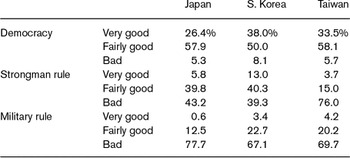
Preference for democracy reflects a latent demand for democracy. The 2006 AB Survey asked respondents whether a democratic political system would be very good, fairly good, or bad for the country. The question elicits orientations to democracy as a value, not institutional practices of democracy. Responses to it can be understood as an indication of a potential, if not actual, demand for democracy. How broadly and deeply do our East Asian publics prefer democracy?
As Table 1 shows, democratic preference appears to be widespread. In each of the three countries surveyed, absolute majorities (84 per cent in Japan, 88 per cent in South Korea, and 92 per cent in Taiwan) expressed a preference for democracy by selecting the ‘very good’ or ‘fairly good’ response category. Only tiny minorities (5 per cent in Japan, 8 per cent in South Korea, and 6 per cent in Taiwan) chose the ‘bad’ response category. All the proportions favoring democracy were much greater than two-thirds of the population, a so-called minimum threshold of democratic consolidation. Moreover, all the proportions disfavoring democracy were far less than 15 per cent of the population, a permissible upper limit. The legitimacy of democracy is hardly a contested belief among our East Asian publics.
Preference for democracy and authoritarian alternatives

Note: The percentage of ‘don't know’ (DK) and no answer (NA) responses is not reported.
Source: 2006 AsiaBarometer Survey.
Yet close inspection of the table reveals that preference for democracy is not deep, even though broad. In Japan, for instance, only one-quarter (26 per cent) considered democracy as very good. In both South Korea and Taiwan, only about one-third (38 per cent in South Korea and 34 per cent in Taiwan) considered democracy to be very good. In contrast, more than one-half (58 per cent in Japan, 50 per cent in South Korea, and 58 per cent in Taiwan) considered democracy to be fairly good. Notable is that those judging democracy as good outnumbered those judging it as very good by substantial percentage points (32 per cent in Japan, 12 per cent in South Korea, and 24 per cent in Taiwan). These findings suggest that the legitimacy of democracy is not deeply endorsed in these three East Asian countries.
Rejection of authoritarian alternatives
The rejection of undemocratic alternatives, such as military or strongman rule, likely contributes to a latent demand for democracy. The 2006 AB Survey asked respondents if each of these undemocratic alternatives would be very good, fairly good, or bad for the country. First, as Table 1 shows, more than two-thirds (78 per cent in Japan, 67 per cent in South Korea, and 70 per cent in Taiwan) rejected military rule by choosing the ‘bad’ response category. Only a few (1 per cent in Japan, 3 per cent in South Korea and 4 per cent in Taiwan) viewed military rule as very good. Notable, however, is that one-quarter of new democracies (26 per cent in South Korea and 24 per cent in Taiwan) and one-tenth of an established democracy (13 per cent in Japan) viewed military rule as good. Without a doubt, military rule is the most unpopular form of governance in these three countries. Yet the above finding suggests that a sizable minority in South Korea and Taiwan might welcome a military takeover during difficult times.
Second, strongman rule, that is, ‘governance by a powerful leader without the restriction of parliament or elections’, is more or less rejected by the mass publics of these three countries. In Taiwan, a great majority (76 per cent) considered strongman rule to be bad. In contrast, however, less than one-half in Japan (43 per cent) and South Korea (39 per cent) viewed strongman rule as bad. It is noteworthy that nearly one-half in Japan (46 per cent) and South Korea (53 per cent) viewed strongman rule as good or very good. Citizen orientations to strongman rule were equally divided in Japan, where its supporters were as numerous as its opponents (46 per cent vs. 43 per cent). In South Korea, however, supporters of strongman rule outnumbered its opponents by 14 percentage points (53 per cent vs. 39 per cent). Evidently, a strong nostalgia remains for the effective institutions of past civilian authoritarian rule in South Korea.
All the findings indicate that not every form of authoritarian rule is rejected. Large majorities of citizens in Japan, South Korea, and Taiwan uniformly rejected military authoritarian rule. Yet rejection of civilian authoritarian rule varies cross-nationally. Especially, rejection of strongman rule was weaker in Japan and South Korea than in Taiwan. Apparently, a level of popular skepticism exists about the checks and balances of democratic institutions in Japan and South Korea.
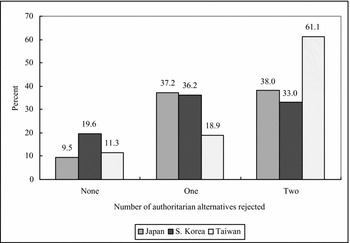
To estimate the extent to which people rejected authoritarian rule, we added up the antiauthoritarian responses into a 3-point index of authoritarian detachment. The scores of the index indicate the number of authoritarian alternatives that respondents viewed as bad. Hence, a score of ‘2’ indicates rejection of both authoritarian alternatives, whereas a score of ‘0’ indicates that none of them was rejected. As Figure 1 shows, those who rejected both military and civilian authoritarian rule did not constitute a majority in Japan (38 per cent) or South Korea (33 per cent), whereas they did in Taiwan (61 per cent). Nonetheless, those who did not reject either of them also did not constitute a majority in Japan or South Korea. Only small minorities (10 per cent in Japan, 20 per cent in South Korea and 11 per cent in Taiwan) failed to reject any form of authoritarian rule. Largely due to differences in rejection of strongman rule, detachment from authoritarian rule appears to be deeper in Taiwan than in Japan or South Korea.
Rejection of authoritarian alternatives
Note: The percentage of DK/NA not reported.
Source: 2006 AsiaBarometer Survey.

Relative preference for democracy
As scholars of democratic transition argue, the legitimacy of democracy can be strengthened if there are no preferable alternatives (Przeworski, Reference Przeworski, O'Donnell, Schmitter and Whitehead1986). As proponents of a democracy-as-a-lesser-evil thesis also maintain, preference for democracy over its authoritarian alternatives matters for democratic consolidation (Rose, Mishler, and Haerpfer, 1998).
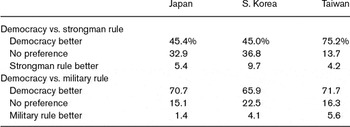
Following this line of reasoning, we examine the extent to which people prefer democracy over authoritarian alternatives. In order to do that, we constructed two indices of relative preference for democracy by subtracting scores of each authoritarian regime preference from those of democratic regime preference. The resulting scores, which ranged from ‘–2’ to ‘2’, were then collapsed into three categories: ‘1’ (pro-democratic), ‘0’ (no preference) and ‘–1’ (pro-authoritarian). Table 2 reports the results.
First, more than two-thirds (71 per cent in Japan, 66 per cent in South Korea, and 72 per cent in Taiwan) viewed democracy better than military rule. In contrast, only a few (1 per cent in Japan, 4 per cent in South Korea, and 6 per cent in Taiwan) viewed military rule better than democracy. Those preferring democracy to military rule far outnumbered those preferring military rule to democracy by huge percentage points (70 per cent in Japan, 62 per cent in South Korea, and 66 per cent in Taiwan). Only small minorities (15 per cent in Japan, 23 per cent in South Korea, and 16 per cent in Taiwan) are uncertain about the choice between democracy and military rule.
Relative preference for democracy over authoritarian alternatives

Note: The percentage of DK/NA not reported.
Source: 2006 AsiaBarometer Survey.
Second, three-quarters (75 per cent) in Taiwan and less than one-half (45 per cent) in both Japan and South Korea viewed democracy better than strongman rule. In contrast, only tiny minorities (5 per cent in Japan, 10 per cent in South Korea, and 4 per cent in Taiwan) viewed strongman rule better than democracy. Those preferring democracy to strongman rule far outnumbered those preferring strongman rule to democracy, but by considerably varying percentage points (40 per cent in Japan, 35 per cent in South Korea and 71 per cent in Taiwan). It is worth noting that those who were uncertain about the choice between democracy and strongman rule constituted sizable minorities in Japan (33 per cent) and South Korea (37 per cent). In contrast, this indecisive group formed a small minority in Taiwan (14 per cent).
These findings suggest that not all forms of authoritarian alternatives have lost their relative appeal among our East Asian publics. Evidently, military rule has lost most of its legitimacy in comparison to democracy. Yet civilian authoritarian rule still remains a credible alternative to democracy in the minds of ordinary people in Japan and South Korea.
Commitment to democracy
Preference for democracy may not indicate commitment to democracy because it does not necessarily entail rejection of undemocratic alternatives. Commitment to democracy requires not only preference for democracy, but also rejection of undemocratic alternatives. Hence, some researchers emphasize that democratic consolidation requires that ‘people must not only say that they prefer it as the best form of government, but they must simultaneously abandon nostalgia for authoritarian alternatives’ (Bratton, Mattes, and Gyimah-Boadi, 2005: 28).
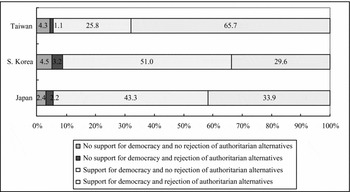
To determine the extent of commitment to democracy, we combined pro-democratic and antiauthoritarian regime orientations together to develop four patterns of regime orientations: (1) support for democracy and rejection of authoritarian rule; (2) support for democracy and no rejection of authoritarian rule; (3) no support for democracy and rejection of authoritarian rule; and (4) no support for democracy and no rejection of authoritarian rule. It should be emphasized that the numeric strength of those belonging to the first pattern, namely committed democrats, tends to approximate the extent of popular demand for democracy. Figure 2 reports the percentage of each pattern of regime orientations.
Patterns of regime orientations
Notes: The percentage of DK/NA not reported.
Source: 2006 AsiaBarometer Survey.

According to this figure, one-third in Japan (34 per cent), less than one-third in South Korea (30 per cent), and two-thirds in Taiwan (66 per cent) belonged to the first pattern of supporting democracy and rejecting authoritarian rule. Second, more than two-fifths in Japan (43 per cent), one-half in South Korea (51 per cent), and one-quarter in Taiwan (26 per cent) belonged to the second pattern of supporting democracy, but not rejecting authoritarian rule. In striking contrast, only a few in Japan (2 per cent), South Korea (3 per cent), and Taiwan (1 per cent) belonged to the third pattern of rejecting authoritarian rule but not supporting democracy. Finally, only a few in Japan (2 per cent), South Korea (5 per cent), and Taiwan (4 per cent) belonged to the fourth pattern of neither rejecting authoritarian rule nor supporting democracy. Those belonging to the third and fourth patterns were not democrats, even nominally, because they considered democracy to be bad.
A combined proportion of those antidemocrats constituted only a tiny minority in each of the three countries (5 per cent in Japan, 8 per cent in South Korea, and 5 per cent in Taiwan). Unlike these antidemocrats, those belonging to the second pattern are ambivalent democrats and they constituted a majority in Japan and South Korea. In contrast, those belonging to the first pattern, committed democrats, formed a majority in Taiwan. These findings suggest that levels of popular demand for democracy would be higher in Taiwan than in Japan or South Korea. It is of particular note that commitment to democracy is especially shallow in South Korea (Shin and Wells, Reference Shin and Wells2005).
Overall, if popular demand for democracy is a key component of cultural democratization, the varying proportions of committed democrats suggest that Japan and South Korea remain far away from a minimum threshold of democratic consolidation, whereas Taiwan is very close to it. Judging by levels of popular commitment to democracy, we may say that our East Asian democracies maintain, more or less, shallow cultural foundations.
Institutional supply of democracy
Satisfaction with voting and civil rights
The working of democracy or institutional practices of democracy determines a ‘supply of democracy’. Hence, the standard question that taps satisfaction levels with democracy may be used to estimate the extent of a perceived supply of democracy. Higher levels of satisfaction with democracy may reflect the adequacy of institutional supply, whereas lower levels of satisfaction may reflect its inadequacy. However, satisfaction with democracy may not be a good indicator of the extent of institutional democratization because it tends to elicit generalized orientations to democracy as a whole. Instead, certain specific measures of institutional performance can serve as better indicators of democratic supply.
What are the key democratic institutions that should be evaluated? Some scholars of the first wave of democratization emphasize the following three institutions of democracy: universal suffrage, civil rights, and an executive accountable to an elected legislature (Collier, Reference Collier1999; Ziblatt, Reference Ziblatt2006). Among this scholarly group, institutional democratization refers to the adoption or introduction of these institutions. Hence, satisfaction with these institutional attributes may be regarded as the perceived adequacy of a supply of democracy. First, we deal with voting and civil rights and then the institutions that are horizontally accountable to each other.
The democratic political process requires a set of constitutional rights, which are widely regarded as the basic rules of the democratic political game. For instance, Robert Dahl (1971: 3) proposes a set of rights as institutional guarantees for democracy. They include freedom to form and join organizations, freedom of expression, and the right to vote. Without a doubt, universal suffrage and civil rights, which are crucial for public debate, criticism, and participation, are viewed as key institutional criteria of modern democracy (Levitsky and Way, Reference Levitsky and Way2002). Indeed, institutional democratization is a process of making these rights available to greater numbers of people.
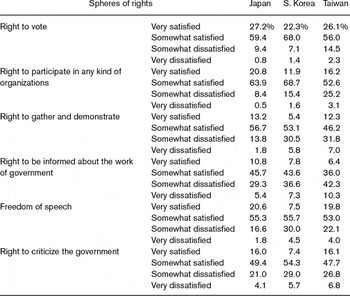
The 2006 AB Survey asked respondents to evaluate their satisfaction or dissatisfaction with the provision of six political and civil rights in their countries based on a 4-point verbal scale, whose values ranged from ‘1’ (very satisfied) to ‘4’ (very dissatisfied). The six rights included the right: to vote; to participate in any kind of organization; to gather and demonstrate; to be informed about the work of government; to have freedom of speech; and to criticize the government. By no means do these six areas exhaust all the rights and liberties essential to liberal democracy. For instance, rights associated with due process of law are not included. Nonetheless, they are among those rights that Dahl and other scholars of democratization consider as key institutional attributes of democracy.
In recognizing the need to distinguish between electoral democracy and liberal democracy (Diamond, Reference Diamond2002; Levitsky and Way, Reference Levitsky and Way2002), we used the level of satisfaction with voting rights to estimate a supply of electoral democracy and the level of satisfaction with other civil rights to indicate a supply of liberal democracy. To what extent do East Asian citizens enjoy the voting and civil rights that their democracies provide? Table 3 reports the results.
Satisfaction with voting and civil rights

Note: The percentage of DK/NA not reported.
Source: 2006 AsiaBarometer Survey.
It seems that free, fair, and competitive elections are an established institutional practice in our three targeted East Asian countries. Absolute majorities (87 per cent in Japan, 90 per cent in South Korea, and 82 per cent in Taiwan) expressed some degree of satisfaction with the practice of voting rights. Only small minorities (10 per cent in Japan, 9 per cent in South Korea, and 17 per cent in Taiwan) displayed some degree of dissatisfaction. This finding suggests that our East Asian democracies maintain the standard practices of vote casting and counting.
Yet a supply of liberal democracy varies from one country to another. First, in Japan people found themselves more satisfied than dissatisfied in all five spheres of civil rights. The most satisfying was the right to join organizations. In this sphere, the satisfied far outnumbered the dissatisfied by 76 percentage points. The least satisfying was the right to be informed about the work of government. In this sphere, the satisfied outnumbered the dissatisfied by only 22 percentage points.
Second, in South Korea people found themselves more satisfied than dissatisfied in all five spheres of civil rights. The most satisfying was the right to join organizations. For this right, the satisfied greatly outnumbered the dissatisfied by more than 64 percentage points. The least satisfying was the right to be informed about the work of government. Here, the satisfied slightly outnumbered the dissatisfied by only 8 percentage points.
Lastly, in Taiwan people found themselves more satisfied than dissatisfied in four of the five spheres of civil rights. The exception to the overall trend of satisfaction and, therefore, the least satisfying as well was the right to be informed about the work of government, where the dissatisfied outnumbered the satisfied by 10 percentage points. The most satisfying was freedom of speech. For this civil right, the satisfied far outnumber the dissatisfied by more than 47 percentage points.
Obviously, levels of satisfaction with civil rights vary from one sphere to another. Of particular note, citizens in all three countries assessed the right to be informed about the work of government as the least satisfying of the five civil rights evaluated. This finding suggests that East Asian democratic governments are not adequately transparent in the eyes of their ordinary citizens.
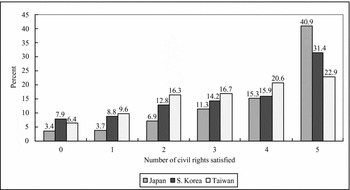
Simultaneous consideration of the supply of five civil rights allows us to determine the extent to which the three East Asian democracies reflect standards of liberal democracy. To estimate the degree of liberal democratization, we constructed a 6-point index of overall satisfaction with civil rights by adding together the number of rights respondents found satisfying. Figure 3 reports the results. Depending on the number of civil rights satisfied, we created three categories of democracy-in-practice: illiberal (0–2 rights satisfied), partially liberal (3–4 rights satisfied), and liberal (5 rights satisfied).
Overall satisfaction with civil rights
Note: The percentage of DK/NA not reported.
Source: 2006 AsiaBarometer Survey.

The proportions of those who expressed some degree of satisfaction in all five spheres of rights were 41 per cent in Japan, 31 per cent in South Korea, and 23 per cent in Taiwan. These figures show that from the public's standpoint, Japan is a more liberal democracy than South Korea and Taiwan. In contrast, the proportions of those who expressed some degree of satisfaction in less than three spheres of rights were 14 per cent in Japan, 30 per cent in South Korea, and 32 per cent in Taiwan. These figures show that citizens in South Korea and Taiwan viewed their democracies as more illiberal than their counterparts in Japan. It is interesting that in Japan those who viewed their democracy as liberal outnumbered those who viewed it as illiberal. In South Korea, those who saw their democracy as liberal were as numerous as those who saw it as illiberal. In Taiwan, on the other hand, those who viewed their democracy as illiberal outnumbered those who viewed it as liberal. These findings illustrate that the extent to which liberal institutional democratization is higher in Japan than in South Korea and Taiwan. The latter two countries still appear to engage in some authoritarian political practices and are in need of extending the limits of liberal democratic rights.
Overall, voting rights in our East Asian democracies is highly satisfying. Moreover, most civil rights, except for one or two spheres, are largely satisfying. Yet levels of satisfaction with civil rights are far lower than levels of satisfaction with voting rights. Apparently, the extent of voting rights and the extent of civil rights do not match. These findings clearly demonstrate that these three East Asian democracies are electoral democracies, and that they still fall short of the standards of liberal democracies.
Trust in political institutions
One of the key institutional elements of democracy features executive accountability to elected parliament, which derives from the principles of a separation of powers and checks and balances. The authority structure of democracy emphasizes parliamentary autonomy and executive accountability. Hence, satisfaction with the performance of the executive and legislative branches of government may indicate democratic supply by these key institutions that are supposed to be accountable to each other.
Lacking direct measures of this institutional attribute of democracy, we relied on standard survey questions to tap the trust levels in both the executive and parliament. By referring to formal structures rather than incumbents, these survey questions may capture orientations to institutional arrangements. Hence, the trust levels in both political branches of government may be helpful in exploring the extent of institutional practices of horizontal accountability.
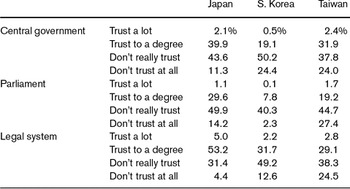
The 2006 AB Survey asked respondents how much trust they had in central government (executive) and parliament. Table 4 shows the results. The publics of new East Asian democracies displayed more distrust than trust in two political branches of government. In South Korea, only a small minority (20 per cent) trusted the central government and a far smaller minority (8 per cent) trusted the National Assembly. A similar pattern of institutional distrust was also found in Taiwan. Only one-third (34 per cent) trusted the central government and only one-fifth (21 per cent) trusted the Legislative Yuan. Japan, a widely known established democracy in East Asia, is no exception to this general pattern. Less than one-half (42 per cent) trusted the central government and only one-third (31 per cent) trusted the Diet.
Trust in institutions

Note: The percentage of DK/NA not reported.
Source: 2006 AsiaBarometer Survey.
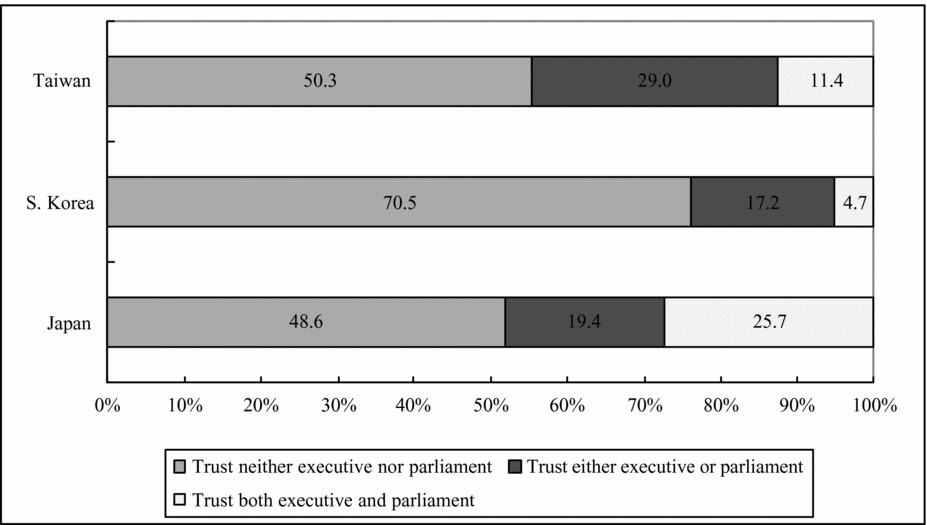
To estimate the adequacy of institutional practices of horizontal accountability, we counted the number of affirmative responses to both questions. A score of ‘0’ on this index means that respondents did not trust either of the institutions, and a score of ‘2’ means that both institutions were trusted. As Figure 4 reveals, the proportions of those who trusted neither of the institutions were 49 per cent in Japan, 71 per cent in South Korea, and 50 per cent in Taiwan. At the same time, the proportions of those who trusted both institutions were 26 per cent in Japan, 5 per cent in South Korea, and 11 per cent in Taiwan. The percentage of those who trusted neither of the political branches of government far outnumbered those who trusted both of them, although percentage points varied considerably (23 per cent in Japan, 66 per cent in South Korea, and 39 per cent in Taiwan). Of particular note is the preponderance of popular distrust in the political branches of government in South Korea. In general, East Asian democracies apparently maintain, more or less, dissatisfying institutional practices of horizontal accountability from their publics’ perspective.
Trust in the political branches of government
Note: The percentage of DK/NA not reported.
Source: 2006 AsiaBarometer Survey.
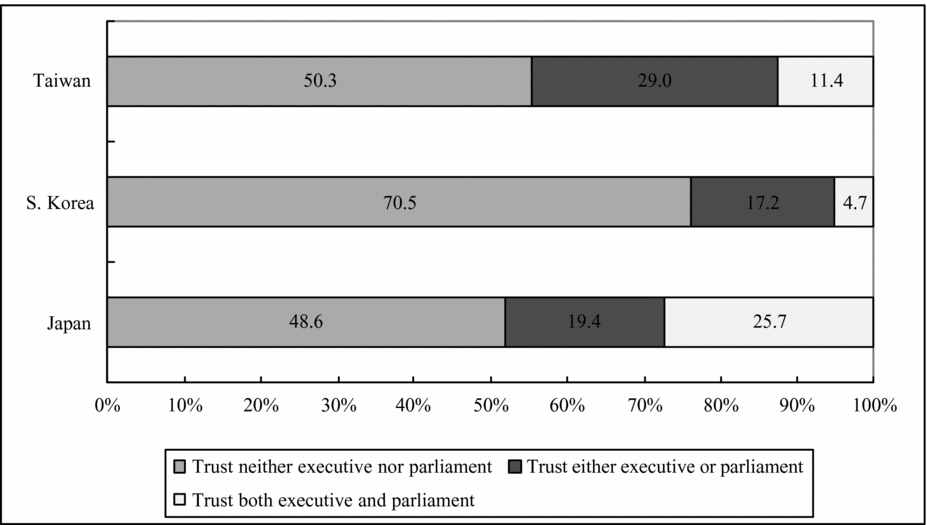
The formal relationship between the executive and parliament differs in the three countries, because South Korea and Taiwan maintain a presidential system of government and Japan a parliamentary system. Nonetheless, there were no large differences in satisfaction with institutional practices of horizontal accountability. Regardless of the number of years they have persisted, the three East Asian democracies failed to establish a satisfactory level of representative political institutions in the eyes of their ordinary citizens.
Finally, a legal system plays a critical role in ensuring the viability of horizontal accountability, because it allows autonomous public actors to exercise checks and balances (Diamond and Morlino, Reference Diamond and Morlino2004). As Table 4 shows, trust in a legal system also varies cross-nationally. For instance, more than one-half of the respondents (58 per cent) in Japan displayed some degree of trust in their legal system. It is worth noting that those who trusted the legal system outnumbered those who distrusted it. In contrast, about one-third in both South Korea (34 per cent) and Taiwan (32 per cent) expressed some degree of trust in their legal systems. Unlike Japan, those who distrusted the legal system outnumbered those who trusted it in South Korea and Taiwan. One of the key features of liberal democracy is to protect individual citizens from the arbitrary use of state power. The protection of individual constitutional rights serves as the main reason that a liberal democracy requires its legal system, including an independent judiciary, to function. Hence, lower levels of trust in the legal system of these new democracies, especially in South Korea and Taiwan, reflect inadequate institutional practices of the rule of law.
Overall, levels of institutional democratization in these three East Asian countries appear to be, more or less, low. Yet it should be emphasized that some cross-national differences in the institutional supply of liberal democracy exist. In particular, institutional practices of accountability were found to be notably poor in South Korea and Taiwan and not so much in Japan.
Demographic differences
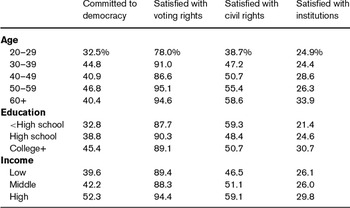
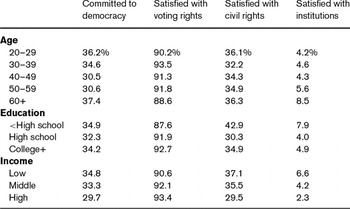
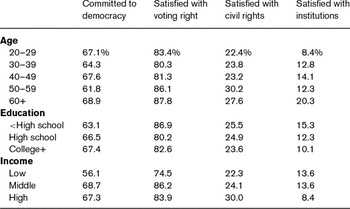
We now examine whether commitment to democracy and satisfaction with democratic institutional practices vary among different segments of the population in each country. Tables 5 to 7 show the results.
Table 5 shows how different segments of the Japanese population see democracy and experience democratic institutional practices. First, in every segment of the population, except for the high-income group, less than one-half supported democracy while rejecting its authoritarian alternatives. Second, in every segment of the population, except for the youngest group, nearly nine-in-ten were satisfied with voting rights. Third, in most segments of the population more than one-half were satisfied with civil rights. Among the youngest respondents, only one-third displayed some degree of satisfaction with civil rights. Lastly, in every segment of the population, only one-quarter expressed some degree of trust in the political branches of government. Interestingly, the people in their twenties were the least supportive of democracy and the least satisfied with voting and civil rights. Overall, regardless of age or education, popular demand for democracy tends to be relatively low. For every segment of the public, a supply of voting rights is highly satisfying, whereas a supply of civil rights is moderately satisfying. Institutional practices of horizontal accountability were dissatisfactory in every segment of the population.
Table 6 shows how different segments of the South Korean population see democracy and experience democratic institutional practices. First, in every section of the population, only one-third supported democracy while rejecting its authoritarian alternatives. Second, in every segment of the population, nearly nine-in-ten were satisfied with voting rights. Third, in most segments of the population, only one-third was satisfied with civil rights. Those most dissatisfied with civil rights were found more often among high-income people and those least dissatisfied came from the poorly educated. Lastly, in every segment of the population, only a tiny minority displayed some degree of trust in the political branches of government. Overall, popular demand for democracy tends to be low across the board. For every segment of the public, a supply of voting rights is highly satisfying, whereas the supply of civil rights is fairly dissatisfying. Regardless of age, education, or income, people were greatly dissatisfied with institutional practices of horizontal accountability.
Demographic differences in commitment to democracy and satisfaction with political rights and institutions: Japan

Note: The percentage of DK/NA not reported.
Source: 2006 AsiaBarometer Survey.
Demographic differences in commitment to democracy and satisfaction with political rights and institutions: South Korea

Note: The percentage of DK/NA not reported.
Source: 2006 AsiaBarometer Survey.
Demographic differences in commitment to democracy and satisfaction with political rights and institutions: Taiwan

Note: The percentage of DK/NA not reported.
Source: 2006 AsiaBarometer Survey.
Table 7 shows how different segments of the Taiwan population see democracy and experience democratic institutional practices. First, in nearly every segment of the population, except for low-income people, more than two-thirds supported democracy while rejecting its authoritarian alternatives. Low-income people were the least committed to democracy. Second, in nearly every segment of the population, more than four-in-five were satisfied with voting rights. Again, low-income people were the least satisfied with voting rights. Third, in nearly every segment of the population, only one-quarter was satisfied with civil rights. Lastly, in many segments of the population, only a tiny minority displayed some degree of trust in the political branches of government. Those least dissatisfied with institutional practices of horizontal accountability were found more often among the elderly or the poorly educated. Overall, unlike in Japan or South Korea, popular demand for democracy tends to be relatively high across the board. For every segment of the population, a supply of voting rights is highly satisfying, whereas a supply of civil rights is highly dissatisfying. Similar to the South Korean case, everyone was greatly dissatisfied with institutional practices of horizontal accountability.
In brief, in nearly every major demographic category of the publics in all three countries, those satisfied with voting rights outnumbered those dissatisfied and those dissatisfied with the political branches of government outnumbered those satisfied. In many segments of the population in Japan, those satisfied with civil rights outnumbered those dissatisfied. Yet, in every segment of the population in South Korea or Taiwan, those dissatisfied with civil rights outnumbered those satisfied. Moreover, in nearly every segment of the population in Japan or South Korea, those displaying no commitment to democracy outnumbered those displaying full commitment. Yet, in nearly every segment of the population in Taiwan, those displaying full commitment to democracy outnumbered those displaying no commitment.
All these findings suggest that generational change, the expansion of education, and rising standards of living may not further the spread of popular commitment to democracy in these countries. The findings also suggest that ‘critical citizens’ may be a common phenomenon in every demographic category of East Asian democracies (Norris, 1999).
Democratic deficits
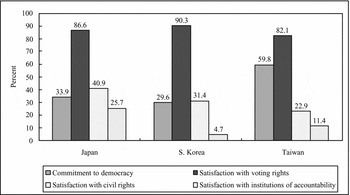
This study is based on the notion that democratic consolidation requires a high-level equilibrium between popular demand for democracy and institutional supply of democracy (Rose, Mishler, and Haerpfer, 1998). When popular demand for democracy is greater than institutional supply of democracy, we may say that institutional democratic deficits exist. When institutional supply of democracy is greater than popular demand for democracy, we may say that cultural democratic deficits exist. How do the three East Asian countries fare in this democracy audit? To address this question, we compare the extent of commitment to democracy with the extent of satisfaction with democratic institutional practices. Figure 5 reports the results.
Popular demand for democracy and institutional supply of democracy
Source: 2006 AsiaBarometer Survey.

In Japan, only one-third (34 per cent) displayed a full complete commitment to democracy by supporting democracy and rejecting its authoritarian alternatives. The full legitimacy of democracy is not widely endorsed. This finding indicates that popular demand for democracy may not be high. Yet the institutional supply of electoral democracy is considered highly adequate. An overwhelmingly majority of Japanese respondents (87 per cent) was satisfied with voting rights. Yet the institutional supply of liberal democracy is found to be somewhat wanting. Only two-fifths (41 per cent) were satisfied with all of the evaluated civil rights. The institutional supply of horizontal accountability was seen as deficient. Only one-quarter (26 per cent) was satisfied with the two key institutions of representative government. In total, there exist relatively modest levels of institutional supply of liberal democracy but low levels of popular demand for democracy. Hence, we may say that Japan still faces cultural democratic deficits.
In South Korea, just under one-third (30 per cent) expressed a full commitment to democracy. Similar to Japan, the full legitimacy of democracy is not widely endorsed. This finding suggests that popular demand for democracy may not be high. Yet the institutional supply of electoral democracy is considered highly adequate. An absolute majority (90 per cent) was satisfied with voting rights. However, the institutional supply of liberal democracy is viewed as inadequate. Again, just under one-third (31 per cent) was satisfied with all the civil rights surveyed. The institutional supply of horizontal accountability was viewed as dismally poor. Only a tiny minority (5 per cent) displayed some degree of trust in the popularly elected branches of government. Overall, there are relatively low levels of popular demand for democracy as well as institutional supply of liberal democracy. Hence, we may say that South Korea faces both cultural and institutional democratic deficits.
In Taiwan, nearly three-fifths (60 per cent) displayed a full commitment to democracy. Unlike in Japan or South Korea, the full legitimacy of democracy appears to be widely endorsed. This finding suggests that popular demand for democracy is fairly high. The institutional supply of electoral democracy is viewed as adequate. More than four-fifths (82 per cent) were satisfied with voting rights, although the institutional supply of liberal democracy is judged as greatly deficient. Only one-quarter (23 per cent) was satisfied with all civil rights evaluated. Moreover, the institutional supply of horizontal accountability is regarded as depressingly poor. Only one-tenth (11 per cent) expressed some degree of trust in the political branches of government. Overall, there exist high levels of popular demand for democracy but low levels of institutional supply of liberal democracy. We may say that Taiwan faces institutional democratic deficits.
In sum, popular demand for democracy is higher in Taiwan than in Japan or South Korea. The institutional supply of electoral democracy is highly adequate in all three countries. Yet the institutional supply of liberal or representative democracy is more inadequate in South Korea and Taiwan than in Japan. All these findings suggest that cultural democratization progressed more in Taiwan than in Japan or South Korea, whereas liberal institutional democratization advanced further in Japan than in South Korea or Taiwan.
Conclusion
In this article, in an effort to determine the extent of cultural and institutional democratization, we attempted to describe how ordinary people in Japan, South Korea, and Taiwan view democracy and its authoritarian alternatives and how they experience institutional practices of their democracies. The analysis of the 2006 AB Survey data clearly shows that these three East Asian democracies face some public political discontent just as Western established democracies do (Dalton, Reference Dalton2004). We found that in democratic East Asia, citizens are dissatisfied with the provision of some civil rights and institutions of horizontal accountability, although they remain highly satisfied with voting rights. These findings suggest that East Asian democracies were not adequately liberal, though unequivocally electoral, in the eyes of their peoples. Moreover, preference for democracy as a value is widely present, yet the extent of commitment to democracy is limited, to varying degrees.
All the findings suggest that these three East Asian democracies face their own unique challenges for democratic consolidation (Chu, Diamond, and Shin, 2001; Pharr and Putnam, 2000). First, South Korea has weak popular demand for democracy and a poor institutional supply of liberal democracy. Taiwan has a poor institutional supply of liberal democracy, but fairly strong popular demand for democracy. Japan has a moderate institutional supply of liberal democracy and weak popular demand for democracy. Obviously, these three East Asian democracies differ among themselves in their institutional and cultural qualities.
Lastly, the patterns of citizen regime orientations in the three countries are notable. The analysis shows that the peoples of East Asian democracies unequivocally rejected military authoritarian rule. Yet they were ambivalent toward civilian authoritarian rule. There still remains some skepticism toward liberal democracy, if not electoral democracy. Perhaps popular affinity for civilian authoritarian rule may reflect the lingering influence of Confucian cultural tradition. It is argued that the Confucian conception of good governance may differ from the ideal of liberal democracy based on equality of freedom, rule of law, checks and balances, and political and social pluralism (Park and Shin, Reference Park and Shin2006). The Confucian model rejects the principles of democratic institutions such as a separation of powers and checks and balances, which are viewed as jeopardizing the unity of a polity. The Confucian conception of good governance justifies effective authority structures that unify rather than divide governing powers. In view of this cultural tradition, it is not surprising that East Asian democracies still remain vulnerable to illiberal political institutions and practices (Bell, Reference Bell, Bell, Brown, Jayasuriya and Jones1995). The patterns of citizen regime orientations found in the 2006 AB Survey data seem largely consistent with such an interpretation.
In sum, all the findings may not justify an optimistic view of the viability of a liberal democracy in East Asia (Carothers, Reference Carothers2002; Croissant, Reference Croissant2004). Regardless of how old or new their democracies are, or whether they have presidential or parliamentary systems, East Asian democracies, more or less, fail to maintain a satisfying supply of liberal rights and institutions of horizontal accountability, even though they succeed in maintaining a satisfying supply of voting rights. In the eyes of their citizens, East Asian democracies are deficient in providing the solid protection of some liberal democratic rights associated with public participation and criticism. They appear to maintain formal democratic institutions and informal authoritarian practices. In order for East Asian democracies to progress toward a more consolidated liberal democracy, the relationship between political culture and institutions should be mutually supportive and form a high-level equilibrium between them.