INTRODUCTION
Understanding factors that influence the evolution of parasite virulence in natural parasite populations is critical if we are to improve human health, livestock management and wildlife conservation (Thompson et al. Reference Thompson, Lymbery and Smith2010). Here, we define virulence as host fitness costs generated by parasite exploitation. Many variables can influence parasite virulence including life history (Lion and Boots, Reference Lion and Boots2010; Leggett et al. Reference Leggett, Buckling, Long and Boots2013), parasite mode of transmission (Ewald, Reference Ewald2004), infection composition (Choisy and de Roode, Reference Choisy and de Roode2010; Staves and Knell, Reference Staves and Knell2010), parasite and host genetics (Lambrechts et al. Reference Lambrechts, Fellous and Koella2006), habitat heterogeneity (Boots and Mealor, Reference Boots and Mealor2007; Best et al. Reference Best, Webb, White and Boots2011), and host demography (Vale, Reference Vale2013). Parasite genetics, specifically the relatedness of individual parasites within a host, impacts virulence (e.g. Davies et al. Reference Davies, Fairbrother and Webster2002; Ben-Ami et al. Reference Ben-Ami, Mouton and Ebert2008; Buckling and Brockhurst, Reference Buckling and Brockhurst2008). Based on kin selection theory, if the parasite requires a live host for transmission then infections with related parasites are expected to result in lower virulence than infections with unrelated parasites (Hamilton, Reference Hamilton1964; Combes Reference Combes2001). Related parasites benefit from increased inclusive fitness when they prolong their host's lifespan while unrelated parasites must compete for host resources. Since parasites must use host resources (and thus negatively impact their host) to create offspring and transmit them to new hosts, unrelated parasites are faced with a situation where more virulent genotypes are expected to have the highest fitness (Combes Reference Combes2001; Bell et al. Reference Bell, De Roode, Sim and Read2006).
Many theoretical models have investigated this relationship and found that mixed-genotype infections are associated with increased parasite competition and virulence (Zhang et al. Reference Zhang, Sandland, Feng, Xu and Minchella2007; Wild et al. Reference Wild, Gardner and West2009; Choisy and de Roode, Reference Choisy and de Roode2010). There have been a few notable empirical studies looking at relatedness and virulence, many of which support the theoretical findings that high relatedness selects for lower virulence (Taylor et al. Reference Taylor, Mackinnon and Read1998; Davies et al. Reference Davies, Fairbrother and Webster2002; de Roode et al. Reference de Roode, Pansini, Cheesman, Helinski, Huijben, Wargo, Bell, Chan, Walliker and Read2005; Lopez-Villavicencio et al. Reference Lopez-Villavicencio, Courjol, Gibson, Hood, Jonot, Shykoff and Giraud2010), although some do not (Gower and Webster, Reference Gower and Webster2005; Keeney et al. Reference Keeney, Bryan-Walker, Khan, King and Poulin2009a ). Mixed infections have been linked to higher virulence across parasite systems including those involving fungi (Lopez-Villavicencio et al. Reference Lopez-Villavicencio, Courjol, Gibson, Hood, Jonot, Shykoff and Giraud2010; Staves and Knell, Reference Staves and Knell2010; Vojvodic et al. Reference Vojvodic, Boomsma, Eilenberg and Jensen2012), parasitic plants (Puustinen et al. Reference Puustinen, Koskela and Mutikainen2004), bacteria (Ben-Ami et al. Reference Ben-Ami, Mouton and Ebert2008; Bashey et al. Reference Bashey, Young, Hawlena and Lively2012), cestodes (Jager and Schjorring, Reference Jager and Schjorring2006), trematodes (Davies et al. Reference Davies, Fairbrother and Webster2002; Karvonen et al. Reference Karvonen, Rellstab, Louhi and Jokela2011) and Plasmodium (Taylor et al. Reference Taylor, Mackinnon and Read1998; de Roode et al. Reference de Roode, Pansini, Cheesman, Helinski, Huijben, Wargo, Bell, Chan, Walliker and Read2005). In the rodent malaria system it has also been found that suppression of one parasite strain in a mixed infection results in reduced virulence, as expected for single strain infections (de Roode et al. Reference de Roode, Culleton, Bell and Read2004).
Many of these studies were based in the lab and did not progress beyond a single generation (Alizon and Lion Reference Alizon and Lion2011), making it impossible to detect changes in virulence levels over time or to assess the impact that within-host competition may have on population level virulence (Alizon et al. Reference Alizon, de Roode and Michalakis2013). Moreover, a large fraction of this work was conducted using laboratory parasites and hosts, which often exhibit less genetic diversity than those found in the field (Richards and Shade, Reference Richards and Shade1987; Stohler et al. Reference Stohler, Curtis and Minchella2004). Because evolution requires genetic variation on which to act, these organisms may not serve as representative models for virulence evolution in nature.
Studies investigating kin selection and virulence in natural populations are rare, and those that exist have sampled populations at a single time point (Steinauer et al. Reference Steinauer, Hanelt, Agola, Mkoji and Loker2009; Hoa et al. Reference Hoa, Zwart, Phuong, Oanh, de Jong and Vlak2011) providing a static picture that cannot account for temporal variation in infection composition and virulence. For instance, the percentage of kin vs non-kin infections in a parasite population is a reflection of the frequency and composition of parasite inputs into the host population at that time, rather than evidence for or against the presence of kin selection (i.e. if the parasites that enter the system are unrelated, we would expect to see infections with non-kin parasites). Without a connection that links the infection composition within hosts to virulence in the host population over time, it becomes difficult to determine whether kin selection is acting within a given parasite system. While laboratory studies that use field-derived parasites have shown evidence of kin selection (Karvonen et al. Reference Karvonen, Rellstab, Louhi and Jokela2011; Bashey et al. Reference Bashey, Young, Hawlena and Lively2012), long-term, natural or semi-natural studies would be useful to further investigate how kin selection functions in natural parasite populations. To fully understand factors that influence kin selection in these populations we must also consider ecological variables that can alter parasite relatedness.
According to recent theoretical work, genetic and ecological traits, including parasite and host dispersal, host resistance, and the spatial heterogeneity of parasite and host populations, can impact parasite relatedness and virulence in natural populations (Wild et al. Reference Wild, Gardner and West2009; Choisy and de Roode, Reference Choisy and de Roode2010; Lion and Boots, Reference Lion and Boots2010; Best et al. Reference Best, Webb, White and Boots2011). In particular, host movement and host resistance can influence parasite population genetics by controlling the dispersal and infection success of parasite genotypes (Lambrechts et al. Reference Lambrechts, Halbert, Durand, Gouagna and Koella2005; Wild et al. Reference Wild, Gardner and West2009; Best et al. Reference Best, Webb, White and Boots2011). Parasites that are transmitted on global scales are predicted to have higher virulence than those on local scales (Boots and Sasaki, Reference Boots and Sasaki1999; Boots and Mealor, Reference Boots and Mealor2007; Lion and Boots, Reference Lion and Boots2010) suggesting that isolated parasite populations that have access to only low movement hosts will have lower virulence than those that use high movement hosts. Further, the ecology of the host-parasite system, including host susceptibility and population viscosity, has also been shown to strongly impact predictions of virulence evolution (Lion and Boots, Reference Lion and Boots2010). Despite theoretical expectations that changes in virulence occur when these variables are altered, empirical tests of these models are lacking.
This review utilizes kin selection theory to explore how variations in host ecological parameters (host movement and resistance) can impact genetic relatedness and virulence in parasites that utilize complex life cycles. Here we will focus on parasites that require a live host for transmission, as these organisms should exhibit the same direction of selection on virulence (high relatedness yields lower virulence). Many parasites that do not require a live host have also been documented to have more complex competitive interactions including cooperative and cheating strategies (Alizon and Lion, Reference Alizon and Lion2011; Barrett et al. Reference Barrett, Bell, Dwyer and Bergelson2011), which has been addressed elsewhere (see Alizon et al. Reference Alizon, de Roode and Michalakis2013 for a comprehensive review of kin selection and its possible outcomes in these and other systems).
Both micro- and macro- parasite-host systems can serve as models to study virulence evolution. We will begin by focusing on macroparasite systems, utilizing trematode examples to outline basic scenarios before expanding our predictions to more complex systems. Trematodes provide a useful model for investigating the impact of host movement and resistance on virulence because their ecology and life cycle provide a suitable framework from which predictions about virulence evolution can be generated and expanded. For instance, many trematodes have complex life cycles that typically involve definitive hosts that vary in their movement and develop through a more narrow range of less mobile first intermediate hosts (Fig. 1). Virulence in populations of intermediate hosts that become infected with either low- or high-movement definitive host parasites can be examined to investigate the impact of host movement on virulence. Likewise, since research on intermediate host resistance to trematodes is well studied, the combined impact of host resistance and movement on parasite virulence can be assessed in intermediate host populations. Microparasites can also be used to address these questions, but they, as well as some macroparasite systems, can have highly mobile intermediate and definitive hosts, increasing the complexity of the system. We will outline potential virulence evolution studies, beginning with examples from trematodes with low-mobility intermediate hosts, then expanding to trematode and microparasite systems, such as Plasmodium, that have increased mobility at intermediate host stages. We will then incorporate other ecological factors, such as habitat heterogeneity, to assess their possible impact on virulence.
Trematode parasites have complex life cycles that include terrestrial and aquatic hosts. (A) The definitive host is a vertebrate organism where the parasite develops into an adult, reproduces sexually, and lays eggs which are passed out of the host in faecal material. (B) Intermediate hosts are usually aquatic invertebrates that become infected either through the ingestion of parasite eggs or penetration by miracidia, a larval trematode form, which then reproduces asexually. (C) Some parasite life cycles only use one intermediate host, from which cercariae emerge and go on to infect the definitive host. (D) Other trematode species use multiple intermediate hosts. Second intermediate hosts are then ingested by definitive hosts where the parasites grow into adults.

The aims of this article are to: (1) use existing theory and empirical data to discuss the effects that host movement and host resistance could have on parasite virulence; (2) develop predictions connecting host movement and host resistance to virulence evolution in parasite populations; and (3) outline empirical studies that could be used to test these predictions in micro- and macro-parasite systems.
HOSTS AS TRANSPORTERS
In trematode parasites, the definitive host is often the primary distributor of parasite genotypes throughout the landscape because intermediate hosts tend to be relatively limited in their movements (McCoy et al. Reference McCoy, Boulinier, Tirard and Michalakis2003; Poulin, Reference Poulin2003; Keeney et al. Reference Keeney, King, Rowe and Poulin2009b ) (Fig. 1). Parasite species may use a wide range of definitive hosts, often including low-movement and high-movement animals (Johnson and McKenzie, Reference Johnson, McKenzie, Toledo and Fried2009; Detwiler et al. Reference Detwiler, Zajac, Minchella and Belden2012), which can alter parasite relatedness in different ways. For instance, Echinostoma trivolvis, a trematode parasite, has been reported to infect various waterfowl as well as muskrats in the field (Johnson and McKenzie, Reference Johnson, McKenzie, Toledo and Fried2009; Detwiler et al. Reference Detwiler, Bos and Minchella2010, Reference Detwiler, Zajac, Minchella and Belden2012). A muskrat, with its limited lifetime dispersal, can be considered a low-movement host that is unlikely to deposit Echinostoma larvae outside of the area in which it was originally infected. These may then infect the same muskrat, or other local muskrats. Over time this cycle of infection, interbreeding, and deposition would increase the relatedness of parasites within that area (Wild et al. Reference Wild, Gardner and West2009), provided that there is limited parasite input from any hosts travelling from other populations.
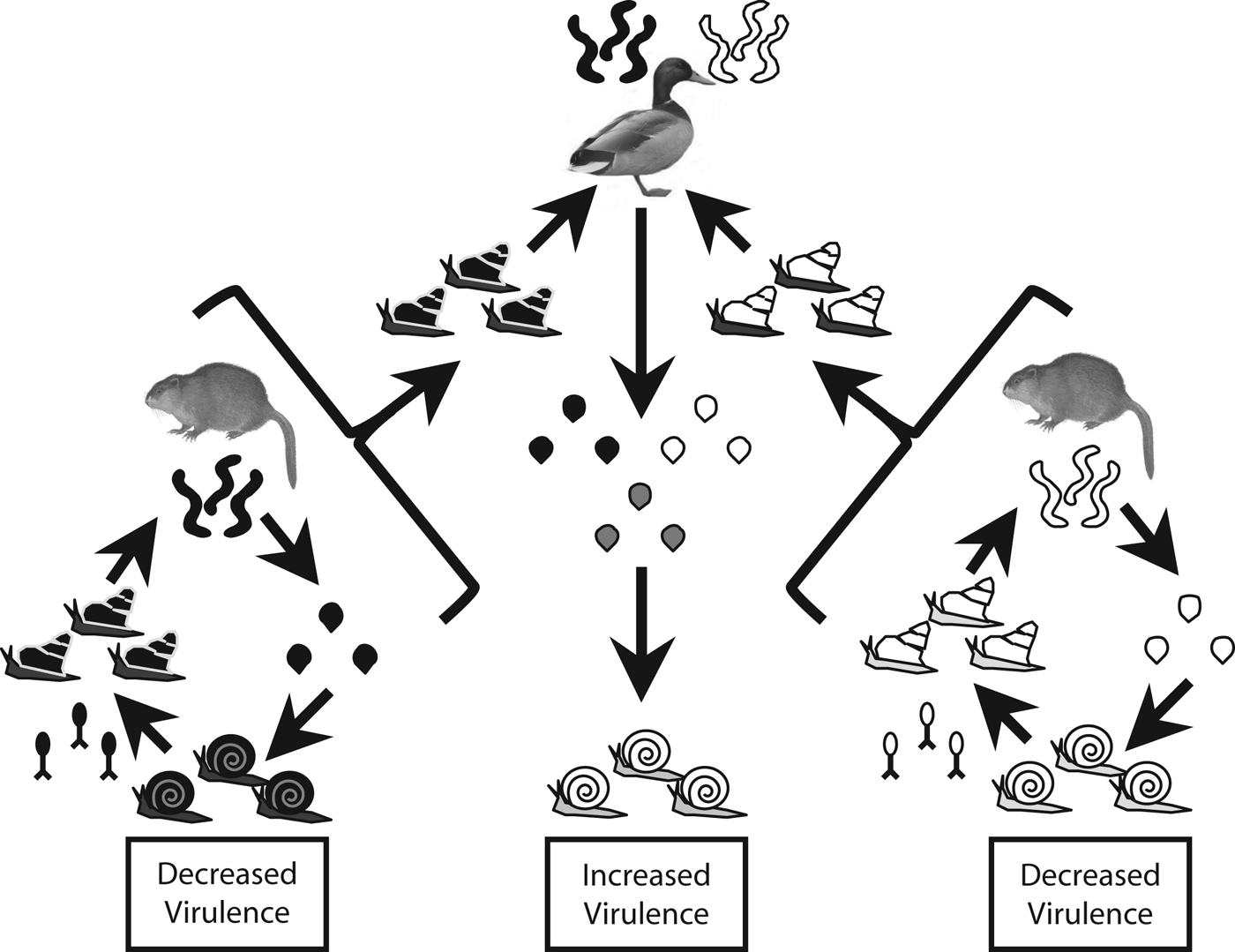
Alternatively, waterfowl tend to be high-movement organisms that move among different, otherwise isolated parasite populations. They serve as ‘mixing bowls’, where parasite genotypes from previously isolated regions can interbreed and create new genotypes that are then distributed back into the environment wherever the host travels (Curtis et al. Reference Curtis, Sorensen and Minchella2002). Large numbers of parasite genotypes from different parasite populations, and interbreeding among them, promotes genetic diversity and also decreases the relatedness of parasites within these definitive hosts. Thus, low-movement hosts are expected to facilitate the evolution of lower virulence in parasite populations while high-movement hosts are predicted to select for increased parasite virulence (Fig. 2).
Echinostoma trivolvis can infect a range of definitive hosts with varying levels of movement, including low-movement hosts such as muskrats, which maintain homogeneity in the population and decrease virulence, and high-movement hosts such as the mallard duck, which acts as a ‘mixing bowl’ (Curtis et al. Reference Curtis, Sorensen and Minchella2002), allowing parasites from separate populations to interbreed, depositing mixed genotypes into parasite populations, and causing increased heterogeneity and virulence. Symbols are labelled as in Fig. 1.

Some macroparasites, including some trematodes, have complex life cycles consisting of mobile second intermediate hosts, such as fish (Ballabeni and Ward, Reference Ballabeni and Ward1993) or crabs (Keeney et al. Reference Keeney, Waters and Poulin2007), which can play an important role in the parasite genetic diversity transmitted to definitive hosts (Detwiler, Reference Detwiler2010). Like mobile definitive hosts, these intermediate hosts can connect previously unconnected parasite populations and impact the relatedness of parasites in an infection. Studies assessing population genetics in second intermediate hosts have found high levels of parasite genetic diversity (Keeney et al. Reference Keeney, Waters and Poulin2007; Leung et al. Reference Leung, Poulin and Keeney2009) and we predict that high mobility intermediate hosts will select for higher virulence in both intermediate and definitive host populations.
Of course, movement and virulence exist on a continuum. Low-movement and high-movement hosts often share habitats, so the frequency of high-movement host visitation is another factor to consider when predicting virulence in a given parasite population. If a population of parasites primarily utilizes low-movement hosts but is exposed to visitations from high-movement hosts, then the population could exhibit relatively low genetic relatedness and high virulence despite the presence of a low-movement host population. While higher movement of parasites has been linked to higher virulence in empirical studies (Kerr et al. Reference Kerr, Neuhauser, Bohannan and Dean2006; Boots and Mealor, Reference Boots and Mealor2007), theoretical work has indicated that the relationship between movement and virulence may peak at intermediate levels of transmission distances under some circumstances (Lion and Boots, Reference Lion and Boots2010), suggesting that the strength of selection on virulence is dependent on the ecology, host demography and life history of each parasite system (Hall et al. Reference Hall, Smyth, Becker, Duffy, Knight, MacIntyre, Tessier and Cáceres2010). Another possibility is the development of a very virulent parasite that causes local host population extinction before selection on virulence can occur. It is possible then, that some habitats are characterized by extinction and re-colonization of hosts and parasites rather than selection on virulence over time.
While the link between host movement and virulence has not been investigated in the field, the connection between host movement and the genetic structure of a parasite population has been established (see Nadler, Reference Nadler1995 for review; Blouin et al. Reference Blouin, Yowell, Courtney and Dame1995). Natural population surveys indicate that parasite populations exist in a continuum from isolated (Sire et al. Reference Sire, Durand, Pointier and Theron1999; Theron et al. Reference Theron, Sire, Rognon, Prugnolle and Durand2004; Kuhls et al. Reference Kuhls, Keilonat, Ochsenreither, Schaar, Schweynoch, Presber and Schönian2007) to highly mixed (Dabo et al. Reference Dabo, Durand, Morand, Diakite, Langand, Imbert-Establet, Doumbo and Jourdane1997; Keeney et al. Reference Keeney, King, Rowe and Poulin2009b ; Steinauer et al. Reference Steinauer, Hanelt, Agola, Mkoji and Loker2009) groups of genotypes, and that these patterns can be linked to the movement of hosts in the sampling region. Thiele et al. (Reference Thiele, Sorensen, Gazzinelli and Minchella2008) examined the genetic structure of Schistosoma mansoni parasites collected from human definitive hosts and found evidence that the parasite infrapopulations were not as distinct as might be expected, given the focal nature of schistosome transmission. This result has also been found in human populations in other regions (Steinauer et al. Reference Steinauer, Hanelt, Agola, Mkoji and Loker2009; Standley et al. Reference Standley, Kabatereine, Lange, Lwambo and Stothard2010), as well as in other parasite systems including Schistosoma japonicum in humans and bovines (Wang et al. Reference Wang, Shrivastava, Johansen, Zhang, Wang and Webster2006), nematodes in cattle and sheep (Blouin et al. Reference Blouin, Dame, Tarrant and Coutney1992, Reference Blouin, Yowell, Courtney and Dame1995) and spirochaetes in ticks (Qiu et al. Reference Qiu, Dykhuizen, Acosta and Luft2002; Gomez-Diaz et al. Reference Gomez-Diaz, Boulinier, Sertour, Cornet, Ferquel and McCoy2011). The opposite scenario, where populations of parasites are isolated and genetically distinct, has been identified using schistosomes in humans from a village in Melquiades, Brazil where localized river use by the people in the region resulted in distinct parasite assemblages (Curtis et al. Reference Curtis, Sorensen and Minchella2002). This pattern has been shown in other parasite systems including Schistosoma haematobium and mansoni populations (Gower et al. Reference Gower, Gouvras, Lamberton, Deol, Shrivastava, Mutombo, Mbuy, Norton, Webster, Stothard, Garba, Lamine, Kariuki, Lange, Mkoji, Kabatereine, Gabrielli, Rudge, Fenwick, Sacko, Dembele, Lwambo, Tchuente, Rollinson and Webster2013), Plasmodium falciparum populations in humans (Anderson et al. Reference Anderson, Haubold, Williams, Estrada-Franco, Richardson, Mollinedo, Bockarie, Mokili, Mharakurwa, French, Witworth, Velez, Brockman, Nosten, Ferreira and Day2000), Ixodes uriae and Ixodes ricinus tick populations (McCoy et al. Reference McCoy, Boulinier and Tirard2005; Kempf et al. Reference Kempf, De Meeus, Vaumourin, Noel, Taragel'ova, Plantard, Heylen, Eraud, Chevillon and McCoy2011), Leishmania sp. protozoa (see Schonian et al. Reference Schonian, Kuhls and Mauricio2011 for review), and Fascioloides magna flukes in deer (Mulvey et al. Reference Mulvey, Aho, Lydeard and Smith1991).
Effects of habitat fragmentation on host movement
Factors that influence host movement and patterns of parasite transmission have been shown to impact virulence (Boots and Mealor, Reference Boots and Mealor2007; Hall et al. Reference Hall, Smyth, Becker, Duffy, Knight, MacIntyre, Tessier and Cáceres2010). For instance, habitat structure was found to play a large role in the differences in disease intensity of Daphnia dentifera populations in different lakes (Hall et al. Reference Hall, Smyth, Becker, Duffy, Knight, MacIntyre, Tessier and Cáceres2010) and the prevalence of the lyme disease bacterium Borrelia burgdorferi in white-footed mice (Allan et al. Reference Allan, Keesing and Ostfeld2003). Habitat fragmentation is one process that can influence host movement and habitat structure. Fragmentation results in patches of suitable habitat that are isolated in the landscape (Opdam, Reference Opdam1991; Mbora and McPeek, Reference Mbora and McPeek2009). Populations in smaller and more isolated patches tend to have less gene flow, be more prone to extinction and have lower colonization rates than those in larger patches (Opdam, Reference Opdam1991).
Despite the abundance of fragmentation research, only a few empirical studies have incorporated parasites, with most of these studies examining parasite prevalence in response to fragmentation (Allan et al. Reference Allan, Keesing and Ostfeld2003; Gillespie and Chapman, Reference Gillespie and Chapman2008; Mbora and McPeek, Reference Mbora and McPeek2009; Cristóbal-Azkarate et al. Reference Cristóbal-Azkarate, Hervier, Vegas-Carrillo, Osorio-Sarabia, Rodríquez-Luna and Veà2010). For parasites, decreased gene flow of the host should correlate to decreased genetic variation in the parasite population, with parasites within a patch becoming isolated from outside patches along with their host. Studies have shown that organisms with intermediate dispersal ability are impacted the most by habitat fragmentation (Fahrig, Reference Fahrig2003; Blanchet et al. Reference Blanchet, Rey, Etienne, Lek and Loot2010), since high-movement organisms can extend their range to include more suitable patches (Widen, Reference Widen1989; Rolstad, Reference Rolstad1991), while low-movement organisms can exist within a single suitable patch (Andrén, Reference Andrén1994; Blanchet et al. Reference Blanchet, Rey, Etienne, Lek and Loot2010). We might expect that the effects of fragmentation on parasites would be similar to the effects on its host, with parasite genotypes that infect hosts with intermediate dispersal ability at the highest risk of extinction. Low-movement hosts and their parasites may be relatively unaffected by fragmentation, as long as their original home range is able to fit within available suitable patches (Cotner and Schooley, Reference Cotner and Schooley2011), and the virulence of the parasites in those hosts is low enough that it does not drive the host population to extinction. However, parasites within very small and highly disturbed fragments may face extinction if the habitat is unable to support their host population (Cristóbal-Azkarate et al. Reference Cristóbal-Azkarate, Hervier, Vegas-Carrillo, Osorio-Sarabia, Rodríquez-Luna and Veà2010). High movement hosts may increase their ranges to include more suitable habitat, expanding the range of population mixture to include novel parasite genotypes in incorporated patches. For instance, deer mice have been shown to increase transmission of the Sin Nombre virus because they move farther in fragmented landscapes (Langlois et al. Reference Langlois, Fahrig, Merriam and Artsob2001).
Fragmentation will have implications for virulence. It is known that animals with larger home ranges have higher parasite prevalence (Gregory, Reference Gregory1990; Nunn et al. Reference Nunn, Altizer, Jones and Sechrest2003; Mbora and McPeek, Reference Mbora and McPeek2009), and that parasites that transmit over larger spatial scales have higher virulence (Boots and Sasaki, Reference Boots and Sasaki1999; Boots and Mealor, Reference Boots and Mealor2007). Fragmentation will also increase the density of host populations in habitat fragments, increasing parasite transmission, prevalence and diversity (Allan et al. Reference Allan, Keesing and Ostfeld2003; Mbora and McPeek, Reference Mbora and McPeek2009). An increase in host home range will decrease relatedness and affect more parasite populations, potentially increasing virulence over a larger spatial scale. The opposite result, where fragmentation removes a parasite population from the range of a high-movement host or causes a host of intermediate movement to become extinct, leads to decreased genotype diversity, decreased virulence and possibly local parasite extinction. It is likely that fragmented landscapes will contain small, isolated patches with depleted or absent parasite populations. Therefore, the size and distribution of patches in a fragmented landscape, and their effect on host movement, could determine where parasites are located, the virulence of existing populations, and the patterns of disease found in host populations of a given region.
HOSTS AS FILTERS
Hosts may play a role in virulence evolution by acting as a ‘filter’ that selects against particular parasite genotypes through resistance (Combes, Reference Combes2001). Resistance is the ability of a host to avoid infection by a parasite and is often associated with host morphological, physiological or immunological mechanisms (Bayne, Reference Bayne2009). It is often a genotype-specific trait, where hosts are resistant to specific parasite genotypes and susceptible to others (Webster and Woolhouse, Reference Webster and Woolhouse1998; Webster et al. Reference Webster, Gower and Blair2004; Lambrechts et al. Reference Lambrechts, Fellous and Koella2006; Lefevre et al. Reference Lefevre, Williams and de Roode2011). Host resistance can impact parasite population structure. If the host population is only susceptible to certain parasite genotypes it will decrease the likelihood that different, unrelated genotypes will co-infect the same host and therefore lower virulence levels (Fig. 3). Likewise, the presence of resistant hosts in a population can result in an overdispersed parasite population structure in which a few infected hosts are responsible for the majority of a parasite population's transmission (Woolhouse et al. Reference Woolhouse, Dye, Etard, Smith, Charlwood, Garnett, Hagan, Hii, Ndhlovu, Quinnell, Watts, Chandiwana and Anderson1997; Matthews et al. Reference Matthews, Low, Gally, Pearce, Mellor, Heesterbeek, Chase-Topping, Naylor, Shaw, Reid, Gunn and Woolhouse2006; Paull et al. Reference Paull, Song, McClure, Sackett, Kilpatrick and Johnson2011). For instance, a meta-analysis of RNA-viruses in birds found that only 20% of the hosts were responsible for up to 80% of the parasite transmission (Jankowski et al. Reference Jankowski, Williams, Fair and Owen2013).
Resistant intermediate hosts act as a filter, removing incompatible genotypes from the population by preventing them from establishing infection. (A) If parasites are transported to a population of novel intermediate hosts they may not be adapted to infect those hosts and may find them resistant to infection (resistance represented by the dashed line). (B) If the novel host population is not evolved to be resistant it may become infected by all deposited genotypes, increasing unrelated interactions and virulence in the population.

Resistance has been documented in both definitive and intermediate hosts, and has been well studied in gastropod intermediate hosts of some trematodes (Richards, Reference Richards1975; Webster and Woolhouse, Reference Webster and Woolhouse1999; Bayne, Reference Bayne2009). Here, we discuss intermediate host resistance and its impact on virulence, using existing knowledge from trematode systems and making predictions about its role in parasite virulence evolution. Definitive host resistance and the underlying immunology linked to resistance are beyond the scope of this review, but the possible impact of definitive host resistance on predictions will be outlined. For information on definitive host resistance and its mechanisms see Bartholomew (Reference Bartholomew1998) (Salmonids and Myxosporeans), Finkelman et al. (Reference Finkelman, Shea-Donohue, Goldhill, Sullivan, Morris, Madden, Gause and Urban1997) (rodents and nematodes), Gazzinelli et al. (Reference Gazzinelli, Ropert and Campos2004) (mammals and protozoans) and Harris et al. (Reference Harris, Lambrechts, Rousset, Abate, Nsango, Fontenille, Morlais and Cohuet2010) (mosquitoes and Plasmodium).
In trematode parasite systems, resistance is associated with a high cost because resistant hosts must allocate energy towards immune defences. Indeed, resistant hosts often have decreased growth and reproduction compared with uninfected non-resistant hosts (Cooper et al. Reference Cooper, Richards, Lewis and Minchella1994; Webster and Woolhouse, Reference Webster and Woolhouse1999; Gandon and Michalakis, Reference Gandon and Michalakis2000). Therefore, if virulence is low, selection may not favour the maintenance of resistance even if the prevalence of infection in the host population is high (Minchella, Reference Minchella1985; Duncan et al. Reference Duncan, Fellous and Kaltz2011).
Interestingly, recent studies in other parasite systems have demonstrated that developing resistance to monocultures of parasites bears no cost to a host while resistance to parasites of different genetic backgrounds is costly (Labbe et al. Reference Labbe, Vale and Little2010; Koskella et al. Reference Koskella, Lin, Buckling and Thompson2012). Both of these studies focused on obligately killing parasites such as bacteriophage in bacteria or Pasteuria ramosa in Daphnia, where resistance may be more beneficial because the cost of infection (host death) is so high. Environmental factors also impact resistance (Hall and Ebert, Reference Hall and Ebert2012), and it is possible that the cost of resistance may be masked by environmental conditions and go undetected in some studies (see Sandland and Minchella, Reference Sandland and Minchella2003). Whether intermediate hosts in nature pay a cost to develop resistance to homogeneous parasite environments, such as those established by low-movement hosts, is an intriguing question that has not been fully explored in parasite systems with complex life cycles.
The ability of an intermediate host population to develop resistance is, in part, dependent on the genetic diversity within the host population (Luquet et al. Reference Luquet, Garner, Lena, Bruel, Joly, Lengagne, Grolet and Plenet2012). Generally, higher genetic diversity results in less infection in host populations (see King and Lively, Reference King and Lively2012 for review). Host genetic diversity is dependent upon the effective population size (N e ), which affects the amount of inbreeding and genetic drift in the population. The N e of a parasite and host population influences whether changes in parasite genetics over time are caused by selection or are merely an artefact of drift (Criscione and Blouin, Reference Criscione and Blouin2005).
Resistance in host populations is difficult to quantify and the majority of studies documenting resistance in populations have focused on microbial and/or plant pathogens (Duffy and Sivars-Becker, Reference Duffy and Sivars-Becker2007; de Roode and Altizer, Reference de Roode and Altizer2009; Laine et al. Reference Laine, Burdon, Dodds and Thrall2011), with few studies looking at the dynamics of resistance and virulence in these populations over time (Tack et al. Reference Tack, Thrall, Barrett, Burdon and Laine2012). Knowledge about the proportion of hosts in a population that are infected with multiple parasite genotypes, and how virulence differs in populations with different proportions, would be useful to understand the impact resistance could have on virulence evolution. Studies assessing parasite genotypic diversity within hosts exist in many parasite systems (Minchella et al. Reference Minchella, Sollenberger and Pereira De Souza1995; Keeney et al. Reference Keeney, King, Rowe and Poulin2009b ; Steinauer et al. Reference Steinauer, Hanelt, Agola, Mkoji and Loker2009; Tognazzo et al. Reference Tognazzo, Schmid-Hempel and Schmid-Hempel2012; Nkhoma et al. Reference Nkhoma, Nair, Al-Saai, Ashley, McGready, Phyo, Nosten and Anderson2013), but have not linked the genetic composition of parasite infections to virulence in natural populations. We predict that resistance in natural, low-movement, intermediate host populations should result in selection for lower virulence levels in those host populations, regardless of the amount of definitive host movement (Fig. 3).
Likewise, resistance in definitive hosts will act to decrease virulence in the definitive host population by decreasing the number of different genotypes that establish in individual hosts. However, definitive host resistance may not lower the overall genetic relatedness of parasites in an intermediate host population if many, highly mobile, hosts from different areas visit that population and deposit a variety of parasite genotypes. Interestingly, there is evidence that a trade-off exists between hosts in complex life cycles, in which virulence in one host corresponds to avirulence or low virulence in the next (Davies et al. Reference Davies, Webster and Woolhouse2001). Whether the direction of this trade-off is fixed, or one type of host will always end up with less virulence than the other is unclear, but future research investigating virulence across a parasite's life cycle would be useful in resolving this relationship.
TRANSPORTERS, FILTERS AND VIRULENCE EVOLUTION
While the presence of resistance in an intermediate host population may filter out novel parasite genotypes that are transported into the population by definitive hosts, it is possible that resistance is in itself a result of the movements of the definitive host. For instance, if a high-movement definitive host transports novel parasite genotypes into a population of intermediate hosts, and the parasites are able to infect those hosts, then the new parasite genotypes would decrease relatedness of the parasites within each intermediate host and increase the virulence of the parasite population (Davies et al. Reference Davies, Fairbrother and Webster2002; de Roode et al. Reference de Roode, Pansini, Cheesman, Helinski, Huijben, Wargo, Bell, Chan, Walliker and Read2005). This increase in virulence could select for increased frequency of resistance in the intermediate hosts, because the cost of getting infected and tolerating parasite damage would be higher than the energetic allocations to maintain resistance and remain uninfected. In contrast, if there are only low-movement definitive hosts in the life cycle, then there will be increased relatedness of the parasites within, and decreased virulence to, the intermediate host population. This would select against host resistance since the intermediate hosts are only subject to low virulence levels and should instead tolerate the infection to avoid paying the cost for maintaining resistance. In this way, definitive host movement may be the driver of both virulence evolution as well as the development and maintenance of intermediate host resistance. In the simplest scenario, high-movement definitive hosts select for increased virulence that selects for resistance, while low-movement hosts select for decreased virulence that can lead to lower resistance.
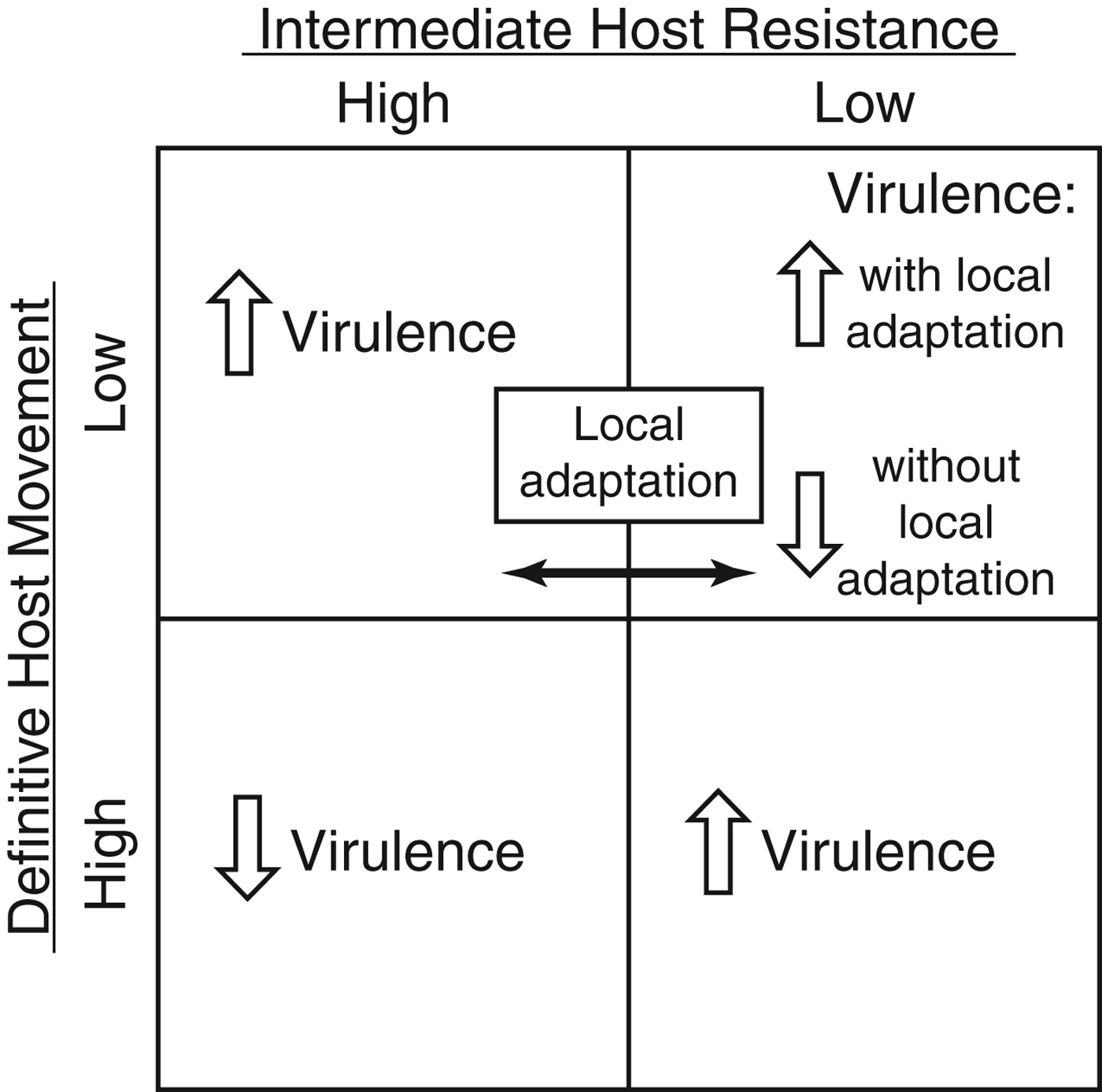
Overall, the movement and resistance of hosts can be used to develop predictions about the expected virulence in host-parasite systems (Fig. 4). However, the interaction between these two factors can alter expected outcomes. A factor that complicates how host movement and resistance influence virulence is local adaptation, in which parasites evolve towards being able to infect ‘native’ hosts in their environment (Prugnolle et al. Reference Prugnolle, Liu, de Meeus and Balloux2005). Studies have shown that parasite populations that have low migration, and are thus genetically differentiated from other populations, are better able to infect sympatric hosts than allopatric hosts (Lively, Reference Lively1989, Reference Lively1999; Kaltz and Shykoff, Reference Kaltz and Shykoff1998). This scenario is often the case with trematode parasites and their intermediate hosts (Thiele et al. Reference Thiele, Correa-Oliveira, Gazzinelli and Minchella2013). A parasite population that is locally adapted will impose a higher fitness cost on its local host population, resulting in a higher level of virulence than predicted for parasites that utilize low-movement definitive hosts. This increase in virulence could in turn select for resistance to the virulent genotype within the intermediate host population, which would then select for a decrease in the virulence of the parasite population as that genotype is decreased. As susceptible hosts become more unavailable in a local host population and resistance is higher, some models predict the development of higher virulence (Lion and Boots, Reference Lion and Boots2010), while others predict selection for lower virulence (Gandon and Michalakis, Reference Gandon and Michalakis2000). However, in the context of local adaptation we would expect both to be true – higher resistance should target and decrease the most virulent genotype, lowering virulence in the population. Meanwhile, remaining genotypes should become locally adapted given the proper settings, and increase virulence to their hosts. As a result, we would predict cyclic fluctuation of virulence levels over time in these natural populations (see Fig. 4), as expected under Red Queen dynamics (Decaestecker et al. Reference Decaestecker, Gaba, Raeymaekers, Stoks, Van Kerckhoven, Ebert and De Meester2007).
Virulence predictions based on host resistance and movement.

There is some evidence that parasites can co-evolve with their hosts and quickly overcome host resistance (Ridout et al. Reference Ridout, Skamnioti, Porritt, Sacristan, Jones and Brown2006; Webster et al. Reference Webster, Shrivastava, Johnson and Blair2007), but the rate at which they overcome resistance is dependent on the genetic composition of both the host and parasite populations (Fournet et al. Reference Fournet, Kerlan, Renault, Dantec, Rouaux and Montarry2013). However, if a parasite population is locally adapted to a specific host population then they may be unable to establish infection in hosts outside of that population (Greischar and Koskella, Reference Greischar and Koskella2007; Jones-Nelson et al. Reference Jones-Nelson, Thiele and Minchella2011) and, without continued exposure to that host population, would be unable to overcome non-native host resistance. This inability to infect hosts outside the local area would result in low-mobility host populations being ‘resistant’ to non-local parasite genotypes – a phenomenon that would directly impact the genetic structure of parasite populations and the influence that high-movement definitive hosts have on virulence evolution.
FUTURE EMPIRICAL RESEARCH
With the increasing availability of cost-effective high-throughput sequencing, researchers are now able to combine parasite genetics with infection patterns in the field, allowing virulence evolution theory to be tested in natural host-parasite systems (Archie et al. Reference Archie, Luikard and Ezenwa2009). With molecular markers we can assess the genetic structure of host and parasite populations, and, in complex life cycles, examine differences in parasite genetics across life stages and within different hosts. However, population genetics studies that investigate virulence are limited because of the difficulties associated with sampling natural parasite populations. These include: unknown time of infection, unknown host age and the possible presence of other parasite species. These unknown variables prevent the accurate measurement of virulence using standard methods (parasite yield as a measure of parasite fitness and host growth and mortality as host costs, etc.). Macroparasite infection rates in first intermediate host populations also tend to be low, since parasites are often aggregated within a few hosts, making the acquisition of appropriate sample sizes difficult (Jovani and Tella, Reference Jovani and Tella2006; Steinauer et al. Reference Steinauer, Hanelt, Agola, Mkoji and Loker2009). Generally, research on natural populations of microparasites, and the development of genomic tools for these groups, has progressed farther than that on macroparasites, so research that links virulence to parasite populations may be more feasible with organisms like Plasmodium, where natural populations of host and parasite have been more thoroughly investigated at the present time.
For example, it has already been shown that mixed genotype infections of Plasmodium result in higher virulence, and that more virulent pathogens have a competitive advantage in mixed infections (de Roode et al. Reference de Roode, Pansini, Cheesman, Helinski, Huijben, Wargo, Bell, Chan, Walliker and Read2005; Mackinnon and Marsh, Reference Mackinnon and Marsh2010). Plasmodium parasites also exhibit kin discrimination (Reece et al. Reference Reece, Drew and Gardner2008), and so the relatedness of parasites within a host may be influencing virulence evolution. Additionally, natural variation in parasite resistance levels has been documented in both the intermediate vertebrate hosts as well as the definitive mosquito hosts in this system (Lambrechts et al. Reference Lambrechts, Halbert, Durand, Gouagna and Koella2005; see Longley et al. Reference Longley, Smith, Fortin, Berghout, McMorran, Burgio, Foote and Gros2011 for review). In Anopheles spp. mosquitoes the genetic interaction between each parasite and host determines resistance, with specific host-parasite combinations resulting in infection, and others not (Lambrechts et al. Reference Lambrechts, Halbert, Durand, Gouagna and Koella2005). This indicates that genetic diversity in both host and parasite populations is important in dictating compatibility. However, in a rodent malaria model it was found that the vertebrate host genotype played a larger role than the interaction between host and parasite, suggesting that the diversity of intermediate host population genetics determines the amount of resistance, and degree of parasite genotype filtering that occurs in natural populations (Grech et al. Reference Grech, Watt and Read2006).
In terms of host movement, we know that both the definitive and intermediate hosts in the Plasmodium system can vary in their movement levels (Simard et al. Reference Simard, Ayala, Kamden, Pombi, Etouna, Ose, Fotsing, Fontenille, Besansky and Costantini2009; Wesolowski et al. Reference Wesolowski, Eagle, Tatem, Smith, Noor, Snow and Buckee2012). Human (intermediate host) movement can vary in distance and frequency and there are records of human movement that have been linked to areas of malaria prevalence in an attempt to better understand transmission patterns for this parasite (Wesolowski et al. Reference Wesolowski, Eagle, Tatem, Smith, Noor, Snow and Buckee2012). Likewise, Anopheles spp. mosquitoes, the definitive host, vary in their movement levels. Anopheles gambiae mosquito populations are currently in the process of speciation and have populations that are distinguished by different chromosomal inversions. Two forms, Savannah and Mopti, each of which differs in its ecology, were previously described by Coluzzi et al. (Reference Coluzzi, Petrarca and Di Deco1985). The Savannah form is dependent on natural bodies of water to breed, and is only reproductively active during rainy seasons (Simard et al. Reference Simard, Ayala, Kamden, Pombi, Etouna, Ose, Fotsing, Fontenille, Besansky and Costantini2009). The Mopti form is adapted to anthropogenic sites and utilizes stable structures such as irrigation canals for reproduction. The two forms occur in sympatry, but are reproductively isolated (Simard et al. Reference Simard, Ayala, Kamden, Pombi, Etouna, Ose, Fotsing, Fontenille, Besansky and Costantini2009). Based on genetic evidence of population differentiation, Mopti mosquitoes are thought to have lower movement than Savannah mosquitoes (Simard et al. Reference Simard, Ayala, Kamden, Pombi, Etouna, Ose, Fotsing, Fontenille, Besansky and Costantini2009), providing a low- and high-movement definitive ‘host’ for use in future research.
Population genetics studies of P. falciparum, the most virulent among the Plasmodium that infect humans, have shown that parasites in areas with high genetic admixture between populations have high genetic diversity and high transmission (Anderson et al. Reference Anderson, Haubold, Williams, Estrada-Franco, Richardson, Mollinedo, Bockarie, Mokili, Mharakurwa, French, Witworth, Velez, Brockman, Nosten, Ferreira and Day2000), a variable known to be correlated with virulence (Anderson and May, Reference Anderson and May1981). Likewise, parasites in populations that are genetically isolated had low genetic variation, high relatedness and low transmission (Nkhoma et al. Reference Nkhoma, Nair, Al-Saai, Ashley, McGready, Phyo, Nosten and Anderson2013). This supports predictions that host movement levels could influence the genetic structure of parasite populations and the direction of virulence evolution, as outlined in Fig. 2.
Current research in this host-parasite system has established links between parasite relatedness and virulence, and host movement and virulence. Further research investigating host resistance in areas of high and low disease prevalence and looking at parasite relatedness in hosts of high and low movement will help fill gaps in our knowledge and allow us to better understand virulence evolution in natural parasite systems. Since both the parasite and host genomes are sequenced (Gardner et al. Reference Gardner, Hall, Fung, White, Berriman, Hyman, Carlton, Pain, Nelson, Bowman, Paulsen, James, Eisen, Rutherford, Salzberg, Craig, Kyes, Chan, Nene, Shallom, Suh, Peterson, Angiuoli, Pertea, Allen, Selengut, Haft, Mather, Vaidya, Martin, Fairlamb, Fraunholz, Roos, Ralph, McFadden, Cummings, Subramanian, Mungall, Venter, Carucci, Hoffman, Newbold, Davis, Fraser and Barrell2002; Holt et al. Reference Holt, Subramanian, Halpern, Sutton, Charlab, Nusskern, Wincker, Clark, Ribeiro, Wides, Salzberg, Loftus, Yandell, Majoros, Rusch, Lai, Kraft, Abril, Anthouard, Arensburger, Atkinson, Baden, de Berardinis, Baldwin, Benes, Biedler, Blass, Bolanos, Boscus, Barnstead, Cai, Center, Chatuverdi, Christophides, Chrystal, Clamp, Cravchik, Curwen, Dana, Delcher, Dew, Evans, Flanigan, Grundschober-Freimoser, Friedli, Gu, Guan, Guigo, Hillenmeyer, Hladun, Hogan, Hong, Hoover, Jaillon, Ke, Kodira, Kokoza, Koutsos, Letunic, Levitsky, Liang, Lin, Lobo, Lopez, Malek, McIntosh, Meister, Miller, Mobarry, Mongin, Murphy, O'Brochta, Pfannkoch, Qi, Regier, Remington, Shao, Sharakhova, Sitter, Shetty, Smith, Strong, Sun, Thomasova, Ton, Topalis, Tu, Unger, Walenz, Wang, Wang, Wang, Wang, Woodford, Wortman, Wu, Yao, Zdobnov, Zhang, Zhao, Zhao, Zhu, Zhimulev, Coluzzi, della Torre, Roth, Louis, Kalush, Mural, Myers, Adams, Smith, Broder, Gardner, Fraser, Birney, Bork, Brey, Venter, Weissenbach, Kafatos, Collins and Hoffman2002), molecular tools are readily available (Campino et al. Reference Campino, Auburn, Kivinen, Zongo, Ouedraogo, Mangano, Djimde, Doumbo, Kiara, Nzila, Borrmann, Marsh, Michon, Mueller, Siba, Jiang, Su, Amaratunga, Socheat, Fairhurst, Imwong, Anderson, Nosten, White, Gwilliam, Deloukas, MacInnis, Newbold, Rockett, Clark and Kwiatkowski2011), and data about disease intensity are on record for some regions (Wesolowski et al. Reference Wesolowski, Eagle, Tatem, Smith, Noor, Snow and Buckee2012), the Plasmodium-host system serves as an example where future virulence research incorporating variables that impact natural parasite populations is feasible.
Studies on macroparasite systems, such as trematodes, will require more preliminary research on the characteristics of host movement and resistance, as well as parasite transmission and genetics, but could utilize semi-natural experiments to counter some of the difficulties researchers face with these systems. To link movement and resistance to virulence in a semi-natural setting, parasites can be obtained from collected field intermediate hosts and, with time, a laboratory life cycle can be established using these intermediate hosts (or F1 offspring with known age and infection status) and laboratory (or field) definitive hosts. Experimental designs that include moving different parasite mixtures across intermediate host populations housed in outdoor holding tanks could serve as a semi-natural means of simulating host movement differences. The extent that genotypes are filtered out of the parasite population by host resistance could be evinced by genotyping the larval stages that go into and emerge from the intermediate hosts. These parasite treatments could be continued for more than one host generation by exposing host offspring to the same parasite genotypes as the parental generation. This experimental design will help determine whether the trend towards lower virulence in related infections extends beyond the single generation shown in laboratory experiments. Tracking these populations will determine how host resistance impacts parasite virulence on a population level and will allow observation of whether cyclical fluctuations in resistance and virulence occur in the populations over time.
CONCLUSION
While virulence is well studied in mathematical models and laboratory populations, studies of virulence in natural populations are lacking. Host movement and resistance are two variables that can influence the evolution of parasite virulence by shaping the distribution of genetic variation, and ultimately relatedness, in parasite populations. With the increasing ease and availability of molecular technology, population-level studies of parasite and host genetics are now feasible and should be the focus of virulence research in the future. Studies of parasite population genetics can assess the genetic structure of parasite populations, relatedness within them and gene flow among them, and link this information to disease dynamics to better understand factors that drive virulence evolution. These studies can be paired with natural or semi-natural designs to better investigate the effects of movement and resistance on the evolution of virulence and determine whether host ecology and kin selection can predict parasite virulence.
ACKNOWLEDGEMENTS
The authors would like to thank Drs Nancy Emery, Jillian Detwiler, Richard Howard, J. Andrew DeWoody, David Bos, Greg Sandland and Elizabeth Thiele, as well as members of the Minchella lab for helpful discussions and comments, Luke Tyrrell for assistance with figures, and two anonymous reviewers whose comments greatly improved this manuscript.