The end of the Napoleonic Wars in 1815 effected a severe agricultural and manufacturing depression. As Roger Wells notes, the ‘war-induced high farm-product prices’ suffered deflation, whilst there was no longer any need to produce the ‘artefacts of war’. Men who had previously been in military service re-entered the labour market depressing wages and increasing unemployment. While in the manufacturing areas the depression was ‘relatively short’, in rural areas it was both enduring and intense. Indeed, as David Eastwood contends, ‘the post-war depression generated the most acute crisis in the entire period’ between 1780 and 1840. This was especially the case in relation to the poor laws, with national poor relief expenditure rocketing post-1816.Footnote 1 The £2 million spent on relief in England and Wales in 1783–5 had doubled by 1802–3 and continued to escalate to £8 million by 1818. When accounting for population growth, there was still a significant increase in the average annual cost of poor relief in England and Wales, which rose from 4 s per head in 1776 to 13 s in 1818.Footnote 2
Following a ‘detailed statistical inquiry into the operation of the poor laws and the scale of relief payments’ by the government, a House of Commons select committee was appointed in 1816 to investigate further.Footnote 3 The select committee comprised forty gentlemen, including Thomas Frankland Lewis, later a commissioner of the new poor law, and chairman William Sturges Bourne, chair of the Hampshire quarter sessions from 1817 to 1822 and later a member of the royal commission on the poor laws 1832–4.Footnote 4 The aim of Sturges Bourne and the select committee was not, however, to abolish the old poor laws – as many commentators had called for – but to develop legislation which permitted administrative reform of the existing parish administrative structure.Footnote 5 The result was a series of parliamentary bills, two of which became known as the ‘Sturges Bourne Acts’ of 1818 and 1819. The 1818 act allowed voting rights in open vestries to be weighted according to a vestryman's property rating, while the act of 1819 permitted parishes to appoint select vestries and assistant overseers, two measures designed to allow parishes to restrict relief.
Notwithstanding that, as Steve King has suggested, the acts had ‘fundamental consequences for the experience of being poor’, their adoption and impact on the provision of poor relief has been little researched and as such remains poorly understood.Footnote 6 The reasons behind this lack of systematic attention are perhaps understandable for two reasons. First, the royal commission's Poor Law Report of 1834 stated that, while the reforms were potentially ‘highly beneficial’, in practice, so the report asserted, they were unpopular. Those select vestries that were appointed were sparsely attended and being prone to making ‘injurious’ relief decisions, and that poorly documented.Footnote 7 Secondly, analysis of the implementation of the reforms has been hindered by their ‘enabling’ status, the ‘opt in’ nature making the legislation of seemingly low importance. The reforms have thus been left in the shadow of that which followed – the Poor Law Amendment Act of 1834. This condescension of posterity is perhaps best summed up by the Webbs. To them, the measures were ‘[an] example of the inability of this generation to grapple effectively with its problems’.Footnote 8
This perspective on Sturges Bourne's reforms has been left largely unquestioned. In the words of Wells, ‘the adoption of Sturges Bourne has not been systematically studied, merely commented upon’.Footnote 9 Standard texts on poor law history therefore tend to detail the reforms as part of wider ‘legislative context’ chapters, but then pass over the uptake and effects of the reforms.Footnote 10 A two-parish analysis by Wells (of Sussex), and short surveys of the adoption of Sturges Bourne's reforms by Mark Neuman for Berkshire, Anne Digby for Lancashire and Yorkshire, and most recently David Green for London, are notable exceptions to this rule. Yet, apart from the last study which argues that the measures were ineffective in the metropolis because London already possessed many similar relief-granting bodies, these studies all demonstrate that the legislation appears to have achieved its stated objective in reducing relief costs.Footnote 11 Neuman, for instance, found that the new regime led to a 33 per cent reduction in relief expenditure in the Berkshire parish of White Waltham in the first year of adopting a select vestry, while the ‘heavily pauperised’ parish of Bray reduced its poor relief expenditure by 37 per cent.Footnote 12 Clearly, the reforms could make a considerable impact on the nature of relief and poor relief claimants of the early nineteenth century.
After detailing the specific facets of Sturges Bourne's reforms, this article considers first the nature and pattern of adoption – focusing specifically upon its two main provisions: select vestries and assistant overseers – before going on to consider the impact of the reforms on the poor. After establishing overall trends in England as a whole, the analysis offers a more detailed analysis of the uptake in several counties (for which see below). Focusing on the parish level administration of Sturges Bourne's reforms allows me to see how the complex ‘micro-politics’ operated when innovations in the delivery of relief were applied on the ground.Footnote 13 Lynn Hollen Lees and Steve Hindle use the term ‘welfare process’ to encapsulate the complex web of interactions within the ‘micro-politics’ of relief, the latter explaining how its ‘various participants – the labouring poor, the parish officers, the county magistrates, the itinerant judiciary’ engaged in ‘protracted and often antagonistic negotiations’ to reach a relief decision.Footnote 14 This chosen geographical focus is the ‘region’ of Wessex (Dorset, Hampshire, Somerset, and Wiltshire) with West Sussex. Together, these counties represented a variety of landscapes and rural industries: from the cloth trade of Wiltshire and Somerset, dairy farming in Dorset, Somerset, and Wiltshire, mining in Somerset, arable and livestock farming in Hampshire and Sussex, extensive forest industries in Hampshire and Wiltshire, and the important coastal fishing industry. Outworking also persisted in parts of Dorset, Somerset, and Wiltshire, not least in gloving and button-making. There were ‘closed’ parishes under the tight control of one family, such as Lord Egremont's dominance over large portions of West Sussex, and ‘open’ parishes composed of many landowners with small land holdings. Wages and rates of poverty therefore varied markedly from place to place as fortunes of different sectors changed.
The diversity offered by Wessex and West Sussex allows for the many potential ways in which the legislation was applied by different communities to be analysed and how it impacted upon the lives of relief claimants. Building upon Wells's important but initial study of the two Sussex parishes of Ticehurst and Westbourne,Footnote 15 the analysis presented here allows both for a richly textured understanding of experience and a deeper consideration of the varying ways in which the reforms were implemented across a far wider geographical area. Influenced by Lees's assertion that ‘[t]he heart of the welfare process lay in the contacts between the pauper and administrator’, select and open vestry minutes, overseers' accounts and other administrative documents from parishes throughout the region have been consulted to gather information as to how administrators judged and treated relief claimants. By so doing, the approach of the article allows us to move beyond the more socially abstract economic and political dynamics of the reforms, to instead offer an evaluation of their everyday human effects.
I
Before examining the impact of Sturges Bourne's reforms, it is important first to outline the several clauses of the two acts. The first Sturges Bourne's Act permitted parishes to reset the weighting of vestry votes on the basis of one vote per the first £50 property assessment with a sliding scale thereafter, up to a maximum of six votes for an assessment £150 or more. Those without property were also barred from attending vestry meetings. While this was controversial, and attracted opposition for making the vestry an exclusive group, the committee believed that the major ratepayers would better control the expenditure of the poor rates and reduce corruption. As Bryan Keith-Lucas puts it, the measure was intended to take the administration of poor relief ‘out of the hands of the poor themselves.’Footnote 16
The 1819 Act was specifically concerned with the mechanisms of relief provision, and permitted any parish to ‘establish a Select Vestry for the concerns of the Poor’ of between five and twenty ‘Substantial Householders or Occupiers’.Footnote 17 The select vestry had to be voted for by the majority of members of the open vestry and renewed annually therein, the official written agreement requiring the signature of one magistrate.Footnote 18 A chairman would be elected by the majority of the members of the select vestry and had a casting vote on unresolved decisions. Being required to meet at least once every fourteen days, the role of the select vestry was:
to examine into the State and Condition of the Poor of the Parish, and to inquire into and determine upon the proper Objects of Relief, and the Nature and Amount of the Relief to be given; and in each case take into Consideration the Character and Conduct of the poor Person to be relieved, and shall be at liberty to distinguish, in the Relief to be granted between the deserving, and the idle extravagant or profligate.Footnote 19
Once such inquiries were made, the overseer was bound to abide by the decisions of the select vestry and administer relief accordingly, except in cases of ‘sudden Emergency or urgent Necessity’.Footnote 20
The select vestry was not just a relief-issuing body, though, for the 1819 Act also permitted loans to be made to the poor which would then be repaid in weekly instalments.Footnote 21 Scholars of local government, most notably David Eastwood, have suggested though that the idea of a committee composed exclusively for the administration of relief was not itself a new practice. Separate committees were formed prior to the 1819 Act with the specific task of managing the welfare of the poor. Dorchester, for instance, had a system akin to a select vestry from 1794, before deciding in 1821 to place the pre-existing committee under the regulations of Sturges Bourne.Footnote 22 Committees were also frequently formed to undertake a specific task on behalf of the wider vestry. In the spring of 1798, for example, the Wincanton vestry established a committee of nine men ‘to examine into the Managemt. and expenditure of the Workhouse’.Footnote 23
Sturges Bourne's 1819 Act also permitted the appointment of assistant overseers, to be sanctioned annually by two magistrates after checking the applicant's financial indemnity agreement. In return for undertaking ‘all such of the Duties of the Office of Overseer of the Poor’, and any specified in the contract of his appointment, the assistant would receive a salary set by members of the vestry.Footnote 24 According to Eastwood, this section of the Act encouraged ‘a few would-be bureaucrats to devote themselves to parish administration’, thereby promoting a growing ‘professionalism’, akin to a ‘poor law civil service’.Footnote 25 Indeed, assistant overseers were paid a salary from the parish purse and were re-appointed on an annual basis. But just as select vestries were not an entirely new idea before the passage of the 1819 Act, neither were assistant overseers. Variably called ‘perpetual’, ‘deputy’, ‘acting’, ‘standing’, and ‘rating’ overseers, such pre-Sturges Bourne appointees were often to be found collecting the rates, distributing poor relief, managing poorhouses, and even playing the church organ.Footnote 26 Some rural parishes in Wessex and Sussex employed assistant overseers many years before the Sturges Bourne reforms, the large, sparsely populated parish of Chew Magna making such an appointment as early as 1769.Footnote 27 Chew Magna, according to George Nicholls, was archetypal: the appointment of assistant overseers being particularly desirable in large rural parishes where collecting the rates and distributing poor relief was particularly onerous.Footnote 28 These early ‘assistant overseers’ were usually salaried, but not always exclusively supported from the parish funds. In 1811, the Bruton vestry appointed Thomas Bord as a ‘rating overseer’ to collect the rates. His salary was £20 a year, but only half came from the poor rates. Each ordinary overseer was also to contribute £5 from their own pockets, as it was a task by law they were supposed to undertake themselves.Footnote 29
The 1819 Act also contained a series of other optional directives. One such clause allowed parishes to procure twenty acres of land on which to work the poor.Footnote 30 Another clause also allowed parish vestries both to build and expand parish workhouses for the accommodation of the poor.Footnote 31 Furthermore, parishes were also permitted to enter into arrangements with adjoining parishes for the hire or purchase of workhouses, thus imitating the provisions of Gilbert's Act (1782).Footnote 32 According to Wells, appointing a select vestry while also providing relief according to Gilbert's Act was forbidden in Sturges Bourne's 1819 Act.Footnote 33 Indeed, several parish officials at the time thought this to be the case, with three parishes in Hampshire informing the Poor Law Commission in the Rural Queries that they could not adopt Sturges Bourne's Act because they had adopted Gilbert's Act.Footnote 34 An examination of the act shows, however, that it was not strictly forbidden: a penultimate section of the 1819 Act contained a proviso merely expressing that the act does not intend to alter the ‘Powers, Directions, Provisions or Regulations' of Gilbert's Act and those stipulations contained in local acts ‘for the Maintenance, Relief or Regulation of the Poor’. All magistrates and parish officials were, therefore, able to decide for themselves whether also to adopt the provisions of Sturges Bourne's Act.Footnote 35
Magistrates retained their importance in parishes adopting the implementation of the poor laws under Sturges Bourne's Acts. One magistrate alone could issue relief in cases of emergency to a claimant from a parish operating a select vestry, as they could for a claimant from a parish with an open vestry. Yet Sturges Bourne endeavoured to make it harder for parish relief decisions to be overturned. After hearing a complaint from an individual, just one magistrate was required to direct an open vestry to alter their decision. A claimant from a parish operating a select vestry, however, needed the support of two magistrates.Footnote 36 According to Peter Dunkley, the role of magistrates to act as a referee on relief decisions meant that minimum standards of relief were often met.Footnote 37 Steven King concurs.Footnote 38 Wells, on the other hand, demonstrates how magistrates united with their own class, the propertied, to use poor relief as a way to control the community.Footnote 39 By analysing the notebooks of Samuel Whitbread, Peter King found a benevolent magistrate who had overturned two-thirds of the cases he heard. But such decisions were not necessarily replicated by others.Footnote 40 Depending on the disposition of each magistrate, therefore, the need of an additional magistrate to support a complaint towards a select vestry decision may have put an additional barrier between the claimant and their poor relief, as Sturges Bourne had intended. Before a vestry could act according to Sturges Bourne's measures, though, magistrates also had to ratify the appointments. Only one signature was needed for a select vestry appointment and two were needed for an assistant overseer's appointment. This may have been because of the financial risks involved in the appointment of a suitable, and reliable, paid official. Although the magistrates' approval was a standard part of the process in the official adoption of enabling legislation, it could often serve as a barrier to its implementation, as will be discussed in the next section.
II
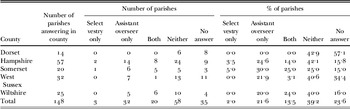
Parishes could adopt both of the main enabling aspects of the Sturges Bourne Acts or just one, i.e. just a select vestry or an assistant overseer. As the Webbs claimed, answers to question 32 of the ‘Rural Queries’ of the 1834 Poor Law Report suggest that, for the sample counties, the appointment of an assistant overseer was far more popular than the appointment of a select vestry (see Table 1).Footnote 41 There are, however, methodological problems to consider with this source. Some parishes that did not explicitly state that they had a select vestry in their replies alluded to the existence of a select vestry, while some parishes also stated that they had ‘Perpetual’ or ‘Acting’ overseers as opposed to assistant overseers.Footnote 42 In both instances, I have included such respondents in the select vestry and an assistant overseer tallies respectively. Notwithstanding such issues, fifty-six responses to the Rural Queries from Wessex and West Sussex explicitly stated that their parish adopted at least one of the two main provisions of Sturges Bourne's 1819 Act, whilst fifty-eight respondents had neither provision in place. Thus, when taking into account the number of parishes which failed to respond to the question, 37·1 per cent of parishes answering the Rural Queries from this region positively stated they had adopted one or more of the two main provisions of Sturges Bourne's 1819 Act. We can also deduce that those parishes which engaged with the legislation were more likely just to appoint an assistant overseer, or to appoint an assistant overseer alongside a select vestry, than just to adopt a select vestry.
Parishes with select vestries and assistant overseers in 1832, according to the Rural Queries

Source: BPP 1834 (44). Part 3. Question 32. Several answers to the Rural Queries were not included because the answers related to an area larger than a parish (such as magistrates' divisions) and/or they represented duplicate answers, or a response was completed about the parish in the Town Queries.
The main limitation of figures of adoption as derived from the Rural Queries is that they only formally record the number of parishes which had either a select vestry or assistant overseer, or both, at the time the returns were taken. Many more parishes had previously appointed a select vestry and an assistant overseer and subsequently abandoned them. The Rural Queries provide some hints as to this complexity where especially detailed responses provided a potted history of their relationship with the act. For instance, the respondent from Pulborough in West Sussex wrote: ‘[t]here has been a Select Vestry, but it is now discontinued, not being deemed beneficial’.Footnote 43 At North Curry, Somerset, there was no select vestry, and the assistant overseer had only been appointed nine months prior to the return.Footnote 44
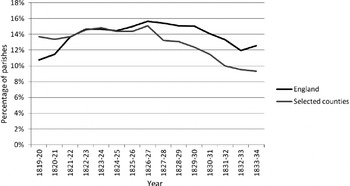
The adoption (and possible abandonment) of these policies can be traced over time through the use of parliamentary returns produced by the Select Committee on Poor Rate Returns who, from 1819 to 1834, collated the number of parishes with select vestries and assistant overseers in England and Wales. Figure 1 shows the percentage of parishes in England as a whole and in the selected counties that appointed a select vestry between 1819 and 1834. As is shown, select vestries were initially more popular in the sample counties than in England as a whole, however; the number of select vestries in other areas of the country rose much more rapidly in the early 1820s, so that by 1825 the percentage of parishes with select vestries in the selected southern counties was slightly lower than the national average. Thereafter, the number of select vestries throughout the country and – in greater proportion – the southern sample counties fell. By 1833–4, fewer than 10 per cent of parishes in the study counties had a select vestry in operation.
Percentage of parishes in England and selected southern counties of England with a select vestry, 1819–1834.

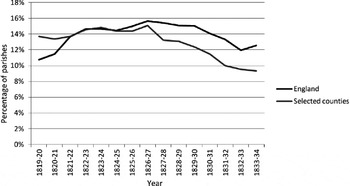
There was a very different pattern in assistant overseer appointments compared to select vestry appointments (Figure 2). The proportion of parishes with assistant overseers in both England and the study counties increased over time, albeit unevenly. Between 1825 and 1827, there was a significant increase in the proportions of parishes with assistants, and, again, a steady increase during the early 1830s. Notably, the policy was always more popular in Wessex and West Sussex than in England as a whole. These figures, however, conceal the numbers of parishes which adopted the policies for only short periods of time and those parishes which continued to use select vestries and assistant overseers over extended periods of time. This is because the annual returns did not provide the names of parishes adopting each policy, only the number of parishes with a select vestry and the number of parishes with an assistant overseer in each county. Although we cannot tell from the returns exactly which parishes had adopted, and continued to operate under, the enabling act at what times, it can be deduced that more parishes adopted Sturges Bourne's provisions at some time than the crude figures suggest.
Percentage of parishes in England and selected southern counties of England with an assistant overseer, 1819–1834.

The main reason why open vestries adopted the provisions of Sturges Bourne's 1819 Act was to reduce poor relief expenditure. This is further illustrated by the data presented above, which shows that both schemes markedly increased in popularity during years of economic strain. Moreover, many of the parishes that responded to the Rural Queries in the south explicitly noted that a saving had been made in the poor rates after implementation of the act.Footnote 45 A larger number still also noted, albeit vaguely, that the act was ‘advantageous’ or produced ‘a good effect in the parish’.Footnote 46 This reflects the findings of Neuman, who found that the parish of White Waltham (Berkshire) had reduced its relief expenditure by 33 per cent within a year of establishing a select vestry and that Bray, in the same county, saved 37 per cent.Footnote 47 All was not entirely positive in Wessex though. Five parishes noted that the act had very little effect, including Tillington (West Sussex) where it was observed that ‘The effect has not been beneficial.’Footnote 48
The appointment of assistant overseers and select vestries was influenced, as well as restricted, by a number of other factors. As noted, assistant overseers were particularly useful in rural parishes with widely dispersed populations. At Burghclere (Hampshire), it was reported that ‘[a]n Assistant Overseer is necessary in this parish, the cottages being scattered’.Footnote 49 Here, it was likely that the parish asked the assistant overseer both to collect the poor rates and distribute poor relief payments. Assistant overseers working in larger parishes tended to have a higher salary, reflecting the labour required to supply relief to the poor in all corners. William Finder, for instance, was paid £50 by the vestry of Kings Somborne (Hampshire), a parish that covered 8,000 acres. Eling, at 10,960 acres, some of which was on the New Forest fringe, paid their assistant overseer £60 per annum.Footnote 50 Select vestries, on the other hand, could only be introduced in parishes which had a sufficient number of large landowners to create the select vestry in the first place, the act stipulating that at least five individuals were needed for a select vestry. Many rural parishes in the south of England were, however, dominated by a small number of large landowners. At Old Shoreham, for instance, it was reported that the reforms were not adopted because ‘there … [was] no resident Farmer in the Parish but myself’.Footnote 51 It is possible that such parishes, and many urban parishes, could have already had an exclusive relief-granting body in place, such as those parishes acting under Gilbert's Act and local acts to provide workhouses. As outlined earlier, though, this did not necessarily deter the individual parishes within unions from acquiring a select vestry. Indeed, it is striking that the same factors which limited the adoption of select vestries in rural southern England were also replicated in the capital. Parishes such as Southwark and the City of London, as Green relates, were too small to operate a select vestry, while many other London parishes ‘operated, however poorly, under private local acts’.Footnote 52
There were two stages to the formal adoption of Sturges Bourne's provisions: a vote from ratepayers in favour of the provision, and the approval of magistrates. At both of these stages, plans to adopt the legislation could be scuppered. By far the more controversial of the two key policies was the select vestry, not least because it placed relief administration in the hands of the few. Besides, many parishes had a long tradition of appointing assistants for their overseers, thereby rendering the new legislation instantly familiar. Open vestries that had already adopted restricted and weighted votes under the 1818 Act also introduced select vestries with apparent ease. Other open vestries had more unpredictable decision-making processes. In Hinton Charterhouse, near Bath, the ‘principal paymasters’ voted in favour of a select vestry while the small ratepayers opposed the move; a select vestry could therefore not be appointed. It was reported that one man who had lived in the parish for forty years, but had never sat on the vestry, decided to attend that particular meeting and vote against the measure, reinforcing social historians' long-held assumptions that smaller ratepayers sided with the poor rather than with the bigger farmers.Footnote 53
Not only did these local dynamics impact on the initial votes for a select vestry, but they also generated complex administrative histories. As Wells related, the ‘Westbourne select vestry was soundly defeated on one occasion, while Ticehurst's retreated several times'.Footnote 54 Yet the re-appointment of select vestries also depended on their effectiveness. Indeed, if a select vestry had not actively undertaken measures to reduce relief expenditure it was unlikely that it would be appointed again. Amport, for instance, had once had a select vestry but reported that ‘it is now given up, in consequence of non-attendance of the members’.Footnote 55 Only four or five farmers attended the fortnightly meeting of the select vestry at Mottisfont (Hampshire), so relief was left to the discretion of the assistant overseer.Footnote 56 Some parishes even levied fines on those who failed to turn up, to ensure that a sufficient number of people were present to make decisions.Footnote 57 It appears that the royal commission's claim that select vestries were poorly attended was broadly accurate.
The role of magistrates was also potentially problematic. According to Wells, the magistrates at the Battle Petty Sessions supported, and even promoted, the policies developed and decisions made by the select vestries. Indeed, the majority of relief refusals brought to the sessions by individuals remonstrating against the decisions were rejected, especially those based on moral grounds. This reinforced the views and decisions made by the select vestries and assistant overseers which, in turn, buttressed the legitimacy of adopting the measures. This, to Wells, was strong evidence that magistrates in the south-east generally ‘supported the central tenets of Sturges Bourne’.Footnote 58 Such a harmonious working relationship did not hold throughout southern England. Evidence from parliamentary papers suggests a much more complex relationship. It was reported by many parish officers that select vestries brought beneficial effects, including a reduction in the poor rates, and magistrates supported their endeavours, yet it was also noted that parishes encountered difficulties with their magistrates.Footnote 59 In Shepton Mallet (Somerset) a select vestry was voted in by the ratepayers in 1822, but the magistrates refused to ratify it.Footnote 60 As Keith Snell notes, this was because Sturges Bourne's Acts were a ‘move against the power of the magistracy’ in that although open vestry decisions could be overturned by one magistrate, select vestry decisions had to be overturned by two.Footnote 61 The independence that appointing a select vestry would bring parish authorities was certainly understood by the parish officials. As one Hampshire vestry stated: ‘that no effectual measures can be adopted for the employment of the Poor till the Parish shall be made less dependent upon the Magistrates, by placing itself under the operation of the Act for the establishment & regulation of Select Vestries’.Footnote 62
Even in places where select vestry appointments had been ratified by magistrates, magistrates could undermine the efforts of select vestries by overturning their decisions. At Holcombe (Somerset) the magistrates paid ‘little or no courtesy … to the orders of the select vestry’. According to the parish officers, the poor would constantly ‘fly to a magistrate’ for an appeal of the vestry's decision, thereby giving relief claimants ‘the upper hand of the parish’. Select vestries needed, the Holcombe respondents contended, ‘stronger and more efficient powers … independent of magistrates’. In the following year, the select vestry effected no savings and the poor rates increased. By 1825, the select vestry had been abandoned, the blame for its demise placed on the ‘determined opposition shown to all its measures, by the magistrates’.Footnote 63 This strikes at the more general tension between parish officials and magistrates in the administration of relief under the old poor laws. The vestry clerk of Chiddingly (East Sussex) believed the business of the select vestry would be ‘done much better’ without the ‘interference’ of magistrates.Footnote 64 It is important to note, though, that many other parish officials believed that magistrates were not a nuisance, but rather provided a useful mechanism by which claimants could be heard, thus keeping the parish in check.Footnote 65 Either way, magistrates could make or break a select vestry.
The next four sections of this article assess the impact of Sturges Bourne's poor law reforms on relief provision. This is not a straightforward process though, not least because, as detailed above, measures reflected, and thus legitimized, the actions of pre-existing forms of select vestries and proto-assistant overseers. The sections occasionally refer to similar practices in other exclusive relief-granting bodies and open vestries. While this offers further elucidation, it also hints at the ability of practices involved in administering the reforms to filter into other economizing parishes at this time.
III
Upon appointment, a select vestry usually reviewed the relief provided to those in regular receipt of support, and then reviewed those who claimed relief irregularly. Assistant overseers signed an agreement, requiring the sanction of two magistrates, which stipulated their task of, alongside making rates, collecting rates, keeping the accounts, and issuing relief, investigating the circumstances of relief claimants. At Droxford, assistant overseer John Dollar was instructed to ‘make enquiry as to the Character and Circumstances of the Person or Persons applying for such relief’.Footnote 66 At Bishop's Waltham, James Perrin was told to ‘enquire into the character circumstances & condition of all Persons applying for relief of his her & their family & to report thereon to the rest of the Parish officers’.Footnote 67 Other parishes' instructions were similar, closely following the language and ethos of Sturges Bourne's legislation.
Once at the parish pay-table, the select vestry wanted to see the poor and question them as to their situation. Particular members of families were asked to attend the vestry. In 1822, the Botley select vestry ordered that Joseph Thomas and all of his family should attend the next meeting, the select vestrymen wanting to obtain more detailed information about their circumstances.Footnote 68 Occasionally, specific groups of the poor were asked to attend. For instance, the Fareham select vestry asked all those receiving relief for bastard children to present themselves.Footnote 69 There were serious repercussions for those not adhering to the select vestries' stipulations. In 1833, the Winsford select vestry asked Ann Crockfield to bring her eldest daughter, aged ten, to attend the next vestry. When she failed to attend, her regular allowance was stopped. At a subsequent meeting, Ann did present her daughter to the select vestry, claiming that her daughter had been unable to attend the previous meeting because she had a lame foot. The excuse did not wash with the select vestry: Ann's pay was reduced to 5 s a month on the basis that her eldest daughter was ‘fit’ to be bound as an apprentice.Footnote 70 Occasionally, acquaintances would be sent to the vestry on the claimant's behalf, invariably with little effect. In April 1824, William Fidow required assistance from Corsham (Wiltshire) parish, sending a third party to make his claim to the select vestry. The vestrymen were not satisfied with the representation and stipulated that William must attend ‘himself’ or he would not be relieved.Footnote 71
Once in the vestry, it was expected that the poor would detail their circumstances, including their occupations, earnings, and living arrangements, relief being refused if such information was not divulged. At Botley, William Whitlock was not allowed any further relief because he failed to give an account of his earnings over the last fortnight.Footnote 72 A similar stance was also taken by some open vestries during the 1820s. William Evans and James Cole attended a Wimborne Minster vestry in 1829, but on failing to give an account of their earnings, the parish refused to pay their house rents. In his family's worsening situation, William's wife claimed poor relief. As well as being frowned upon for being ‘without her husband’, she had also failed to give an account of her husband's earnings. When this information was finally provided by the family, it was looked upon with suspicion. The following month, William attended the vestry and detailed his weekly earnings (12 s 10d) and rent (1 s 6d). This was, according to the vestry, a very unsatisfactory account of his earnings.Footnote 73 It is little wonder then that select vestries therefore resorted to asking employers directly for a list of employees and weekly wages.Footnote 74 In some instances, even the employer's wages were placed under scrutiny. Mr Watts, of Fareham, was accused by the select vestry of not paying sufficient wages to a male labourer called Edwards. Edwards, and his family, were offered the workhouse, rather than an increase in outdoor relief, possibly in the hope that Watts would increase his wages.Footnote 75
Through their investigations, select vestries also knew about alternative forms of welfare available to parishioners, those questioned about their circumstances having not only to reveal details about their family circumstances and living arrangements, but also about their membership of local friendly societies (‘clubs’). On hearing that clubs would not pay out for a claim, the select vestry would often take the issue further to prevent their having to relieve the individual from parish funds. When an unwell Nathaniel Hayward turned up to the Corsham select vestry, stating that his club refused him ‘pay’, the gentlemen decided that their assistant overseer should take the matter to a magistrate.Footnote 76 Select vestries were well aware that by individuals subscribing to a friendly society it would reduce the parishes' liabilities if the person later needed assistance. As such, ‘topping up’ club payments to afford a claimant proper relief might appear to have contravened the spirit of Sturges Bourne's 1819 Act but would still be far cheaper than having fully to relieve the individual. For instance, Elizabeth Clothier, a parishioner of Chew Magna, received just 18d per week from the club, probably on account of illness. The select vestry agreed that this payment was too low and she was given 5 s per month from the parish purse.Footnote 77 Parishes also used the poor's membership of such clubs to reduce their own expenses. For instance, when in 1830 the parish of Wimborne Minster decided that Thomas Scutt should go into the poorhouse, it was ordered that the overseers should receive his ‘Club money’.Footnote 78 Due to the benefits these clubs brought to the parish finances, it is unsurprising that the select vestrymen also encouraged the poor to retain their memberships. One man was given 3 s a week ‘as long as he remain on the Club’.Footnote 79
Even if the poor did not attend the pay-table, parishes with assistant overseers could still find out about claimants' circumstances, the assistant overseer being ordered to survey the poor and relay any information back to guide the relief decision. Indeed, the assistant overseer – who was also the workhouse master – of Wimborne Minster, was authorized by the parish vestrymen to ‘hire a Horse at the expense of the parish to inspect the state of the poor in the outskirts of the parish’.Footnote 80 On many such occasions, vestries and select vestries ordered assistants to visit particular individual claimants and assess whether or not they actually needed relief. For instance, one assistant overseer was asked to visit a man who had asked for money to pay for his rent and ‘enquire into his Case’.Footnote 81 Surveillance extended beyond salaried assistant overseers' actions, evidence from minute books suggesting that the everyday lives of the poor were also under scrutiny from the wider ratepaying community. For instance, one Winsford man applied for ‘assistance’ during his wife's illness, but a Mr Paul having seen her ‘fetching water’ that morning, her illness was deemed fictitious and the claim rejected.Footnote 82
Individuals claiming for relief from their settled parish, but resident elsewhere, were arguably most vulnerable to economizing practices, the claims made in their ‘pauper letters’ being relatively easy to reject. For instance, Corsham parish on one occasion rejected all the letters they had received from Manchester, Leeds, and Brentford asking for relief.Footnote 83 Another select vestry recorded the letters they had received, frequently noting alongside: ‘not to be answer'd’.Footnote 84 Occasionally an assistant overseer would be asked by the vestry to attend the non-resident poor, in order to obtain first-hand information as to the claimant's circumstances. In 1835, the vestrymen of Clutton even went as far as to send their assistant overseer to Monmouthshire to inquire into the case of William Parker who requested regular non-resident relief payments.Footnote 85
IV
From the very foundation of the Elizabethan poor laws, Hindle tells us, ‘it fell to overseers (and to the ratepayers and vestrymen who elected them) to construct the calculus of eligibility according to which the entitlements of the poor were computed’.Footnote 86 While the Settlement Acts of the late seventeenth and early eighteenth centuries constrained the number of individuals eligible to claim relief in each parish, in order to determine each parishioner's eligibility, parish administrators divided parishioners into two crass categories: the ‘deserving’ and the ‘undeserving’. Although historians, such as José Harris, suggests this distinction was not universally put into practice, Sturges Bourne's 1819 Act explicitly promoted it through the assessment of claimants’ ‘Character and conduct’.Footnote 87 Consequently, in adopting parishes, the morals of the poor came under greater scrutiny. Receiving welfare provision meant that, as Steve Hindle has put it, ‘the range of personal choice that paupers might make about their personal conduct and ethical behaviour’ was reduced. In seventeenth-century England the distinction between deserving and undeserving was manifested through a series of expectations: church attendance, industriousness, sobriety, and deference.Footnote 88 This section shows how Sturges Bourne's second act allowed parish officers to reinforce these same expectations with vigour.
Those in regular receipt of outdoor relief and those living in workhouses were expected to attend church. The select vestry of Whiteparish noted that if the workhouse residents did ‘not attend some place of worship on Sundays their Days allowance for the Day be stop’.Footnote 89 The Botley select vestry issued similar directions, specifically targeting ‘every man who is on the Parish’.Footnote 90 These policies had not only resulted from select vestry discussions, but some open vestries also issued similar directives.Footnote 91 Unlike open vestries, however, select vestries frequently remonstrated with individuals thought able to have prevented their own poverty, especially those whose unemployment was believed to be their own fault. In Fareham, Richard Couzens and William Hawkins were refused relief on the grounds that ‘they had left their work and from their general Character they were therefore considered as idle & profligate’.Footnote 92 Henry Noble's claim for ‘work’ was rejected by a select vestry in Whiteparish, who also requested that he brought a letter ‘stating the reason he was Discharged from Esq. Boltons employ’.Footnote 93 The vestry obviously had its suspicions that Henry had been dismissed due to his own misdemeanours and as such, this errand had no other purpose than to reprimand Henry. It was not just leaving or being dismissed from work that put individuals’ entitlement to assistance in jeopardy. At Botley, John Dowling was not employed by the parish because ‘he has neglected to apply for work which he knew of’.Footnote 94 Women's work was also placed under the spotlight, with one Wincanton man's regular family allowance stopped on account that ‘his wife refuses to work’.Footnote 95
Select vestries also insisted that claimants were sober and publicly grateful for their relief. Not only was drunkenness disruptive, but it was also evidence of profligacy. The Chew Magna vestry, for instance, decided to ‘discontinue all relief to persons who are found spending their time or money in a public house’.Footnote 96 Likewise, Henry Cannon was refused work by the Wincanton select vestry because he was a ‘habitual drunkard’.Footnote 97 By 1833, the parish of Botley no longer operated a select vestry, but its punitive legacy lived on when the open vestry penalized Joseph Terry for ‘repeated drunkenness’ by refusing to find him employment.Footnote 98 At Fareham, more drastic action was taken. Relief was not only to be stopped to those ‘found Tippling in a Publick House’ but it was decided that a ‘list of persons receiving parochial relief be given to the Landlords of all the Publick Houses’.Footnote 99 The select vestry at Wimborne Minster even tried to stop the ‘problem’ at source: the magistrates were asked to reprimand one landlord who not only sold alcohol during divine service but also allowed two paupers to drink so much one Sunday that they were ‘unable to return home till Monday morning’.Footnote 100
Behaviour which did not reflect the expected deference from claimants had repercussions. Regular relief was often reduced for behaviour referred to as ‘bad conduct’ or for ‘misdemeanours’. The Wincanton select vestry gave Robert Day 3 s temporary relief rather than his regular allowance for bad conduct.Footnote 101 James Burin would have received a new pair of shoes had he not ‘abused some of the members of the Select Vestry’ in Winsford, instead they gave him 4 s towards the cost of a pair.Footnote 102 Relief was also curtailed for less dramatic acts of disrespect towards the vestry. Two men were turned away by the select vestry in Whiteparish because they had not attended at the ‘proper time’.Footnote 103 While bad conduct was condemned, it appears that good conduct was rewarded, albeit very rarely. James Phillips received £2 for his ‘[g]eneral good conduct’ in Botley.Footnote 104
Select vestries also restricted relief to those claimants who had the potential to poach – doubly unacceptable as both illegal practice and evidence that they could supplement their living – by refusing relief to claimants with dogs.Footnote 105 At Botley, those with dogs would not be ‘exonerated from paying the poors rate’.Footnote 106 It is worth noting that this policy was also occasionally applied by ordinary vestries,Footnote 107 while other types of exclusive relief-permitting bodies also adopted the policy. For instance, the ‘Court of Guardians’ in Southampton, the town operating under a local act, in 1824 ruled that one woman's weekly pay should be stopped on account of her keeping a dog. It was reported in the local press that soon after the decision the woman presented a dead dog at the pay-table, thus dramatically proving to the authorities she was now without her dog.Footnote 108
Vestrymen had generally assumed that if someone could maintain an animal, they could maintain themselves. Animals should be sold before relief was sought. This may have also been a factor in their dislike of dog ownership, although other animals were also perceived as a source of income. Relief claimants with pigs were told to sell them before they were granted relief. For instance, Robert Martin of Broomfield was refused a shirt for his boy on account of ‘haveing sow & pig’.Footnote 109 Larger animals which assisted labourers to undertake heavy tasks were also used as a reason to refuse relief. James Norris was instructed by the Corsham select vestry to get rid of an ass before he tried to claim for relief again.Footnote 110 The Chew Magna select vestry thought that Joshua Emery ‘ought’ to sell his two donkeys ‘to support his family’.Footnote 111 Neuman found a parish in Berkshire which created a general policy to prevent claims for relief from those with a horse and cart.Footnote 112 Select vestries sometimes refused loans to those labourers who wanted to buy animals to assist them in their work. Isaac Bauchamp's request for a loan to enable him to buy a donkey had been rejected by the Whiteparish select vestry regardless of the fact he would have used it to draw heath from the common to be sold as fuel. Such an occupation may have supplemented or replaced his regular parish relief.Footnote 113
Although relief was overwhelmingly tailored to each individual's behaviour, there were occasions when select vestries issued general policies in relation to the ‘conduct’ of their parishioners. The Millbrook select vestry set a rate of allowance at 3d per gallon loaf for those individuals ‘whose Conduct shall appear not to deserve any more allowance’.Footnote 114 We also know that individuals and families were given less relief according to their stage in the life-course, or whether they were a widow(er) or single woman with a bastard child(ren), as examined above.Footnote 115 The Millbrook select vestry, however, had moved one step beyond this to produce blanket policies based on character.
V
Select vestries paid particular attention to the amount of outdoor relief being given to individuals and their families through magistrate-set ‘Speenhamland-style’ scales. In Hampshire, where 74 per cent of parishes which had answered the Rural Queries allocated relief according to a scale, select vestries were particularly attuned to such issues. In 1822 at Nether Wallop, it was decided that ‘married paupers applying for Relief be allowed so much as will make up their wages the amount of a Gallon Loaf and sixpence Pr Head for their respective families’.Footnote 116 Many select vestries, not surprisingly, attempted to alter scales with a view to saving money. At East Woodhay, also in 1822, the very nadir of the post-war agricultural depression, it was agreed that all monthly allowances would be reduced in proportion to the reduction in the price of provisions.Footnote 117 In other Hampshire parishes, a seasonal reduction in monthly allowances was implemented. At Hambledon in 1824, it was stipulated that all persons who received monthly pay and ‘who leave the Parish for work during the Harvest month’ shall receive no allowance during that month, and that half of all claimants’ monthly pay during harvest ‘shall be taken off’. The following year, the policy became more stringent: all monthly pay was stopped during the harvest month.Footnote 118
All regular outdoor relief maintenance payments, whether allocated according to a Speenhamland-style scale or not, came under closer scrutiny in parishes which had adopted the provisions of Sturges Bourne's Act. Many select vestries had made lists of those receiving outdoor relief. The select vestry of Broomfield, near Bridgwater, for example, decided to start a brand new book to detail the ‘Allowances of the poor’ in the year of their election (1821). On the left-hand side of each page, the claimants’ names were recorded, alongside the sum of their weekly allowance and details of their family. Along the top of the page were columns ‘Character’, ‘Wages’, ‘Employers’, ‘Complaints of the Poor’, what they were ‘allow'd’ and ‘Why allow'd or disallow'd’. These relief tables allowed the parish to review the relief allocated to the poor, both regular and extra amounts, in relation to the broader household economy. Confirming the purpose of these charts, the select vestry agreed several times throughout 1821 that payments were ‘Sufficient for the support of the Paupers.’Footnote 119 Other parishes had similar ideas, with some creating lists to allow for systematic checks upon specific groups of relief claimants.Footnote 120 Wimborne Minster parish officers, for instance, made lists of people with bastard children and those receiving house rents.Footnote 121 The open vestry at Fareham directed the parish surgeon to provide the select vestry with a list of all persons ‘Ill and unable to work on Wednesday morning in every week’ previous to the meeting of the select vestry.Footnote 122 The select vestry was to allocate relief with this information in mind and catch those ‘faking’ ailments.
The 1819 Act, as noted, permitted select vestries to issue loans rather than provide relief, with magistrates empowered to chase individuals for repayments. Loans were often allocated for purchasing one-off items rather than for maintenance; for example, money was loaned to William Strongmell to purchase a saw by the select vestry of Fareham.Footnote 123 While parish loans enabled individuals to obtain expensive items which would help them procure work, in the past many parishes would have previously either bought these items for the individual, or at least paid for part of this item. Some select vestries decided to permit smaller loans to certain relief claimants. At Botley, for example, it was directed that no mechanic or handicraft person be allowed money when out of work except in the form of a loan.Footnote 124 Clearly, this policy was meant to deter individuals from claiming relief unless absolutely essential. Larger sums of money, on occasion, were offered to individuals without the stipulation that the sum of money should be paid back to the parish purse. Such sums were again expended on items to enable individuals to work. The select vestry at Hambledon gave John Merritt £6 so that he could purchase a horse and cart and thus, at least in theory, earn a living for himself and his family. The members of the select vestry noted that he had ‘been Lame a long time and a great expence to the parish’. The same select vestry also gave £5 to George Kiln on condition that he would not apply for parish relief for at least two years.Footnote 125
Occasional payments – sometimes called ‘Extras’ – were also curtailed under the direction of select vestries. House rents and poor rates were commonly paid by parishes in the rural south but this practice was increasingly challenged.Footnote 126 In 1825, the select vestry at East Woodhay resolved that the practice be stopped, and at Corsham the select vestry told the overseers to ‘call on the Landlords’ to reduce rents.Footnote 127 Other one-off payments were curtailed, including clothing and textiles, some select vestries even deciding to set aside dedicated days for the receipt of clothing and textile requests.Footnote 128 Again, these were attempts to control the volume of claims and distributions. Numerous other strategies were also developed. First, limits were set on the clothing provided to parish apprentices. The select vestry of Angmering setting a maximum cost of 30 s for each female taken into service.Footnote 129 Second, clothing was given, but the cost was to be repaid as a loan. William Savage's relief illustrates this point. He was provided with a shirt by the Whiteparish select vestry whilst a patient in the local infirmary, but rather than being given the shirt, he was asked to reimburse the parish ‘in the Harvest’.Footnote 130 Third, items were issued to the poor in the hope that they returned the article. Bruton started to loan blankets to the poor – prior to the passage of the Acts – in 1815.Footnote 131
Taking a very different approach, in 1832, Wincanton select vestry established a clothing ‘society’ with the purpose of assisting poor parishioners in procuring clothing. Similar to the rules of charity-based penny clothing clubs, every person was allowed to contribute 1d a week to a clothing fund which had its own dedicated secretary and treasurer.Footnote 132 At the end of the financial year, the parish would then add half of the amount saved during the year from the poor rates. If the scheme worked, the select vestry had thereby managed to get the poor to fund the cost of two-thirds of their own clothing. Also in the early 1830s, the select vestry of Wimborne Minster directed that a subscription be raised for the purpose of procuring clothing, fuel, and other necessities for the use of the poor.Footnote 133 As such, the parish tried to alleviate their financial burdens through the promotion of charity. Giving relief in fuel, such as wood and coal, was also curtailed under select vestries. Claims for services which enabled the poor to heat their homes had also been restricted, such as in west Somerset where peat-turf digging services were refused to some parishioners.Footnote 134
VI
Although Sturges Bourne's 1819 Act was not a ‘workhouse act’ per se, several of its clauses encouraged the use of workhouses as part of newly restricted regimes. Drawing on the example of the Ticehurst select vestry, Wells notes that at claimants’ first appearance at the pay-table many able-bodied relief recipients and the children of relief-receiving families were asked to enter the workhouse.Footnote 135 Similarly, the Fareham select vestry directed that ‘all Persons having relief whose Friends or Children cannot support them are to be taken into the House’.Footnote 136 Similar forms of ‘workhouse test’ were also ordered in Berkshire, one parish only offering claimants indoor relief, and then only a diet of coarse bread.Footnote 137 While some select vestries filled their workhouses in an attempt to reduce relief costs, others specified that workhouses were exclusively for certain social groups. The Chew Magna select vestry collated a ‘[l]ist of people to leave the poorhouse or to be taken before the justices and prosecuted according to law’, while Whiteparish decided that ‘families occupying apartments in the poor houses … be given notice by the overseers to quit and give up possession at the end of one month from the date of notice’. In other parishes, then, families were forced to find their own accommodation.Footnote 138 The motivation behind all such policies was inevitably economy. This was clearly demonstrated by attempts to charge rents to poorhouse residents – as at Ubley and Fareham – and to put poorhouse residents to work.Footnote 139
Workhouse management regimes were also targeted by select vestries. Indeed, there was a particular enthusiasm amongst select vestries to start ‘farming’ their indoor poor to save the parish money and to revise workhouse regulations accordingly.Footnote 140 The Corsham select vestry decided to farm out its poor to Mr Isaac Roberts, he then being responsible for the maintenance and employment of the indoor poor.Footnote 141 In other parishes, such as Bishop's Waltham, it was the open vestry that directed the select vestry to obtain a ‘farming’ contract.Footnote 142 Nevertheless, in previous years, the select vestry at Bishop's Waltham had considered ‘farming’ the poor of the parish independently of the open vestry, although this had already been considered by the select vestry at a previous meeting.Footnote 143 From the ‘articles of agreement’ between Mr Isaac Roberts and the Corsham select vestry, the select vestry clearly still wanted to retain some control over the management of the workhouse. The articles allowed members of the select vestry to visit the poorhouse and settle disputes between Roberts and the residents.Footnote 144 This was also the practice at Fareham where the contractor was ‘subject to the inspection of the select vestry’.Footnote 145
The administration of pauper work was central to many select vestries, not least in managing parish employment schemes for their under-employed and unemployed outdoor poor. Such schemes are too complex to detail in full here and have been discussed elsewhere.Footnote 146 Parish make-work schemes had been in operation since the Elizabethan Poor Laws and were common throughout southern England by the 1800s. It is unsurprising that select vestries also organized similar schemes. The Wincanton select vestry, for instance, directed unemployed labourers to dig parts of the parish land (‘Ball Common’ and the ‘Brick yard’) and to build and maintain parish roads.Footnote 147 In 1832, it decided to set a separate ‘labour’ rate and duly allocated labourers to work for ratepayers in what was a more elaborate employment system holding ratepayers accountable for the wages of labourers.Footnote 148 Such schemes gained in popularity in the rural south and south-east of England in the 1820s. This may have been the result of the publicity surrounding the apparently successful adoption of a similar scheme at Oundle, in Northamptonshire, in 1822.Footnote 149 Throughout the south, parishes such as Eversley adopted the labour rate system directly as a result of hearing or reading about the ‘Oundle plan’, though others, such as Wincanton, only adopted the practice after it had been formally legitimized in the 1832 ‘Labour Employment Act’.Footnote 150 Similarly, the select vestry of Bruton set up a scheme ‘according to the provisions of the said Act’. Within this scheme, able-bodied men with families would receive between 7 s and 8 s per week and ‘Lads and aged Persons’ would receive between 4 s and 6 s.Footnote 151
When parish work was made available to the poor, it was important that the wages could sustain labouring families. At the same time, regulating labour costs ensured parish work was not more desirable than ordinary work, and by setting minimum wages the ratepayers could ensure that they were not being undercut by one another. After inquiring into the wages given to ‘independent’ labourers, one select vestry paid to their labourers no ‘more [than] one shilling per week less than the wages given by the occupiers for labour of equal value’.Footnote 152 Clearly, many select vestries also followed the directions of magistrates when setting minimum wages. At New Alresford, single men were given 6d per day for their labour by the ‘recommendation’ of the magistrates.Footnote 153 Select vestries not only set the wages of those working on and off the parish, but also made inquiries for those searching for work. In 1823, the Broughton select vestry heard how William Gale was unable to gain sufficient custom as a collar maker. The select vestry offered to ‘find him such work as the Officers shall direct at the regular pay of the Parish’.Footnote 154 Other select vestries were more opportunistic. In 1819, Mr Billis, the Fareham assistant overseer, was directed to take the ‘names of all single men applying for relief with a view of sending them to Work at the Arundel Canal’.Footnote 155
As stated, Sturges Bourne's 1819 Act also permitted parishes to acquire up to twenty acres of land for the employment of the poor. According to Jeremy Burchardt, this policy was ‘rarely acted on’.Footnote 156 Evidence suggests that select vestries did, however, work the poor on newly acquired land, such as in Horsted Keynes (West Sussex) where relief recipients tended to potato crops on rented fields.Footnote 157 Select vestries used other land-based schemes explicitly to produce economy. The ratepayers directed to employ labourers in Wimborne Minster were ordered to allot each of their workers a quarter to half an acre of arable land to be cultivated ‘in their leisure hours’ and by ‘parts of their families not otherwise employed’. No rent would be charged until the end of the first year and if it could not be paid by a labourer, the overseers were obliged to pay instead. To encourage the labourers to cultivate their land well, the select vestry planned to reward those who had ‘managed their land best’ and had ‘received the least aid’ from the parish.Footnote 158 Whilst this promoted industrious habits and ‘independence’ from parochial relief amongst the labouring poor, it would also reduce poor rates. More conventionally, select vestries rented land and allotted portions to individuals. In 1831, the Wimborne Minster parish, building on its earlier policies, considered renting an entire farm before settling on renting a portion of land for spade husbandry.Footnote 159 The stipulations linked to allotment provision could be particularly stringent. In 1833, the select vestry at New Alresford decided to hire ten acres of land to be let to male labourers ‘on condition that such poor persons shall discharge themselves from all liberty for the parish to find him work & relief after the expiration of six months from the time of such taking’. William Butler was the first candidate for the scheme and was given one and a half acres with the select vestry paying for the ploughing and sowing of Butler's patch with wheat and barley by way of ‘encouragement’.Footnote 160
VII
Sturges Bourne's policies facilitated parishes to adopt a more rigorous approach to relief administration. Select vestries paid close attention to relief scales and other regular maintenance costs, extra payments, employment – on the parish or otherwise – and indoor relief. Blanket policies reduced the relief provided to defined groups of claimants. Loans were made and repayments vigorously pursued, and, at the same time, employment stipulations were developed to promote self-sufficiency and reward industriousness. Indeed, possibly one of the most absurd and counterproductive attempts to reduce relief costs was waged by the select vestry of Shipley who, in the 1820s, decided to stop providing tools to those employed by the parish, except ‘Bars, Malls, and Pikes for Stone digging’.Footnote 161 These were all measures introduced with the intention of saving the parish money. In particular, the inspection of the poor and attempts to gauge individuals’ character and conduct were illustrative of a more residualist relief system at work. This enabling legislation tended to reinforce the distinction first developed in the Elizabethan era, between the ‘deserving’ and ‘undeserving’ poor. Furthermore, Sturges Bourne's provisions permitted a select group of individuals to inquire into the lives of relief claimants, whose living arrangements, work, illegal pursuits, ailments, possessions, and leisure activities were all closely scrutinized. Knowledge of these aspects of claimants’ lives allowed officials to restrict individuals’ opportunities to obtain statutory relief. So, while open vestries could have undertaken such inquiries, Sturges Bourne's legislation supported and encouraged these actions.
The details of how parish policy developed in relation to assistant overseers and under the auspices of the select vestry are necessarily complex, but, it is important to note, they were not always derived from the parish itself. Magistrates exerted some influence over their decisions, which suggests that there was some co-operation between magistrates and the parish authorities in some localities. Select vestries also took on board the policies developed by other parishes. As noted above, the Oundle plan found its way to Eversley and was subsequently implemented in 1822. This raises interesting questions about the nature of social policy development under the old poor law, especially regarding the role and importance of ‘policy transfer’ from place to place. Further research is needed to understand better how select vestries developed policies which mirrored those being promoted by organizations outside the statutory relief system. Indeed, the provision of allotments from 1830 onwards was linked to the efforts of the Labourer's Friend Society ‘whose effective campaign’ had ‘promote[d] allotments as the most plausible remedy for the social problems of the countryside’.Footnote 162 Again, it appears that not all policies implemented by local poor law authorities had originated from local governance, but rather inspiration was often derived from other poor law authorities and organizations beyond the parish and even parliament.
Although only the appointment of select vestries was controversial amongst some small ratepayers and magistrates, the examples used above demonstrate that some relief-restricting practices were implemented without officially either appointing a select vestry or assistant overseer. This does not demonstrate the lack of importance of the official legislation; rather, on the contrary, such evidence is suggestive that the ethos of Sturges Bourne's Acts was widely pervasive. Perhaps such parishes were avoiding the structures and labels ‘select vestry’ and ‘assistant overseer’ because of how controversial they were amongst both ratepayers and rural workers alike. For instance, assistant overseers received mental and physical maltreatment in the Swing Riots. Labourers at Brede (East Sussex) attempted to ‘remove’ their assistant overseer by placing him in a cart, which had been especially constructed to enable the men to work on the roads, and dumping him over the parish boundary. This was a practice repeated throughout the Weald.Footnote 163 Select vestries were also targeted by protestors. Three men, aged thirty, twenty-two, and seventeen, were sent to the House of Correction for three months in November 1822 for rioting in a select vestry meeting in Northiam in East Sussex.Footnote 164 In the same county, vestries and select vestries frequently offered rewards to catch those sending threatening letters, the letter pinned to the Mayfield vestry door addressed to the overseer being particularly direct in its denunciation of reformed regimes: ‘Wee do Intend Washing Our Hands inn Your Blood.’Footnote 165 While the thoughts and feelings of relief claimants on the adoption and operation of Sturges Bourne's reforms await systematic analysis, it is apparent that reactions were hostile. To Swing activists, and the labouring class before 1830, the select vestry was the site within which a more restrictive and punitive relief scheme came into existence, and the assistant overseers the ‘face’ of the dreaded new system.