Introduction
The protests against pension reforms aimed at extending working life in several European countries since 2010 illustrate how controversial the question of the ‘right’ or ‘just’ time for permanent transition to retirement is. While there is a broad consensus in economic and political debates that increasing the employment rate of older people is one of the most essential measures to cushion the anticipated economic and social outcomes of the prospective demographic change (Coppola and Wilke Reference Coppola and Wilke2010; Organisation for Economic Co-operation and Development 2012), survey evidence for Europe indicates that a majority of people prefer to retire before reaching statutory retirement age and thus reject the idea of an extension of working life (Esser Reference Esser2005; Hofäcker Reference Hofäcker2015; Radl Reference Radl2012). This discrepancy between economic and political rationalities and people's attitudes is in line with the observation that some European countries are more successful than others in achieving the European Union-wide political objective to increase the labour market participation of older people aged between 55 and 64 years up to 50 per cent or higher (Engelhardt Reference Engelhardt2012; Eurostat 2016). In comparative welfare state analysis, these cross-country differences in the labour market participation of older people are often placed into context with the particular institutional structuring of the pension system in Europe (e.g. standard retirement age, options for early retirement). In contrast, differences in culturally driven norms and values have not yet been taken, explicitly, into account when explaining cross-country differences in the transition to retirement. This is all the more astonishing as there are rather prominent theoretical approaches in comparative welfare state analysis emphasising the role of culture for explaining both individual and political actions. The first approach is the ‘institutionalisation-of-the-lifecourse’, illustrating the way in which ageing and old age are socially constructed (Kohli Reference Kohli1985, Reference Kohli2007). Although the central mechanism here is the constitution of societal institutions, the approach refers not only to processes by which legal or organisational rules define the social and temporal organisation of human life, but also to normative rules derived from cultural values (Ebbinghaus and Hofäcker Reference Ebbinghaus and Hofäcker2013; Kohli Reference Kohli1985; Radl Reference Radl2012). This suggests that one has to differentiate between the lifecourse as an organisational and legal institution, on the one hand, and a subjective, culturally based construction, on the other hand (Diewald and Mayer Reference Diewald and Mayer2009). Some lifecourse scholars even view subjective age norms ‘as blueprints for biographical decision making’ (Radl Reference Radl2012: 768). Secondly, both gender and welfare culture approaches stress the (constraining) function of culture in shaping individuals’ actions and behaviour within a particular welfare arrangement (Aboim Reference Aboim2010; Pfau-Effinger Reference Pfau-Effinger2004, Reference Pfau-Effinger2005).
In summary, there are a lack of studies taking culture or rather the work–retirement culture explicitly into account when trying to explain cross-country differences regarding the transition to retirement and the resulting labour market participation of older people in Europe. Hence, the article attempts to contribute to closing this gap by analysing the impact of cultural norms and values on the labour market participation of older people from a comparative perspective. I suggest framing this cultural context as the work–retirement culture of a country comprising the relevant cultural values, ideals and stocks of knowledge in a society surrounding the retirement transition and the labour market participation of older age groups.
Subsequent to a brief overview of the current state of research regarding retirement transitions, two analytical steps are necessary. First, the work–retirement culture and its impact on individual behaviour has to be conceptualised theoretically. Second, the interrelation between the work–retirement culture and the labour market participation of older people has to be tested empirically. The analysis draws on the third round of the European Social Survey (ESS) that was conducted in the years 2006 and 2007. The ESS data are at present the only available data source that contains a sufficient number of indicators to operationalise the work–retirement culture. Logistic random effects regression analysis is used to estimate the effects of the work–retirement culture on the labour market participation of older people.
Retirement transitions in Europe – the current state of research
Variations in the institutional arrangements regarding the transition to retirement are the most widespread explanation for differences in the employment rates of older people in Europe. In this respect, the wide range of early retirement options like special age-limits for particular groups (e.g. women, the unemployed) or disability pensions are widely seen as the most important factors for early withdrawal from the labour market (Börsch-Supan, Brugiavini and Croda Reference Börsch-Supan, Brugiavini and Croda2009; Ebbinghaus and Hofäcker Reference Ebbinghaus and Hofäcker2013; Hofäcker Reference Hofäcker2015; Hult and Edlund Reference Hult and Edlund2008; Organisation for Economic Co-operation and Development 2012; Radl Reference Radl2013). The statutory pension level is a second, often-mentioned economical/institutional factor. Empirical evidence shows that there is a higher probability of early retirement in countries which have a high statutory pension level (Börsch-Supan, Brugiavini and Croda Reference Börsch-Supan, Brugiavini and Croda2009; Topa et al. Reference Topa, Moriano, Depolo, Alcover and Moreno2011). Another strand consists of socio-demographic factors like health, formal qualifications and unemployment experiences (Ebbinghaus and Hofäcker Reference Ebbinghaus and Hofäcker2013; Radl Reference Radl2013). While being in good health increases the probability of remaining in employment, the opposite is true for the subjective feeling of being in bad health (Börsch-Supan, Brugiavini and Croda Reference Börsch-Supan, Brugiavini and Croda2009; Brown and Vickerstaff Reference Brown and Vickerstaff2011). A high-level qualification or specialised professional skills decrease the likelihood of early withdrawal from the labour market, while older persons with low-level qualifications retire significantly earlier (Bosch and Schief Reference Bosch and Schief2007). The same is true for people with experience of unemployment (Riach and Loretto Reference Riach and Loretto2009). In the last 15 years, a growing body of literature recognises that decision-making on retirement also takes place in the context of the family (Engelhardt Reference Engelhardt2012; Van Solinge and Henkens Reference Van Solinge and Henkens2005). In this case, the impact of coupled retirement is of particular interest because research ‘has shown that many couples “coordinate” their retirement transition’ (Engelhardt Reference Engelhardt2012: 554). Additionally, alternatives to employment like child-care and health-care obligations have to be considered. The latter argument, however, primarily refers to women leaving the labour market comparably early in order to adopt an alternative role in the family (Hank and Buber Reference Hank and Buber2009). Some authors also point to the impact of the industrial sector, demonstrating that older workers in manufacturing have a higher probability of entering occupational early retirement schemes than employees in the service sector (Adler and Hilber Reference Adler and Hilber2009). A further important factor is company size since large companies are more likely to have company-based early retirement schemes than small and medium-sized enterprises (Engelhardt Reference Engelhardt2012).
Compared to the large bulk of literature stressing the importance of institutional and socio-demographic/socio-economic factors on the labour market participation of older people, culture only plays a minor role in the respective literature. Although the idea that age norms differ between national societies is quite uncontroversial (see e.g. Kohli et al. Reference Kohli, Rein, Guillemard and Van Gusteren1991; Radl Reference Radl2012), only a small body of studies explicitly addresses the relationship between culturally driven attitudes and timing of retirement (Esser Reference Esser2005; Radl Reference Radl2012), demonstrating still widespread approval of early exit from work in Europe. Moreover, existing studies emphasise gender differences in the attitudinal patterns. Radl (Reference Radl2012) identifies a mean ideal retirement age of 61 years and 4 months for men and of 59 years and 10 months for women. In all these studies, however, the relationship between cultural norms, values and preferences, on the one hand, and employment participation of older people, on the other hand, is not explicitly addressed.
One reason for the widespread non-consideration of culture in the relevant literature can be seen in its ambiguity regarding both the definition of culture, which varies according to scientific discipline and theoretical framework, and its impact on individual actions (Jansen Reference Jansen2013). Hence, in the following section an attempt is made to conceptualise theoretically the significance of culture for the individual transition to retirement.
Defining and conceptualising the work–retirement culture
A brief overview of existing definitions and conceptions of culture in action
Due to its aforementioned ambiguity, the question of what culture is and what culture does is anything but simple. In this regard, three distinct conceptualisations are distinguished in the relevant scientific literature (Polavieja Reference Polavieja2015; Vaisey Reference Vaisey2009, Reference Vaisey2010). The first, closely related to Parsonian tradition, defines culture as an internalised repository of preferences, beliefs and values that motivates people to act or behave in a particular manner. Moreover, culture is perceived as a coherent and coercive property, largely stable over time and widely shared by all members of society. While those approaches bear the advantage of offering ‘a clear causal link connecting individuals’ ideational configurations to their actions’ (Polavieja Reference Polavieja2015: 169), one considerable problem is that the underlying presupposition of uniformities in action and behaviour widely ignores the potential of individual agency to shape beliefs and values (Archer Reference Archer1996).
The opposite applies to the second approach in which it is argued that culture influences the actions of individuals ‘not by shaping the ends they pursue, but by providing the characteristic repertoire from which they build lines of action’ (Swidler Reference Swidler1986: 284). Accordingly, culture is defined ‘as a complex repertoire, or tool-kit, of symbols, competences, practices, and justifications, people use strategically to make sense of their actions’ (Polavieja Reference Polavieja2015: 169). Although culture-as-repertoire approaches tend to dominate the current sociological debate, one criticism is that they strip culture of any real explanatory role by ruling out the possibility ‘that cultural understandings or beliefs could be motives for action’ (Vaisey Reference Vaisey2009: 1678).
As a consequence, a third approach emerged combining the macro-perspective of the culture-as-property approach and the micro-perspective of repertoire theories, thus stressing the multi-level character of culture (Esser Reference Esser2004; Giddens Reference Giddens, Held and Thompson1989; Pfau-Effinger Reference Pfau-Effinger2005). Individual actors are perceived as ‘reflexive agents’ who ‘choose values and make their society, but do so in the context of their life within and their reflection on social structure’ (Taylor-Gooby Reference Taylor-Gooby2008: 271). In this respect, culture is defined as the entirety of norms, values, beliefs, preferences and stocks of knowledge collectively shared in the respective society, and forming an essential but not deterministic part of the individual reasoning (Alexander Reference Alexander, Alexander and Seidman1990; Archer Reference Archer1996; Pfau-Effinger Reference Pfau-Effinger2005; Polavieja Reference Polavieja2015).
The third conceptual approach is considered to be the most appropriate for analysing the interplay, since culture is conceived here as both a motivational and thus preference-forming element on the individual level (beliefs, preferences and values), and a constraining object on the macro-level (stocks of knowledge), representing societal expectations regarding the appropriateness of these actions. In this respect, the work–retirement culture is perceived as a subset of the overall cultural system comprising all values, beliefs, preferences and stocks of knowledge related to the timing of retirement and the labour market participation in older age groups.
Culture and institutions
A further preparatory step is the clarification of the relationship between culture and institutions since in some strands of the respective literature the former is considered as being part of the institutional sphere (Alesina and Giuliano Reference Alesina and Giuliano2013; Jo Reference Jo2011; North Reference North1990). North (Reference North1990: 3), for example, defines institutions as ‘the humanly devised constraints that structure human interactions’. They ‘are made up of formal constraints (rules, laws), informal constraints (norms of behaviour, conventions), and their enforcement characteristics’, whereby informal rules are considered as ‘part of the heritage that we call culture’ (North Reference North1990: 37). However, for analysing the significance of culture on individual actions and biographical decision-making, it is necessary to separate the effects of culture and institutions from one another. In accordance with Alesina and Giuliano (Reference Alesina and Giuliano2013), one practical way to do so is to consider formal constraints as institutions, while informal ones are regarded as culture. However, the analytical separation of culture and institutions does not mean that they are completely independent from one another. In line with the welfare cultures approach, it can rather be assumed that culture and institutions are interrelated since evolution and further development of legal institutions are not just functional reactions to emerging, changing or prospective social problems, but strongly influenced by cultural norms and values (Jo Reference Jo2011; Pfau-Effinger Reference Pfau-Effinger2005).
A theoretical model of culture in action
An appropriate model to handle the conception of culture described above is Esser's (Reference Esser and Schäfers1994, Reference Esser2004; see also Coleman Reference Coleman1990; Hedström and Swedberg Reference Hedström and Swedberg1996) rational choice based on the Macro-Micro-Macro Model of Action for the following reasons. Firstly, the model is clearly in line with the ‘concept of reflexive agents’ as in the idea of the individual actor is considered as ‘resourceful, restricted, expecting, evaluating, maximizing man’ (RREEMM model), choosing the action alternative with the highest subjective expected utility (SEU) while acting within a context of constraints and resources which will vary in accordance with the particular juxtapositions of class, gender, culture, etc. which constitute its specific position (Esser Reference Esser2004; Hoggett Reference Hoggett2001; Lindenberg Reference Lindenberg1985). The model thereby draws on framing theory and thus takes into account the idea of bounded subjective rationality stemming from the actor's own definition of the situation that takes assumptions about individual cognitive capacities, subjective motives and individually internalised cultural values explicitly into account (Lindenberg and Frey Reference Lindenberg and Frey1993). Secondly, it is possible to treat culture and institutions as separate but interrelated entities and thus to fulfil the theoretical requirements developed above.
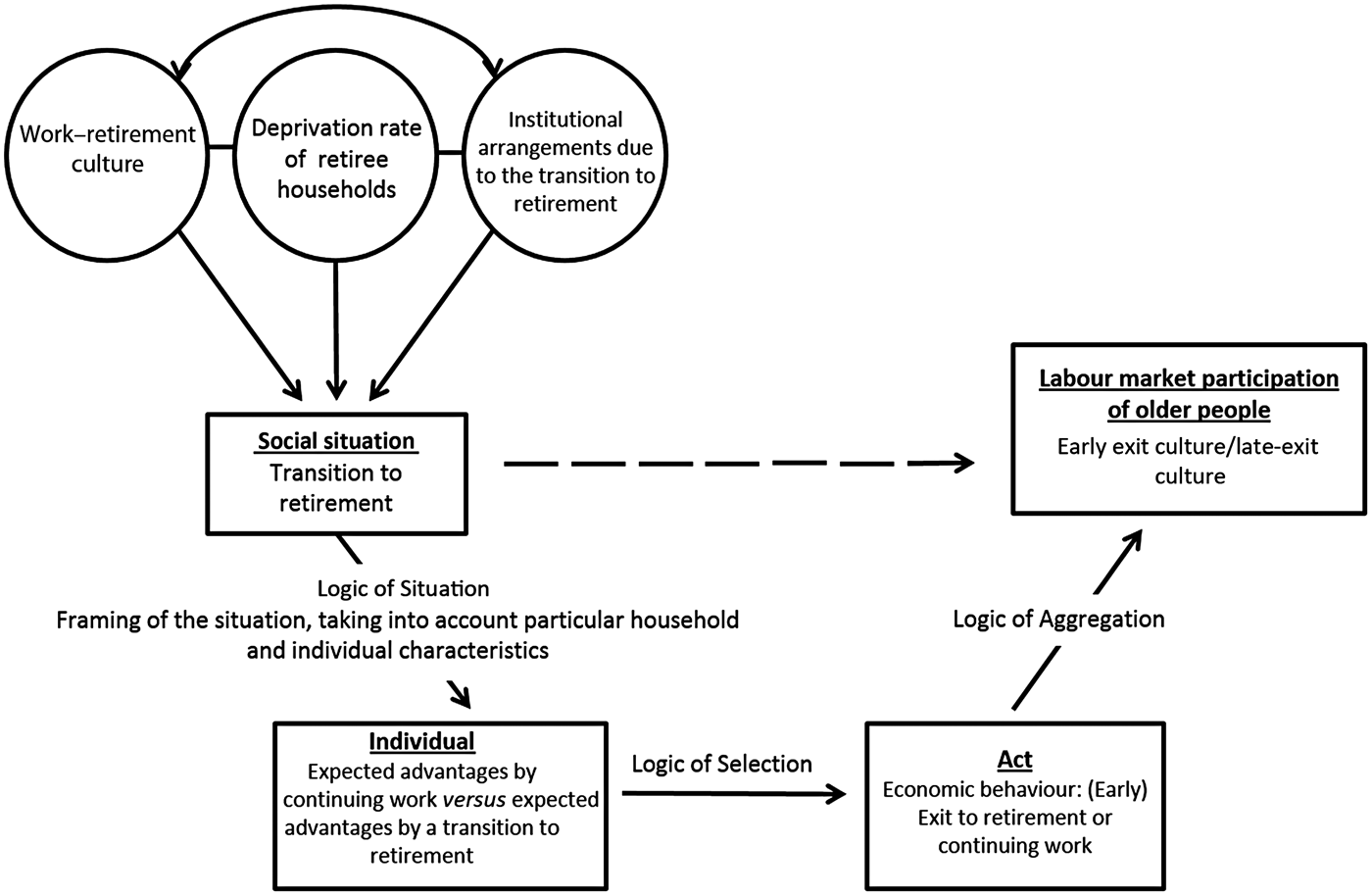
Thirdly, the model possesses a clear rational choice mechanism that specifies which of the possible options for action is chosen and why this is the case – the SEU theory (Esser Reference Esser1993; Riker and Ordeshook Reference Riker and Ordeshook1973). Finally, the multi-level character of the work–retirement culture is explicitly considered. On the societal level, it can be characterised as a constraining ‘object’ in recurring situations where individuals decide on whether to go into retirement or remain in gainful employment. In this case, the work–retirement culture as an object in the situation reflects informal norms and conventions regarding both employment participation at an older age and timing of retirement shared by the societal majority. This means it is in the form of situational objects in which the supra-individual character of culture affects actors’ subjective definition of the situation (DiMaggio Reference DiMaggio1997). As an internalised entity, the work–retirement culture is a preference-forming and thus motivating ‘element’ in the situation influencing subjective expectations and motives regarding the transition to retirement or respectively the continuation of gainful employment. A possible impact of the work–retirement culture as an element in the respective situations is, for example, that people do not necessarily have to participate in the labour market further, but want to do so even if there are legal opportunities to retire. By contrast, a positive impact of the work–retirement culture as a situational object would point towards an autonomous constraining power of culture. In this sense, older workers do not necessarily want to remain in gainful employment, but are aware of the fact that they are culturally expected to do so.
The explanation of collective phenomena is carried out in three analytical steps: the logic of situation, the logic of selection and the logic of aggregation (Figure 1). The logic of situation connects the relevant objective societal arrangements (the legal framework, the adequacy of the statutory income protection in old age and the work–retirement culture) with subjective parameters (e.g. individual health; qualifications; current employment status) and individually perceived options for actions (retire, continue to work, remain in unemployment) guiding the decision-making process of individual actors. The outcomes of this process are subjective expectations concerning the utility of particular options (e.g. continued work may increase retirement income; there are good opportunities for reintegration into the labour force) on the basis of which the individual actor then takes a decision. The second step, the logic of selection, is a micro-level mechanism which shows how a specific combination of individual expectations, beliefs and capabilities generates a particular action. The resulting actions, in turn, are part of the third step, the logic of aggregation towards a certain collective outcome like a comparably low or rather high labour market participation of older people aged between 55 and 64 years, which in most cases deviate from the intentions of individual actors.
The labour market participation in higher ages along Esser's Macro-Micro-Macro Model of Action.

Hypotheses
With regard to the labour market participation of older people, the motivational element of the work–retirement culture means that older workers do not necessarily have to continue with their working lives, but want to do so even if there are legal opportunities to retire. Accordingly, it can be assumed that there is a significant interrelation between the labour market participation of older individuals and culture as a motivational element of the situation (Hypothesis 1). Support for this assumption can be found in the ‘socioeconomics’ paradigm (Etzioni Reference Etzioni2000; Radl Reference Radl2012). From this perspective, cultural values and preferences are capable of shaping actor's ‘intrinsic predispositions’ and thus are ‘adopted by individual actors as goals in their own right’ (Radl Reference Radl2012: 758).
Another mode of action applies to the constraining character of the work–retirement culture. From this perspective, older workers do not necessarily want to remain in gainful employment, but know that they are expected to continue their working lives. Accordingly, it can be assumed that respondents aged between 55 and 64 years and living in a country with an early exit-oriented work–retirement culture have a higher probability of already being in retirement than respondents of the same age living in a country characterised by a late-exit culture (Hypothesis 2). Some evidence for this assumption can be found in lifecourse research. Neugarten, Moore and Lowe (Reference Neugarten, Moore and Lowe1965: 710), for example, already draws attention to ‘systems of norms which refer to age-appropriate behavior’. A second indication of the validity of this hypothesis can be derived from the welfare culture literature. Pfau-Effinger (Reference Pfau-Effinger2005: 12) assumes that cultural values and preferences ‘limit the range of options considered by social actors and shape the range of options for choice which are noticed by the individuals’.
Data and methodology
Data
For three reasons, the third round of the ESS is a rather apposite source for examining the role of culture in explaining the heterogeneity in the labour market participation of older people in Europe. First, the survey was carried out in 23 European countries and thus offers a large variety of different institutional arrangements regarding the retirement transition. Furthermore, the 23 countries are further subdivided into more than 200 regions, providing the possibility to account for within-country variation in multi-level analysis. Second, the third round of the ESS contains individuals’ attitudes regarding a range of questions about timing of retirement and individually set age-limits for labour market participation. Third, the questions of interest are included in a rotating module called ‘The timing of life’ for which a gender-sensitive split-ballot procedure was used that allows the analysis of the assumed gender-specificity of work–retirement cultures. Split-ballot means that half of the respondents, selected at random, were asked about their attitudes concerning women, while the other half were asked the same about men. To date, however, the module was conducted only once. Hence the analysis can neither explain how work–retirement cultures have assumed their respective characters nor how the respective cultural system has been shaped over time. Notwithstanding these restrictions, the available data can surely provide empirical evidence about the variety of work–retirement cultures in Europe and their interplay with the employment participation of older people.
The empirical construction of the work–retirement culture
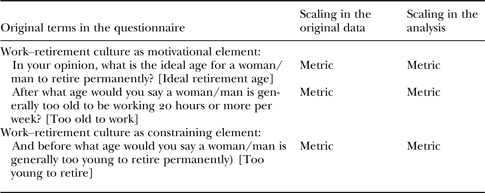
Three survey questions are used to calculate an index representing the work–retirement culture. The first question asks for the ideal age to retire permanently and thus queries an optimal age norm (Radl Reference Radl2012). However, Settersten and Mayer (Reference Settersten and Mayer1997: 242) critically note that optimal age norms are not necessarily linked to actual behaviour, and that prescriptive and proscriptive age norms may be of more relevance, as they reflect ‘shared expectations about when certain transitions “should” or “should not” occur’. It follows that empirical research ‘should thus strive to identify the age range that social norms of ageing define as appropriate for the transition from work to retirement’ (Radl Reference Radl2012: 760). In accordance with this recommendation, the second item used for constructing the work–retirement culture reflects the prescriptive age norm regarding the retirement transition by asking when a woman/man is too old to be working at least 20 hours per week; and the third represents the respective proscriptive one by asking at what age a woman/man is too young to retire permanently. For each question the respondents were invited to propose an age of their choice (Table 1). Besides the fact that the three items used cover both optimal retirement age and prescriptive and proscriptive age limits, they are particularly suitable for the construction of the work–retirement culture since they address both individual preferences regarding the timing of retirement and labour market participation in older age groups, as well as attitudes towards a generalised other by asking men about women, for instance. This dual nature of the questions corresponds to the theoretically assumed twofold significance of work–retirement cultures. The index is aggregated at the country level representing the national work–retirement culture as a macro-variable. For its calculation, respondents of all ages are taken into account, whereas retirement–employment outcomes are considered only for respondents aged 55–64 years. Two further variables are considered, displaying the supposed social acceptance of an extended working life (nominal: approve, neither nor, secretly disapprove, openly disapprove) and the respondents’ assessment at which age a woman/man is characterised as old (metric).
The essential variables to construct the work–retirement culture

Notes: Example for the construction of the index ‘work–retirement culture’: For the construction of work–retirement cultures all valid responses are summed up in an index. In order to improve its interpretability, the resulting individual value is divided by 3 afterwards. If, for example, a Belgian man is asked for the respective age-limits for a woman and mentioned 55 as the ideal retirement age, 58 for the upper age limit and 45 as the lower age limit, his individual index value is 52.7 (55 + 58 + 45 = 158/3 = 52.7). The work–retirement culture in Table 2 represents the country-specific average of the calculated index.
Source: Own description.
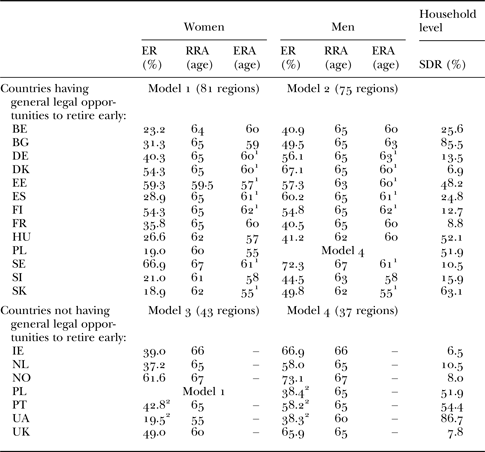
Classification of countries regarding legal opportunities to retire early for women and men, 2006

Notes: ER: employment rate of older people aged between 55 and 64 years. RRA: regular retirement age. ERA: earliest general retirement age. SDR: subjective deprivation rate of retiree households. BE: Belgium. BG: Bulgaria. DE: Germany. DK: Denmark. EE: Estonia. ES: Spain. FI: Finland. FR: France. HU: Hungary. IE: Ireland. NL: The Netherlands. NO: Norway. PL: Poland. PT: Portugal. SE: Sweden. SI: Slovenia. SK: Slovakia. UA: Ukraine. UK: United Kingdom. 1. Actuarial deductions in case of early retirement. 2. Special regulations for certain professional groups.
Source: Own classification based on Mutual Information System on Social Protection data for 2006; EUROSTAT data for 2006; European Social Survey data for 2006–2007.
Both items, however, are not taken into account for index construction because they either reflect the respondents’ opinion about a generalised other (social acceptance of an extended working life) or do not directly target the transition-to-retirement process (begin old age).
Statistical modelling
Ordinary least squares regression (OLS regression)
OLS regression is used to identify country differences regarding work–retirement cultures (Rabe-Hesketh and Skrondal Reference Rabe-Hesketh and Skrondal2008; Snijders and Bosker Reference Snijders and Bosker1999). The index ‘work–retirement culture’ functions as a dependent variable. Standard errors are corrected in accordance with the clustered sample design (Snijders and Bosker Reference Snijders and Bosker1999). Due to the fact that there is no need to interpret the results in relation to a particular reference as is done in dummy-coding, effect coding is used to estimate the effect of country on work–retirement culture (Hank and Buber Reference Hank and Buber2009). The OLS analysis considers 22 countries. Cyprus is excluded because the number of interviews realised (995) is far below the default of 1500 interviews. It should be noted that the use of nations for differentiating between cultures has drawn a lot of criticism over time (Minkov and Hofstede Reference Minkov and Hofstede2014). In this respect, it is often argued that the shape and development of cultural norms, values and stocks of knowledge are the combined result of numerous social influences, as people not only belong to particular nation states but to many social groups like families or occupational groups, all having ‘a distinctive socialising potential’ (Polavieja Reference Polavieja2015: 170). However, recent empirical research on this topic indicates that countries ‘tend to form homogeneous and clearly delineated national clusters on measures of values’ (Minkov and Hofstede Reference Minkov and Hofstede2014: 172).
Logistic random intercept regression
Logistic random effects regression is used to estimate the effects of the work–retirement culture on the individual labour market participation of older people. This method allows researchers to control for the dependency of individuals nested within a higher-level context like countries, regions, schools or school classes (Hox and Kreft Reference Hox and Kreft1994; Rabe-Hesketh and Skrondal Reference Rabe-Hesketh and Skrondal2008). Within this analysis, regions instead of countries provide the base for clustering for three reasons. First, preliminary statistical analyses have shown significant within-country differences regarding the work–retirement culture – notwithstanding the fact of, on average, larger between-country differences. Second, the more clusters taken into account, the better the performance of random intercept models since this corresponds with a greater number of degrees of freedom (Möhring Reference Möhring2012; Rabe-Hesketh and Skrondal Reference Rabe-Hesketh and Skrondal2008). Third, because of the larger first-level N, it is possible to control for a higher number of macro-level indicators, thus minimising the risk of biased estimates due to omitted variables (Möhring Reference Möhring2012).
In random effects models, the residual variance is split up into components that pertain to the different levels in the data. A two-level model with grouping of individuals within national regions would include residuals at both the individual level and the level of regions within the respective countries. Hence the residual variance is partitioned into a between-region component and a within-region component. The region-specific residuals represent unobserved characteristics of the respective region that affect individuals’ outcomes like the economic structure or different levels of unemployment.
In accordance with the theoretical model, culture is accounted for in twofold ways. On the individual level, two variables directly focusing on retirement (‘Ideal retirement age’ and ‘Too old to work’) are taken into account as empirical representatives of culture as ‘element in the situation’. The lower limit for labour market participation (too young to retire) is not taken into account on the individual level because empirical evidence shows that this item is not directly linked to retirement transition (Jansen Reference Jansen2013). The index, in contrast, represents the work–retirement culture as ‘object in the situation’ on the macro-level. In order to avoid any methodological problems because of collinearity between the cultural variables on the individual level and the index on the macro-level, the latter is mean-centred.
The dependent variable is the respondents’ employment participation. It is constructed as a dummy that equals one if respondents are in gainful employment or unemployed but actively looking for work. It equals zero if the respondent is already retired, economically inactive or unemployed but not actively looking for a new job.
For a proper analysis of the interconnectedness of the work–retirement culture and the institutional setting regarding the retirement transition, four different models have to be calculated. Firstly, it seems reasonable to differentiate between women and men since the pension regulations in a noteworthy number of countries under review show rather substantial gender-specific differences, such as different retirement ages for men and women. Secondly, separate models have to be calculated for countries having one or more opportunities for the whole or at least the vast majority of the older population of working age to retire before reaching statutory retirement age, and countries not offering such a general opportunity (Table 2). Overall, 19 countries are considered in multi-level analysis. Besides Cyprus, Austria, Switzerland and Russia are excluded because of a comparatively large number of missing values in at least one of the three items used for the construction of the work–retirement culture (>25%) which might be harmful for the quality of imputed values.
Micro-level variables
In addition to the cultural variables, a set of independent variables is included covering most factors mentioned in the current state of research. Age is implemented in linear form; the same is true for qualification (years of full-time education). The adequateness of retirement income is taken into account by considering individual concerns about its present or expected level (three dummies: not worried; neither nor; worried). Furthermore, a dichotomous variable has been included to consider additional retirement savings. Health status is captured both through three dummy variables (good, fair, bad) and a dichotomous variable indicating whether or not the respondent reports long-standing illnesses or disabilities hampering daily activities. Furthermore, a set of dummies was implemented that simultaneously compiles information about partners/spouses and whether they are employed, retired or part of the non-active population. The model also controls for whether the respondent has experienced any periods of unemployment that lasted three months or longer (dummy). Further controls are sector (service sector versus manufacturing), the company size (<100 versus 100+) and employment status (employee versus self-employed).
Contextual-level variables
Depending on the respective model, four or five macro-indicators are taken into account. In all four models, the average index value is used to display the regional work–retirement culture. The same applies for the adequacy of income in old age that is captured through a variable in the ESS indicating the share of respondents living in households mainly dependent on retirement income and having difficulties making ends meet with that income. Differences between the four models exist with regard to the variables representing the institutional setting. In countries having one or more general opportunities for early retirement, both the lowest and the regular statutory retirement age are used (numerical indicators). Additionally, a dummy variable is taken into account indicating the presence/absence of actuarial deductions in the case of retiring at the lowest statutory retirement age (1 = yes; 0 = no). In contrast, the regular statutory retirement age is the only numerical indicator taken into account for displaying the institutional setting in countries not having one or more universal opportunities for early retirement. Furthermore, a dummy variable is used equalling one if there are any possibilities to retire before reaching statutory retirement age and zero otherwise. All data concerning the character of the institutional setting regarding the transition to retirement have been obtained from the Mutual Information System on Social Protection (MISSOC) that includes information on social protection in all European Union Member States, as well as Iceland, Liechtenstein, Norway and Switzerland (MISSOC 2016).
Table 2 shows the respective values of the macro-indicators for all countries under review for the year 2006 and also contains information about the number of regions considered in the different models. Where necessary, the data are displayed for women and men separately. In addition, the employment rate of older people aged between 55 and 64 years is taken into account to provide the readers with an impression of the large heterogeneity in the employment participation of older people in Europe. With the exception of Poland, there are no substantial gender differences in the classification of countries according to the institutional arrangements regarding the transition to retirement. In Poland, by contrast, there is a general opportunity for women to retire earlier (at the age of 55), while no respective general rule for men exists. For men, there are only some special regulations for certain professional groups.
Patterns of work–retirement cultures in Europe
Descriptive findings: work–retirement cultures in Europe
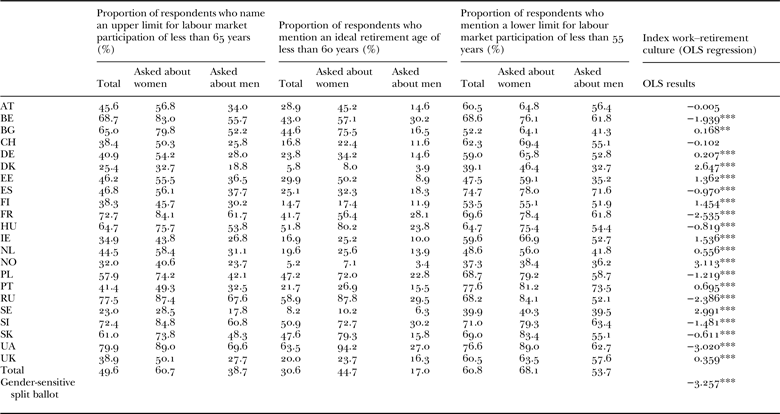
The summary of the descriptive findings is presented in Table 3 for the three items representing the work–retirement culture. Overall, there are marked variations between countries in the culturally driven attitudes towards retirement transitions. Regarding the ideal retirement age, the proportion of respondents proposing an age of less than 60 years is lowest in the Scandinavian countries (in each case less than 10%). A considerable early exit orientation, in contrast, becomes apparent in most Eastern European countries. About 60 per cent of respondents in Russia and the Ukraine as well as more than half of respondents in Slovenia and Hungary select an ideal retirement age of less than 60 years. In Western Europe, early exit orientation is highest in Belgium and France where more than 40 per cent of respondents state such a low retirement age.
Results for the central determinants of the work–retirement culture; descriptive results (in total and separately for women and men) and results from ordinary least squares (OLS) regression

Notes: AT: Austria. BE: Belgium. BG: Bulgaria. CH: Switzerland. DE: Germany. DK: Denmark. EE: Estonia. ES: Spain. FI: Finland. FR: France. HU: Hungary. IE: Ireland. NL: The Netherlands. NO: Norway. PL: Poland. PT: Portugal. RU: Russia. SE: Sweden. SI: Slovenia. SK: Slovakia. UA: Ukraine. UK: United Kingdom. OLS regression: constant = 48.68***; R 2 = 0.307; N = 27,387.
Significance levels: ** p < 0.05, *** p < 0.01.
Source: European Social Survey (third round 2006–2007); own calculations.
A similar pattern is observed for the upper limit of the retirement corridor (‘too old to work’). While at most one-third of respondents in Denmark (25.4%), Norway (32.0%) and Sweden (23.0%) consider a person as too old to work at least 20 hours a week before he/she reaches the age of 65, the respective figures in the Ukraine, Russia and Slovenia are in each case well above 70 per cent. Among the Bismarckian countries, Belgium (68.7%) and France (72.7%) are again the countries with the highest proportions of respondents considering an age of less than 65 years as the upper limit for labour market participation. The results for the third item (too young to retire) are also widely in accordance with the former outcomes – at least with regard to country differences. The distribution, however, shows some peculiarities regarding the lower age threshold of the subjective retirement corridor because the majority in most of the countries fix its lower limit before the age of 55. Thus, the culturally driven attitudes reflected in the distribution of this item are not directly related to the transition to retirement but rather mark a lowest normative limit under which there is no way to legitimise retirement. Table 3 also reveals significant gender differences. More than 60 per cent of respondents do not consider a man aged 65 years and older as too old to work, whereas this only applies to less than 40 per cent of respondents asked about women. Regarding the ideal retirement age, only 17 per cent of respondents asked about a man consider a retirement age of less than 60 years as ideal, while the respective proportion of respondents asked about a woman is 44.7 per cent.
The interplay between the work–retirement culture and labour market participation
OLS regression
The gender specificity becomes even more apparent in the last row of Table 3, showing the results of the OLS regression regarding the gender-sensitive split ballot: the significant regression coefficient of −3.257 means that, on average, the index value for respondents asked about women is more than three years below the respective value for respondents asked about men. Regarding country differences (shown in the last column of Table 3), an early exit-oriented work–retirement culture becomes particularly apparent in most of the Eastern European countries as well as Belgium and France, indicated by the negative regression coefficients. A clear late-exit culture can, in contrast, be seen in the Scandinavian countries. The R 2-value of 0.307 indicates a strong interrelation between the index ‘work–retirement culture’ and the independent variables included in the model.
Logistic random intercept regression
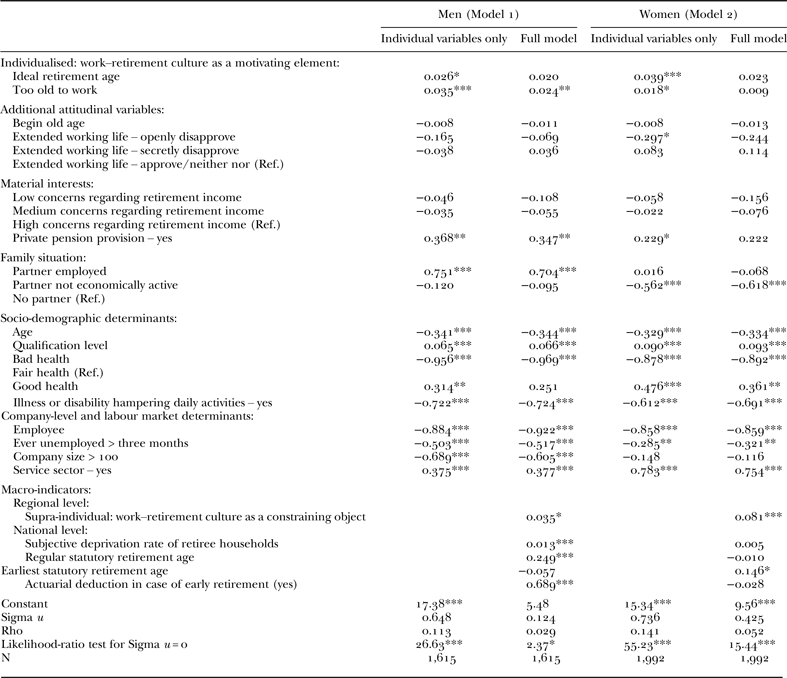
Table 4 contains the estimates of the two models testing the interplay between the work–retirement culture and the employment participation of older people aged between 55 and 64 years in countries having one or more general options for early retirement. The analysis is drawn out separately for men (Model 1) and women (Model 2). Starting with the inter-country variance displayed as rho, there are clear indications that country-level properties matter for variances in the labour market participation of older people. Furthermore, the likelihood-ratio test shows that this proportion significantly decreases in both models, if additional individual and country-level variables are considered (rho for the empty model is reported below Table 5).
Coefficients of multi-level regression analysis regarding the interplay between labour market participation and work–retirement culture: countries having one or more institutionalised opportunities for early retirement for the whole or the majority of the older population (respondent, 55–64 years, is either employed or unemployed but actively looking for a new job)

Notes: Ref.: reference category. Coefficients of the empty model: Model 1, men (75 regions/cluster): Sigma u = 0.739; rho = 0.142; likelihood-ratio test for Sigma u = 0 = 88.98***. Model 2, women (81 regions/cluster): Sigma u = 0.766; rho = 0.151; likelihood-ratio test for Sigma u = 0 = 117.24***.
Significance levels: * p < 0.1, ** p < 0.05, *** p < 0.01.
Source: European Social Survey (third round 2006–2007).
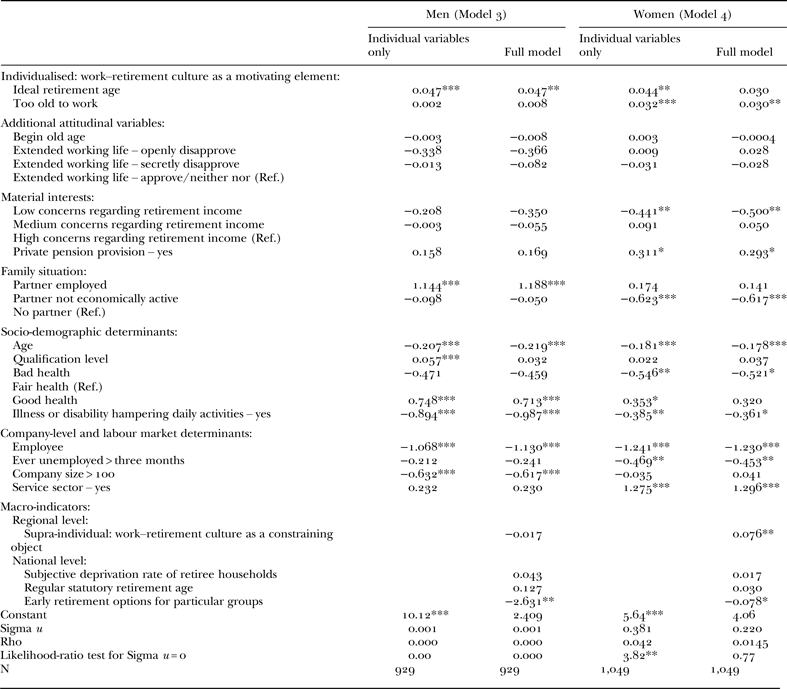
Coefficients of multi-level regression analysis regarding the interplay between labour market participation and work–retirement culture: countries not having institutionalised opportunities for early retirement for the whole or the majority of the older population of working age (respondent, 55–64 years, is either employed or unemployed but actively looking for a new job)

Notes: Ref.: reference category. Coefficients of the empty model: Model 3, men (43 regions/cluster): Sigma u = 0.468; rho = 0.063; likelihood-ratio test for Sigma u = 0 = 15.82***. Model 4, women (37 regions/cluster): Sigma u = 0.649; rho = 0.114; likelihood-ratio test for Sigma u = 0 = 40.44***.
Significance levels: * p < 0.1, ** p < 0.05, *** p < 0.01.
Source: European Social Survey (third round 2006–2007).
In Model 1, a significant correlation can be observed between parts of the work–retirement culture as ‘element’ in the situation and the employment participation of older men. This means that older men suggesting above-average ages for the upper limit of the retirement corridor are more likely to be still employed or actively looking for a job than male respondents stating below-average ages (Model 1). For women, on the other hand, there is no respective correlation on the individual level (Model 2). In contrast, the work–retirement culture as ‘object’ in the situation is shown to be significantly correlated with respondents’ labour market participation in both models under review. The positive coefficients indicate that people living in countries with a more employment-oriented work–retirement culture are more likely to participate actively in the labour market than is the case for respondents living in countries with a more early exit-oriented work–retirement culture. However, the effect is much more pronounced in Model 2, indicating that the constraining/enabling impact of the work–retirement culture is stronger for women than for men. Moreover, there are marked differences between the sexes regarding the impact of the institutional setting. On the one hand, a positive correlation can be observed between statutory retirement age and the probability of older men still being in employment or actively looking for work. The same applies for the presence of actuarial deductions in the case of early retirement and the subjective deprivation rate of retiree households (Model 1). On the other hand, the earliest statutory retirement age is the only additional macro-indicator that has a significant effect on the probability of women remaining in employment or actively looking for work (Model 2).
The picture changes in some respect when analysing countries that do not have general early retirement options (Models 3 and 4). First, country-level properties are of much more minor importance for variances in the labour market participation of older people than is the case in the former models. This is first and foremost true for men, for whom country-level properties only have a measureable impact in the empty model, but also applies for women (Table 5). Moreover, Model 3 shows no significant correlation between the work–retirement culture on the macro-level and the probability of older men still being in gainful employment or actively looking for a new job. Thus, if there are no general institutional options for early retirement or in the case that the existing options are restricted to particular societal groups, like unemployed people or people who have hazardous working conditions for instance, the work–retirement culture as a constraining macro-entity does not play a considerable role for explaining the labour market participation of older men. However, there is a significant correlation between the individually considered ideal age for permanent retirement and the probability of still being in employment or actively looking for work. The positive coefficient means that older men referring to above-average ages regarding the ideal retirement age are motivated to remain in employment although there are no cultural or institutional constraints left hampering their transition to retirement. With regard to the institutional setting, there is a rather strong correlation between the presence of early retirement options for particular societal groups and the probability of being employed, showing the still high importance of early retirement options for older men in most of the European countries under review. In contrast, neither the statutory retirement age nor the subjective deprivation rate of retiree households have a significant impact on the probability of older men still being in gainful employment.
A different pattern emerges when analysing the figures for older women (Model 4). Here, a significant correlation between both the work–retirement culture as ‘element’ and ‘object’ in the situation and the probability of still being employed or actively looking for work can be observed. This means that the meaning of the work–retirement culture for the employment participation of older women is higher the fewer institutional choices there are for early retirement. In contrast, the work–retirement culture as ‘element’ and ‘object’ in the situation matters mostly for men if there are institutional choices regarding the timing of retirement. Hence, in countries that do not have universal early retirement options, the work–retirement culture possesses a much stronger orientation role regarding retirement transition for women than for men. In addition, a comparably high subjective deprivation rate of retiree households increases the probability of being employed. Compared to this, neither of the institutional indicators have any significant impact on the probability of older women remaining in gainful employment.
Discussion and conclusions
Summing up the results, there is clear evidence that the work–retirement culture plays a significant role in explaining differences in the labour market participation of older people in Europe. This finding particularly applies to women living in countries which do not have general early retirement options (Model 4) and men living in countries where there is at least one respective option for early retirement (Model 1). For these groups, the empirical analysis shows a positive impact of both the work–retirement culture as ‘element’ and ‘object’ in the situation. The constraining/enabling function of culture as a macro-entity can also be confirmed for older women living in countries that have general options for early retirement (Model 2). In contrast to that, the impact of culture on the labour market participation of older men living in countries that do not have at least one general early retirement option is limited to the individual level and thus to its motivating property (Model 3). The findings indicate that for men culture primarily matters if there are institutional choices regarding the timing of retirement, while it has a minor role when such general options are missing. Compared to this, the positive impact of culture on the labour market participation of women is strongest if there are no or only a very limited range of choices regarding the timing of retirement. All in all, the findings support the argument of the welfare culture approach that actions of individuals are not fully determined by welfare state policies, but take place ‘in a very complex field of influences, where cultural ideals and values also play an important role’ (Pfau-Effinger Reference Pfau-Effinger2005: 12). Accordingly, both hypotheses are considered as being confirmed, as the findings support the conception of culture as both a preference-forming element on the individual level and a constraining object on the macro-level.
Apart from the hypotheses, the results clearly show a gender specificity in the work–retirement culture. This corresponds with the results of two former studies identifying differences in the age norms for men and women regarding the timing of retirement (Esser Reference Esser2005; Radl Reference Radl2012), and is also in line with the gender culture literature, attesting culture has an important role in the manifestation of the gender division of labour (Aboim Reference Aboim2010; Pfau-Effinger Reference Pfau-Effinger2004). In addition, the gender-specificity of work–retirement cultures supports the well-established finding in both lifecourse and welfare cultures literature that culture and institutions are interwoven (Hofäcker Reference Hofäcker2015; Kohli Reference Kohli2007; Pfau-Effinger Reference Pfau-Effinger2005), since there are still a considerable number of European countries in which women are able to retire earlier than men because of a lower statutory retirement age or particular options for early retirement (MISSOC 2016).
The results of the study are restricted by the cross-sectional character of the underlying data-set that neither allows an analysis of the interplay between the country-specific work–retirement culture and the transition to retirement as process, nor an examination of how work–retirement cultures are shaped over time. This can only be realised by using longitudinal approaches (O'Reilly, Nazio and Roche Reference O'Reilly, Nazio and Roche2014). However, at present there is no longitudinal data-set that allows for cross-country comparisons and comprises variables equally suitable for constructing country-specific work–retirement cultures as is the case for the third round of the ESS. The additional benefit of the study is evident in the fact that it is one of the first quantitative attempts to analyse the autonomous role of culture in explaining the quite large differences in employment participation of older people in Europe. Therefore, it is an important contribution to the existing literature on that topic which is traditionally economically oriented and more focused on the socio-economic determinants of the decision to retire.
The results of this study are also politically of interest. Especially with regard to the politics of active ageing, the results suggest that despite the considerable efforts European governments have made to reverse early retirement policies, there is still a widespread cultural preference in nearly all European countries under investigation to retire before reaching standard retirement age. Hence, if the extension of working lives is the aim, (older) people need to be convinced of the individual benefits of staying longer in employment instead of retiring as soon as possible. Instead of merely facing people with monetary punishment for early retirement, future pension policy should aim to change both the institutional framework regarding the transition to retirement and the work–retirement cultures. The latter could be realised by means of targeted political and media campaigns, for instance. Furthermore, due to the ‘longue durée on the cultural level’ (Pfau-Effinger Reference Pfau-Effinger2005), it would be advisable to avoid radical and sudden changes of the existing scheme but to carry out changes incrementally, as was the case in the long German reform process between 1992 and 2007 (Anderson Reference Anderson2015; Jansen and Knuth Reference Jansen and Knuth2015). Besides a more sustainable change in peoples’ retirement behaviour, an incremental change of the predominating work–retirement culture could also encounter less resistance from the public in case of further reforms to extend working lives.
To conclude, the results surely provide some indications that the work–retirement culture is indeed a further piece of the puzzle towards explaining differences in the labour market participation of older people in Europe. Hence, future research on this topic would be well advised to take culture explicitly into account as both a constraining factor on the societal level and a preference-forming factor on the individual level. However, there are unresolved questions left that need to be tackled in the future. First, the interplay between the work–retirement culture and the respective institutional setting has to be analysed in more detail to learn more about the socialising power of welfare institutions. A recent study by Hofäcker (Reference Hofäcker2015: 24) on this matter shows ambiguous results by finding a ‘close correspondence between desired retirement ages and nation-specific institutional patterns’, on the one hand, and individual behaviour that deviates from the parameters of the institutional arrangement regarding the transition to retirement, on the other hand, since ‘older workers approaching retirement age still intend to retire before … standard retirement ages’. Second, in order to provide a complete picture, longitudinal studies are needed to tease out the extent to which country-specific work–retirement cultures are causally related to older people's labour market participation.
Acknowledgements
The author acknowledges with thanks the support of the Research Network on old-age provision (FNA) of the German Statutory Pension Insurance Scheme (DRV-Bund). The author also wishes to thank the editors and two anonymous referees for very helpful feedback and recommendations. I am also very grateful to Marcel Erlinghagen, Matthias Knuth and Lina Zink for their insightful comments and criticism.