
I. INTRODUCTION
In recent years, new materials with improved combination of physical, mechanical, and chemical properties have increasing demand for lightweight components in automotive and aerospace applications. Ti–Al alloys are the most attractive candidate materials used under elevated temperatures owing to their low density, superior elevated temperature strength, oxidation, and corrosion resistance. Reference Uenishi and Kobayashi1,Reference Moon and Lee2 Compared with other homologous intermetallic alloys, such as Ti3Al and TiAl alloys, Al3Ti possesses the lowest density, ∼3.36 g/cm3, due to its greater aluminum content, highest Young's modulus, ∼216 GPa, Reference Nesper and Sauthoff3 and highest oxidation resistance resulting from the formation of an impervious Al2O3 layer during its exposition to air. Reference Yamaguchi, Umakoshi and Yamane4–Reference Ai, Liu, Feng, Yu, Yu, Ruan, Yuan and Zhang6 The Al3Ti alloy therefore has a great potential application in aerospace and automobile as a high-temperature structural material.
It is well known that intermetallic Al3Ti alloy has the poorest ductility among these three typical titanium aluminide alloys, which limits its engineering application. Researchers have been making great efforts to improve the ductility of this brittle alloy. For example, adding alloying elements Reference Nayak and Murty5,Reference Mabuchi, Hirukawa, Katayama, Tsuda and Nakayama7–Reference Mabuchi, Hirukawa and Nakayama9 and ductile reinforcement with particles, Reference Peng, Fan and Wang10 fibers, Reference Liu, Xiu, Wu, Yang, Chen and Gou11 or ductile metals layers. Reference Vecchio12–Reference Mali, Pavliukova, Bataev, Bataev, Smirnov, Yartsev and Bazarkina15 Recently, a new class of Ti/Al3Ti metallic-intermetallic laminate (MIL) composite was fabricated via a metal foil metallurgical technique, Reference Vecchio12 in which the alternating layers of ductile titanium are used to reinforce the brittle Al3Ti. The composite consists of the alternative Ti and Al3Ti layers, which integrates the advantages of both Ti and Al3Ti, like low density, excellent mechanical properties, and high energy absorption properties, etc, such that this composite is a very promising high-temperature structure material in aerospace applications. To understand the overall mechanical behavior of the MIL composites, it is essential to know the deformation and fracture behavior of each component in the composite. It is found from the literature that the published data associated with the mechanical behavior of the ductile metal reinforcement Ti is abundant, while the data of the brittle phase Al3Ti is quite limited. The fundamental mechanical properties of Al3Ti alloy that are required in the numerical simulation are insufficient until now.
The conventional methods to prepare bulk Al3Ti alloy include mechanical alloying (MA) + spark plasma sintering (SPS), Reference Aguilar-Virgen, Cabrera, Umemoto and Calderon16–Reference Jang, Kang, Kim, Hong and Kim18 induction melting, Reference Varin, Zbroniec and Wang19,Reference Yamaguchi, Umakoshi and Yamane20 ultrasonic consolidation (UC) plus sintering, Reference Dwivedi and Bradley21 and self-propagation high-temperature synthesis (SHS). Reference Zhang, Wang and Zhu22 For example, pure Ti and Al powders were firstly mixed by ball milling to produce intermetallic Al3Ti powders, and then consolidated through spark plasma sintering process by charging the voids between powder particles with plasma under a low pressure. However, it was found that a relatively long milling time is needed to fabricate Al3Ti alloy, and also it is hard to form a pure and dense intermetallic Al3Ti alloy using this methodology. Reference Wu and Hwang23,Reference Heilmaier, Saage and Eckert24 In addition, the uneven distribution of the spark plasma sintering temperature will result in nonuniform microstructure and composition of the intermetallic alloy, which has deleterious influence on the physical and mechanical performance of Al3Ti alloy. For the induction melting method, high demands of melting furnace and high electricity consumption are hard to reach due to the high melting point (1360 °C) of Al3Ti. Reference Varin, Zbroniec and Wang19,Reference Yamaguchi, Umakoshi and Yamane20 The preparation process for newly developed UC technique can be accomplished in two-step: the first step is to bond the Ti and Al foils with proprietary thickness together into a stack using UC technique, the second step is to heat the prebonded laminated stack to fabricate Al3Ti alloy under a given pressure when both the Ti and Al foils are completely consumed. Reference Dwivedi and Bradley21 The reactive product obtained by SHS method is not dense, many pores are often created by the widely different diffusion coefficients between aluminum and titanium, Kirkendall effect, which makes the aluminum atoms existing partial diffusion in Al3Ti.
As mentioned above, several synthesis techniques were developed for preparing the titanium aluminide alloys, Reference Varin, Zbroniec and Wang19–Reference Zhang, Wang and Zhu22 while it has reported that the physical and mechanical properties of the Al3Ti alloys synthesized using different methods have distinct differences, since there were obvious variations in microstructures and density of these Al3Ti alloys prepared by different processing techniques. Therefore, it is essential to investigate the physical properties and mechanical behavior of the pure and dense titanium aluminide Al3Ti alloy prepared by the adequate fabricating technique.
The objective of this study is to prepare a monolithic Al3Ti alloy with high density, and to study the physical and mechanical properties of the Al3Ti alloy. To this end, the dense bulk Al3Ti under investigated in this paper is firstly synthesized using a metallic foil metallurgical technique that is developed based on the fabrication of the metal–intermetallic-laminate composite. Reference Vecchio12–Reference Mali, Pavliukova, Bataev, Bataev, Smirnov, Yartsev and Bazarkina15,Reference Rohatgi, Harach, Vecchio and Harvey25,Reference Adharapurapu, Vecchio, Jiang and Rohatgi26 The microstructures of the synthesized Al3Ti alloy are characterized using scanning electron microscopy (SEM), x-ray diffractometry, and energy dispersive spectroscopy. The physical properties of the Al3Ti alloy are measured by different thermal analysis, ultrasonic measurement, thermogravimetry, and differential scanning calorimetry experimental techniques. The mechanical properties of the Al3Ti alloy are finally determined via compressive tests. Some fundamental physical and mechanical properties of the Al3Ti alloy are therefore obtained in the present study.
II. EXPERIMENTAL PROCEDURES
A. Preparation for titanium aluminide Al3Ti alloy
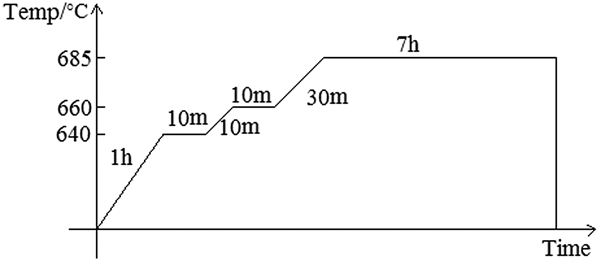
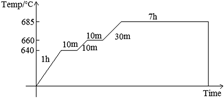
Titanium aluminide Al3Ti alloy was prepared via a diffusion reaction between Al and Ti alloy foils at a temperature of 685 °C in a vacuum hot pressing furnace. The foils used in this study were commercial pure Al 1100 and commercial Ti–6Al–4V alloy (TC4), with the thickness of 1.8 and 0.5 mm, respectively, they were cut into square of 100 × 100 mm. The oxides and contaminations on both surfaces of pure Al and TC4 alloy foils were removed using 800Cw grit silicon carbide paper, and then cleaned in alcohol bath using ultrasonic cleaning machine. After drying, the foils were stacked in alternating layers of titanium alloy and aluminum with titanium alloy covers on the top and bottom. In the preparation process, the vacuum hot press furnace with stacked foils was gradually heated to the maximum temperature ∼685 °C and held for 7 h at this temperature. The pressure applied on the plate during fabrication was 2–3 MPa when the temperature was less than 500 °C, while it was 1–1.5 MPa when heating temperature is in a range of 500–685 °C. The pressure was free during the initial 5 h of the heat preservation. The temperatures and pressures used at different processing stages were shown in Fig. 1. The optimum parameters, for instance, thickness ratio between TC4 alloy and pure Al, heating rate and pressure were confirmed through many trials. Such that the reaction between the TC4 alloy and pure Al foils was exactly done, i.e., TC4 alloy and pure Al foils were completely converted to titanium aluminide Al3Ti except for the residual TC4 alloy layers as thin top and bottom covers. At the last period of synthesis, when the TC4 alloy layers were completely consumed with the Al layers, the applied pressure was increased to 2–3 MPa again to ensure that the residual Al was squeezed out by a higher pressure. The dense bulk Al3Ti alloy was eventually prepared using these optimized processing parameters, including right thickness ratio of the TC4 alloy and pure Al foils, and the variable pressures and temperatures used in different processing periods. It should be pointed out that the right thickness of the TC4 alloy and pure Al foils must be selected to ensure that the TC4 alloy and pure Al foils were exactly consumed without any residual TC4 alloy or pure Al left in the bulk Al3Ti alloy after sintering. The last procedure to fabricate pure titanium aluminide Al3Ti alloy is to remove the residual thin TC4 alloy layers on the top and bottom surface since the diffusion reaction only occurred on one side of covered TC4 alloy layers, while there was no reaction in the other side of covered TC4 alloy foil that is against the high temperature stainless steel plate.
The elevated temperature curve.

B. Measurement method of physical properties
The density of the fabricated titanium aluminide Al3Ti alloy ρ was measured using the buoyancy method, the equation to calculate the density has the following form Reference Goldstein27 :
 $$\rho = {{{g_{\rm{a}}}} \over {{g_{\rm{a}}} - {g_{\rm{w}}}}}{\rho _{\rm{w}}}$$
where the g a, and g w are the masses of the sample measured in air and water, respectively, ρw is the density of water. Here, a rectangular sample of Al3Ti with 20 × 20 × 8 mm (height) was used to weight the mass using a balance (JA2003) with a minimum scale of 0.001 g.
The Possion's ratio and Young's modulus of the Al3Ti alloy were measured according to ASTM E494-10 standard. Firstly, an ultrasonic pulse-receiver (Olympus 5072PR, Olympus Co. Ltd., Beijing, China) was used to measure the propagation velocities of longitudinal and transverse waves in the sample, respectively. The fundamental material properties of Al3Ti alloy, including Young's modulus, shear modulus, and Poisson's ratio were determined using measured sound velocities and material density 28 as:
 $${\rm{Velocity}}\left( V \right) = {{{\rm{thickness}}} \over {{{{\rm{round\ trip\ transit\ time}}} \mathord{\left/ {\vphantom {{{\rm{round\ trip\ transit\ time}}} {\rm{2}}}} \right. \kern-\nulldelimiterspace} {\rm{2}}}}}$$
 $${\rm{Poisson,s\ ratio}}\left( \nu \right) = {{1 - 2{{\left( {{{{V_{\rm{T}}}} \mathord{\left/ {\vphantom {{{V_{\rm{T}}}} {{V_{\rm{L}}}}}} \right. \kern-\nulldelimiterspace} {{V_{\rm{L}}}}}} \right)}^2}} \over {2 - 2{{\left( {{{{V_{\rm{T}}}} \mathord{\left/ {\vphantom {{{V_{\rm{T}}}} {{V_{\rm{L}}}}}} \right. \kern-\nulldelimiterspace} {{V_{\rm{L}}}}}} \right)}^2}}}$$
 $${\rm{Young,s\ modulus}}\left( E \right) = {{\mathop {{V_{\rm{L}}}}\nolimits^2 \rho \left( {1 + \nu } \right)\left( {1 - 2\nu } \right)} \over {1 - \nu }}$$
 $${\rm{Shear\ modulus}}\left( G \right) = \mathop {{V_{\rm{T}}}}\nolimits^2 \rho$$
where, V T, V L are the transverse and longitudinal velocities, respectively.
C. Microstructure characterization
The microstructure and phase type of the Al3Ti alloy were investigated using the SEM, energy dispersive x-ray spectrometer (EDS), and x-ray diffractometer (XRD), respectively. The specimens used for SEM and EDS analysis were well-polished and etched for 15 s in the mixed solution of HF acid (10 mL), HNO3 acid (30 mL), and water (70 mL), while the specimens prepared for XRD scan were just ground by 320Cw and 1000Cw silicon carbide papers, respectively. The x-ray diffractometer with a target of Cu, the working voltage of 40 kV, working current of 40 mA, the scanning range (2θ) of 20–90°, and the step size of 0.033°/step were used in the present XRD test.
D. Thermal analysis
The thermal analysis of the Al3Ti alloy was performed by DSC/TG method. The powder samples used for thermal analysis were prepared using the fine fragments collected from the tested compressive specimens. The thermal analysis tests were carried out on NETZSCH STA 449F3 (NETZSCH Scientific Instruments Trading Ltd., Shanghai, China) in argon atmosphere. Testing temperature range was 35–1470 °C, and the heating rate was 20.0 K/min.
E. Mechanical testing
The compressive specimens were rectangular with the dimension of 6 mm (length) × 6 mm (width) × 8 mm (height), which were cut from the same Al3Ti alloy bulk plate using electrical discharge machine. The compressive tests were performed using an Instron 5500R load frame (Instron Co. Ltd., Beijing, China) at a strain rate of 0.001/s. The load and displacement histories that were measured by the load cell and deflectometer, respectively, were used to obtain the stress–strain curves, strain to failure and compressive strengths of Al3Ti alloy. The fracture surface of the tested specimen was observed by SEM to investigate the failure mechanisms of the synthesized titanium aluminide Al3Ti alloy.
III. RESULTS AND ANALYSIS
A. Physical properties
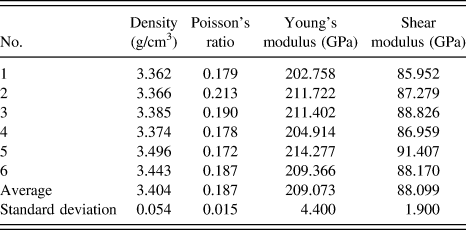
The physical properties of the synthesized Al3Ti alloy, including density, Poisson' ratio, and Young's modulus are shown in Table I. As can be seen from Table I, the average density is ∼3.40 g/cm3, which is slightly higher than the theoretical value ∼3.36 g/cm3. The reason is that the titanium alloy foil used to synthesize the Al3Ti alloy is TC4 alloy rather than pure titanium, i.e., the chemical element vanadium from original TC4 alloy foils is therefore introduced into the final synthesized Al3Ti alloy. The later analysis results by XRD in this work demonstrate that the element vanadium exists in Al3Ti alloy as the Al3Ti0.8V0.2 compound (see Figs. 2 and 3 for details). To further confirm this point, Al3Ti alloy was synthesized again using same sintering process by the foils of commercial pure titanium and pure aluminum, and the density of Al3Ti alloy synthesized using pure titanium is determined to be ∼3.07 g/cm3, which is lower than the theoretical value of Al3Ti alloy, ∼3.36 g/cm3. Therefore, the higher density of Al3Ti alloy can be considered as the contribution of Al3Ti0.8V0.2 compound due to the existence of element vanadium. In addition, as can be seen in Table I, the average Young's modulus is ∼209.07 GPa, also lower than the theoretical value of 216 GPa. This difference may result from the unreacted residual aluminum, since the later analysis results in this work reveal that there is a trace of aluminum phase in Al3Ti alloy detected by DSC although the SEM observation and XRD can not find it due to a very small mount of residual aluminum. It should be recognized that the residual aluminum (even a small amount) may play an important role on the density, Young's modulus and mechanical properties of the Al3Ti alloy. The difference between the current experimental results and theoretical values is related to chemical element vanadium, a trace of the residual aluminum and the micro-pores. Further investigation is therefore being performed to study the variation mechanisms of the physical and mechanical properties of the Al3Ti alloys synthesized by different titanium (commercial pure titanium and TC4 alloy) foils, of which results will be reported in a separated paper.
Physical properties of Al3Ti alloy.

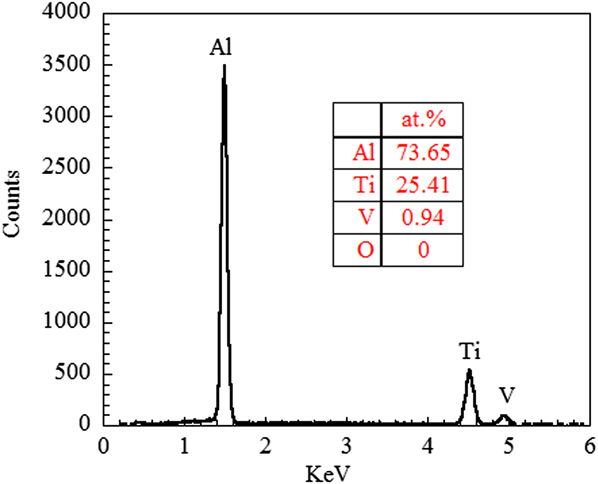
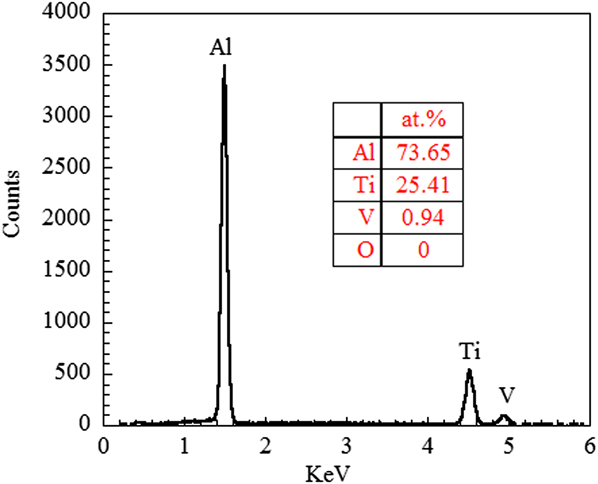
The EDS results scanned from the area as marked in Fig. 4(a).
XRD pattern of titanium aluminide Al3Ti alloy.

B. Microstructure
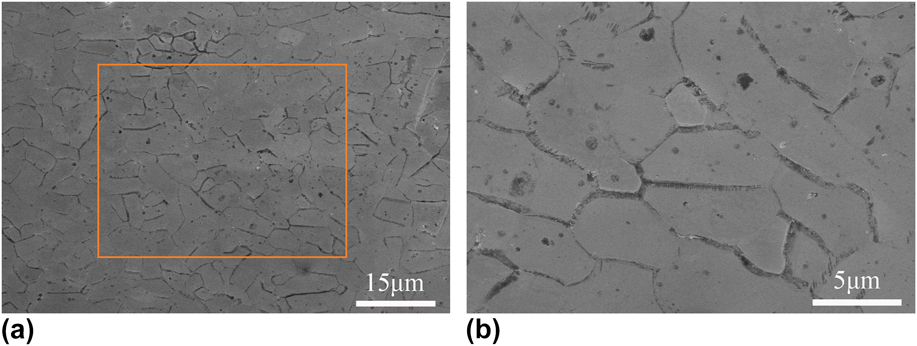
The SEM images of the Al3Ti alloy with different magnifications are shown in Fig. 4. It is noted that the grain size of the Al3Ti is nonuniform and varies in a range of 3–20 μm, there is no other phase visible in boundary and inside of the grain, Al3Ti is the only phase as shown in Fig. 4(b). This experimental result is confirmed by the later results from EDS and XRD, as shown in Figs. 2 and 3, respectively. It is noted from Fig. 2 that the elements of the reacted products are titanium, aluminum, and vanadium, and the atomic percentages of Al and Ti are ∼73.65 and ∼25.41%, respectively. Thus there is no doubt that the newly synthesized alloy mainly consists of the intermetallic Al3Ti phase, which is identical with the result obtained later in this work.
SEM micrographs of titanium aluminide Al3Ti alloy, (a) low magnification and (b) high magnification, here the sample was etched using the solution of HF acid (10 mL), HNO3 acid (30 mL) and water (70 mL).

Figure 3 shows the XRD patterns of the Al3Ti alloy. It is obvious that the most of the newly synthesized products are DO22 Al3Ti phase (PDF card no. 03-065-4202), a trace of Al3Ti0.8V0.2 (PDF card no. 00-043-1154) is also identified by XRD analysis, Al3Ti0.8V0.2 has a similar phase structure as the Al3Ti intermetallic compound (see Fig. 3 for details). The experimental fact that the compound of Al3Ti0.8V0.2 is identified by XRD is in coincide with the EDS result as shown in Fig. 2, in which the chemical element vanadium is detected by EDS technique. Here the chemical element vanadium is believed to come from original TC4 alloy foils, as aforementioned. Both the SEM observation and XRD analysis indicated that the starting titanium alloy and pure aluminum foils are completely reacted and transformed to monolithic intermetallic Al3Ti alloy and a trace of Al3Ti0.8V0.2, no any remaining unreacted titanium or aluminum is detected by the conventional SEM and XRD characterization techniques. As a matter of fact, a trace of residual aluminum is also found to exist in the final products, which just cannot be detected by conventional SEM, XRD experimental techniques due to a relatively small amount.
It should be pointed out that there should have some other intermetallic compounds formed during the reaction between the titanium and aluminum, such as TiAl2, Ti2Al5, Ti3Al, and TiAl apart from the Al3Ti phase, in terms of the Ti–Al binary phase diagram. Why both the SEM and XRD analysis techniques show only Al3Ti phase available in a newly reacted intermetallic compound? It has been demonstrated that the free energy of Al3Ti formation is lower than that of Ti3Al and TiAl compounds in the temperature range of 0–1200 °C, Reference Kattner, Lin and Chang29 which is the reason for Al3Ti alloy firstly generated at the current reacting temperature of 685 °C. On the other hand, the formation of TiAl2 and Ti2Al5 need a series of liquid–solid and/or solid–solid state reactions under high temperature based on the TiAl phase formation that acts on one of the starting phases. Reference Murray30 Therefore without the formation of the TiAl phase, it is hard to transform into other two compounds from the initial TiAl phase. That is to say, the formation of TiAl2 and Ti2Al5 must be on the base of TiAl phase, while according to the thermodynamics and reaction kinetics conditions for forming the Al3Ti and TiAl phases, the later one can hardly form in the current low temperature condition. Accordingly, there are no TiAl2 and Ti2Al5 formation and the Al3Ti phase is the only newly formed product at 685 °C.
It is no doubt that the formation of the Al3Ti is a result of diffusion of the titanium and aluminum atoms. When the heating temperature is higher than the melting point of Al, there are liquid phases and small intermetallic nodules formed between TC4 and Al foils. Reference Harach and Vecchio13,Reference Mackowiak and Shreir31–Reference Meyers, Yu and Vecchio35 The existence of the liquid phase is beneficial for the reaction process, which enables the reaction to be faster and the newly formed intermetallic phase to be dense. Once the complete Al3Ti layer forms, two interfaces of Al–Al3Ti and Al3Ti–Ti also form, and the Al and Al3Ti are in the two phase (L + Al3Ti) region of the Ti–Al phase diagram. Therefore the titanium atoms need to diffuse across the previously formed Al3Ti layer (solid phase) for forming new Al3Ti phase with aluminum atoms coming from liquid phase. With the migration of the solid Al3Ti/liquid Al interface toward to the liquid aluminum, the solid Al3Ti phase grows up and the liquid aluminum phase gradually decreases, when the solid Al3Ti phase meets another solid Al3Ti layer moving from another side, the reaction ends at the mid-thickness of the each initial Al foil, and the entire dense solid Al3Ti plate is synthesized. Clearly, the uniformity of the chemical composition, grain size, and microstructure is strongly dependent upon the reaction time and the initial foil thickness.
C. Thermal analysis (DSC/TG) results
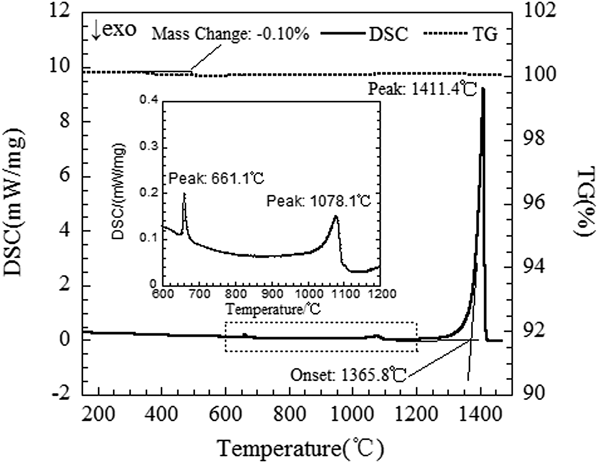
The results of thermal analysis (DSC/TG) are shown in Fig. 5. It is noted that the mass of the sample is almost constant (∼−0.1%) during the whole heating in a temperature range up to 1470 °C, indicating the intermetallic Al3Ti alloy has a superior thermal stability. As can be seen from Fig. 5, there are two endothermic peaks visible in the DSC curve during the heating process. The lowest peak associated with the temperature of 661.1 °C corresponds to the melting point of aluminum (660.4 °C). This lowest temperature peak detected by DSC reflects the existence of the residual aluminum, although the SEM and XRD experimental techniques do not find the residual aluminum due to the small amount, as mentioned previously in this work. In our another study, it is found that the amount of the residual aluminum increases with decreasing applied pressure that is used to squeeze the superfluous aluminum in last processing period. Our further study also reveals the effect of the different content of residual aluminum on the mechanical properties of Al3Ti alloy. While in the current work, the amount of the residual aluminum is too less to be detected by the XRD analysis technique and found by SEM observation. For second peak corresponding to temperature of 1078.1 °C, it is probably related to the compound phase of Al3Ti0.8V0.2 that is identified by XRD, as shown in Fig. 3. However, this conclusion needs further study for figuring out the physical nature of this peak. The temperature corresponding to the intersection point of the two tangent lines is 1365.8 °C, which exactly represents Al3Ti melting point of 1360 °C.
The DSC/TG curves of titanium aluminide Al3Ti alloy.

D. Mechanical properties
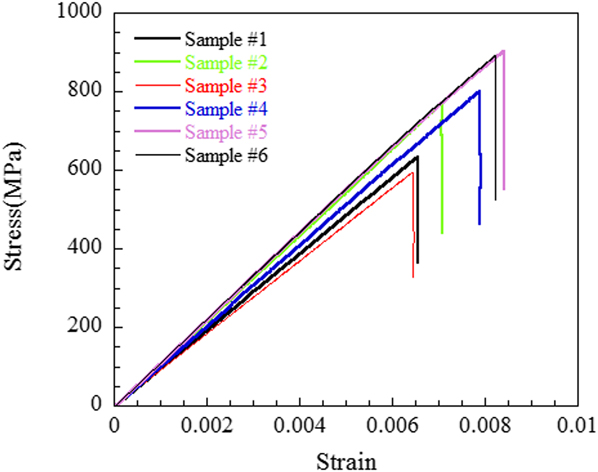
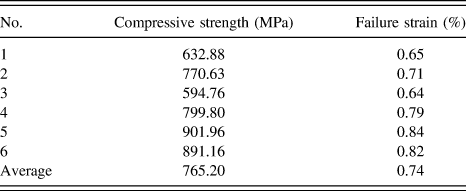
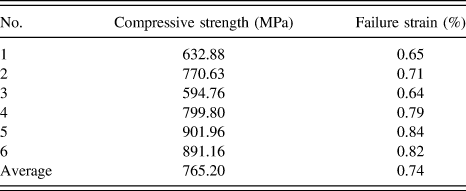
To investigate the mechanical behavior of the intermetallic Al3Ti alloy, the quasistatic compressive tests were performed under a strain rate ∼0.001/s. Figure 6 depicts six typical compressive stress–strain curves. Clearly, all stress–strain curves show linear elastic behavior without any plastic deformation evidence, indicating a brittle fracture occurred in the Al3Ti alloy. Such a stress–strain behavior reflects the inherent nature of the brittle intermetallic Al3Ti alloy. On the other hand, relatively large differences are found in the maximum compressive strengths and failure strains of the six samples. For example, the maximum (sample #5) and minimum (sample #3) compressive strengths are 901.96 MPa and 594.76 MPa, respectively. Similar large scatters are also found in the failure strain for six compressive samples, which also reflects the inherent brittle nature of the Al3Ti alloy.
Typical compressive stress–strain curves of Al3Ti alloy tested under a strain rate of 0.001/s.
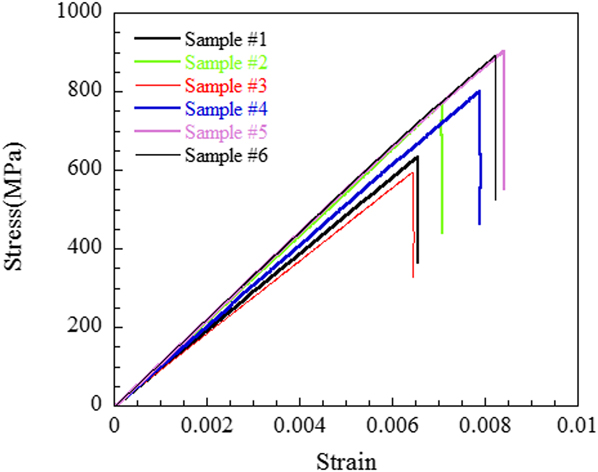
A brief summary of the compressive test results is presented in Table II, the average compressive strength is 765.20 MPa and the average failure strain is 0.74%. Both the average compressive strength and failure strain of the Al3Ti alloy synthesized using metal foil metallurgical techniques in this work are higher than the previously reported elsewhere Reference Vecchio12 in which the Al3Ti alloy was synthesized by two-step processing (ultrasonic consolidation plus sintering technique). In their work Reference Vecchio12 commercial pure titanium and aluminum foils were used to prepare Al3Ti alloy. While in the current work, TC4 alloy and pure aluminum foils are used to fabricate Al3Ti alloy by sintering technique in a vacuum pressure. The comparison with the mechanical properties of the Al3Ti alloys prepared by other processing techniques indicates that the present technique proposed in this work is more competitive.
The compressive strengths and failure strains of Al3Ti alloy tested under a strain rate of ∼0.001/s.
The typical compressive failure characteristics of the Al3Ti alloy were observed by SEM, as shown in Fig. 7. It can be clearly seen that the intermetallic Al3Ti alloy shows a brittle failure features that are similar with that observed in the Al3Ti matrix of the Ti/Al3Ti laminate composites under three-point bend loading conditions. Reference Adharapurapu, Vecchio, Jiang and Rohatgi26 As marked in Fig. 7, a mixed failure mode of the transgranular and intergranular fracture features is visible, which is a typical failure characteristic of the brittle Al3Ti alloy no matter what the stress state applied on it.
The SEM image of fracture surface of Al3Ti alloy, showing the mixture failure mode of the transgranular and intergranular fracture.

IV. SUMMARY AND CONCLUSIONS
A dense intermetallic Al3Ti alloy was successfully synthesized by reactive sintering technique under vacuum conditions. The analysis results obtained by XRD and EDS shows that Al3Ti alloy is the main newly synthesized phase due to the thermodynamics and kinetics of the reaction between TC4 alloy and pure aluminum foils.
The amount of the residual unreacted aluminum is too small to be detected using conventional SEM and XRD analysis techniques, while the result obtained by DSC analysis found the existence of a trace of aluminum that may have a distinct influence on the density, Young's modulus and mechanical properties of the Al3Ti alloy.
The mechanical properties of the Al3Ti alloy were tested at the strain rate ∼0.001/s, and the corresponding compressive strength is 765.20 MPa. The SEM observation demonstrated that the Al3Ti alloy shows a mixed failure mode of the transgranular and intergranular fracture features under compressive stress state.
There are still some fundamental issues need to be further investigated, such as the effect of the chemical element vanadium on the physical properties, the effect of the residual aluminum on the mechanical properties, and physical nature corresponding to the unknown temperature point found in DSC curve. All those problems are being further studied in our group, the newly achieved results will be reported separately in the near future.
ACKNOWLEDGMENTS
The authors gratefully acknowledge the financial support of this study by the National Natural Science Foundation of China (No. 11402060).