Introduction
Stretchable and flexible electronic devices require both structural and active electronic materials that are compliant and able to withstand mechanical deformation without damage. Often, it is desirable that the active electronic materials also act as structural elements—resistant to damage processes such as buckling and fracture without the need for supporting structures. Engineering reliable, flexible, and stretchable devices requires characterizing thermomechanical properties, including strength, stiffness, and ductility of the constituent materials. In addition, the fracture energy, G c (J/m2), quantifies the adhesion of interfaces or cohesion of constituent layers and is one of the most fundamental metrics of reliability. Organic electronic materials have G c values that are often much lower than those of conventional engineering materials, and strategies for improvements are required for thermomechanically reliable technologies. Reference Brand, Bruner and Dauskardt1
Characterizing salient mechanical properties of organic charge-transport layers and semiconducting materials used in organic logic devices, displays, and organic or even recent perovskite photovoltaic solar cells have provided essential lessons for the development of mechanically reliable, electronically active, and flexible technologies.
Mechanical properties important for reliability
Adhesive or cohesive failure may result from residual or applied mechanical stresses introduced during device processing, handling, packaging, and operation. Reference Dauskardt, Lane, Ma and Krishna2,Reference Hutchinson and Suo3 Mechanical stresses provide the driving force for damage and can vary markedly with thermal cycling or device application, particularly for stretchable and wearable devices subject to significant deformation from physiological motion. The driving force for failure processes like film cracking or interface debonding can be quantified in terms of the strain-energy release rate, G (J/m2), which is a function of the previously discussed mechanical stresses. Fracture occurs when G ≥ G c.
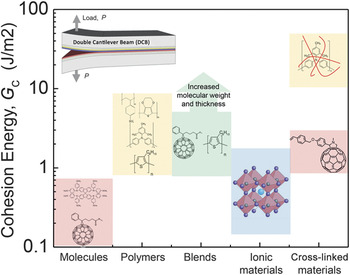
G c values of representative organic electronic materials can be accurately measured and recently characterized ranges are summarized in Figure 1 . Measuring G c does not require any information about the mechanical properties or stresses in the layers themselves, which are often unknown or difficult to characterize. Reference Brand, Bruner and Dauskardt1,Reference Dauskardt, Lane, Ma and Krishna2,Reference Bruner and Dauskardt4
A comparison of G c values for a wide range of active materials in organic electronic devices. Reference Brand, Bruner and Dauskardt1,Reference Dupont, Oliver, Krebs and Dauskardt10,Reference Rolston, Watson, Bailie, McGehee, Bastos, Gehlhaar, Kim, Vak, Mallajosyula, Gupta, Mohite and Dauskardt13,Reference Watson, Rolston, Bush, Leijtens, McGehee and Dauskardt14 The inset shows the double cantilever beam specimen method used to obtain the data in the plot.

Complementary thin-film techniques can be used to elucidate other fundamental mechanical properties useful for understanding mechanical failure. Buckling techniques, Reference Stafford, Harrison, Beers, Karim, Amis, Van Landingham, Kim, Volksen, Miller and Simonyi5 crack onset strain measurements, Reference O’Connor, Chan, Chan, Conrad, Richter, Kline, Heeney, McCulloch, Soles and De Longchamp6 and tensile testing Reference Kim, Nizami, Hwangbo, Jang, Lee, Woo, Hyun and Kim7 provide insight into the stiffness, yielding, and ductility of materials. More complex viscoelastic properties can be characterized using dynamic mechanical analysis techniques, Reference Bruner and Dauskardt4,Reference Suo, Prévost and Liang8 and while important, are not addressed in this article.
Mechanical properties are needed for understanding mechanical stability and provide the basis for reliable thermomechanical design and lifetime prediction. For organic semiconducting materials, however, these properties and their connection to underlying molecular structure are often unknown. In addition, the synergistic effects of mechanical stress along with temperature and temperature cycling, moisture and other environmental species, and damaging solar radiation are just as important. Reference Jørgensen, Norrman and Krebs9–Reference Balcaen, Rolston, Dupont, Voroshazi and Dauskardt12 These variables accelerate damage processes that result in the commonly observed loss of cohesion of layers or adhesion of interfaces, leading to degradation of performance and device failure.
Adhesion and cohesion
We first provide an overview of the typical G c values for cohesion and adhesion of organic electronic material layers and interfaces that, as already noted, are often much lower than conventional engineering materials (Figure 1). Reference Brand, Bruner and Dauskardt1,Reference Dupont, Oliver, Krebs and Dauskardt10,Reference Rolston, Watson, Bailie, McGehee, Bastos, Gehlhaar, Kim, Vak, Mallajosyula, Gupta, Mohite and Dauskardt13,Reference Watson, Rolston, Bush, Leijtens, McGehee and Dauskardt14 G c at the most fundamental level involves the energy needed to cause bond breakage that is related to the bond type and density, and by other energy dissipation processes involving, for example, molecular deformation and flow in a localized fracture process zone. Reference Brand, Bruner and Dauskardt1 In solution-processed molecular materials, such as 2,2′,7,7′-tetrakis[N,N-di(4-methoxyphenyl)amino]-9,9′-spirobifluorene (spiro-OMeTAD) and C60 fullerene layers, the intermolecular forces are weak, and very low fracture energies (∼0.1– 0.5 J/m2) are a result of the absence of stronger covalent or ionic bonds. Reference Watson, Rolston, Bush, Leijtens, McGehee and Dauskardt14 Other classes of molecular materials (e.g., rubrene, pentacenes, diindenoperylenes, perylene diimides, and tetracyanoquinodimethane) utilized in organic electronic devices have entirely uncharacterized fracture properties and related thermomechanical reliability, although G c measurements in our lab suggest similarly low values for 6,13-bis(triisopropylsilylethynyl)pentacene (TIPS-pentacene) layers.
In polymeric semiconducting materials, such as poly(3-hexylthiophene) (P3HT) and poly[bis(4-phenyl)(2,4,6-trimethylphenyl)amine] (PTAA), higher G c values (∼2.5–8 J/m2) result from increasing degrees of polymer–chain interactions and entanglement, requiring that covalent bonds be broken during fracture. Chain entanglement is strongly influenced by the molecular weight (MW) and provides a further mechanism for the dissipation of energy by viscoelastic deformation related to chain pullout in a fracture process zone localized at the crack tip. Reference Bruner and Dauskardt4 Complex composite polymers such as poly(3,4-ethylenedioxythiophene) poly(styrene sulfonate) (PEDOT:PSS) feature entanglements and further ionic interactions that contribute to G c, but also make the material susceptible to so-called “moisture-assisted” decohesion or debonding, as the synergistic effects of water molecules that weaken the ionic interactions together with mechanical stress lead to a time-dependent fracture process at values of G < G c. Reference Dupont, Novoa, Voroshazi and Dauskardt11
Blends of polymers with small molecules such as bulk heterojunction (BHJ) solar cells present an interesting case study. In these systems, the G c of the polymer may be significantly compromised through the addition of fullerene material (e.g., [6,6]-phenyl-C61-butyric acid methyl ester [PCBM]) as the extent of polymer chain interactions is reduced. Reference Dupont, Oliver, Krebs and Dauskardt10 Interestingly, the polymer acts as a solvent for these molecules, allowing for their diffusion and aggregation at surfaces with favorable energies and resulting in fullerene crystal formation. In organic photovoltaic (OPV) devices, this presents a particular challenge for mechanical stability since the weakly interacting fullerene crystal domains compromise both adhesion and cohesion. Reference Dupont, Oliver, Krebs and Dauskardt10,Reference Dupont, Voroshazi, Nordlund and Dauskardt15
Ionic hybrid perovskite materials that feature prominently in current literature are formed by crystallization of ionic species from solution and develop their cohesion as solvent molecules leave. Their solubility, however, indicates that their cohesion is low and can be easily overcome by solvent interactions, unlike materials held together by stronger polar-covalent or covalent bonds, which do not easily dissolve. Accordingly, these brittle, ionic materials offer little resistance to fracture and have extremely low G c values (∼0.3–1.5 J/m2). Reference Rolston, Watson, Bailie, McGehee, Bastos, Gehlhaar, Kim, Vak, Mallajosyula, Gupta, Mohite and Dauskardt13 Additionally, nanoparticulate oxides such as ZnO used as n-type semiconducting materials rely on interparticulate interactions for their cohesion, resulting in fracture well below (∼0.7 J/m2) those expected for the brittle fracture of bulk ZnO. Reference Watson, Rolston, Bush, Leijtens, McGehee and Dauskardt14
Molecular cross-linking strategies that increase molecular interactions with strong covalent bonds can be employed to significantly increase G c values for organic electronic materials, and they will be discussed later.
Other salient mechanical properties
Buckling-based metrologies derive the elastic modulus of polymeric thin films from the buckling wavelength of the films on flexible substrates such as poly(dimethylsiloxane) (PDMS), which acts as a source of compressive strain. Reference Stafford, Harrison, Beers, Karim, Amis, Van Landingham, Kim, Volksen, Miller and Simonyi5 Introducing fullerene (PCBM) into polymer blends increases the elastic modulus of the BHJ films due to a filler effect. Reference Awartani, Lemanski, Ro, Richter, De Longchamp and O’Connor16–Reference Savagatrup, Makaram, Burke and Lipomi18 Conjugated polymers with longer or branched side chains have the opposite effect. Reference Savagatrup, Makaram, Burke and Lipomi18,Reference Roth, Savagatrup, De Los Santos, Hagemann, Carlé, Helgesen, Livi, Bundgaard, Søndergaard, Krebs and Lipomi19 Additives such as 1,8-diiodooctane (DIO), low-molecular-weight PDMS and the fluorosurfactant Zonyl FS-300 in polymers act as plasticizers that also decrease the elastic modulus of the films. Reference Savagatrup, Makaram, Burke and Lipomi18,Reference Savagatrup, Chan, Renteria-Garcia, Printz, Zaretski, O’Connor, Rodriquez, Valle and Lipomi20
Measuring the “crack onset strain” of organic semiconductor layers on flexible substrates has been widely adopted as a method to evaluate the ductility of thin films. Reference O’Connor, Chan, Chan, Conrad, Richter, Kline, Heeney, McCulloch, Soles and De Longchamp6 Ductile films have a high crack onset strain and tend to be more robust, while brittle films crack even under small tensile strain. Reference Roth, Savagatrup, De Los Santos, Hagemann, Carlé, Helgesen, Livi, Bundgaard, Søndergaard, Krebs and Lipomi19 An increase in side-chain length and addition of polymer additives such as fluorosurfactant that decrease the elastic modulus tend to increase the ductility of the films and can be used to achieve good mechanical resilience of OPVs. Reference Savagatrup, Makaram, Burke and Lipomi18,Reference Savagatrup, Chan, Renteria-Garcia, Printz, Zaretski, O’Connor, Rodriquez, Valle and Lipomi20 In order to quantify the importance of elastic modulus (stiffness) and crack onset strain (ductility) on electronic devices, the effects of mechanical strains and fatigue on photovoltaic properties have been investigated on a PDMS substrate. Reference Savagatrup, Makaram, Burke and Lipomi18,Reference Lipomi, Chong, Vosgueritchian, Mei and Bao21
Direct tensile testing of organic semiconductors, including conjugated polymers and BHJ films, has proven difficult due to the combination of their ultrathin and fragile characteristics. To overcome these limitations, a new tensile testing method was recently developed in which films are floated on water, enabling tensile testing of a variety of materials from metals to organic semiconductors. Reference Kim, Nizami, Hwangbo, Jang, Lee, Woo, Hyun and Kim7,Reference Kim, Kim, Lee, Yu, Kim, Song, Shin, Oh, Jeong, Kim and Kim22 This involves attaching a PDMS-coated Al grip to the film surface using van der Waals adhesion in order to manipulate the ultrathin films. The high surface tension of water supports the films, and the low viscosity of water enables frictionless sliding. By adopting this method, the intrinsic mechanical properties of semiconducting polymers such as P3HT have been directly measured on the water surface without requiring complex calculations to account for any substrate effects.
To float the P3HT thin film on the water surface, deionized (DI) water was used to dissolve the underlying PEDOT:PSS layer on which the P3HT was deposited, releasing the film from the substrate. During tensile testing, load and strain data are measured and the elastic modulus and elongation at break can be obtained from the stress–strain curves. Reference Kim, Kim, Lee, Yu, Kim, Song, Shin, Oh, Jeong, Kim and Kim22
This technique has enabled characterization of the stress–strain behavior of OPV thin films, including P3HT and other polymer and BHJ active layers. Properties such as the regioregularity (RR) of conjugated polymers strongly influence their mechanical behavior. Reference Kim, Kim, Lee, Yu, Kim, Song, Shin, Oh, Jeong, Kim and Kim22 For example, the tensile modulus of P3HT was reduced from 287 to 13 MPa with decreasing RR from 98% to 64% and a significant increase in the elongation at break from 0.6% to 5.3%. These effects were attributed to the degree of polymer crystallinity, strongly influenced by the regioregularity of P3HT. Reference Kim, Kim, Lee, Yu, Kim, Song, Shin, Oh, Jeong, Kim and Kim22 Highly crystalline 98% RR-P3HT films were much stiffer and more brittle than less crystalline films with lower RR-P3HT.
This method was also used to elucidate the mechanical properties of all-polymer donor–acceptor layers and polymer-fullerene BHJ layers used in organic solar cells. Reference Kim, Kim, Kang, Lee, Kang, Shin, Wang, Ma, Jeong, Kim and Kim23 The tensile modulus of a poly[[N,N′-bis(2-hexyldecyl)-naphthalene-1,4,5,8-bis(dicarboximide)-2,6-diyl]-alt-5,5′-thiophene] (P(NDI2HD-T))-based all-polymer active layer was measured to be only 0.43 GPa, while the modulus of a PCBM-based BHJ layer utilizing the same donor polymer was 4× larger at 1.76 GPa. Moreover, the all-polymer active layer showed a significantly improved elongation (stretchability) of 7.16% compared to that of BHJ films, which was measured as ∼0.12%. Similarly, ductile crack growth of the all-polymer active layer at ∼7% elongation highlights the difference in ductility of the all-polymer active layer in comparison to the brittle BHJ films, which exhibited fracture at very low tensile strain. The superior mechanical properties of all-polymer active layers reveal the mechanical fragility of PCBM-polymer blends, highlighting the potential benefits of all-polymer systems for future mechanically robust devices.
Influence of operating conditions
Mechanical reliability and resulting operational lifetimes of organic electronic devices are influenced by the complex synergy of “stressing” parameters, such as cyclic mechanical flexing and stretching, operating temperatures, thermal cycling, moisture ingress, and damaging solar radiation. Reference Balcaen, Rolston, Dupont, Voroshazi and Dauskardt12,Reference Printz, Chiang, Savagatrup and Lipomi24,Reference Dupont, Voroshazi, Heremans and Dauskardt25 These variables accelerate damage processes and must be included in a comprehensive analysis of thermomechanical reliability.
The synergistic effects of multiple stressing parameters provide particular challenges for organic materials, which are often more sensitive compared to more stable inorganic engineering materials. These differences highlight an emerging area of research that will require significant efforts to characterize fundamental damage processes, develop quantitative predictive models, and improve accelerated testing protocols to enable reliable flexible organic devices. Here, we review recent studies that provide some indication of this important area of device reliability.
Mechanical strain and thermal cycling
The action of alternating (or cyclic) mechanical strains and thermal cycling can result in the rearrangement of polymer networks and several forms of damage, such as strain localization, crazing, cohesive cracking, and interface separation. Damage accumulates and progresses on a cycle-by-cycle basis akin to well-known mechanical fatigue in structural materials. In polymers, cyclic straining can also dissipate heat that produces rearrangements in the molecular structure and marked changes in mechanical properties, including chain scission and reduction of the load-bearing capacity. Reference Printz, Chiang, Savagatrup and Lipomi24 Damage often develops faster (in less time) compared to monotonic loads or constant temperatures and is particularly relevant when assessing the mechanical integrity of flexible devices.
Applying the mechanical testing metrologies already described can provide valuable insights into the influence of alternating mechanical or thermal cycling, but improved testing techniques and analysis are urgently required. The influence of 10s to 1000s of cycles are often currently reported, however, the effects of ∼105 or more cycles are generally required for engineering reliable devices.
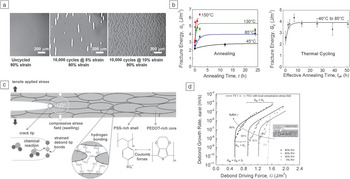
The effects of alternating loading on the structure and ductility of thin semiconducting poly(3-heptylthiophene) (P3HpT) films can be revealed by observing damage (in the form of cracks) using optical microscopy ( Figure 2a). Reference Printz, Chiang, Savagatrup and Lipomi24 Films that had not undergone cyclic straining exhibited pinhole fracture at ∼90% strain, just below the strain at which the PDMS substrate failed. Conversely, films that had been cyclically strained for 10,000 cycles demonstrated brittle failure, and as the cyclic strain amplitude was increased, so did the brittleness of the resulting films.
Effects of environmental stressors on organic electronic device materials. (a) Micrographs of cracking in poly(3-heptylthiophene) (P3HpT) films under different strain cycling conditions at 90% strain (highest strain before failure of the substrates) showing the synergistic effects of strain and cycling on crack density in films. Reproduced with permission from Reference Reference Printz, Chiang, Savagatrup and Lipomi24. © 2016 Elsevier. (b) Measured G c as a function of annealing time modeled at different temperatures. The isothermal curves are integrated over the temperature profile of a thermal cycle and used to accurately predict effects of thermal cycling on G c. Reference Balcaen, Rolston, Dupont, Voroshazi and Dauskardt12 (c) Illustration of a poly(3,4-ethylenedioxythiophene) poly(styrene sulfonate) (PEDOT:PSS) layer consisting of grains with a PEDOT-rich core and PSS-rich shell, showing the decohesion mechanism enabled by a stress-dependent chemical reaction between the water molecules and strained hydrogen bonds at the debond tip. Reference Dupont, Novoa, Voroshazi and Dauskardt11 (d) Debond growth rate curves at a constant temperature and varying moisture content (RH). The applied driving force at the debond tip, G tip; the applied debond driving force, G a; the threshold driving force, G th; and the intrinsic resistance to bond rupture in the reactive environment, 2γ. Reference Dupont, Novoa, Voroshazi and Dauskardt11

Surprisingly, this damage mechanism was not observed in thermally cycled OPVs, and mechanical stability was increased without significant effect on the device performance. Thermal cycling of P3HT:PCBM devices from –40°C to 85°C showed increasing G c values through the first 200 thermal cycles, similar to the influence of annealing after device fabrication. Reference Balcaen, Rolston, Dupont, Voroshazi and Dauskardt12 A kinetic model was developed to predict the increase in G c as a result of thermal cycling based on integrating the isothermal annealing data over the temperature profile of a thermal cycle (Figure 2b). This allowed for an equivalence between annealing and thermal cycling, where an effective annealing time was determined during thermal cycling. The model successfully predicted the effects of thermal cycling on G c for various cycle numbers and could be generalized to other temperature ranges. Although no evidence of a cycle-by-cycle damage accumulation mechanism was observed, there is likely to be a more pronounced effect over the course of thousands of cycles, which would be more representative of the operational lifetime of a device.
Environmental species
Moisture and other environmental species such as oxygen and radicals are ubiquitously present in the operating environments of stretchable and flexible devices. Reference Krebs, Gevorgyan and Alstrup26 Here, we focus on water, a protic solvent and a nucleophile that acts to solvate ionic species and hydrolyze chemical bonds, including carboxylic acid esters, silicates, and imines. The synergistic effects of water and mechanical stress can result in a time-dependent cracking process in which interfaces debond or layers decohere at values of G < G c. The mechanical stress in such kinetic decohesion processes results in strained atomic bonds or molecular interactions at the crack tip. This amplifies the solvating or hydrolyzing effects of the water molecules, highlighting the synergistic effects of these two stressing parameters in device structures. Reference Kook and Dauskardt27,Reference Lane, Snodgrass and Dauskardt28
Decohesion kinetics are studied by measuring the decohesion rate, da/dt (m/s), in terms of the applied driving force, G, to produce a da/dt versus G curve, where a is the length of the advancing crack. The threshold value, G TH, represents the lowest decohesion driving force at which the process occurs and is a particularly important indicator of material reliability in the presence of a given environmental species. Reference Dauskardt, Lane, Ma and Krishna2
As an example, moisture plays a significant role in increasing the decohesion rate of the BHJ and charge-transport layers such as PEDOT:PSS. Reference Dupont, Novoa, Voroshazi and Dauskardt11 Since PEDOT:PSS is water soluble and highly hygroscopic, the hydrogen bonds holding the individual grains together are susceptible to moisture-assisted decohesion (Figure 2c). When decohesion rates are measured in humid environments, increasing the humidity markedly increases the decohesion rate, or alternatively considered, shifts the entire da/dt versus G curves to lower G values with correspondingly lower values of G th (Figure 2d). The insidious nature of this time-dependent process is evident by noting that decohesion occurs at G values much lower than G c for PEDOT:PSS. Similar degradation mechanisms have been reported for many polymer and glassy materials and should certainly be anticipated for other organic electronic polymer molecular complexes.
UV exposure
Organic materials are particularly susceptible to photochemical degradation when exposed to UV light. For example, the solar spectrum induces degradation in the form of discoloration along with embrittlement through changes in mechanical properties. However, the underlying degradation mechanisms and their effect on long-term reliability are not well known and provide particular challenges for the reliability of organic electronic devices.
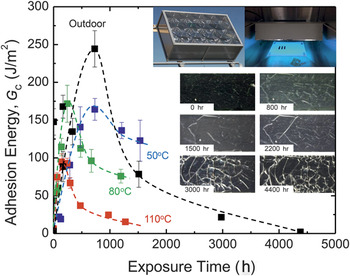
To demonstrate the complex behavior, we present the results of a recent study of both indoor and outdoor UV exposure on the adhesion and cohesion of a highly transparent silicone adhesive to an antireflective Al2O3 layer. Reference Cai, Miller, Tappan and Dauskardt29 Surprisingly, during the initial periods of photodegradation under simulated indoor UV exposure, the silicone was found to fail adhesively at the silicone/Al2O3 interface and the adhesion energy was found to systematically increase by two orders of magnitude from 6 to >100 J/m2 ( Figure 3 ). With further exposure, however, the failure became cohesive in the silicone with a gradual decrease in G c values.
The synergistic influence of concentrated outdoor sunlight exposure or laboratory UV exposure with temperature on the adhesion of a highly transparent silicone adhesive layer to an antireflective Al2O3 layer. Initially, the layered structure failed adhesively. With increasing exposure, adhesion increased until failure occurred cohesively; at which point UV exposure resulted in further embrittlement of the silicone adhesive. Insets (moving clockwise from top left show) the outdoor concentrator optics allowing for exposure with 1100× solar concentration onto a 1 cm2 target (black curve), UV exposure of silicone specimens under investigation in an indoor environmental chamber at 50°C, 80°C, or 110°C at 10% relative humidity (blue, green, and red curves, respectively), and specimens aged under the outdoor concentrator showing formation and growth of cracks through 4400 h of concentrated solar irradiation, similar to those observed for specimens aged in laboratory conditions. Reference Cai, Miller, Tappan and Dauskardt29

The underlying degradation process was shown to be associated with a photochemical oxidization reaction in which carbon side groups in the silicone molecular structure are cleaved, which then allows a cross-linking reaction to produce additional silicon to oxygen bonds. Both the increase in adhesion with initial exposure followed by the decrease in cohesion could be explained in terms of the increased cross-link density of the silicone. A mechanics model incorporating the photochemical cross-linking reaction was developed to explain the trends. Reference Cai, Miller, Tappan and Dauskardt29 Exposure to outdoor concentrated solar flux produced exactly the same behavior (Figure 3), and models from the short-term indoor exposures could be used to rationalize the outdoor exposure results, providing confidence in the models and suggesting strategies that could be used for organic electronic device reliability predictions.
Strategies for improving mechanical reliability
We discuss here an incomplete list of strategies that can be employed to increase thermomechanical reliability of organic electronic devices by drawing from several examples from our studies. The strategies generally involve manipulating materials chemistry, molecular structure, and interface structure to improve salient mechanical properties.
We note that improvements in mechanical properties must be undertaken with careful consideration of device electrical and optoelectronic properties, since these could have deleterious effects on device performance. Reference Bruner and Dauskardt4,Reference Dupont, Oliver, Krebs and Dauskardt10 Our recent studies on the mechanical integrity of organic and perovskite solar cells show stark trends where G c values appear to scale inversely with power-conversion efficiency. Reference Rolston, Watson, Bailie, McGehee, Bastos, Gehlhaar, Kim, Vak, Mallajosyula, Gupta, Mohite and Dauskardt13 This points to the development of materials and devices that were optimized only for efficiency with no consideration for mechanical reliability. Future materials and device development must be undertaken where both device performance and thermomechanical reliability are considered.
Molecular weight
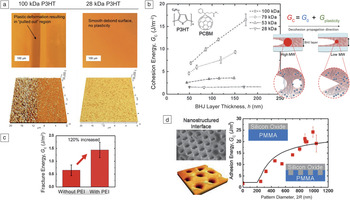
The molecular weight of semiconducting polymers has been correlated to the mobility of charge carriers in field-effect transistors, their surface morphology, and gelation rates in solution. Reference Kline, McGehee, Kadnikova, Liu and Fréchet30–Reference Ma, Kim, Lee and Heeger33 Additionally, the MW of P3HT can significantly influence the cohesive fracture energy of OPV BHJ layers. Reference Bruner and Dauskardt4,Reference Tummala, Bruner, Risko, Brédas and Dauskardt34 In general, increasing the MW increases intermolecular bonding and chain entanglement, allowing for a greater degree of plastic deformation before cohesive failure ( Figure 4a–b). G c increases as a result because chain entanglement leads to increased friction during chain pullout, Reference Tummala, Risko, Bruner, Dauskardt and Brédas35 and more interchain π-π stacking increases the number of van der Waals bonds needed to be broken for chain disentanglement. This effect is shown in Figure 4a, where atomic force microscope images of the fractured surface show increased roughness due to increased plasticity at the crack tip when higher MW P3HT is used.
Strategies to improve the fracture energy G c of organic electronic materials. (a) Atomic force microscope images of fractured poly(3-hexylthiophene) [6,6]-phenyl-C61-butyric acid methyl ester (P3HT:PCBM) surfaces showing an increase in roughness with increasing molecular weight. (b) Measured G c of P3HT:PCBM for various molecular weights and bulk heterojunction (BHJ) layer thicknesses, showing a strong dependence of cohesion on both of these variables. Inset schematic shows the larger plastic zone at the crack tip generated for the higher-molecular-weight (MW) BHJ layer. G c is the sum of the intrinsic energy required to debond the interface, G 0, and the energy contributed to the plasticity, G plasticity. Reference Bruner and Dauskardt4 (c) Fracture energies measured at the interface between perovskite and spiro-OMeTAD layers with and without polyethyleneimine (PEI) specimens. Reference Yun, Lee, Kim, Ko, Kim and Son37 (d) Adhesion promotion of an oxide–polymer interface by nanopatterning of SiO2 on poly(methyl methacrylate) (PMMA), showing the effect of varying feature diameter (2R) on adhesion energy, which increases G c due to a larger fraction of pillars pulled out. Reference Cai and Dauskardt38

Plastic deformation also explains the increase in G c observed with increasing thickness in OPV layers made with ≥53 kDa P3HT. With increased BHJ layer thickness, the plastic zone surrounding the BHJ crack tip can extend out to a larger volume before being constrained by the stiff top and bottom substrates, thus dissipating more energy. This presents significant opportunities that may enable large-scale manufacturing, as studies have shown that device technologies with relatively low G c values (<5 J/m2) become difficult to produce, with mechanical failures decreasing the manufacturing yield. Reference Brand, Bruner and Dauskardt1,Reference Dauskardt, Lane, Ma and Krishna2
Molecular cross-linking
Increasing the molecular interactions of the generally weakly interacting molecular networks of organic electronic materials with covalent cross-links or even van der Waals bonds provides the opportunity to increase mechanical properties, including the elastic stiffness, strength, and cohesion. For solution-processed materials, cross-linking also increases solvent resistance, enabling new device architectures with the ability to use more solvents to deposit subsequent device layers.
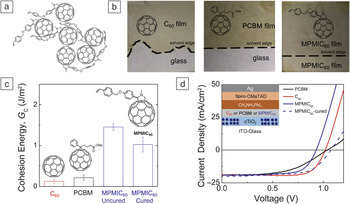
An example is provided by 1-(p-phenoxy-p-methylvinylbenzene)-indolino[2,3][60]fullerene (MPMIC60) ( Figure 5 ), which was developed as a replacement for fragile molecular fullerene materials such as C60 and PCBM, some of the weakest organic electronic materials we have ever characterized (Figure 1). Reference Watson, Rolston, Bush, Leijtens, McGehee and Dauskardt14 MPMIC60 features a flexible aromatic substituent intended to increase van der Waals bonding between molecules in the solid state (Figure 5a). In addition, the styrene portion of this substituent imbues MPMIC60 with cross-linking chemical reactivity. Thermal activation results in the transformation of MPMIC60 into a cross-linked film, resistant even to submersion in 1,2-dichlorobenzene (Figure 5b). G c of MPMIC60 was increased tenfold in comparison to PCBM and fourteenfold over C60 (Figure 5c). Perovskite solar cells constructed in n–i–p architectures using MPMIC60 also exhibited improved photovoltaic performance compared to those made with PCBM, which was etched by solvents used in the deposition of subsequent layers. Furthermore, mechanical failure was mitigated in the fullerene layer of perovskite cells using MPMIC60, which also exhibited increased short-circuit current (J SC) and open-circuit voltage (V OC) in comparison to C60 control devices (Figure 5d). Reference Watson, Rolston, Bush, Leijtens, McGehee and Dauskardt14
Improvements via cross-linking. (a) The flexible substituent of 1-(p-phenoxy-(p-methylvinylbenzene)-indolino[2,3][60]fullerene (MPMIC60) is designed to increase van der Waals interactions in the solid state. (b) Cured films of MPMIC60, [6,6]-phenyl-C61-butyric acid methyl ester (PCBM), and C60 fullerenes after dipping in 1,2-dichlorobenzene. The reactive styrene units of MPMIC60 enable transformation of MPMIC60 into a film resistant to dissolution. (c) MPMIC60 shows marked improvements in cohesion energy over C60 and PCBM fullerene in both cured and uncured states. (d) Perovskite solar cells utilizing MPMIC60 exhibited increased open-circuit voltage (V OC) and short-circuit current (J SC) over C60 controls. Reference Watson, Rolston, Bush, Leijtens, McGehee and Dauskardt14 Note: spiro-OMeTAD, spirobifluorene; ITO, indium tin oxide.

Similarly, recent work developing a covalent cross-linking strategy for poly(triarylamine) (PTAA), which usually shows G c values below ∼2.5 J/m2 and adhesion energy values to perovskite layers as low as ∼0.3 J/m2, enabled the formation of solvent-resistant hole-transporting composites exhibiting G c ∼ 25 J/m2. Additionally, the cross-linker was found to promote adhesion to the perovskite layer and the resulting solvent-resistance-enabled fabrication of inverted p–i–n solar cells with markedly increased efficiency, above 17%. The cross-linked PTAA forms a more robust film that enhances stability during device processing, becoming a sputter buffer layer with resilience to harsh plasma and oxidizing conditions that cause standard PTAA-based devices to completely degrade.
Interfacial intermixing and chemistry
Interfaces in organic electronic devices are often the source of mechanical weakness, and strategies to increase interfacial adhesion through changes in interfacial chemistry are important. Many adhesion-promoting chemistries exist for polymer materials, but few can be employed without disrupting device performance through unintended changes to electronic band alignment and charge transport across the interface. Increased adhesion must also be accomplished in combination with increased cohesion to the generally weak organic electronic adjacent layers, and special challenges exist when increasing adhesion to inorganic layers such as perovskites.
Two examples can be given where significant increases in adhesion have been achieved by manipulating interfacial chemistry for polymer/polymer and polymer/inorganic interfaces. Hydrophilic PEDOT:PSS and hydrophobic BHJ layers have a weak polymer/polymer interface. Annealing at elevated temperatures allowed for the formation of a molecularly intermixed zone between P3HT:PCBM and PEDOT:PSS, the thickness of which is dependent on the annealing conditions. Reference Dupont, Voroshazi, Nordlund, Vandewal and Dauskardt36 The zone initially forms as mobile P3HT chains diffuse into the PEDOT:PSS during annealing and reorient. The composition of the layer changes as interdiffusion occurs, which initially contains PCBM for low temperature or short annealing times, and then PCBM migrates out toward the bottom of the BHJ with higher temperature and duration. G c increases with annealing time and temperature as the intermixed zone expands (Figure 2b), which increases long-range chain–chain interactions, polymer entanglements, and electrostatic bonds. Reference Tummala, Risko, Bruner, Dauskardt and Brédas35,Reference Dupont, Voroshazi, Nordlund, Vandewal and Dauskardt36 These results suggest thermal annealing after the fabrication of devices could be used to improve adhesive properties and long-term stability.
Another example involves the weak polymer/inorganic interface formed between spiro-OMeTAD and CH3NH3PbI3 layers in perovskite solar cells. The application of polyethyleneimine (PEI) at the interface was shown to increase adhesion by 120% from 0.6 ± 0.2 J/m2 to 1.4 ± 0.3 J/m2 by forming chemical bonding across the interface (Figure 4c). Reference Yun, Lee, Kim, Ko, Kim and Son37 Nuclear magnetic resonance (NMR) analysis and contact-angle measurements revealed that PEI increased intermolecular interactions such as N–HPEI···Ospiro-OMeTAD and further improved wettability of the spiro-OMeTAD precursor solution to the perovskite film. Additionally, PEI reduced moisture ingress into the perovskite layer under high-humidity conditions. PEI therefore represents an effective interfacial compatibilizer with amine groups, interacting with both perovskite and spiro-OMeTAD layers to increase adhesion.
Nanopatterned interfaces
Modifying the interfacial structure, including increasing interfacial roughness or creating interfacial features, has long been recognized as a strategy to increase adhesion. A recent study used optically transparent organic and oxide layers as barrier layers in flexible organic electronic devices. Interfacial nanostructures in the form of ordered SiO2 pillars with diameters (2R) varying from 0 nm (planar interface) to ∼1000 nm at selected feature depths (h) from 0 nm to 1100 nm were fabricated at an interface between poly(methyl methacrylate) (PMMA) and SiO2. Reference Cai and Dauskardt38 The adhesion energy was demonstrated to be a strong function of the feature size and aspect ratio and could be used to increase the adhesion by an order of magnitude from ∼2 J/m2 (planar interface) to ∼24 J/m2 for the nanostructured interface (Figure 4d). Furthermore, UV aging studies demonstrated that the patterned interface was more resistant to photodegradation and maintained a higher adhesion than its planar counterpart for all durations of UVA and UVB exposure.
Concluding remarks
Thermomechanical reliability, including the synergistic effects of “stressing” parameters involving not only mechanical stresses and strains imposed on flexible and stretchable organic electronic devices but also environmental parameters like moisture and UV exposure, are important considerations for reliable technologies. We have reviewed mechanical testing techniques for elucidating salient thermomechanical properties and provided an indication of the generally mechanically fragile nature of many of the relevant organic electronic materials. Several important lessons for understanding factors that contribute to mechanical failure were provided, and strategies to enhance thermomechanical properties were discussed. For flexible and stretchable organic devices to be a technological success, improved mechanical properties and thermomechanical reliability analysis cannot be an afterthought to device operating performance, but must be addressed in the development of robust and efficient devices.

Jae-Han Kim is currently a doctoral candidate in the Department of Mechanical Engineering at the Korea Advanced Institute of Science and Technology (KAIST), South Korea. He received his BS degree in mechanical engineering in 2011 from Hanyang University, South Korea, and his MS degree in mechanical engineering in 2013 from KAIST. His current research focuses on the mechanical properties and reliability of advanced energy/electronic materials, including organic solar cells, fuel cells, ceramics, and metal thin films for mechanically robust flexible and stretchable devices. Kim can be reached by email at jaehan.kim@kaist.ac.kr.

Inhwa Lee is currently a doctoral candidate in the Department of Mechanical Engineering at the Korea Advanced Institute of Science and Technology (KAIST), South Korea. She received her BS degree in mechatronics engineering in 2011 from Korea University of Technology and Education, South Korea, and her MS degree in mechanical engineering in 2013 from KAIST. Her current research interests include mechanical properties and interfacial reliability of organic electronic materials and interface engineering of multilayered structures for improving the reliability of organic solar cells and perovskite solar cells. Lee can be reached by email at inhwa@kaist.ac.kr.

Taek-Soo Kim joined the Department of Mechanical Engineering at the Korea Advanced Institute of Science and Technology (KAIST), South Korea, in December 2010, and also directs the Advanced Packaging and Thin Film Lab. He obtained his BS degree in mechanical engineering in 2001 from Yonsei University, South Korea, and MS degree in 2006 and PhD degree in 2010, both in mechanical engineering from Stanford University. His research group focuses on mechanics-related subjects of advanced packaging and thin films: adhesion, deformation, fracture, fatigue, reliability, and stress–strain-induced multiphysics phenomena. Kim can be reached by phone at +82-42-350-3238 or by email at tskim1@kaist.ac.kr.

Nicholas Rolston is a doctoral candidate in the Department of Applied Physics at Stanford University. He received his undergraduate degrees in physics and mathematics in 2014 at the University of Iowa, during which he fabricated semiconductor nanowire heterostructures with molecular beam epitaxy. He has worked on thermomechanical reliability and degradation of organic photovoltaic devices, and his current research focuses on designing robust perovskite solar cells for improved mechanical and environmental stability. Rolston can be reached by email at rolston@stanford.edu.

Brian L. Watson is a postdoctoral fellow in the Department of Materials Science and Engineering at Stanford University. He received his BSc degree from the University of Cape Town, South Africa, in 2007, and his PhD degree in chemistry from Arizona State University in 2013. Watson’s current research interests focus on utilizing chemical strategies to overcome mechanical and environmental susceptibilities of organic and hybrid electronic materials together with the development of new solar-cell architectures that exhibit increased reliability without compromised efficiency. Watson can be reached by email at brian.watson@stanford.edu.

Reinhold Dauskardt is the Ruth and William Bowes Professor in the Department of Materials Science and Engineering and has additional appointments in the Department of Mechanical Engineering and the Department of Surgery at Stanford University. The underlying theme of his research group is to enable innovation and design of high-performance materials and devices by exploiting the fundamental connection between material structure, processing, and resulting device performance and reliability. Application areas include nanoscience and energy technologies along with skin science and soft biological tissues. Dauskardt can be reached by phone at 650-725-0679 or by email at dauskardt@stanford.edu.