Hypoplastic left heart syndrome remains one of the most complex and challenging CHD. A three-stage surgical palliation has become the standard of care for these patients. Stage I palliation consists of the standard Norwood procedure combined with a Blalock–Taussig shunt, right ventricular-to-pulmonary artery conduit, or central shunt.Reference Norwood, Lang and Hansen 1 Of late, the hybrid procedure has emerged as an alternative to the standard Stage I palliative procedures and includes placement of pulmonary artery bands and a ductus arteriosus stent.Reference Norwood, Lang and Hansen 1 , Reference Galantowicz and Cheatham 2 This is followed by Stage II palliation comprising a superior cavopulmonary anastomosis and then the final stage of palliation comprising of a Fontan procedure. Patients who have undergone the hybrid procedure undergo a comprehensive Stage II procedure comprising removal of the pulmonary artery bands with possible pulmonary artery reconstruction, removal of the patent ductus arteriosus stent with aortic arch reconstruction, a Damus–Kaye–Stansel connection of the aortic and pulmonary artery roots, a bidirectional superior cavopulmonary connection, and an atrial septectomy.Reference Galantowicz and Cheatham 2
Despite advances in surgical techniques and perioperative monitoring, the early mortality rate for these patients remain high, ranging from 4 to15%.Reference Cross, Harahsheh and McCarter 3 , Reference Ghanayem, Allen and Tabbutt 4 The national mortality rate for patients undergoing the Norwood operation is one in five patients and this varies based on centre and surgical volume.Reference Pasquali, Ohye and Lu 5 – Reference Jacobs, O’Brien and Pasquali 10 The time between discharge from the hospital following Stage I palliation and presentation for Stage II palliation – also referred to as the interstage period – poses risks due to haemodynamic instability with high mortality rates attributed to several factors. These include low birth weight, genetic syndromes, greater than moderate ventricular dysfunction, greater than moderate atrioventricular valve regurgitation, restrictive or intact atrial septum, re-coarctation of the aortic arch, obstruction of pulmonary arteries or the shunt, delayed age at surgery, longer cardiopulmonary bypass times, and postoperative renal dysfunction.Reference Ghanayem, Allen and Tabbutt 4 , Reference Tabbutt, Ghanayem and Ravishankar 6
Thrombosis of the systemic-to-pulmonary shunt is one of the potentially fatal complications following Stage I palliation.Reference Fenton, Siewers and Rebovich 11 – Reference Li, Yow and Berezny 13 The nature of the Stage I surgery, small infant size, shunt size, as well as abnormalities of the coagulation cascade and platelet function due to cardiopulmonary bypass place these patients at risk for shunt thrombosis.Reference Monagle, Chan and Goldenberg 14 – Reference Jahangiri, Kreutzer and Zurakowski 19 Blalock–Taussig shunt thrombotic occlusion rates ranging from 1 to 17% have been noted in previous studies.Reference Fenton, Siewers and Rebovich 11 , Reference Wells, Yu and Batra 20 , Reference Al Jubair, Al Fagih and Al Jarallah 21 The occlusion can occur during the immediate postoperative period as well during the interstage period. The use of routine thromboprophylaxis has been advocated, but there is still a lack of conclusive evidence about its risk versus benefits.Reference Monagle, Chan and Goldenberg 14 , Reference Giglia, Massicotte and Tweddell 22 , Reference Wessel, Berger and Li 23
The purpose of our study was to evaluate variability in antithrombotic practices at discharge following Stage I and Stage II surgery. The secondary aim of our study was to assess the incidence of interstage shunt thrombosis and other thrombosis related morbidity and mortality, such as seizures, stroke, cardiac arrest, and need for cardiac catheterisation during interstage in relation to discharge antithrombotic treatment.
Materials and methods
We carried out a multicentre, retrospective chart review using the National Pediatric Cardiology Quality Improvement Collaborative registry database. The National Pediatric Cardiology Quality Improvement Collaborative registry is a secure, web-based system (REDCap; Vanderbilt University, Nashville, Tennessee, United States of America) with data voluntarily entered by participating centres in the United States.Reference Kugler, Beekman Iii and Rosenthal 24 Patient enrolment in the database was started in June 2008. Local institutional review board approval was obtained before extracting data from the registry. Any infant with hypoplastic left heart syndrome or other complex single-ventricle malformation that underwent Stage I (Norwood or Norwood-variant) procedure and who was discharged alive is eligible for enrolment in the registry. This registry captures data on patient demographics, clinical presentation, hospitalisation, Stage I procedure, initial hospital discharge, interstage clinic visits, and hospitalisation episodes. All patients who underwent standard Stage I palliation who survived to hospital discharge from 2008 to 2013 were included in this analysis. The thromboprophylaxis strategy of patients undergoing the hybrid procedure was evaluated; however, given that they may be exposed to perioperative stresses different from that of Norwood/Norwood-variant, which are performed on cardiopulmonary bypass, they were excluded from Stage I site variability and outcomes analysis. All Stage II patients were included in the analysis irrespective of the type of Stage I palliation procedure they received, Norwood versus the hybrid procedure. Data elements such as type of discharge anticoagulants and adverse events applicable for that clinical time period were analysed.
A descriptive review of the choice of antithrombotic medication at the time of Stage I and Stage II procedures following discharge was performed. Variation in practice patterns at individual patient level as well as among various surgical sites was assessed. In order to evaluate interstage adverse outcomes, information about documented shunt thrombosis or catheter-based shunt intervention and other potentially related thrombotic adverse outcomes associated with thromboprophylaxis use, such as stroke, seizures, and cardiac arrest, were collected.
Results
Patient population
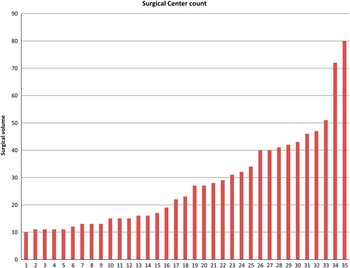
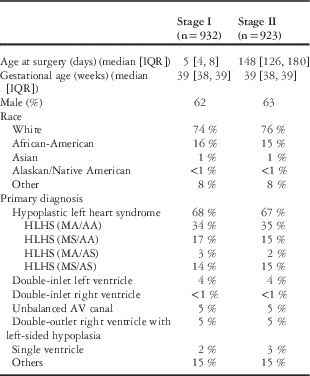
A total of 932 standard Stage I patients were included in the present study. This group predominantly included males (62%) and Caucasians (74%) with hypoplastic left heart syndrome being the most common diagnosis (68%) (Table 1). The majority (56%) of these patients underwent a Norwood procedure with right ventricular-to-pulmonary artery conduit with 41% undergoing the Norwood procedure with a Blalock–Taussig shunt. The remaining 3% of patients received central shunts or right ventricular-to-pulmonary artery conduits but were classified as “other”. Of the 932 patients discharged from Stage I, 69 (7.4%) died and 17 (1.8%) required transplant. A total of 86 patients underwent hybrid Stage I palliation and were excluded from Stage I analysis. The Stage II study population included 923 patients with a predominantly male (63%), Caucasian (76%) population with the most common diagnosis being hypoplastic left heart syndrome (67%) (Table 1). Surgical centres with >10 patient enrolment in the National Pediatric Cardiology Quality Improvement Collaborative database were included during assessment of intersite variability. Centres with <10 patient enrolment were excluded from the intersite variability analysis. Figure 1 shows the distribution of centres according to the centre’s surgical volume. The surgical centre numbers were maintained the same in all figures.
Distribution of centres according to surgical volume.

Demographic details of patients undergoing Stage I and Stage II palliation surgery.

AA=aortic atresia; AS=aortic stenosis; AV=atrioventricular; HLHS=hypoplastic left heart syndrome; IQR=interquartile range; MA=mitral atresia, MS=mitral stenosis
Interstage antithrombotic use
The antithrombotic medications were classified into the following groups: aspirin only, enoxaparin only, clopidogrel only, warfarin only, combination therapy, aspirin+at least one of the other drugs, and no antithrombotics. Although the mechanism of action of these medications are different, for ease of reading, all of the above-mentioned medications will be referred to as “discharge antithrombotic or antithrombotic regimen” from this point onwards.
Stage I discharge regimen
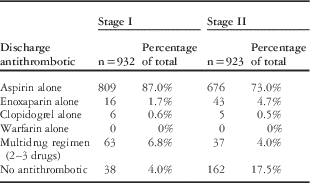
Aspirin was the most frequently used antithrombotic and was also the most frequently used solitary drug of choice in 87% of all patients (Table 2). Approximately 7% of the patients were discharged on a multidrug antithrombotic regimen consisting of aspirin with or without clopidogrel and/or warfarin and/or enoxaparin. Therefore, approximately 93.8% of patients were discharged on aspirin either as a single regimen or as part of a multidrug regimen; 4% of the patients were sent home with no antithrombotics. Aspirin was the most common discharge anticoagulant, irrespective of whether the patient had a right ventricular-to-pulmonary artery conduit (88%) or a Blalock–Taussig shunt (86%) placed.
Distribution of discharge antithrombotics following Stage I and Stage II palliation.

Hybrid discharge regimen
A total of 86 hybrid patients who were discharged were included in the registry: 75 of the 86 (87%) went home on aspirin only, 6 (7%) went home on no antithrombotics, 3 (3%) went home on enoxaparin, and 2 (2%) went home on combination medications.
Stage II discharge regimen
There was more variability of discharge antithrombotics in Stage II patients. Of the 923 Stage II patients, 77% of the patients were sent home on aspirin either as a single regimen or as part of a multidrug regimen (Table 2). Stage II patients were discharged home more frequently without any thromboprophylaxis when compared with the Stage I population (17.5% in Stage II versus 4% in Stage I). Patients went home more frequently on enoxaparin (4.7% in Stage II compared with 1.6% in Stage I); 4% of the patients went home on a multidrug regimen.
A separate analysis of the hybrid patients following comprehensive stage II was also performed. There were a total of 64 hybrids patients identified after Stage II, and it was noted that a larger proportion of these patients (22 of 64 or 34.4%) were discharged on enoxaparin when compared with the non-hybrid/standard patients (21 or 2.5%); 31% (20/64) were discharged on aspirin, and almost 20% (13 of 64) went home without thromboprophylaxis.
Intersite variability
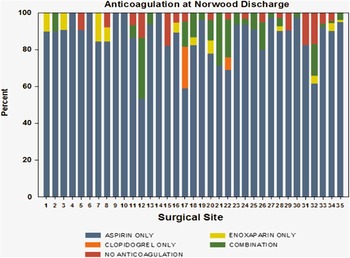
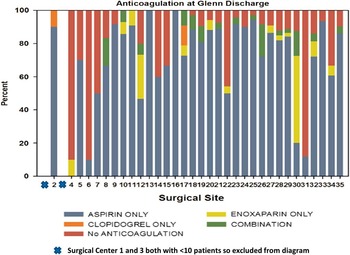
The intersite variability on the choice of antithrombotics following standard Stage I and Stage II palliation is shown in Figures 2 and 3. Although the majority of the Stage I sites used aspirin as the choice of antithrombotic therapy at discharge, there were a few sites where up to 50% of the patients were discharged either on no antithrombotics or on non-aspirin antithrombotic therapy. In addition, several sites discharged a significant number of their patients on combination medications. There was more intersite variability noted following Stage II palliation as noted in Figure 3. Although aspirin was still the most frequently used medication at the time of discharge, there were sites where the vast majority of the patients were discharged on no antithrombotics and many sites where patients were discharged on enoxaparin or combination therapy.
Anticoagulation at Stage I discharge.

Anticoagulation at Stage II discharge.

Interstage shunt thrombosis and other adverse outcomes
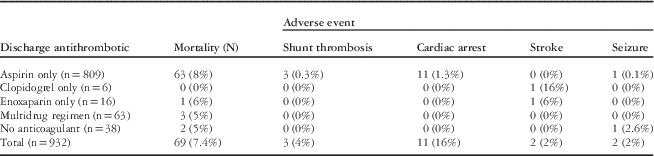
Interstage shunt thrombosis was identified in three patients (Table 3). All three patients underwent Stage I palliation with a Blalock–Taussig shunt and were discharged on aspirin. Data are limited in terms of their clinical presentation, but all three patients were re-admitted with shunt thrombosis, which was confirmed by cardiac catheterisation during that admission. The first patient was taken to surgery for central shunt placement with pulmonary artery augmentation. Ultimately, the patient was not considered a satisfactory Stage II candidate and was withdrawn from the registry. The second patient had a stroke following shunt thrombosis and care was withdrawn. The third patient required extracorporeal membrane oxygenation and eventually underwent Stage II surgery.
Distribution of discharge antithrombotics based on interstage adverse outcomes.

Other adverse outcomes such as stroke, seizure, and cardiac arrest were identified in patients, and their discharge antithrombotics were evaluated (Table 3). A total of 11 patients were identified with cardiac arrest and two with stroke. All patients with cardiac arrest were discharged home on aspirin. Among all, two patients had seizures, of which one was sent home on aspirin and the other went home on no antithrombotics; two patients suffered from stroke, the first was discharged on clopidogrel and the other on enoxaparin.
Of the 69 patients who died during the interstage, 63 (91%) were discharged home on aspirin and the remaining three (4%) were on combination medications, two were on no antithrombotic (3%), and one was on enoxaparin (1.5%).
Interstage cardiac catheterisation
A total of 44 patients (5% of total Stage I patients) were re-admitted during the interstage period for Blalock–Taussig shunt or right ventricular-to-pulmonary artery conduit dilation and/or stenting via cardiac catheterisation. Of the 44 patients, 33 were sent home on aspirin at the time of Stage I discharge. This accounted for 4.5% of the total patients (n=809) who went home on aspirin only (Table 4).
Interstage Blalock–Taussig (BT) shunt/right ventricular-to-pulmonary artery conduit dilation and/or stenting.

Discussion
Despite several advances in the management of single-ventricle Norwood palliated patients, there continues to be significant morbidity and reported mortality. Thrombosis of the systemic-to-pulmonary artery shunt is one of the potentially life-threatening complications in these patients following Stage I palliation.Reference Cross, Harahsheh and McCarter 3 , Reference Ghanayem, Allen and Tabbutt 4 Therefore, maintaining patency of the Blalock–Taussig shunt or the right ventricular-to-pulmonary artery conduit is of utmost importance.Reference Fenton, Siewers and Rebovich 11 , Reference Levy and Tanaka 18 The use of routine thromboprophylaxis has been advocated, but there is still lack of conclusive evidence regarding the choice of medications, route, dosage, and the impact on clinical outcomes; one of the largest prospective multicentre studies by Fenton et alReference Fenton, Siewers and Rebovich 11 concluded that aspirin use decreased the risk of shunt thrombosis and its associated morbidity and mortality. In the American Heart Association consensus statement for prevention and treatment of thrombosis in paediatric and CHD, Giglia et alReference Giglia, Massicotte and Tweddell 22 recommended long-term use of low-dose aspirin for prevention of long-term thrombosis of systemic-to-pulmonary artery shunts in the absence of increased risk of bleeding (Class I; level of evidence B). In 2013, Wessel et alReference Wessel, Berger and Li 23 found during a prospective, randomised trial of Clopidogrel in infants with shunts that 88% were being treated with aspirin. Similar to the above-mentioned studies, the vast majority of the Norwood centres in our cohort sent their patients home on antithrombotic therapy following Stage 1 palliation, with aspirin being the most common choice. Several centres also used enoxaparin or clopidogrel, but infrequently or in combination with aspirin. Warfarin was never used as a solitary drug. Some patients were sent home on combination therapy – aspirin with at least one other drug. It is possible that this may have been influenced by the postoperative or ICU stay-related complications such as line-associated thrombosis (arterial or venous), stroke, or following interventional catheterisation procedures, such as a Blalock–Taussig shunt stenting or balloon angioplasty, where there may be a desire for increased antithrombotic therapy. Nevertheless, we were unable to assess these factors because of unavailability of such data in the registry.
There was a relatively low rate of shunt-related complications in this patient group during the interstage study period (<1%). This was lower compared with other studies where shunt occlusion rates in the immediate postoperative phase ranged from 4 to 15%.Reference Wells, Yu and Batra 20 , Reference Al Jubair, Al Fagih and Al Jarallah 21 We also suspect that the percentage of mortality that can be attributed to shunt thrombosis and its consequences may be underestimated, as there is often a lack of histopathological evidence for shunt thrombosis at the time of death due to lack of autopsy data for all patient deaths.Reference Fenton, Siewers and Rebovich 11 , Reference Alkhulaifi, Lacour-Gayet and Serraf 25 A few studies have looked at the advantages of one antithrombotic versus another in this population. It is likely that individual centre and clinician practice drive some of the variation noted in this study. Variability in hybrid patients may be accounted for by the difference in their mechanism of surgery as well as postoperative course compared with the Norwood population. Galantowicz et alReference Galantowicz and Yates 26 in their study demonstrated a higher incidence of pulmonary embolism requiring anticoagulation with enoxaparin during the comprehensive Stage II postoperative period. This may account for the larger proportion of patients who were discharged on lovenox following the comprehensive stage II palliation surgery.
Side-effect profile, variable pharmacokinetic profile, and requirement of expertise for close monitoring of drug levels for heparin and warfarin may also play an important role in decision making. It is also acknowledged that the optimal dose of aspirin has not been determined and children have been shown to demonstrate aspirin resistance at doses currently being utilised.Reference Mir, Frank and Journeycake 27 Recent evidence for the optimal aspirin dosing and aspirin resistance is currently being evaluated with utilisation of thromboelastography with platelet mapping, aspirin resistance testing, and urine thromboxane levels.Reference Heistein, Scott and Zellers 28 , Reference Romlin, Wahlander and Stromvall-Larsson 29 It is interesting to note that all patients except one who suffered adverse outcomes from thrombosis were on antithrombotics at discharge; however, information on dose of medication or compliance at home was not available through the database.
Limitations
This study is limited by its retrospective nature. The overall rate of shunt thrombosis and other morbidities was rare in the interstage period. Therefore, it was not possible to identify a definite association with medical management choices. Lack of data on why medications were prescribed made it difficult to understand the reasoning behind therapeutic choices. Immediate postoperative Norwood-associated shunt thrombosis and thrombotic complications are not reported in this database, thereby limiting this descriptive review. Only 38 of the 69 patients who died had autopsy data, and therefore the total number of shunt thrombosis may have been an underestimate.
Conclusions
Aspirin is by far the most common choice for thromboprophylaxis following Stage I and Stage II palliation. Clopidogrel, enoxaparin, and warfarin were also used, but infrequently or in addition to aspirin. Substantially more variation was noted in the type of discharge antithrombotic following Stage II palliation, with 17.5% of patients going home on no thromboprophylaxis compared with 4% after Stage I.
Despite this study having a large number of interstage patients, the incidence of adverse outcomes such as shunt thrombosis was rare. Given this low number, no significant association between shunt thrombosis and type of thromboprophylaxis could be derived. Other thrombotic complications such as seizures and stroke also occurred, with low frequency. Prospective studies, collaborations with more centres and other research registries, and individualised dosing studies or monitoring could prove beneficial in providing more insight.
Acknowledgements
None.
Financial Support
This research received no specific grant from any funding agency or from commercial or not-for-profit sectors.
Conflict of Interest
None.
Ethical standards
The authors assert that all procedures contributing to this work comply with the ethical standards of national guidelines and has been approved by the institutional ethical committee