There are an estimated 1 million children and 1.4 million adults living with CHD as of 2010, Reference Gilboa, Devine and Kucik1 with the age group of 13–17 years old representing the highest relative growth in prevalence. Reference Marelli, Mackie, Ionescu-Ittu, Rahme and Pilote2 It is anticipated that approximately 85% of CHD patients will survive to adulthood and the majority will require lifelong specialised CHD care. Reference Warnes, Liberthson and Danielson3 The period of transition to adulthood, considered to be age greater than 17 years, is associated with lapses in care and patient misperceptions of medical needs, leading to unplanned hospitalisations, patient morbidity, and increased healthcare costs. Reference Yeung, Kay, Roosevelt, Brandon and Yetman4–Reference Kikkenborg Berg and Pedersen6 For teens with CHD, transfer of medical care to a qualified adult provider plays a key role in the complex psychosocial, cultural, and medical transition to a healthy and successful adult life. As noted in the American College of Cardiology/American Heart Association consensus statement in 2011, optimal transition requires a therapeutic alliance between patients, healthcare providers, and parents/caregivers, starting as early as at the age of 12. Reference Sable, Foster and Uzark7 In a consensus statement, the Society of Adolescent Medicine stated that “Many adolescents with chronic conditions are at higher risk than their peers for unnecessary dependency […] A successful transition to adult health care may help prevent this by enhancing autonomy, increasing a sense of personal responsibility and facilitating self-reliance”. Reference Rosen, Blum, Britto, Sawyer and Siegel8 It is our hope that by identifying discrepancies in understanding between parents and teens, we can optimise patient encounters towards a healthy and successful transition to adulthood. A previously published study from this multicentre sample has shown that greater agreement between teen and parental perception of a teen’s knowledge was associated with a greater increase in patient knowledge and self-efficacy. Reference Uzark, Yu and Lowery9 The purpose of this study was to further characterise the specific gaps and differences in perceptions between patients with CHD and their parents in regard to transition readiness. These perceptions can influence patient behaviours, and may be instrumental in shaping transition-related interventions, a growing area of study. Reference Cotts10
Methods
As part of a multicentre study to evaluate transition readiness in teens/young adults with heart disease, responses were collected via electronic tablet in cardiology clinics from patients and one parent of each patient aged 13–18 years. Reference Uzark, Yu and Lowery9 This study was approved by the Institutional Review Board at each site and informed consent was obtained from the study patients. Patients were recruited via convenience sample based on an existing diagnosis of heart disease and the reason for clinic visit was the routine follow-up. Patients were excluded if they were being evaluated for an acute issue, or if unable to complete the survey due to cognitive impairment. Eligible patients completed two questionnaires: the CHD Transition Readiness Assessment and an information request checklist. A parallel survey was distributed to one parent/caregiver for each patient, with identical survey items, but alternatively phrased to address the parent’s perception of their child’s knowledge, behaviour, and self-efficacy. Survey items regarding pregnancy and contraception were only queried to female respondents, and survey items regarding medications were only available after a respondent indicated they were taking at least one cardiac medication. Data were automatically downloaded for analysis using Research Electronic Data Capture (REDCap) software. Reference Harris, Taylor and Minor11
The CHD Transition Readiness Assessment is a previously validated and reliable survey tool developed specifically for teens and young adults with CHD during the period of transition to adulthood. Reference Uzark, Smith and Donohue12 The CHD Transition Readiness Assessment is comprised of three primary components: perceived knowledge; self-management; and self-efficacy. Amongst these three domains, the assessment captures a patient’s knowledge, behaviours, and feelings, respectively. This is intended to form a complete picture of their readiness for transition to adulthood.
Perceived knowledge deficit is scored as the percentage of questions in which the respondent either did not know or was not sure of the information queried. Reference Uzark, Smith and Donohue12 Parent responses reflect the parent’s perception of their teen’s knowledge, not their own knowledge. Reliability of these responses compared to actual knowledge has been evaluated as 86–90% during the validation of the Transition Readiness Assessment. Reference Uzark, Smith and Donohue12 A higher knowledge deficit percentage corresponds to a more significant deficiency in knowledge (not a higher degree of transition readiness).
Self-management behaviours have been previously described as the patient’s autonomy taking and refilling medications, contacting the medical team, making appointments, etc. Reference Ferris, Harward and Bickford13 Self-management responses ranged from “almost always” to “never” in regard to frequency of patient behaviours.
Self-management is primarily related to self-efficacy, a person’s belief about his or her ability and capacity to execute those behaviours. Reference Uzark, Smith and Donohue12 Self-efficacy responses ranged from “very easy” to “very hard” in regard to a patient’s perceived ability to execute these behaviours. Both self-management and self-efficacy, using the 5-point Likert scale data, were linearly transformed to a 0–100-point scale with higher scores indicating greater self-management and self-efficacy.
The request for information checklist asks the respondent if they have any interest in information on specific topics addressed in the Transition Readiness Assessment, along with the preferred source of information. Teens and parents received the same checklist, and the parental version was intended to reflect information that each parent desired (as opposed to what they believed their teen desired). The information request checklist was distributed via paper copy, not an electronic tablet.
Statistical analysis
Data are reported as frequency (%) for categorical variables and mean ± standard deviation or median with interquartile range for continuous variables. The overall transition readiness scores in perceived knowledge deficit, self-management, and self-efficacy were compared between parents and teens using a paired t-test. For knowledge deficit scores, Cohen’s (unweighted) κ statistic was used to examine agreement between responses of teens and parents, with a value approaching 0 representing a higher degree of disagreement, while a value approaching 1 represents agreement. Reference Cohen14 Cohen suggests values ≤ 0 as indicating no agreement and 0.01–0.20 as none to slight, 0.21–0.40 as fair, 0.41–0.60 as moderate, 0.61–0.80 as substantial, and 0.81–1.00 as almost perfect agreement. Reference Cohen14 For self-efficacy and self-management, agreement on the responses for each individual survey item between teens and parents was evaluated using weighted Cohen’s κ statistic, to account for 5-point ordinal Likert scale. The weighted κ statistic (as opposed to unweighted κ statistic) is calculated using a predefined table of weights measuring the degree of disagreement between two raters on the 5-point Likert scale. For example, a response of “almost always” compared to “often” carries less weight than “almost always” compared to “almost never”. Similar to the unweighted κ statistic, a value approaching 0 (or a negative value) indicates disagreement, while a value approaching 1 indicates agreement. Information request checklist items were also compared between teens and parents using McNemar’s test. All analyses were performed using SAS version 9.4 (SAS Institute, Cary, NC, United States of America), with a statistical significance level of 0.05 using two-sided tests.
Results
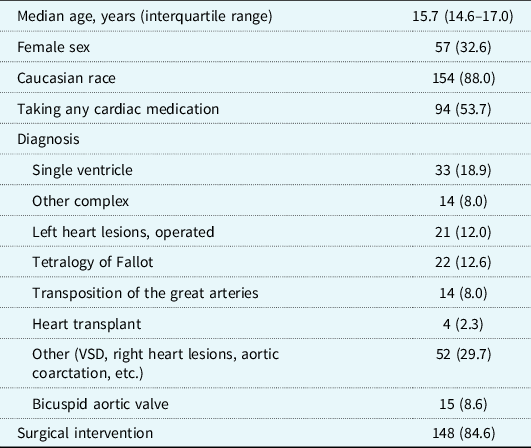
Data were collected from 175 patient–parent pairs who participated in a larger study of transition readiness in teens and young adults previously reported. Reference Uzark, Yu and Lowery9 Response rate amongst patients to whom the survey was offered was 91%. Patient characteristics are summarised in Table 1. Median patient age was 15.7 years. The patient cohort included in the analysis was 32.6% female, 88.0% Caucasian, and 53.7% were taking at least one cardiac medication. The cohort included a variety of structural heart lesions, including over one-third of respondents meeting criteria for great complexity as defined by the 32nd Bethesda Conference. Reference Warnes, Liberthson and Danielson3 Eighty-five percent had previously undergone surgical intervention.
Patient and clinical characteristics in patients <18 years of age with heart disease (n = 175)

Data are presented as n (%) unless otherwise indicated
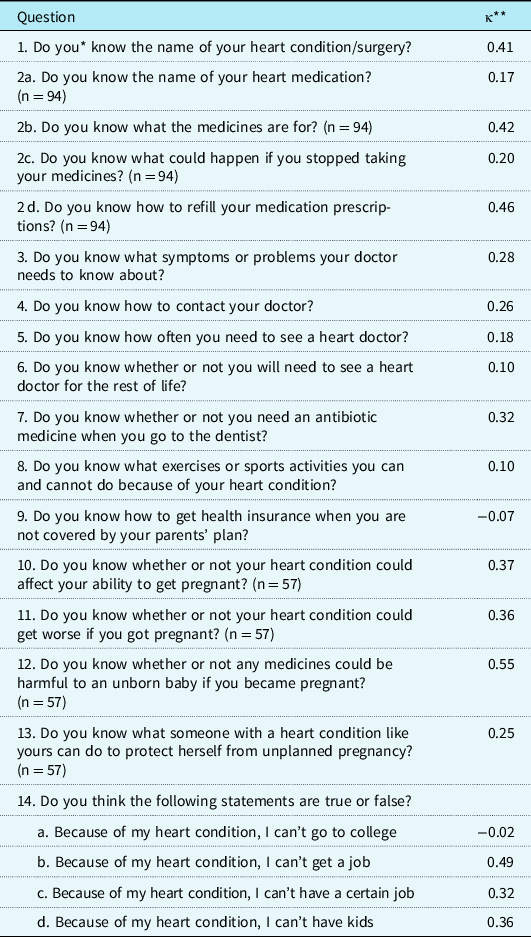
Parents perceived a higher knowledge deficit in their teens, as compared to teens’ own self-perception of their knowledge. Pooled results amongst parents showed 29.2% of queried items in which they believed their teen did not know the answer, compared to 25.9% of teens themselves responding they did not know (p = 0.01). Across all knowledge items, agreement between parent and teen was moderate at best (κ range: −0.07–0.55), (Table 2). In regard to specific areas of perceived knowledge deficit, agreement between parents and teens was stronger in regard to the name of their heart condition/surgery (κ = 0.41), the purpose of their medicines (κ = 0.42), and the potential harm of medications during pregnancy (κ = 0.55). Agreement was weakest in terms of what exercise or sports activities were allowed (κ = 0.10), the need for lifelong cardiology follow-up (κ = 0.10), how to get health insurance (κ = −0.07), and ability to attend college (κ = −0.02).
Agreement between patients’ and parents’ perceived knowledge in patients < 18 years of age with heart disease (n = 175)

* Questions in parental survey alternatively phrased “Does your teen…”
** Cohen’s κ statistic was calculated. Cohen suggests values ≤ 0 as indicating no agreement and 0.01–0.20 as none to slight, 0.21–0.40 as fair, 0.41–0.60 as moderate, 0.61–0.80 as substantial, and 0.81–1.00 as almost perfect agreement
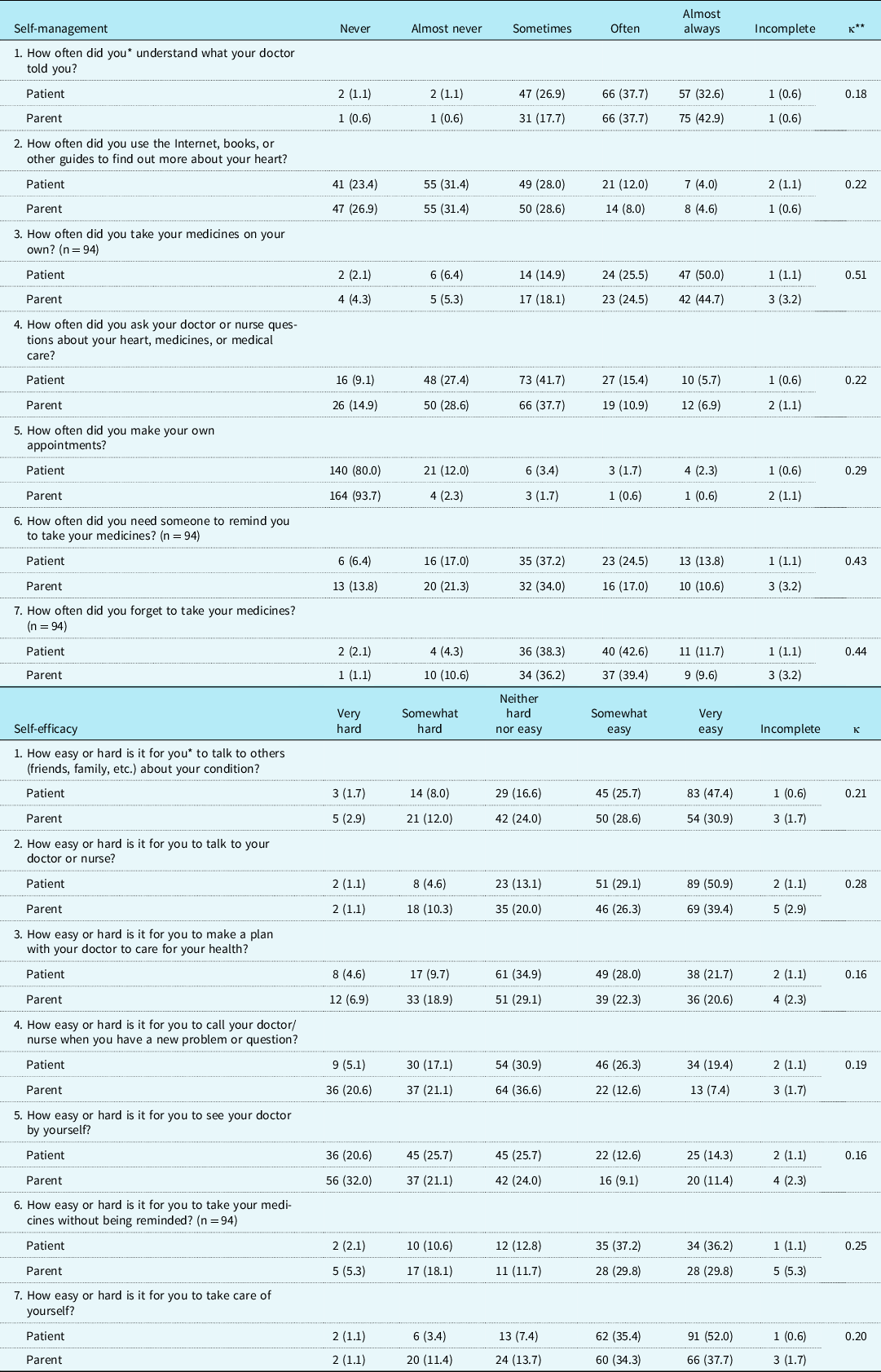
With respect to self-management, scores were similarly low between teens and parents (mean 41.0 ± 15.8 for teens versus 39.3 ± 15.2 for parents, p = 0.27). In regard to individual behaviours, agreement was slight to moderate, with weighted κ statistic ranging from 0.18 to 0.51 (Table 3). Agreement was lowest for teen’s understanding of what doctors told them with parents tending to overestimate their teen’s understanding (with 80.6% of parents reporting their teen “often” or “almost always” understanding their doctor compared to 70.3% of teens, weighted κ = 0.18). There was also discordance between parental and teen reports in regard to the patient independently making his or her own appointments (weighted κ = 0.29), but there was a trend towards “never” and “almost never” for both groups (92% of teens reporting “never” or “almost never” compared to 96% of parents). Agreement was highest in regard to teens needing reminders to take medications and how often teens forget to take their medications (weighted κ = 0.43 and 0.44, respectively).
Frequency and percentage of responses for self-management and self-efficacy in patients < 18 years with heart disease and their parents (n = 175)

* Questions in parental survey alternatively phrased “your teen…”
** Weighted κ statistic was calculated. Cohen suggests values ≤ 0 as indicating no agreement and 0.01–0.20 as none to slight, 0.21–0.40 as fair, 0.41–0.60 as moderate, 0.61–0.80 as substantial, and 0.81–1.00 as almost perfect agreement
Teens scored significantly higher in overall self-efficacy as compared to their parents’ perceptions (mean 68.2 ± 18.3 for teens versus 58.6 ± 21.1 for parents, p < .0001). Teens had a higher frequency of responding “very easy” or “somewhat easy” in all self-efficacy items, while parents more frequently responded “very hard” or “somewhat hard”, and overall agreement ranged from slight to fair (weighted κ range of 0.16–0.28, Table 3).
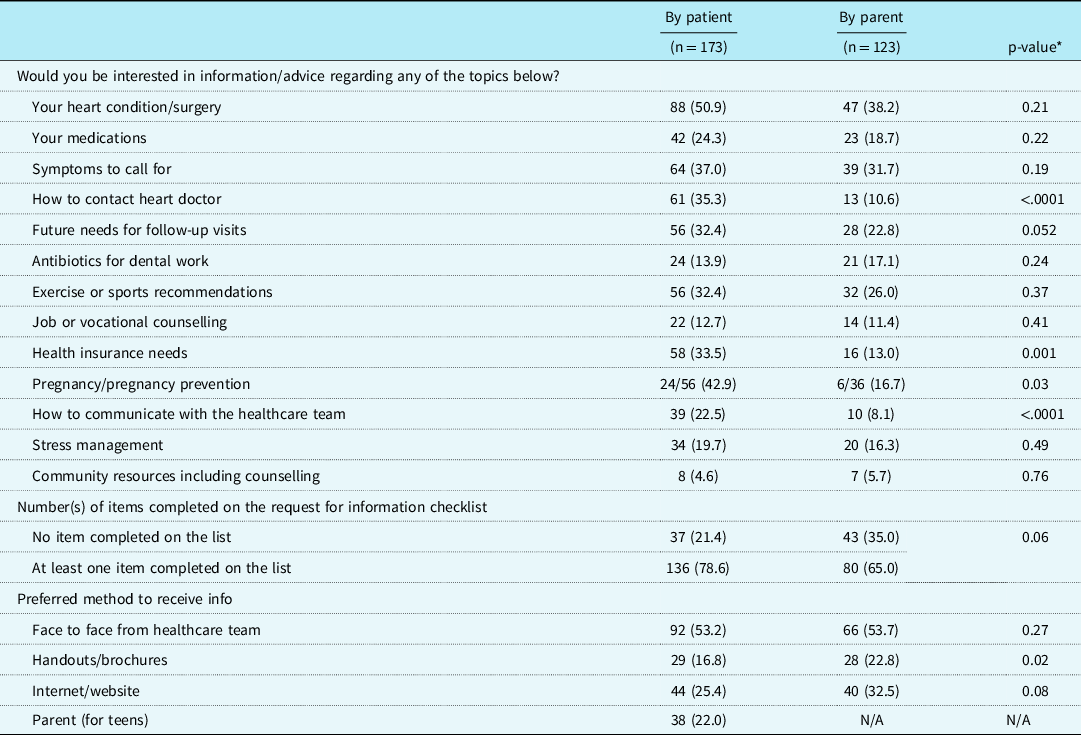
Results from the request for information checklist are presented in Table 4. The checklist was available from 123 (70.3%) parents compared to 173 patients (98.9%). Patients were more likely to request at least one piece of information as compared to their parents (78.6% versus 65%, p = 0.06). Teens more frequently requested information than their parents related to how to contact their heart doctor (35.3% of teens compared to 10.6% of parents, p < .0001), health insurance needs (33.5% versus 13%, p = 0.001), pregnancy/pregnancy prevention (42.9% of female respondents versus 16.7% of corresponding parents, p = 0.03), and how to communicate with the healthcare team (22.5% versus 8.1%, p < .0001).
Knowledge-seeking behaviour in parents and patients <18 years of age with heart disease

Data are presented as n (%)
* p-value from McNemar’s test for comparison between patient and parent
Discussion
In this study, we have identified significant gaps in perception between teens with CHD and their parents regarding critical factors in readiness for teens to transition to adulthood and towards independence in medical care. Prior studies have observed that young adults with CHD tend to remain dependent on their parents longer than their healthy peers. Reference Kokkonen and Paavilainen15,Reference McLoughlin, Matthews and Hickey16 Decreased communication between parents and teens may be a contributing factor to the lapses in care observed in the transitional age group. Reference Gurvitz, Valente and Broberg5 For all of these reasons, it is important to characterise any transition-related misperceptions between parents and their children starting in the early teens, which in turn enables providers to proactively address these issues. Our study shows that the overall agreement between parents and teens was poor to fair, and the findings encountered here can guide us towards more effective patient and parent encounters.
In general, parents perceived a greater knowledge deficit in their teens than teens self-reported. Agreement was lowest for many important non-clinical factors, including college plans, insurance, and exercise or athletic participation. In contrast, agreement was high for name of the heart condition and what the medications are for. This may suggest that clinicians and/or parents focus less on elements that impact a patient’s education, vocation, activities, and other lifestyle factors. We observed only fair agreement between parent and teen with respect to family planning and pregnancy. Deng, et al observed that family planning and pregnancy counselling in patients with CHD most commonly occurred between ages 20 and 25 despite the patient opinion that ages 16–18 would be preferable. Reference Deng, Gleason and Awh17 This age distinction is often around the age when parents are less likely to attend a clinic appointment, further suggesting teens may not be granted the space to discuss their care with their provider privately. In regard to exercise and activities, prior studies have shown that patients with CHD have a tendency to refrain from healthy exercise despite no medical contraindications. Reference Swan and Hillis18 Our observed disagreement between parents and teens in physical activity-related survey items suggests a lack of parent/teen communication on the topic or varied interpretations regarding counselling by clinicians when counselling is not specific (“activity as tolerated” or “can limit self”). Finally, we observed a notable parent/teen disagreement in knowledge deficit in regard to insurance, which is unsurprising based on typical parent/teen responsibilities. Still, we observed that teens do request insurance information frequently while parents do not. Lapses in insurance in patients with CHD were previously commonplace, although improving recently. Reference Lin, Novak, Rich and Billadello19 Our data suggest that teens may possess some awareness of a long-term need to manage their own insurance. Some clinics specialising in adolescents with chronic disease are integrating insurance counsellors, vocational/educational support, and social work into their care model, Reference Riley, Patterson, Lane, Won and Ranalli20–22 and future studies will be useful in their application to CHD subspecialty care. Also in regard to long-term planning, agreement was low between parents and teens on whether a patient will need to see a heart doctor for the rest of their life. A lack of awareness of follow-up needs has been linked with loss to follow-up. Reference Mackie, Rempel, Rankin, Nicholas and Magill-Evans23
Agreement between parents and teens on self-management was higher than other survey domains, however, overall scores were low. For example, although parents and teens agree, both have observed that teens frequently forget, or need reminders to take their medications. The self-management survey item of least agreement shows that over one in four teens did not fully understand what their doctor told them, while parents did not seem to observe this, identifying a concerning gap in teen comprehension. This aligns with prior studies that show patient confidence tends to outweigh practical medical management skills, possibly related to parental hesitancy to shift greater responsibility to their children. Reference Stewart, Chahal and Kovacs24,Reference Sparacino, Tong, Messias, Foote, Chesla and Gilliss25 Our data support prior studies in children with cardiovascular disease demonstrating that observable behaviours tend to have more patient–parent concordance than non-observable behaviours (thoughts and feelings). Reference Uzark, Jones, Slusher, Limbers, Burwinkle and Varni26,Reference Petek, Hertiš and Marčun Varda27
While parents and teens agreed that self-management was deficient, parents tended to underestimate their teen’s self-efficacy. For self-efficacy, agreement was highest regarding how easy or hard it is for teens to talk to their doctor or nurse, with responses weighted towards “very easy” or “somewhat easy”. This is in contrast to self-management data, where two-thirds of teens reported “sometimes” or “almost never” asking questions to the medical team. Teens indicated that they feel comfortable discussing their condition, but data suggest they are not granted the space to do so. Providers may direct their conversation towards the parent, which in turn may lead to poor engagement by the patient. Furthermore, certain topics such as pregnancy/pregnancy prevention or stress management may be better suited for a private conversation with the patient/provider only, Reference Marcell and Burstein28 and these topics were amongst the most commonly requested educational materials requested by teens, but not requested by their parents. This serves as a reminder that teen patients should be given the opportunity to ask questions to their provider without a parent present, which does not always happen during a clinical encounter. It will also prepare teens to eventually see their provider independently.
Patients were more likely to respond “often”, whereas parents were more likely to respond “never” in regard to their teen’s utilisation of supplemental materials including the Internet or books. In the information request checklist, teens were more likely to request additional educational materials than their parents. Approximately half preferred to receive medical information via a method other than face-to-face contact. Reference Uzark, Yu and Lowery9 This suggests that teens may independently be researching their heart condition without their parent’s knowledge, showing independence, initiative, and a desire to learn and advocate for their care. However, teens are at risk of encountering misinformation on their condition from the Internet or via social media unbeknownst to parents. Institution-sponsored web-based and app-based tools are currently in development, with the ultimate goal to provide accurate personalised educational materials for each patient. Reference Lopez, O’Connor and King29,Reference Thompson, Martinko, Budd, Mercado and Schentrup30 The use of technology has been linked with a higher degree of self-management in teens with chronic conditions. Reference Virella Pérez, Medlow, Ho and Steinbeck31 Applebaum and colleagues found a high proportion of teens felt comfortable communicating with the medical team via text message and expressed a desire for an online information-sharing platform. Reference Applebaum, Lawson and von Scheven32 Current sharing of protected health information via institutional EMR-based web platforms often prohibits teens from independent use without parental consent. The majority of Internet-based tools are targeted at older adults and parent caregivers, Reference Fedele, Cushing, Fritz, Amaro and Ortega33,34 although some promising adolescent-targeted websites are emerging that offer general CHD content, but not specific to the individual patient. 35,36 The items with the greatest disagreement between parents and teens on the information request checklist were in regard to contacting the medical team, and an EMR-integrated, adolescent-focused patient portal may be an effective intervention. If providers can engage parents to promote their child’s independence via new technology, the findings reported in this study show that patients are eager to try to utilise it.
Of note, the Transition Readiness Assessment tool used in this study evaluates patient and parent perceptions of knowledge gaps, rather than a test of their actual knowledge. Prior studies have examined parent/teen knowledge, when Hsiao-Ling, et al in Taiwan found that higher parental disease knowledge corresponds with increased disease knowledge in teens. Reference Yang, Chen, Wang, Gau and Moons37 Our findings support a study from Burstrom, et al who observed that teens perceive themselves as more prepared to take over responsibility for their health and to be transferred to adult care as compared to their parents. Reference Burström, Acuña Mora and Öjmyr-Joelsson38 Our data suggest that the teen and parent perception of disease knowledge is a distinct and likely an equally important driver of patient and parent behaviours.
Limitations of this study include the lack of data surrounding parental behaviours and parenting styles, along with a high degree of variability amongst providers in regard to counselling practices and resources offered to families, which certainly influence readiness for transition. Although the study was conducted at multiple centres, there still was a lack of racial diversity amongst patients, and parental demographics were not obtained. In future studies, a more diverse sample may help identify groups in most need of transition education, and could guide educational initiatives or programming. Additionally, our convenience sample is limited to patients attending clinic visits, and therefore no data were obtained on patients lost to follow-up, a critical and challenging population to study.
Overall, parents and teens differ in several key perceptions regarding knowledge and management of heart disease, including lifestyle implications of CHD. While, some degree of direct parental supervision may be necessary during the earlier teen years, especially regarding practical matters like medication adherence or appointment-making, parents need support in teaching their teens to take responsibility for their health needs. Providers and parents can work together to help foster independence in teens with CHD through earlier patient-centred clinical encounters, encouraging communication in the home, and attention to the teen’s specific information needs and preferences.
Acknowledgements
None.
Financial support
This study was funded in part by the University of Michigan Congenital Heart Center, Departments of Cardiac Surgery and Pediatrics, Charles Woodson Research fund, C.S. Mott Children’s Hospital, Save a Heart, and CHAMPS for Mott.
Conflicts of interest
None.
Ethical standards
All procedures performed in studies involving human participants were in accordance with the ethical standards of the institutional and/or national research committee. Informed consent was obtained on all study participants.