

Rabbinic discourse in the Babylonian Talmud “thinks with” demons in noticeable and perhaps surprising ways. Demons—referred to as shedim, mazzikin, and ruḥot—appear in stories set in the biblical past, and in contemporaneous stories about the rabbis themselves. The rabbis treat demons legally across talmudic strata: halakhic debates about demonic concerns are attributed to Tannaim, Palestinian Amoraim, and Babylonian Amoraim, and are also found in the anonymous layer of the Babylonian Talmud. The redactors of the Talmud, intentionally or not, create the impression that demons were a consistent part of rabbinic life in both narrative and law. Demons play an important role in rabbinic thinking and rabbinic theology.Footnote 1
The modern study of demons in the Babylonian Talmud has been shaped by two complementary trends: the tendency of the Wissenschaft des Judentums to dismiss the demonic in classical rabbinic thought as foreign and corrupting superstition, and the growing field of Irano-Talmudica.Footnote 2 As early as 1866, Alexander Kohut noted the prominence of demons in the Babylonian Talmud, and pointed to the Babylonian Talmud's Zoroastrian milieu as the primary explanation for the rabbis’ demonology.Footnote 3 Much more recently, the emergence of the discipline of Irano-Talmudica—the study of the Babylonian Talmud in its Sasanian, specifically Zoroastrian, context—has become a fruitful avenue that continues the work first laid out by Kohut. Scholars such as Yaakov Elman have pointed to Zoroastrian demonology as a central element that explains both the prominence and the features of the Babylonian rabbis’ demonology.Footnote 4
The utility and strength of the field of Irano-Talmudica is debated. The rabbis produced the Babylonian Talmud in Sasanian Babylonia, where a Zoroastrian elite ruled a populace made up of rabbinic and nonrabbinic Jews, Syriac Christians, Mandaeans, Manichaeans, and followers of ancient Mesopotamian religious practices. Where Elman and his students have pointed to Zoroastrian parallels to rabbinic literature,Footnote 5 Mark Geller has suggested that rabbinic medical practices are best paralleled by ancient Mesopotamian scientific traditions.Footnote 6 At the same time, scholars such as Richard Kalmin and Michal Bar-Asher Siegal have argued that the literature of the Syriac Christian communities is a fruitful comparanda for the Babylonian Talmud.Footnote 7 Meanwhile, Robert Brody has cautioned against “parallelomania” in contextualizing the Babylonian Talmud, preferring to see much development as internal to the rabbinic movement and the logic of the Talmud itself.Footnote 8 This paper builds on the work of these scholars to situate a single story in tractate Kiddushin within this rich cultural matrix. Like Elman, Geller, Kalmin, and Bar-Asher Siegal, I uncover interconnections between the rabbis and other communities in late antique Sasanian Babylonia. Like Brody, I focus on what these interconnections mean for our understanding of the internal logic of the rabbinic movement.
R. Aḥa b. Jacob in the Study House of Abbaye
Mishnah Kiddushin 1:7 discusses a father's responsibilities to his sons. The Babylonian Talmud in its commentary on this mishnah explains that, among other responsibilities, a father must ensure that his son studies the Torah. The rabbis acknowledge that since a man is also required to study Torah himself, and since the study of Torah presumably involves some financial outlay, a father may not be able to afford to ensure that both he and his son study Torah. B. Kiddushin 29b ranks these competing priorities:
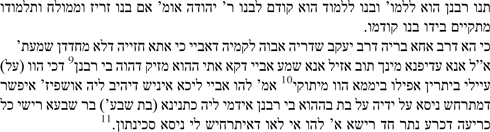
Our rabbis taught: If one wishes to study [Torah] and his son [also] wishes to study [and the father has limited resources], he takes precedence over his son. R. Judah said: “If his son is industrious and sharp-witted, and remembers what he has studied, his son takes precedence over him.”
Thus the [son] of R. Aḥa b. Jacob was sent by his father [to study] before Abbaye. When he returned [home], [his father] saw that his legal traditions were not honed. [R. Aḥa b. Jacob] said to him: “I am better than you. You remain here, and I will go [to study].” Abbaye heard that he was coming. There was a certain demon [in] the be rabbanan [place of advanced study],Footnote 12 such that [even] when two entered, even during the day, they would be injured. Abbaye said to them, “Let no man offer him hospitality, for perhaps a miracle will take place through him.” When [R. Aḥa b. Jacob] stayed the night in that be rabbanan, [the demon] appeared to him as a seven-headed serpent. Each time that [R. Aḥa b. Jacob] bowed down, one head fell off. [R. Aḥa b. Jacob] said to them: “If there had not a miracle on my behalf, you would have endangered me!”
The rabbinic discussion of precedence is followed by a bizarre story about R. Aḥa b. Jacob vanquishing a demon in Abbaye's house of study. The story of this third-generation Babylonian Amora purports to answer the question of whether a son or his father should be sent to study by insisting that in this case, the father's superior intelligence requires the prioritization of his own study over that of his son. It speaks to a real concern in the mishnah about the tensions between teaching oneself and teaching one's children.
The story also invokes legal issues that appear in other discussions of demons in the Babylonian Talmud. In B. Berakhot 3a–b, the anonymous voice of the Talmud suggests that doing certain things, such as entering ruins, together with another person may help prevent demonic harm because demons are unlikely to attack if they are outnumbered.Footnote 13 In other talmudic texts, a first-generation Palestinian Amora and a Tanna restrict demonic dangers to nighttime hours; they assume daytime is relatively safe.Footnote 14 The story in B. Kiddushin 29b suggests a familiarity with the Babylonian rabbinic distinctions between the demonic dangers at particular times and in particular situations. Read against the background of B. Berakhot and other such passages, the anonymous voice in B. Kiddushin uses the language of people entering the be rabbanan in groups of two to heighten the danger in the study house. Even in pairs, even during the day, the demon is harmful and maybe even fatal.
The story of R. Aḥa and the demon is thus part of a much wider demonic discourse in the Babylonian Talmud. Certain details take on increased significance in this broader discourse: the demon's form as a seven-headed serpent, R. Aḥa’s defeat of the demon through prayer, and the demon's remarkable malevolence in the rabbinic schoolhouse. Contextualizing these details sheds important light on how and why the story was composed and understood to be meaningful.
A Serpent with Seven Heads
A combat myth that pits a hero against a serpent or dragon is a common motif across Indo-European cultures and traditions.Footnote 15 These narratives depict the moment in which a hero (usually male, often divine) defeats a dragon as a pivotal moment in the hero's transformation into a hero. Within Jewish tradition, the echoes of this myth are found only obliquely in biblical and Second Temple texts; and in these accounts, God is the hero who defeats the beast.Footnote 16 Psalm 74:14, for example, praises God for vanquishing a multiheaded serpent-like figure by saying: אַתָּה רִצַּצְתָּ, רָאשֵׁי לִוְיָתָן; תִּתְּנֶנּוּ מַאֲכָל, לְעָם לְצִיִּים, “You crushed the heads of the Leviathan, you gave him as food for the creatures of the wilderness.”
Within rabbinic texts, B. Kiddushin 29b is the only case that pits a dangerous serpent-like demon against a rabbinic hero. Yet snakes are linked to invisible forces as early as the biblical story of Moses healing the snake-plagued Israelites by erecting a bronze serpent that cures all who looked at it through an act of sympathetic magic (Numbers 8–9).Footnote 17 And indeed, unseen but potentially fatal dangers, reptiles, and demons are associated with each other in many places in tannaitic and Palestinian amoraic literature.Footnote 18 The Babylonian Talmud expands the association of snakes and unseen forces and constructs elaborate rituals meant to protect followers of the rabbis from ophidian harm.Footnote 19 The dangers associated with snakes and the dangers associated with demons often overlap and at times even blend into each other.Footnote 20 Nonetheless, the seven-headed serpent demon in B. Kiddushin 29b is the only instance in either Second Temple or rabbinic literature where an ophidian and/or demonic danger has more than one head.
There are, however, a number of multiheaded demons in contemporaneous Zoroastrian demonology. The evil demon Azdahāg or Aži Dahāka (lit. man-like serpent or dragon) is the most prominent.Footnote 21 In the oldest Zoroastrian texts, Aži Dahāka appears in mythological narratives of the first kings. Yašt 14 describes the actions of the mythic hero-king Θraētaona:Footnote 22
He smashed the giant dragon [Aži Dahāka] with three mouths, three heads, six eyes, a thousand tricks, the mighty strong, deceiving Lie, that evil (affecting) the living beings, possessed by the Lie: the mighty strong Lie that the Evil Spirit whittled forth, against the bony world of the living, for the destruction of the living beings of Order.Footnote 23
Though this text was written in the first millennium BCE, Azdahāg has a long afterlife, as can be seen in the Pahlavi Zoroastrian texts written in the ninth and tenth centuries CE. According to these later texts, he ruled the world for one thousand years in a reign replete with demons and forbidden magic.Footnote 24 The Dēnkard book 9 recounts that, in an early battle, Frēdōn (Pahl. for Θraētaona) attacked Azdahāg with a club and a sword. Each time Azdahāg's body was pierced with a sword, it produced reptiles and other harmful creatures.Footnote 25 Azdahāg is an obvious possibility for a Zoroastrian parallel to the narrative of B. Kiddushin. And yet Azdahāg is traditionally vanquished by armed conflict, and is consistently described as having only three heads.Footnote 26 Calvert Watkins has argued that a late Indo-European (Greco-Indo-Iranian) combat myth specifically depicts a hero fighting a monster with three heads and six eyes.Footnote 27 Though groupings of seven are indeed found in Zoroastrian texts, there are actually no extant contemporaneous Zoroastrian texts that describe a serpent with seven heads.Footnote 28
And yet there is a much older corpus of texts in which seven-headed serpent demons are both common and prominent—the ancient Near Eastern texts of Mesopotamia and northern Syria. The rabbis of Sasanian Babylonia lived in a region that had once been the seat of the ancient Babylonian Empire. The Babylonians were themselves heirs to even more ancient Near Eastern traditions inherited from ancient Sumer and Akkad, and had also absorbed Assyrian cultural and religious tropes. The ancient Near East spanned millennia of political and cultural development; intellectual and cultural historians must take into account the heterogeneity and change that characterized this region in this period. However, as I discuss below, a significant number of older ideas did survive and were reshaped first by communities living in the Babylonian Empire, and later by communities living in a Sasanian milieu. Several aspects of this wider culture as filtered through the Babylonians shed new light on the elusive tale of the seven-headed demon in B. Kiddushin 29b.
Ancient Mesopotamian mythological accounts tell of a primordial battle between the gods that led to the creation of a mythic seven-headed snake warrior.Footnote 29 According to the Babylonian epic of creation, the Enuma Elish, written during the reign of Nebuchadnezzar I (r. c. 1125–1104 BCE), it was the goddess Tiamat who sought to destroy the gods who killed her husband.Footnote 30 To build her army, Tiamat created eleven monsters, one of which was the Mušmaḫḫu, a giant serpent with seven heads. Though the other gods defeated Tiamat and her army in battle, the text suggests that the gods did not destroy the Mušmaḫḫu, but rather preserved it in some form in the primordial deep.Footnote 31 In older Sumerian texts, the war-god Ninurta is described as vanquishing “the seven-mouthed mušmah serpent” and hanging its body from the “shining cross-beam” of his chariot.Footnote 32 Sumerian and Akkadian visual images of Ninurta depict him using some sort of weapon to battle the beast.Footnote 33
This idea was not exclusive to ancient Mesopotamia. To the west in Ras Shamra, in what is now northern Syria, the Ugaritic Baal Cycle also describes a series of battles between the gods. In a number of places, the goddess Anat declares,
Anat is an ancient Northwest Semitic war goddess often depicted wielding either a bow or a sword.Footnote 35 In this account too, the hearer or reader is probably meant to imagine her vanquishing the seven-headed serpent, whose name is Lotan, through physical violence, using one of her signature weapons.Footnote 36
Seven-headed serpents were a common ancient Near Eastern image, but not a late antique Zoroastrian one. The figure had a long afterlife in Babylonian and Semitic cultures.Footnote 37 In fact, there is significant evidence of the mythological persistence of the imagery of a seven-headed serpent into the first millennium CE, most famously in the New Testament book of Revelation. This first-century CE text contains an apocalyptic account of the final battle in the end of days that includes a vision of “a great red dragon, with seven heads and ten horns, and seven diadems on his heads” (Revelation 12:3).Footnote 38 Thus the ancient Near Eastern traditions of an evil seven-headed serpent opposed to divine rulership persisted at least into first-century CE Asia Minor. And like its ancient antecedents, in Revelation the dragon—who is also Satan and the devil—is vanquished through a physical battle, this time with the angel Michael and his armies. While I am not suggesting that the rabbinic creators of the story in B. Kiddushin knew of and were drawing on the image of the seven-headed dragon in Revelation, the survival of the story in Revelation suggests that the trope of the seven-headed serpent demon may well have also survived into this period in other contexts.Footnote 39
There is substantial evidence of the persistence of Sumerian, Akkadian, and Babylonian traditions in Babylonia well into the period in which the Babylonian rabbis told their story of the seven-headed demon in the schoolhouse of Abbaye. Some scholars have dated Akkadian and Sumero-Akkadian cuneiform tablet fragments to scribal communities in the second and early third centuries CE.Footnote 40 Certain regions of Babylonia observed ancient Mesopotamian festivals into the Parthian period (150 BCE – 226C CE).Footnote 41 In Edessa in Upper Mesopotamia, late antique Syriac Christian authors continued to rail against named Babylonian gods in their homilies, heresiologies, and martyrologies.Footnote 42 Stephanie Dalley has convincingly argued that knowledge of the Enuma Elish and its mythic narratives continued into the reign of the Sasanian king Kosrow I (531–79 CE).Footnote 43 As in the case of the seven-headed demon, we should not imagine that Babylonian deities, rituals, festivals, and texts survived in their precise ancient forms, but rather that some ideas persisted and remained “live” to new adoptions and adaptations well into the seventh century CE.
In the overwhelming majority of the ancient mythological texts that depict a seven-headed serpent or dragon, the figure is an evil intermediary being, or, as in Revelation, symbolizes Satan and his evil empire.Footnote 44 In all of these narratives, the serpent is vanquished in battle by a divine or human hero. The seven-headed serpent is thus an ancient Near Eastern antagonist; its presence in this rabbinic narrative points to Babylonian origins, rather than Zoroastrian ones, for the villain and themes of this aggadah. Avigail Manekin Bamberger has shown that the Akkadian demon Šulak survived in the Babylonian Talmud as B. Gittin 70a's privy-demon Bar Shirika; the case of the seven-headed serpent demon in B. Kiddushin 29b is yet another example of this type of survival.Footnote 45
Though this discussion has demonstrated the connection between the seven-headed serpent demon in the Bavli and in ancient Near Eastern traditions, it must also highlight differences between the rabbinic approach to dealing with the demon and these older depictions. Jon D. Levenson has noted that “in Talmud and midrash, the traditions about the sea monster are less important than in the Hebrew Bible and certainly less important than in postbiblical Jewish apocalyptic. This is, in part, because other ways of conceiving the eschatological foe, all of them likewise rooted in the Hebrew Bible, become more prominent and begin to eclipse the ancient combat myth.”Footnote 46 The primordial serpent demon, associated with divine combat, has become, in the Babylonian Talmud, a minor demon haunting a house of study and vanquished by an all-too-human rabbi. In the earlier accounts of a battle with a mythic seven-headed dragon or serpent, the serpent is defeated in physical battle, oftentimes with explicitly listed weapons.Footnote 47 R. Aḥa vanquishes the demon by bowing.
Battling Demons through Prayer
The rabbis of the Babylonian Talmud often use the verb כרע, “to bow,” to describe the bowing that occurs during the rabbinically mandated Amidah prayer.Footnote 48 As a component of prayer, bowing ultimately becomes a synecdoche for prayer as a whole. According to this story, then, the act of praying to God destroys demons. While the heroes of the ancient Mesopotamian myths are either gods or kings, the hero of the talmudic story is a rabbi who is identified by his particularly honed Torah study; his exorcistic act is a rabbinic act of prayer. It is the power of R. Aḥa's prayer that destroys the demon.
The interaction between the rabbi and the demon is physically embodied. Within the logic of the narrative, the demon is real; the description of the demon focuses on his actions (killing rabbis) and his physical form (a seven-headed serpent). And though physical contact is never made, R. Aḥa b. Jacob's mode of vanquishing is itself physical; he uses his entire body against his demonic foe to slowly sever the demon's seven heads.
The shift from combat narratives involving weapons and physical violence to combat narratives involving prayer and ritual gestures to destroy demons is also attested in early Christian texts.Footnote 49 In the fourth and fifth centuries CE, the number of depictions of Christian holy men defeating demons through prayer increases significantly in both the Byzantine and Sasanian Empires. The Egyptian Athanasius's fourth-century Life of Anthony and the fifth-century Life of Daniel the Stylite both depict monastic figures repelling and destroying demons through the power of prayer paired with acts of genuflection.Footnote 50 Within the Sasanian Empire, the Syriac Acts of the Persian Martyrs and contemporaneous Zoroastrian texts also depict demons being killed through verbal and physical prayer acts. The holy men described in the Syriac Martyr Acts use the recitation of biblical verses and the sign of the cross to ward off demonic attackers;Footnote 51 Zoroastrian texts list particular prayer formulae that work to repel or destroy demons.Footnote 52 Each late antique religious community thus deployed the formulae and postures they used for prayer to defeat demonic antagonists. Richard Kalmin has shown that the fourth century was particularly significant for the transmission of traditions and attitudes from the Roman East to the Babylonian rabbis.Footnote 53 It is thus unsurprising that it is in this period that the motif of prayer defeating demons becomes prominent in Babylonian rabbinic literature and in the literatures of other Sasanian religious communities.
The figure of the itinerant holy man who moves from community to community performing miraculous healings and exorcisms appears across late antique cultures.Footnote 54 The production of the Babylonian incantation bowls also attests to the prevalence of the use of powerful words and physical rituals to banish and destroy demonic dangers.Footnote 55 So while the demon in Abbaye's schoolhouse may be an ancient Near Eastern figure, the way that R. Aḥa b. Jacob destroys him aligns with the modes of ritualized demon vanquishing present in late antique Sasanian Babylonia.
To take a step back, the narrative in B. Kiddushin portrays a Sasanian rabbi killing an ancient Near Eastern demon using late antique means. In an act of cultural bricolage, the rabbis create a narrative that is entirely their own. Whether or not the rabbis did so intentionally, they participated selectively in multiple discourses about demons that circulated in late antique Babylonia, some of them actually thousands of years old.Footnote 56
Demons Malevolent and Otherwise in Babylonia
Within this complex cultural network, the demon's location in the rabbinic house of study must also be explained. Religious spaces are often constructed as particularly fraught. Those who enter these spaces may require appropriate rituals and purification in order to leave them unscathed.Footnote 57 The demon in B. Kiddushin 29b is clearly a malevolent force who harms men who enter the house of study even in the daytime, even in pairs. He seems to attack those who are most knowledgeable about rabbinic ways of dealing with demons in the very location of their expertise.
Early Christian texts attest that malevolent demons are found particularly in holy places—sacred buildings, groves, and water sources—where they function to impede and prevent proper modes of worship and fellowship.Footnote 58 I have argued elsewhere that in the Babylonian Talmud demons appear especially in places frequented by the rabbis.Footnote 59 And yet, in almost all of the cases in the Bavli, demons appear in rabbinic spaces precisely as a marker of their approbation and affiliation with the rabbis. Demons are superhuman, and thus have tremendous creative and destructive capacities, but they appear to prefer to be left alone, using these abilities sparingly and only when absolutely necessary.Footnote 60 In the dominant discourse of the Babylonian Talmud, the rabbis present demons as neutral or even positive figures, pledged to Torah and the divine will.Footnote 61 The rabbis even cite demons with upstanding biblical names—such as the demons Joseph and Jonathan—as rabbinic teachers themselves.Footnote 62 This rabbinic context highlights the true strangeness of the story of the seven-headed serpent demon in the schoolhouse of Abbaye. For the rabbis, it is actually exceptional that the demon in Abbaye's study house is entirely malevolent, attacking Torah scholars and needing exorcism.Footnote 63
The story of the demon in Abbaye's schoolhouse thus points to an inherent complexity in the rabbinic construction of demons. Demons are both neutral and/or positive participants in the rabbinic system, and dangerous threats to rabbinic survival. This construction is substantively different from the construction of demons in contemporaneous Zoroastrian and Christian texts. All ancient demonologies were complex, attesting to the rich thinking of late antique believers. For Syriac Christian authors, demons were servants of Satan, inherently opposed to the worship of God and the promotion of the good. For Zoroastrians, most demons were the wicked creations of the evil god Ahreman, who worked exclusively to cause evil in this world.Footnote 64 However, the rabbis did not have the luxury of dismissing demons as entirely evil. Like all late antique religious systems, rabbinic Judaism defied a simple theological systematization.
Rabbinic religion was a messy, multivalent, multivocal set of beliefs, practices, and paradigms. However, God's oneness and benevolence were always elements of the loose framework in which rabbinic theology developed. In dealing with malevolent intermediary beings, the rabbis had three theological options: first, that demons are evil beings created by God for some mysterious or even nefarious purpose, which would challenge God's benevolence; second, that demons are evil beings outside of divine control, which would challenge God's omnipotence; or third, that God is in fact benevolent, and God's demons are, if not uncomplicatedly good, at the very least not always evil. But though the rabbis choose this third option, that does not mean that demons cannot be dangerous and even fatal to the unwitting or unworthy. Rabbinic theology and rabbinic legal thinking converged in a construction of the nature of demons that had little to do with contemporaneous Christian and Zoroastrian understandings of the demonic.
The rabbis’ construction of demons as potentially dangerous but complex intermediary beings who are the creations of a single divine being aligns with ancient Near Eastern constructions of demons in surprising ways, beyond the simple shared imagery of a seven-headed serpent demon. Ancient texts from Sumer and Akkad, as well as Babylonian and Assyrian texts, describe a wide range of ancient Mesopotamian demons. The seven-headed Mušmaḫḫu was on the wrong side of the primordial divine battle and was thus unequivocally depicted as evil and needing to be vanquished, but many demons served as the neutral servants of generic or specific gods. Ancient Mesopotamian scribes categorized demons as good or evil, depending on whether the tasks these demons were given were beneficent or harmful to humankind.Footnote 65 Some classes of demons, such as the UDUG, LAMA, and gallû, included both “evil” and “good” demonic beings, and scribes were careful to use the appropriate adjectives in inviting or adjuring demonic forces. Hundreds of years before the rise of Babylonia, King Gudea of Lagaš had described himself as blessed with having a good UDUG demon who went before him, and a good LAMA demon who followed him.Footnote 66 This verbal formula survived, and one later Babylonian scribe recorded a desire that “the good sédu and the good lamassu daily walk by my side.”Footnote 67 Ancient Mesopotamian demonology was thus incredibly rich; demons could be servile, neutral, evil, vindictive, capricious, good, exorcistic, and/or apotropaic. Individual natures and contexts mattered.
Like the ancient Mesopotamians, the rabbis believed that demons could be neutral, and even good. But, also corresponding to ancient Mesopotamian beliefs, they held that demons could be harmful, lashing out against those who transgress some unwritten rule of the divine world, or, more dangerously, for no apparent reason at all. This characterization remains true whether a religious community worships a sprawling pantheon with a range of divine actors and motivations, or a single complex God whose actions are presented and represented in a wide range of ancient Jewish literatures.
* * * * *
The Babylonian rabbis were active participants in the culture of Sasanian Babylonia, with all the inherited traditions and competing cultural claims that marked the region. In many cases, rabbinic demonology adopts and adapts certain contemporaneous beliefs about demons. But this demonology is not always an import from Zoroastrianism. There are significant differences in the ways the rabbis and the Zoroastrians imagined demons; differences that make sense when we think about the different theological systems within which their demonologies functioned. Instead, as my analysis of B. Kiddushin 29b has shown, sometimes rabbinic demonology harkens back to much earlier ancient Near Eastern demonology. At times the Bavli aligns more with early Mesopotamian concepts still circulating in Sasanian Babylonia than it does with the concepts of contemporary Zoroastrians and Christians. And at times these ancient Mesopotamian concepts are reframed in ways that orient them with late antique models of leadership and religious experience.
The scholars who debate the rabbis’ cultural context are right to insist that the rabbis of the Babylonian Talmud must be understood within their Sasanian world. However, this Sasanian world was not static; we must not imagine any two religious communities interacting in isolation from the multitude of other religious groups in Sasanian Babylonia. Sasanian culture was not simply the product of the influx of Zoroastrian beliefs and ideas from Iran to Sasanian Babylonia, from an elite to subject peoples; it included diverse elements—including western Christian ideas as well as beliefs and traditions that had taken root in Mesopotamia thousands of years earlier and that continued to be important in the lives of many late antique believers.
But we must also not characterize or dismiss rabbinic demonology as entirely foreign. No community's world view can be isolated from internal developments within its own group. Rabbinic demonology is embedded in much larger legal discourses about Torah study, ritual obligations, and family life. In their telling of the story of the demon in B. Kiddushin 29b, the rabbis perform an act of creative bricolage in which diverse elements are combined and recombined selectively to construct a thoroughly rabbinic narrative. Yaron Eliav has proposed the model of “filtered absorption” for understanding the encounter between Judaism and Greco-Roman culture, which he describes as a gradual and variable adaptation to new cultural elements that also reshaped these elements “in conformance with the new system in which they had to function.”Footnote 68 A similar move can be seen in the Babylonian Talmud's approach to demonology. This framework constructs the Babylonian Talmud's demonology as entirely rabbinic and locates it within the complex rabbinic project of theological world building.
This one ʾaggadataʾ demonstrates several features of rabbinic demonic discourse that point to the creative acts of bricolage and cultural interpretation that the rabbis perform: the physical embodiment of the demonic in rabbinic space, the rabbinization of nonrabbinic and even non-Jewish figures and ideas, and the insistence that only the rabbi and his keen understanding of Torah can defend the community from demonic danger. A seven-headed serpent demon is integrated into the Talmud; polytheism, with its multitude of flawed and capricious deities, is not. Late antique prayer practices are the only effective mode of exorcism, but the prayers are performed by rabbis and directed towards the one true God. The Indo-European combat myth has been transformed into a battle between a serpent-demon and a human rabbi, a battle waged through rabbinic prayer whose end result is the acknowledgement of the worthiness—and cleverness—of R. Aḥa b. Jacob and the rabbinic movement as a whole.


