Introduction
The growing use of compulsion in UK active labour market policies has stimulated much academic debate. Theodore (Reference Theodore1998) argues that it heralds a shift from the welfare state to a Schumpeterian workfare state. This is signalled by the punitive nature of programmes which attempt to recast ‘supply-side’ problems as the product of deficient work ethic. Smith and Macnicol (Reference Smith, Macnicol, Edwards and Glover2001) view it as a means of expanding the labour supply to meet the requirements of the precarious and casualised labour market. Wacquant (Reference Wacquant1999) argues that it reflects a ‘new penal common sense’ which seeks to criminalise poverty and normalise insecure, low-paid employment. Neo-liberal societies rely on the police and penal institutions to contain the disorders produced by mass unemployment, the imposition of precarious wage work and shrinking social protection. ‘The invisible hand of the market and the iron fist of the state combine and complement each other to make the lower classes accept de-socialized wage labour and the social instability it brings in its wake’ (Wacquant, Reference Wacquant2003: 14).
Policy articles that have sought to examine how UK welfare reform is actually implemented have been much thinner on the ground. Meyers et al. (Reference Meyers, Glaser and MacDonald1998) maintain that part of the cycle of great expectations and dashed hopes in US welfare reform reflects a persistent lack of attention to policy implementation. Yet Lipsky (Reference Lipsky1980) has shown how the intentions of policy makers may be frustrated by the behaviour of public service workers operating in a ‘corrupted world of service’. This article draws upon the findings of the evaluation of the Jobseeker Mandatory Activity (JMA) to discuss how Jobcentre Plus personal advisers are likely to implement key welfare reforms.
The JMA pilot was a ‘work first’ programme that sought to help JSA claimants back into work quickly rather than develop their human capital. The focus was on those aged 25 years or more who had been claiming benefit for six months. The intervention comprised a three-day work-focussed course followed by three personal adviser interviews at intervals of two weeks. The pilot was tested over a two-year period with the first customers entering provision in April 2006. The evaluation of the JMA was undertaken by a small team led by the author and combined direct observation of the delivery of twelve JMA courses, desk-based analysis of sixty action plans and 187 semi-structured face-to-face interviews with key stakeholders. The interviews were carried out in two waves and included staff responsible for the design of the programme, participants, course provider staff, Jobcentre Plus personal advisers and managers.
‘The pilots are an excellent example of the reforms we want to bring to the welfare state – strengthening rights and responsibilities to get people off benefits and into work’ (DWP Press Release, 8 April 2006). The course and follow-up interviews were all mandatory and participants were informed that failure to attend would result in a one-week benefit sanction. The mandatory nature of provision was described as: ‘another test of whether they are actively seeking work’ (DWP design staff). Sanctions were intended to produce a ‘deterrent effect’ on those fraudulently claiming benefit. Individuals were given two chances to participate before being submitted to decision makers with a view to stopping their benefit. The JMA extended sanctioning activity. ‘It is the first time we will be [automatically] sanctioning individuals for failing to turn up for interviews’ (DWP design staff).
Street-level bureaucracy
There is a venerable tradition of social science research that has explored the multiple interests that interact to influence policies as they devolve down hierarchical lines (Riccucci, Reference Riccucci2002). Lipsky's (Reference Lipsky1980) concept of street-level bureaucracy has highlighted the potential role of front-line workers. He argued that their actions have substantial and sometimes unexpected consequences for the actual direction and outcome of programmes. Hasenfield (Reference Hasenfield1992) points out that the impact of street-level bureaucrats is particularly important because they are called upon to ‘process people’, i.e. transform those dependant upon benefit into active labour force participants.
Street-level bureaucrats were defined as those that ‘interact directly with citizens in the course of their jobs, and who have substantial discretion in the execution of their work. Typical street-level bureaucrats . . . grant access to government programs and provide services within them’ (Lipsky, Reference Lipsky1980: 3). They include police officers, doctors and benefit officials. Street-level bureaucrats mediate between institutions and citizens. As front-line practitioners, they translate institutional policy into daily, situated practice. This gives them a significant degree of control with potentially profound consequences for both institutions and citizens. Lipsky saw them as policy makers in an environment that they do not control.
However, as mediators they are confronted with a conflict between organisational and user-centred goals. The dilemma between responsiveness and standardisation is a key tension. Responsiveness refers to approaches that take into account individual needs, whereas standardisation equates to a tendency to treat all clients the same (Hjorne et al., Reference Hjorne, Juhila and Nijnatten2010). In addition, the demand for services always exceeds the resources provided by organisations to front-line workers. As Lipsky (Reference Lipsky1980: 37) put it: ‘the resource problem in most cases is not resolvable’. Consequently, individuals operate in a ‘corrupted world of service’ where they struggle with insufficient resources, high caseloads, unpredictable clients and Agency goals that are often vague, conflicting and ambiguous.
These conflicts prompt front-line workers to develop ‘routines and simplifications’ to make their jobs more manageable. They tend to use discretion to make work easier. Such practices are referred to as ‘defences against discretion’, the paradox being that discretion is exercised for the benefit of the worker rather than the client. Lipsky (Reference Lipsky1980: 14) argues that front-line workers exercise discretion even when their work is formally circumscribed by rules. ‘They [rules] may be so voluminous and contradictory that they can only be enforced or invoked selectively.’ Consequently, public policy is effectively made in the crowded offices and daily encounters of street-level workers. ‘The decisions of street-level bureaucrats, the routines they establish and the devices they invent to cope with uncertainties and work pressures, effectively become the public policies they carry out’ (Lipsky, Reference Lipsky1980: xii).
Some have argued that Lipsky's account of front-line practice is less relevant now because the growth of managerialism has curtailed individual discretion in public organisations (see Clarke and Newman, Reference Clarke, Newman, Deakin and Page1993; Lawson, Reference Lawson, Taylor-Gooby and Lawson1993; Langan, Reference Langan, Clarke, Gewirtz and McLaughlin2000). There are two principles of managerialism: that managers gain control over front-line practice, and that this occurs in indirect ways (Kolthoff et al., Reference Kotlhoff, Huberts and Van Den Heuvel2007). However, Brodkin (Reference Brodkin2006) contends that discretion cannot be eradicated from street-level organisations. The evaluation of the JMA provides a particularly useful case study for discussing the continuing salience of ‘street level bureaucracy’ because policy makers were explicit that the pilot should reduce local discretion. Personal advisers were to ensure that all eligible customers participated in the pilot and that all of those failing to attend were referred to decision-makers for sanctioning.
The ‘corrupted world of service’ of Jobcentre Plus
Van Berkel (Reference Van Berkel, van Berkel and Valkenberg2007) has shown that the shift towards active welfare states and the introduction of new forms of governance, inspired by private sector management techniques, have had radical consequences for those implementing social policies. These changes have immersed welfare-to-work organisations in an almost permanent process of reorganisation. Furthermore, the culture of such organisations has been transformed from a primary concern with determining benefit eligibility towards more personal conversations about clients’ lives and behaviours. Meyer et al. (Reference Meyers, Glaser and MacDonald1998) encapsulate this as a change from ‘people sustaining’ activities towards a ‘people transforming’ role. Front-line workers have also had to increasing focus on outcomes and contribute towards the realisation of Agency targets.
Jobcentre Plus was established in April 2002 following the merger of the Employment Service and the Benefits Agency. From the outset, it was viewed as a vehicle for transforming the way in which workless people were supported. ‘The Agency will have a new culture that puts its customers and their attachment to the labour force first’ (HM Treasury, Reference Treasury2001: 27). It provides a single, integrated service to all benefit claimants of working age from over 800 offices. Every working day, it receives 13,000 vacancies from employers, conducts 36,000 work-focused interviews, helps 4,000 people into work and processes over 16,000 new benefit claims (House of Commons Work and Pensions Select Committee, 2006a: 1).
The evaluation of the JMA has revealed four key dimensions of the Agency's ‘corrupted world of service’:
• competing Agency goals;
• a preoccupation with performance measures;
• the imperative to reduce costs and demonstrate ‘value for money’;
• headcount reductions and low morale.
First, Jobcentre Plus has competing goals which are related to its two key functions of helping people into work and ‘policing’ benefit entitlement. This is the basis of an inherent conflict between the Agency's customer service ethos and sanctioning activities. On the one hand, it views the unemployed as ‘customers’ and has a customer service target. ‘We have made good progress in making improvements that matter to our customers. The time we take to deal with claims to benefit has reduced’ (Jobcentre Plus Chief Executive Review, 2008: 2). On the other hand, the Agency plays a pivotal role in enforcing a stricter benefit regime. Consequently, a long-term goal was to reduce losses from fraud and error in working age Income Support and Jobseekers’ Allowance by 15 per cent from 2005/6 to March 2010.
Second, the Agency exemplifies the new public sector where economy, efficiency, value for money, effectiveness, performance and accountability to the public, predominantly conceived as taxpayers, have been guiding principles (Henkel, Reference Henkel1991). Jobcentre Plus has annual performance targets which are set out in a Business Plan. During September 2005, a new performance-improvement tool known as ‘Red, Amber, Green’ was introduced to measure individual performance. An ‘amber’ designation indicates that performance is within 30 per cent of the target, whereas ‘red’ is reserved for a performance of less than 30 per cent. Advisers falling into these two categories have a personal development plan of improvements that is reviewed monthly. The system placed about one-third of advisers into the ‘red’ category (House of Commons Work and Pensions Select Committee, 2006a: 17). The Agency's interviewing and job submission targets took precedence over the pilot. Bedfordshire management explained that: ‘Jobcentre Plus is a target driven organisation. We tick boxes.’ A Wakefield adviser complained that: ‘The targets are at the back of my mind the whole time.’
Third, the Agency was under pressure from central government to reduce operating costs and obtain better value for money. A key priority was to improve the efficiency and effectiveness of service delivery by standardising processes to minimise waste and raise productivity. ‘I am proud of the significant contribution Jobcentre Plus made to enable the Department for Work and Pensions to exceed its challenging efficiency target for the Spending Review 2004 period’ (Jobcentre Plus, 2008: 3). The imperative to reduce costs was felt to underpin a lax attitude towards preparing staff for the launch of new initiatives. A manager in Bedfordshire noted that the usual approach was: ‘Have a read of this and get on with it.’ Staff in Barrow complained that they had received no specific guidance. Rather an adviser had worked out what to do and then had written step-by-step instructions for others. More generally, Jobcentre Plus staff undertake comparatively little one-on-one training or interview skills practice, such as role playing, on-line training or ‘E-learning’ (McNeil, Reference McNeil2009).
Finally, the Agency had completed a major job-reduction programme, which had been prompted by the 2004 Spending Review. In May 2008, it was confirmed that Jobcentre Plus had made headcount reductions of 16,450 full-time equivalent staff. During 2007/8, the Agency reduced its staffing by 1,568 to 66,378 full-time equivalent staff (Jobcentre Plus, 2008). There has been a marked impact on job satisfaction and morale. The Chief Executive of Jobcentre Plus told the Select Committee on Work and Pensions that the staff satisfaction index was ‘probably as low as I have ever seen it in Jobcentre Plus’ (House of Commons Work and Pensions Select Committee, 2006b). Strike action was undertaken during the piloting period.
Street-level bureaucracy in Jobcentre Plus
The JMA was not immune from the effects of the job reduction programme, which increased the workloads and pressures on all front-line staff. Participants often reported that their interviews were too short, between five and fifteen minutes, to be of any benefit. Follow-up interviews in Cheshire and Warrington and South London were not completed within the required timescales or with the same staff. Huddersfield advisers indicated that it took four weeks to conduct the first follow-up interview. Management staff in Calderdale & Kirklees acknowledged that: ‘Jobcentre Plus implementation of the programme has been appalling. We are just ticking boxes at the moment.’ More broadly, McNeil (Reference McNeil2009) found that almost a half of advisers surveyed (47 per cent) said they did not have as much time as they would like to support their clients.
Some have argued that the growth of managerialism has fettered professional discretion so that the ‘free space’ of the worker no longer exists. This might also resolve the dilemmas of front-line practice in a way that is unfavourable to both clients and professionals (Hjorne et al., Reference Hjorne, Juhila and Nijnatten2010). The responsiveness versus standardisation dilemma is, for example, resolved in favour of the latter. It becomes more difficult to proceed from client needs, because there is an increasing pressure of guidelines to undertake more uniform work. However, the present study has found wide variations in front-line practice, primarily because competing Agency goals allowed front-line workers to undertake their own interpretations of the adviser role. This tendency was often compounded when staff were not adequately trained for the implementation of new initiatives.
This conflict was reflected in the diverse approaches taken to implementation of the JMA. The Cumbrian and Bedford offices viewed the pilot as a means of providing additional help to their ‘customers’. ‘We are giving real support not scaring customers’ (Bedford adviser). Similarly, advisers in other areas ignored directives to become more challenging. Calderdale and Kirklees management acknowledged that: ‘The customer service option is easier than the sanction option.’ In contrast, the JMA was primarily seen as a vehicle for deterring those fraudulently claiming benefit in South London. ‘Action Plans are not a focus here. The aim is to find out which ones don't really need to be signing on (i.e. working elsewhere, but mainly if not really available for and actively seeking work). It's a test. It might be naive to think that they are much more than this’ (South London management).
It is in this context that Cumbrian participants were the most positive about the follow-up interviews which often lasted up to one hour. In-depth discussions had helped advisers to gain a better insight into individual needs. The empathy and understanding of dedicated JMA advisers was also singled out for praise. Some requested that their JMA adviser become their normal point of contact with the Agency. A very different picture emerged in areas lacking dedicated staff and where the pilot was viewed primarily as a means of deterring benefit fraud. In South London, for instance, it was an impersonal process that was likened to a ‘conveyor belt’ in which both parties were reluctant participants. A Woolwich jobseeker reported that: ‘The adviser didn't want to be there, and nor did I.’
The evaluation shed light on some of the additional factors behind such marked local variations. First, the participating offices varied significantly in terms of size. The South London offices were, for example, characterised by very high numbers of JSA customers, which meant that advisers had bigger workloads. In contrast, the small size and intimate nature of some of the Cumbrian offices was felt to be more conducive to client-centred working. Second, the offices served widely different welfare populations. Entrenched problems of worklessness were a feature of some of the former industrial communities in the north of England. Similarly, offenders and those with drug and alcohol problems were more prevalent in some of the larger urban offices. South London and Luton had significant numbers of customers with English as a second language. Third, staff serving deprived communities often exhibited an adversarial approach to working with a ‘hard core’ of customers. This was echoed by some of the external providers. ‘They are all pushed through our door. But we have no security guards here unlike Jobcentre Plus. And most of our tutors are female’ (Calderdale and Kirklees Provider Management). Finally, such offices were often characterised by a high degree of staff turnover.
This echoes the findings of Riccucci's (Reference Riccucci2002) study of the implementation of US welfare reform in Michigan, which found that the influence that street-level workers exerted meant that not one but many different welfare programmes were being implemented. ‘As our study of front-line workers in Michigan demonstrates, access to assistance and services may now be highly variable, even within a single state system’ (Riccucci, Reference Riccucci2002: 917). Blackmore (Reference Blackmore2001) also found that the degree of vigour with which the rules about providing evidence of job search were applied varied widely within and between Jobcentres. More recently, Knight et al. (Reference Knight, Bertram, Davidson, Dunn, Durante, Fish, Oldfield, Ray, Vegeris, Vowden and Winterbotham2010) have found a reluctance to sanction because it was time consuming. This raises important equity issues.
The design of the pilot envisaged that the role of the adviser in the sanctioning process would be limited to administration and referral. This was valued by some because the impartial and impersonal nature of the process was judged to reduce the potential to disrupt positive relationships with customers. However, the evaluation also found widespread unease with removing local discretion. In South London, advisers complained that decision-making staff: ‘Don't know the customers and cannot see a wider pattern of behaviour.’ A Calderdale and Kirklees adviser noted that: ‘Because all local office input has been removed, you cannot use your common sense.’ A few of those living in rural areas in Cumbria were penalised for arriving late, even though this was caused by genuine problems with public transport. It was pointed out that inappropriate sanctioning could be counter-productive for longer-term customer relationships.
There was widespread support for sanctioning. ‘It has to be there. You need the stick of it. Fear makes them attend the course rather than its positive aspects’ (South London adviser). Some followed procedures to the letter even when this caused great personal distress. A Calderdale and Kirklees adviser cited a customer that had been referred for sanctioning activity for attending his father's funeral. ‘I was ashamed. I could not look him in the eye.’ Those temporarily leaving courses for probation appointments or to pick up methadone were also sanctioned. The inexperience and lack of training of some front-line staff was probably a key contributory factor. Similarly, Handler (Reference Handler, Henman and Fenger2006) found that staff favoured punishing those that did not comply with US welfare regulations. He suggests that many workers saw themselves but a short step away from welfare themselves. ‘Workers trained, socialised and supervised in this manner will apply rules strictly, impose sanctions . . . and get through the day as quickly and painlessly as possible’ (Handler, Reference Handler, Henman and Fenger2006: 124). In the UK, McNeil (Reference McNeil2009) found that levels of personal adviser pay were modest and there were limited opportunities for pay progression.
Nevertheless, the way in which the JMA was staffed often meant that sanctioning rules were not followed. The most common model was for pilot duties to be shared amongst adviser teams, which allowed management to exercise more control over staff diaries. However, many individuals found juggling several different responsibilities difficult with the result that a range of practices flourished. South London management likened the pilot to: ‘battery hen work; they have referrals to do, DMA action, and do three interviews over eight weeks.’ Another contributory factor was the high turnover of staff in some offices. Those that missed initial training exercises and ‘walk-throughs’ were often unsure of the proper procedures to follow. A Wakefield adviser complained that she had sought assistance from her colleagues about sanctioning procedures, but found that they were all doing things differently.
Many made allowances for ‘exceptional cases’, especially when it had not been possible to convey messages about the mandatory nature of provision. This was often difficult because of the relatively little contact they had with claimants. The Social Security Advisory Committee (2009) has also drawn attention to low claimant awareness of the UK sanctions regime, which is complex and difficult to understand for both claimants and personal advisers alike. Workload pressures also meant that many were unable to explore whether there were genuine reasons for repeat breaches. In contrast, some were reluctant to refer participants for sanctioning because they lacked confidence in the process. A Bedfordshire adviser maintained: ‘I have no confidence in decision making and appeals.’ There had been several decision-makers in some areas, each with different ideas about how the process should be conducted.
Riccucci (Reference Riccucci2002) also found that street-level workers in Michigan took a lenient approach to sanctioning. At one site, the sanctioning message was not emphasised. At another, a worker visited non-compliant clients to avoid having to refer them for sanctioning. ‘The reasons they gave for a lenient approach ranged from concern about the clients’ well-being to concern about their own workload’ (Riccucci, Reference Riccucci2002: 913). Blackmore (Reference Blackmore2001) suggests that the main reason why the stricter benefit regime was not initially enforced in the UK was a lack of staff resources, which meant that there was insufficient time to conduct all the necessary checking procedures. This problem was exacerbated by a lack of staff training when Jobseekers’ Allowance (JSA) was implemented, and the high turnover of staff in some offices.
Implications for the implementation of the new regime for problem drug users
The present research is particularly timely because ongoing policy reforms will place further responsibilities upon front-line staff and present far-reaching challenges for the adviser role. The Drug Strategy 2010 seeks, for example, to ensure that the benefits system supports engagement with drug or alcohol recovery services. ‘Our aim is to increase the number of drug and alcohol dependent benefit claimants who successfully engage with treatment and rehabilitation services and ultimately find employment’ (HM Government, 2010: 23). At the same time, the 2010 White Paper ‘Universal Credit: Welfare that Works’ (DWP, 2010) has further strengthened the conditionality and sanctions regime.
Those who take illicit drugs, in particular heroin and crack cocaine, are termed ‘problem drug users’. The term was first used by the Advisory Council for the Misuse of Drugs (1982: 34) and meant those who ‘experience social, psychological, physical or legal problems related to their drug use’. This definition did not specify any particular type of drug, but it has become synonymous with users of opiates, especially heroin and crack cocaine. Hay and Bauld (Reference Hay and Bauld2008) estimate that they may account for almost 7 per cent of the working age population on benefits in England, while they make up only 1 per cent of the working age population. Most are male and this type of drug use is most prevalent among individuals aged in their twenties and thirties (Bauld et al., Reference Bauld, Hay, McKell and Carroll2010). Many have experienced disadvantage from an early age. Problems with housing and homelessness are common as are low levels of educational attainment. Mental and physical health difficulties, such as hepatitis C, HIV/Aids and physical impairments, affect a significant proportion (Bauld et al., Reference Bauld, Hay, McKell and Carroll2010). Many have criminal records (see Neale, Reference Neale2001).
The present article discusses the implications of the Agency's street-level bureaucracy for the implementation of two key proposals:
• identifying problem drug users claiming JSA and ESA;
• extending the use of sanctioning in the benefits system.
Identifying problem drug users
The current approach is to encourage voluntary disclosure. Claimants of Jobseekers Allowance (JSA) or Employment and Support Allowance (ESA) that are dependant on heroin or crack cocaine should discuss the matter with a Jobcentre Plus personal adviser. An appointment at a local drug treatment service can then be arranged if their drug dependency is a barrier to seeking, gaining or staying in work. The Agency also has a small number of Drugs Co-ordinators that seek to raise the awareness amongst advisers of the available drug treatment services and build relationships with external agencies.
A trusting relationship with a trained and experienced worker is essential for discussing such personal (and illegal) activities. Yet some staff expressed extremely negative views towards problem drug users and offenders. They were identified as constituting a ‘hard core’ of customers that were difficult or actively disruptive. Wright (Reference Wright and Millar2003) has shown how Jobcentre staff made moral judgements to distinguish between ‘good’ and ‘bad’ clients. The former were usually compliant, which made the work of front-line staff quick and uneventful. In contrast ‘bad’ clients were often deemed undeserving of help. Many thought that it was futile working with the ‘hard core’, since it was impossible to market them to employers. Furthermore, growing workloads may further undermine the ability of front-line staff to devote the time necessary for developing relationship of trust. Reflecting on the key lessons of the pilot, Bedfordshire management reported: ‘We have to question how we let customers get depressed and de-motivated. We don't spend enough time with them’ (Bedfordshire management).
There is an acknowledgement that advisers will need to undergo effective training if they are to work with problem drug users in a sensitive way. ‘We will continue to provide training for Jobcentre Plus advisers to give them the knowledge about drug and alcohol dependence, and know where to refer people for assessment’ (HM Government, 2010: 20–1). Yet many drew our attention to the inadequate way in the Agency prepares its staff for the launch of new initiatives. Training exercises had left them ill prepared to administer the JMA. A Wakefield adviser, for example, felt that sanctioning processes were not well understood: ‘It is trial and error here.’ More fundamentally, it is questionable how far training will change discretionary practices if conditions of work remain the same. Brodkin (Reference Brodkin1997) has shown that front-line workers often respond to pressures by limiting client interaction to gaining the information necessary for the completion of their paperwork.
In these circumstances, it is likely that many claimants will simply not disclose drug problems to Jobcentre Plus personal advisers. Some will also actively resist revealing such information given the potential repercussions. Those with children, for example, may be particularly reluctant to disclose, given that this might result in the involvement of social services. Nevertheless, some will discuss the matter with their personal adviser. The way in which individuals will be dealt with will partly depend on which advisers they see in the jobcentre. The current focus on helping claimants into treatment may be interpreted very differently. Some advisers may view those unwilling, for whatever reason, to enter drug treatment as breaking their ‘contract’ and be liable for sanctioning. Others will turn a ‘blind eye’ to such practices or take a more lenient approach preferring to engage in more positive and informative discussions with claimants about the extent to which their drug use constitutes a barrier to work.
A more pro-active stance to identifying problem drug users may be adopted in the future. The experience of US welfare reform, which has required staff to identify substance misuse problems as part of employability assessments, may be instructive. Henderson et al. (Reference Henderson, Dohan and Schmidt2006) investigated the practice of Californian welfare agency workers. They found that front-line workers faced numerous barriers to identifying such individuals. First, workers had to rely on self-disclosure and looking for signs of drug use, as informed by professional training. Yet this only provided generic information and was too broad or vague to be useful. Second, welfare reform increased the workloads of front-line staff, which meant that time pressures forced some to sideline issues such as substance misuse. Third, front-line staff often found it difficult to broach the subject for fear of undermining their relationship with the individual. Finally, some felt that such problems fell outside their frame of reference.
Sanctioning
There have been a series of UK policy reforms since the mid-1980s that have placed a new focus on the responsibilities of unemployed claimants. Griggs and Bennett (Reference Griggs and Bennett2009) have identified the idea of a ‘contract’ in the benefits system, with increasing conditionality and sanctions for claimants. More recently, conditionality has been extended to previously ‘inactive’ groups, such as lone parents. This approach has been further intensified by the Coalition Government. The 2010 White Paper Universal Credit: Welfare that Works (DWP, 2010) introduces further changes including:
• increasing the level of conditionality that is applied to some recipients;
• strengthening the sanctions regime so that it more effectively encourages individuals to meet their responsibilities; and
• introducing Mandatory Work Activity so that some recipients will be required to take part in full-time work activity for four weeks.
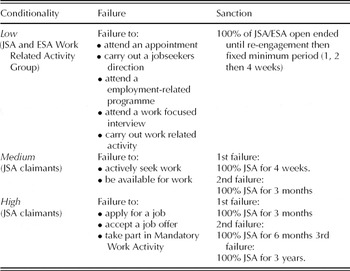
‘Having strong and clear sanctions are critical to incentivise benefit recipients to meet their responsibilities. Currently, we believe that sanctions are set at too low a level’ (DWP, 2010: 28). Consequently, a new sanctions structure will be introduced (see Table 1). Some claimants face the prospect of losing benefits for up to three years. Advisers will continue to play a pivotal role in the sanctioning process. They are to ensure that the conditionality requirements placed on recipients are reasonable and they will be given the flexibility to target stronger conditionality on some jobseekers.
Proposed future sanctions structure under the existing benefit system

Source: Department for Work and Pensions (2010), Universal Credit: Welfare that Works, London: HMSO.
There is an acknowledgement of the sensitivities of sanctioning vulnerable groups. ‘We will also maintain safeguards for vulnerable people and ensure that mental health and substance abuse problems are taken into consideration’ (DWP, 2010: 29). The Drug Strategy (2010) also indicates that those refusing treatment will not be specifically targeted. ‘In practice, this means that those not in treatment will neither be specifically targeted with, nor excused from sanctions by virtue of their dependence, but will be expected to comply with the full requirements of the benefits regime or face the consequences’ (HM Government, 2010: 23).
However, the Social Security Advisory Committee (2010) has shown that problem drug users already experience high rates of sanctioning. The present research has also highlighted the zeal of some advisers to sanction such individuals. It is, therefore, highly likely that they will bear the brunt of the tougher sanctioning regime. Howard (Reference Howard, Henman and Fenger2006) has found that Australian ‘breach penalties’ disproportionately affected ‘vulnerable’ persons such as the homeless and those with mental health problems. Handler's (Reference Handler, Henman and Fenger2006) review of US welfare reform has also discovered that those least able to succeed in the labour market were the most likely to be sanctioned. Similarly, Crisp and Fletcher's (Reference Crisp and Fletcher2008) comparative review of workfare programmes in the US, Canada and Australia indicated that welfare recipients with multiple barriers often found it difficult to meet their obligations and were sanctioned.
Benefit recipients will be able to show ‘good cause’ and also to appeal against the imposition of a sanction. The current length of time for someone to show ‘good cause’ in relation to being sanctioned is five days. However, the Social Security Advisory Committee (2010) has suggested that this may be too short a time for problem drug users because of their ‘chaotic lives’ and low levels of understanding of the sanctions regime due to associated mental health problems or learning difficulties. This has been borne out by the present study, which has also shown that there are serious problems with awareness and communication of the rules at the local office level, with the result that many benefit recipients are simply not aware of their rights.
The use of sanctions within the benefits system is designed to change behaviour. It relies on people being able to behave rationally and alter their conduct in order to avoid a financial penalty. Yet the Social Security Advisory Committee (2010) has argued that the ability of many problem drug users to behave rationally is severely compromised. It has also highlighted the lack of evidence that sanctions significantly influence the behaviour of more vulnerable claimants, who often fail to understand how the regime operates. The UK Drug Policy Commission (2010) has also found little reliable evidence that introducing financial benefit sanctions would impact on the willingness of individuals to address their substance use dependency.
This may help to explain why the evidence for the impact of sanctions on behaviour is mixed. Handler (Reference Handler, Henman and Fenger2006) suggests that US sanctions influenced the behaviour of some Temporary Assistance for Needy Families (TANF) recipients but not others, many of which lost all financial assistance. This picture is corroborated by the present study. JMA Advisers often reported that few of those sanctioned were subsequently penalised again, but that the impact on the behaviour of a ‘hard core’ was much more limited. An adviser in Huddersfield noted that: ‘Some have lost three weeks money rather than go on it [the course].’ Furthermore, some had become violent and confrontational. A Halifax adviser noted that: ‘They rip their certificates up in your face.’ Some providers experienced problems retaining tutors due to the stresses of dealing with such individuals. The response of many advisers was to call for even more draconian sanctions.
Hardship, debt and stress are the regular outcomes of sanctions with little corresponding benefit (Griggs and Bennett, Reference Griggs and Bennett2009). There may also be important negative impacts on emotional well-being. Dorsett (Reference Dorsett2008) found widespread feelings of anger, humiliation, depression and anxiety when a sanction was imposed. Crisp and Fletcher (Reference Crisp and Fletcher2008) also indicate that US workfare sanctions led, in extreme cases, to the complete withdrawal of benefits and left some individuals with no work or income. Hardship payments are currently available to benefit recipients in need who receive a sanction. However, the White Paper (DWP, 2010) signals a commitment to replace them with loans and ensure that those who persistently fail to meet the requirements imposed on them cannot rely on these alternative sources of support.
A key message from the present study is that front-line practice will be structured by the pressures of time and the amount of paperwork required for sanctioning activities. Riccucci (Reference Riccucci2002) also found that many front-line workers in Michigan described their job goal as getting the paperwork done. Complaints about the amount of paperwork required for sanctioning were a constant refrain. An adviser in Hanley, for example, complained about: ‘the phenomenal increase in workloads with additional paperwork at all stages of the process’. Furthermore, the administrative complexity of the sanctioning procedures often meant that they were inconsistently followed. There were also profound problems with awareness and communication regarding the sanctioning regime.
In his foreword to the White Paper (DWP 2010: 1), Iain Duncan Smith states that welfare reform ‘extends a ladder of opportunity to those who have previously been excluded or marginalised from the world of work’. Yet the Social Security Advisory Committee (2010: 5) has warned that the increased sanctioning of vulnerable claimants will ‘move people further from the labour market as they drop out of the benefits system and turn to other sources of income such as crime and prostitution’. This potential has been borne out by research. O'Connor et al. (Reference O'Connor, Bruce and Ritchie1999) have shown that the coping strategies of some individuals have included engagement in informal work and crime. Moreover, Machin and Marie (Reference Machin and Marie2004) have found that property crime rates rose in areas that had more sanctioned individuals. There is, therefore, a real danger that policy reforms may exacerbate labour market inequalities and open a trap door into informal work and criminal activity which will further undermine deprived communities.
Concluding remarks
Discretion remains an enduring feature of front-line practice in Jobcentre Plus. This has potentially profound implications for severely disadvantaged groups when the latest policy reforms are fully implemented. Competing Agency goals and the inadequate training of front-line staff have provided the necessary ‘space’ for front-line workers to undertake their own interpretations of the adviser role. Some have focussed on providing an enhanced service to their ‘customers’, whereas others have sought to use the pilot as a vehicle for more effective policing of benefit claims. The Agency's ‘people transforming’ role obliges staff to make moral judgements to help determine the legitimacy of individual claims on welfare resources. In addition, the Agency's ‘corrupted world of service’ requires staff to contribute towards the realisation of targets which heightens the personal conflict between organisational and user-centred goals. Nevertheless, there appear to be intrinsic features of the adviser role which also explain why discretion remains. For some, the exercise of discretion allows them to maintain their self-regard. Meyers et al. (Reference Meyers, Glaser and MacDonald1998) study of welfare reform in California found that those engaging in positive and informative discussions with clients often related their motivation to their pride as helping professionals. This may be highly valued in organisations suffering from headcount reductions and low morale.