Introduction
It is widely accepted that semantic knowledge is predominantly shared across languages of multilingual people (e.g., Kroll, Van Hell, Tokowicz & Green, Reference Kroll, Van Hell, Tokowicz and Green2010; Paradis, Reference Paradis and Paradis1993). Consequently, we might expect that semantic treatment for an acquired language impairment (aphasia) would be effective for all languages and that treatment effects would generalise within and across the languages of a multilingual person. However, considerable empirical data challenges this hypothesis (e.g., Abutalebi, Rosa, Tettamanti, Green & Cappa, Reference Abutalebi, Rosa, Tettamanti, Green and Cappa2009; Ansaldo & Saidi, Reference Ansaldo and Saidi2014; Croft, Marshall, Pring & Hardwick, Reference Croft, Marshall, Pring and Hardwick2011; Faroqi-Shah, Frymark, Mullen & Wang, Reference Faroqi-Shah, Frymark, Mullen and Wang2010; Goral, Rosas, Conner, Maul & Obler, Reference Goral, Rosas, Conner, Maul and Obler2012; Goral, Naghibolhosseini & Conner, Reference Goral, Naghibolhosseini and Conner2013; Kiran, Sandberg, Gray, Ascenso & Kester, Reference Kiran, Sandberg, Gray, Ascenso and Kester2013; Knoph, Simonsen & Lind, Reference Knoph, Simonsen and Lind2017; Lerman, Edmonds & Goral, Reference Lerman, Edmonds and Goral2018). Therefore, several researchers have hypothesised that patterns of generalisation are likely related to differences in proficiency and use of each language (e.g., Edmonds & Kiran, Reference Edmonds and Kiran2006; Goral et al., Reference Goral, Rosas, Conner, Maul and Obler2012; Nadeau, Reference Nadeau2019), the balance between the language network and the language control network (e.g., Goral et al., Reference Goral, Naghibolhosseini and Conner2013; Kiran et al., Reference Kiran, Sandberg, Gray, Ascenso and Kester2013; Li, Li & Kiran, Reference Li, Li and Kiran2020), and the specific type of treatment provided (Goral & Lerman, Reference Goral and Lerman2020).
To date, most studies in this field have looked only at generalisation after treatment in one language of a multilingual person with aphasia, either the L1 (i.e., the first-acquired language) or a later-acquired language. In the few case-studies that administered treatment to more than one language in consecutive blocks (Goral et al., Reference Goral, Rosas, Conner, Maul and Obler2012; Keane & Kiran, Reference Keane and Kiran2015; Kiran & Roberts, Reference Kiran and Roberts2010; Kurland & Falcon, Reference Kurland and Falcon2011), treatment focused on single-word noun retrieval for all except one study (Goral et al., Reference Goral, Rosas, Conner, Maul and Obler2012) where both noun and verb retrieval were targeted. The current study investigated treatment effects in two multilingual participants with aphasia who received language treatment in each of their two pre-stroke highly proficient languages, in consecutive treatment blocks. Thus, we were able to compare within-language generalisation for each participant, as well as to evaluate whether cross-language generalisation occurred, and if so, in which language(s). Furthermore, we administered Verb Network Strengthening Treatment (VNeST), a treatment shown to improve language skills in both monolingual and multilingual people with aphasia by specifically strengthening the semantic verb network (Edmonds, Reference Edmonds2016; Li et al., Reference Li, Li and Kiran2020). We explain our results based on current language models for multilingual representation and aphasia recovery within the context of semantic verb treatment within a sentence framework.
Multilingual language representation
In multilingual people there is extensive overlap of brain regions that underlie language processing in the different languages (e.g., Abutalebi, Cappa & Perani, Reference Abutalebi, Cappa and Perani2001; Higby, Kim & Obler, Reference Higby, Kim and Obler2013; Perani, Paulesu, Galles, Dupoux, Dehaene, Bettinardi, Cappa, Fazio & Mehler, Reference Perani, Paulesu, Galles, Dupoux, Dehaene, Bettinardi, Cappa, Fazio and Mehler1998). Most models of multilingual language representation are based on the widely accepted premise that semantic knowledge is predominantly shared across languages (e.g., Kroll et al., Reference Kroll, Van Hell, Tokowicz and Green2010; Kroll & Tokowicz, Reference Kroll, Tokowicz, Kroll and de Groot2005; Paradis, Reference Paradis and Paradis1993). This semantic knowledge, which underlies conceptual representations, is thought to arise from connectivity within and across association cortices in the brain (e.g., Nadeau, Reference Nadeau2012, Reference Nadeau2019) that subserve all the languages of multilingual people (e.g., Wong, Yin & O'Brien, Reference Wong, Yin and O'Brien2016).
By engaging and manipulating these shared conceptual representations, a multilingual person is hypothesised to coactivate lexical representations for each language (e.g., Hartsuiker & Bernolet, Reference Hartsuiker and Bernolet2017; Kroll et al., Reference Kroll, Van Hell, Tokowicz and Green2010). However, these coactivated lexical items will each carry their own language-specific syntactic, morphosyntactic, and phonological constraints (Kroll & Tokowicz, Reference Kroll, Tokowicz, Kroll and de Groot2005; Nadeau, Reference Nadeau2019). Multilingual people will thus need to inhibit non-target lexical items to overcome competition between target lexical items and non-target lexical items that arises from coactivation (e.g., Keane & Kiran, Reference Keane and Kiran2015). A control mechanism, such as that described in Green's (Reference Green1998) Inhibitory Control Model, is hypothesised to inhibit this interference between lexical items in the target and non-target languages.
Lexical items from two languages are posited to be connected to shared semantic knowledge, with stronger connections between an early-acquired L1 and the semantic system than between a later-learned L2 and the semantic system (see for example, the Revised Hierarchical Model [RHM]; Kroll et al., Reference Kroll, Van Hell, Tokowicz and Green2010; Kroll & Stewart, Reference Kroll and Stewart1994). Consequently, the name of any single target item in a highly proficient L1, with strong connectivity between the substrates subserving semantic-phonologic knowledge, is more likely to be activated, and therefore require less within-language interference control, than target items in a less-proficient L2. Additionally, successful L2 processing is expected to require stronger cross-language interference control of a highly proficient L1, compared to successful L1 processing which is expected to require weaker cross-language interference control of a less-proficient L2 (Kroll et al., Reference Kroll, Van Hell, Tokowicz and Green2010).
Most models describing bilingual language representation focus mainly on single words, and in particular nouns. However, several researchers have also considered verbs within sentences, as part of an extended framework of bilingual language representation and language use (e.g., Alferink & Gullberg, Reference Alferink and Gullberg2014; Hartsuiker & Bernolet, Reference Hartsuiker and Bernolet2017; Pickering & Branigan, Reference Pickering and Branigan1998; Salamoura & Williams, Reference Salamoura and Williams2007; van Gompel & Arai, Reference Van Gompel and Arai2018). Semantic knowledge of verbs is considered to include both schematic and syntactic information, unlike nouns where semantic knowledge is largely based on schematic information (Ferretti, McRae & Hatherell, Reference Ferretti, McRae and Hatherell2001). When syntax, argument structure and/or thematic role information fully overlap across languages, their mental representation is expected to be fully shared when proficiency in the L2 reaches a level similar to the L1 (Pickering & Branigan, Reference Pickering and Branigan1998; Prior, Kroll & MacWhinney, Reference Prior, Kroll and MacWhinney2013; Salamoura & Williams, Reference Salamoura and Williams2007; van Gompel & Arai, Reference Van Gompel and Arai2018), especially when boosted by similar word order (Hartsuiker & Bernolet, Reference Hartsuiker and Bernolet2017). When these properties only partly overlap, one theory suggests that their mental representations will be connected but not shared (e.g., van Gompel & Arai, Reference Van Gompel and Arai2018), and properties of the L1 may dominate (Nadeau, Reference Nadeau2019). A second theory suggests that as L2 proficiency increases, structures will merge (known as semantic convergence) resulting in shared mental representations (e.g., Alferink & Gullberg, Reference Alferink and Gullberg2014; van Gomel & Arai, Reference Van Gompel and Arai2018). Thus, models of bilingual language representation, such as the RHM (Kroll et al., Reference Kroll, Van Hell, Tokowicz and Green2010; Kroll & Stewart, Reference Kroll and Stewart1994), can be extended from nouns to verbs since the evidence suggests that verbs, like nouns, are connected in the bilingual mental lexicon (e.g., Prior et al., Reference Prior, Kroll and MacWhinney2013; Salamoura & Williams, Reference Salamoura and Williams2007; Schoonbaert, Hartsuiker & Pickering, Reference Schoonbaert, Hartsuiker and Pickering2007; van Gompel & Arai, Reference Van Gompel and Arai2018) or even share stronger connections to other verbs and/or to related nouns than nouns do to other nouns (Faroqi-Shah, Kevas & Li, Reference Faroqi-Shah, Kevas and Li2021).
Multilingual people with aphasia
Aphasia is an acquired language disorder resulting from neurological damage to the language network, usually a predominantly left-hemisphere network that includes both cortical and subcortical structures (e.g., Fedorenko & Thompson-Schill, Reference Fedorenko and Thompson-Schill2014; Hoffmann & Chen, Reference Hoffmann and Chen2013; Kiran & Thompson, Reference Kiran and Thompson2019). Due to the extensive overlap of brain regions that underlie language processing in the multilingual brain, damage to the language network might be expected to regularly result in a similar impairment across language skills relative to pre-morbid proficiencies (i.e., parallel impairment), as well as parallel recovery of those language skills spontaneously or with treatment. However, several patterns of impairment and recovery of language have long been documented in this population, and include parallel impairment and recovery as well as differential impairment and recovery, where one language is affected more than others, with that language recovering at a different rate or at the expense of other languages (Albert & Obler, Reference Albert and Obler1978; Paradis, Reference Paradis1977, Reference Paradis and Paradis1993).
Differential patterns have been explained by differential strength of encoding, such as for the first-acquired language (Ribot, Reference Ribot1882) or for the more used language (Pitres, Reference Pitres and Paradis1895), as well as by the involvement of the language control network (e.g., Abutalebi & Green, Reference Abutalebi and Green2007). The language control network includes the pre-frontal cortex, the inferior parietal cortex, the anterior cingulate cortex, and the basal ganglia, among other regions (e.g.. Abutalebi & Green, Reference Abutalebi and Green2007; Wong et al., Reference Wong, Yin and O'Brien2016). When damaged or disrupted, differential impairment and recovery may be expected as well as greater interference between semantically-related items within and across languages due to faulty interference control of the non-target language (Abutalebi et al., Reference Abutalebi, Rosa, Tettamanti, Green and Cappa2009; Keane & Kiran, Reference Keane and Kiran2015; Kiran et al., Reference Kiran, Sandberg, Gray, Ascenso and Kester2013).
Treating aphasia in multilingual people
Potentially, the most efficient way to rehabilitate language impairment in multilingual people with aphasia would be to provide treatment that generalises not only to untrained stimuli and untrained contexts in the treated language (within-language generalisation) but also to untrained stimuli and untrained contexts in the untreated language (cross-language generalisation – e.g., Boyle, Reference Boyle2004; Goral & Lerman, Reference Goral and Lerman2020; Lerman et al., Reference Lerman, Edmonds and Goral2018). Data from both monolingual and multilingual people with aphasia indicate that within-language generalisation of single-words often occurs, especially after semantic treatment (rather than phonological treatment, for example) and to semantically-related words more than non-semantically-related words (e.g., Faroqi-Shah et al., Reference Faroqi-Shah, Frymark, Mullen and Wang2010; Greenwald, Raymer, Richardson & Rothi, Reference Greenwald, Raymer, Richardson and Rothi1995; Howard, Patterson, Franklin, Orchard-Lisle & Morton, Reference Howard, Patterson, Franklin, Orchard-Lisle and Morton1985; Kiran et al., Reference Kiran, Sandberg, Gray, Ascenso and Kester2013; Law, Wong, Sung & Hon, Reference Law, Wong, Sung and Hon2006; Marshall, Pound, White-Thomson & Pring, Reference Marshall, Pound, White-Thomson and Pring1990; Nickels & Best, Reference Nickels and Best1996; Peach & Reuter, Reference Peach and Reuter2010; Webster & Whitworth, Reference Webster and Whitworth2012). Furthermore, treating verbs within a sentence in monolingual people with aphasia was observed to generalise more often to both untreated sentences and single-word naming of verbs, as well as to discourse context, when compared to treating verbs at the single-word level where generalisation to sentences was less frequent (e.g., Edmonds, Nadeau & Kiran, Reference Edmonds, Nadeau and Kiran2009; Edmonds, Reference Edmonds2016; Raymer & Ellsworth, Reference Raymer and Ellsworth2002; Wambaugh, Mauszycki & Wright, Reference Wambaugh, Mauszycki and Wright2014; Webster & Whitworth, Reference Webster and Whitworth2012).
In multilingual people with aphasia, researchers have observed more widespread within-language generalisation effects after semantic-based treatments in the dominant language (defined as either the first-acquired language – L1 – or the pre-morbidly more-proficient language) than in the non-dominant language (defined as the pre-morbidly less-proficient language, which is typically also a later-acquired language) for single-word naming (e.g., Edmonds & Kiran, Reference Edmonds and Kiran2006; Faroqi-Shah et al., Reference Faroqi-Shah, Frymark, Mullen and Wang2010; Kiran et al., Reference Kiran, Sandberg, Gray, Ascenso and Kester2013; Kurland & Falcon, Reference Kurland and Falcon2011). Kiran and colleagues (Reference Kiran, Sandberg, Gray, Ascenso and Kester2013) suggest that this pattern supports a Competing Mechanisms Theory, according to which strong spreading activation of strengthened semantic knowledge offsets interference from semantically-related nouns. Greater activation is expected due to treatment in a pre-morbidly highly proficient language that is relatively less impaired post-stroke than in a post-stroke more-impaired language (e.g., Kiran et al., Reference Kiran, Sandberg, Gray, Ascenso and Kester2013). We extend this theory to verbs as well (e.g., Li et al., Reference Li, Li and Kiran2020; Salamoura & Williams, Reference Salamoura and Williams2007).
Cross-language generalisation may be expected within a framework of largely shared neuronal networks for the different languages of multilingual people. However, damage to the language control network, and subsequent damage to interference control mechanisms could preclude cross-language generalisation (e.g., Ansaldo & Saidi, Reference Ansaldo and Saidi2014; Green & Abutalebi, Reference Green and Abutalebi2008; Khachatryan, Vanhoof, Beyens, Goeleven, Thijs & Van Hulle, Reference Khachatryan, Vanhoof, Beyens, Goeleven, Thijs and Van Hulle2016; Paradis, Reference Paradis, Stemmer and Whitaker1998), especially when the two languages differ in pre- and post-stroke abilities (Faroqi-Shah et al., Reference Faroqi-Shah, Frymark, Mullen and Wang2010; Lerman et al., Reference Lerman, Edmonds and Goral2018; Li et al., Reference Li, Li and Kiran2020). Based on the Competing Mechanisms Theory (Kiran et al., Reference Kiran, Sandberg, Gray, Ascenso and Kester2013), we might expect to see more cross-language generalisation after treatment in a post-stroke more-impaired L2 than after treatment in a post-stroke less-impaired L1 due to greater spreading activation of L1 compared to L2, and conversely weaker interference from the L2 lexicon compared to from the L1 lexicon during treatment. There is some empirical evidence to support this theory, from several case-studies where semantic treatment of noun retrieval in a more-impaired language resulted in cross-language generalisation but treatment in a less-impaired language did not result in cross-language generalisation (e.g., Edmonds & Kiran, Reference Edmonds and Kiran2006; Kiran & Roberts, Reference Kiran and Roberts2010; Kurland & Falcon, Reference Kurland and Falcon2011). However, not all participants received treatment in both languages, making it difficult to draw strong conclusions. Furthermore, in two cases where cross-language generalisation was reported in participants who received treatment in both languages, the improvement observed could have been a carryover effect from treatment in the post-stroke less-impaired language that was treated first (see Edmonds & Kiran, Reference Edmonds and Kiran2006; Kurland & Falcon, Reference Kurland and Falcon2011).
An opposing explanation is the lingering suppression theory, according to which cross-language generalisation after treatment in a post-stroke more-impaired L2 may be unlikely if interference from the L1 is strongly suppressed during treatment to facilitate successful treatment in L2. If this suppression of interference lingers during post-treatment assessment, potentially due to damage of interference control mechanisms, cross-language generalisation would not be observed. For successful treatment of L1, however, interference from a post-stroke more-impaired L2 would not need to be strongly suppressed during treatment. Here too, there is some empirical evidence to support this theory, from a number of case-studies where semantic-level treatment was administered, for either nouns, verbs, or both, and cross-language generalisation was observed after treatment in a non-L1 (i.e., not the first-acquired language) to other non-L1 languages, both pre-morbidly more- and less-proficient than the treated language, but not to the L1 (e.g., Goral et al., Reference Goral, Rosas, Conner, Maul and Obler2012, Reference Goral, Naghibolhosseini and Conner2013; Goral, Levy & Kastl, Reference Goral, Levy and Kastl2010; Knoph, Lind & Simonsen, Reference Knoph, Lind and Simonsen2015; Knoph et al., Reference Knoph, Simonsen and Lind2017; Miertsch, Meisel & Isel, Reference Miertsch, Meisel and Isel2009).
Verb Network Strengthening Treatment
VNeST is an aphasia treatment developed with the aim of improving sentence production within constrained tasks and in discourse contexts by strengthening connections in the substrates for semantic knowledge of verbs (as the core of the sentence) and a variety of possible thematic roles (e.g., subjects/agents, objects/patients – e.g., Edmonds, Reference Edmonds2016; Edmonds et al., Reference Edmonds, Nadeau and Kiran2009; Edmonds & Babb, Reference Edmonds and Babb2011; Ferretti et al., Reference Ferretti, McRae and Hatherell2001). By systematically retrieving verbs together with their thematic roles, conceptual representations of the verb network are expected to be repeatedly activated, and thus strengthened (Edmonds, Mammino & Ojeda, Reference Edmonds, Mammino and Ojeda2014), potentially spreading activation throughout the substrate subserving the network. Thus, production of correct lexical targets is expected to be more reliable after treatment, for a variety of language tasks. However, there is also a risk that increased activation through treatment will also increase activation of semantically-related verbs or thematic role fillers (nouns) for any given verb, resulting in increased interference that then needs to be controlled during lexical production after treatment.
VNeST has been observed to be effective in monolingual people with both fluent and non-fluent aphasia, resulting in within-language generalisation in different language tasks for participants with mild to moderate-severe aphasia both for lexical retrieval (including single words, sentences and discourse – Edmonds, Reference Edmonds2016) and comprehension tasks (Lerman, Goral, Edmonds & Obler, Reference Lerman, Goral, Edmonds and Obler2020). For multilingual people with aphasia, within-language generalisation would be expected for both languages, with more widespread generalisation for a pre-morbidly more-proficient L1 than a pre-morbidly less-proficient L2, as explained above. Furthermore, VNeST has high potential for cross-language generalisation due to the focus on shared semantic knowledge, especially when basic word order and argument structure are shared across the languages of a multilingual person (Hartsuiker & Bernolet, Reference Hartsuiker and Bernolet2017; Salamoura & Williams, Reference Salamoura and Williams2007).
Indeed, in two studies on multilingual individuals with aphasia who each received VNeST in one of their languages, within- and cross-language generalisation were observed to some degree (Lerman et al., Reference Lerman, Edmonds and Goral2018; Li et al., Reference Li, Li and Kiran2020). Lerman et al. (Reference Lerman, Edmonds and Goral2018) found that in their pre-morbidly balanced bilingual participant with mild-moderate expressive (Broca's) aphasia, lexical retrieval of single words and within sentences improved in the post-stroke more-impaired L2 after treatment in the L2, and in the untreated less-impaired L1, lexical retrieval during discourse improved. Li et al. (Reference Li, Li and Kiran2020) treated two balanced bilingual participants in their L1 and found that both participants (one with moderate-severe expressive aphasia, and one with mild anomia) demonstrated within- and cross-language generalisation for sentences. In the participant with moderate-severe expressive aphasia, cross-language generalisation was also observed for single-word naming of nouns and verbs, and discourse. The results of these two studies support the theory that pre-morbid language proficiency influences post-stroke generalisation patterns – however, in both studies the participants received treatment in only one language, weakening the conclusions that could be drawn.
The current study
This study explores patterns of within- and cross-language generalisation in two multilingual participants. Both participants received VNeST in each of their two pre-morbidly highly proficient languages, in consecutive treatment blocks, a design that allowed us to ask the following research questions:
1. Does within-language generalisation of lexical retrieval (at the word and sentence level) and lexical comprehension (at the word level) occur to a similar extent in each language of a pre-morbidly highly proficient multilingual person with aphasia after receiving VNeST?
2. Does cross-language generalisation of lexical retrieval (at the word and sentence level) and lexical comprehension (at the word level) occur to a similar extent in each language of a pre-morbidly highly proficient multilingual person with aphasia after receiving VNeST?
We hypothesised that VNeST would result in stronger within-language generalisation in the participants’ post-stroke less-impaired L1 than in their post-stroke more-impaired L2. This hypothesised disparity is based on the RHM and the relative strengths of connections of each post-stroke lexicon to shared semantic knowledge (Faroqi-Shah et al., Reference Faroqi-Shah, Frymark, Mullen and Wang2010; Kroll et al., Reference Kroll, Van Hell, Tokowicz and Green2010; Li et al., Reference Li, Li and Kiran2020), as well as the relative extent of control that would be necessary to suppress within-language interference (Kiran et al., Reference Kiran, Sandberg, Gray, Ascenso and Kester2013). Furthermore, based on previous research with VNeST, we expected that lexical retrieval would improve not only for verbs and their thematic role fillers (nouns) in sentences, but also for noun and verb single-word naming and for lexical retrieval in discourse (e.g., Edmonds, Reference Edmonds2016; Edmonds et al., Reference Edmonds, Nadeau and Kiran2009). Potentially, improvement would also occur for lexical comprehension of nouns and verbs (Lerman et al., Reference Lerman, Goral, Edmonds and Obler2020), due to the connectivity between noun and verb knowledge as reflected in priming effects (e.g., Ferretti et al., Reference Ferretti, McRae and Hatherell2001).
We further hypothesised that cross-language generalisation may occur after VNeST in either language, based on the theory that association cortices which subserve shared semantic knowledge (e.g., Nadeau, Reference Nadeau2012, Reference Nadeau2019) may potentially be strengthened sufficiently for improvement to occur in lexical processes (retrieval and comprehension). However, we also expected strong cross-language interference from the post-stroke less-impaired L1 during treatment in the non-L1 which would need to be suppressed. This suppression may linger after treatment ends (Goral et al., Reference Goral, Naghibolhosseini and Conner2013) resulting in no cross-language generalisation into the less-impaired L1.
Methodology
Participants
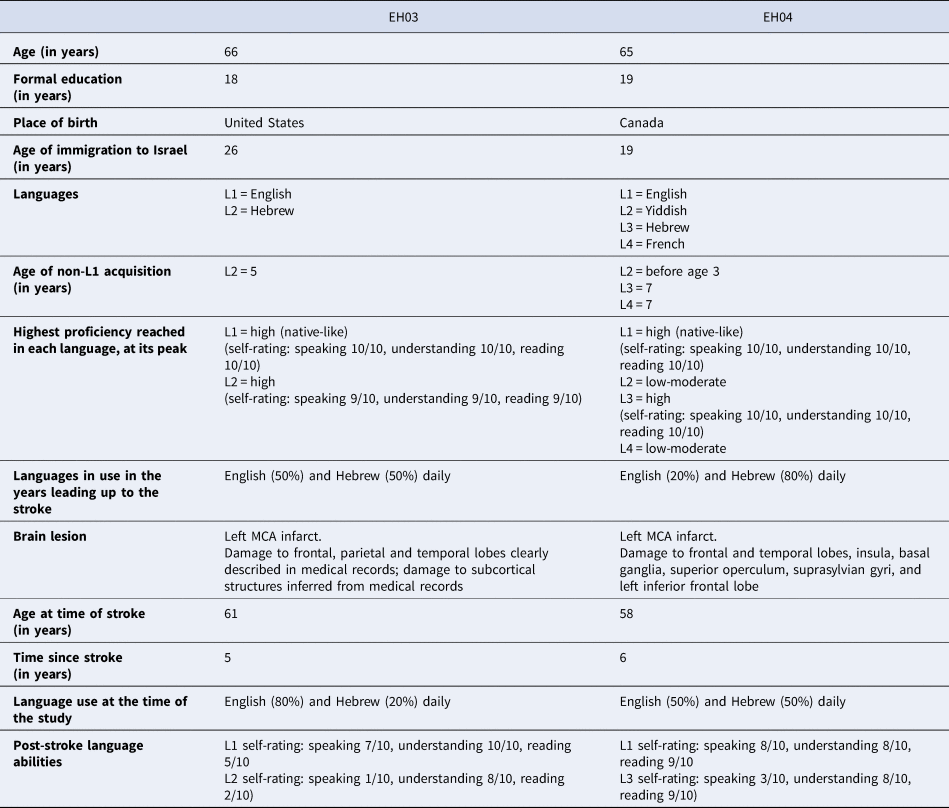
Two male participants (EH03 and EH04) were recruited for this study, as part of a wider study on multilingualism and aphasia. They were both right-handed, and with no neurological diagnoses other than a single left middle cerebral artery (MCA) infarct, which occurred 5–6 years prior to taking part in the study. They both acquired English as their native language (L1) while living and going to school in North America, and acquired Modern Hebrew from elementary school age, including literacy skills – becoming fluent in Hebrew in all modalities after moving to Israel as young adults (age 19 and 26 years). See Table 1 for demographic information, language background and stroke history for the two participants.
Demographic information, language background and stroke history.

Note. L1 = first-acquired language; L2 = second acquired language; L3 = third acquired language; L4 = fourth acquired language; MCA = Middle Cerebral Artery.
Language background information was collected with a modified version of the Language Experience and Proficiency Questionnaire (LEAP-Q; Marian, Blumenfeld & Kaushanskaya, Reference Marian, Blumenfeld and Kaushanskaya2007). EH03 reported that English remained his dominant, most proficient language across the lifespan in all language domains. He had also been highly proficient in Hebrew from age 26 up until the stroke – i.e., for 35 years. He reported using mostly English at home pre-stroke and both English and Hebrew at work, while Hebrew was the language of the everyday environment. His left MCA infarct resulted in an original diagnosis of non-fluent aphasia, agrammatism, and moderate apraxia of speech, together with right hemiparesis. EH03 reported that his post-stroke English abilities were less impaired than his Hebrew abilities in all language modalities. Thus, EH03 was defined as having a differential impairment, with a bigger difference between languages post-stroke as compared to pre-stroke.
EH04 reported that he acquired both English and Yiddish from birth, but that he had rarely used Yiddish since childhood, with English being his dominant, most proficient language across the lifespan in all language domains. He acquired both French and Hebrew in school to a moderate proficiency, but after moving to Israel at age 19, his French fell into disuse while his Hebrew proficiency increased in all language domains, reaching high proficiency and remaining so up until the stroke – i.e., also for 35 years. He used English as his main home language pre-stroke, and Hebrew as the main language at work as well as in his environment. His left MCA infarct resulted in an original diagnosis of non-fluent aphasia, with mild-moderate apraxia, together with right hemiparesis. EH04 reported that his post-stroke English abilities were less impaired than his Hebrew abilities for production but not for comprehension, and that since the stroke he sometimes mixed languages unintentionally when speaking. Thus, EH04 was also defined as having a differential impairment, with a bigger difference between speaking abilities in each language post-stroke as compared to pre-stroke.
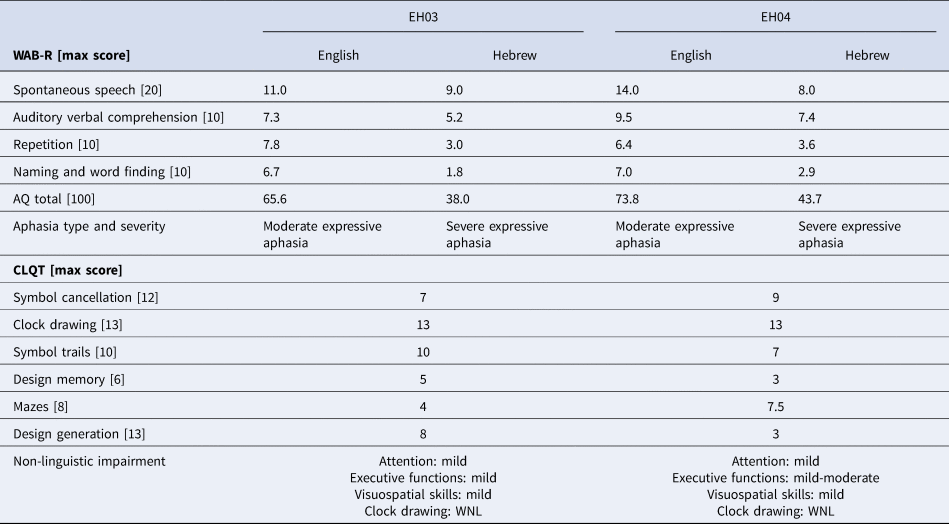
Based on the Aphasia Quotients (AQ) of the Western Aphasia Battery Revised (WAB-R) in English (Kertesz, Reference Kertesz2006), and an adapted version of the WAB-R to Hebrew, both EH03 and EH04 were diagnosed with moderate expressive aphasia in English and severe expressive aphasia in Hebrew at baseline for our study. Furthermore, based on the non-linguistic subtests of the Cognitive Linguistic Quick Test (CLQT – Helm-Estabrooks, Reference Helm-Estabrooks2001), both participants were found to have a mild or mild-moderate impairment for their age for each type of cognitive function measured (attention, executive functions, visuospatial skills) except clock drawing, for which they were within normal limits, and these non-linguistic cognitive functions remained stable across the study. See Table 2 for the baseline WAB-R and CLQT scores.
Baseline scores for the Western Aphasia Battery Revised in English and Hebrew, and the Cognitive Linguistic Quick Test non-linguistic subtests.

Note. WAB-R = Western Aphasia Battery-Revised; AQ = Aphasia Quotient; CLQT = Cognitive Linguistic Quick Test; WNL = within normal limits.
Procedure: treatment
Verb Network Strengthening Treatment (VNeST) was provided in English and Hebrew, in consecutive treatment blocks (with the order counterbalanced across participants). We followed a modified version of Edmonds' (Reference Edmonds2014) treatment protocol for VNeST, adding a written component to the original protocol to further boost the potential for strengthening the semantic verb network by using all four modalities of language (speaking, understanding, reading, and writing). Each time a verb was presented to the participant during a treatment session, the same set of steps was followed; we labelled this set of steps as one verb cycle. These steps were as follows. First, the participant was asked to read aloud a VERB, written on an index card, and write it down (independently, or if he could not then by copying). The participant then produced four SVO sentences (the basic sentence structure in both English and Hebrew) together with the Speech and Language Therapist (SLT) using the VERB and the words ‘who’ and ‘what’ written on index cards (i.e., who VERBs what?). A cueing hierarchy was used to allow the SLT to help the participant produce relevant subjects and objects when necessary; when independent retrieval of a lexical item assigned to a thematic role was challenging, a minimal cue was offered, involving a semantic or contextual cue – for example, an occupational cue (“Can you think of someone who POURS something as part of their job?”), or a familial cue (“Can you think of someone in the family who WASHES something?”) etc. If retrieval was still challenging, a maximal cue was offered, with one correct option and three foils written down, and the participant was asked to choose the most appropriate option. The SLT wrote down the participant's responses on index cards and asked the participant to copy each sentence. When he had produced and written four sentences, the participant was asked to read the sentences aloud. If he was unable to do so independently, he was asked to repeat each sentence one word at a time.
Following this, one SVO sentence was chosen by the participant to be expanded to include where, when and why. The expanded sentence was facilitated by the SLT asking relevant WH-questions related to the sentence and providing the words ‘where’, ‘when’, and ‘why’ written on index cards. For example, for the sentence “The chef WEIGHS flour” the SLT might ask “Where does the chef weigh flour?”, “When does the chef weigh flour?”, and “Why does the chef weigh flour?”. The SLT wrote down the participant's responses on index cards and then asked the participant to read the entire expanded sentence aloud. Again, if he was unable to do so independently, he was asked to repeat the sentence one word at a time. Then, the participant was asked to make semantic plausibility judgements about sentences that included the VERB and that were presented auditorily by the SLT, with sentences either semantically feasible, or having either an unrelated agent, an unrelated patient, or where the agent and patient were reversed. Finally, the participant was asked to independently retrieve the VERB, write it down, and produce up to four relevant SVO sentences without help from the SLT.
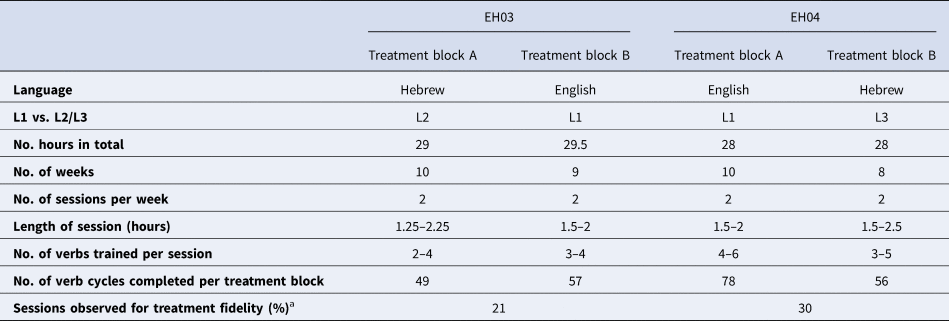
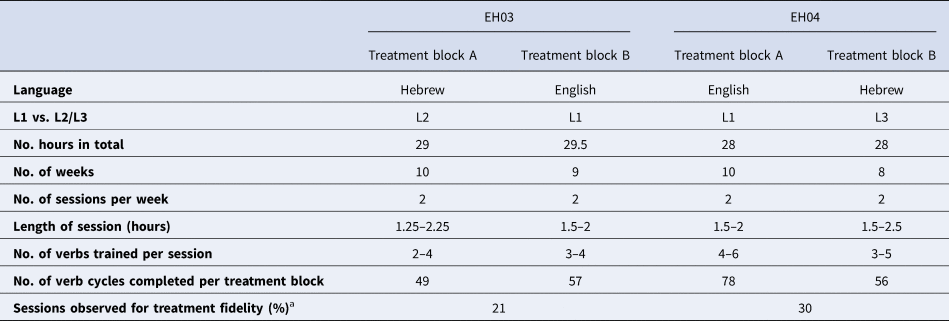
A list of 20 different verbs was compiled for training with the VNeST protocol. No cognates were included, and the verbs shared argument structure across languages. For verbs with more than one direct translation equivalent, only one translation equivalent was used throughout the study. Ten verbs overlapped with verbs in the sentence construction subtest of the Revised English-Hebrew Aphasia Battery (the REHAB, see below), and 10 verbs did not overlap with any specific single-word or sentence level stimuli in the REHAB. These 20 verbs were trained in a pseudo-random order throughout both treatment blocks. In the second treatment block, three new verbs replaced three verbs from the original list that were observed to be relatively easy for each participant to produce within sentences. In each treatment session, several verb cycles were completed (see Table 3). Throughout each treatment block, once all 20 verbs had been trained, the list was reshuffled into a new pseudo-random order, and the same 20 verbs were trained again. This continued until the end of the treatment block, resulting in each verb being trained 3–4 times overall, per participant, per language. See Supplementary Table S1 (Supplementary Materials) for the list of verbs that were trained across the treatment blocks.
Summary of treatment blocks for each participant.
Note. SLT = speech-language therapist; L1 = first-acquired language, L2 = second acquired language, L3 = third acquired language.
a Sessions were either video recorded or observed in real time by a second SLT.
Treatment was provided by qualified SLTs who were highly proficient in both English and Hebrew and had been trained on the VNeST protocol. Treatment was provided in the participants’ homes, in a quiet environment, and treatment fidelity was calculated at over 95% for all sessions, based on the protocol steps described above. See Table 3 for a detailed summary of each treatment block for each participant.
Procedure: assessment
Improvement during the treatment blocks
In order to assess whether learning occurred during the treatment blocks, and thus whether any treatment effects (within- or cross-language) could be attributed to the treatment, we capitalised on the highly structured nature of the steps involved in VNeST. We charted and plotted retrieval abilities throughout each treatment block for every practiced verb and found that, overall, improved verb argument retrieval occurred following VNeST. Thus, we accepted that changes between the pre- and post-treatment assessments could be attributed to successful treatment. The procedures we used to assess improvement during the treatment sessions and the results of our calculations can be found in Supplementary Appendix S1, Supplementary Appendix S2, Supplementary Table S2, and Supplementary Figures S1, S2, S3 and S4 (Supplementary Materials).
Pre- and post-treatment assessment
The outcome variables described in this section allowed measuring within- and cross-language generalisation in language tasks assessed before and after each treatment block. Assessment was conducted using the REHAB, a comprehensive Aphasia Battery for Hebrew–English speakers (Lerman & Goral, Reference Lerman and Goraln.d.), which was developed to include subtests of production and comprehension, at the word, sentence, and discourse levels. The REHAB is comparable across English and Hebrew for several important psycholinguistic factors, such as frequency, cognates vs. non-cognates, number of translation equivalents, etc. The tasks in the REHAB relevant for this study include four production tasks and two comprehension tasks. The production tasks are picture-based action naming, picture-based object naming, picture-based sentence construction, and discourse. Discourse was elicited from pictures (picture descriptions and story sequences) and from verbal instruction (personal narratives and procedural narratives). The comprehension tasks are auditory comprehension of nouns and verbs. See Supplementary Table S3 (Supplementary Materials) for a detailed description of the REHAB subtests.
Participants were assessed in both languages at baseline, after the first treatment block and after the second treatment block. The REHAB in each language was split into three comparable thirds. At each time-point, assessment was conducted over 4–5 testing days, with one third of the REHAB administered each day in either English, Hebrew, or both. When both languages were assessed on the same day, long breaks between sessions were provided to preserve language mode of each session and, overall, the order of testing was counterbalanced across languages for each participant.
Assessment was conducted in the participants’ homes by qualified SLTs trained to administer the REHAB. Each language was assessed by a different SLT who was proficient in the language they were testing, and at least moderately proficient in the other language. All sessions were video recorded, and the transcriptions of all sessions were completed with accuracy confirmed on 25% of the data by a second transcriber. Accuracy of transcriptions was high, > 99% accuracy, across all tasks and all languages. It should be noted that for SLTs who both assessed and provided treatment for either participant, the language of assessment matched the language of treatment, to preserve language mode and minimise potential language mixing.
Due to the long assessment process at each time-point, and the potential fatigue and frustration of the participants during the long assessment sessions, no washout period between treatment blocks occurred. (A washout period would have resulted in the need to administer the entire assessment procedure again before the second treatment block). Therefore, for data about language change following the first treatment block, baseline measures were compared to post-treatment measures, and for data about language change following the second treatment block, post-treatment measures after the first treatment block were compared to post-treatment measures after the second treatment block.
Scoring was conducted blind relative to testing time by two raters. We measured accuracy of retrieval in the action naming and object naming tasks, and accuracy of relevant SVO sentence production in the sentence construction task. For discourse, we calculated the number of relevant SVO sentences (Complete Utterances = CUs – as per Edmonds et al., Reference Edmonds, Nadeau and Kiran2009). For the auditory comprehension tasks, we measured accuracy of responses. Inter-rater reliability was calculated using Krippendorff's Alpha coefficients (Hayes & Krippendorff, Reference Hayes and Krippendorff2007), and for both participants, Krippendorff's Alpha coefficient was high (EH03 α = .91, EH04 > .99).
Statistical analyses
For within- and cross-language generalisation, two different statistical measures were calculated. For action naming, object naming, sentence construction, and comprehension tasks (all tasks that allow for individual stimuli to be compared post-treatment relative to pre-treatment), the McNemar test of equal change was calculated for each treatment block. We used the Benjamini-Hochberg approach to multiple comparisons when necessary, because it controls the family-wise error rate without being overly conservative (Benjamini & Hochberg, Reference Benjamini and Hochberg1995).
In order to capture small but meaningful changes across all language tasks, we also used a measure of effect sizes called Non-overlap of All Pairs (NAP) which calculates data overlap between pre- and post-treatment phases in within-subject research designs even with a small number of observations (in this study, three pre- and three post-treatment – Conner, Goral, Anema, Borodkin, Haendler, Knoph, Mustelier, Paluska, Melnikova & Moeyaert, Reference Conner, Goral, Anema, Borodkin, Haendler, Knoph, Mustelier, Paluska, Melnikova and Moeyaert2018; Parker & Vannest, Reference Parker and Vannest2009) and is considered to be a reliable effect size method which is sensitive to small changes (Cavanaugh, Terhorst, Swiderski, Hula & Evans, Reference Cavanaugh, Terhorst, Swiderski, Hula and Evans2020). A NAP score of between −1.0 to 1.0 is obtained, with a positive NAP score indicating that post-treatment scores were better than pre-treatment scores, and a negative NAP score indicating that post-treatment scores were worse than pre-treatment scores. We used Conner et al.'s (Reference Conner, Goral, Anema, Borodkin, Haendler, Knoph, Mustelier, Paluska, Melnikova and Moeyaert2018) strict criterion of a moderate effect (medium NAP score: +/− .58-.84) indicating partial overlap, and a strong effect (high NAP score: +/− .85-1.0) indicating little or no overlap.
Results
Within-language generalisation
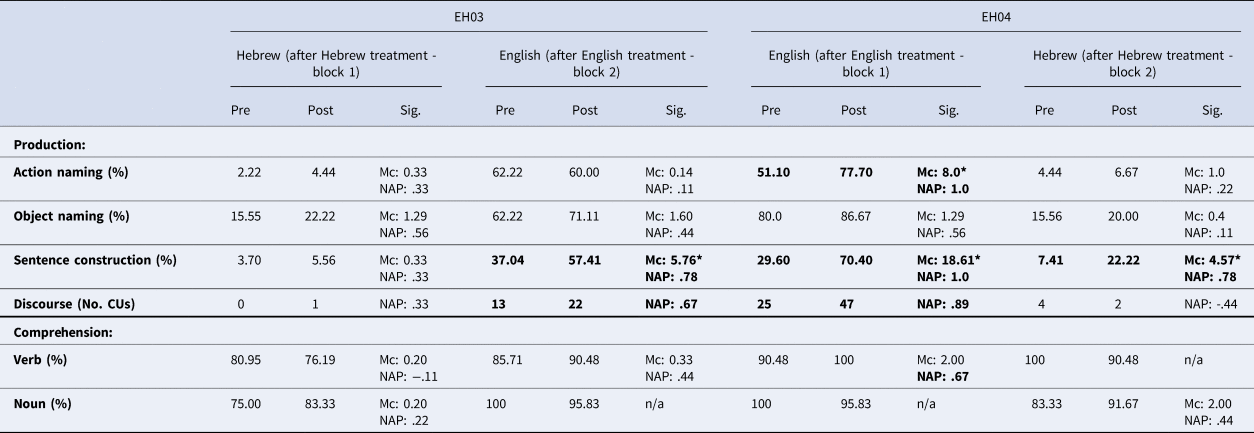
See Table 4 for the within-language generalisation measures for production and comprehension of both participants in English and Hebrew. For both EH03 and EH04, the most widespread and significant generalisation of treatment effects occurred in their L1 English (which was also their post-stroke less-impaired language). Improvements in English were observed for EH03 in accurate SVO production in the sentence construction task, and CU production in the discourse task, with an increase in the percentage of CUs out of all utterances from 15–21% pre- to post-treatment. Improvements in English were observed for EH04 in the action naming task, accurate SVO production in the sentence construction task, and CU production in the discourse task, with an increase in the percentage of CUs out of all utterances from 27–44% pre- to post-treatment.
Within-language generalisation for EH03 and EH04 after each language block, across different tasks.
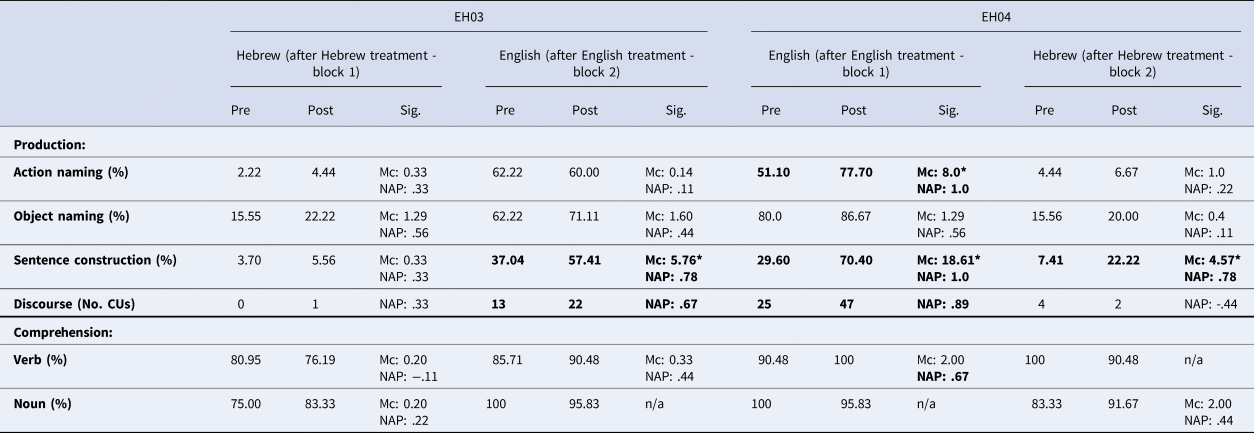
Note. Pre = pre-treatment score; post = post-treatment score; Sig. = significance; Mc = McNemar; NAP = Non-Overlap of All Pairs (.58 = medium NAP score). CUs = Complete Utterances. * indicates statistical significance at the .05 level. Bold indicates either statistical significance (McNemar) or a score of 0.58 or above (NAP).
For the comprehension tasks in English, a number of measures were at ceiling (with a score of 100% pre-treatment), and thus statistical analysis was not conducted. Looking at those measures where pre-treatment scores were not at ceiling, we observed improvement for verb comprehension for EH04 only.
Conversely, for both EH03 and EH04 in their later-acquired Hebrew (L2/L3), less widespread improvements were observed after treatment. For EH03, a general positive trend was observed for all production tasks and for noun comprehension, but no measures changed significantly. For EH04, a general positive trend was observed for single-word and sentence-level production tasks, and noun comprehension, but significant improvement was observed only for accurate SVO production in the sentence construction task.
Cross-language generalisation
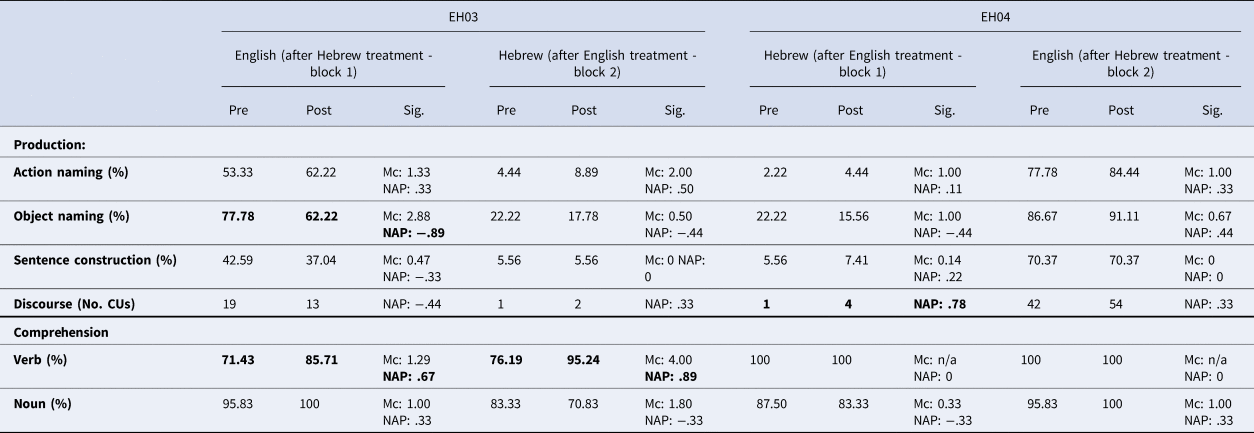
See Table 5 for the cross-language generalisation measures for production and comprehension of both participants in both languages. For both EH03 and EH04, cross-language generalisation was not significant for any measure calculated with the McNemar, after correcting for multiple comparisons. However, a number of medium and high NAP scores indicated some change. For EH03, language abilities in his later-acquired Hebrew after treatment in L1 English indicated improvement to verb comprehension. Similarly, for EH04, language abilities in his later-acquired Hebrew after treatment in L1 English indicated improvement to CU production in discourse (the raw scores of which, although low, were communicatively meaningful and all occurred during discourse elicited from picture descriptions) with an increase in the percentage of CUs out of all utterances from 3–7% pre- to post-treatment. For EH04, no comprehension tasks indicated change; verb comprehension was at ceiling level both pre- and post-treatment.
Cross-language generalisation for EH03 and EH04 after each language block, across different tasks.
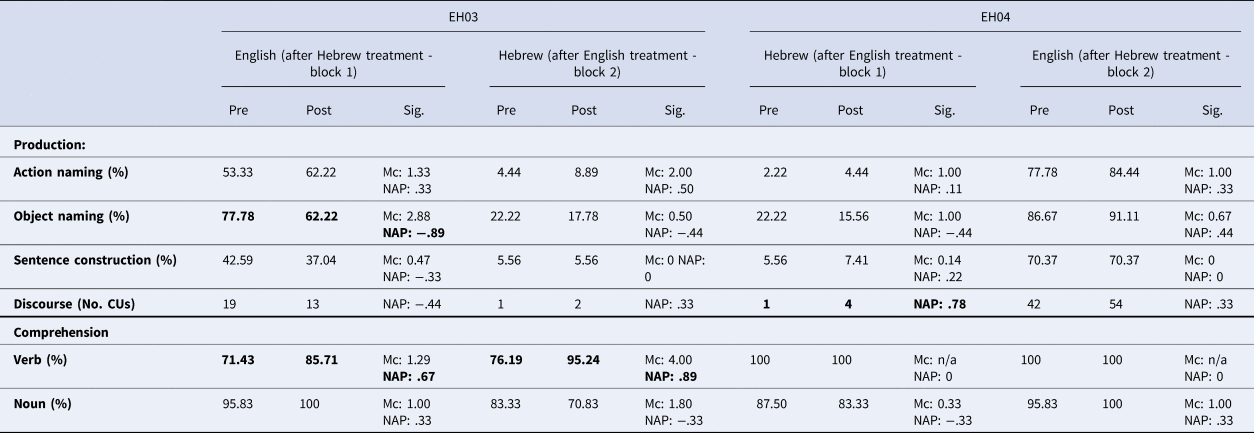
Note. Pre = pre-treatment score; post = post-treatment score; Sig. = significance; Mc = McNemar; NAP = Non-Overlap of All Pairs (.58 = medium NAP score). CUs = Complete Utterances. * indicates statistical significance at the .05 level. Bold indicates either statistical significance (McNemar) or a score of 0.58 or above (NAP).
For EH03, language abilities in his L1 English after treatment in his later-acquired Hebrew indicated an increase in verb comprehension with a decrease in object naming. For EH04, language abilities in his L1 English after treatment in his later-acquired Hebrew indicated no significant change in production or comprehension tasks.
Discussion
In this study we asked whether within- and cross-language generalisation occur after Verb Network Strengthening Treatment (VNeST) in each language of two pre-morbidly highly proficient multilingual participants with aphasia, whose language impairments post-stroke were differential (L1 English was better-spared than their later-acquired Hebrew). To answer our research questions, we examined treatment generalisation and found robust within-language generalisation and limited cross-language generalisation, as discussed below.
Within-language generalisation
We asked whether patterns of within-language generalisation of lexical retrieval in sentences and single-words and lexical comprehension of single-words were comparable across two languages in our highly proficient, but differentially impaired, multilingual participants with aphasia after receiving VNeST. We hypothesised that VNeST would result in stronger within-language generalisation for the lexicon with stronger connections to the substrate for conceptual representations – L1 English in our participants. Regularities in the semantic system, early age of acquisition, and long duration of language use all support this prediction (Nadeau, Reference Nadeau2019). Our results are comparable to those of previous studies with monolingual and multilingual participants with moderate-severe aphasia who received VNeST and supported our hypothesis: we found within-language generalisation for both languages and stronger within-language generalisation in L1 English for both participants than in their later-acquired Hebrew.
As expected, each participant showed improvement in some language tasks, either for production of words, sentences and/or discourse (e.g., Edmonds, Reference Edmonds2016; Edmonds et al., Reference Edmonds, Nadeau and Kiran2009; Edmonds, Obermeyer & Kernan, Reference Edmonds, Obermeyer and Kernan2015), for comprehension of words (e.g., Lerman et al., Reference Lerman, Goral, Edmonds and Obler2020), or for both production and comprehension. The differential improvements observed across tasks may be associated with relative pre-treatment language profiles, as suggested by Edmonds and colleagues (Reference Edmonds, Obermeyer and Kernan2015) who hypothesised that such inter-task differences could be related to processes such as sentence construction ability, as well as self-monitoring, pronoun production and heavy vs. light verb usage. For example, EH03 showed greater within-language improvement in sentences (sentence-level and discourse) than in single-word naming in English, which could be an indication of his reliance on sentence structure to help produce relevant words. Alternatively, the differential improvements may result from the extent to which comprehension and production abilities were engaged during treatment, relative to the degree of impairment of those abilities. For example, compare the two participants’ English within-language generalisation of lexical retrieval during single-word, sentence, and discourse tasks, and/or lexical comprehension of single-words, to Hebrew within-language generalisation, where only EH04 showed significant improvement and only for SVO sentence production in the sentence-level task. Furthermore, we note that this improvement in Hebrew occurred after the second treatment block, and therefore we are hesitant to interpret the improvement in sentence production in Hebrew as within-language generalisation only. It is possible that it reflects a cumulative effect from the first treatment block (i.e., the treatment in his less-impaired L1 English).
The within-language generalisation patterns observed in this study are consistent with the hypothesis that the connectivity of association cortices that subserve conceptual representations is strengthened through VNeST, because the process of building sentences via verbs, their argument structure and appropriate thematic roles is performed extensively and repetitively (Fox & Stryker, Reference Fox and Stryker2017). The lexicon with stronger connections to the substrate for those conceptual representations (in this case, English) is bolstered by this strengthened semantic knowledge more than other lexicons (in this case, Hebrew) are. These results are also consistent with Ribot's law (Ribot, Reference Ribot1882) and more recent findings that the first-acquired language of bilingual individuals is often better-spared and shows better recovery than their later-acquired language(s) (e.g., Kuzmina, Goral, Norvik & Weekes, Reference Kuzmina, Goral, Norvik and Weekes2019). Furthermore, there is evidence from both participants (EH03 in English, EH04 in Hebrew) that the structure provided by sentences in sentence and/or discourse level tasks aided retrieval relative to single-word naming, a result that supports previous research (e.g., Edwards, Tucker & McCann, Reference Edwards, Tucker and McCann2004; Schneider & Thompson, Reference Schneider and Thompson2003; Webster, Morris & Franklin, Reference Webster, Morris and Franklin2005; Whitworth, Webster & Howard, Reference Whitworth, Webster and Howard2015). Moreover, it adds further support to the use of VNeST as a viable treatment option for people with aphasia generally, and multilingual people with aphasia specifically.
Regarding the comparison between production and comprehension, we hypothesised that VNeST would positively affect both types of language tasks (Ferretti et al., Reference Ferretti, McRae and Hatherell2001; Lerman et al., Reference Lerman, Goral, Edmonds and Obler2020). While comprehension is essentially easier than production because it requires less precision; for example, a close semantic error is often enough to comprehend but would be considered an error for production, we observed more within-language generalisation in production tasks than in comprehension tasks for English. We suggest that this reflects the type of aphasia that our participants demonstrated, with better-spared comprehension skills than production skills in both languages. When we compared accuracy scores across pairs of tasks (object naming with noun comprehension, action naming with verb comprehension), at any given testing-point, for both participants and in both languages, all comparisons showed higher comprehension skills than production skills. Thus, we hypothesise that if connectivity within association cortices subserving semantic knowledge is indeed strengthened, production skills may be positively affected prior to comprehension skills when comprehension skills are better spared after a stroke.
In summary, the answer to our first research question is that within-language generalisation was observed following VNeST, but, as predicted by the RHM and spreading activation accounts (e.g., Kiran et al., Reference Kiran, Sandberg, Gray, Ascenso and Kester2013; Kroll et al., Reference Kroll, Van Hell, Tokowicz and Green2010) as well as by Ribot's law (Reference Ribot1882) and recent findings (e.g., Faroqi-Shah et al., Reference Faroqi-Shah, Frymark, Mullen and Wang2010; Kuzmina et al., Reference Kuzmina, Goral, Norvik and Weekes2019), improvements were observed primarily in the participants’ post-stroke less-impaired, first-acquired language.
Cross-language generalisation
Our second research question asked whether patterns of cross-language generalisation of lexical retrieval in sentences and single-words and lexical comprehension of single-words were comparable across languages in our highly proficient (but differentially impaired) multilingual participants with aphasia after receiving VNeST. We hypothesised that cross-language generalisation would likely only occur in one direction: into Hebrew after treatment in English. We did not expect to observe cross-language generalisation into English after treatment in Hebrew, potentially due to any lingering suppression of interference from the less-impaired, first-acquired language (English) that would be necessary for Hebrew treatment to be effective (e.g., Goral, Reference Goral, Gitterman, Goral and Obler2012; Goral et al., Reference Goral, Naghibolhosseini and Conner2013; Kiran et al., Reference Kiran, Sandberg, Gray, Ascenso and Kester2013).
The minimal cross-language generalisation observed only partially supports our hypothesis re directionality. While some significant cross-language effects were observed in the direction that we anticipated (into Hebrew, after treatment in English), we note that for EH03, the improvement in Hebrew comprehension after treatment in English could be either a cumulative effect from the first treatment block or a carryover effect from the first treatment block. Furthermore, for the opposite direction (into English, after treatment in Hebrew), no significant cross-language generalisation was observed for production, as predicted, but verb comprehension in EH03 unexpectedly improved.
While we are cautious in interpreting these minimal findings, we note a number of interesting patterns, relative to previous literature, that warrant further investigation. We observed that for both participants, generalisation occurred after a treatment block in the post-stroke less-impaired language (English) across the different tasks, regardless of whether this was the first or second treatment block. Thus, our results support models of multilingual language representation that posit proficiency-related strengths of connectivity between each lexicon and the shared conceptual representations, such as the RHM (Kroll et al., Reference Kroll, Van Hell, Tokowicz and Green2010), that can be extended to semantic networks of verbs (Hartsuiker & Bernolet, Reference Hartsuiker and Bernolet2017; Pickering & Branigan, Reference Pickering and Branigan1998; Salamoura & Williams, Reference Salamoura and Williams2007). These results are supported by Li et al. (Reference Li, Li and Kiran2020) who also found within- and cross-language generalisation after treatment in L1, although they did not provide treatment in L2 for comparison.
Additionally, the greater improvement in the less-impaired language is also consistent with the Competing Mechanisms Theory, according to which patterns of within- and cross-language generalisation will be determined by the relative strengths of the spreading activation mechanism and the interference control mechanism, depending on relative post-stroke abilities of each language (e.g., Goral & Lerman, Reference Goral and Lerman2020; Green, Reference Green1998; Kiran et al., Reference Kiran, Sandberg, Gray, Ascenso and Kester2013). In their landmark paper on within- and cross-language generalisation patterns, Kiran and colleagues (Reference Kiran, Sandberg, Gray, Ascenso and Kester2013) suggest that within-language generalisation that occurs without cross-language generalisation is more likely in participants whose post-stroke language impairment is differential rather than parallel. Comparing our results to those in their paper (considering only production skills as they did), we note that the relative patterns of within- and cross-language generalisation in our participants with a post-stroke differential language impairment are similar to their results, even though our research focused on the semantic verb network rather than the semantic noun network. Thus, our results further support models that indicate a key role for the relative degree of post-stroke language impairment interacting in potential treatment generalisation across different semantic networks (e.g., Kiran et al., Reference Kiran, Sandberg, Gray, Ascenso and Kester2013; Lerman et al., Reference Lerman, Goral, Edmonds and Obler2020).
We found, for EH03 in Hebrew (after treatment in English), cross-language generalisation occurred for verb comprehension but not for production tasks. This finding supports the hypothesis that potential deficits in interference control occur at the lexical level rather than the semantic level of language processing, and are thus more salient during production tasks than comprehension tasks (e.g., Biegler, Crowther & Martin, Reference Biegler, Crowther and Martin2008). Thus, these results are also in line with the Competing Mechanisms Theory (Kiran et al., Reference Kiran, Sandberg, Gray, Ascenso and Kester2013). However, we note that comprehension tasks may have been easier for EH03 compared with production tasks because a close semantic error could still result in an acceptable response for comprehension but not for production.
Based on the Competing Mechanisms Theory (Kiran et al., Reference Kiran, Sandberg, Gray, Ascenso and Kester2013), we would expect less cross-language interference from lexical items when the stimulus allows for a range of acceptable answers, such as describing a picture scene, rather than when there is only one correct answer, such as confrontation naming, where direct interference is expected to be stronger (Goral et al., Reference Goral, Rosas, Conner, Maul and Obler2012). We observed this pattern to some extent for EH04 in Hebrew (after treatment in English), where cross-language generalisation occurred for discourse but not for any of the picture naming tasks, thus further supporting the Competing Mechanisms Theory (Kiran et al., Reference Kiran, Sandberg, Gray, Ascenso and Kester2013).
Finally, we also found potential support for the lingering suppression theory (Goral et al., Reference Goral, Naghibolhosseini and Conner2013) which posits that more cross-language interference would occur after treatment in a highly proficient, post-stroke less-impaired L1 (English in the case of these participants) than in a more-impaired, later-acquired language (Hebrew). Although our cross-language generalisation results were not strong, and should be interpreted with caution, we note that no cross-language generalisation in English after treatment in Hebrew was observed for EH04, and for EH03 such generalisation occurred in only one comprehension task alongside a significant decline in object naming. These results support the interpretation that strong interference from English needed to be suppressed during treatment in Hebrew and that this mechanism lingered after treatment ended. We cautiously suggest that the minimal cross-language generalisation observed in our participants with post-stroke differential language impairment, and particularly for the significant decline in object naming in English after treatment in Hebrew observed in EH03, may be the result of damage to the language control network (Abutalebi & Green, Reference Abutalebi and Green2007; Wong et al., Reference Wong, Yin and O'Brien2016). Compare our results to a previous report by Kiran and Roberts (Reference Kiran and Roberts2010), whose pre-stroke highly proficient bilingual participant had no documented damage in the language control network and exhibited bidirectional cross-language generalisation. The relationship between the language control network and the potential suppression of interference of one language over another is an important topic for future research in this field.
In summary, the answer to our second research question is that minimal cross-language generalisation was observed following VNeST. Within the boundaries of these limited effects, we observed that cross-language generalisation occurred more in Hebrew (the later-acquired language) after treatment in English (the L1) than vice versa, as predicted by the RHM and spreading activation accounts (e.g., Kiran et al., Reference Kiran, Sandberg, Gray, Ascenso and Kester2013; Kroll et al., Reference Kroll, Van Hell, Tokowicz and Green2010) as well as by the theory of lingering suppression (Goral et al., Reference Goral, Naghibolhosseini and Conner2013). Thus, our results tentatively support our hypothesis, but this issue warrants further investigation in future studies.
Limitations and future research
While our study contributes valuable experimental data from the field of aphasia to support the theoretical discussion relating to language representation and processing in multilingual people, there are a number of limitations to our study that we wish to address. First, our results come from only two participants. More studies on participants with varying language backgrounds (age of acquisition, pre-stroke proficiency levels – balanced or differential, post-stroke language impairment patterns – L1 more or less impaired than L2, etc.) who, crucially, receive treatment in each of their languages are necessary to better understand the mechanisms underlying observed within- and cross-language generalisation.
Second, our conclusions regarding cross-language generalisation should be interpreted with caution, as they are based on relatively limited effects. This is, however, typical of studies that examine cross-language generalisation (e.g., Kiran et al., Reference Kiran, Sandberg, Gray, Ascenso and Kester2013; Lerman et al., Reference Lerman, Edmonds and Goral2018) as well as typical of studies that examine treatment effects after VNeST, where effects are not expected and have not been observed in all language tasks and at all levels (single words, sentences and/or discourse) for any participant (e.g., Edmonds et al., Reference Edmonds, Obermeyer and Kernan2015). Also, we are cautious to interpret data from the second treatment block of each participant as only reflecting generalisation of treatment effects of the language treated in that second treatment block. Indeed, our results from both within- and cross-language generalisation indicate that providing almost 30 hours of VNeST may not be sufficient to strengthen semantic knowledge enough to improve retrieval in the post-stroke more-impaired language (i.e., the lexicon with weaker connectivity to shared semantic knowledge – e.g., Kroll et al., Reference Kroll, Van Hell, Tokowicz and Green2010). Thus, the improvements to Hebrew that we observed (in the sentence construction task for EH04 after treatment in Hebrew, and in the verb comprehension tasks for EH03 after treatment in English) may be the result of a cumulative effect of VNeST effects in both languages, that strengthened semantic verb knowledge enough to improve Hebrew skills. We also acknowledge that the absence of a wash-out period between the two treatment blocks makes the interpretation of the results of the second treatment block more difficult. We note however, that if aphasia treatment is successful, one would not expect that the treatment effects would diminish after a short period of time; rather, the hope is that a subsequent treatment will build on a previous one. So, while the fact that we did not employ a wash-out period is potentially problematic, had we had a short wash-out period we would still need to consider cumulative effects of therapy.
Third, Kiran et al.'s (Reference Kiran, Sandberg, Gray, Ascenso and Kester2013) Competing Mechanisms Theory refers to spreading activation between semantically-related items. Our assessment battery did not specifically look at semantically-related nouns and verbs relative to the verbs used during VNeST. It is possible that had we done so, more within- and cross-language generalisation would have been observed for those items than for those tested in this current study. While our assessment battery and VNeST verb list were developed with Hebrew–English bilingual considerations at the forefront, as well as comparison of similar stimuli across tasks within the assessment battery, in the future researchers in this field may want to consider the semantic relationship of verbs across assessment and treatment, in addition to considering the bilingual aspect of stimuli.
Fourth, although the theories underlying within- and cross-language generalisation hinge on spreading activation and interference control, neither of these mechanisms were directly tested in our study. Future research should consider how to test these mechanisms (both behaviourally and neurally) in multilingual participants with aphasia who are engaged in treatment studies looking at within- and cross-language generalisation patterns.
Finally, our research is limited to one type of treatment – VNeST – within the context of lexical production and comprehension skills. Thus, our results are limited to the current treatment approach. Future research is needed regarding treatment effects of varying treatment approaches and their generalisation within and across languages in multilingual people with aphasia.
Conclusion
Most treatment studies of multilingual people with aphasia provide treatment in one language only and look at patterns of within- and cross-language generalisation in one direction only. While comparing generalisation patterns across participants provides a partial understanding of potential theories underlying language representation in multilingual people, variability across participants regarding language background and/or brain lesion makes it challenging to identify the contribution of factors to generalisation patterns. In this study we compared generalisation patterns within participants by investigating these patterns in two participants with similar language backgrounds and brain lesions, who each received two treatment blocks, one in each language.
We found that generalisation was more salient after treatment in the post-stroke less-impaired language – regardless of whether this was the first or second treatment block – than after treatment in the post-stroke more-impaired language. This observation provides further support for the hypothesis that connectivity is greater between the lexicon of an early-acquired more-proficient language and shared semantic knowledge than between the lexicon of a later-acquired, less-proficient language and shared semantic knowledge. Moreover, our results suggest that models of bilingual language representation that advocate for such differential connectivity can be extended from semantic knowledge of nouns to semantic knowledge of verbs. Our findings of within- and cross-language generalisation are also consistent with both the Competing Mechanisms Theory (Kiran et al., Reference Kiran, Sandberg, Gray, Ascenso and Kester2013) and the theory of lingering suppression (Goral et al., Reference Goral, Naghibolhosseini and Conner2013).
Due to the inherent complexity within and across multilingual people with aphasia, more research is needed on participants who present with different profiles of aphasia and with different pre- and post-stroke language profiles. Given the expectation that treatment will not result in improvement to all language skills equally in any participant, it is crucial to continue evaluating diverse multilingual people with aphasia to better understand the complexity of the interaction of the different variables.
Acknowledgements
We thank the participants and their families for their participation in this study. We also thank our three Israel-based research assistants – Reut Cohen, Inbal Maciano and Einat Galezer – for their help with assessment, treatment, and analysis of the data, and Dafna Olenik for her help with participant recruitment. Additionally, we thank Taryn Malcolm and three anonymous reviewers for their careful reading of two earlier drafts of this paper and their comments and suggestions on how to improve them.
Supplementary Material
For supplementary material accompanying this paper, visit https://doi.org/10.1017/S1366728921001036
Supplementary Table S1 provides a list of verbs trained during the treatment blocks, in each language.
Supplementary Appendix S1, Appendix S2, Table S2, Figures S1, S2, S3 and S4 provide a description of our methods and results for calculating whether learning occurred during each treatment block for both participants.
Supplementary Table S3 provides a detailed summary of the Aphasia Battery subtests used in this study.