


Introduction
In his short story, The Anarchist Banker, Ferdinand Pessoa playfully described the logic that drives a self-professed anarchist to amass an enormous fortune.Footnote 1 Seeking an escape from the controlling influence of money and all other ‘social fictions’, and the rank inequality it creates, the Banker meticulously explains and justifies the steps he takes to self-enrichment, stretching concepts of self-interest and rational calculation to their extreme.
Anarchism, the Banker argues, is the only ideal of rebellion sufficient to strip society of its ‘fictions’ or at the very least to better balance the minimal ‘social fictions’ necessary to keeping society just and true. The social fiction most conducive to sustaining the natural order of things is the one most committed to destroying ‘social fictions’, and that is anarchism. But anarchism drives the Banker to question why self-sacrifice and duty should lead to revolution? Surely, these so-called virtues are also social fictions? In which case, he reasons, struggling for the realisation of personal enrichment, with the aim of being ready for the social revolution when it comes, is perfectly reasonable. Likewise, the ‘tyranny of helpfulness’, or mutual aid, incapacitates others, stripping them of their autonomy in the long run. The only way to avoid tyranny is to pursue independence, to equalise your material status with others, notwithstanding the natural inequalities of birth. It was only because he was not the sharpest intellect, and the rest of the anarchist movement had rejected him, the anarchist Banker pointed out, that he was forced to defend this individuality by amassing wealth:
I used whatever means I could – sequestration, financial sophistry, unfair competition. So what? Was I supposed to worry about means when I was combating social fictions which were both immoral and unnatural? I was working for freedom and I had to use what weapons I could to combat tyranny […] I created only freedom. I freed one person. I freed myself. Because my course of action – which, as I proved to you before, was the only true anarchist course of action – did not allow me to free anyone else. The one person I was able to free, I freed.Footnote 2
Gripped by the ‘delirium of reason’, Pessoa’s banker reduces the axioms of anarchism and liberalism to absurdity.Footnote 3 Yet the Banker’s behaviour leaves a deeper mark. The airy betrayal of the anarchist ethic of mutual aid and collective freedom, in the name of liberty, appears to disclose the defectiveness of the anarchist account of behaviour and motivation as the source of social progress. In effect, the Banker universalises the fantasy of ‘libertarian exit’, to borrow Raymond Craib’s phrase,Footnote 4 or what Mark Fisher called ‘capitalist realism’,Footnote 5 and does so because he has internalised the fallacy that no anarchist ‘ought’ can result from a malign ‘is’. So fixed are the social fictions of ‘bourgeois’ society, and so impervious to moral change, that his attempt to challenge them leads him to recreate them as his own.
In this chapter, we find the counter to the Banker’s ruggedly individualist norms in the UK housing and workers’ co-op, Radical Routes (RR). Founded in the 1980s, RR has been de-commodifying property in a socio-economic system characterised by aggressive competition and gross inequality for more than thirty years.
It began making loans to member co-ops in 1991. During the period of our research (2017–20), it had ‘over 300 investors who together hold more than £1 Million of share capital investment’,Footnote 6 and it has made £1.5 Million in loans without incurring loss.Footnote 7 We pinpoint RR’s success in its deployment of what it calls ‘structured mutual aid’ and show how the possibility of this success story relies on its non-reductionist defence of the implicit and explicit virtues of a culture of anarchy.
Radical Routes is constituted to promote what Rocker described as a culture of freedom (anarchy) and to resist the will to power we discussed in Chapter 4. However, Gustav Landauer’s term ‘from separation to community’ best describes the co-op’s ethos of militant detachment. Radical Routes’s member co-ops are mutual aid societies par excellence and serve as bases to prefigure a radical form of co-operativism against capitalism and consumerism. Just as Landauer planned to remove himself from a populace ‘united by the state’ and preserve community for future generations,Footnote 8 RR provides support and advice to those who wish to delink their homes and workplaces from contemporary finance capitalism. Yet whereas his initiative was ‘born of grief’ and a profound sense of isolation, RR’s was born of defiance and a desire to protect gains anarchist communities had made in the late 1980s by providing secure homes and workplaces for activists and fellow travellers, constituted by and through a model of decentralised federation.
Our analysis centres on the constitutional review RR undertook in 2017.Footnote 9 This was prompted by a long-running and fractious dispute about clause 5.1 of RR’s Aims and Principles. The rule required individual members of member co-ops (henceforth MOMS),Footnote 10 to devote fifteen hours a week of work towards ‘radical social change’. The discussion of the rule exposed some deep-rooted tensions in RR. These related to perceptions of the federation’s class, racial and gender cleavages, the perceived dilution of its principles, and the roles and responsibilities of RR, its executive and its members. By opening a debate about the legitimacy of a contentious, historic rule, the federation was compelled to conduct a root and branch review of its constitution. The culture of mutual aid carried them through what could have been a corrosive process and reaffirmed the federation’s commitment to its broadly anarchist principles.
The review led by the ‘5.1group’ did not resolve all the issues the internal debates threw up. Indeed, it revealed the strength of the centripetal forces active within the federation, the problems of constitutionalising mutual aid and the vulnerability of RR to the stratagems of would-be anarchist bankers. But it reaffirmed the centrality of RR’s co-operative culture and demonstrated the feasibility of grassroots constitutionalising. To borrow Pettit and Brennan’s concept: by consciously embracing the homestead and the workplace as manageable sites of revolutionary social transformation, RR shows how ‘ordinary human beings’ are able to ‘incentivise virtuous behaviours’ to sustain desired institutional arrangements.Footnote 11 Indeed, RR shows how the ‘intrinsically repugnant’ market mechanisms G. A. Cohen lamented can be refashioned to promote unselfish co-operation and how socialist experiments may be replicated ‘on a nationwide scale, amid the complexity and variety that comes with nationwide size’.Footnote 12
The chapter has three main parts. We begin by contextualising RR’s history, tracing its development from the era of Reaganomics and Thatcherism to locate RR on the radical fringe of the UK and global co-operative movement (RR: The Historical Context). The history helps explain the unique features of RR’s constitution and the genesis of the system of ‘structured mutual aid’.
The second part (The Constitution of RR) explains how MOMS understood the federation in 2017–18. Using data gathered by the 5.1 group, we discuss the origins and contentiousness of ‘Rule 5.1’, which committed members of RR’s co-ops to complete fifteen hours of socially transformative action every week, and the debates this rule provoked.
In the third part (The Constitutional Review), we recount the wider debates sparked by the proposal to remove the rule, the constitutional dilemma it posed and how the process of reflection was constitutive of RR’s renewal. This investigation gave all concerned a unique perspective on the functioning and limits of the rules, institutions and decision-making processes of the federation, and the extent to which they assisted the ‘structured mutual aid’ built into its constitutional aims and principles in the early 1990s. We conclude with a reflection on the relationship between anarchy and culture, so central to RR’s success, and present it as a model of and for anarchist constitutionalising more broadly.
Radical Routes: The Historical Context of Its Founding Constitutional Ethos
Radical Routes emerged in the 1980s as an outgrowth of an initiative started by Roger Hallam to launch an independent, green ‘new university’ in the Hockley area of inner-city Birmingham.Footnote 13 Eager to find a home for the project, Hallam and others arranged a loan to purchase a co-operatively owned house and then used their acquired knowledge to help launch Common Ground, a group of ‘closely interacting’ housing and worker co-ops.Footnote 14 In 1988, an expanded network took the name Radical Routes.Footnote 15 In 1991, it became a secondary co-op, enabling RR to raise investment through a national scheme.Footnote 16
According to Hallam, RR’s aim was ‘to lend money and give advice to unemployed people wishing to start their own co-ops’.Footnote 17 The investment scheme was designed to alleviate the problems experienced by ‘the homeless or unemployed’, who struggled to secure bank loans ‘because of the social prejudice’.Footnote 18 By taking control of its own finance, Hallam explained, RR cut out ‘the middleman’ and saved ‘about 8 or 10 per cent for the borrowers’.Footnote 19
The timing seemed anything but propitious. Analysts disagree about the ideological complexion of ‘Thatcherism’Footnote 20 and about the extent to which the transformation of the UK economy in the 1980s coincided with or was initiated by the first Thatcher administration. But there is general agreement that the economic recession of the 1970s exposed the flimsiness of the post-war consensus,Footnote 21 creating a space for the reprogramming of UK welfare policy in line with what Manfred Steger referred to as the ‘globalist rearrangement’ of prevailing ideologies.Footnote 22 Tony Blair’s Third Way was part of this.
The ‘climate of opinion’, one of the five factors that Johnston Birchall identifies as key to co-op success, was perhaps not favourable to RR’s off-grid co-op experiment.Footnote 23 Yet ironically, the monetarist initiatives pursued by successive governments after 1979 provided it with the opportunity and the motivation. Radical Routes used ‘tested coop structures’ and the existing ‘legislative and financial architecture’ to meet an ‘unmet need’.Footnote 24 It was a critical and subversive response to the flaws of welfarism and market liberalism. Confounding the expectations of successive governments keen to co-opt the co-op movement as part of a wider shake-up of welfare policy, RR capitalised on legislative changes introduced to support private landlords and adopted historic co-op principles to turn co-operativism into a transformative, anticapitalist force.
Radical Routes’s co-operativism took shape against the backdrop of the ‘right to buy’Footnote 25 – the discounted sale of council properties to sitting tenants – and demutualisation.Footnote 26 As Murie argues, its immediate effect was the displacement of some of the poorest families from social housing. However, by accelerating the ‘exit of more affluent tenants’ from the public sector, the policy also left a cultural legacy. Those left in the social rented sector were designated ‘nonaspirational’.Footnote 27 Ambition was turned into a legitimate marker of inequality and hardship into an indicator of woeful irresponsibility. As Colin Ward remarked, Thatcherism rendered self-help as ‘devil-take-the-hindmost individualism’,Footnote 28 detaching ‘the duty to help one’s self’ from the duty, understood in its ‘highest sense’, to help ‘one’s neighbours’.Footnote 29 It was Manchester liberalism stripped of idealism and scaffolded by the state.
Demutualisation, changing from a trust, or member-owned organisation, to a private company, reinforced the ideational change by promoting entrepreneurship and risk-taking at the cost of ‘co-operative culture […] economic democracy, and control of capital by co-operative members’.Footnote 30 Following the US playbook, managers led initiatives to dilute mutualist norms and bolster the government’s Friedmanite dream of creating a shareholder society.Footnote 31 It turned out to be a fantasy: demutualisation concentrated wealth in the hands of corporate buyers and exacerbated problems of financial exclusion by reducing access to services.Footnote 32 In addition, it undercut the values of the remaining mutuals by forcing them to operate in a landscape that supported individual rights over collective interdependence and market competition over local provision.Footnote 33 A lengthy analysis published in the autonomist magazine Aufheben argued: ‘financial deregulation […] allowed the big clearing banks to enter the market for mortgage lending […] Unrestrained by the mutualist ideology of the building societies, the banks lent aggressively […] Faced with the competition of banks, building societies were obliged to abandon much of their mutualist ideology and take advantage of financial deregulation to become more like banks themselves’.Footnote 34
The shift that Aufheben documented stirred Hallam’s anarchist response. Acknowledging the pacifying power of ‘social and psycho-logical forces’, he argued that ‘society’ and ‘capitalism’ are only ‘made real through individuals’ actions’ and that the ‘structures have to be recreated by ourselves’.Footnote 35 From this perspective, the pervasive threat of Thatcherism was the belief that there was no alternative. Argument and experience were useful counters. But opportunity was ‘the critical factor’. Hallam argued: ‘The great tragedy is that a lot of people, particularly the young, come to see our society as the fraud it is, but end up conforming to the roles offered to them because there are no alternative ways of living available’.Footnote 36
The legislative break RR exploited was the change to housing benefit introduced by the Thatcher government.Footnote 37 As Cath Muller, a member of the 5.1 group explained, the government removed the prohibition on paying housing benefit to landlords, thus enabling ‘people to create a co-operative landlord that could accept benefits-level incomes’ and, therefore, ‘a possibility for autonomous co-operatives’.Footnote 38 This was the key initiative that made RR possible.
Inspired by the activism of the co-op movement ‘in its growing years’, RR developed an ‘emancipatory and revolutionary’ model to build a national federation.Footnote 39 As RR’s investor brochure explained, the early socialist co-operators had enabled ‘working people’ to ‘take back some of the control that the capitalist system and urbanisation had taken from them’. In doing so, they had ‘opened people’s eyes to new ways of working together’, ways that ‘still offer a challenging alternative’.Footnote 40
Radical Routes’s radicalism has never translated into a definite ideological stance, but its worldview or perspective on politics is anticapitalist and antistatist, and it uses an older anarchist language of wage slavery to describe relationships in capitalism:
Our world is shaped by the forces of greed, capitalism and materialism, where maximum production and optimum profits are vigorously pursued, making life a misery for many and putting us and the environment at risk.
The system is ultimately controlled by the rich and powerful, the capitalists and bureaucrats, through the use of many mechanisms such as ownership of the economy (making people slaves to a job) and control of the media (creating a passive culture).Footnote 41
As the pamphlet ‘Introduction to Radical Routes’ states, the federation welcomes co-ops that ‘are opposed to capitalist systems of hierarchy, exploitation and money as power. We support co-operatives which are opposed to the destruction of the environment, committed to a positive ecological outlook and which support grass roots resistance to injustice’. It continues that ‘Mutual aid and trust are central to the Radical Routes outlook’.Footnote 42
Radical Routes’s radicalism readily combines with a pragmatic approach to social transformation. The conception articulated at RR’s founding meeting in 1988 was more clearly tailored to organising than to proselytising or protest. Radical Routes was to be ‘as non-hierarchical’ and ‘unoppressive’ ‘as possible’ and ‘ecological’ but also ‘creative and exciting’ and ‘fulfilling for its members’. It was ‘outward looking’: it was committed to ‘working with the community’, helping ‘people take control of their own lives’ and assisting in ‘providing for people’s basic needs’ while ‘challenging consumerism’. By ‘campaigning positively to achieve these goals’, RR would breed ‘positive change for society’ while ‘keeping our vision’. This was to expand ‘personal freedom and cooperation, and openness’ and integrate ‘all aspects of life’. Radical Routes would demand ‘new norms of conflict resolution’ and create an environment ‘where everybody is valued’.Footnote 43
Radical Routes’s pragmatism reflected long-established co-op practices, but its norms distinguished it from mainstream post-war models. As Muller explains, the co-ops that mushroomed in the 1970s were largely ‘regulated by the state’ and typically dependent ‘on income from the Housing Corporation’; they had ‘a lot less autonomy over their living conditions, membership, and what they could charge as rent’. In contrast, RR co-ops were ‘affordable and accessible to people who are actively trying to change the world’. They were also able to focus ‘on radical social change, rather than just on cheap housing’.Footnote 44 Radical Routes also bucked the trends towards social enterprise that started to take hold in the 1990s and early 2000s through initiatives taken by the Blair administrations.Footnote 45 Although RR is a member of the national body, Co-operatives UK (CUK),Footnote 46 and has worked with it to advance RR member interests,Footnote 47 it sees itself as an outlier in the organisation. In Muller’s assessment: ‘Coops UK management team and members see Coops UK as a trade body’. They think that ‘more people should be in coops […] and having a bigger percentage of the economy in co-operative ownership and run co-operatively would be better for society in general’. But in trying to ‘make trading conditions better for their members’ CUK ‘has to work across all of the political parties’ and ‘deal with the Conservative Government […] to create or maintain a favourable trading environment’. Its work does not ‘challenge mainstream politics’ and barely tests its members. Indeed, CUK’s ‘biggest members aren’t much interested in politically challenging ideas, or in being challenged themselves on how co-operative they’re being’.Footnote 48
Radical Routes appealed to a different constituency. Hallam defined RR as ‘activist’.Footnote 49 Radical Routes’s activism had two dimensions. The first was to provide struggling activists with ‘alternative living options, which combine work and housing’.Footnote 50 As Patrick Nicholson, RR’s former Treasurer, explained: ‘Being activists isn’t easy. Many of us are on low incomes, living at the whim of private landlords or in debt to banks, tied to unrewarding jobs, forever scrabbling to get to a position where we can do the things we feel are really important’.Footnote 51 The second was to extend co-operativism and, thus activism, by example. Radical Routes advocated ‘taking control’ of work and housing to intensify and extend militancy through co-operation. Elaborating on the vision in the direct action newssheet Schnews, RR described its member co-ops as,
bases from which […] to build a society of people who see the value of co-operation over wasteful and destructive competition, who can work without the results of their labour being diverted to share holders, managers and directors and play without these same people filling their pockets. Who actively oppose the environmental and ecological destruction which goes hand in hand with relentless production of absolutely anything at any cost provided that it makes money for someone who already has more money than they know what to do with. Who will not tolerate exploitation, oppression and injustice and who have the imagination, confidence and practical enthusiasm to develop alternatives through grass roots participatory democracy, egalitarianism and from time to time, hard work.Footnote 52
Radical Routes’s strategy was and is fundamentally prefigurative and non-representational. Under its original rules, it was committed to work ‘towards the elimination of discrimination based on race, ethnic origin, nationality, gender, disability, sexuality (lesbians/gay men), age, class, appearance, religion, responsibility for dependents, unrelated criminal convictions’ or ‘any other matter which causes any person to be treated with injustice’.Footnote 53 Since then, RR has aligned the means and ends of action and actively cultivated non-dominating social relationships to advance social revolution.Footnote 54 Radical Routes’s ambition is to support its co-ops to bring reality closer to its vision of ‘a world based on equality and co-operation, where people give according to their ability and receive according to their needs […] where decision making is open to everyone with no hierarchies’.Footnote 55
Working for Social Change
In 2011, RR commissioned a social audit to review twenty years of its operation. One of its aims was to document RR’s impact, beyond supporting co-ops and housing. It included a breakdown of MOMS activity by type and area of action. Although there was some overlap between these categories, the results showed that MOMS were engaged in local, national and international campaigning and solidarity work, direct action, publishing, legal support, education, creating local alternatives, resource sharing, low-impact living and fundraising. In order of priority, their interests were environment and social justice, antifascism, gender, animal rights and peace, queer/LGBT rights. Drilling down, individual MOMS revealed a wide diversity of interests. Members in one co-op listed: ‘prisoner support, running eco-renovation workshops, hunt sabbing [disrupting hunts], community supported agriculture, food co-op, Transition Town, Toad Patrol, Taking Control events, women’s day’. Another co-op reported more localised action: ‘getting people to grow their own food, engaging in radical direct action and being supported by everyone else in the co-op, organising events, writing zines, taking part in community projects’.Footnote 56
Radical Routes did not produce an explicit statement on activism or create a hierarchy. For example, the social audit did not rank confrontational direct action over community engagement or illegalism over legalism.Footnote 57 However, it does provide some general pointers. The expectation outlined in the 2005 Members’ Pack is that action is consistent ‘with the aims and principles of Radical Routes’ and could ‘include home-educating children, campaigning work, organic agriculture’.Footnote 58 The sample list included in the 2015 introductory booklet includes: ‘sustainable land use […] radical bookshops, magazine publication, how to set up co-ops, campaigning work […] non-violent direct action, international peace work, home education, electrical, plumbing and small scale building work, support services’.Footnote 59 The statement on the current website is thinner. Applicants are instructed that RR is picky about membership and that joining entails telling RR what co-op members are doing to advance social change: ‘being a card carrying member of Greenpeace is not enough’.Footnote 60 However, the member co-ops who pass RR’s informal vetting (which relies on recommendations by existing members and the ability to demonstrate radical activism) are free to pursue their own agendas and tailor activism to their outlooks.
In sum, RR’s stance is less a principled embrace of tactical diversity than an acceptance of the diverse projects that members initiate – the underlying culture of the federation does the rest. The Birmingham Bike Foundry (BBF), Footprint print shop, both worker co-ops, and Walden Pond, a housing co-op, are three of the members spotlighted in the 2013 social audit and RR’s introductory materials.
The BBF is a repair and renovation shop. It registered with RR in 2010. Three of the four founding members were also members of Gung Ho,Footnote 61 an RR housing co-op. The BBF’s work involves skill-sharing, running mechanics courses and on-road bike training. It allows locals to use BBF tools to repair their own bikes and rents its office space to the local IWW West Midlands branch and its members to assist with union administration and local industrial relations.Footnote 62 It also allows other activist and local community groups to use the space for meetings. Nevertheless, the BBF does not consider the bike repair shop as social change activity because it is not ‘explicitly anti-capitalist’.Footnote 63
Footprint was set up in 1996 by four environmental activists who decided to set up a print shop after being offered an old press. Having mastered the machinery, they began producing material for activists and local community groups in 2000. Housed in the basement of Cornerstone, an RR housing co-op, Footprint embeds ecological, anticapitalist and antiwork practices in its production processes: members work part time, engage in peer-to-peer learning, minimise waste, prioritise value fulfilment over profit and accept jobs selectively from groups with similar values, such as RR.Footnote 64 Part-time labour frees them to engage in change activity, for example, community and political action and co-op promotion.Footnote 65
Walden Pond started in 1997,Footnote 66 initially in London and, after repeated evictions, settled in Hastings.Footnote 67 The artist Emily Johns and writer Milan Rai, co-editors of Peace News, are founder members. The co-op serves as a base for peace activism and as a space to trial creative, transformative ways of living, while also running workshops for the wider community on co-op organisation. Speaking at a local event, Johns explained:
The most significant aspect is having secure and stable housing – we’re not trapped into ‘money jobs’ in order to have a home. We share intelligences, resources and skills – and different ways of looking at a problem, which means we’re more likely to come up with a good solution. We’ve made relationships beyond the family and there’s a sense of optimism; these human connections are our utopia, where we’re united in our values, principles and ethics.Footnote 68
The doctrinal and subcultural differences between co-ops and their approaches to activism are pronounced and cut across worker and housing co-ops. In Gung Ho, action that qualifies as social change activity must involve ‘working with people outside out immediate acquaintances’ and ‘be anticapitalist’. It can constructively advance libertarian communist goals or destructively involve strike or resistance activity. But either way, it ‘will be informed by a thought out and consistent critique of capitalism’.Footnote 69 Compare that to the Coventry Peace House’s (CPH) focus on ‘peace, human rights, social justice, the environment and community building’Footnote 70 or the libertarianism of Random Camel, a co-op for ‘punks, pranksters and gangsters’. Advertising for new recruits in 2013, the co-op gave a rich account of its activism:
some work at the museum st[reet] veggie cafe in town, the library, the parks and in gardens and care homes. We put on bicycle balls, intentional community gatherings, help run the Ripple food coop, are involved in Transition Towns, make recycled and textile and line-drawn art and costumes, like cycling, herbalism, tribal belly dance and tango and ‘normal’ dancing, comics, ska, singing folk tunes, seasonal celebrations, fire, natural, sustainable and traditional building technologies. We go hunt sabbing and protest against GM wheat and unnecessary road building, grow food and preserve it, WWOOF [an agency that coordinates workers on organic farms], make films about the privatisation of the NHS, promote cooperation and autonomous community action, and are mostly anarchist in politics. Whoo!Footnote 71
Golem, an LGBT+ friendly housing co-op in Swansea, has its own unique approach. Entries in a MOMS online social change diary recorded a series of ‘craft-related social change ideas and ideas for direct action’, which included ‘doing some gardening (growing food, composting), knitting tiny hats for Innocent Drinks, blogging about the knitting, participating in the co-op cooking rota, using and talking about their mooncup, recycling and remaking, buying second hand clothes, attending community events and, illness permitting, taking part in protests and rallies for radical change, especially “sexuality and skillsharing gubbins”’.Footnote 72
In part, the divergence between the activities of the co-ops reflects generational changes in RR’s membership. In the other part, it describes some significant differences between MOMS’ philosophical outlooks and political priorities. Reconciling all this activity in a singular concept of ‘social change’ is a near-impossible task. Conflicts about rival interpretations of socially transformative practice are almost built into RR.
Milan Rai suggested that the confusion about Rule 5.1’s demand for fifteen hours of work towards radical social change, related to the conflation of ‘socially constructive’ or ‘autonomous’ activity with ‘social change’ action. To give an example: social work that helped the unemployed navigate the benefits system was constructive not transformative. Similarly, home education designed to impose ‘stricter discipline and more rote learning’ on children was an example of an autonomous action incompatible with RR’s aims and principles.Footnote 73
Yet this helpful distinction between RR and its member co-ops does not factor in the distance between members across co-ops: social action undertaken in one co-op does not fit the bill for social change activism in another. In the constitutional review, one MOM said that they felt RR routinely judges co-ops and individuals. Others reported feeling pressured in RR but uncertain about the source:
where does that pressure come from!? I’ve not had that from any particular person. At the intro at the Gathering we talked about the Aims and Principles […] I’m home-educating here, so I am a radical change. Other people focus on what we’re not doing. But the aims and principles we ARE doing them. Just being alive and a decent person, we’re doing it.Footnote 74
As we discuss below, the constitutional review revealed frustration about the muddiness of the advice that RR had issued to different co-ops at different times and as well as the pressure to undertake work in addition to the activity they were already doing under the banner of social change. RR’s members largely affirmed their commitment to RR’s aims and principles but disagreed about the obligations RR imposed on members as a condition of their membership and, by extension, RR’s effectiveness as a vehicle for radical change. The debate about transformative work, then, was centrally concerned with RR’s constitution, primarily, how it defined its core values. Before we explain how this became manifest, we outline RR’s constitutional structure.
The Constitution of RR
In contrast to the IWW, RR is continually (re)constitutionalised directly by its members, not decided by representatives, and is less beholden to historical mythmaking. Like OO, its rules and practices align with principles formulated by bodies external to it. Indeed, RR’s constitution must comply with a legal framework that is unsympathetic to its aims.
Radical Routes’s constitution is structured by mutual aid. Indeed, adapting Kropotkin’s term, RR had introduced a system of ‘structured mutual aid’ to describe the symbiotic relationship between it and its member co-ops, reinforce co-op norms and protect RR from would-be carpetbaggers and freeloaders, that is, those who would seek to wind up the co-op and sell it for personal profit. Radical Routes is ‘based on people helping each other in organised ways’.Footnote 75 The system of mutual aid locks RR, its member co-ops and its MOMS, into a reciprocal and binding contractual relationship.
The national legislative framework that enables it to operate is openly hostile to RR’s norms and primary goal: to decommodify property. Radical Routes openly confronts the compromises that the law forces it to make. The effort to show that ‘not all space has to be used for market speculation and money making’, it argues, forces co-op members to ‘live out’ some of the contradictions of capitalism. In the three following subsections (Mutual Aid, Rules, Institutions and Decision-Making), we describe the key features of the constitution and discuss RR’s attempt to constitutionalise mutual aid in a bid to resist what Somerville calls co-op ‘degeneration’.Footnote 76
Mutual Aid
Radical Routes is a body of individuals delegated from member co-ops to manage the federation. In a thin sense, the structure and organisation of mutual aid refer to the mechanics of RR’s business or the financial and service relationship it provides its member co-ops: RR extends loans to members and provides advice and support in return. Co-ops invest in RR, make service payments and repay loans with interest, thus securing homes and workplaces.Footnote 77 Radical Routes provides access to funding for Gatherings, its quarterly meetings, and allocates budgets to working groups so that co-ops have a direct role in the delivery of RR’s objectives.
In a thicker sense, mutual aid is a ‘culture of cooperative support’ that makes the reciprocal system work.Footnote 78 Radical Routes’s introductory pamphlet explicitly ties members’ obligations to RR to the advancement of co-op ethics and the promotion of common goals:
Groups that join are expected to be active within Radical Routes; contributing time, effort and money in the form of service payments. The amount of work expected of member groups varies according to the size of the group […] By working for Radical Routes members help themselves and others, giving more people the same opportunities. One advantage of this mutual aid system is that member co-ops can provide effective support to one-another. Many needs and problems are common to other groups and so are understood and can be effectively dealt with. Mutual aid and trust are fundamental to the Radical Routes outlook.Footnote 79
The principle of mutual aid runs deep in RR, but relies on three others: autonomy, the satisfaction of need and solidarity. While the first is linked to voluntary self-government, the second two derive from co-operation. On the current website, RR describes itself as ‘mutual aid network – where all members contribute “according to their ability and each according to their needs”. Basically, we do the work ourselves!’Footnote 80 A graphic on the site unpacks the relationship between needs and autonomy by describing ‘mutual support’ as (i) ‘necessary’ to RR’s purposes (ii) integral to RR’s worldview and (iii) empowering (see Figure 7.1). The accompanying text tells readers that RR’s ‘whole outlook rests on us helping one another to achieve autonomy’ and that by ‘[w]orking together, we’re stronger’.Footnote 81
Radical Routes structure and governance.
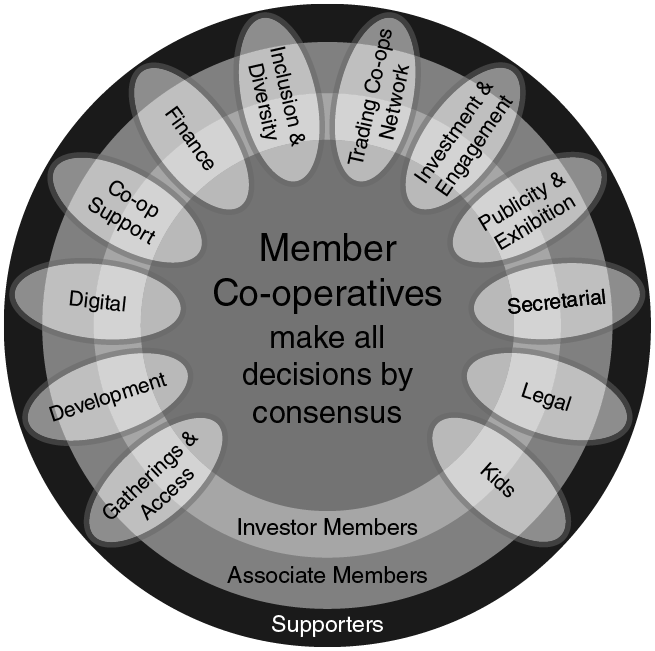
Figure 7.1 Long description
This image depicts both the normative and organisational structure of Radical Routes. The member co-ops are central, the working groups depicted as petals surrounding them, and investor members, associate members, and supporters depicted as wider concentric circles further away from the centre, in that order.
As a constitutional principle, mutual aid refers to the ethics of co-operation which RR attempts to instil in members by incentivising co-operative behaviour. When Hallam called RR ‘activist’ not ‘lifestyle’,Footnote 82 he evoked Murray Bookchin’s concerns about the flimsiness of countercultural movements and his scepticism about the power of shared values or common outlooks to maintain durable anarchist organisation.Footnote 83 To counter this, he recommended what Michael Taylor calls the ‘effective use of controls’ to anchor and cultivate RR’s activism.Footnote 84
Hallam used an oxymoron ‘vanguard anarchism’ to describe his approach to the constitutional control mechanisms he advocated.Footnote 85 Radical Routes’s 2005 member’s pack refers to his ‘general rule of thumb’: namely, that ‘using more structure than you think you may need is a good policy’. Anticipating the objection, Hallam added that structure or rules were no barrier to innovation: ‘Processes or techniques should be innovated upon freely’. But experience had taught him that ‘it is almost always the case that a bit more structure is agreed to have been useful once implemented’.Footnote 86
The requirement to work for radical social change as set out in Rule 5.1 is the most obvious control measure RR uses to cultivate and protect mutual aid. But there are others. Radical Routes’s induction process and probationary membership are used to test norms and values. The requirements to attend RR’s quarterly meetings – Gatherings – and participate in workshops exist to build collective responsibility. The recommendation that richer members invest any surplus funds in RR is an attempt to increase their stakes in the co-op, incentivise participation in its institutions, and lock them into the federation. The encouragement to promote and organise ‘participatory education through skills-and-knowledge-sharing events, Taking Control events, [and] informative material and workshops’ is similarly intended to foster a sense of common endeavour.Footnote 87
Structured mutual aid is the cornerstone of RR’s mutual aid system, but it is also a vulnerability. To stave off co-op degeneration, RR must hold the values and enforcement mechanisms in balance. The risk of the mutual aid system is that it imposes burdensome obligations on members that seem to be at odds with RR’s internal culture. This risk is heightened by the plurality of RR’s membership. Radical Routes must address the qualms of members who perceive laxity in the informal practices adopted by others without upsetting those who consider structural controls inimical to the advancement of cultural practice.
Moreover, it is complicated by RR’s precarious legal position. In a polemic about rule changes in 2011, Hallam argued that RR is permanently vulnerable to decline because its constitution is enmeshed in a system of law. The thinking behind RR, he reminded his critics, ‘was that activists would set up [a] co-op and use this as a base for radical action’. The continuation of this activity, he contended, relied on structured mutual aid because activism ‘is not supported by the law’. The law says: ‘you cannot stop a person becoming a member of a co-op for “radical” reasons any more than you can by pointing to the colour of her/his skin’.
The liberal case is that a tenant must be a member – this is what is says in the rules. But the radical case says that the tenant should not be a member until he/she has shown his/her radical credentials […] The liberal case […] says that a member can only be expelled if he/she does not pay he/her rent and possibly for not taking part in the admin of the co-op and/or is anti-social […] The radical case says that if the member is not radical enough etc then he/she has to go.Footnote 88
As Gradin explains, RR is a voluntary organisation: ‘none of its members are legally required to be a part of it or follow its policies’. Consequently, ‘[i]f a member cooperative refuses to implement a decision or policy, Radical Routes does not have any strict formal sanctions other than exclusion from the organization’.Footnote 89 Radical Routes’s revised rules include provision for RR to veto members’ own rule changes made by co-ops that attempt to demutualise.Footnote 90 Yet this change implicitly acknowledges the obstacles that law puts in its path.
Radical Routes’s recent history suggests a trend towards the relaxation of internal controls. The change to RR’s income rule was a significant marker. Originally, RR’s secondary rules restricted MOMS income to a maximum average of double the income paid by Income Support or Job Seeker’s Allowance.Footnote 91 In 2005, RR accepted a proposal to require members to set their own policy on personal income, rather than bind individuals to the RR policy.Footnote 92 Long standing members also report members’ disengagement from RR and subtle shifts in the interpretation of RR’s mission. Cath Muller’s self-described glass-half-empty assessment is that ‘Radical Routes has gone from being something with a coherent and quite radical agenda of communities taking control of all aspects of their lives and livelihoods, to being something of a housing coop service organisation’.Footnote 93
Certainly, since its foundation, RR has altered beyond recognition. Over five times its original size, at the time of the review, the federation was comprised of thirty-five housing co-ops, four trading co-ops and one social centre.Footnote 94 None of the original seven co-op members remained in the federation (there is no need to if you do not have outstanding loans to RR), though some of these founder co-ops continue to thrive. A little over half of the existing members have joined since 2010, which mirrors the timing of the rise in membership numbers in the IWW and the global Occupy movement. Yet RR’s legal architecture had not changed.
Rules
Radical Routes has three tiers of rules. The first derives from its affiliation to the International Cooperative Alliance (ICA)Footnote 95 and the second two from RR’s legal status as a public mutual society regulated by the FCA.Footnote 96 This framework codifies the underlying norms of the federation.
The ICA was established in 1895 to ‘provide mutual encouragement’ to ‘peacefully and by voluntary association’ work out ‘an organisation of industry in which the production and distribution of wealth shall be carried on in common interest, and upon agreed principles of equity and reason’.Footnote 97 The modern ICA describes itself as a forum to ‘boost cooperation’ between co-ops by developing partnerships and business relationships, organising international events, sharing know-how and facilitating training. Celebrating innovative ‘forms and kinds of cooperatives’, it embraces organisational diversity and inclusion,Footnote 98 while acting as a global steward of the Statement of Cooperative Identity, the keystone of co-operative values and principles derived from the ideas set out in 1844 by the Rochdale Pioneers.Footnote 99
As an autonomous federation in the global co-operative movement, RR adopts the ICA’s statement of identity, and the ICA’s seven principles of co-operation are enshrined in RR’s ‘primary’ rules, as required by the FCA.Footnote 100 Radical Routes’s ‘primary’ rules mostly follow a standard FCA template: they register the co-op’s name and objects and its membership and governance codes (including a three-page disputes procedure and process for expulsion), decision-making processes and borrowing and investment rules. Radical Routes is registered as a par value, common ownership and fully mutual ‘multi-stakeholder’ co-op. Taking each term in turn, this means that all members have the same £1 (non-tradeable) share in the RR (members can be investors or co-ops),Footnote 101 that individual members cannot financially profit from the co-ops assets, and that users/investors are members and all members are users/investors.Footnote 102 Once the common ownership co-op is established, the assets become worthless to individual members in monetary terms.
As a secondary co-op, RR is formed by two or more ‘primary’ co-ops. The legal framework is designed to prevent any member from profiting from membership in RR, other than by ‘getting an affordable place to live’.Footnote 103 Radical Routes’s ‘secondary’ rules are set out in the Policy Document.Footnote 104 These are a thicker set of rules that ‘go beyond matters required by society legislation’.Footnote 105 They are not registered with the FCA. While they have no statutory force, they would still carry legal weight in court. They commit member co-ops to ICA principles, the FCA rules, and the rules outlined in the policy document: namely, the declarative goals of RR to challenge capitalist and materialist norms. Toughening the ICA’s statement of identity, the Policy Document states:
We are working towards taking control over our housing, education and work through setting up housing and worker co-ops, and co-operating as a network.
Through gaining collective control over these areas, we aim to reduce reliance on exploitative structures and build secure bases from which to challenge the system and encourage others to do so.Footnote 106
The policy document also sets out the specific rules regulating membership and governance, including the conduct of meetings and the role of the working groups through which the federation is run.
Member co-ops also have primary and secondary rules. Applicant co-ops have the option of adopting the model rules RR has registered with the FCA, or not.Footnote 107 The RR model rules for housing co-ops reinforce RR’s primary rules, cascading the rules on governance, dispute resolution, expulsion, consensus decision-making, and accounting procedures. Radical Routes recommends them as ‘the best rules for creating a fully mutual housing co-operative in common ownership and managed by general meeting’.Footnote 108 The cost incentivises their adoption: members pay £375 to register with RR’s model rules and £950 to the FCA to register with a unique set.Footnote 109
Radical Routes requires member co-ops to publish their secondary rules on the member’s space on the RR website and to notify RR of any revisions. Applicants are also required to produce a full set of secondary rules prior to admission.Footnote 110 In both cases, the secondary rules must include specific statements pertaining to ‘[p]olitical and social change activity’, ‘low impact life style’, ‘[p]ractical and financial support for radical non-hierarchical groups, disability access and policy on rents’.Footnote 111
Members interpret these provisions in unique ways and write in very different tones. The variation reflects their distinctive aims and ambitions and the energy and identities of the individuals that steward them. Yet there are commonalities. For example, in Mary Ann Johnson (known as MAJ), an RR member housing co-op in north London, the secondary rules specify that applicants must share the co-op’s values and give preference to those who have a connection with and/or commitment to the local area. The responsibility for childcare falls to parents or carers, but co-op members are encouraged to support carers and ‘value children as individuals and respect their ideas and opinions’. Members are ‘jointly responsible for maintaining communal areas’, encouraged to live sustainably by reducing ‘consumption of environmentally damaging products’ and adopt ‘a vegetarian/vegan diet’ to prevent suffering to animals.Footnote 112
In Random Camel, the Ipswich housing co-op, members ‘are committed to living communally, simply and with a low environmental impact’, in a house that is ‘animal aware’ and ‘explicitly vegan with provisions for veggies’. As well as taking responsibility ‘for their own belongings’ including their ‘animals and any pests’, they agree not to leave ‘clutter’ in communal areas. High-income earners ‘are expected to use excess for the benefit of the planet and its inhabitants’ and any ‘member sent to prison will have a place in the co-op upon release, providing the sentence was not in relation to something against the ethics and rules of the members or for a highly prolonged period’.Footnote 113
In Wild Peak, the secondary rules ‘encourage the use of considered direct action to defend people, other species and our environment and to precipitate, and nurture, a better world’ and include a co-op land management plan. There are detailed rules about the rights and obligations of resident children and responsibilities of their parents, carers or guardians; applicants planning to have children during their membership are required to declare this in advance. The co-op restricts members’ maximum disposable income to ensure ‘parity of “lifestyles”’ and makes provisions to deal with any excess. Communal spaces are formally designated non-smoking and vegan, and private vehicles are permitted on co-op land only with approval of the co-op.Footnote 114
The multiple tiers of rules reflect the realities RR and its member co-ops face. As the first article of the Policy Document states, the federation operates ‘in a world not of our making but one that has been moulded over thousands of years of exploitation and injustice’.Footnote 115 Radical Routes is required to work within the FCA’s statutory framework. Formulating rules is not an option.
Radical Routes’s stance raises complex issues of theory and practice.Footnote 116 For some activists, its legal compromise is a sacrifice of principle. A critic writing in the Earth First! magazine Do or Die argued that RR’s foundations had been corrupted by the stranglehold of bureaucracy and its conformity with legal norms: ‘setting down roots in polluted ground is not going to develop healthy politics or healthy communities’.Footnote 117 According to this view, squats are better suited to the development of ‘collectively, responsibility, mutuality and autonomy’.Footnote 118 The drawback is that squatting leaves property unsecured and squatters vulnerable to whims of owners and developers. Also writing in Do or Die, a long-time squatter remarked: ‘Temporary Autonomous Zones […] sound good on paper’ but are less attractive when ‘angry builders and cops […] show up first thing in the morning’ to force residents to pack ‘everything in shopping trolleys’ and move to the next available space. It may be ‘an adventure’ first-time round, but endless replay is ‘a pain in the arse’.Footnote 119
Radical Routes’s legality addresses that insecurity. But the point missed in this exchange is that the rules are not just red tape. Hallam’s view, that the rules were essential to the promotion of mutual aid, captures a truth about RR: its rules have a status equivalent to the Preamble in the IWW or the ‘Principles of Solidarity’ in OWS. Their revision in the review process was as potentially divisive as OO’s dispute about decolonisation proved to be. Indeed, the battle over the interpretation and status of Rule 5.1 has been the defining struggle of the federation over the past ten years. This debate played out in specific institutions and with particular decision-making procedures, to which we now turn.
Institutions
Radical Routes set up three main institutions to meet its needs for mutual aid and self-reproduction: Rootstock, the quarterly Gatherings, and the Working Groups.
Rootstock was the ethical ‘investors’ co-op’ issuing ‘withdrawable shares’ to investors interested in ‘furthering the aims of Rootstock (providing loans to member coops) rather than financial gain’.Footnote 120 As Hallam explained, when RR started to agitate for ‘housing without landlords, work without bosses and education without teachers’, he soon realised that it also needed to organise ‘finance without bankers’.Footnote 121 As a ‘social investment society’ and a member co-op of RR, Rootstock transferred the money by buying shares in RR which then provided loans to member co-ops typically refused funding by banks and conventional building societies. It charged lower rates of interest and loan handling fees.Footnote 122 Radical Routes also paid ‘limited interest to investors’, sufficient only to ‘retain capital’ and meet Rootstock’s aims.Footnote 123 Being members of Rootstock and therefore MOMS, investors were exempted from RR’s usual rules for individuals on social change activityFootnote 124 but were ‘invited to forgo their right to interest’ or reduce the normal level by half, as a further gesture to RR and Rootstock’s co-operative principles. Formally separate from RR, Rootstock submitted annual accounts to the FCA and was run by a committee elected at Rootstock’s Annual General Meeting (AGM). All investors had the same voting rights. To ensure control of Rootstock remained with RR, all other RR member co-ops were required to invest at least £50 in Rootstock.Footnote 125
The Gatherings are quarterly inter-regional meetings run over a weekend to ‘take care of the business of RR’ and consider issues affecting the federation. Promoted as social events open to co-op members, prospective members and ‘random […] visitors or interested people’, the Gatherings have historically been conducted in open fields, repurposed barns and other temporary spaces, or in the co-ops’ own spaces or community centres. They are RR’s principal management body: working groups meet to make decisions, and co-op representatives attend to confirm any decisions that MOMS have agreed to in advance. Attendance can be patchy, but in principle, each member co-op sends representatives to be present in each of the main business meetings. In short, the Gatherings function as RR’s general meeting, and its representatives constitute its committee.Footnote 126
Gatherings have two parallel streams: induction sessions for joining members and business meetings for existing members.Footnote 127 The latter are for ‘decision making’ and ‘discussion’, ‘reporting on work done and allocating task to do’.Footnote 128 Gatherings consider proposals from member co-ops and RR working groups, discuss suggested policy changes, membership applications, scrutinise changes in the national legal architecture pertaining to co-ops, for example, the implications of new housing law, and report social change activities. They also collectively manage RR’s budget at timetabled finance meetings, consider loan requests and agree allocations.
Gatherings are structured to ensure that RR’s business is covered before working groups convene. The working groups are the RR’s frontline institutions. As the strapline in RR’s 2005 member’s pack put it: ‘Working Groups help RR thrive’. Member co-ops and MOMS contribute to make this happen, currently half a day a week for co-ops with over five members and, for those with less, half a day every two weeks.Footnote 129 But investors, associates, supporters ‘or anyone else in the world’ can get involved in a working group.Footnote 130 Like the Gatherings, working groups have a dual function: managing RR’s core business and cementing relationships across the federation and, in theory, with the wider community.Footnote 131
Radical Routes has thirteen ‘recognised’ or standing working groups; the recent expansion and reconfiguration since 2005 reflects the priority RR attaches to inclusion, access and co-op support.Footnote 132 Each recognised group has core members, a specific brief and, in some cases, reporting functions. Some groups have extensive responsibilities: Finance working group presents quarterly finance reports, supports member co-ops develop financial plans and pays expense claims. The Investment and Engagement working group supports the democratic engagement of investors and manages investments and withdrawals of RRs shares (including regulatory compliance). Yet RR limits their powers. For example, RR charges the Finance working group with organising the federation’s participatory budgeting process, rather than devolve decision-making to the Finance working group members.Footnote 133 Radical Routes sets the criteria that the Finance working group uses to determine the eligibility of loan requests, thus reducing its capacity to exercise discretion. Similarly, to enable effective scrutiny, RR designates time at each Gathering for the Investment and Engagement working group to report to and take questions from co-op members.
The key institutional change made in 2022 was to transfer stock, property, assets and liabilities from Rootstock to RR. The change created a new class of ‘investor members’ and an elected Investor Member Group (IMG) to facilitate the participation of non-co-op member investors in RR’s business. The IMG is open to all investor membersFootnote 134 and works independently of RR, meeting in-person or virtually in advance of each Gathering to discuss RR’s upcoming business. It appoints an Investor Member Delegate to attend Gatherings (‘General Meetings’ in the primary rules) and the AGM to present its view, making it a member of RR’s management committee alongside all other member co-ops.
Decision-Making
The ICA principles and RR’s primary rules adopt the principle ‘one member one vote’ to define the democratic process. Radical Routes secondary rules vary this process of decision-making considerably. For example, voting is used at AGMs for elections to the Investor Members Group since most investors are not present. However, consensus decision-making (CDM) is the default at Gatherings for working groups, and voting is considered a sign of the failure of that process.Footnote 135 Radical Routes’s current website rejects ‘voting and representation’ as ‘anti-democratic’ majoritarianism, steeped in ‘macho controlling behaviour’ and encouraging of ‘alienation’ and ‘hierarchies’.Footnote 136
Radical Routes takes a holistic view of CDM: consensus is not just about the mechanics of decision-making. Rather, it describes an approach to self-government and collective action which requires time, training, practice and transparent process. The Resource Manual for A Living Revolution, cited in RR’s 2005 member’s pack, describes it as ‘a process for making group decision without voting’ in which agreement ‘is reached through a process of gathering information and viewpoints, discussion, persuasion, a combination of synthesis of proposals and/or the development of totally new ones’.Footnote 137 The aim is not to achieve unanimity, but a decision that everyone can live with, even if they disagree.Footnote 138
The diagram included in the 2005 member’s pack details the phases of decision, breaking the consultation process into three parts: before, during and after Gatherings. Working groups, or member co-ops table proposals for members to discuss before a proposal reaches a Gathering. Separate rules regulate emergency proposals. The point of the ordinary process is to reduce members’ scope for ambush and promote skill sharing and dialogue across the federation. They also allow for second and third chances for blocked proposals and ‘last resort voting’.
Many of RR’s rules about the organisation of Gatherings, information sharing and co-op participation in RR business have been made with consensus in mind. The rules governing the admission of new members are similarly designed to maintain consensus as the norm. By the time new members join, at least one MOM should have attended the workshops Introducing RR, and those related to RR Finance, Facilitation and Consensus Building.Footnote 139
As the 2005 member’s pack acknowledged, CDM is highly demanding. Participants must learn how to express themselves and how to listen to others; develop skills that encourage others to join discussions and ‘unlearn’ the principles of competitive advantage imbibed through ‘majority-vote culture’.Footnote 140 It works best when participants share values and have similar worldviews. But in any event, it requires ‘a high level of commitment […] which affects the whole lifestyle of a community’.Footnote 141 Yet this is also the chief advantage of CDM. By promoting commitment through participation, intelligence through collective engagement and solidarity through concord, CDM fosters the culture RR cultivates to meet its mission and sustain its values. However, when that consensus broke down, RR did not rely on CDM or majoritarianism to resolve differences between members. Rather, it undertook a comprehensive constitutional review.
The Constitutional Review
The constitutional review was instituted to resolve potentially fractious disagreement about RR’s fifteen-hour rule, known as Rule 5.1. It had started life as a twenty-hour rule, set up by worker co-ops to preserve and bolster RR’s radicalism. The caricature story is that it was introduced to stop drug culture from taking hold in RR co-ops. According to Milan Rai and Emily John’s concise history, in the 1990s, the fifteen-hour rule was a ‘boundary marker’ designed to ‘preserve RR for radical activists who are radical and active’. Described as a commitment to ‘radical social change action’ (RSCA), it was amended in 2001 to allow exemptions ‘where the size or composition of the co-ops membership’ militated against it.Footnote 142 The text agreed at the Summer 2001 Gathering read:
Individuals are expected to be doing 15 hours of work per week in line with the aims and principles of Radical Routes. This rule does not apply to investors’ co-operatives and where the size or composition of the Co-op’s membership makes this difficult, it may be applied to a specific subset of the membership or waived altogether with the explicit agreement of a Radical Routes gathering.Footnote 143
Further calls for revision followed in 2011. Some co-ops objected that the rule forced MOMS to undertake unpaid work, disregarding both dramatic changes to the benefit system and the value of the activism they already pursued. A connected complaint was that 5.1 had institutionalised ‘hairshirtism’,Footnote 144 enforced by ‘guilt tripping’.Footnote 145
The issue came to a head in 2014 when a new member not only admitted that it was not meeting the work requirement but also that it was unwilling to monitor the activities of MOMS. It seemed that the commitment to radical social change ran counter to its plans. Its appeal to RR was: ‘We want to expand, buy more property, take on more members’.Footnote 146 New members, it argued, would be put off by the fifteen-hour rule.
The 2014 proposal was to drop the fifteen-hour rule in favour of devoting an unspecified, albeit ‘significant’ proportion of free time to RSCA and allow members to decide how MOMS met RR’s aims and principles. The Gathering agreed to postpone a decision.Footnote 147 In a discussion paper, Milan Rai, a fierce advocate for the retention of the rule, helpfully distinguished two main strands in the opposition.Footnote 148 Advocates for ‘autonomy’ respectively argued members should decide what qualifies as RSCA, or that they should have latitude to recruit MOMS as they see fit, without regard to RSCA. In the second group, the hours objectors were similarly divided into two subsets: those who wanted members to set the number of hours in co-ops and those who wanted to remove set hours altogether.Footnote 149
At the Autumn 2015 Gathering, a subgroup was formed (the ‘5.1 group’) to initiate an open and convivial review process. This would involve visiting member co-ops and discovering what MOMS thought about the rule, how it affected their social change work and their day-to-day lives. The 5.1 group used simple, well-established social scientific research methods to ensure a degree of objectivity in the reporting, including go-rounds, consistent note taking, asking the same questions to each group, having two convenors at all meetings, and using tools like NVivo to code and analyse the resulting data.
The 5.1 group did not have a shared or agreed-upon stance. However, the nightmare haunting the review and expressed by some members of the team, was that the removal of a minimum guideline would give free reign to co-ops to accept MOMS who were entirely uncommitted to social change and/or prefigurative living. Without a critical mass of members willing to uphold RR’s aims and principles, RR’s institutions would also likely collapse. Passivity would lead to inequalities of power and knowledge and undermine shared responsibility. Without shared values, attitudes or priorities, decision-making would become harder to achieve, especially by consensus. Radical Routes would not be able to meet its principal objective: to promote co-operation against capitalism and consumerism. In short, the abolition of the rule threatened to launch RR into a spiral of decline.Footnote 150
Ironically, the review revealed that the crisis had passed, and RR had survived. Indeed, Rule 5.1 barely featured in some co-op meetings; two MOMS in London were surprised to find that they had not been asked to discuss it more directly. Instead, it exposed a range of other issues the 5.1 team had not been expecting to deal with. Most disconcertingly, it revealed the depth of members’ disengagement and alienation from RR. Specifically, the review enabled MOMS to express a wider set of complaints about unacknowledged hierarchies in the federation, RR’s narrow social composition, and insular subcultural norms. Yet while facilitators discovered serious concerns about RR’s practices (echoing some of the findings in the IWW), they also found a willingness to reconnect with the network and re-discovered the cultural resources it had at its disposal to do this. We turn now to the process and its findings.
The 5.1 Review
Facilitators in the 5.1 group invited MOMS in each co-op to respond to twenty questions about RR’s purpose, operation, attractiveness and membership. The data highlighted a set of institutional problems as well as an underlying constitutional issue. The institutional problems related to a lack of resources, the conduct of meetings and the strain of managing RR as an activist co-op. The point made by one MOM at Walden Pond was that running Rootstock left little time for activism. Another MOM put the same point more starkly: RR is, they said, ‘running a fucking bank by consensus over four weekends a year in a field and none of us are being paid and it also wants to be a political movement’.Footnote 151
The underlying constitutional problem turned on RR’s perceived lack of inclusivity: MOMS routinely described RR as socially exclusive. As Matt Wilson argues in the 5.1 report, a common perception is that RR attracts a narrow demographic. The ‘view that “everyone’s middle-class” in RR came up again and again’.Footnote 152 In response to the question, ‘who is RR for’ one MOM quipped: ‘is the correct answer white middle class people?’.Footnote 153
This perception ‘may be factually incorrect’. But as Wilson also notes, RR lacks up-to-date data to know one way or the other.Footnote 154 Moreover, the data gathered for the 2013 social audit tells a similar story. Only 80 out of 259 MOMS responded, but as the analysts remarked, the results indicated a ‘lukewarm response on inclusivity compared to RR’s other values’, that a ‘sizeable minority do not feel that Radical Routes is a safe and including space for all people’ and that the ‘relative optimism about Radical Routes being a safe and including space for people irrespective of gender is not shared by people identifying as trans, queer and other non-binary gender identities’.Footnote 155
The perception of exclusion says something about MOMS’ lived experience of RR and the underlying concern that RR’s practices reinforce white middle class privilege. One MOM argued: RR is ‘not for people of colour, it’s not for people of non-binary gender. There is some nod for inclusion based on disability’, but ‘there’s a bit of a class issue as well’; RR is ‘more open and supportive of articulate, educated, middle-class people’.Footnote 156
Gatherings were a lightning rod for criticism. Some of the grumbles mirrored those we heard in the IWW. Typically, MOMS talk about informal hierarchies operating as cliques within the network, advantaging those who can master the jargon and/or those who have gained confidence to participate in debates from long experience. They also complain about ‘meeting fatigue’,Footnote 157 the volume of preparatory reading each meeting required, the inconvenience of attending meetings at weekends, the strain of engaging with lots of new people and coping with intense or boring or awkward conversations.
Decision-making was not a scheduled topic of discussion, but consensus decision-making was mentioned explicitly in a third of the co-op meetings. Where co-ops are well run internally and have good relations with RR, consensus was not perceived to be a problem. One long-standing member co-op suggested that consensus attracts people to RR because they know it will give them more ‘control’ over their lives.Footnote 158 Elsewhere, MOMS remarked that ‘resolving the conflicts within Radical Routes [by consensus] is an immense drain of emotional energy’, which is off putting to new members.Footnote 159 Another new member remarked that ‘We work by consensus which can be painful, but everyone knows it takes a while to get through the process’.Footnote 160
One MOM summed up a widely held view when they said that they came away from Gatherings ‘feeling really hacked off’ even though they had ‘met really lovely people at them’.Footnote 161 Indeed, such was the strength of feeling about meetings, that some MOMS felt torn about continuing their membership:
I think [our co-op] should be a member or associate. In a way I think [we…] should be a full member, because if [we…] agrees with the values and wants to do the things we’ve described in terms of mutual aid and supporting other co-ops, then Radical Routes is only the people participating, it requires people to be it. Yet at the same time I’m turned off by endless meetings on meetings on meetings and then have an internal reaction, do I personally want to do it and be at all those meetings, and then I lean back towards associate [membership].Footnote 162
Other gripes touched more directly on RR’s norms. One was that RR’s prevailing subcultural norms make the meetings unwelcoming. A self-professed ‘crusty’, entirely comfortable with RR’s subcultural aesthetics, argued that the marginalised locals their co-op worked with in north London would ‘just walk away’ from Gatherings: anyone ‘that’s not crusty looking’ would be unlikely to stay ‘for very long’.Footnote 163 A MOM in Birmingham echoed this view: the ‘aesthetics’ of Gatherings by ‘white people with dreadlocks’, are simply off putting.Footnote 164 A MOM in a relatively new member co-op believed that the problem was historic:
one of my big impressions from early interaction before this coop, was that early on they [co-ops] had a fair amount of trust in each other because it was a really small face-to-face network of people who knew each other from protesting – they’d been in affinity groups, held each other’s ropes. They’d already protected each other – so Gatherings were about checking [people] out: are you [familiar], have we seen you on demos, are you one of us?Footnote 165
The related complaint is that these norms exert a pernicious influence on RR’s organisational culture. Almost all co-ops identified barriers in the Gathering. Countless participants pointed out that travelling to gatherings is often logistically challenging. The remoteness of locations and ‘the fact we expect people to sleep on floors’ were identified as significant barriers to participation.Footnote 166 Radical Routes’s ingrained traveller ethos and the default to camping in spaces that lack basic facilities made Gatherings impossible or extremely difficult for some members. One MOM reported that RR’s traditions of ‘camping, slumming it, squatterliness, which is in some ways charming’ was unsuited to wheelchair users and ‘all sorts of people for all sorts of reasons’.Footnote 167 Another reported their unwillingness to recommend RR to ‘a group of friends, some with ADHD, [some] wheelchair users, [and some with] anxiety issues’. They continued: ‘I suddenly had this overwhelming feeling that no matter how hard I work in access I still wouldn’t feel comfortable to get them to join – it felt an overwhelming task to pull the whole of RR to a point where these people wouldn’t be asked to turn up in the cold and mud for 4 weekends a year. They physically couldn’t come to Gatherings’.Footnote 168
Older MOMS and MOMS with children said that they felt badly catered for. The Kids Working Group was overhauled in 2013 to address its dysfunction and has since enjoyed mixed successes. One MOM noted, ‘even though there is a kids group it’s sometimes not very well run – the only way I could take them was if I took my partner with me to run the kids group’.Footnote 169
MOMS’ worries about RR’s shortcomings did not generate any clear agreement about the strategy RR should adopt to correct it. One view is that RR should remain exclusive, even if it broadens its social base. Radical Routes, one MOM said,
isn’t for everyone, it doesn’t need to or try to include everyone. One of the things that makes it or anything like it work is a common bond, but when the common bond gets stretched out to just agreeing with an ideology then it starts to flake, people need to have an affinity to enact mutual aid and put up with each other’s crap tendencies.Footnote 170
In another meeting, a MOM argued that RR should make inclusion its business. The idea animating RR was that ‘it is open for everyone and that there is great diversity’.Footnote 171 Although some co-ops appear to veer in one direction or the other, these positions are often complicated within co-ops by MOMS’ uncertainties and differences. In response to the question ‘who is RR for?’, MOMS in one co-op answered:
(mom i) Anyone who isn’t racist or horrible or nasty.
(mom ii) people who are […] activist, or people who see that living in a housing co-op is a good way of providing housing, or a way of life […]
(mom iii) it’s for anybody who wants to contribute to it? I wasn’t sure, but surely it’s for everybody who wants to contribute?Footnote 172
MOMS in a second co-op were similarly divided, and their discussion is worth recounting at length:
(mom i) it’s currently for largely a group of activists whose activisms we share, but [specifically for] a group […] who are largely socially, physically and health-wise enabled and I would like it to be for as wide a group of people as possible.
(mom ii) I feel that it’s currently for people with a lot of capacity and who are able to generate an impression of being a very particular type of activist […] eg vegan hippies who turn up in charity shop jumpers and sit round a campfire.
(mom i) I can see 2 or 3 of those jumpers in this room!
(mom ii) I love those hippies, but I think it should be wider – I think it’s the reason I got socially accepted so quickly.
(mom iii) when we turned up, we were soooo welcomed and we though yay it’s for everyone and then we realised quickly it was for US.
(mom ii) should be for literally anyone who wants to have a housing co-op. I want practices and processes to be robust enough that if Richard Branson, Simon Cowell and the Queen wanted a housing co-op we could let them. It’s a bit like the UK approach to immigrants – super thick barbed wire wall, keep everyone out. I will happily sit and chat to a Nazi about what it’s all about rather than just chuck out people who might be really great activists if only they had a house to live in. I believe that a society with an organisation working on equalising housing will create a society in which other forms of activism are significantly more enabled.Footnote 173
Perhaps the most significant finding of the 5.1 process was the feeling that RR functions in a permanent tension. MOMS argued that RR aims to stretch its co-operative aims and ties endlessly without weakening their snap. On the one hand, it exists to provide an alternative for everyone caught up in capitalism’s suffocating webs. On the other, it meets the needs of disadvantaged and consciously downwardly mobile, self-identified radicals. The tension ought not to be surprising, given the centrality of education, outreach and community connection central to RR’s co-op mission, and members’ self-awareness that co-ops support niche cultures that are not always attractive to everyone in marginalised communities. MOMS in one co-op concluded that RR is ‘stuck’ because it is ‘right on the edge’.Footnote 174 This is a ‘difficult place to be’ and demands strength, clarity, ‘integrity and living by your principles’. In a nutshell, the irresolvable problem was how to expand ‘and still keeping your principles without moving towards the mainstream’.Footnote 175 The triumph of the review process was to bring this tension into the open without seeking permanently to resolve it. Trust in the underlying cultural commitments of the federation did RR’s heavy lifting.
Affirmation
One of the startling features of the constitutional reform process was how cathartic it became. For all the disgruntlement it brought to the surface, and the disagreements it exposed, the visits of the 5.1 group to the member co-ops ultimately enabled the disparate parts to reconnect to the whole and revive a sense of cultural mission: radicalism.
The 5.1 group did not invite MOMS to talk directly about radicalism or activism, but those who participated in the review frequently mentioned RR’s reputation for ‘radicalism’ as a stimulus for membership. Newer members, often motivated by a desire to secure a loan, joined RR because they also considered RR’s aims and principles compatible with their own. For one MOM, membership in RR re-connected their co-op to a ‘leftover […] more radical Britain’.Footnote 176
MOMS in long-standing member co-ops commonly referenced RR’s aims and objectives to explain their continuing membership, including mutual aid, peace, justice, environmental and ecological sustainability and intersectionality. Radicalism variously evoked ‘caring for the planet […] sustainability and conscious living’Footnote 177 and the ‘ethos […] of ideological anti-capitalism and anti-hierarchical governance’.Footnote 178 For one MOM, RR served ‘to remind us why we exist and our politics’ by ‘networking’ and socialising ‘with nice people’ to ‘support other co-ops and new members’.Footnote 179
Radical Routes’s transformative agenda also featured prominently in MOMS’ assessments. MOMS valued the connection RR gave them to a wider process of collective organising, even though it does not sit comfortably in the global co-op movement. As one MOM put it, RR is ‘bigger than the house’.Footnote 180 Thinking about the role of RR, one MOM commented:
Got a picture in my head of connective tissue with flow of all the resources that a healthy body needs, a circulatory system for cash, skills, support, friendship, inspiration – having been part of a co-op that was isolated, that wasn’t part of the system, which felt unhealthy […] when we joined RR I felt this amazing sense of stepping into our ideals, walking your ideals – mutual aid, looking after yourself and each other, not relying on governments to just sort everything else, or landlords […] this is as far as you can go without actually getting rid of money, taking control of resources in common ownership. It’s an education – an educated body of people willing to share their in-depth knowledge. Can be quite a steep learning curve. It’s really going into the intellectual legal sources of power and bringing that back and breaking it apart and disseminating it.Footnote 181
In this perspective, RR has succeeded in transforming the ‘politics of daily life’Footnote 182 and ‘transforming the foundations of our lives’.Footnote 183 It has enabled MOMS to enjoy living as opposed to being reduced to bare life. One MOM underlined the ‘very important mutual aid structure [RR] offers’ and the ‘vision of the founding members to make a home that allows us to survive in a city, and beyond that to even enjoy living in a city, by being mindful of our environmental impact that is somewhat dictated by urban living’.Footnote 184 Radical Routes was described in another co-op as a haven for ‘marginalised people’, desperate to free themselves from the arbitrary power of the landlord who ‘discovers we’re trans and kicks us out’.Footnote 185 Remembering ‘how difficult it was to live in a rented property, dealing with incompetent and unscrupulous landlords, at affordable rent’, a MOM from the early days echoed this view and equated radicalism with ‘safety’:
We have equally been able to build on our day-to-day skills, for example in terms of gardening, DIY and cooking. This opportunity is non-trivial for people living together and is often denied through living in rented accommodation. As someone with autism, the ability of living with a large group of people in order to get things done – which I kind of view as a family, in that everyone knows everyone but we are interdependent within – has helped me to glean an understanding of general responsibilities I simply would not have had from living alone or with random people.Footnote 186
This affirmation of the virtues of the federation should be balanced against the access complaints mentioned above. Nevertheless, supporting its most vulnerable members in this way is an indication of the work of the federation in supporting everyone else too. Radical Routes is thereby able to evidence the transformative capacity of the federation, not only through its culture, but through its wider and deeper constitutional politics. This is surely an indication of the example RR can set in society more broadly.
The evaluations co-ops gave of the 5.1 process at the conclusion of the meetings also attest to their integrity and fruitfulness. Members repeatedly thanked facilitators for visiting and listening. Reflecting on the review process, one MOM told the facilitators: ‘For me it’s like a reconnection with RR’s aims and principles and our aim and principles and my own beliefs’.Footnote 187 The same sentiment was expressed elsewhere: ‘I really appreciate youse coming here, it’s the first time I’ve felt engaged’.Footnote 188 Another commented:
it’s been an amazing day, I take my hat off to you doing this, it’s the only way to do it, tiring, long-winded. I feel it’s unfinished today, it’s raised lots of things, I could start again tomorrow! Always leave ’em wanting more. I’m worried, if I feel it’s unfinished, you must feel ‘god we’ve just turned this rock over and all the worms are escaping, how are we going to put it back?’ I don’t know how you’ll collate all the info, there’s no easy answer.Footnote 189
In one co-op, the positive effect of the review meetings was compared to the Remain campaign’s mishandling of the Referendum on the UK membership of the EU: ‘If the EU had gone out and said “this is what we’re about what would you like us to do differently” people would have been less likely to leave the EU. The same with Radical Routes. It’s much more likely that people will engage with it and stay in it’.Footnote 190
Conclusion
By the time the review had concluded, the fifteen-hour rule had already been dropped. The replacement Rule 5.1 now reads:
Radical Routes Ordinary Member co-operatives inspire, enable and expect their members to be engaged in activities in line with the Aims & Principles of Radical Routes, as this is the purpose of Radical Routes, and where the size or composition of the Co-op’s membership makes this difficult, it may be applied to a specific subset of the membership or waived altogether.Footnote 191
As well as treating this running sore, the review also elicited several practical proposals for change. These included improving access, making Gatherings hybrid, switching to better tech and developing the website. Some changes have already been implemented. For example, a new Working Group for access was established in 2020, and the website was overhauled. Co-ops positions on proposals are shared online in advance of Gatherings, most of which are accessible online.
Since the review, the conversation about change is not so much concerned with practicalities as it is with deciding how best to preserve or enhance mutual aid. The review has stimulated discussions of the merits of consensus decision-making and has begun to refocus attention from gatekeeping to inclusivity: how better to support people with disabilities, people with mental health issues, working-class people and people subject to multiple oppressions.
Radical Routes’s success in promoting its founders’ aims and principles is something to behold. One MOM remarked:
we’ve proven that housing co-ops work. My ex-estate agent parents look at this as the best thing that could have happened to their children. Thank God you have this secure housing that you can’t get kicked out of and feel like you own without chucking all of your money into it and without propping up the buy-to-let market or sale of council housing.Footnote 192
What more can we learn about anarchy and global constitutionalism from RR’s experiences? Radical Routes shows us that it is possible to hold multiple autonomous units together in a horizontal federation where the federation itself is only a veto away from paralysis. Radical Routes is also a plural organisation, and the adoption of secondary rules by member co-ops has enabled difference in unity. There are tensions and conflicts. As one MOM argued, RR is characterised by the indeterminacy of its anarchism. In RR, radical ‘is a weasel word’ that ‘means whatever you want it to mean […] Everyone thinks it means what they think it means […] Lots of people use radical to mean, “like us”’.Footnote 193 Yet, shaped by mutual aid, RR shows that it is possible to hold antagonistic viewpoints in balance, protect against direct, indirect or structural violence, and live contentedly and antagonistically within the systems of pacification that shape modern neo-liberal society. Finally, RR’s experience shows that the absence of a final point of authority is not a block to these ambitions, it is their sine qua non.
Radical Routes’s anarchist constitutional politics is central to the possibility of the anarchy it supports. Its constitution relies on shared ambitions, a set of rules to protect precarious institutions from internal and external attack, the adoption of decision-making methods that empower members at every level of the federation, and a strong collective identity. Its grassroots, bottom-up approach to constitutionalising affirms the feasibility of anarchist approaches: RR emphatically embraces what Taylor calls ‘ordinary capability’ as a principle of self-government, detaching it from systems of representation and conceptions of common good. In Cohen’s terms, its co-ops dent the ‘enormous practical force of the belief that socialism is infeasible’.Footnote 194 Radical Routes’s numbers may decline, but its success is measured elsewhere, while the template they have devised can be mimicked anywhere. Radical Routes shows how to close the gap between accessible and sustainable socialism.
Radical Routes also shows the crucial role culture plays in sustaining the federation. The price of freedom in RR is not cultishness. Rather, the role of mutual aid is equivalent to the role that the belief in democracy and rights or the common good plays in liberalism and republicanism: shared values shape institutions, decision-making practices and the rules. The significant difference in RR is that the relationship between culture and constitution is overt and demonstrated through the property relations it collectively sustains. Whereas a commitment to liberal values or republican ideals is typically enforced through violence, in RR, the co-operative property relations underpin decentralised, co-operative or anarchic modes to conflict resolution. Once we re-frame culture through the lens of constitutionalising, we can appreciate both the ways in which it functions conservatively, to preserve the federation, and transformatively to change prevailing social relationships as it percolates outwards (no matter how slowly). The lesson is that it is possible to adopt principles of mutual aid to support the replication of constitutional practice in plural cultural contexts, as long as the underlying property relations sustain that.
As we have shown, RR’s collective identity is not the same as cultural cohesion, but collective identity nevertheless tends to insularity and exclusiveness. Yet the tension between expansion and partisanship endemic in RR’s anticapitalist co-operativism reinforces the anarchist case for decentralised federation.
Radical Routes is affiliated to a global co-op movement that has millions of member co-ops across the world. While this movement is constrained by neoliberal norms, RR is probably fated to remain a drop in the co-op ocean. However, the training and education provided by the network already animates projects outside its confines.Footnote 195 Members change the world they engage with, as well as the spaces they inhabit. As we will now explore further in the conclusion, the revolution in everyday life is not about growth through ‘scaling up’, as Cohen argued, but by linking up: extending through affiliation, collaboration, mimicry and adaptation – constitutionalising horizontally.
The objective should not be to replicate a co-op at a national scale, or even regionally, but to preserve the autonomy of the myriad groups, co-ops and other collectively intentional groups, in a federation that structures mutual aid across society. The challenge is not just to rely on the constitution or the culture of the constituent groups but to focus as carefully on the constitutional culture of the federation and coalition it seeks to preserve. The threat of fragmentation can support cohesion, but not forever. This is what RR did so much better than the IWW and Occupy: it constitutionalised anarchy.
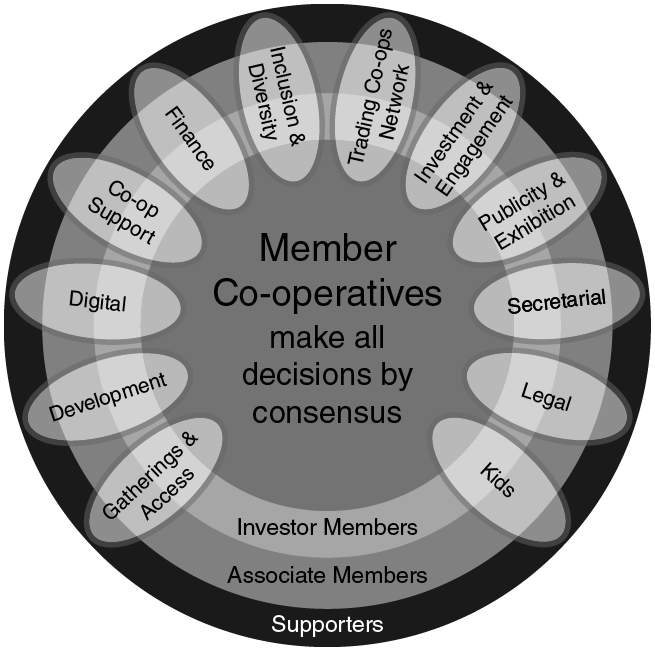

 Open access