A close relationship has been reported between seed size and many different plant traits such as seedling size, relative growth rate, seedling survival, distance of dispersion, colonization and density of seeds in the soil (Coomes & Grubb Reference COOMES and GRUBB2003, Jurado & Westoby Reference JURADO and WESTOBY1992, Lahoreau et al. Reference LAHOREAU, BAROT, GIGNOUX, HOFFMANN, SETTERFIELD and WILLIAMS2006, Saverimuttu & Westoby Reference SAVERIMUTTU and WESTOBY1996, Souza & Valio Reference SOUZA and VALIO2001). Although the association of seed size and shade tolerance is unclear (Westoby et al. Reference WESTOBY, LEISHMAN and LORD1996) some authors have suggested that a larger-seeded species is better able to tolerate low light availability (Foster Reference FOSTER1986, Foster & Janson Reference FOSTER and JANSON1985, Leishman & Westoby Reference LEISHMAN and WESTOBY1994) by producing a vigorous seedling with a higher ability to withstand predation (Armstrong & Westoby Reference ARMSTRONG and WESTOBY1993, Foster Reference FOSTER1986) and delaying the beginning of carbon fixation so as to increase survival under a canopy and under leaf litter.
Plant litter which constitutes dead plant material of small size is composed mainly of leaves, flowers, fruits, stems and plant debris covering the forest floor. The production of litter depends on several factors such as primary production in the community as well as changes in climate, with rainfall and length of the growing season as main components (Facelli & Pickett Reference FACELLI and PICKETT1991, Vázquez-Yanes et al. Reference VÁZQUEZ YANES, OROZCO–SEGOVIA, RINCÓN, SÁNCHEZ-CORONADO, HUANTE and BARRADAS1990). The litter layer of the floor of the Santa Genebra forest (where seeds and litter were collected) varies enormously. In general, the amount of litter accumulated at a site can be altered by the influx of litter from other sites or by efflux to other sites. This occurs by the action of winds, floods, soil unevenness, as well as physical and chemical degradation, heterotrophic consumption and decomposition. Leaf litter deposition affects the regeneration process in gaps by modifying micro-environmental conditions which reduce both light availability and quality. Factors such as temperature, humidity and nutrient availability are also acutely modified (Facelli & Pickett Reference FACELLI and PICKETT1991). The micro-environment within the litter may or may not favour its decay, thereby changing its accumulation (Xiong & Nilsson Reference XIONG and NILSSON1997). Litter can physically affect the emergence of seedlings as well as hindering their roots from reaching the soil. Also, litter reduces soil temperature amplitude and water evaporation, increasing local humidity. In contrast, sometimes litter reduces water infiltration from the rain to the soil. In gaps litter also acts as a light filter affecting the germination of light-sensitive seeds (Scariot Reference SCARIOT2000).
Within forest communities, light is a highly variable and often limiting resource (Chazdon & Fletcher Reference CHAZDON, FETCHER, Medina, Mooney and Vazquez-Yanes1984) and is a major factor affecting species replacement during secondary succession. Thus, early successional species (pioneer) are considered to be shade-intolerant, because they require full sunlight for seedling establishment and growth, whereas climax or late-successional species are considered to be shade-tolerant, because they are able to establish and survive under the forest canopy (Swaine & Whitmore Reference SWAINE and WHITMORE1988, Whitmore Reference WHITMORE1989).
As many pioneer species have small seeds (Swaine & Whitmore Reference SWAINE and WHITMORE1988, Valio & Scarpa Reference VALIO and SCARPA2001), it seems reasonable that seedling establishment can be negatively affected under leaf litter. Another characteristic that would limit seedling establishment of pioneer species is seed germination. Seed germination of many different pioneers is often delayed, with photodormancy being an important feature among such species (Valio & Scarpa Reference VALIO and SCARPA2001, Vazquez-Yanes & Orozco-Segovia Reference VÁZQUEZ-YANES and OROZCO-SEGOVIA1987). Such problems do not appear to be so pronounced in late-successional species. Soon after germination, seedling growth is another critical phase in the life history of the plant. Small-seeded species, with limited seed reserves, are smaller and perhaps more susceptible to predation (Mack Reference MACK1998). In this study, the germination factor was excluded since the experiments with litter started with previously germinated seeds. Litter could affect plant establishment by creating a physical barrier (Ahlgren & Ahlgren Reference AHLGREN and AHLGREN1981, Benitez-Malvido & Kossmann-Ferraz Reference BENITEZ-MALVIDO and KOSSMANN-FERRAZ1999, Hamrick & Lee Reference HAMRICK and LEE1987). Some long-term studies have been conducted relating seed size and plant establishment through the litter (Froborg Reference FROBORG2001, Rebollo et al. Reference REBOLLO, PÉREZ-CAMACHO, GARCÍA DE JUAN, REY BENAYAS and GÓMEZ-SAL2001).
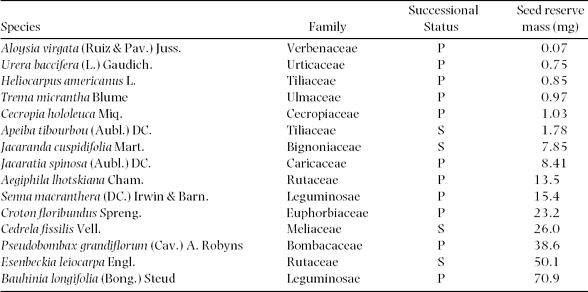
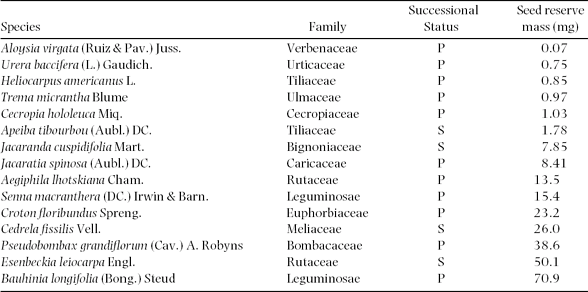
The species in this study (Table 1) are dicotyledonous, belonging to 13 different families (in the text they will be designated by the generic name). The seeds and leaf litter were collected in the Santa Genebra forest, Campinas, Brazil (22°49′S, 47°06′W: 670 m asl). This forest is a fragment of the Atlantic Forest. It is a semi-deciduous tropical forest standing in a reasonably fertile soil. The climate presents a warm and wet season and a dry season with mild temperatures. Seed mass was obtained after drying seed reserve organs (cotyledon plus endosperm) of 15 seeds in paper bags at 80 °C for 48 h. Species were classified by successional status according to Swaine & Whitmore (Reference SWAINE and WHITMORE1988). Exclusive gap colonizers were considered pioneers and species that can occur in gaps and under canopies at least in the early stages of ontogeny, were considered non-pioneers (secondary or climax species). Seeds were arranged in two size classes according to dry weight. Seeds with a reserve mass of 10 mg or more were considered large seeds and seeds with reserve mass less than 10 mg were considered small seeds. In the Santa Genebra forest, the seed size varies widely according to the species (from a few μg up to 2 g dry weight). Since smaller seeds were expected to be more affected by the layers of litter, species with seeds in the upper range of mass were not studied. For germination, seeds were sown in Petri dishes on filter paper imbibed in distilled water and placed in a growth chamber with a 12-h photoperiod at an alternating temperature of 30/20 °C. Experiments were conducted in a glasshouse in order to test the effect of litter on seed size and early seedling recruitment of 15 tropical tree species. Photosynthetic active radiation (PAR) was measured with a spectroradiometer (Licor 190A) connected to a data logger (LI-1000) and was about 45% of full sunlight. Temperature in the glasshouse during the experiment ranged from 39 °C to 10 °C. Shortly after germination, seeds were transferred to plastic trays with forest soil under three different conditions: (1) Control – germinated seeds were placed on the surface of soil without litter; (2) Under the litter – a wooden frame (5 cm wide) with the same dimensions as the tray was placed on the borders of the tray. Then, germinated seeds were placed on the soil, and litter was added over the soil to a depth of 5 cm; (3) Over the litter – a wooden frame with a fixed nylon net at its base was placed over the tray and filled with leaf litter. Germinated seeds were placed on the top of the leaf litter. The net at the bottom of the wooden frame facilitated the observations of root penetration into the soil without disturbing the leaf layer.
Some characteristics of the studied species. P: pioneers; S: Secondary or non-pioneers.
Trays were distributed in the glasshouse and their positions were changed every week in order to avoid bias (Hurlbert Reference HURLBERT1984). The choice of a 5-cm-deep layer was for ease of handling as well as being common for the forest floor. Four replicates of 15–20 seeds per litter treatment, per species, were used. After 60 d the number of surviving seedlings was counted in the control. The number of emerging seedlings was counted in the treatment under leaf litter. In the over-leaf-litter treatment only the seedlings in which the main root reached the soil through the nylon net were counted. Data were transformed into arcsine-square root values and analysed. Analysis of variance and the Tukey test were applied at the 5% level.
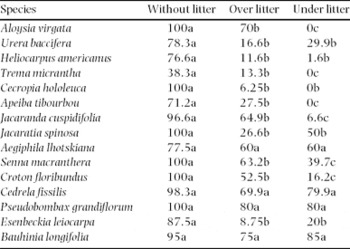
With regard to Bauhinia, Pseudobombax, Cedrela and Aegiphila, all considered as large-seeded species, there was no significant difference between the three treatments (Table 2). For these species litter layers did not represent a physical obstacle to growth, so that seedlings can emerge from below the litter layer or roots can reach the soil through the litter layer. For Urera, Heliocarpus, Trema, Jacaratia and Esenbeckia, there were no significant differences between under and over leaf litter, although both treatments inhibited seedling growth in relation to the control. With the exception of Esenbeckia with large seeds, the others are small-seeded species. This inhibition of seedling growth in relation to the control could be explained in the case of the under litter treatment to the small seedlings not having the strength to break through the layer of the litter above and, in the case of over litter, to low humidity at the litter surface causing reduced growth of the roots.
Percentage of emerging seedlings in the three treatments: without litter, over litter and under litter. Means followed by the same letter, in each row, are not significantly different by the Tukey test at the 5% level.

Aloysia, Apeiba, Cecropia, Jacaranda, Senna and Croton presented significant differences across all the treatments performed. The under-litter treatment was the one that most drastically affected the seedling emergence (coincidently the species had very small seeds, except for Senna and Croton). There was a positive relationship between seed mass and seedling emergence under litter (r = 0.76; P = 0.001), however, without a significant relationship between seed mass and roots reaching the soil (seedlings over the litter layer).
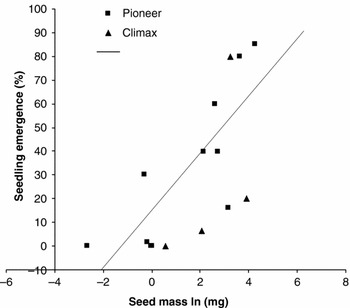
Aloysia, Apeiba, Cecropia, Trema, Heliocarpus, Jacaranda and Jacaratia, all considered as small-seeded species, did not succeed in overcoming the 5-cm-deep layer of leaf litter (Table 2). Nevertheless Aegiphila, Pseudobombax, Bauhinia and Cedrela, all considered as large-seeded species, presented high percentages of individuals emerging from the leaf litter (Table 2). The linear regression showed a positive significant relationship between seed size and percentages of individuals overcoming litter (Figure 1). However, there was no significant relationship between seed size and the number of roots reaching the soil surface. So there was no support for the argument of some authors that large-seeded species have an advantage because they produce larger roots and increase recruitment (Molofsky & Augspurger Reference MOLOFSKY and AUSPURGER1992). It seems that the amount of litter is more important than different types of litter since the larger-seeded species are more competitive than the smaller ones. Although this general tendency was in fact observed for most species, seed size had little effect on seedling establishment of some species. The species Urera, a small-seeded pioneer species, presented a significant percentage of individuals crossing leaf litter. Such percentages were even higher than those encountered for Esenbeckia, a late-successional large-seeded species. The large-seeded pioneers Senna and Croton, did not succeed in overcoming the litter layer. The elongation of the hypocotyl would increase the chance of emerging through the litter but would make a seedling more vulnerable to fungal attack and mechanical damage (Casal et al. Reference CASAL, BALLARÉ, TOURN and SANCHEZ1994). There must be factors other than seed size that are also important and leaf litter cannot be considered only as a physical barrier, since its deposition also affects micro-environmental conditions. Vazquez-Yanes et al. (Reference VÁZQUEZ YANES, OROZCO–SEGOVIA, RINCÓN, SÁNCHEZ-CORONADO, HUANTE and BARRADAS1990) showed that tropical tree litter can change spectral composition of light, especially when wet. Germination and seedling growth are both affected by these changes in light spectra (Ballaré et al. Reference BALLARÉ, SÁNCHEZ, SCOPEL and GHERSA1988, Kitajima & Fenner Reference KITAJIMA, FENNER and Fenner2000, Valio & Scarpa Reference VALIO and SCARPA2001). In this study, the germination factor was excluded since the experiments with litter started with previously germinated seeds. Even for large-seeded species plant establishment can be reduced by a shaded and wet litter environment, where there is an increase in the probability of infections by fungi or herbivore attack (Myster Reference MYSTER1994). Some authors also reinforce the phytotoxic effects of leaf litter (Carter & Grace Reference CARTER and GRACE1986).
Relationship between seedling emergence from litter and ln seed mass after 2 mo of treatment: r = 0.76; n = 15; P = 0.001; y = 15.1 + 12.1 x.

In conclusion, it seems that differences between under- and over-litter treatments lies more on physical conditions than seed characteristics. The under litter condition involves high mechanical pressure, high humidity, altered light quantity and quality, presence of many pathogens and allelopathic substances, all of which act against seedling emergence and survival. In these circumstances seed size seems to be important to overcome the negative effects of the litter. In case of the over litter condition in a gap, the upper layer of litter loses water during the sunny hours of the day thus affecting root growth. Under the canopy, where light quantity and quality are altered, the root:shoot growth ratio of the seedlings is drastically reduced in many pioneer and non-pioneer species. This phenotypic plasticity in which there is a higher translocation of photosynthates to the aerial part in detriment of the roots makes it almost impossible for the small roots to reach the soil under the litter layer. In this case, seed size is not relevant.