Introduction
Meningioma constitutes about 15–30% of primary brain tumours in adults.Reference Louis, Perry and Reifenberger1 Peak incidence is seen in the fifth to seventh decades.Reference Longstreth, Dennis, McGuire, Drangsholt and Koepsell2 The pathological classification as per WHO includes grade 1, grade 2 and grade 3.Reference Louis, Perry and Reifenberger1
Surgery is the mainstay of treatment, and the completeness of surgery is an important prognostic factor.Reference Stafford, Perry and Suman3,Reference Condra, Buatti, Mendenhall, Friedman, Marcus and Rhoton4 WHO grade 2 and 3 tumours have a higher incidence of recurrence rates, which range between 29–52% and 50–94%, respectively.Reference Aghi, Carter and Cosgrove5,Reference Yang, Park, Park, Kim, Chung and Jung6 Many studies have shown that the addition of adjuvant radiation (RT) could prevent recurrence and improve overall survival.Reference Milosevic, Frost, Laperriere, Wong and Simpson7–Reference Dziuk, Woo and Butler9
For grade 1 meningioma, RT is recommended as adjuvant treatment after subtotal resection (STR), definitive treatment or in recurrent setting. Adjuvant RT is indicated in grade 2 and 3 meningiomas irrespective of resection status. Modern RT techniques like 3D conformal RT (3DCRT), stereotactic RT (SRT) and intensity-modulated RT (IMRT) are associated with improved local control, survival and less toxicity.Reference Hug, Devries and Thornton8,Reference Henzel, Gross and Hamm10
Gross tumour volume (GTV) is defined as the tumour bed and the residual nodular enhancement on the postoperative contrast-enhanced MRI, and in definitive RT cases, it is the gross tumour seen on the contrast-enhanced MRI. Different CTV margins have been recommended in literature, ranging from 2 mm to 2 cm.Reference Hug, Devries and Thornton8,Reference Goldsmith, Wara, Wilson and Larson11–Reference Debus, Wuendrich and Pirzkall18 CTV margins are different with different conformal techniques such as 3DCRT, SRT, IMRT and SRS (stereotactic radiosurgery). There is no definite evidence to suggest that local recurrences are associated with reduced CTV margins.
In our centre, we had been using a different CTV margin for meningiomas. The aim of this retrospective study is to find the recurrence rates associated with various CTV margins and to identify the ideal CTV margin for meningiomas.
Materials and Methods
Study population
A retrospective review of 86 patients with a diagnosis of intracranial meningioma who received conformal RT for intracranial meningioma at our centre from 2014 to 2017 were included in the study after getting approval from the institutional review board (IRB No: 12151). Data was collected from the electronic medical records, RT charts, Eclipse version 13·7 (Varian Medical Systems, California, USA) and Brain Lab I Plan, version 4·5·5 (Hewlett Packard for Brainlab, Feldkirchen, Germany). Patient demographics, surgical and histopathological details, RT details, outcomes and follow-up data were analysed. Patients who did not come for follow-up were telephonically contacted and enquired about their symptoms and functional status.
Surgery
Operable patients underwent either gross tumour resection (GTR) or STR or near-total resection (NTR).
Radiotherapy
When patients were treated with SRT, GTV to PTV margin was 3–5 mm. In 3DCRT and IMRT, the GTV to PTV margin was between 5 mm and 2 cm. All patients received doses ranging from 54 to 59·4 Gy at 1·8 Gy per fraction using 6 MV photons.
Patterns of recurrence classification
For documented recurrences, recurrence imaging was deformably co-registered to planning CT scan. In-field recurrence was defined as recurrence within the 90% isodose line, and out-of-field recurrences were those that occurred outside the 90% isodose line.
Statistical analysis
Follow-up recurrences were estimated from the date of completion of RT. All the quantitative variables were summarised using mean or median with IQR depending on the distribution of each of the variables, and categorical data were summarised using frequency and percentage. Survival outcome was evaluated using Kaplan–Meier curves. Statistical analysis was done using SPSS software, version 21.
Results
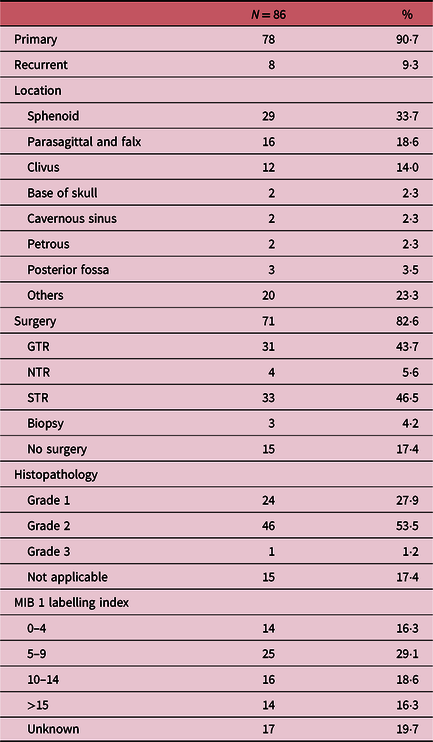
Patient, tumour, surgical and histopathological characteristics are summarised in Table 1. The median age of the study cohort was 46 years (range 17–72). Eight patients (9·3%) were treated for recurrent disease. Among the 86 patients, 82·6% underwent surgery of which 43·7% had GTR, 46·5% had STR and 5·6% had NTR.
Tumour surgical and histopathological characteristics
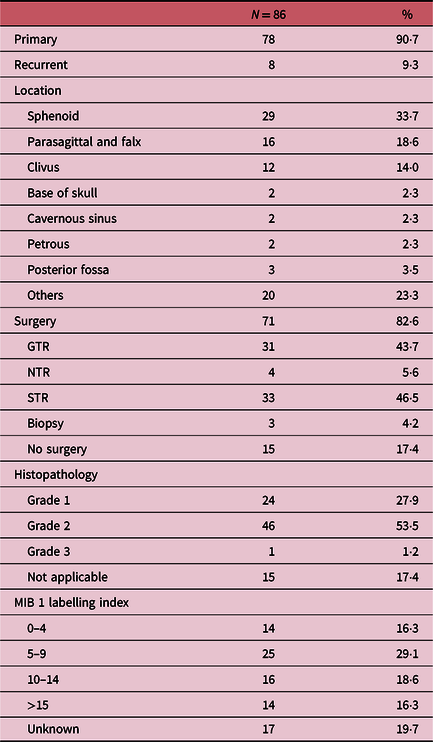
Surgery was not done in 13 patients due to unresectability and in two patients who were medically inoperable. All these patients received direct RT. Eleven of them were treated with SRT and four with 3DCRT.
There were 27·9% with grade 1, 53·5% with grade 2 and 1·2% with grade 3 meningiomas. The grade was unknown in 17·4% unresectable patients. Mindbomb E3 Ubiquitin protein ligase 1 (MIB 1) labelling index was <4% in 16·3% patients, 5–9% in 29·1% patients, 10–14% in 18·6% patients and >15% in 16·3% patients (Table 1).
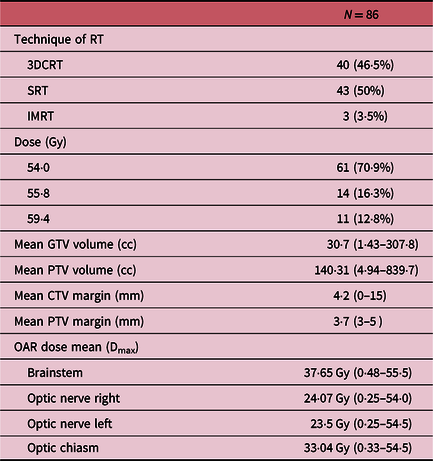
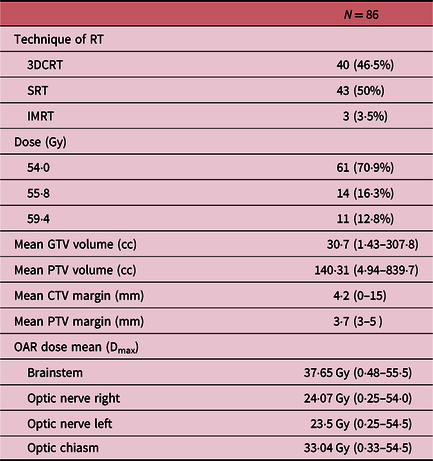
RT was delivered by SRT in 50%, 3DCRT in 46·5% and IMRT in 3·5%. RT dose delivered was 54 Gy in 30 fractions in 70·9%, 55·8 Gy in 31 fractions in 16·3%, and 59·4 Gy in 33 fractions in 12·8%. The mean GTV volume was 30·7 cc (range 1·43–307·8). The mean CTV and PTV margins were 4·2 mm (range 0–15) and 3·7 mm (range 3–5), respectively. The doses to all the organs-at-risk were within acceptable limits (Table 2).
Details of RT
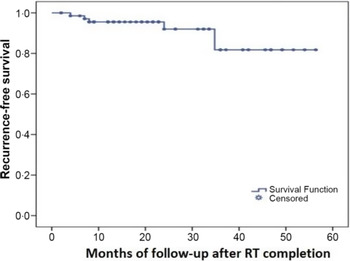
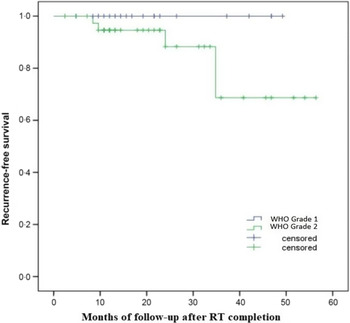
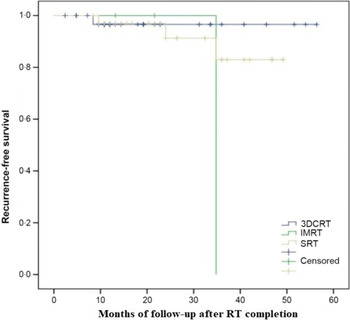
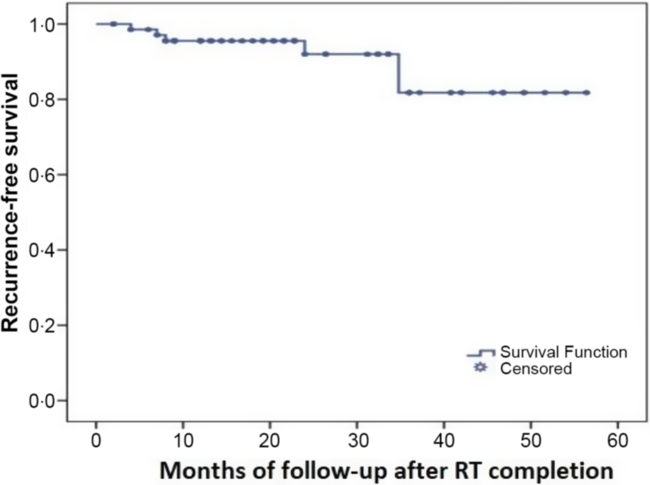
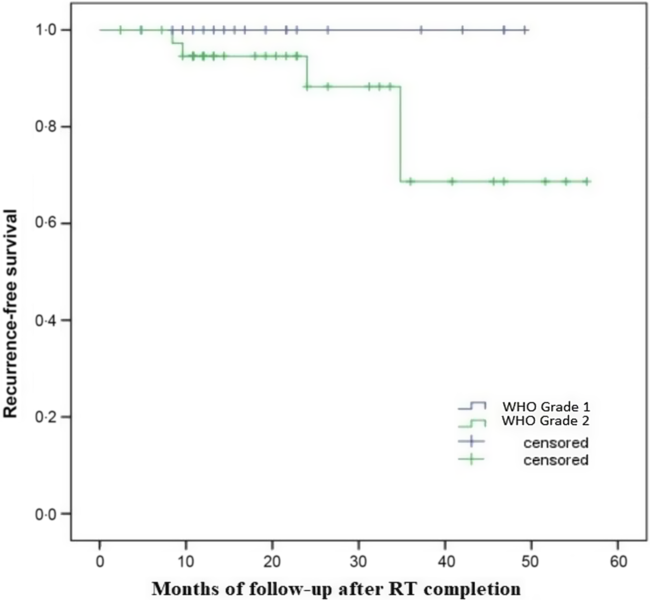
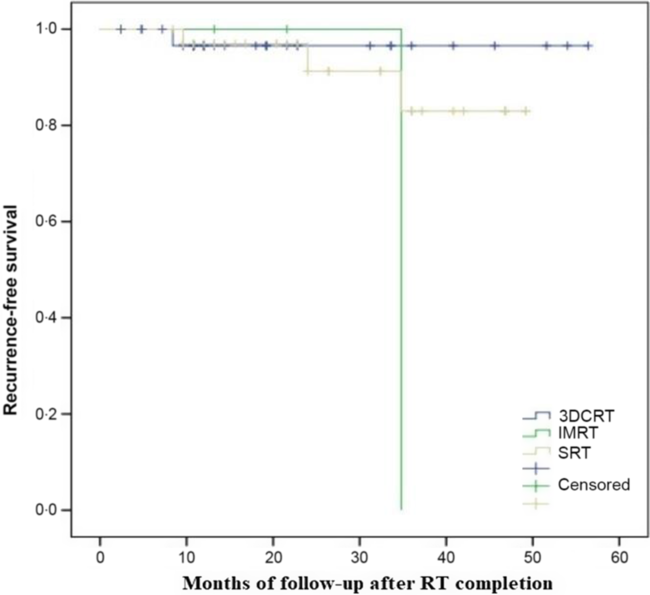
The median follow-up was 1·7 years (range 0·2–4·7). Fifteen patients (17·4%) were lost to follow-up and were censored during analysis. One patient died due to unrelated cause at four months. Five patients (5·8%) had disease recurrence at a median duration of 2 years (range 0·7–2·9). The 3-year recurrence-free survival (RFS) was 81·5% (Figure 1). Figure 2 shows the RFS for grade 1 and 2 tumours. Figure 3 shows RFS in relation with RT techniques.
Kaplan–Meier curve showing RFS for all patients.
Kaplan–Meier curve showing grade of tumour and RFS. *Grade 3 was excluded from Kaplan–Meier as there was only one patient.
Kaplan–Meier curve showing RT technique and RFS.
Patterns of recurrence
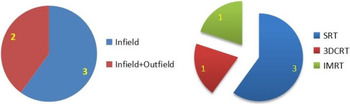
Among the five patients who had disease recurrence, three had in-field recurrence and two had in-field and out-of-field recurrence (Figure 4). Three patients were treated for recurrent tumours.
Recurrence patterns and technique.
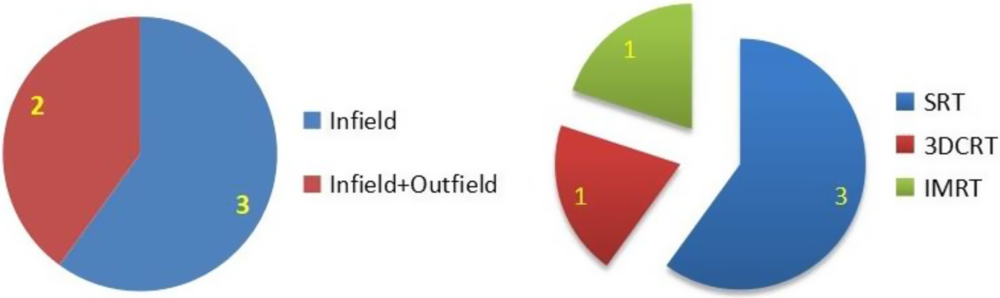
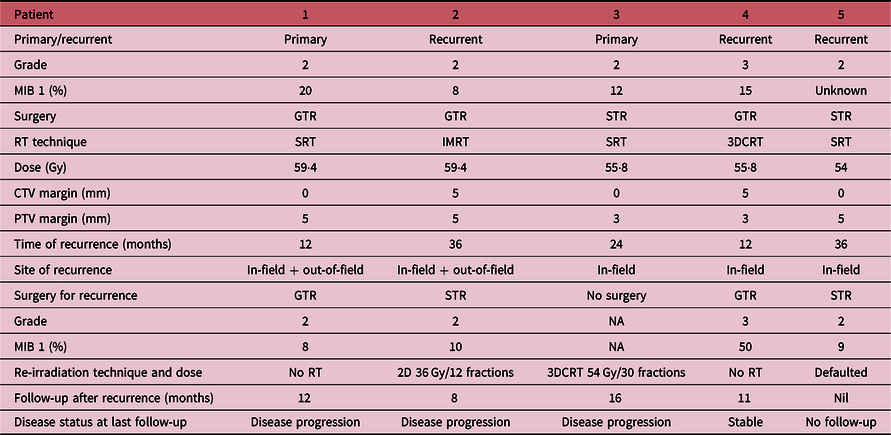
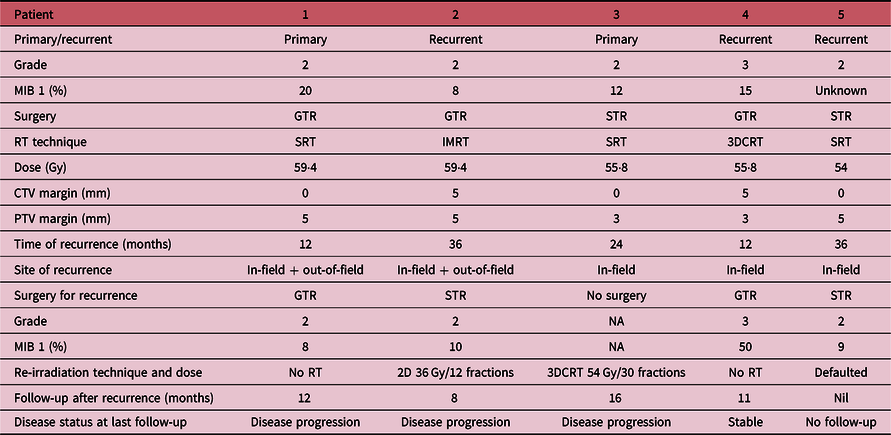
Four were grade 2 and one was grade 3 tumours. All patients had high MIB 1 index. Among the patients who recurred, three had SRT, one 3DCRT and one IMRT (Figure 4). Table 3 shows the characteristics of recurrent cases.
Characteristics of recurrent cases
Management of recurrence
Of the five patients, four underwent re-excision (two GTR and two STR) and two had re-irradiation. At last follow-up, three patients had further disease progression and were treated with palliative treatment (Table 3).
Discussion
GTR is the main stay of management and gives better local control outcomes compared to partial resection. Nevertheless, the addition of RT reduces local recurrence rate and improves survival irrespective of the grade of meningioma.Reference Hanft, Canoll and Bruce19–Reference Rogers, Gilbert and Vogelbaum21 The 10-year survival rates after surgery and RT for WHO grade 1 meningiomas vary between 88 and 98%.Reference Condra, Buatti, Mendenhall, Friedman, Marcus and Rhoton4,Reference Ohba, Kobayashi and Horiguchi22 The 2-year and 5-year overall survival rates for WHO grade 2 meningioma following surgery and RT are 93 and 73%, respectively, and for WHO grade 3 are 57 and 42%, respectively.Reference Combs, Schulz-Ertner, Debus, von Deimling and Hartmann23
In a study by Vendrely et al. on 156 patients with intracranial meningiomas who received RT, the local control was 79·4% at a median follow-up of 40 months.Reference Vendrely, Maire and Darrouzet24
Park et al. analysed the role of adjuvant RT in atypical meningiomas. Among the 83 patients, 56 had surgery alone and 27 had surgery followed by RT. The median radiation dose was 61·2 Gy. The 3-year progression-free survival (PFS) was 71% with GTR and RT, and 65% after GTR alone.Reference Park, Kang and Kim25
Asymptomatic or incidentally detected WHO grade 1 meningiomas are managed by observation using annual MRI examinations.Reference Vernooij, Ikram and Tanghe26 GTR is the cornerstone in the definitive management of symptomatic tumours.Reference Chamberlain27,Reference Kumar, Kumar, Khosla, Gupta, Radotra and Sharma28 SRS can also achieve excellent local control rates ranging between 89 and 99% at 5 years and 79–97% at 10 years in grade 1 meningiomas.Reference Cohen-Inbar, Tata, Moosa, Lee and Sheehan29–Reference Unger, Lominska and Chanyasulkit33
In a study by Huffmann et al., 15 patients with atypical meningioma were treated with SRS with a median dose 16 Gy. The crude local control was 60% at 18–36 months. Six patients (40%) progressed within the resection bed.Reference Huffmann, Reinacher and Gilsbach34
Choi et al. reported 25 patients with atypical meningioma with a median SRS dose of 22 Gy in 1–4 fractions. Out of the nine patients with recurrence, three had within the target volume, five had in resection bed and one had inside and outside of target volume.Reference Choi, Soltys and Gibbs35 Thus, the target volume in atypical meningioma extends beyond the enhancing tumour, and the entire surgical bed has to be included in the treatment volume with adequate margins.Reference Rogers, Zhang and Vogelbaum16,Reference Attia, Chan and Mott36
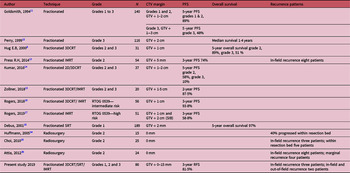
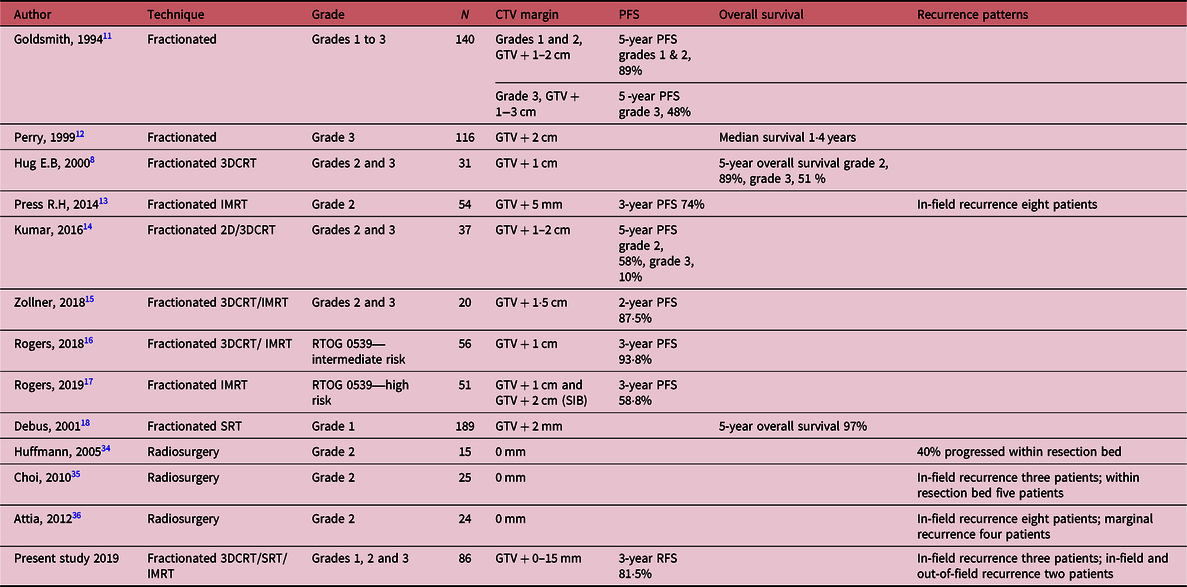
Table 4 shows multiple studies with different CTV margins and outcomes. In grade 1 and 2 meningiomas a CTV margin of 1–1·5 cm and in grade 3 meningiomas a CTV margin of 2 cm will be ideal.
Studies showing different CTV margins
NRG Oncology RTOG 0539
NRG Oncology RTOG 0539, a phase II study, allocated meningioma into three risk groups, viz. low, intermediate and high risk, based on WHO grade, extent of resection and recurrence status.
Intermediate-risk group included:
-
1. Newly diagnosed WHO grade 2 with gross total resection
-
2. Recurrent WHO grade 1 of any resection extent.
They received RT to a dose of 54 Gy in 30 fractions either by 3DCRT or by IMRT. GTV was delineated based on postoperative MRI. The CTV was GTV plus 1 cm, and the PTV was CTV plus 3–5 mm. Among the 52 patients who received RT, 48 were evaluable, and the 3-year PFS was 93·8% (p = .0003).Reference Rogers, Zhang and Vogelbaum16
High-risk group included:
-
1. Newly diagnosed or recurrent WHO grade 3 meningioma irrespective of resection extent
-
2. Recurrent WHO grade 2 meningioma irrespective of resection extent
-
3. Newly diagnosed WHO grade 2 meningioma after STR.
All patients received IMRT using a simultaneous integrated boost (SIB)—60 Gy in 30 fractions to PTV 60, and 54 Gy in 30 fractions to PTV 54. GTV was delineated based on pre- and postoperative MRI. CTV 60 was GTV plus 1 cm margin, and CTV 54 was GTV plus 2 cm margin. PTV was CTV plus 0·3–0·5 cm margin.
Among the 57 patients who received RT, 53 were evaluable and the 3-year PFS was 58·8%.Reference Rogers, Won and Vogelbaum17
Low-risk group included newly diagnosed WHO grade 1 meningioma irrespective of resection status. These patients were observed following surgery. Initial reports suggest that surgery followed by observation can be advised following gross total resection. However, following STR they may benefit from adjuvant RT.Reference Rogers, Zhang and Vogelbaum37 Multiple other studies also have shown that RT improves local control in symptomatic WHO grade 1 meningiomas.Reference Cohen-Inbar, Tata, Moosa, Lee and Sheehan29,Reference Sheehan, Starke and Kano38–Reference Jang, Jung, Chang, Chang, Park and Chang40
RT alone is effective in treating unresectable meningiomas and provides excellent tumour control. This approach is most commonly used for skull base meningiomas and optic nerve sheath meningiomas.Reference Korah, Nowlan, Johnstone and Crocker41
The majority of our patients were WHO grade 1 and grade 2 meningiomas. Our 3-year RFS was 81·5%, which is comparable with many of the cited studies on grade 1 and 2 meningiomas.Reference Hug, Devries and Thornton8,Reference Goldsmith, Wara, Wilson and Larson11,Reference Press, Prabhu and Appin13–Reference Rogers, Zhang and Vogelbaum16 None of our patients with grade 1 meningioma had recurred, and it is same as with published literature.Reference Goldsmith, Wara, Wilson and Larson11,Reference Debus, Wuendrich and Pirzkall18 Studies that have utilised radiosurgery with 0 mm CTV margin for meningiomas have showed in-field and marginal recurrences in the range of 30–40%.Reference Huffmann, Reinacher and Gilsbach34–Reference Attia, Chan and Mott36 In our series, we did not treat any patients with radiosurgery; however, we had three in-field recurrences among 43 patients who were treated with SRT and all three had 0 mm CTV margin.
Limitations of the study
A major limitation of our study was its retrospective nature, and our CTV margins were irrespective of grade and resection status Hence, we strongly believe that a risk grouping based on resection status and grade, as suggested by NRG Oncology RTOG 0539 trial, will help in standardising margins required for volume delineation and would result in reducing local recurrences and improving survival in meningiomas.
Conclusion
In summary, local recurrences are more common in WHO grade 2 and 3 meningiomas. SRT had more recurrence probably because of smaller CTV margins. We propose to use a CTV margin of at least 5−10 mm as well as a dose escalation to 59·4 Gy to prevent/reduce local recurrences in grade 2 and grade 3 meningiomas.
Acknowledgements
We acknowledge the contributions made by the statistician, Ms Dona Maria Philip.
Disclosures
None.
Sources of support
None.