Does integration into the international system help developing countries enhance their environmental performance? Although industrialized countries still account for the bulk of environmental pollution, emissions generated in developing countries have increased significantly over recent years. For example, a recent report by the International Energy Agency (IEA) states that carbon dioxide (CO2) emissions by developing countries ‘increased at a much faster rate’ than CO2 emissions by industrialized countries.Footnote 1 It is thus crucial to understand which factors have the potential to slow the increase in pollution in developing countries, contributing to national and global sustainability.
The existing literature pays considerable attention to the effects of income, democracy and economic openness when explaining variation in the environmental performance of both industrialized and developing countries.Footnote 2 I argue that membership in inter-governmental organizations (IGOs) improves the environmental performance of developing countries because IGOs can provide them with much needed resources in the form of knowledge and technology necessary to curb pollution. Furthermore, IGOs can constitute a forum in which actors having an interest in environmental quality may successfully influence other countries’ behaviour. Finally, in addition to increasing the reputational stakes for reneging on agreements, IGOs also allow for issue linkage.
I test these propositions empirically using time-series cross-section analysis of 114 developing countries from 1970 to 2000. The results confirm that IGO membership is indeed associated with a reduction in both air pollution and emissions of greenhouse gases. Moreover, I find that, whereas an increase in income leads to higher emissions, the type of political regime does not have any effect on environmental performance in developing countries.Footnote 3
To understand the mechanisms behind the strong effect of IGO membership on developing countries’ environmental performance better, I disaggregate IGO membership on the basis of function and degree of institutionalization. Surprisingly, it is not membership in environmental IGOs that drives the results. Rather, it is membership in umbrella, nuclear, economic general and military organizations that is conducive to improved environmental performance in less developed countries. A possible explanation is that these types of organizations, by disseminating information, providing technological and financial resources and successfully linking different issues, enhance the capacity of developing countries to provide environmental quality.
While some degree of formalization or institutionalization of an organization is needed to affect environmental quality in developing countries, interestingly, those organizations that can constrain their member countries’ behaviour the most are not necessarily the most effective ones. With regard to CO2 emissions, the effect of moderately institutionalized organizations is more pronounced than the effect of the most institutionalized ones. A possible explanation is that technology and knowledge transfer, issue linkage and broader socialization processes might work well as long as the organization possesses at least some degree of institutionalization.
The implications of this article are twofold: first, international integration should not be reduced to trade opennessFootnote 4 and capital mobility, since other important characteristics of the international system, such as membership in IGOs, seem to affect environmental performance in important ways. Indeed, this article finds that trade openness and foreign investment are not systematically associated with a reduction in emissions, whereas IGO membership is always connected with improvements in environmental quality. Second as the type of the political regime does not seem to play a significant role in the environmental performance of developing countries, tying them into a strong system of international organizations might be a fruitful way forward.
The following section develops the theoretical argument and outlines the hypotheses to be tested. Next, the data and methods used are described, and the results of the empirical analysis are presented. The final section summarizes the findings and discusses the theoretical and policy implications.
Theoretical framework
The theoretical argument is structured in three parts. First, the effect of IGO membership is analysed by emphasizing two main channels through which IGO membership can alter environmental quality in developing countries. On the one hand, I argue that integration into the international system can enhance the willingness of developing countries to improve their environmental performance through issue linkage and the diffusion of environmental interest. On the other hand, it can augment the capability of developing countries to foster environmental quality through the flow of resources in the form of knowledge and improved technologies. Second, following the logic of the Environmental Kuznets Curve, I present arguments suggesting that, in the case of developing countries, an increase in national income should be associated with a decrease in environmental quality. Third, drawing on the literature dealing with the relationship between the political system and the provision of public goods, I posit that the political system should not have an independent effect on environmental quality in developing countries. This implies that democratic developing countries should not be characterized by better environmental performance relative to their autocratic counterparts.
Membership in International Organizations
Most of the literature on international integration and the provision of environmental quality focuses solely on economic facets of international integration, such as tradeFootnote 5 and foreign direct investment (FDI).Footnote 6 Few studies have taken the political dimension of globalization into account. A notable exception is that by Ward, who examines whether countries that are more central to the network of international environmental regimes act more sustainably at the national level.Footnote 7 Using social network analysis, he finds that more central countries indeed care more about domestic environmental quality. Although his study concentrates on the network of international environmental treaties and organizations, he notes:
the Kantian view is that IGOs, economic interdependence and democracy form a mutually supportive triangle that promotes peace. The network of IGOs facilitates deterrence of bad behaviour, mediation and problem-solving, sharing of information and the generation of norms and trust.Footnote 8 This raises the possibility that nations’ environmental records may relate to their general position in the international system, just as recent work suggests that joint membership of non-trade-related IGOs increases trade between pairs of nations.Footnote 9, Footnote 10
Following Ward, I propose to analyse the impact of IGO membership on a country's willingness to take care and capability of taking care of its environment. Thereby, I evaluate whether the inclusion of the political aspect of international integration, in addition to the economic facets of globalization, adds to our understanding of environmental quality in developing countries.
The general purpose of intergovernmental organizationsFootnote 11 is to facilitate co-operation at the international level and thereby enable countries to solve problems that they often are unable to solve independently, thus realizing benefits from mutual co-operation.Footnote 12 IGOs promote co-operation by reducing transaction costs, decreasing uncertainty, strengthening the shadow of the future, increasing reputational costs and by allowing credible commitments.Footnote 13 Consequently, I argue that membership in IGOs may influence the environmental performance of developing countries for the following reasons:Footnote 14
(1) At least in principle, IGOs can compel member states to obey their rules by raising the reputational stakes for reneging on agreements.Footnote 15 In addition, many IGOs establish non-compliance procedures such as sanctions that can help enforce conformity with the rules of the organization. Note, however, that this will directly affect environmental quality only in the case of IGOs that have some environmental purposes, such as the Multilateral Fund for the Implementation of the Montreal Protocol or the North Atlantic Salmon Conservation Organization.
(2) IGOs create norms defining good behaviour – or rather what constitutes bad conduct.Footnote 16 Although a specific IGO might not have been created with an explicit environmental mandate, the broader idea of environmental protection as being of importance might still spread through membership in this IGO. In this sense, international organizations can constitute a forum in which states and other actors that have an interest in environmental protection, such as environmental non-governmental organizations (ENGOs), can promote this idea and also influence other states. Hence, IGO membership can be important to socializing states in relation to environmental protection.
A pertinent example is sustainable development. In the last two decades many IGOs have taken up this issue. Although not all of these organizations actually provide developing countries with relevant technologies and resources, they increase both domestic awareness and international pressure for sustainable development. IGOs such as the Organization of American States or the African Union are examples of organizations that have passed declarations devoted to sustainable development, and the former has even established a department dealing with this issue, besides embracing the promotion of environmental quality.Footnote 17
This effect of IGO membership is also emphasized in the literature on policy diffusion. Cao, for example, shows that interactions at the international level through trade ties or connections in IGO networks, which serve as channels for information transfer, play a significant role in the socialization process among states.Footnote 18
(3) Even though countries become members of an IGO for specific reasons, e.g. financial assistance, they are also exposed to the other purposes of the organization, such as environmental protection. Examples include the World Bank and the European Union (EU). Jahn, for instance, posits that ‘membership in an international organization such as the EU may support the improvement of environmental standards. The rationale is that particular environmentally conscious countries take the role of pioneers that push environmental issues onto the agenda of countries that might be perceived as environmental laggards’.Footnote 19 The case of Laos corroborates this argument. By joining the Association of Southeast Asian Nations (ASEAN) in 1997, Laos was required to implement a number of agreements pertaining to making agri-economic development more sustainable, which as a side effect positively affected Laos's environment.Footnote 20
The three arguments above all refer to mechanisms through which IGOs might influence a country's willingness to enhance its environmental performance. In this sense, these arguments can equally pertain to both developing and developed countries. However, an additional argument suggests that membership in IGOs may especially affect the capability of developing countries to improve their environmental performance by allowing for information and technology transfer. This channel is especially important since developing countries often lack the necessary resources and technologies to combat environmental degradation.Footnote 21 Porter et al. argue that new information and knowledge about environmental pollution can create awareness of environmental quality as an important public good, and knowledge about technology for abatement could be distributed.Footnote 22 This implies that a country that is better ‘politically’ integrated in the international system could receive more relevant information and could more easily draw on technical knowledge and assistance from international organizations. Examples of IGOs that diffuse information and technologies that also benefit the environment are the World Bank, the Food and Agriculture Organization (FAO) and the World Health Organization (WHO). The World Bank as part of its general ‘greening’ strategy created, together with some Western governments, the Global Environment Facility (GEF), which aims to provide mainly developing countries with grants and technical assistance to address environmental problems such as climate change, ozone depletion, biodiversity loss and pollution.Footnote 23 Similarly, the FAO's department dealing with natural resource management and environmental issues seeks to promote sustainable land and water use by providing technical assistance and research-driven knowledge on the best ways of achieving sustainable farming and the sustainable management of natural resources. In that way, the organization directly transfers technology and knowledge necessary to reduce environmental pollution to developing countries. Hence, although these organizations mostly pursue goals that are not motivated by environmental protection per se, such as access to safe drinking water and sustainable farming, they also provide technologies and know-how that are often conducive to protecting the environment.
Taken together, these arguments lead to the conjecture that membership in IGOs should positively influence the environmental performance of developing countries:
HYPOTHESIS 1: A developing country that is a member of more IGOs provides higher levels of environmental quality.
However, one could argue that not all international organizations can influence developing countries’ environmental performance to the same extent. Gartzke et al. note that IGOs differ with regard to their degree of institutionalization and thus with regard to their ‘ability to enact policies and decisions’.Footnote 24 Accordingly, the degree of institutionalization of an IGO may partly determine to what extent it has the capability to influence its members. That is, while IGOs whose ‘bureaucratic, executive, or judicial organs do not have any formalized power’Footnote 25 (minimally institutionalized IGOs) should lack the capability to strongly exert influence over their members, IGOs that ‘possess clear mechanisms for coercing or influencing state behaviour’Footnote 26 (strongly institutionalized IGOs) could in principle limit member states’ sovereignty and thus affect their policies.
Consequently, the influence channels of IGOs discussed above, such as issue linkage or the provision of knowledge and technology, should be more pronounced in those IGOs that are more institutionalized. In contrast, minimally institutionalized IGOs, which lack strong administrative structures and capabilities, might find it harder to provide resources in the form of knowledge and technology needed in developing countries to enhance their environmental performance. Hence, I expect that more institutionalized IGOs possess the institutional requirements to influence environmental quality in developing countries, whereas the influence of minimally institutionalized IGOs should not be so pronounced.
HYPOTHESIS 2: The effect on developing countries’ environmental quality is greater for more institutionalized IGOs than for minimally institutionalized ones.
Domestic Factors
In addition to a country being influenced by its degree of international integration, there are important domestic factors that shape its environmental performance. The literature puts special emphasis on a country's income and its political system. Consequently, I will discuss these two factors in the following paragraphs and adapt the argument to the specific context of developing countries.
Income
Many empirical studies find an inverted U-shaped relationship between gross domestic product (GDP) per capita and several indicators of environmental pollution, labelling this the Environmental Kuznets Curve (EKC).Footnote 27 The logic underlying the EKC is that, in the course of a country's economic development, rising national income increases the scale of economic activity, which – all else being equal – leads to rising pollution levels (scale effect). However, after a certain threshold of national income has been reached, pollution is supposed to decline: first, the composition of the economy is likely to change from manufacturing to service industries (composition effect); second, technological progress tends to reduce pollution (technology effect). In addition, during the early stages of economic development, environmental quality is usually considered a luxury good;Footnote 28 and since states only have limited resources available, environmental quality usually ranks far behind the demand for better economic conditions. However, once people attain a certain standard of living, environmental quality turns into a normal public good and citizens demand that their government take action to reduce or avoid pollution, for example, by enacting appropriate environmental regulations.Footnote 29
Applied to the context of developing countries, the EKC argument implies that most, if not all, of these countries should be situated on the upward sloping part of the curve. This means that these countries are confronted with deteriorating environmental quality when experiencing economic growth, since at their present stage of economic development neither the composition nor the technological effect would outweigh the scale effect. Consequently, we should expect that for developing countries an increase in national income would be associated with a reduction in environmental quality, because these countries have not yet reached the point after which an increase in national income is associated with an increase in environmental quality.
Political system
In addition to the effects of the EKC argument that developing countries will face increasing environmental degradation as they get wealthier, even democratic political structures might not play a positive role in the provision of environmental quality in developing countries.
A number of studies relate democracy or democratic structures to environmental quality.Footnote 30 Most of this literature shows that democracies, in general, tend to be better providers of environmental quality, although the magnitude of the effect seems to vary strongly with the particular indicator used to proxy environmental quality. The general logic underlying most of these studies is that democracies provide more public goods to their citizens than do autocracies because democratic leaders need the support of the majority of their citizenry in order to survive in office.Footnote 31 In this context, the recent literature often relies on Bueno de Mesquita et al.'s selectorate theory to analyse the influence of the political system on the provision of public goods.Footnote 32 Bueno de Mesquita et al. define the selectorate as the group that is eligible to select the leader of a country. The winning coalition is then defined as the subgroup of the selectorate whose support is necessary for the leader to gain or stay in power. In a democracy with a majoritarian electoral system, the winning coalition would be about half of the selectorate, whereas in an autocracy this would be a small elite group usually consisting of the military or party elites. Applying Bueno de Mesquita et al.'s terminology, we can deduce that leaders in autocracies need to satisfy a smaller winning coalition in order to stay in power compared with leaders in democratic countries.Footnote 33 Since leaders have only limited resources at their disposal to attain political support, it follows that autocratic leaders can concentrate these resources on their small winning coalition, whereas leaders in democracies need to disperse their resources to a larger group. To maximize political support given their resources, it is more efficient for democratic leaders to provide public goods than to buy off their winning coalition with targeted private goods. Consequently, democratic leaders should provide more public goods to ensure the support of a larger group, whereas in autocracies leaders should mostly rely on private goods targeted to their small winning coalition.
In contrast to Bueno de Mesquita et al.'s reasoning, it can be argued that autocracies might supply more public goods as their leaders usually have a longer planning horizon.Footnote 34 As most environmental problems develop slowly and often only become apparent in the distant future, democratic leaders, who may be seen as being more myopic due to more frequent elections, might not be interested in facing the short-term costs of providing long-term environmental quality.Footnote 35 In addition, some studies claim that in mature democracies public goods are underprovided, because special interest groups have gained a disproportionate influence on the government. Therefore, they say, democratic governments often provide private goods to these interest groups instead of providing public goods to the whole population.Footnote 36
The crucial assumption if democracy is to have a positive effect on environmental quality is that the median voter demands that the government provide this public good. However, the particular nature of environmental quality as a luxury good implies that environmental quality is demanded very little or not at all at low-income levels, demand rising as income increases.Footnote 37 People in developing countries might, therefore, not demand that their governments take action in order to enhance environmental quality. As Neumayer notes: ‘This need not imply that poor countries care less about the environment per se. Rather, because of their poverty, they might prioritize issues other than the environment’.Footnote 38 This point is important since I do not argue that people in developing countries do not care about pollution. The argument states only that people in developing countries prioritize issues such as economic growth, education or health care over environmental quality. This in turn implies that democratic developing countries that have only limited resources at their disposal might not have strong incentives to invest these resources in the provision of environmental quality.
Consequently, I argue that the political system should not have an independent effect on the environmental performance of developing countries. Or, put differently, if there is no (or very little) public demand pressuring a government to increase environmental quality, democratic governments do not have enough electoral incentives to spend scarce resources on improving their environmental performance. Hence, democratic developing countries per se should not be characterized by higher environmental quality relative to their autocratic counterparts.
In summary, this article postulates that membership in international organizations can improve the environmental performance of developing countries by linking different issues, by promoting the general idea of environmental sustainability, and by providing a channel through which these countries may receive technology and resources necessary to reduce pollution. Furthermore, the theoretical arguments suggest that an increase in a country's income should be associated with a decrease in its environmental performance, while the political system should not play a decisive role in the provision of environmental quality in developing countries.
Empirical analysis
I use time-series cross-country (TSCS) analysis covering the period 1970–2000 to test my hypotheses. Based on the theoretical arguments, the sample consists of all developing countries in the world. Each year the World Bank publishes a classification of countries into low-income, lower-middle income, higher-middle income and high-income groups.Footnote 39 Following this classification, I include in my sample all countries that are not characterized as ‘high-income’. Since the classification threshold varies each year, the highest threshold, which is the one in the year 2000, was chosen. Hence, the 114 countries with a Gross National Income (GNI) per capita level of less than US$ 9,266 were included in the sample. However, in order to test the robustness of my results, all the statistical models were re-estimated using only the samples that include all the countries up to the lower-middle income level (US$ 2,995) and up to the low-income level (US$ 755) classification thresholds, respectively. The results were not sensitive to sample size.Footnote 40
Variables
The motivation behind this article is to identify whether membership in IGOs can help developing countries curtail their environmental pollution. Although environmental regulation is often a necessary condition for improved environmental outcomes, several reasons have led me to focus exclusively on environmental quality measures. First, in contrast to domestic environmental policy outputs, environmental quality measures are in most cases easily comparable across countries, especially in the case of developing countries. Second, alongside country fixed effects, the empirical design controls for various factors such as economic growth and population structure that could potentially compromise governments’ ability to affect environmental quality. Third, it is usually the case that citizens care more about whether pollution is reduced than whether their government has enacted certain environmental regulations; therefore, environmental quality measures should be at the heart of this study.
In the literature, many different measures of environmental quality have been employed such as indicators of air quality,Footnote 41 water qualityFootnote 42 or indices that combine several measures of environmental quality such as the environmental sustainability index or the genuine savings index.Footnote 43 Unfortunately, the paucity of data that exists in time-series cross-section format limits the choice to sulphur dioxide (SO2) and carbon dioxide (CO2) emissions.Footnote 44 The two indicators are measured in levels instead of growth rates for two reasons. First, I consider levels as more appropriate, since all my arguments refer to the quality of the environment and not to changes in environmental performance. And, second, changes could be misleading in the sense that the growth rate of pollution may be high, implying bad environmental performance, whereas the overall state of the environment is still good; or growth rates may be low while the state of the environment is quite bad.
Both indicators proxy for important aspects of environmental quality: SO2 is a primary contributor to acid rain and detrimental to human health and the well-being of the ecosystem. It mostly arises from burning fossil fuels such as coal or oil and is primarily emitted by power plants, petroleum refineries, metal processing facilities, locomotives and large ships. The data on SO2 emissions are taken from Stern.Footnote 45 CO2 is largely a by-product of energy production and use and is mainly released during the combustion of fossil fuels and cement manufacturing.Footnote 46 CO2 emissions are the primary contributor to global warming and climate change since they account for the majority of greenhouse gases.Footnote 47 The data on CO2 emissions come from the World Bank's Development Indicators.Footnote 48 Both SO2 and CO2 emissions are measured in thousand metric tons per capita in order to control for population size. I use the natural log of both variables because of their long right-tail distribution.
Theory suggests that developing countries that are members of more IGOs should emit less SO2 and CO2. However, the different natures of the two pollutants suggest that the effect could be stronger in the case of SO2 and less pronounced in the case of CO2. This is because SO2, compared with CO2, is a local air pollutant whose adverse effects on the environment and human health are felt locally. In contrast, the harm arising from CO2 pollution is of a global nature, implying that governments need to co-ordinate in order to combat the effects of CO2 emissions, which opens the possibility for free-riding behaviour. Furthermore, the effects of CO2 emissions, such as climate change, are long term in nature, whereas SO2 emissions have more short-term effects, such as acid rain. This might give governments an additional incentive to prioritize the abatement of SO2 over CO2 emissions. Hence, we might see a difference in the magnitude of the negative effects of IGO with the effect being bigger for SO2.
The main independent variables of my analysis are a country's membership in intergovernmental organizations, its income and its political system. The first independent variable is operationalized as the yearly cumulative count of each country's IGO memberships. The data come from the Correlates of War Project (COW).Footnote 49 The use of this cumulative measure is appropriate as this acknowledges that being a member of a certain number of IGOs limits a country's options for further membership, whereas the number of new memberships per annum does not do so.
To evaluate the argument that more institutionalized IGOs may be more effective in influencing developing countries’ environmental performance than IGOs that only exist on paper, I rely on data from Boehmer et al.Footnote 50 They code three degrees of institutionalization: minimally, moderately and highly institutionalized IGOs.Footnote 51 Minimally institutionalized IGOs are organizations that ‘lack any bureaucratic, executive, or judicial organs that possess any formalized power’.Footnote 52 Medium institutionalization refers to organizations to which ‘member states relinquish minimal amounts of their sovereignty to support IGO projects and missions’Footnote 53, and highly institutionalized IGOs are organizations that ‘possess clear mechanisms for coercing or influencing state behavior’.Footnote 54
The political system of a country is operationalized using the combined Polity IV score ranging from 1 – most autocratic – to 21 – most democratic.Footnote 55 Polity IV captures the competitiveness of political participation, the guarantee of openness and competitiveness of executive recruitment, and the existence of institutionalized constraints on the exercise of executive power. Since Polity IV has been criticized with regard to its aggregation procedure,Footnote 56 I use two additional measures of democracy for robustness checks. First, I rely on the dichotomous index of democracy developed by Alvarez et al. (ACLP index)Footnote 57 and, second, I use Bueno de Mesquita's measure capturing the size of the winning coalition relative to the size of the selectorate.Footnote 58
To account for the effect of national income on pollution, the log of GDP per capita is included in the model. Although the logic of the environmental Kuznets curve suggests that both GDP per capita and its square term should be included in the regression model, doing so results in statistically insignificant estimated coefficients for both variables.Footnote 59 This is due to the fact that the analysis is restricted to developing countries. Here we should observe income negatively impacting on environmental performance.Footnote 60 Therefore, using a quadratic specification does not capture the theoretically expected relationship. The data on national income come from Gleditsch, which is an updated version of the Penn World Tables.Footnote 61
A number of control variables are also included in the statistical model. I control for the fact that a growing economy is often associated with environmental degradation. Since a larger population usually consumes more natural resources and thereby produces greater environmental degradation, population density is also included.Footnote 62
Several existing studies have examined the economic facets of globalization and their influence on environmental quality. To be able to separate the impact of international political integration from the economic aspects of international integration, I also include a country's trade openness and its foreign direct investment (FDI) inflows. The literature on economic globalization and provision of public goods contrasts arguments on general welfare enhancing gains with arguments on regulatory competition.Footnote 63 According to the first argument, stronger economic integration should have, on average, a positive effect on environmental quality because of the welfare enhancing gains of globalization. In particular, it is argued that increasing economic integration allows countries to specialize in industries in which they have a comparative advantage, making for a more efficient allocation of resources and higher productivity. As a result, a country's national income is supposed to increase, which then leads to higher public goods provision.Footnote 64 According to the second argument, increasing economic interdependence leads to strong regulatory competition between countries.Footnote 65 In order to increase their competitiveness and attract foreign capital, countries are pushed towards less stringent regulations, which can lead to either a regulatory chill or even to a race to the bottom that would undermine the provision of public goods such as environmental quality and social welfare benefits. Which of the two effects actually prevails is mainly an empirical question.Footnote 66 Trade openness is measured by the yearly ratio of the sum of exports and imports to GDP.Footnote 67 FDI inflows are measured in percent of GDP and the data are taken from the World Bank Development Indicators.
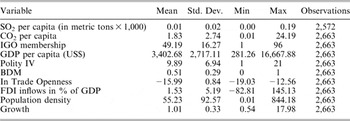
Finally, a time trend is added to the model in order to control for events such as technology improvements over time. Table 1 displays descriptive statistics of the variables used in the regression models.
Descriptive Statistics

Note: Negative values for FDI net inflows per capita imply that more capital is going out of the country than coming into the country.
Empirical Results
To test the implications of my arguments empirically I use a fixed-effects estimation procedure with panel-corrected standard errors (PCSE) and a Prais–Winsten specification to control for autocorrelation. Since IGO membership effects may need some time to trickle through, all of the independent and control variables enter into the model with a one-year time lag.Footnote 68
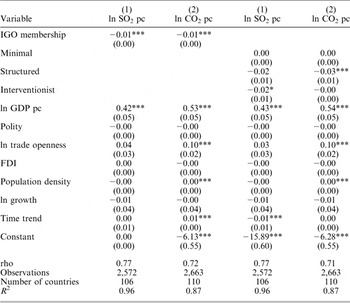
Table 2 shows the results of testing Hypothesis 1, anticipating a positive relationship between IGO membership and environmental performance. As expected, membership in international organizations has a positive influence on the environmental performance of developing countries as measured by either of the two indicators.Footnote 69 Interestingly, the results do not show a distinct difference between the coefficient of IGO membership in the models for SO2 and CO2, although CO2 emissions pose a more global and long-term threat, in contrast to SO2 emissions, whose adverse effects are of a more local and short-term nature.
IGO Membership and Environmental Quality

Note: Panel-corrected standard errors in parentheses; ***p < 0.01, **p < 0.05, *p < 0.1.
Country effects are not displayed in the regression table.
Columns 3 and 4 in Table 2 show the results when I disaggregate IGO membership according to the degree of institutionalization of the respective organizations. As expected, we see that minimally institutionalized organizations are never associated with a significant reduction in SO2 and CO2 emissions. Interestingly, however, it is not always the most institutionalized IGOs that are significantly associated with better environmental quality. As the results show, highly institutionalized IGOs are the most important organizations only in the case of SO2 emissions. In the case of CO2 emissions, those IGOs with a medium degree of institutionalization seem to be the most influential.
I infer from these findings that some degree of formalization or institutionalization of an organization is needed to affect environmental quality in developing countries. However, it is not necessarily the most institutionalized or powerful organizations, in the sense that they can constrain their member countries the most, that affect environmental quality in developing countries. This could be due to the fact that the main mechanisms behind the influence of IGOs – as proposed in the theoretical part of this article – are technology and knowledge transfer, issue linkage and a broader socialization process towards environmental protection. As long as they fulfil these purposes, organizations that possess some degree of institutionalization seem to be associated with better environmental quality in developing countries.
With regard to a country's income, we observe that an increase in GDP per capita is indeed associated with an increase in pollution as predicted by the EKC argument. This confirms the theoretical assertion that the countries in this sample have not yet reached that point on the EKC after which an increase in income would lead to improved environmental quality.
Finally, as argued in the theoretical part, democratic developing countries do not seem to perform better with regard to environmental quality, relative to their autocratic counterparts. The results show no statistically significant effect of the political regime type on either of the two indicators of environmental quality. These results are therefore compatible with the assertion that at the stage of early economic development, environmental quality is perceived as a luxury good, implying that citizens do not demand that their governments spend scarce resources on enhancing environmental quality.
Interestingly, none of the control variables exerts a robust influence. Population density is associated with an increase in CO2 emissions but is not statistically significant for SO2 emissions. Similarly, trade openness turns out to be significant only for CO2 emissions, countries that are more open emitting more CO2. Economic growth and foreign direct with investment, in contrast, are not significantly associated with either SO2 or CO2 emissions.
Further Disaggregation of IGO Membership
In addition to the degree of institutionalization, the function or purpose of a particular IGO might also be of importance. Although my theoretical arguments potentially apply to all types of IGO, some do seem likely to be more important for certain types than for others. For example, the possibility of issue linkage should be more pronounced in umbrella (multi-purpose) IGOs since they deal with a large variety of issues. Technology transfer, in contrast, should be more likely to occur in more technically oriented IGOs such as agrarian or nuclear IGOs. Furthermore, because of their precise thematic focus, environmental IGOs should clearly be interested in improving environmental quality in developing countries. Hence, defined by purpose, some types of IGOs may have a stronger influence than others.
Ingram et al. code IGOs according to their mandate into general umbrella, political, economic and social organizations.Footnote 70 I extended the time period covered by Ingram et al.'s coding to the year 2000.Footnote 71 The only exception I made to their coding instructions was that I created additional categories for nuclear and agrarian IGOs. Thus, IGOs were categorized as military (for instance, the North Atlantic Treaty Organization (NATO)), umbrella (for example, Association of Southeast Asian Nations (ASEAN), European Union (EU)), economic general (such as the World Trade Organization (WTO) and the International Monetary Fund (IMF)), economic co-operation (for example, the World Bank), economic industry specific (as in Cocoa Producers Alliance), economic standardization (for example, Caribbean Postal Union), social (such as the World Health Organization (WHO), the International Labour Office (ILO), the United Nations Educational, Scientific and Cultural Organization (UNESCO)), environmental (like the Global Environmental Facility (GEF)), nuclear (for example, the International Atomic Energy Agency (IAEA)), and agricultural (for instance, the Food and Agriculture Organization (FAO)) organizations.
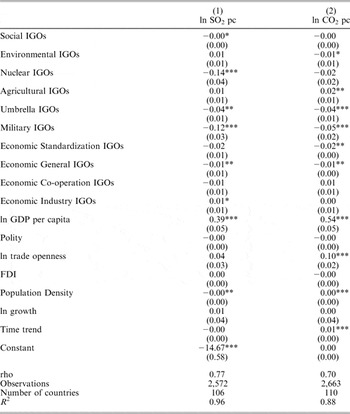
Table 3 shows the results using the disaggregated IGO measure instead of the general count variable. Interestingly, only membership in umbrella, economic general and military IGOs exert a significantly negative effect on pollution for both environmental indicators while controlling for membership of other IGO types. Membership in social and nuclear IGOs is of importance only when considering SO2, but it has no effect in the case of CO2 emissions. In contrast, environmental and economic standardization IGOs are associated with lower CO2, but not lower SO2, emissions. Finally, economic co-operation, economic industry specific and agricultural IGOs are never linked to better environmental quality.
Disaggregating IGO Membership

Note: Panel-corrected standard errors in parentheses; ***p < 0.01, **p < 0.05, *p < 0.1.
Country effects are not displayed in the regression table.
In addition to being interesting in its own right, disaggregating IGO membership can provide some intuition concerning the underlying mechanisms whereby IGOs may affect environmental performance in developing countries. The strong effect of umbrella organizations such as the EU or ASEAN, for example, is a first indication that some IGOs seem to be very successful in connecting different issues. Although environmental protection is usually not the main goal of these umbrella organizations, they often concern themselves with environmental issues also Different umbrella organizations such as the EU or ASEAN possess institutionalized committees or departments that deal exclusively with environmental protection. Hence, countries joining these IGOs for economic or political reasons are, as a side effect, also influenced with regard to their environmental quality.
This can be illustrated using the African Union (formerly the Organization of African Unity), an umbrella organization trying to promote greater unity and solidarity between African nations and to foster co-operation in different fields such as economic issues, human rights, etc. Among its institutional bodies, the organization has a Committee on Industry, Science and Technology, Energy, Natural Resources and Environment.Footnote 72 This committee has, for instance, a project on bio, safety jointly undertaken with the German technical co-operation agency (Deutsche Gesellschaft für Technische Zusammenarbeit GmbH) to provide the Union's member states with the necessary skills and technical tools to implement the Cartagena Protocol.Footnote 73
The effect of social IGOs in the case of SO2 emissions seems to hint at two different mechanisms. On the one hand, these organizations appear to constitute a good forum for information dissemination, and through the socialization process that takes place at these fora they may also diffuse environmental protection, as proposed in the literature on policy diffusion.Footnote 74 On the other hand, many of these organizations – such as the WHO and ILO – or research related organizations – such as the International Commission for the Scientific Exploration of the Mediterranean Sea – often diffuse knowledge and technology helpful to the environment in general while aiming at improving or preserving human health, labour conditions or biodiversity.
Acknowledging the fact that 25 per cent of all diseases worldwide arise because of environmental hazards, the WHO carries out research and gives policy advice on how to deal with various forms of environmental hazards most effectively.Footnote 75 Among other things, the WHO offers guidelines on how to dispose of hazardous waste, documents the health risks associated with indoor air pollution, advocates measures to decrease indoor air pollution and monitors the changes in pollution levels in households around the world. These far-reaching measures make the organization an important diffuser of the latest research and knowledge on the impacts of various forms of environmental degradation and on effective countermeasures to tackle the different health problems associated with environmental pollution.
Technology and knowledge transfer as well as capacity building are also sometimes the tasks of nuclear and economic IGOs. For example, UNIDO (the UN Industrial Development Organization), which promotes industrial development mainly by providing technical co-operation, also has a special thematic focus on the environment and energy. In this context, UNIDO provides technical advice on topics such as cleaner production processes, renewable forms of energy and waste recycling.Footnote 76 Similarly, the IAEA supports developing countries with technical co-operation, besides providing information and technology on the safe use of nuclear energy and treatment of nuclear waste.Footnote 77 For example, the IAEA has carried out a project in Cameroon focusing on the use of nuclear techniques in groundwater assessment.Footnote 78
In contrast, the rather small impact of environmental organizations is somewhat surprising, since one would expect that IGOs that are established to deal with environmental issues would have a significant effect on pollution. This finding suggests that, although joining environmental IGOs commits countries to the idea of taking care of their environment, this does not have an impact on the way they act at the national level.Footnote 79
The lack of influence of environmental IGOs does have a methodological advantage as it allows us to address the problem of endogeneity. One potential risk of looking at IGO membership and its influence on environmental quality is that, at least concerning environmental IGOs, countries may ‘self-select’ into these IGOs. This would imply that only countries with a very good environmental record would join environmental IGOs because these countries can be sure of meeting the obligations prescribed by the respective organization. Yet, one could also argue that countries with larger environmental problems may be more willing to join environmental organizations, since these organizations could provide laggard countries with technology and know-how. Alternatively, polluting countries may join environmental organizations in order to signal to their citizenry that henceforward they are planning to take the environment more seriously. Since environmental IGOs are – if at all – only vaguely associated with CO2 emissions, we can be rather confident that results are not due to self-selection into the organizations that do have an impact.
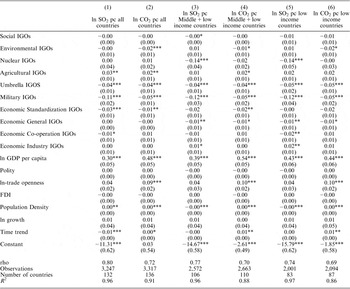
To provide further corroboration for the idea that technology and knowledge transfer as well as capacity building are indeed part of the influence of the different types of organizations, I have run the analysis on three different samples: all countries (i.e. including high-income countries), middle-income and low-income countries, and low-income countries only. If technology transfer is indeed one mechanism through which IGO membership influences the provision of environmental quality, we should observe that the effect of the various IGO memberships is stronger in the developing country sample than in the sample that also includes high-income countries. As the results in Table 4 show, the effect of umbrella, nuclear, military and general economic IGOs is weaker in samples including high-income countries than in the sample with low-income countries only. These findings thus reinforce the conclusion that membership in IGOs can be an opportunity for developing countries to obtain access to advanced technology and knowledge of how to combat environmental degradation.
Disaggregating IGO Membership across Different Samples

Note: Panel-corrected standard errors in parentheses; ***p < 0.01, **p < 0.05, *p < 0.1. Country effects are not displayed in the regression table.
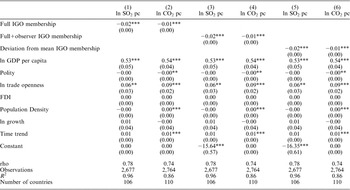
In addition to disaggregating IGO membership, I checked the robustness of my results using the different variables offered by the Correlates of War project.Footnote 80 The Correlates of War IGO dataset offers three slightly different variables measuring IGO membership. These measures differ according to whether a state has full, associated or observer membership. Up to now I have used the most inclusive (or least ‘stringent’) variable, the one that includes full, associated and observer membership. However, using either the most narrowly defined variable, which includes full membership only, or the IGO variable that includes both full and associated membership, while excluding observer status, instead of the most inclusive IGO variable, does not alter any of the earlier results. IGO membership, independent of its measurement, is always associated with a reduction in pollution (see columns 1 to 4 in Table 5).
Robustness Checks

Note: Panel-corrected standard errors in parentheses; ***p < 0.01, **p < 0.05, *p < 0.1. Country effects are not displayed in the regression table
Moreover, although the test statistic for non-stationarity of panel data shows that all independent variables are stationary, each country's IGO membership usually increases over time. Therefore, it could be possible that the effect of IGO membership is merely due to this time trend and is not driven by IGO membership per se. To show that this is not the case, I created a variable that measures the deviation of each country's IGO membership from the average IGO membership per year. Positive deviations thus imply that this country is a member of more IGOs than the average country in this year whereas negative deviations imply that this country is a member of fewer IGOs than the average country. The results, as shown in columns 5 and 6 in Table 5, are the same as in the case of the general IGO variable: countries that are members of more than the average number of IGOs are better stewards of their environment.
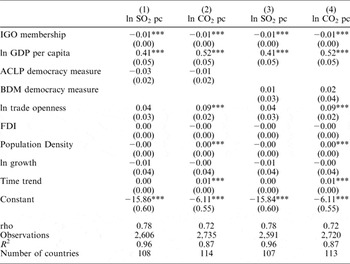
Finally, the robustness of the results was further checked by replacing the Polity IV measure of democracy with the dichotomous ‘ACLP’ democracy variableFootnote 81 and Bueno de Mesquita et al.'s democracy indicator.Footnote 82
As the results in Table 6 show, replacing the measure of democracy does not change the results reported above. At the stage of early economic development, political regime type does not seem to affect environmental quality. As long as citizens do not strongly demand that their political leaders use the scarce resources available to reduce pollution, democracies seem to be no better stewards of their environment than their autocratic counterparts.
Robustness Checks

Note: Panel-corrected standard errors in parentheses; ***p < 0.01, **p < 0.05, *p < 0.1.
Country effects are not displayed in the regression table.
Conclusion
This article set out to examine which factors have the potential to curtail environmental pollution in developing countries, focusing on membership of IGOs. Controlling for economic aspects of globalization, such as trade openness and FDI inflows, I have evaluated whether the inclusion of the political aspect of international integration adds to our understanding of the environmental performance of developing countries.
More precisely, I have argued that IGOs can act as channels through which developing countries may receive technology and resources necessary to reduce pollution, especially since IGOs also allow for issue linkages. Moreover, IGOs, in addition to increasing the reputational stakes for reneging on agreements, can provide a forum for actors interested in the environment to diffuse knowledge of and influence other countries towards greater environmental protection. The results indeed show that IGO membership is robustly associated with a decrease in both SO2 and CO2 emissions.
Furthermore, and in line with theoretical expectations, my findings demonstrate that in the early stages of economic development political regime type has no independent effect on environmental performance. The reasoning behind this finding, as proposed in this article, is that in the early stages of economic development the citizenry in developing countries will not demand that their governments spend scarce resources on improving environmental quality at the expense of basic needs such as education and health. Without these necessary electoral incentives, however, democratic governments do not seem to care more about their environment than their autocratic counterparts, leading to the results that in the early economic development stage democratic developing countries are no better stewards of their environment than autocratic ones. Finally, with respect to a country's income, the results suggest that an increase in GDP per capita is associated with an increase in pollution levels.
Turning from these more general findings to a more detailed analysis of IGO membership, we obtain more insights on the mechanisms that allegedly link IGO membership to a country's environmental performance. By disaggregating IGO membership according to the function and degree of institutionalization of the organization, I shed light on the theoretical underpinning behind the effect of IGO membership.
As expected, when differentiating IGO membership according to the degree of institutionalization, we see that only organizations that possess some degree of formalization or institutionalization can affect environmental quality in developing countries. Interestingly, however, those organizations that can constrain their member countries the most, i.e. the most institutionalized organizations, are not necessarily the most effective ones. In the case of CO2 emissions, the effect of moderately institutionalized organizations is stronger than the effect of the highly institutionalized organizations. This finding is in line with the explanation that the main mechanisms behind the influence of IGO membership as proposed in the theoretical part – which are technology and knowledge transfer, issue linkage and a broader socialization process favouring environmental protection – might work well as long as the organization has some degree of institutionalization, without necessarily needing to be a highly institutionalized organization.
Disaggregating the influence of IGOs further according to their function allows us to specify empirically which of the theoretically proposed mechanisms could be at play: for example, due to their large thematic scope, the influence of umbrella organizations such as the EU or ASEAN can be read as meaning that some IGOs are successful in connecting different issues. Although countries usually join these umbrella IGOs for economic or political reasons, they are, as a side effect, also influenced by the environmental functions of these organizations. By comparison, the importance of social IGOs in the case of SO2 emissions suggests two different mechanisms. First, these organizations may constitute a good forum for the dissemination of information. Furthermore, through the socialization process that takes place at these fora, these organizations may also act as diffusion channels for the idea of environmental protection as suggested in the literature on policy diffusion.Footnote 83 Second, many of these organizations disseminate know-how and technology that is helpful to the environment in general, while primarily aiming at improving or preserving human health or labour conditions. Examples of such organizations would be the WHO, the ILO or research-related organizations such as the International Commission for the Scientific Exploration of the Mediterranean Sea. This latter mechanism of information and know-how transfer could also underlie the influence of economic and nuclear organizations, as these IGOs often seem to be conducive to the provision of technological and financial resources, thereby increasing the capacity of developing countries to improve the quality of the environment.
The implications of this article for the study of public goods provision are twofold: first, it seems meaningful to enlarge the focus of existing studies by including additional aspects of the international system into the analysis. As the empirical analysis of this article indicates, the investigation of trade openness and foreign direct investment, which have been important components of past research on environmental quality,Footnote 84 does not seem to play a crucial role in the environmental performance of developing countries. In contrast, membership in intergovernmental organizations is robustly associated with a reduction in both air pollution and greenhouse gas levels. Second, and in contrast to the findings of existing studies,Footnote 85 political regime type per se does not seem to play a significant role in the environmental performance of developing countries.
Hence, the results suggest that in order to improve the quality of the environment in developing countries it seems most promising to tie these countries into various intergovernmental organizations. This is especially true for those organizations that possess at least some degree of institutionalization and which deal with a wide variety of issues.