1. Introduction
Multiphase flows are found in various industrial, environmental and biological contexts, where rigid particles, bubbles or droplets of different shapes and densities are suspended in a continuous phase. The presence of solid particles in a fluid significantly influences overall transport, resulting in complex interactions and behaviours. A classic example of this is sedimentation, which refers to the collective settling of particles due to gravity or centrifugal forces. Sedimentation is crucial in numerous applications, such as slurry transport, separation processes in industrial drainage, red blood cell sedimentation in blood vessels, particle settling in fluidized beds and reactors, and the dynamics of wastewater treatment tanks (O’Melia Reference O’Melia1998; van der Hoef et al. 2008; Ji et al. Reference Ji, Xiong, Wu, Chen and Wu2009; Zhong et al. Reference Zhong, Yu, Liu, Tong and Zhang2016). Consequently, to understand the coupled behaviour of fluid–particle systems in these scenarios, it is essential to resolve spatial and temporal scales that capture the intricate physics of particle interactions and sedimentation.
When a single particle settles in a fluid, the balance between drag and gravitational forces allows it to reach a constant terminal settling velocity. However, as the number of particles or the solid volume fraction in the suspension increases, hydrodynamic interactions between particles hinder individual settling, causing particles to settle at velocities lower than the terminal velocity. The topic of calculating this average, or ‘hindered’, settling velocity has received considerable attention in the literature. Theoretical predictions by Batchelor (Reference Batchelor1972) and Batchelor & Wen (Reference Batchelor and Wen1982) described the average settling velocity of particles in a suspension, though these predictions are limited to very dilute, statistically homogeneous suspensions under Stokes flow conditions. Beyond the dilute limit, particles interact with multiple neighbours through hydrodynamic forces and collisions, forming dynamic microstructures. These microstructures lead to fluctuations in individual particle velocities around the mean sedimentation velocity, affecting the overall settling behaviour. In response, empirical correlations for average settling velocity have been proposed by researchers such as Richardson & Zaki (Reference Richardson and Zaki1954) and Garside & Al-Dibouni (Reference Garside and Al-Dibouni1977), based on experimental data over a range of volume fractions. Later, Di Felice (Reference Di Felice1999) introduced modifications for dilute suspensions settling with inertia, applying a factor less than
 $1$
to the average settling velocity to account for the effects of particle microstructures.
The configurational distribution of particles in suspension evolves based on the Péclet number (
 $\text{Pe} = U_{{sed}} R / D$
), where
 $U_{{sed}}$
is the characteristic sedimentation velocity,
 $R$
is the particle size, and
 $D$
is the colloidal diffusion coefficient. The Péclet number is the ratio between the characteristic particle diffusive and sedimentation times. Hamid & Yamamoto (Reference Hamid and Yamamoto2013a
,Reference Hamid and Yamamoto
b
) and Hamid et al. (Reference Hamid, Molina and Yamamoto2013) studied the combined effects of hydrodynamic velocity fluctuations and self-diffusion on the sedimentation of monodispersed spherical particles at finite Péclet numbers. Their research showed a clear transition from a regime dominated by Brownian motion to one dominated by hydrodynamic fluctuations. They also found that at
 $\text{Pe} \geqslant 30$
, diffusivities, velocity fluctuations and relaxation times display non-Brownian characteristics. Here, we focus on the non-Brownian limit, where the Péclet number is high. In this regime, we track the motion of an ensemble of sedimenting spheres until they reach a steady state, observing changes in microstructure and sedimentation velocity.
In addition to the average settling velocity, interparticle hydrodynamic interactions also create particle velocity fluctuations around the mean settling velocity. Caflisch & Luke (Reference Caflisch and Luke1985) were the first to propose that particle velocity fluctuations diverge as the system size increases. Experimental (Nicolai & Guazzelli Reference Nicolai and Guazzelli1995; Nicolai et al. Reference Nicolai and Guazzelli1995) and numerical (Ladd Reference Ladd1996, Reference Ladd1997) studies have also shown good agreement in the temporal behaviour of these fluctuations. However, Nicolai & Guazzelli (Reference Nicolai and Guazzelli1995) and Nicolai et al. (Reference Nicolai and Guazzelli1995) suggested that velocity fluctuations are independent of system size, while Ladd (Reference Ladd1996, Reference Ladd1997) found a strong dependence on system size. This discrepancy was later addressed by Segre et al. (Reference Segre, Herbolzheimer and Chaikin1997) in an experimental study, introducing the concept of a characteristic correlation length, or ‘swirl size’. They observed that velocity fluctuations tend to saturate when the system size exceeds this characteristic swirl size, and they scale as
 $\phi ^{1/3}$
at low volume fractions, in contrast to the
 $\phi ^{1/2}$
scaling suggested by Hinch (Reference Hinch1988). Subsequent studies by Cunha et al. (Reference Cunha, Abade, Sousa and Hinch2002) and Padding & Louis (Reference Padding and Louis2008) also supported the
 $\phi ^{1/2}$
scaling at low volume fractions, though the dependence of velocity fluctuations on
 $\phi$
at higher volume fractions remains unclear. Later, Brenner (Reference Brenner1999) theoretically predicted that the scaling changes from
 $\phi ^{1/2}$
to
 $\phi ^{1/3}$
at high volume fractions.
Although most research on sedimentation focuses on spherical particles due to their well-understood behaviour and the availability of models describing their interaction with fluid flow, many natural and industrial applications, such as environmental pollution control, chemical engineering, and the production of short-fibre composites (Tinland et al. Reference Tinland, Meistermann and Weill2000; Van Der Lans et al. Reference Van Der Lans, Pedersen, Jensen, Glarborg and Dam-Johansen2000; Li et al. 2006) involve non-spherical particles. This makes the analysis of such flows more complex. Non-spherical particles can vary in orientation relative to the flow, which affects the forces and torques that they experience (Hölzer & Sommerfeld Reference Hölzer and Sommerfeld2009; Zastawny et al. Reference Zastawny, Mallouppas, Zhao and van Wachem2012), and leads to hydrodynamic behaviours different from those of spherical particles. The sharp edges of anisotropic particles enhance flow separation, increasing the drag coefficient. Furthermore, while the rotation of spherical particles generates minimal vorticity, the rotation of non-spherical particles displaces more fluid and generates significant vorticity. Studies on the free motion of anisotropic particles, such as oblate and prolate spheroids (Ardekani et al. Reference Ardekani, Costa, Breugem and Brandt2016), disks (Zhong et al. Reference Zhong, Chen and Lee2011; Chrust et al. Reference Chrust, Bouchet and Dušek2013) and cylinder-like objects (Fernandes et al. Reference Fernandes, Ern, Risso and Magnaudet2005; Mathai et al. Reference Mathai, Zhu, Sun and Lohse2017) are available in the literature. Given our interest in understanding the effects of particle shape on suspension behaviour, we chose cubic particles for this study. Cubes can be defined with a single parameter, similar to spheres, which simplifies the exploration of key governing parameters. Additionally, three orthogonal planes of symmetry of a cube result in added-mass effects that act solely as resistance to acceleration, without creating cross-coupling between force and torque.
As mentioned earlier, while numerous theoretical, numerical and experimental studies focus on the sedimentation of spheres, there is a notable lack of similar research on anisotropic particles such as cubes. Mallavajula et al. (Reference Mallavajula, Koch and Archer2013) conducted simulations and experiments on fluid flow around cubic particles, examining their rheological properties in the dilute regime. Later, Cwalina et al. (Reference Cwalina, Harrison and Wagner2016) investigated the rheology of concentrated cubic colloidal suspensions under steady and dynamic shear flow at low Reynolds numbers (
 $\text{Re} = \rho U_{{sed}} R / \eta$
, where
 $U_{{sed}}$
is the characteristic sedimentation velocity,
 $R$
is the particle size, and
 $\rho$
and
 $\eta$
are the density and viscosity of the fluid, respectively). They analysed the steady and dynamic shear viscosities, as well as the difference between the first and second normal stresses, across a wide range of particle concentrations and applied stresses. Rahmani & Wachs (Reference Rahmani and Wachs2014) conducted a numerical study on the settling behaviour of cubic and tetrahedral particles, observing that these particles follow vertical paths, then transition to helical or spiral paths, and eventually exhibit chaotic motion at varying Reynolds numbers. They also demonstrated that the rotation rates and resulting forces on anisotropic particles, such as cubes and tetrahedrons, are much more pronounced compared to those on spheres. Later, Seyed-Ahmadi & Wachs (Reference Seyed-Ahmadi and Wachs2019) attempted to explain the significant variations in the drag coefficient of moving cubes by linking them to the particle’s path and vortex structures at different Galileo numbers. Unlike spheres, cubes exhibited helical motion across all density ratios in their study, making it a characteristic type of motion for cubic particles. In a more recent study by the same authors (Seyed-Ahmadi & Wachs Reference Seyed-Ahmadi and Wachs2021), it was observed that the tendency for columnar cluster formation, measured using particle-pair distribution functions, is somewhat lower for cubes than for spheres at moderate volume fractions with inertia. They attributed this effect to the higher rotation rates of cubes, which lead to an enhanced lift force, increasing the likelihood that a cube will escape from an existing cluster.
Despite extensive research on sedimentation, several open questions remain, such as the nature of velocity fluctuations, the movement of individual particles in suspension, and the formation of microstructures, especially in the context of spherical and cubic particle suspensions. Motivated by these open questions and the intriguing differences between spherical and cubic particles, we are particularly interested in studying how spheres and cubes behave while settling under gravity in the Stokes regime. This study aims to investigate the evolution of particle microstructure and its impact on the transport properties of non-Brownian suspensions of spherical and cubic particles over a wide range of solid volume fractions. We organize our paper as follows. Section 2 provides the motivation for the study, describes the simulation set-up, and outlines the governing equations and numerical method. Section 3 presents the numerical results, including hindered settling velocity, velocity fluctuations and particle microstructure. Finally, § 4 summarizes the key findings.
2. Governing equations and numerical method
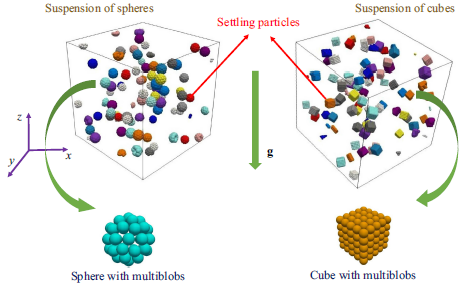
The applied numerical set up is illustrated in figure 1. Two particles of different types are investigated, namely spherical (left) and cubic (right) particles. In simulations, monodisperse spherical/cubic particles are allowed to settle under the action of gravity in a quiescent viscous fluid under creeping flow conditions, i.e.
 $\text{Re}=0$
. The suspension is composed of
 $M$
rigid particles denoted by
 $\{\Im _p\}_{p=1}^M$
, where each particle is tracked by the position of its centre
 $\boldsymbol{q}_p$
and its orientation
 $\boldsymbol{\theta }_p$
. We use unit quaternions to represent orientations, but other formulations are formally equivalent (Delong et al. Reference Delong, Balboa Usabiaga and Donev2015). The linear and angular velocities of particle
 $p$
are denoted by
 $\boldsymbol{u}_p$
and
 $\boldsymbol{\omega }_p$
, respectively. The total external force applied to particle
 $p$
is
 $\boldsymbol{f}_p$
, and the total torque around the centre of the particle is
 $\boldsymbol{\tau }_p$
. The velocity and pressure,
 $\boldsymbol{v}$
and
 $p$
, of the fluid with viscosity
 $\eta$
are governed by the Stokes equations
 \begin{align} -\boldsymbol{\nabla } p + \eta\, {\nabla }^2 \boldsymbol{v} = \boldsymbol{0}, \end{align}
 \begin{align} \boldsymbol{\nabla } \cdot \boldsymbol{v} = 0, \end{align}
while on the particle surfaces, the flow obeys the no-slip condition
 \begin{equation} \boldsymbol{v}(r)=\boldsymbol{u}_p+ \boldsymbol{\omega }_p \times (\boldsymbol{r} - \boldsymbol{q}_p) \,\,\,\,\,\, \text{for} \, \boldsymbol{r} \in \partial \Im _p. \end{equation}
The equations are closed by the balance of force and torque. The flow exerts a traction on the particle surfaces
 $-\boldsymbol{\lambda } = \boldsymbol{\sigma } \cdot \boldsymbol{n}$
, where
 $\boldsymbol{n}$
is the surface normal, and
 $\boldsymbol{\sigma } = -p{\boldsymbol{I}} + \eta ( {\boldsymbol{\nabla }} \boldsymbol{v} + ({\boldsymbol{\nabla }} \boldsymbol{v})^{T} )$
is the fluid stress. This hydrodynamic traction, integrated on the particle surfaces, balances the external forces and torques applied to the particles:
 \begin{equation} \begin{aligned} &\int _{\partial \Im _p} \boldsymbol{\lambda }(\boldsymbol{r})\, {\rm d}S_{\boldsymbol{r}}= \boldsymbol{f}_p, \\ &\int _{\partial \Im _p} (\boldsymbol{r} - \boldsymbol{q}_p) \times \boldsymbol{\lambda }(\boldsymbol{r})\, {\rm d}S_{\boldsymbol{r}}= \boldsymbol{\tau }_p . \end{aligned} \end{equation}
We construct rigid bodies of essentially arbitrary shape as a collection of rigidly connected ‘blobs’, each having finite radius
 $a$
and position
 $\boldsymbol{r}_i$
(see figure 1), forming a composite object that we will refer to as a rigid multiblob (RMB). The hydrodynamic problem is solved by the RMB method, which is a regularized boundary integral method, formulated as a symmetric saddle system involving the mobility matrix between markers. A detailed description of this method can be found in Balboa Usabiaga et al. (Reference Balboa Usabiaga, Kallemov, Delmotte, Bhalla, Griffith and Donev2016) and Kallemov et al. (Reference Kallemov, Bhalla, Griffith and Donev2016). After discretizing the particles, the integrals in the balance of force and torque (2.4) become sums over the blobs, while the no-slip condition is applied on each blob:
 \begin{align} \sum _{{\boldsymbol{r}}_i \in \Im _p} {\boldsymbol{\lambda}}_i &= {\boldsymbol{f}}_p, \\ \nonumber \sum _{{\boldsymbol{r}}_i \in \Im _p} ({\boldsymbol{r}}_i - {\boldsymbol{q}}_p) \times {\boldsymbol{\lambda }}_i &= {\boldsymbol{\tau}}_p, \\ \nonumber {\boldsymbol{v}}\left ( {\boldsymbol{r}}_i \right ) = {\boldsymbol{u}}_p+ {\boldsymbol{\omega} }_p \times ({\boldsymbol{r}}_i - {\boldsymbol{q}}_p) &= \sum _{j} {\boldsymbol{M}}_{ij} {\boldsymbol{\lambda} }_j \,\,\,\,\, \text{for} \, {\boldsymbol{r}}_i \in \Im _p. \end{align}
In the no-slip equation,
 $\boldsymbol{\lambda }_j$
represents a finite force acting on the blob
 $j$
, while the mobility matrix
 $\boldsymbol{M}_{ij}$
couples the force acting on the blob
 $j$
to the velocity of blob
 $i$
. The mobility
 $\boldsymbol{M}_{ij}$
is constructed by a double convolution of the Green’s function of the Stokes equation,
 $\boldsymbol{G}_{\text{St}}(\boldsymbol{r}, \boldsymbol{r}')$
, with two Dirac delta functions defined on spheres of radius
 $a$
centred on the blobs
 $i$
and
 $j$
(Rotne & Prager Reference Rotne and Prager1969; Wajnryb et al. Reference Wajnryb, Mizerski, Zuk and Szymczak2013):
 \begin{align} {\boldsymbol{M}}_{ij} = {\boldsymbol{M}}(\boldsymbol{r}_i, \boldsymbol{r}_j) &= \frac {1}{(4\pi a^2)^2} \int \delta (|\boldsymbol{r}' - \boldsymbol{r}_i|-a)\, \boldsymbol{G}_{\text{St}}(\boldsymbol{r}', \boldsymbol{r}'')\, \delta (|\boldsymbol{r}'' - \boldsymbol{r}_j|-a)\, {\mathrm{d}}^3 r''\, {\mathrm{d}}^3 r'. \end{align}
This regularization of the Green’s function makes the mobility
 $\boldsymbol{M}$
positive definite and the numerical method quite robust and easy to implement. To include the effect of the periodic boundary condition, we compute the action of the mobility matrix with a fast multipole method that accounts for the periodic images with a linear computational cost (Yan & Blackwell Reference Yan and Blackwell2021).
Schematic representation of the fully periodic cubic computational box consisting of a randomly placed spherical/cubic particles. The spherical body is discretized with a resolution of
 $42$
small blobs, whereas a resolution of
 $125$
blobs is considered for cubic particle.

The mobility problem (2.5) is a linear system for the unknown particle velocities
 ${\boldsymbol{u}}_p$
and
 $\boldsymbol{\omega }_p$
, and the force acting on the blobs
 $\boldsymbol{\lambda }_i$
. The structure of the equations is more evident if we rewrite them in a compact matrix form. To do so, first, we define composite variables with the velocities
 $\boldsymbol{U}_p = \{\boldsymbol{u}_p, \boldsymbol{\omega }_p \}$
and the external forces–torques
 $\boldsymbol{F}_p = \{\boldsymbol{f}_p, \boldsymbol{\tau }_p \}$
of particle
 $p$
, and the whole system of particles
 $\boldsymbol{U}=\{\boldsymbol{U}_p\}_{p=1}^M$
and
 ${\boldsymbol{F}}=\{{\boldsymbol{F}}_p\}_{p=1}^M$
. With this notation, we can write the mobility problem (2.5) as the saddle point linear system of equations
 \begin{equation} \begin{bmatrix} \boldsymbol{M} & -\boldsymbol{K} \\ -\boldsymbol{K}^{T} & \boldsymbol{0} \end{bmatrix} \begin{bmatrix} \boldsymbol{\lambda } \\ \boldsymbol{U} \end{bmatrix} = \begin{bmatrix} \boldsymbol{0} \\ -\boldsymbol{F} \end{bmatrix}, \end{equation}
where
 $\boldsymbol{K}$
is a block matrix that converts the particle velocities into blob velocities, and its transpose sums over the force on the blobs to give the total force–torque acting on the particles. For a many-particle suspension, (2.7) is a large linear system than can be solved efficiently by a preconditioned GMRES iterative solver (Balboa Usabiaga et al. Reference Balboa Usabiaga, Kallemov, Delmotte, Bhalla, Griffith and Donev2016). Finally, the spheres and cubes are pulled by an external force along the
 $z$
-axis to model the pull of gravity. With the finite resolution used to discretize particles (see figure 1), lubrication forces are not recovered exactly, therefore an additional repulsive force is incorporated to account for the steric interactions between solid particles, effectively preventing artificial overlaps. The force acting between blobs forming the colloids is derived from the potential
 \begin{align} \psi (\boldsymbol{r})= \begin{cases} \psi _0 \exp \left (-\dfrac {r-2a}{b} \right ) & \text{if } r \gt 2a, \\ \psi _0 + \psi _0 \dfrac {2a - r}{b} & \text{if } r \leqslant 2a, \end{cases} \end{align}
where
 $\psi _0$
denotes the strength of the repulsion, while
 $b$
characterizes the decay length of the interaction.
3. Results and discussion
Three-dimensional simulations are performed within a cubic, triply periodic domain, illustrated in figure 1. The computational domain has dimensions
 $L \times L \times L$
, where
 $L$
is the length of each side. To achieve the desired solid volume fraction
 $\phi$
, we fix the total number of particles
 $M$
, and adjust the size of the computational box. The solid volume fraction is then calculated as
 $\phi =MV/L^3$
, where
 $V$
represents the volume of each particle, being either spherical or cubic in shape. The characteristic length scale, denoted by
 $R$
, is defined as the radius for spherical particles and the volume-equivalent sphere radius for cubes, i.e. the cubes have side length
 $h = ( 4\pi /3 ) ^{1/3} R$
. We use dynamic simulations to obtain the trajectories and velocities of sedimenting particles. Particles are initially seeded at random positions, ensuring that particles do not overlap. Then the trajectories are computed for a finite time, and ensemble averages are formed over all the particles as time goes on. In our coordinate system, gravity is aligned in the negative
 $z$
-direction, also referred to as the vertical direction in the following. The horizontal direction corresponds to the
 $x$
- and
 $y$
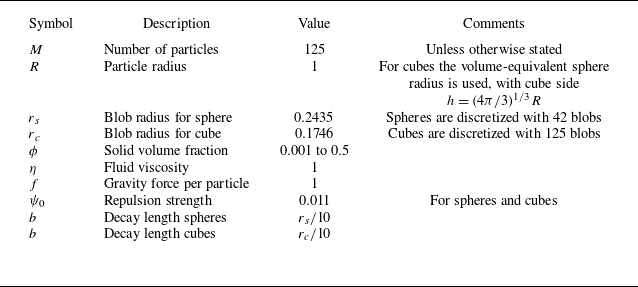
-coordinates. The physical parameters and computational settings used in the present study are listed in table 1.
Physical parameters used in the present study.

3.1. Sedimentation of two spheres
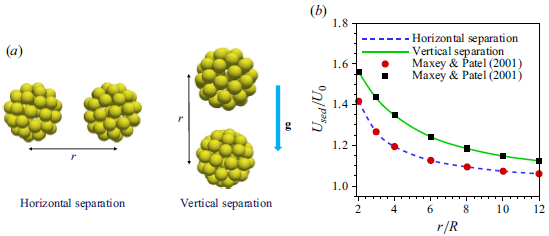
(a) Schematic representation of two spheres falling freely in an infinite domain, with the spheres initially separated either horizontally or vertically. The separation distance
 $r$
refers to the distance between their centres. (b) Comparison of the settling velocities for a pair of equal spheres separated either horizontally or vertically with the results of Maxey & Patel (Reference Maxey and Patel2001). Here,
 $U_{{sed}}$
and
 $U_0$
are the settling velocities for a pair of identical spheres and an isolated sphere, respectively.

We begin our investigation by validating the steady motion of a pair of identical and equal sized spheres settling under gravity in an unbounded domain (i.e.
 $L \rightarrow \infty$
). The initial configuration of two spheres is shown in figure 2(a). The spheres are separated either horizontally or vertically to the line of the centres. As pointed out by Batchelor (Reference Batchelor1972), the settling velocity depends on the separation between the particles and the orientation of the line of centres to the vertical. Later, Maxey & Patel (Reference Maxey and Patel2001) introduced a finite-valued force multipole expansion to describe the dynamics of spherical particles sedimenting in Stokes flow. They used the force coupling method to evaluate the settling velocity of two equal spheres in the above-mentioned configurations. If the particles are otherwise isolated and not influenced by other particles or boundaries, then they will have equal settling velocities due to the symmetry of the induced Stokes flow. The mutual influence of the disturbance flow created by each particle leads to a settling velocity larger than that for a single isolated particle. Our numerical result in figure 2(b) shows good agreement with the results of Maxey & Patel (Reference Maxey and Patel2001). The settling velocity
 $U_{{sed}}$
is scaled by the Stokes velocity
 $U_0$
of a single sphere, and given in terms of the distance between the centres, so
 $r/R=2$
corresponds to touching spheres. There is no external torque on the particles and they are free to rotate in response to the local fluid velocity. Figure 2(b) suggests that the particles settle with the same velocity as an isolated sphere in an infinite medium, when they are very far apart from each other (i.e.
 $r/R \to \infty$
). However, the mutual influence of the flow disturbance created by each particle results in a settling velocity that is larger than that of a single isolated particle. This effect leads to a velocity ratio
 $U_{{sed}}/U_0 \approx 1.41$
at
 $r/R = 2.01$
for horizontally separated spheres.
3.2. Effect of domain size
Average settling velocity of spherical particles versus the number of particles
 $M$
at two different solid volume fractions: (a)
 $\phi = 0.025$
and (b)
 $\phi = 0.36$
. The system size
 $L$
is changed according to
 $M$
to keep the volume fraction constant, the settling velocity is normalized by
 $U_0$
, and error bars represent the standard deviation of the mean settling velocity. The red symbols represent the value
 $M=125$
, which we use in the rest of our simulations.

The system size determines how well the system approximates an infinite suspension and whether artificial effects distort the settling dynamics (Climent & Maxey Reference Climent and Maxey2003; Lu et al. Reference Lu, Xu, Zhong, Ni and Tryggvason2023). To ensure that the system size is sufficiently large, we study its influence on the average sedimenting velocity of spherical particles in two cases: a dilute suspension (
 $\phi = 0.025$
) and a moderately dense suspension (
 $\phi = 0.36$
). In both cases, we vary the number of particles
 $M$
and the system size
 $L$
, while keeping the volume fraction constant, and measure the average sedimenting velocity. The results indicate that in both cases, a small box size significantly affects the mean settling velocity; see figures 3(a,b). However, as the domain size increases, it soon reaches the asymptotic value. In the rest of the work, we use
 $M=125$
so the finite size effects are small while the computational cost is still moderate. The red symbols in figures 3(a,b) indicate the selected box size used in our simulations for different solid volume fractions.
3.3. Sedimentation velocity of a monodisperse suspension of spheres and cubes
Dimensionless mean sedimentation velocity of monodisperse spheres (upper row) and cubes (lower row) at various volume fractions. The error bars indicate the standard error of the mean settling velocity for several independent random configurations.

The microstructure of suspension evolves in time during sedimentation from an initial equilibrium distribution to a new steady-state distribution. Therefore the sedimentation velocity
 \begin{align} U_{{sed}}(t)= \left\langle \frac {1}{N} \sum _{i=1}^{N} U_i(t) \right \rangle, \end{align}
ensemble averaged over the initial configurations, is time-dependent. To obtain the mean sedimentation velocity, an ensemble average (denoted by
 $\langle \cdot \rangle$
) of different initial configurations of the particles is considered. These configurations were randomly sampled from an equilibrium hard-particles distribution function by the Monte Carlo method (Metropolis et al. Reference Metropolis, Rosenbluth, Rosenbluth, Teller and Teller1953). The initial equilibrium averages were taken over
 $15$
independent initial configurations. The time evolution of
 $U_{{sed}}(t)$
for randomly distributed suspension of spheres and cubes, at various solid volume fractions from equilibrium to steady state, is shown in figure 4. The time-dependent settling velocity is normalized by the settling velocity of an isolated particle
 $U_0$
(sphere/cube for corresponding cases) falling under gravity, whereas the time is normalized with
 $t_s=R/U_0$
. The characteristic length scale
 $R$
is already mentioned in table 1. The settling velocity of a monodisperse suspension of spheres and cubes fluctuates slightly as time progresses. Figure 4 shows that the mean sedimentation velocity of a suspension of spheres is always slightly higher at all volume fractions compared to cubic suspension. As reported in the study of Seyed-Ahmadi & Wachs (Reference Seyed-Ahmadi and Wachs2019, Reference Seyed-Ahmadi and Wachs2021), anisotropic particles (i.e. cubes, tetrahedrons, etc.) always produce higher rotational displacements due to their sharp edges and rapid variation of hydrodynamic loads. Thus cubic suspension causes a strong upward flux to hinder the settling process as compared to spheres. Figure 4 also shows the deviation of the settling velocity of a random initial suspension from its mean as time progresses (indicated by error bars).
During the settling process the particles take some time to rearrange their configuration, which affects the sedimentation velocity. This relaxation time and the dispersive motion of the particles have been studied by several researchers. The study of Kuusela (Reference Kuusela2005) demonstrated that the relaxation time in the vertical direction for a sphere suspension follows approximately a
 $\phi ^{-1/2}$
relaxation in the full range of volume fractions. A sharp decrease in the relaxation time is also observed in the investigation of Hamid et al. (Reference Hamid, Molina and Yamamoto2013) at
 $\phi \gt 0.3$
in the direction of gravity, mainly because of the ordering of the particles, whereas a jump in relaxation time at
 $\phi \approx 0.5$
could occur because of very-long-range ordering of the particles. At moderate range of volume fractions (i.e.
 $ 0.1 \leqslant \phi \leqslant 0.4$
), the intensity of hydrodynamic interactions between particles increases, which in turn enhances the velocity fluctuations in the directions parallel and perpendicular to gravity. As a consequence, a significant time is required for the particles to relax in order to reach an equilibrium state. With the additional increment in
 $\phi$
, the settling process is strongly hindered, and the settling particles produce a weaker upward flux of the surrounding fluid in a tightly packed space. The velocity fluctuations in both directions – and hence the relaxation time – diminish drastically. As a result, both the suspensions quickly reach the steady state at
 $\phi \simeq 0.5$
. A detailed analysis of the velocity fluctuations for both suspensions will be discussed in the next subsection.
Average settling velocity
 $U_{{sed}}$
of the particles normalized by the Stokes velocity
 $U_0$
as a function of volume fraction (
 $\phi$
) to highlight the hindered settling of the particles. Solid lines denote our simulation result; dashed lines show various theoretical predictions of Batchelor (Reference Batchelor1972), Hayakawa & Ichiki (Reference Hayakawa and Ichiki1995), Richardson & Zaki (Reference Richardson and Zaki1997), Di Felice (Reference Di Felice1999), and the simulation results of Yamamoto et al. (Reference Yamamoto, Molina and Nakayama2021); the symbols represent the experimental data of Nicolai et al. (Reference Nicolai and Guazzelli1995). Here, the error bars are smaller than the symbols’ size.

In figure 5, we present the normalized average settling velocity
 $U_{{sed}}/U_0$
as a function of the solid volume fraction, where
 $U_{{sed}}$
and
 $U_0$
denote the ensemble average of the suspension settling velocity and the terminal settling velocity of an isolated sphere, respectively. We also compare our computational result for spheres with the existing theoretical predictions (Batchelor Reference Batchelor1972; Hayakawa & Ichiki Reference Hayakawa and Ichiki1995; Richardson & Zaki Reference Richardson and Zaki1997; Di Felice Reference Di Felice1999), experimental study (Nicolai et al. Reference Nicolai and Guazzelli1995) and simulation data (Hamid et al. Reference Hamid, Molina and Yamamoto2013; Yamamoto et al. Reference Yamamoto, Molina and Nakayama2021), which involves many-body hydrodynamic interactions. We observe that the sedimentation velocity decreases with increasing volume fraction. Since both the particles and the fluid are incompressible as particles sediment, an upward flow to balance the flow of mass is generated that hinders the sedimentation velocity. This effect of particle volume fraction on the average sedimentation velocity was first introduced by Batchelor (Reference Batchelor1972). The theoretical prediction of Batchelor assumes a uniform distribution in the separation of pairs of spheres, ignoring the fluid back flow effects, given by
 $U_{{sed}}/U_0=1-6.55 \phi$
, which is valid only for low volume fractions, where long-range hydrodynamic interactions can be neglected. We find good accuracy in the sedimentation velocity for spheres with Batchelor’s correlation in the range
 $\phi \leqslant 0.04$
. For larger volume fractions, our simulation result overestimates Batchelor’s model. Hayakawa & Ichiki (Reference Hayakawa and Ichiki1995) also proposed the normalized sedimentation rate in the context of a resistance problem, given by
 $ {U_{{sed}}}/{U_0} = {(1-\phi )^3}/{ 1+2 \phi + 1.492 \phi (1-\phi )^3 }$
. Our current result also agrees well with the Hayakawa–Ichiki model for
 $\phi \leqslant 0.05$
. The simplest semi-empirical relation for a hindered settling function has been proposed by Richardson & Zaki (Reference Richardson and Zaki1997) as
 $U_{{sed}}/U_0=(1- \phi )^n$
, which gives good predictions at higher
 $\phi$
. Several studies have found different exponents ranging from
 $n=4.7$
to
 $n=6.55$
for the Stokes flow, whereas in our study, the best suited exponent is
 $n=5.9$
for spheres, and
 $n=6.2$
for cubes. Finally, we observe that the cubes always sediment slower than the sphere suspensions for all volume fractions, except possibly at the very dilute regime.
3.4. Velocity fluctuations
Dimensionless hydrodynamic velocity fluctuations of particles as a function of volume fraction (
 $\phi$
) are shown for (a) the settling direction (
 $\sigma _{\parallel }$
) and (b) the direction perpendicular to settling (
 $\sigma _{\perp }$
). The insets illustrate the dependence of velocity fluctuations on
 $\phi ^{1/2}$
for
 $\phi \leqslant 0.1$
. (c) The anisotropy in velocity fluctuations,
 $\Gamma = \sigma _{\parallel } / \sigma _{\perp }$
, is plotted as a function of volume fraction (
 $\phi$
).

During settling, particle velocities fluctuate both vertically and horizontally due to inter-particle hydrodynamic interactions. Vertical velocity fluctuations reflect temporal deviations from the mean sedimentation velocity, while horizontal fluctuations, occurring perpendicular to gravity, are characterized by the mean velocities in the
 $XY$
-plane. The time-averaged standard deviations of particle velocities parallel and perpendicular to gravity are quantified as
 $\Delta U_z = \sqrt { \langle [U_{iz} - U_{{sed}}]^2 \rangle }$
and
 $\Delta U_{xy} = \sqrt { \langle U_{ix}^2 + U_{iy}^2 \rangle }$
, respectively. Here,
 $U_{iz}$
represents the temporal velocity of the
 $i$
th particle along the gravitational direction, while
 $U_{ix}$
and
 $U_{iy}$
are the velocities in the horizontal directions. These standard deviation values are normalized by the corresponding settling velocity of each suspension, commonly referred to as ‘relative fluctuation’ (Nicolai et al. Reference Nicolai and Guazzelli1995; Climent & Maxey Reference Climent and Maxey2003). Figures 6(a) and 6(b) display dimensionless velocity fluctuations of particles in the settling direction (
 $\sigma _{\parallel } = \Delta U_z / U_{{sed}}$
) and in the perpendicular direction (
 $\sigma _{\perp } = \Delta U_{xy} / U_{{sed}}$
), respectively. The fluctuations exhibit similar qualitative behaviour in both directions. At low volume fractions (
 $\phi \lt 0.04$
),
 $\sigma _{\parallel }$
and
 $\sigma _{\perp }$
display characteristics of the Stokes regime, with a
 $\phi ^{1/2}$
dependence (see insets of figures 6
a,b). As the solid volume fraction increases, velocity fluctuations rise gradually up to a moderate range (
 $0.04 \leqslant \phi \leqslant 0.2$
). Beyond this range (
 $\phi \gt 0.2$
), a gradual decline in fluctuations is observed for both directions. Additionally, velocity fluctuations are slightly higher for cubes compared to spheres, with the differences between the two shapes becoming more pronounced as
 $\phi$
increases. As the volume fraction increases within the range (
 $0.04 \leqslant \phi \leqslant 0.2$
), particles are more crowded and collision events, where steric interactions push the particles apart, become more common. Consequently, momentum is significantly transferred from the axial direction to the transverse direction, which amplifies velocity fluctuations in the transverse direction (Yao et al. Reference Yao, Criddle and Fringer2021). Notably, even a slight reorientation of a cube can generate considerable hydrodynamic torques, leading to rotations that further enhance this effect (Seyed-Ahmadi & Wachs Reference Seyed-Ahmadi and Wachs2019). As a consequence, cubes seem to experience higher transverse velocity fluctuations compared to spheres, thus facilitating a more efficient transfer of momentum from the axial to the transverse direction. With further increment in
 $\phi$
, the average inter-particle distance, which is inversely proportional to
 $\phi$
, diminishes, causing particles to become more densely packed (Zaidi Reference Zaidi2018). Beyond
 $\phi \gt 0.2$
, this dense packing restricts particle motion, resulting in a reduction in velocity fluctuations. In this range, the reduced inter-particle spacing disrupts the fluid structure required for particle clustering, while the frequency of hydrodynamic collisions rises, further suppressing velocity fluctuations.
The increase in velocity fluctuations with rising solid volume fraction is closely associated with the degree of anisotropy in these fluctuations, for both cubic and spherical suspensions. This anisotropy, defined as the ratio of vertical to horizontal velocity fluctuations (
 $\Gamma = \sigma _{\parallel } / \sigma _{\perp }$
), is shown in figure 6(c). In highly dilute conditions, anisotropy is notably high for both particle shapes, primarily due to restricted lateral movement in this regime. For dilute suspensions (
 $\phi \leqslant 0.05$
),
 $\Gamma$
ranges between 1.7 and 2.1 for both cases, aligning with the experimental findings of Nicolai & Guazzelli (Reference Nicolai and Guazzelli1995) on non-Brownian spheres under very dilute conditions. As the solid volume fraction increases to moderate levels (
 $\phi \approx 0.2$
), velocity fluctuations intensify in both the vertical and horizontal directions, leading to a substantial reduction in anisotropy. In this range, the anisotropy decreases compared to the dilute regime, with
 $\Gamma$
approaching approximately
 $1.3$
for cubic suspensions. A similar trend was also observed in the studies of Nicolai & Guazzelli (Reference Nicolai and Guazzelli1995) and Ladd (Reference Ladd1996). In the study of Seyed-Ahmadi & Wachs (Reference Seyed-Ahmadi and Wachs2021) at finite Reynolds numbers, it was observed that higher rotational velocities of cubes contribute to the transfer of momentum and energy from the gravity direction to the transverse direction, which led to a lower velocity fluctuations anisotropy in cubic suspensions than in spherical suspensions. Here, we observe the same effect in the zero Reynolds number regime. As
 $\phi$
increases further to
 $0.5$
, the anisotropy continues to decline due to more frequent and multidirectional inter-particle collisions.
3.5. Probability density function of particle sedimentation velocity
The PDF of vertical velocity is presented for suspensions of (a) spherical and (b) cubic particles across different solid volume fractions. Negative values of
 $U_i/U_{{sed}}$
indicate that particles are moving vertically upwards, against the direction of gravity. (c) The percentage of particles moving opposite to gravity at any given moment, as a function of solid volume fraction.

To better understand the differences in velocity fluctuations between spherical and cubic particles, we investigate the instantaneous particle velocity during sedimentation. Figures 7(a) and 7(b) illustrate the normalized probability density function (PDF) of particle velocity as a function of bulk concentration. Notably,
 $U_i/U_{{sed}} \gt 1$
indicates that particles are falling faster than the average sedimentation velocity. Positive values of
 $U_i/U_{{sed}}$
imply downward movement (i.e. in the direction of gravity), while negative values represent upward movement. Note that as the particles settle, the surrounding fluid generates an upward jet, due to the conservation of mass, that can drag some particles with it. Interestingly, the variance of the velocity in the vertical direction is a non-monotonic function of the volume fraction. In a very dilute regime (
 $\phi \approx 0.001$
), both the spherical and cubic suspensions exhibit a sharp peak, indicating that the velocity variance is small. In this range, the larger inter-particle separation distance results in weaker hydrodynamic interactions, thus deviation from the single-particle dynamics is small. Additionally, the percentage of upward-moving particles (
 $N_{U_z}$
) is calculated by integrating the area under the PDF of the settling velocity. Figure 7(c) illustrates that, in the highly dilute regime, the fraction of upward-moving particles approaches nearly zero for both types of particles.
As the volume fraction increases, velocity fluctuations increase, causing particles to disperse more and collide more frequently. At moderate concentrations, hydrodynamic interactions among nearby settling particles and inter-particle collisions create a strong upward jet, which can lift some particles (both spheres and cubes) along with it. The frequent hydrodynamic interactions and particle rebounds after collisions may also lead to individual particles moving upwards. A closer examination of the PDF of vertical particle velocity reveals that the tails become stretched as
 $\phi$
increases from
 $0.025$
to
 $ 0.125$
, with the left tail slightly longer than the right. Therefore, the fraction of upward-moving particles increases with rising bulk concentration in the low to moderate range. Results in figure 7(c) indicate that in cubic suspensions, approximately
 $5.3 \pm 0.2 \,\%$
of particles move against the settling direction, compared to only
 $4.6 \pm 0.1 \,\%$
for spherical particles at
 $\phi \approx 0.1$
. In this range, a closer inspection of figures 7(a,b) reveals that the peak of the PDF is slightly higher for spherical particles, indicating that a greater number of them attain velocities close to the mean sedimentation velocity. In contrast, cubic particles exhibit a slightly stretched left tail in the negative region, showing a broader distribution of lower velocities; see also supplementary figure 1. The sharp edges and rapid changes in hydrodynamic forces due to variations in orientation make cubes more susceptible to strong translational and rotational displacements, as well as velocity fluctuations. Additionally, cubes tend to acquire slightly higher angular velocities than spheres, resulting in significant rotation-induced forces perpendicular to their direction of movement. Consequently, cubic suspensions generate larger rotation-induced forces due to the higher magnitude of angular rotation, resulting in a greater fraction of particles being entrained by the upward jet compared to spherical suspensions. At moderate
 $\phi$
, this effect becomes more pronounced, with
 $6.2 \pm 0.2 \,\%$
of cubic particles moving upwards, compared to only
 $2.86 \pm 0.08 \,\%$
for spherical particles at
 $\phi \approx 0.24$
(figure 7
c).
However, as
 $\phi$
increases further, the system becomes more densely packed, suppressing velocity fluctuations in both directions. Consequently, the tails of the PDF begin to contract for both particle types (figure 7
a,b), leading to a gradual decrease in the percentage of upward-moving particles, as shown in figure 7(c). In the very dense regime (
 $\phi = 0.5$
), only a small fraction of spherical particles (
 $0.070 \pm 0.003 \,\%$
) exhibit instantaneous upward movement, whereas a slightly larger fraction of cubic particles (
 $1.3 \pm 0.1 \,\%$
) continue to move upwards.
3.6. Suspension microstructure
The RDF
 $g(r)$
is obtained to characterize the microstructure of (a) spherical and (b) cubic suspensions, evaluated as functions of radial distance across various volume fractions.

The bulk volume fraction is a key factor in determining the spatial distribution and orientation of settling particles. In this subsection, we analyse the microstructure formation of these particles after reaching steady state. The microstructure of a particle suspension reflects the local arrangement of particles relative to each other, which is governed primarily by inter-particle hydrodynamic interactions. To characterize the overall structures within the suspension, we use the radial distribution function (RDF) (Sundaram & Collins Reference Sundaram and Collins1997; Wang et al. Reference Wang, Wexler and Zhou2000), calculated as an ensemble average over multiple independent configurations. The RDF represents the probability of finding a particle at distance
 $r$
from a reference particle, often expressed as the ratio of number density within a shell at that distance to the bulk number density:
 \begin{equation} g(r)=\frac {n(r)}{4\pi \rho r^2\, \delta r}. \end{equation}
Here,
 $n(r)$
represents the number of particles within a shell of radius
 $r$
,
 $\rho$
is the average particle density in the computational domain, and
 $\delta r$
is the shell thickness. Figure 8 displays the time-averaged RDF as a function of solid volume fraction for both suspension types. In the RDF expression given in (3.2),
 $g(r)$
becomes zero for distances smaller than the diameter of a particle due to steric interactions that prevent particles from overlapping, and it approaches 1 at larger distances as the shell density aligns with the bulk density. Figure 8 also shows that local particle ordering diminishes at shorter distances for lower volume fractions, while increasing volume fractions enhance this ordering. Peaks in the RDF indicate a higher likelihood of finding particles at specific distances, indicating the gradual formation of a particle ‘cage’ around each reference particle.
For dilute suspensions (
 $\phi \simeq 2.5\,\%$
), the RDF exhibits a subtle peak for both spherical and cubic particles, though it is slightly lower for cubic suspensions (figure 8). In this regime, weak hydrodynamic interactions allow particles to form transient pairs, maintaining contact for extended periods. Consequently, a slightly higher local density of spherical particles is observed around the reference particle compared to cubic particles in this regime. As
 $\phi$
increases, hydrodynamic interactions among multiple particles become more pronounced, leading to the formation of aggregates or clusters in close contact, as reflected in the sharper RDF peaks. Unlike spherical particles, which maintain a fixed contact point at
 $r/R = 2$
(figure 8
a), cubic particles interact over a broader range of centre-to-centre distances (Seyed-Ahmadi & Wachs Reference Seyed-Ahmadi and Wachs2019). As a result, the RDF profile for cubic particles appears to be more oblique (figure 8
b). At a moderate solid volume fraction (
 $\phi \simeq 36\,\%$
), the particle-pair distribution undergoes a gradual transition. Initially, particle pairs accumulate around
 $r/R = 2.2$
for spheres and
 $r/R = 2.33$
for cubes. This enrichment later shifts to a depletion at greater distances, approximately
 $r/R \simeq 3.4$
for spheres and
 $r/R \simeq 3.5$
for cubes. The reduced inter-particle spacing compared to dilute conditions increases the likelihood of cluster formation at short distances. This effect is more pronounced for spherical particles, as evidenced by their higher RDF peaks. In contrast, cubic particles exhibit a greater tendency to escape clustering due to their higher rotational velocities, a behaviour also reported by Seyed-Ahmadi & Wachs (Reference Seyed-Ahmadi and Wachs2019). With further increment in
 $\phi$
, intensified hindered settling results from reduced inter-particle distances, leading to a more isotropic particle structure. This is reflected in the persistent oscillations beyond the first RDF peak for both suspensions at
 $\phi \simeq 0.5$
. At larger distances from the reference particle (
 $r/R \geqslant 5.1$
for both cases), the particle distribution becomes random, with
 $g(r) \simeq 1$
.
The pair distribution function in cylindrical coordinates is presented for suspensions of (a) spheres and (b) cubes across varying solid particle volume fractions.

Although the RDF describes the probability of finding particles within a shell regardless of orientation, it is crucial to assess whether particle pairs show directional preferences in anisotropic suspensions, such as those settling under gravity. To analyse orientation preferences, we compute the pair distribution function,
 $g(z,r)$
, in cylindrical coordinates for both spherical and cubic suspensions. Here,
 $g(z,r)$
represents the average distribution of particles located vertically at height
 $z$
and horizontally at distance
 $r$
from a reference particle. Figure 9 shows the pair distribution function for various solid volume fractions. At low volume fractions, pairwise interactions dominate, while many particle interactions become important at higher concentrations. As a result of inter-particle hydrodynamic interactions, settling particles naturally rearrange themselves away from their initial random configuration, leading to either clustering or dispersion. At low volume fractions (
 $\phi \approx 0.025$
), there is a notable depletion of particles in the vertical direction near the reference particle for both spherical and cubic suspensions (figure 9). Additionally, particle pairs are enriched in the direction perpendicular to gravity, with peaks at
 $r/R=2.3$
for spheres and
 $r/R=1.5$
for cubes. However, cubes show a weaker concentration peak in the horizontal direction (figure 8). A similar situation is observed at
 $\phi =0.125$
, but the anisotropy is weaker.
As the volume fraction increases, short-range hydrodynamic interactions between nearby particles become more pronounced, causing more particle pairs to cluster around the reference particle, and enhancing structural ordering. We observe a transition from a preferential horizontal alignment at lower bulk concentrations (
 $ 0.025 \leqslant \phi \leqslant 0.125$
) to a more concentric, ring-like distribution at moderate concentrations (
 $ 0.15 \leqslant \phi \leqslant 0.4$
). A spherical contour of particle pairs forms at distances
 $ r/R = 2.05$
to
 $r/R= 2.65$
for spheres and
 $ r/R = 1.15$
to
 $r/R= 1.6$
for cubes at
 $ \phi = 0.36$
(figure 9), revealing an isotropic ordering. At this volume fraction, a second ring due to second neighbours becomes visible.
The most intriguing case occurs at the highest volume fraction studied,
 $\phi =0.5$
, where the pair distribution functions of cubes and spheres exhibit striking differences. For spheres, the pair distribution function shows a high concentration of particles at
 $r/R \approx 2$
in all directions. Beyond this region, the pair distribution function shows strong fluctuations. As the system is very crowded, spheres take longer to explore the configurational space, and it is difficult to reduce the statistical errors. In contrast, the pair distribution function for cubes shows a stronger ordering in the horizontal direction at high density. Distinct vertical lines appear at distances around
 $r/R \approx 2$
, followed by separations at
 $r/R \approx 2.7$
and
 $r/R \approx 4.5$
, indicating a preferred arrangement of cubes in the
 $xy$
-plane in a square lattice, with lattice spacing
 $d\approx 2 R \approx 1.25 h$
, where
 $h= ( 4\pi /3 ) ^{1/3}R$
is the cube side length. The continuous lines along the
 $z$
-axis indicate that cubic particles lack ordering along the gravity direction. This suggests that cubes form columnar structures capable of sliding past one another within the densely packed suspension; see also supplementary movie 1.
3.7. Segregation of spherical/cubic particles in a bidisperse suspension
Gravitational sedimentation is a fundamental technique for solid–liquid separation, widely applied in polydisperse systems where size segregation and particle sorting are essential. Although monodisperse systems, comprised of particles of uniform size, have been explored extensively (Brady & Bossis Reference Brady and Bossis1988; Phillips et al. Reference Phillips, Brady and Bossis1988; Ladd Reference Ladd1993; Padding & Louis Reference Padding and Louis2008; Guazzelli & Hinch Reference Guazzelli and Hinch2011; Hamid et al. Reference Hamid, Molina and Yamamoto2013), the dynamics of polydisperse suspensions (systems with particles of varying sizes, densities, or shapes) remains a topic of significant interest. Polydisperse systems present complex behaviour, as the distribution of particle sizes and densities critically influences the overall flow response. Predicting the settling velocity of each particle class in a polydisperse suspension is a primary challenge; understanding these velocities is essential, as they shape the concentration profile and enable effective particle separation by size. Here, we focus on bidisperse sedimentation, which serves as a simplified yet valuable model for examining inter-particle interactions within polydisperse systems. In bidisperse suspensions with low total volume fractions, the hindrance effect becomes more complex than in monodisperse suspensions due to differential impacts of fluid displacement on the settling velocities of distinct particle classes. Although previous studies have measured settling velocities in bidisperse suspensions, these primarily focus on the settling velocities of interfaces or isolated particles within distinct zones of the suspension. When translational symmetry in the vertical direction is disrupted, for example, by the presence of horizontal boundaries, distinct concentration regions can form, leading to varied settling dynamics. In such cases, measurements are typically concentrated on the settling velocities at the interfaces between these zones (Davies Reference Davies1968; Lockett & Bassoon Reference Lockett and Bassoon1979; Al-Naafa & Selim Reference Al-Naafa and Selim1992; Chen et al. Reference Chen, Jia, Fairweather and Hunter2023). In bidisperse suspensions, where particles differ in radii, two primary sedimentation fronts generally propagate from top to bottom: one at the boundary between clear fluid and small particles, and another between small particles and a homogeneous suspension containing both particle sizes. The ratios of particle densities and sizes significantly affect size-based segregation in these systems. Numerical simulations using Stokesian dynamics have been conducted on bidisperse suspensions, covering size ratios up to 4 (Cunha et al. Reference Cunha, Abade, Sousa and Hinch2002; Wang & Brady Reference Wang and Brady2015). Recently, Li & Botto (Reference Li and Botto2024) examined the settling velocity statistics for dilute, non-Brownian, polydisperse sphere suspensions using Stokesian dynamics, analysing how total volume fraction and particle size distribution width influence sedimentation behaviour. They also reported that in a polydisperse mixtures of small and large spheres, the normalized average settling velocity decreases more rapidly with increasing
 $\phi$
for smaller particles.
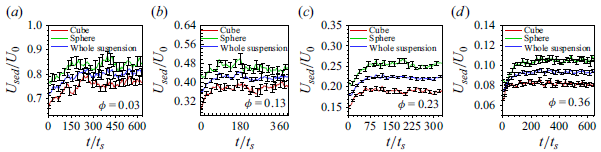
Settling velocities of different species (mixture of spheres and cubes) in a bidisperse suspension are shown for different volume fractions (
 $\phi$
) as functions of time. The velocity of each species is normalized by the Stokes settling velocity of an isolated sphere (
 $U_0$
) in a triply periodic box. We usually employ Stokes time
 $t_s=R/U_0$
as a time scale, where
 $R$
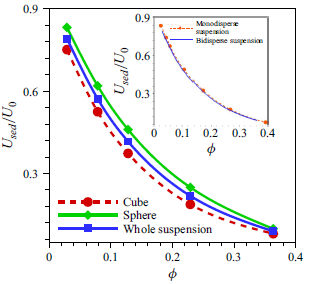
is taken as the radius of sphere. Average sedimentation velocities of the spheres, cubes and the whole suspension are indicated by green, red and blue solid lines, respectively.

In this subsection, we examine the settling velocity of non-Brownian bidisperse suspensions composed of a mixture of cubes and spheres, spanning a range of particle volume fractions from low to high. We assume that all particles have a uniform mass density and identical volumes. To achieve this, we calculate an equivalent side length for the cubes, ensuring that each cube has the same volume as a sphere with unit radius. In the bidisperse case, we consider a total of
 $150$
particles, evenly divided between the two particle shapes. We define the total solid volume fraction (
 $\phi$
) as the sum of the volume fractions of each particle type:
 $\phi = \phi _1 + \phi _2$
, where
 $\phi _1$
and
 $\phi _2$
represent the volume fractions of spheres and cubes, respectively. We examine the case of equal volume fractions for both particle types, i.e.
 $\phi _1 = \phi _2$
, and apply equal downward force (
 $f=1$
) on all the particles. As illustrated in figure 10, the sedimentation velocity of the bidisperse suspension is strongly influenced by the volume fraction of each species. To reduce statistical error, the velocity distributions are averaged across several random initial configurations of particles within a triply periodic simulation box. In the most dilute case (
 $\phi = 0.03$
), the suspension requires a longer time to reach a steady state. The average sedimentation velocity of each species plays a key role in the overall settling dynamics of the suspension. As shown in figure 10(a), spheres settle faster than cubes. This disparity is due in part to the higher angular rotation induced by the sharp edges of the cubes (Seyed-Ahmadi & Wachs Reference Seyed-Ahmadi and Wachs2019, Reference Seyed-Ahmadi and Wachs2021), which enhances the hindrance effect relative to that experienced by spheres. As the volume fraction increases, interparticle hydrodynamic interactions become more pronounced, causing a moderate reduction in the settling velocity of each species. At higher volume fractions (
 $\phi = 0.36$
), the suspension quickly reaches a steady state, with the reduced settling velocity attributed to increased hindrance effects and diminished velocity fluctuations in both perpendicular and parallel directions. Our study shows that spheres settle faster than cubes at all volume fractions, with segregation efficiency improving at lower
 $\phi$
.
The average settling velocity of the particles
 $U_{{sed}}$
, normalized by the Stokes velocity
 $U_0$
, is shown as a function of volume fraction (
 $\phi$
). In this context,
 $U_0$
represents the settling velocity of an isolated sphere in the same periodic domain. Here, the error bars are smaller than the size of the symbols. The inset shows the difference between mean sedimentation velocity of the bisdisperse suspension and that of a monodisperse suspension of spheres.

Figure 11 presents the normalized average settling velocity for different particle types in a bidisperse mixture across various bulk concentrations. The hindered settling behaviour follows a trend similar to that observed in monodisperse suspensions (figure 5), but the mean settling velocities of individual species differ significantly. While the overall velocity of the mixture is slightly lower than that of a monodisperse suspension of spheres in the dilute limit, the variation in settling velocities between species is notable. Figure 11 shows that spheres settle at a rate
 $11\,\%$
faster than cubes in this range (i.e.
 $U^{{sphere}}_{{sed}} / U^{{cube}}_{{sed}}=1.11$
). In a mixture of regular and irregular particles, spheres exhibit the most hydrodynamic shape, minimizing drag and enabling faster settling. In contrast, irregular particles such as cubes, with sharp edges and flat faces, experience higher drag, leading to slower descent. As the volume fraction (
 $\phi$
) increases, the generated upward flux of the surrounding fluid increases, which slows the settling rate. In this regime, the relative velocity difference between spheres and cubes increases to
 $34 \,\%$
at
 $\phi \approx 0.25$
. With further increment in
 $\phi$
, hindered settling becomes more pronounced, reducing somewhat the segregation efficiency. At higher concentrations (
 $\phi \approx 0.36$
), the relative velocity difference narrows to
 $24 \,\%$
, and the overall mixture velocity approaches a magnitude comparable to that of a monodisperse suspension of spheres.
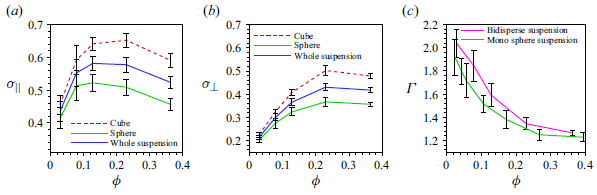
Dimensionless hydrodynamic velocity fluctuations of particles as functions of volume fraction (
 $\phi$
) are shown for (a) the settling direction (
 $\sigma _{\parallel }$
) and (b) the direction perpendicular to it (
 $\sigma _{\perp }$
). (c) Comparison of anisotropy in velocity fluctuations of bidisperse mixture with the monodisperse sphere suspension.

In a polydisperse suspension, the particle shape also affects the velocity fluctuations. Figures 12(a,b) present the velocity fluctuations of individual species and the entire mixture in directions parallel and perpendicular to gravity. For dilute bidisperse suspensions (
 $\phi \approx 0.1$
), figure 12(a) shows a clear difference in the velocity fluctuations in the vertical direction between the two species. In this regime, velocity fluctuations in both directions are more pronounced than in monodisperse suspensions. Specifically, the fluctuations of the cube velocities in the vertical direction are
 $26\,\%$
higher in the mixture than in the monodisperse suspension, while for spheres, the relative difference is only
 $4\,\%$
. This results in an overall rise in vertical velocity fluctuations in the bidisperse mixture compared to monodisperse cases.
As the solid volume fraction increases, reduced interparticle distances lead to more frequent collisions and stronger hydrodynamic interactions. This effect causes a rise in vertical velocity fluctuations (
 $\sigma _{\parallel }$
) at
 $\phi \approx 0.23$
for both particle types. In this range, cubic particles in a bidisperse mixture show a
 $40 \,\%$
increase in
 $\sigma _{\parallel }$
compared to monodisperse cubic suspensions, while spherical particles exhibit a
 $27 \,\%$
increase. Simultaneously, horizontal velocity fluctuations steadily increase for both species. These trends collectively alter the degree of anisotropy in velocity fluctuations, as shown in figure 12(c). The combined contributions of individual species lead to a net rise in both
 $\sigma _{\parallel }$
and
 $\sigma _{\perp }$
for the entire mixture, directly influencing the anisotropy of velocity fluctuations. As the volume fraction increases from low to moderate values, the anisotropy parameter
 $\Gamma$
decreases (figure 12
c). While
 $\Gamma$
follows the same qualitative trend as in figure 6(c), a noticeable difference emerges between the whole mixture and monodisperse sphere suspensions. However, the absolute difference diminishes as the solid volume fraction increases, due to a steady rise in horizontal fluctuations. At higher
 $\phi$
, intensified hydrodynamic interactions suppress velocity fluctuations in both directions, stabilizing particle motion and leading to a gradual decay in
 $\sigma _{\parallel }$
and
 $\sigma _{\perp }$
for both species. Consequently, the overall anisotropy of the bidisperse mixture decreases, though it remains slightly higher than in the monodisperse case. The pair distribution function shows a weaker ordering in the bidisperse suspension compared with the monodisperse suspensions; see supplementary figure 2. The weaker ordering could explain the higher-velocity fluctuations observed in bidisperse suspensions.
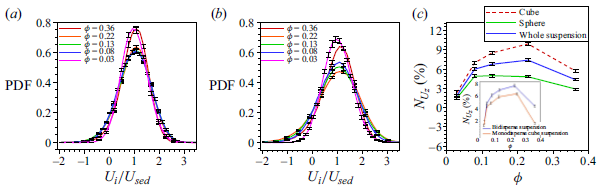
The PDFs of the vertical velocity for (a) spherical and (b) cubic particles in a bidisperse suspension are shown across different solid volume fractions. Negative values of
 $ U_i / U_{{sed}}$
indicate particles moving upwards, opposing gravity. (c) The percentage of particles (
 $ N_{U_z}$
) moving against gravity at any given moment as a function of solid volume fraction. The inset compares
 $ N_{U_z}$
in a bidisperse suspension to that in a monodisperse system.

In addition to examining the overall settling behaviour and velocity fluctuations of the particle mixture, we also analyse the normalized PDFs of vertical particle velocities (figure 13) for all particles within the simulation domain. While the PDF for bidisperse suspensions follows a trend similar to that of monodisperse suspensions (figure 7), a key distinction emerges in the distribution of vertical velocities between the two particle species in a bidisperse mixture. Across all solid volume fractions, the PDF of vertical velocity exhibits a slightly higher peak for spherical particles than for cubic particles, indicating that a larger fraction of spheres settle with velocities close to their mean sedimentation velocity. Additionally, a small fraction of particles moves instantaneously against gravity (see supplementary movie 2), even in the dilute regime (
 $\phi \lt 0.1$
; figures 13
a,b). The longer tail in the PDF for cubic particles suggests that cubes are more likely to exhibit upward motion than spheres, contributing to the overall velocity distribution of the mixture. As shown in figure 13(c),
 $7.67 \pm 0.27 \,\%$
of cubic particles display upward motion, compared to
 $4.94 \pm 0.2 \,\%$
for spherical particles. This results in a total of
 $6.38 \pm 0.23 \,\%$
of particles in the bidisperse suspension moving instantaneously against gravity, higher than the
 $5.27 \pm 0.17 \,\%$
observed in monodisperse suspensions (inset of figure 13
c).
At moderate volume fractions, the tail of the PDF extends further into the negative velocity region due to increased velocity fluctuations and particle dispersion in the plane perpendicular to gravity. Consequently, more particles exhibit upward motion in bidisperse suspensions than in monodisperse ones. As shown in the inset of figure 13(c), at
 $\phi = 0.23$
,
 $7.39 \pm 0.2 \,\%$
of particles in the bidisperse suspension move upwards, compared to
 $6.14 \pm 0.17 \,\%$
in the monodisperse case (see also supplementary movies 3 and 4). However, as
 $\phi$
increases further, intensified hydrodynamic interactions and inter-particle collisions suppress velocity fluctuations in both directions. As a result, at
 $\phi = 0.36$
, only
 $6 \pm 0.26 \,\%$
of cubic particles and
 $3 \pm 0.14 \,\%$
of spherical particles exhibit upward motion, highlighting the impact of enhanced particle interactions on the settling dynamics of the mixture.
4. Conclusion
This study provides a comprehensive investigation of sedimentation mechanisms in cube and sphere suspensions across a wide range of solid volume fractions, from dilute to dense regimes. Using the rigid multiblob method, we numerically predict particle dynamics within a periodic domain, uncovering key aspects of particle interactions in sedimenting systems. Our simulations align well with existing empirical correlations and experimental data for sphere suspensions when fluid inertia is neglected. Particle–particle and particle–fluid interactions play a crucial role in determining the macroscopic properties of sedimenting suspensions, with their influence strongly dependent on the global particle volume concentration. At low volume fractions, velocity fluctuations scale as
 $\phi ^{1/2}$
due to microstructural effects, but diminish at higher concentrations. Notably, horizontal velocity fluctuations are significantly higher for cubes due to stronger orientation-induced forces. Cubes also transfer momentum more effectively from gravity to the horizontal direction, as indicated by the ratio of vertical to horizontal velocity fluctuations. The anisotropy in velocity fluctuations decreases monotonically with increasing volume fraction. The strong transverse motions of cubes not only homogenize the suspension structure but also make particle momentum more isotropic compared to sphere suspensions. Additionally, in moderate to dense regimes, some particles exhibit transient upward motion against gravity. This behaviour is likely driven by the formation of particle-rich and particle-poor regions, which induce local fluid convection, causing upward motion in particle-poor areas.
Microstructural analysis reveals that at low volume fractions, an anisotropic microstructure governs transport properties, with particles predominantly orienting horizontally around a test particle. This orientation effect is more pronounced for spheres than cubes, as reflected in the sharper peak of the radial distribution function for spheres. As the volume fraction increases, many-body interactions and microstructural effects collectively control transport properties.
We also examine bidisperse suspensions composed of spherical and cubic particles, tracking the evolution of settling velocities from an initially random distribution to a steady state. In bidisperse systems, particle settling is affected by mutual interference, with settling velocities strongly dependent on solid volume fractions in the low to moderate range. Horizontal and vertical velocity fluctuations increase for each species in comparison with the monodisperse suspensions, significantly influencing suspension kinematics by enhancing anisotropy in velocity fluctuations. The presence of different particle shapes introduces inhomogeneous velocity fields due to varying drag forces, leading to differential settling speeds between species. Our results show that spheres settle faster than cubes across all volume fractions, promoting species segregation. Furthermore, increased velocity fluctuations and stronger hydrodynamic interactions in bidisperse suspensions generate locally strong return fluid fluxes, temporarily dragging more particles upwards, particularly in moderate to dense regimes, highlighting the intensity of particle interactions in these conditions.
Supplementary material and movies
Supplementary material and movies are available at https://doi.org/10.1017/jfm.2025.363.
Funding
This work has been partially funded by the Basque Government through the projects Elkartek SosIAMet KK-2022/00110 and the BERC 2022–2025 programme. Financial support by the Spanish State Research Agency through BCAM Severo Ochoa Excellence Accreditation CEX2021-001142-S/ MICIN/AEI/10.13039/501100011033 and project no. PID2020-117080RB-C55 ‘Microscopic foundations of soft matter experiments: computational nano-hydrodynamics (Compu-Nano-Hydro)’ is also acknowledged.
Declaration of interests
The authors report no conflict of interest.