Introduction
Although the cerebellum has been historically associated with balance and motor control, increasing evidence suggests cerebellar involvement in higher-order cognitive functions and modulation of behavior and affect (Moberget et al., Reference Moberget, Alnæs, Kaufmann, Doan, Córdova-Palomera, Norbom and Westlye2019). In comparison with typically developing people, altered cerebellar volumes were reported in several disorders such as attention deficit hyperactivity disorder (Valera, Faraone, Murray, & Seidman, Reference Valera, Faraone, Murray and Seidman2007), autism spectrum disorder (Guo et al., Reference Guo, Duan, Suckling, Wang, Kang, Chen and Chen2021), schizophrenia/psychosis (Moberget et al., Reference Moberget, Doan, Alnæs, Kaufmann, Córdova-Palomera, Lagerberg and Westlye2018) and bipolar disorder and major depressive disorder (Minichino et al., Reference Minichino, Bersani, Trabucchi, Albano, Primavera, Chiaie and Biondi2014). In addition, a larger cerebellar volume was associated with better performance in working memory tasks (Ding, Qin, Jiang, Zhang, & Yu, Reference Ding, Qin, Jiang, Zhang and Yu2012) and educational attainment in older adults (Boller, Mellah, Ducharme-Laliberté, & Belleville, Reference Boller, Mellah, Ducharme-Laliberté and Belleville2017).
Previous studies found cerebellar development has a rapid increase in the first two years of life (Wu, Chen, & Shen, Reference Wu, Chen and Shen2011), followed by an inverted U-shaped trajectory in childhood and adolescence, reaching its peak at 12 years for females and 16 years for males (Tiemeier et al., Reference Tiemeier, Lenroot, Greenstein, Tran, Pierson and Giedd2010). Lower cerebellar gray matter has been associated with higher exposure to childhood adversities (Walsh et al., Reference Walsh, Dalgleish, Lombardo, Dunn, Van Harmelen, Ban and Goodyer2014) and worse reading, working memory and processing speed scores in youth (Moore, D'Mello, McGrath, & Stoodley, Reference Moore, D'Mello, McGrath and Stoodley2017). Furthermore, cerebellar morphometry has emerged as one of the strongest neuroimaging predictors of general psychopathology, psychotic symptoms and norm-violating behavior in adolescents (Moberget et al., Reference Moberget, Alnæs, Kaufmann, Doan, Córdova-Palomera, Norbom and Westlye2019). Understanding typical and atypical cerebellar development throughout childhood and adolescence may shed light on neurodevelopmental pathways related to psychopathology, executive functions, and educational outcomes. Although research has begun to elucidate the relationship between cerebellum development and these outcomes in child development, several challenges remain.
First, most of the current literature investigating associations between psychopathology and cerebellar structure is based on cross-sectional or case–control comparisons, with a few exceptions (Castellanos, Reference Castellanos2002; Mackie et al., Reference Mackie, Shaw, Lenroot, Pierson, Greenstein, Nugent and Rapoport2007; Shaw et al., Reference Shaw, Ishii-Takahashi, Park, Devenyi, Zibman, Kasparek and White2018). Case–control studies miss the full distribution of a trait by constraining variability at its extremes (Kaczkurkin et al., Reference Kaczkurkin, Moore, Sotiras, Xia, Shinohara and Satterthwaite2020). An alternative is normative models (Marquand et al., Reference Marquand, Kia, Zabihi, Wolfers, Buitelaar and Beckmann2019; Parkes et al., Reference Parkes, Moore, Calkins, Cook, Cieslak, Roalf and Bassett2021). They take into account heterogeneity present in clinical cohorts by analyzing the individual data relative to the typical range through stratification in centiles of variation on a reference population (Marquand et al., Reference Marquand, Kia, Zabihi, Wolfers, Buitelaar and Beckmann2019). This allows the detection of variation from the typical range at the individual level, without requiring the presence of a generalized pattern of deviations or that atypical patterns overlap across the entire cohort – that is, the investigation moves its focus from the ‘average patient’ to the ‘individual patient’.
Second, despite associated with many mental disorders, current studies investigating cerebellar development and psychopathology do not separate common from specific manifestations. This suggests there might be transdiagnostic aspects that are in fact associated with the cerebellar development. Such patterns can be captured by bifactor modeling approaches that separate the common (i.e.‘p’ factor) from specific aspects of psychopathology (Caspi et al., Reference Caspi, Houts, Belsky, Goldman-Mellor, Harrington, Israel and Moffitt2014). However, few studies have investigated cerebellum development with the p-factor and specific residualized factors (Romer et al., Reference Romer, Knodt, Houts, Brigidi, Moffitt, Caspi and Hariri2018). Therefore, the use of bifactor models can disentangle which spectra of psychopathology are more closely linked to the cerebellum volume while also investigating the role of the general factor.
Third, except for reported associations between cerebellar gray matter volume and educational attainment (Boller et al., Reference Boller, Mellah, Ducharme-Laliberté and Belleville2017), no studies have investigated whether deviations in typical cerebellum development can impact academic achievement – a prerequisite to reach educational milestones and possibly an early factor for future life success. Fourth, even if associations between cerebellar growth deviations with these outcomes emerge, the predictive utility of cerebellar growth curves has not been investigated so far, as the World Health Organization (WHO) physical growth charts have. Finally, no study has investigated whether the putative associations between cerebellum development and psychopathology or academic achievement can be mediated by executive functions – a common neurocognitive construct that has been associated with both transdiagnostic models of psychopathology (Martel et al., Reference Martel, Pan, Hoffmann, Gadelha, do Rosário, Mari and Salum2017) and educational outcomes (Biederman et al., Reference Biederman, Monuteaux, Doyle, Seidman, Wilens, Ferrero and Faraone2004). Understanding mediators for these associations could advance our understanding on the links between health and education.
In the current study, our aims were: (1) to investigate if deviations of typical age- and sex-expected cerebellar volumes are associated with psychopathology, executive functions and academic achievement and (2) to investigate if deviation at baseline and changes from baseline to follow-up could predict these outcomes (i.e. the predictive utility of measuring cerebellar growth deviations). Therefore, we first estimated typical cerebellar development with normative models based on a subsample of children not exposed to risk factors for mental disorders and without any mental health conditions. Deviations from typical development were constructed for the remaining participants as standardized differences for each age and sex and used as predictors of outcomes in cross-sectional association analysis. Second, static and dynamic predictive analysis were carried out. Finally, we conducted a mediation analysis to investigate whether associations between deviations in cerebellar development (at baseline) and mental health and education achievement (at follow-up) could be mediated by executive functions (at follow-up). We hypothesized that larger age-expected cerebellar volume would predict lower levels of general psychopathology (cross-sectionally and longitudinally) and higher levels of executive functions and academic achievement. We also hypothesized that most of the effects of cerebellum development on psychopathology and academic achievement would be mediated by executive functions.
Materials and methods
Study design and participants
Participants were children and adolescents from a large, community school-based cohort, the Brazilian High-Risk Cohort Study for Mental Conditions (Salum et al., Reference Salum, Gadelha, Pan, Moriyama, Graeff-Martins, Tamanaha and Rohde2015). The study had a screening and an assessment stage. At screening, all parents of students from state-funded schools in Porto Alegre (22 schools) and São Paulo (35 schools) with more than 1000 enrolled students were invited to participate, on compulsory school registration days in 2010. 8012 caregivers (87.3% mothers) agreed to be screened by lay interviewers, with a modified version of the Family History Screen (FHS) (Weissman et al., Reference Weissman, Wickramaratne, Adams, Wolk, Verdeli and Olfson2000). The FHS is a structured interview used to screen all family members for psychiatric conditions based on DSM-IV. A family liability index (FLI) was generated from the FHS, which expresses the percentage of family members who screened positive for a psychiatric condition, adjusted for the degree of relatedness (mother, father and sibling counts as 1.0, half sibling is 0.5). After the screening phase, participants (one child per family) were divided into a randomly selected subgroup from the community (N = 958) and a high-risk for mental health condition subgroup, prioritizing those with the highest FLI (N = 1553). A subsample of 677 individuals (59.7% high-risk) underwent structural magnetic resonance imaging (MRI) acquisition in 2010, at 6–14 years of age, and were assessed in the Multiple Automatically Generated Templates (MAGeT) Brain framework. 447 (59.6% high-risk) repeated the exam after a 3-year interval (range of 2.7–4.0 years between waves), at 9–17 years of age. A more detailed description of this cohort is described elsewhere (Salum et al., Reference Salum, Gadelha, Pan, Moriyama, Graeff-Martins, Tamanaha and Rohde2015).
Measures
Neuroimaging
Image Acquisition was carried out in two 1.5-T MRI scanners (models GE Signa HD in Porto Alegre and GE Signa HDX in São Paulo). Anatomical T1-weighted scans were acquired in a maximum of 156 axial slices with the following parameters: TR = 10.916 ms, TE = ms 4.2, thickness = 1.2 mm, flip angle = 15°, matrix size = 256 × 192, FOV = 245 mm, NEX = 1, bandwidth = 122.109.
Cerebellum segmentation
All anatomical scans were nonuniformity corrected and skull-stripped (https://github.com/CobraLab/minc-bpipe-library; https://doi.org/10.1016/j.neuroimage.2014.05.044). Cerebellar volume was measured using an automated segmentation algorithm that uses high-resolution MRI atlases of the human cerebellum as inputs within the MAGeT Brain framework (Chakravarty et al., Reference Chakravarty, Steadman, van Eede, Calcott, Gu, Shaw and Lerch2013). A detailed description of the segmentation and measuring method can be found elsewhere (Park et al., Reference Park, Pipitone, Baer, Winterburn, Shah, Chavez and Chakravarty2014). All the images were visually inspected after the segmentation according to MAGeT Brain Quality Control Guide (https://github.com/CobraLab/documentation/wiki/MAGeT-Brain-Quality-Control-(QC)-Guide) to categorize for obvious fails, small errors or perfect/near-perfect segmentations. Eight images in total were excluded.
The cerebellar hemispheres were chosen a priori for this study, excluding the vermis. No other brain structures were tested in this analytical pipeline, aside the estimation of the total intracranial volume (ICV) for our sensitivity analysis.
Total Intracranial volume
We used FreeSurfer version 5.3 to estimate total ICV for both timepoints by dividing a predetermined constant with an atlas scaling factor, which is the volume-scaling factor that matches an individual's MRI to the MNI305 head atlas (Buckner et al., Reference Buckner, Head, Parker, Fotenos, Marcus, Morris and Snyder2004). Previous studies showed a good correlation between total ICV estimated by Freesurfer and manually estimated (Malone et al., Reference Malone, Leung, Clegg, Barnes, Whitwell, Ashburner and Ridgway2015).
Psychopathology
Dimensional Psychopathology measures were obtained using the Child Behavior Checklist (CBCL) at baseline and at 3-year follow-up. Using confirmatory factor analysis (CFA), we constructed a longitudinal bifactor model using the 32 internalizing- and 35 externalizing-related items according to the item classification described in the CBCL user guide (Achenbach & Rescorla, Reference Achenbach and Rescorla2001). p-factor and specific internalizing and externalizing factor scores were extracted. CFA specifications, CBCL factor model, global fit and model-based reliability can be found in online Supplementary Table S1.
Executive Functions
Executive functions were assessed using six tests measuring working memory, inhibitory control and temporal processing. Working memory was measured by the total accuracy in the backward step of the digit span from the Wechsler Intelligence Scale for Children (WISC-III) score (Wechsler, Reference Wechsler2002) and Corsi Blocks (Vandierendonck, Kemps, Fastame, & Szmalec, Reference Vandierendonck, Kemps, Fastame and Szmalec2004). Inhibitory control was measured by accuracy in the Conflict/No-Go trials of the Conflict Control Task (Hogan, Vargha-Khadem, Kirkham, & Baldeweg, Reference Hogan, Vargha-Khadem, Kirkham and Baldeweg2005) and the Go/No-go (GNG) task (Bitsakou, Psychogiou, Thompson, & Sonuga-Barke, Reference Bitsakou, Psychogiou, Thompson and Sonuga-Barke2008). Temporal processing was measured using the accuracy in the invisible trials of the time anticipation (TA) task (Toplak & Tannock, Reference Toplak and Tannock2005). Executive functions were modeled using CFA as a longitudinal extension of the model described in Martel et al. (Reference Martel, Pan, Hoffmann, Gadelha, do Rosário, Mari and Salum2017). Briefly, working memory, inhibitory control and temporal processing were fit in a second-order model for executive function abilities at both time points. Factor structure and global model fit are described in online Supplementary Table S2. Task details are described in the online Supplemental Material.
School Achievement
(a) Achievement on school subjects was evaluated using CBCL items on school performance, applied in the home interview at both time points. The participants were rated as failing, below average, average or above average by their caregiver. Items were fitted in a unidimensional model using CFA (see details in online Supplementary material).
(b) Reading and writing abilities were assessed by speech therapists with the reading (61 reading decode items) and writing (12 isolated words in dictation) subsets of the Brazilian School Performance Test (Stein, Reference Stein1998). Reading and writing ability at both time points were fitted in a two-correlated factor model using CFA (see online Supplementary material).
(c) Reading comprehension was assessed by text comprehension questions rated by a trained evaluator and applied only at follow-up (Lucio, de Kida, de Carvalho, Cogo-Moreira, & de Ávila, Reference Lucio, de Kida, de Carvalho, Cogo-Moreira and de Ávila2015). These items were fitted in a CFA and details can be found elsewhere (Simioni et al., Reference Simioni, Pine, Sato, Pan, Fonseca, Schafer and Salum2019).
Other variables
(a) Socioeconomic class was assessed using the classification from the ‘Associação Brasileira de Empresas de Pesquisa’ (Brazilian Association of Research Companies) (ABEP, 2010). It is a composite score comprising the main caregiver's educational level and household assets and conditions. A/B represent the high/comfortable class; C is considered middle class; and D/E the lowest social class.
(b) Child neglect/trauma was derived from a factor model described elsewhere (Salum et al., Reference Salum, DeSousa, Manfro, Pan, Gadelha, Brietzke and Grassi-Oliveira2016). Briefly, it was based on four parent-report questions and three child-report version of the first three questions, which assessed if the child has (1) ever been seriously beaten by an adult (including parents) at home, hurting him/her or leaving bruises or marks; (2) not had enough to eat or been forced to use dirty or torn clothes; (3) ever been cursed with words like stupid, idiot, dumb or useless or been exposed to someone shouting or screaming; (4) ever been exposed to anything sexual or threatened to hurt him/her if refused to do it. Responses were rated on a 4-point scale: 0, never; 1, one or two times; 2, sometimes; 3, frequently. The factor model provided a general trauma factor score. Subjects with trauma score equal or higher than 0.5 s.d. were considered as the high trauma category, and below this threshold, low trauma.
(c) Participant's psychiatric conditions were assessed at baseline and follow-up using parent-report to lay interviewers on the Brazilian-Portuguese version of the Development and Well-being Assessment (DAWBA) (Fleitlich-Bilyk & Goodman, Reference Fleitlich-Bilyk and Goodman2004; Goodman, Ford, Richards, Gatward, & Meltzer, Reference Goodman, Ford, Richards, Gatward and Meltzer2000), which is a semi-structured interview used to generate current DSM-IV diagnoses. Verbatim responses as well as structured answers were then evaluated by nine trained psychiatrists who confirmed, refuted or altered initial computerized diagnostic probabilities to determine the final diagnosis (overall agreement = 91%).
(d) Parental psychiatric condition was assessed using the Mini International Psychiatric Interview Plus (MINI Plus), applied to the main caregiver (94.9% mothers) to assess depressive episode, manic episode, panic disorder, agoraphobia, social anxiety disorder, alcohol abuse and dependence, drug abuse and dependence, psychotic conditions, generalized anxiety disorder and attention-deficit/hyperactivity disorder (ADHD) (Amorim, Reference Amorim2000; Sheehan et al., Reference Sheehan, Lecrubier, Sheehan, Amorim, Janavs, Weiller and Dunbar1998).
(e) Intelligence quotient (IQ) was assessed by trained psychologists with the vocabulary and block design subtests of the Wechsler Intelligence Scale for Children, 3rd edition – WISC-III (Wechsler, Reference Wechsler2002), using the Tellegen and Briggs method (Tellegen & Briggs, Reference Tellegen and Briggs1967). We applied Brazilian norms (do Nascimento & de Figueiredo, Reference do Nascimento and de Figueiredo2002).
Data Analysis
We used a normative model to build a cerebellum developmental curve using the same strategy used in the WHO growth charts. For this, we first divided the sample into a typically developing (TD) sample (n = 216) and a Test Sample (TS, n = 461). The TD sample was composed of children who (1) had neuroimaging data; (2) no mental health condition in either timepoint according to DAWBA, including no severe intellectual disability (IQ<69); and (3) were not exposed to established risk factors for mental disorders, which included any exposure to child neglect/trauma throughout the life course, low family income (socioeconomic classes D and E) and parental history of any mental disorders. The test sample was composed of all individuals not included in the TD sample and included participants with varying levels of mental health conditions and risk factors.
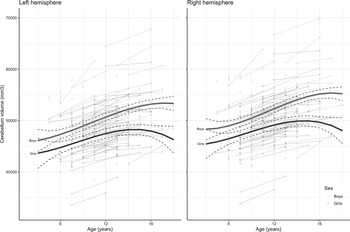
Then, we used a growth model for each cerebellar hemisphere (generalized least square – GLS) to create age and sex-standardized curves of cerebellar growth in the TD group, considering baseline and follow-up measures (Fig. 1). GLS models used random intercept and random slope for the effects of age for each subject. We used a single linear model with main effects for age, sex and age-by-sex interactions (as well as interactions for polynomial terms), using random age slopes for each participant. We then applied the best-fitting polynomial model on the test sample creating a cerebellar standardized volume deviation variable by standardizing the deviations using the parameters (mean and standard deviation) of the TD sample. A score of zero in this variable represents observed and expected volumes are equal. Negative values represent cerebellar volumes smaller than expected for age and sex; positive values represent cerebellar volumes larger than expected for age and sex.
Changes in cerebellum development in youth in typically developing children. Age and sex-standardized cerebellar growth trajectories of typically developing children. Normative model considering baseline and follow-up structural MRI measures of individuals without mental health condition at baseline and follow-up or exposure to risk factors to develop it (main caregiver without mental health conditions, low social class and exposure to neglect/trauma).

We investigated the association of these cerebellar standardized volume deviations with CFA-generated measures of psychopathology (general and specific factors), academic achievement and executive functions using five structural equation models (SEM) for each hemisphere (all outcomes included and set to be correlated). First, we used mixed effects SEM to investigate if cerebellar standardized volume deviation is associated with the outcomes at each respective timepoint (mixed-effects model, using data from both timepoints and the subject as a random intercept effect). We also estimated the association of the age- and gender-regressed cerebellar volume (i.e. not volume deviation) on the outcomes using the validation sample as a supplementary analysis. Second, we adjusted the mixed-effect models to ICV to estimate to which extent the findings were due to ICV rather than cerebellar volume. We supplementary estimated the association of the ICV-adjusted cerebellar volume (i.e. not volume deviation) on the outcomes using the validation sample. Third, we used SEM to investigate if ICV-adjusted baseline cerebellar standardized volume deviation predicts the outcomes at follow-up, adjusted by their baseline levels (static longitudinal model). Fourth, we used SEM to investigate if changes in ICV-adjusted cerebellar standardized volume deviation (measures at follow-up minus measures at baseline) predicted changes in the outcomes (dynamic longitudinal model). Fifth, we investigated if associations between cerebellar standardized volume deviation (at baseline) and psychopathology and academic achievement (at follow-up) were mediated by executive functions at follow-up (mediation analysis). Mediation analysis design was similar to the static model, where we investigated if variation of the outcome measured at follow-up was predicted by variation on the baseline cerebellar volume deviation and if this association was mediated by an executive function measured at follow-up. The abovementioned CFA-generated outcomes were saved and further regressed on age and gender. As the reading comprehension was only assessed at follow-up, we investigated the association with this measure using a linear model.
We used inverse probability weights (IPW) in all analysis to reduce attrition bias. The IPW was calculated based on variables that presented significant differences between baseline and follow-up, as described in online Supplementary Table S3. These variables were included as predictors of attrition in a logistic regression model. The predicted response values were inversed to generate the IPW (Seaman & White, Reference Seaman and White2013). This regression model is presented in online Supplementary Table S4.
CFA was performed in Mplus version 8.6 (Muthén & Muthén, Reference Muthén and Muthén2017) and implemented in R version 4.0.3 using the MplusAutomation package (Hallquist & Wiley, Reference Hallquist and Wiley2018), which was also used to extract factor scores generated in Mplus. Other analyses were conducted in R. SEM were carried out using maximum likelihood estimator and full information maximum likelihood to handle missing data, using the ‘sem’ function in the lavaan package (Rosseel et al., Reference Rosseel, Oberski, Byrnes, Vanbrabant, Savalei, Merkle and Jorgensen2018). Full information regarding CFA and SEM specifications can be found online Supplementary material, page 1.
Results
Participants
Factor Models for psychopathology, executive function and academic achievements fitted the data well (see online Supplementary material page 2–4 and Tables S1 and S2). The CBCL bifactor model presented a factor loading pattern which demonstrated that p-factor may represent mood dysregulation/dysphoria, internalizing may represent high shyness and externalizing represents specific substance use problems. Nevertheless, this pattern is common in several bifactor models using the CBCL and the p-factors are highly correlated, even when entire domains and sets of items are not used in the model (Hoffmann et al., Reference Hoffmann, Moore, Axelrud, Tottenham, Zuo, Rohde and Salum2022).
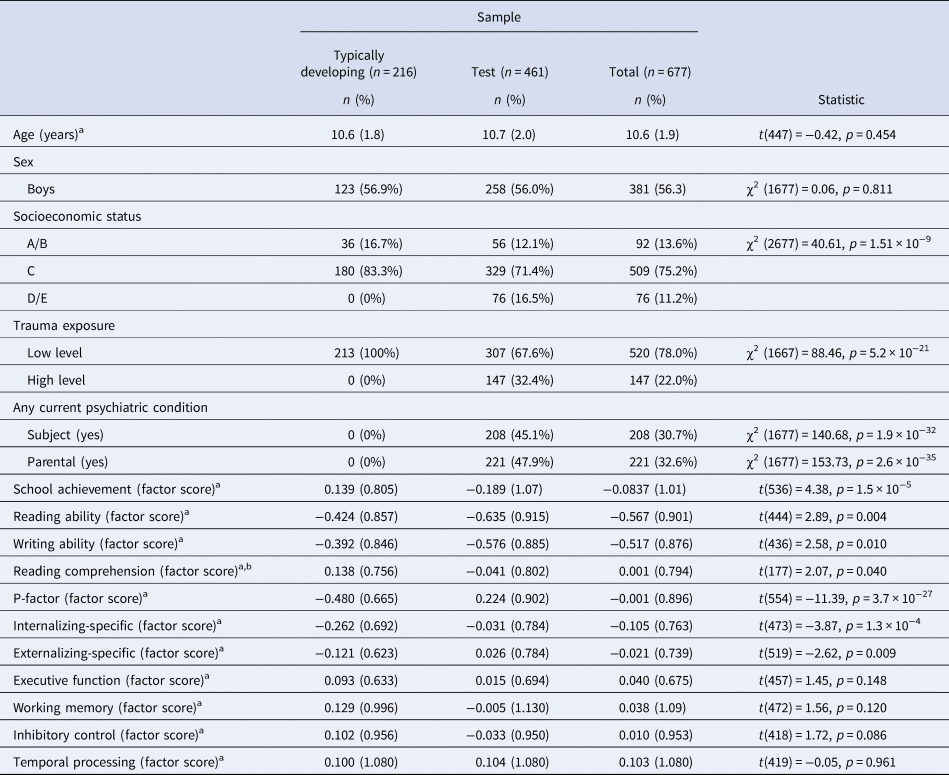
Table 1 describes the baseline characteristics of the study participants in the typically developing and test samples. Psychopathology, school achievement and executive function mean levels by type of sample at baseline are depicted in online Supplementary Fig. S1. There were no significant differences between the samples regarding age and sex. All study variables are detailed in online Supplementary Table S3, by each sample at baseline and follow-up, and depicted in online Supplementary Fig. S2. It is possible to observe that, over time, subjects in the test sample have their literacy abilities and internalizing and externalizing factors (in the test sample) increased, but not the p-factor, which remains stable. Moreover, temporal processing decreased over time in the test sample only. All other executive functions remained stable over time in both groups. Therefore, literacy abilities and internalizing-specific psychopathology increase are somewhat normative, while externalizing psychopathology increase and temporal processing decrease characterizes non-normative development.
Descriptive table of typically developing and test samples at baseline

a Mean (s.d.).
b Measured at follow-up only.
Cerebellum Trajectories in the typically developing children
We tested linear, quadratic and cubic terms for cerebellum volumetric longitudinal change over time. According to Alkaike and Bayesian information criteria (AIC and BIC, in which lower scores are better), the best fitting GLS was the cubic model for left (AIC = 5945.540, BIC = 5982.938) and right cerebellum (AIC = 5944.287, BIC = 5981.685), in comparison with the linear and quadratic models (online Supplementary Table S5). There was age-by-sex interactions in cerebellum growth in which females presented lower volumes through development in comparison with males (online Supplementary Table S6). Sex-specific cerebellum trajectories are depicted in Fig. 1.
Associations With psychopathology and cognition
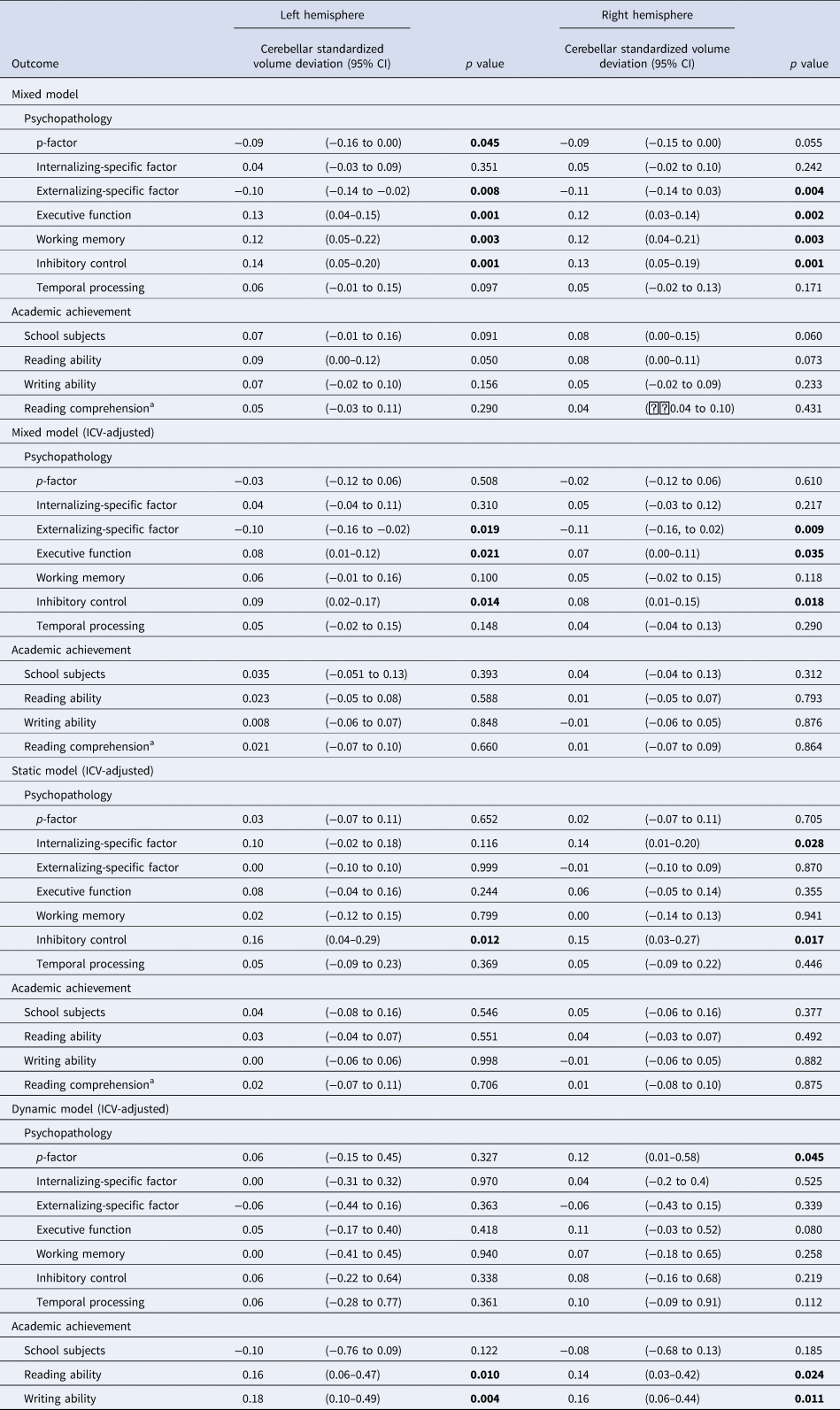
All SEM fitted the data well and fit indices can be found in online Supplementary Table S7. Mixed models showed that both right and left cerebellar volumes larger than expected for age and sex were associated with the lower externalizing factor. Associations with the p-factor were borderline significant for left (p = 0.045) and right hemispheres (p = 0.055) and no associations were found for the internalizing factor (Table 2). Also, cerebellar volumes larger than expected for age and sex were associated with higher general executive functions (composite of working memory, inhibitory control and temporal processing) and inhibitory control and working memory domains. No direct associations were found for academic achievement outcomes. A similar pattern was found if we consider the association of volumes and not its deviation from the norm (online Supplementary Table S8). After adjusting for total ICV, deviations from cerebellar typical trajectories were no longer associated with p-factor and working memory, but associations remained significant for externalizing specific factor, general executive function and inhibitory control (Table 2). The ICV-adjusted associations of left and right cerebellar volume deviation with the outcomes in the mixed models are depicted in online Supplementary Figs S3 and S4 respectively. If we consider the association of ICV-, age- and gender-adjusted cerebellar volumes (i.e. not its deviation from the norm), negative associations remained significant for externalizing specific factor and right cerebellar volume, while other associations were no longer found (online Supplementary Table S8).
Mixed, ICV-adjusted, static and dynamic models of cerebellar volume deviation predicting educational, psychopathology and executive function outcomes

Note: All estimates were from structural equation models including all outcomes predicted by each hemisphere. All predictors and outcomes were standardized by age and sex; ICV, total intracranial volume.
a follow-up only.
In static regression models, in both hemispheres, cerebellar volume larger than expected for age and sex was associated with higher inhibitory control at follow-up (Table 2). For the right hemisphere, cerebellar volume deviation was associated with the higher internalizing specific symptom (Table 2), which increases thorough time in TD and test samples (online Supplementary Table S3). This means these deviations predict future outcomes above and beyond associations with current levels of the same outcomes and ICV. The dynamic regression model demonstrated that changes between baseline to follow-up in cerebellar standard deviation volumes were associated with changes in reading and writing ability outcome, even when adjusted for ICV (Table 2).
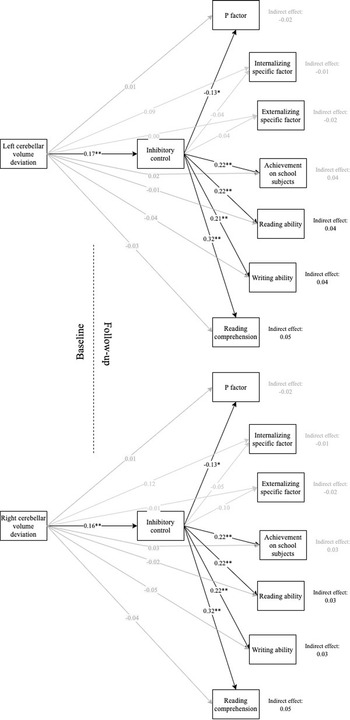
Because inhibitory control was the only executive function-related variable that was predicted by baseline levels of cerebellar volume deviation, we examined whether this function could be a potential mediator between cerebellum deviations and psychopathology and academic achievement. Mediation models partially supported our hypothesis and are presented in Fig. 2. The association between cerebellar standardized volume deviation for both hemispheres were associated with future reading and writing abilities as well as reading comprehension task through mediation by follow-up inhibitory control. Despite associated with inhibitory control, academic achievement in school subjects and the p-factor have not presented significant indirect effects in the mediation model. Complete standardized regression coefficients of the mediation SEM can be found in online Supplementary Table S9.
Mediation models between cerebellar standardized volume deviations at baseline and psychopathology and academic achievement at follow-up. Mediation between cerebellar standardized volume deviations at baseline and p-factor, internalizing and externalizing specific factors, achievement on school subjects, reading and writing abilities and reading comprehension at follow-up by inhibitory control at follow-up, for both left (upper) and right (bottom) cerebellar hemispheres. Results demonstrate full mediation of cerebellar standardized volume deviations at baseline on reading and writing abilities and reading comprehension by inhibitory control. Correlation between outcomes was estimated in the structural equation model but not demonstrated for simplicity. Numeric values are standardized regression coefficients. Gray arrows and numeric values represent non-significant associations (p > 0.05). *, p < 0.05; **, p < 0.01.

Discussion
Our study investigated the developmental trajectories of the cerebellum in the light of typical developing models, focusing on how deviations of the age-expected curve could correlate and predict psychopathology, executive functions and academic achievement. Increased cerebellar volume in both hemispheres was associated with lower levels of externalizing specific factor and higher general executive functions and inhibitory control individually. Furthermore, cerebellar volumes deviation predicted inhibitory control above and beyond its baseline levels and changes in cerebellar deviations predicted changes in reading and writing ability. Cerebellar volume deviations also predicted academic achievement, which was fully mediated by inhibitory control. Of note, all these results considered adjustment for the total ICV, suggesting those results might not be driven by global brain effects.
A cerebellar involvement in cognitive and emotional regulation has been proposed for decades. A cortico-cerebellar network establishing reciprocal connections was suggested based on anatomical and neurofunctional data (Van Overwalle, D'aes, & Mariën, Reference Van Overwalle, D'aes and Mariën2015). These bidirectional loops allow the operationalization of forward models, in which the cerebellum receives a command from cortical regions and integrates it with somatosensorial afferences to create an expected result and correct errors if necessary. This mechanism is involved in the learning process (Sokolov, Miall, & Ivry, Reference Sokolov, Miall and Ivry2017) and can be applied to explain cerebellar contributions to cognitive-emotional regulation and behavior modulation (Ito, Reference Ito2008). This bidirectional information fluency and its disruption is captured by the term ‘dysmetria of thought’, that symbolizes the function of the cerebellum as a center of integration of multimodal stimuli to predict and regulate emotions and cognition (Schmahmann, Reference Schmahmann1998).
The development of psychiatry towards understanding comorbid disorders suggests that transdiagnostic measures might be a more comprehensive approach to study underlying dysfunctions (Caspi et al., Reference Caspi, Houts, Belsky, Goldman-Mellor, Harrington, Israel and Moffitt2014). Besides, if the cerebellum acts as an integrator of internal models and environmental information, it is more likely that a dysfunction on its structure and connectivity implicates a general impairment rather than one specific pathology. Indeed, morphometric alterations on the cerebellum and its cortical connections have been related to general liability for psychiatric disorders and cognitive performance in populations of different age ranges (Moberget et al., Reference Moberget, Alnæs, Kaufmann, Doan, Córdova-Palomera, Norbom and Westlye2019; Romer et al., Reference Romer, Knodt, Houts, Brigidi, Moffitt, Caspi and Hariri2018; Romer et al., Reference Romer, Knodt, Sison, Ireland, Houts, Ramrakha and Hariri2021). However, to the best of our knowledge, the p-factor had never been associated with longitudinal trajectories of cerebellar growth before and present results don't support this association due to borderline significant association estimates at best, especially when adjusted for ICV. In fact, pervasive thinner neocortex is associated with transdiagnostic general psychopathology (Romer et al., Reference Romer, Elliott, Knodt, Sison, Ireland, Houts and Hariri2020). We found, however, an association with externalizing specific factor even when adjusted for ICV, revealing a specific association with a factor characterized by antisocial and substance use behavior.
We also found an association between increased cerebellar volumes and executive functions and inhibitory control. This could ultimately impact cognition, self-regulation and mental health (Romer et al., Reference Romer, Knodt, Houts, Brigidi, Moffitt, Caspi and Hariri2018, Reference Romer, Knodt, Sison, Ireland, Houts, Ramrakha and Hariri2021). The cerebellar volume also had a direct impact on reading and writing, which are related to impairment in self-regulation processes (Nigg, Reference Nigg2016). Previous evidence demonstrated a correlation between academic performance and structure and connectivity of several brain areas, but we haven't found studies investigating direct associations of academic achievement with the cerebellum. In fact, adjusting for total ICV, we found that the direct associations are still likely to occur and were due to overall brain volume. Taken the cross-sectional (mixed model), static and dynamic models together while interpreting the mediation model, it is likely that the cerebellum may underpin academic achievement (i.e. learning how to read and write) through inhibitory control. Nonetheless, the associations between cerebellar volume deviation with externalizing specific factor likely reveal that the cerebellum acts as a marker of this dimension of psychopathology.
Our study has limitations. First, the TD sample, which is our reference cohort, was composed of 216 children only, with substantial attrition. We attempted to minimize attrition bias by using weights in our models. Nevertheless, the reduced sample size of the reference cohort might have compromised the ability to capture a full range of variations from typical development. Second, the TD sample did not include screening for other medical conditions that could affect brain development. However, recruitment occurred at the community, in which the prevalence of medical conditions is unlikely to be overrepresented in this sample, especially considering that subjects with intellectual disability and developmental disorders such as autism spectrum disorder and ADHD were excluded. Third, the 3-year follow-up can be understood as a short time period to observe cerebellar development and subsequently measure its trajectory, especially subjects in puberty and considering that the cerebellum reaches its peak volume later than the cerebrum (Tiemeier et al., Reference Tiemeier, Lenroot, Greenstein, Tran, Pierson and Giedd2010). Nonetheless, the accelerated cohort design enables the analysis of a wider age range and we found robust associations at this stage of development already. This indicates there is potential for measuring future functional consequences of the full morphologic development of the cerebellum at older ages. Fourth, the study of cerebellar volume by T1-weighted images rather than in high-resolution might limit our ability to draw accurate charts. Despite that, even such gross measures already seemed to predict psychopathology and education achievement in this population. Fifth, adjusting for total ICV does not exclude that some of the findings could also be driven by alterations of specific brain areas that could confound the relation of cerebellar volumes with the outcomes. Therefore, care must be taken in interpreting that the associations found are specific to the cerebellum.
Conclusions
In the present work, we have established a direct relation of cerebellar growth trajectories and the externalizing-specific dimension of psychopathology and executive functions, as well as an indirect association with academic performance via inhibitory control. Therefore, this study represents another step towards understanding the cerebellum complexity. Future research might improve the understanding and measurement of the clinical impact of the cerebellar alterations, especially on longitudinal settings in a developmental approach. Considering that psychiatric and learning disorders are increasingly conceptualized and hypothesized as neurodevelopmental conditions, a shift in focus to primarily investigate the deviations from typical development may improve understanding and management of behavioral, cognitive and executive abnormalities.
Supplementary material
The supplementary material for this article can be found at https://doi.org/10.1017/S0033291722002926.
Financial support
This work was supported by Conselho Nacional de Desenvolvimento Científico e Tecnológico (CNPq, Brazil; grant number 573974/2008–0), the Coordenação de Aperfeiçoamento de Pessoal de Nível Superior (CAPES, Brazil), the Fundação de Amparo à Pesquisa do Estado de São Paulo (FAPESP, Brazil; grant number 2008/57896–8) and the Fundação de Amparo à Pesquisa do Estado do Rio Grande do Sul (FAPERGS, Brazil). All of them are public institutions of the Brazilian government developed for scientific research support. It was also funded by the National Institute of Mental Health (grant number 1-R01-MH-120482–01).
Conflict of interest
The authors declare none.
Ethical standards
For participants aged younger than 18 years, parents provided written consent and participants provided verbal consent. Participants aged 18 or older also provided written consent. The study was approved by the Ethics Committee of the University of São Paulo and of the Hospital de Clínicas de Porto Alegre.
The authors assert that all procedures contributing to this work comply with the ethical standards of the relevant national and institutional committees on human experimentation and with the Helsinki Declaration of 1975, as revised in 2008.