Introduction
Maize has an important place in world grain production and consumption. In the last decade, global maize production has increased by 30% (FAO, 2017). Being equally important for human and animal nutrition, maize has a number of different end uses. Although not classified as an oil crop due to low oil content in the grain (Watson, Reference Watson, White and Johnson2003), maize ranks higher than many oil crops in providing plant-based oils (Mittaine and Mielke, Reference Mittaine and Mielke2012; Ash and Matias, Reference Ash and Matias2018).
Since it provides more energy, high oil content is desirable in maize especially when used as animal feed. Studies have shown that livestock fed high-oil maize have a faster increase in body weight (Lambert, Reference Lambert and Hallauer2001). To meet the demand for maize oil, it is desirable to increase the oil ratio of the maize kernel and develop high oil maize lines/hybrids. Oil ratio varies between 3.5 and 5% in normal hybrids, while hybrids with 7–8% oil can be obtained through classical breeding studies (Lambert, Reference Lambert and Hallauer2001). Valuable high-oil germplasms (e.g. Illinois High-Oil (IHO) and Alexho Synthetic and Beijing High-Oil (BHO)), and hybrids are available for use throughout the world (Yang and Li, Reference Yang, Li, Bennetzen, Flint-Garcia, Hirsch and Tuberosa2018), despite the yield penalty associated with elevated oil levels (Thomison et al., Reference Thomison, Geyer, Lotz, Siegrist and Dobbels2002, Reference Thomison, Geyer, Lotz, Siegrist and Dobbels2003).
Improving the quality of oil is another research area in maize. The primary factor affecting oil quality is its fatty acid composition. Hence, developing hybrids with special fatty acid composition is a legitimate pursuit for breeders. Different fatty acids offer advantages for different purposes. For example, oleic acid is sought for its resistance to oxidation (Yodice, Reference Yodice1990), while linoleic acid is considered valuable in nutrition (McVetty and Scarth, Reference McVetty and Scarth2002). Amounts of carotenoids and tocopherols in maize are also among the evaluation criteria for nutritional quality. Thanks to their antioxidant effect, these compounds are known to extend the shelf life of maize oil (Chow and Draper, Reference Chow and Draper1974), and reported to be effective against many diseases (Hallfrisch et al., Reference Hallfrisch, Muller and Singh1994; Block, Reference Block, Packer, Hiramatsu and Yoshikawa1999). Studies on carotenoids and tocopherols have shown a considerable genetic diversity in maize genotypes, which can be used for human benefit through breeding studies (Egesel, Reference Egesel2001; Rocheford et al., Reference Rocheford, Jeffrey, Egesel and Lambert2002; Egesel et al., Reference Egesel, Wong, Lambert and Rocheford2003).
The variation of oil content and composition of secondary components have been investigated on maize inbreds, hybrids and landraces (Cheesbrough et al., Reference Cheesbrough, Snow, Schneerman and Weber1997; Berardo et al., Reference Berardo, Mazzinelli, Valotti, Lagianna and Redaelli2009; Kuhnen et al., Reference Kuhnen, Menel, Henrique, Bernardi, Fernando and Maraschin2011; Öner, Reference Öner2011; Ryu et al., Reference Ryu, Werth, Nelson, Scheerens and Pratt2013). Recently, interest in maize landraces has increased due to the high genetic variability they harbour (Newton et al., Reference Newton, Akar, Baresel, Bebeli, Bettencourt, Bladenopoulos, Czembor, Fasoula, Katsiotis, Koutis, Koutsika-Sotiriou, Kovacs, Larsson, Pinheiro de Carvalho, Rubiales, Russell, Dos Santos and Vaz Patto2010; Strigens et al., Reference Strigens, Schipprack, Reif and Melchinger2013), which could alleviate the bottleneck effect and narrowed gene pools caused by yield-focused breeding programmes (Tanksley and McCouch, Reference Tanksley and McCouch1997; Fu, Reference Fu2015). In this respect, research on the oil content and oil quality of landraces has a special importance for breeding programmes.
This study was conducted to evaluate the performance of Turkish maize landraces for oil content and oil quality traits. The potential of using these materials in breeding programmes was evaluated based on the inheritance values calculated.
Materials and methods
One hundred ninety-two Turkish maize landraces stored in Turkish National Gene Bank were used as experimental material in this study. General information about experimental material (provincial information and stock numbers of National Gene Bank records) is presented in Table 1. After a seed increase in 2017, the field trial was carried out in 2018 at the Crop Production Research and Application Unit of Çanakkale Onsekiz Mart University. The soil of experimental plots was low in organic matter (1.22%), slightly alkaline (pH = 8.2), nonsalty (0.53 mS/cm) and had a fair amount of potassium (570 kg/ha). The season was compatible with long-term averages climatically, which can be considered suitable for irrigated maize cultivation. The field experiment used an augmented design with six blocks, each one containing 32 landraces and seven check hybrids. Planting was made by hand in the first week of May 2018. Each genotype was planted in 4 m single-row plots with 0.7 × 0.2 m spacing. Standard fertilization and irrigation processes required for maize were applied throughout the field trial (BÜGEM, 2018). Selected plants in each plot were hand pollinated to prevent xenia effect on kernel quality traits (Kahriman, Reference Kahriman2016). Harvest was made by hand when the plants had reached physiological maturity, which was observed through the formation of black layer on the kernels.
The information about the origin and gene bank codes of 192 maize landraces investigated in this study

Oil, oleic acid, linoleic acid, total monounsaturated fatty acid (MUFA), total polyunsaturated fatty acid (PUFA) and total saturated fatty acid contents were determined by near-infrared (NIR) spectroscopy. For the NIR measurements, grains from five ear samples from each plot were shelled and ground in a laboratory mill (Fritsch pulverisette 14, Germany) with a 0.5 mm sieve diameter. The flour sample was placed in a rotating vessel of the NIR device (Spectrastar 2400D, USA). Afterwards, the spectra, taken from these samples between 1200 and 2400 nm with 1 nm intervals, were applied to the local calibration model previously developed by Egesel and Kahrıman (Reference Egesel and Kahriman2012), to estimate the oil ratio of the samples on dry matter basis. The same samples were kept in diethyl ether overnight in a refrigerator, and cold extraction method was applied to elute crude oil. After the oil extraction process, the crude oil samples were obtained from the solvent + oil mixture with a rotary evaporator (Hahnvapor, Hahnshin S&T Co., Korea) at 35°C. The fatty acid contents (%) of the crude oil samples were determined using NIR instrument (Spectrastar 2400D, Unity Scientific, USA) with the help of a local calibration model developed by Egesel et al., (Reference Egesel, Kahriman, Ekinci, Kavdir and Büyükcan2016). This calibration is able to calculate each fatty acid as a percentage within a crude oil sample through prediction models developed based on gas chromatography analyses.
Total carotenoid content (TCC) of the samples was determined according to the method proposed by Rodriguez-Amaya and Kimura (Reference Rodriguez-Amaya and Kimura2004). TCC on dry weight basis was calculated based on the following formula:
 $${\rm TCC}\;\lpar {{\rm \mu g/g}} \rpar = \displaystyle{{25{\rm \;} \times {\rm \;}A1{\rm \;} \times {\rm \;}{10}^4} \over {2500{\rm \;} \times {\rm \;}W}}$$
where A1 is the absorbance value and W is the sample weight.
Tocopherol content was determined according to the method proposed by Jargar et al. (Reference Jargar, Hattiwale, Dhundasi and Das2012). Total tocopherol content (TTC) in 100 ml sample was calculated in mg by applying the following formula:
 $${\rm TTC}\;\lpar {{\rm mg/}\;100\,{\rm ml}} \rpar = \displaystyle{{A1\;\times \;100} \over {1.5\;\times 1000}}$$
where A1 is the concentration value obtained from the standard curve. The results from this formula were converted to amount of tocopherol of a sample in dry weight basis by using the sample weights.
Statistical analyses
Because of the large number of genotypes to be analysed and limited amount of seeds available for the entries, the experiment used an augmented design (Venugopalan et al., Reference Venugopalan, Swamy and Chandraprakash2008), and the data were analysed accordingly. Analysis of variance (ANOVA) was performed in R program (R Core Team, 2018) using the augmentedRCBD package (Aravind et al., Reference Aravind, Mukesh, Wankhede and Kaur2019). Descriptive statistics such as mean, standard deviation, standard error, skewness and kurtosis values were calculated. Genotypic, phenotypic and environmental variance (GV, PV and EV) and respective variation coefficients (GCV, PCV and ECV) were determined. Using these values; broad sense heritability (hBS), genetic advance (GA) and genetic advance over the mean (GAM) values were estimated according to Aravind et al. (Reference Aravind, Mukesh, Wankhede and Kaur2019). PCA-Biplot and boxplot graphics were used to show the differences among the genotypes for the investigated traits. These graphics were created in the R program with the help of the ggpubr package (Kassambara, Reference Kassambara2019).
Results
ANOVA results are presented in Table 2. There were significant differences among the landraces for all traits except for carotenoid content. The differences between averages of checks and landraces were also found to be statistically significant, with the exception for carotenoid content. Check hybrids were also a significant source of variation for most of the variables investigated in this study (Table 2).
Mean squares from the ANOVA of the investigated traits for 192 landraces and seven check hybrids

SoV, source of variation; df, degrees of freedom; MUFA, monounsaturated fatty acids; PUFA, polyunsaturated fatty acids; SFA, saturated fatty acid; TCC, total carotenoid content; TTC, total tocopherol content.
a Estimation adjusted by ignoring treatment effect.
b Estimation adjusted by eliminating treatment effect.
c Estimation adjusted by eliminating block effect.
d Estimation adjusted by ignoring block effect.
*, ** indicate significance level at 0.05 and 0.01, respectively.
Descriptive statistics are shown in Table 3. In terms of oil content, genotypes ranged from 2.31 to 8.34%, with a mean of 4.75%. Genotypes had remarkable ranges for fatty acids, carotenoids and tocopherols. Oil, carotenoid and tocopherol data showed significant skewness values, indicating a violation of normal distribution.
Descriptive statistics calculated based on the data from 192 landraces and seven check hybrids for the investigated traits

MUFA, monounsaturated fatty acids; PUFA, polyunsaturated fatty acids; SFA, saturated fatty acid; TCC, total carotenoid content; TTC, total tocopherol content.
a On dry basis.
b On percentage of crude oil.
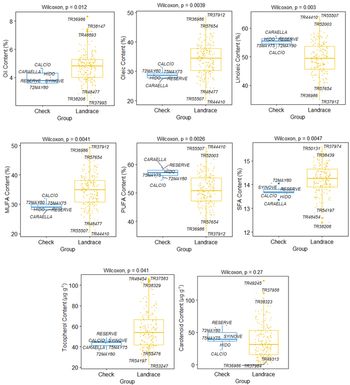
The variation within the landraces and checks is shown in Fig. 1. All of the variation could be explained with a total of seven dimensions in PCA-Biplot analysis, and the first two dimensions explained 77.6% of the total variation for the investigated traits (Fig. 1). According to PCA-Biplot, it was seen that the variation for oil, oleic acid, linoleic acid, MUFA, PUFA and SFA contents was explained in the first dimension, while the carotenoid and tocopherol contents were explained in the second dimension. Considering the correlations between the dimensions and the variables (data not shown), it was understood that oil content, oleic acid, MUFA and SFA content had positive correlations, while carotenoid, PUFA and linoleic acid contents had negative correlations with the first dimension. The tocopherol and carotenoid contents had positive and significant relationships with the second dimension; however, there was a negative correlation between this dimension and the oil content. When the correlation coefficients between the dimensions and the traits were examined along with the vector directions, the correlations among the investigated traits could also be evaluated on the PCA-Biplot. Accordingly, it was understood that there were positive relationships between PUFA and linoleic acid, as well as tocopherol and carotenoid contents. The remaining variables were positively correlated with each other. There was a negative correlation between the first group of traits (PUFA and linoleic acid) and second group of traits (oil, MUFA, SFA and oleic acid) whose vectors are in the opposite direction. In addition to these findings, the PCA-Biplot also provided information about the variation of the traits present within the local maize landraces based on the regions they were collected. Positioning of the ellipses representing the genotype groups helps us to interpret the differences among those groups for the investigated traits. The shapes and widths of the ellipses provide information about the genotypic variation for these traits. It is understood that the landraces collected from Southeastern Anatolia and Mediterranean regions had high variability. The small size of the ellipse of the check varieties indicated that the variation in terms of the variables was limited (Fig. 1). The maize landraces for all regions had much larger variation than the check hybrids. Boxplot graphics (Fig. 2), which were created to compare differences between the check varieties and maize landraces in detail, also confirmed this situation. In boxplot charts, the most important differences between check varieties and maize landraces were evident for oil, oleic acid, linoleic acid, MUFA, PUFA and SFA. Although not separate in PCA-Biplot charts, it was observed that the checks had higher means than landraces in terms of PUFA and linoleic acid contents. However, it is shown that many landraces had superiority to check varieties in terms of oil content (TR36986, TR38147 and TR48893), oleic acid (TR37912, TR36986 and TR577654), MUFA (TR37912, TR36986 and TR57654) and SFA (TR54197, TR48454 and TR38258). Especially, the landraces originated from the Black Sea and Aegean regions had higher contents of oil, oleic, MUFA and SFA as compared to check hybrids.
PCA-Biplot of the genotypic variation for 192 landraces and seven check hybrids for the investigated traits as analysed by the geographic regions of Turkey.

Boxplots for comparison of the landraces and check hybrids according to the investigated traits.

Inheritance related calculations are shown in Table 4. For all traits, PV was found higher than GV. The carotenoid and tocopherol content had higher GCV and PCV values than other traits. The heritability values were between 15.8 and 85.7%. Low heritability was observed for carotenoid content (15.8%), while fatty acids were highly heritable traits based on broad-sense heritability values (>80%). Theoretical GAM values ranged between 0.67 and 20.39. GAM corresponding to these values varied between 4.72 and 36.5% for the investigated traits.
Inheritance parameters of the investigated traits as calculated from 192 landraces and seven check hybrids

MUFA, monounsaturated fatty acids; PUFA, polyunsaturated fatty acids; SFA, saturated fatty acid; TCC, total carotenoid content; TTC, total tocopherol content; PV, phenotypic variance; GV, genotypic variance; EV, environmental variance; GCV, genotypic coefficient of variability; PCV, phenotypic coefficient of variability; ECV, environmental coefficient of variability; hBS, broad-sense heritability; GA, genetic advance; GAM, genetic advance over the mean; H, high; M, moderate; L, low.
a On dry basis.
b On percentage of total fatty acids.
Discussion
Quality breeding has become a popular objective in maize and increasing oil content is one of the common targets in breeding programmes (Sharma and Carena, Reference Sharma and Carena2016). Oil content is a quantitative trait controlled by many genes, and generally associated with larger embryo sizes in maize kernel (Yang et al., Reference Yang, Ma, Zhang, Yan, Guo, Song and Li2012). Although different limit values have been specified in the literature, a genotype should contain more than 7% oil in its kernel to be considered as high oil maize (Lambert, Reference Lambert and Hallauer2001). In the current study, it was observed that there is a significant variation within the genotypes screened for oil content (2.31–8.34%), and most Turkish landraces have higher oil content than the check varieties. It was determined that there are three landraces (TR36986, TR48893 and TR48461) among these populations that can be classified as high-oil maize (>7%).
Quality breeding for maize oil also focuses on improving the fatty acid composition (Pollak and Scott, Reference Pollak and Scott2005). There are three main objectives on the improvement of fatty acid composition in maize: (i) reducing total saturated fatty acids below 6%, (ii) increasing the total fatty acids for margarine manufacturing and (iii) increasing the oleic acid content for making maize oil compatible with the major oil crops such as canola, soybean and olive. Fat soluble compounds such as carotenoids and tocopherols have an important role against oxidation (Singh et al., Reference Singh, Vasudev, Yadava, Chaudhary, Prabhu, Chuadhary, Kumar and Langyan2014). Although there are no limits set on the fatty acids and fat-soluble compounds, there are findings that make it possible to classify maize landraces for these properties. Burt et al. (Reference Burt, Grainger, Smid, Shelp and Lee2011) reported that maize accessions with high carotenoid content contained 50–101 μg/g carotenoids. The TCC of the genotypes used in our study was determined in the range of 0–130 μg/g, and it was observed that there are a considerable number of maize landraces with carotenoid content over 50 μg/g (Fig. 2).
The ecology of the region where the plant material was collected and the farmers who selected these genotypes should have important effects on the genetic variation found in these landraces. Fig. 1 indicates that geographic region is a factor on the distinctive characteristics possessed by Turkish landraces. Indeed, the seven geographical regions of Turkey diverge significantly in terms of the environmental factors sculpting plant architecture. The landraces collected from these regions show certain plant characteristics based on the long-term adaptation to the climatological effects of those areas. Grain quality traits are no exception in this regard. More importantly, the selection processes applied by farmers throughout generations must have played a decisive role in the genetic make-up of these materials (Mwololo, Reference Mwololo2010). In fact, landraces are genetic resources grown in and adapted to a certain area for a long time (Hellin et al., Reference Hellin, Bellon and Hearne2014). It is unlikely that oil and oil quality traits have been taken into consideration by the local farmers, but certain traits such as appearance, taste and colour seem to be conserved during this selection process. The presence of genotypes with low and high levels of carotenoids is an indication of divergent selection processes applied by humans with different preferences.
Number of the essential fatty acids found in nature are known to be around 20–25 (Kenar et al., Reference Kenar, Moser, List and Ahmad2017), whereas maize oil mostly contains palmitic, stearic, oleic, linoleic and linolenic acids (Weber, Reference Weber, Watson and Ramsted1987). Among these, oleic and linoleic acids make up most of the total fatty acids in maize oil. It has been reported earlier that oil content is positively correlated with oleic acid, but a negative correlation exists between oil and linoleic acid (Orhun and Korkut, Reference Orhun and Korkut2011). The results from our study are in agreement with this information. Biosynthesis of unsaturated fatty acids occurs at the expense of one another. Oleic acid is known to be the precursor of the linoleic acid, which, in turn, is converted to linolenic acid through enzymatic activity (Belo et al., Reference Belo, Zheng, Luck, Shen, Meyer, Li, Tingey and Rafalski2008). Due to the nature of this pathway, there is a negative correlation between these fatty acids. Oleic and linoleic acids are the main sub-components in MUFA and PUFA, respectively. Generally, MUFA and PUFA show negative correlation with each other. In our study, the correlations detected between those fatty acids also confirm these evaluations. Several studies have investigated the relationship of carotenoids and tocopherols with fatty acids in maize. Goffman and Böhme (Reference Goffman and Bohme2001) reported a positive (r = 0.41) and moderate correlation between tocopherol content and PUFA in maize kernel. Considering the proximity of the trait vectors in the PCA-Biplot graphs, similar correlations exist for MUFA and PUFA with tocopherol and carotenoid contents in Turkish maize landraces. We also detected a high correlation between tocopherol and carotenoid contents. This finding agrees with the results of Kahriman et al. (Reference Kahriman, Onaç, Mert, Öner and Egesel2019).
The estimated broad-sense heritability for oil content (hBS = 63.9%) is within the limits specified in the literature. Rosulj and Husic (Reference Rosulj and Husic2002) reported that heritability varied between 13 and 85% in four different maize populations. In this study, all the traits had high heritability values (hBS > 60%), except for the carotenoid content. This indicates that genetic effects have an important role in the phenotypic variation for these traits. GA values calculated based on heritability estimates provide useful information for breeding programmes. However, the inclusion of dominance and epistatic interactions should be considered at this point (Wray and Visscher, Reference Wray and Visscher2008). Additionally, the heritability estimates here were calculated for all genotypes; in other words, they were not population-specific calculations. In order to make a better use of these genetic materials in the future breeding programmes, it may be necessary to calculate heritability values at the population level, especially for the promising landraces for one or more of the investigated traits. It would be possible to use the selected populations as donor germplasm in the efforts of developing inbred lines. Breeding studies assisted with in vivo doubled haploid technique have shown that the genetic variation carried in such populations could be successfully exploited (Strigens et al., Reference Strigens, Schipprack, Reif and Melchinger2013).
In conclusion, a comprehensive screening of Turkish maize landraces was carried out for oil content and oil quality-related traits. The results indicate the presence of a considerable genetic variation within the maize landraces for most variables. Exploiting this variation would require testing the promising landraces in replicated trials with advanced experimental designs over different environments.
Acknowledgements
We thank the Scientific Research Commission of Çanakkale Onsekiz Mart University for supporting this research through the project FIA-2017-961. We also extend a warm appreciation to our students from the Field Crops and Agricultural Biotechnology Departments, who contributed to the lab work.
Financial support
This research was funded by the Scientific Research Commission of Çanakkale Onsekiz Mart University (Project number: FIA-2017-961).
Conflict of interest
The authors declare no conflict of interest.