Introduction
Oocyte cryopreservation is an important method to preserve female fertility in different pathological conditions (Gidoni et al., Reference Gidoni, Holzer, Tulandi and Tan2008). It can also lead to establishment of oocyte banks. In addition, oocyte cryopreservation is a successful alternative for storing the excess of oocytes during anti-retroviral therapy (ART) avoiding associated ethical issues. When the risk and delay of stimulation become unacceptable for the patient, the strategy of freezing immature oocytes followed by in vitro maturation stands out (Huang et al., Reference Huang, Tulandi, Holzer, Tan and Chian2008). One of the major problems associated with the cryopreservation of metaphase II oocytes is the sensitivity of the microtubular spindle to low temperatures and cryoprotectants (Borini et al., Reference Borini, Levi Setti, Anserini, De Luca, De Santis, Porcu, La Sala, Ferraretti, Bartolotti, Coticchio and Scaravelli2010). This could be avoided by cryopreserving the oocytes at the germinal vesicle (GV) stage and metaphase I (MI) stage when the chromosomes are within the nuclear membrane or not arranged on the spindle that could be disrupted due to the cryopreservation and thawing process (Paynter, Reference Paynter2000). Cryopreservation of immature oocytes is a way of circumventing the spindle damage problem. However one major disadvantage of immature oocyte cryopreservation is that in vitro maturation after thawing is required. Although in vitro maturation is a routine in some animal species, it is not the case for human oocytes. Only a few successful pregnancies from cryopreserved immature oocytes have been reported (Tucker et al., Reference Tucker, Wright, Morton and Massey1998; Wu et al., Reference Wu, Zhang and Wang2001). Recent studies on immature oocyte cryopreservation focus mainly on cryopreservation methods, frozen carrier and freezing liquid to avoid cryodamage. Unfortunately, the results are not very promising.
It has been pointed out that (Fujinami et al., Reference Fujinami, Hosoi, Kato, Matsumoto, Saeki and Iritani2004); artificial oocyte activation (AOA) may be beneficial to fertilization and early embryonic development. But the effect of AOA on thawed immature oocyte followed by in vitro maturation remains unknown. A human oocyte enters the first meiotic division during embryonic life and arrests in this phase for an extended time. Upon resumption of the first meiotic division, the oocyte is subsequently arrested at the second metaphase (MII) where it waits for fertilization. Upon fertilization, spermatozoa overcome the second meiosis arrest by inducing a series of cellular events within the oocyte that are essential for normal development. These events are collectively called oocyte activation (Ben-Yosef and Shalgi, Reference Ben-Yosef and Shalgi1998). Oocyte activation is also characterized by two main molecular events including an increase in intracellular Ca2+ concentrations followed by meiotic promoting factor inactivation for M–G1 transition (Tesarik et al., Reference Tesarik, Mendoza and Greco2000). Intracytoplasmic sperm injection (ICSI), in which several critical steps in normal fertilization are bypassed, has been widely performed with the thawed oocytes to improve the rate of fertilization 20 to 30 min after ICSI, the rise in intracellular-free calcium concentration from endoplasmic reticulum stores originates at oocyte cortex instead of the point of sperm entry, which leads to inadequate oocyte activation (Heindryckx et al., Reference Heindryckx, Van der Elst, De Sutter and Dhont2005). Irreversible loss of high oocyte mitochondrial polarity in thawed oocytes may be associated with defects in Ca2+ signalling after insemination and could have downstream consequences for normal embryogenesis (Jones et al., Reference Jones, Van Blerkom, Davis and Toledo2004). Chemical compounds for AOA can induce calcium increase and initiate oocyte activation (Hosseini et al., Reference Hosseini, Hajian, Moulavi, Shahverdi and Nasr-Esfahani2008). However very limited research has been done to date about AOA on the thawed immature oocytes followed by in vitro maturation.
In this paper, we evaluated the effect of AOA on thawed failed-matured oocytes in in-vitro fertilization (IVF), in order to enable potentially a new option for fertility preservation in many pathological conditions and as an adjunct to conventional IVF cycles.
Materials and methods
Oocytes selection
A total of 386 failed-matured oocytes was used for the study. These oocytes were obtained from patients who underwent an ICSI cycle between February 2009 and December 2009. This study was approved initially by the ethical and scientific committee of the first affiliated hospital of Anhui Medical University, China. All patients involved in the study were informed thoroughly and they all signed written consent forms. The indication for ICSI treatment was types of male infertility, oligozoospermia and obstructive azoospermia. The patients were given standard ovarian stimulation using a long or short protocol. After down-regulation with a gonadotropin-releasing hormone (GnRH) antagonist, the patients were stimulated with human menopausal gonadotropin (r-FSH: Gonal F, Serono Inc. Italy; HMG: Lizhu Pharmaceutical Ltd, Zhuhai, China). Oocyte retrieval was performed through vaginal puncture under ultrasound guidance. After ovum pick-up, oocytes were denuded enzymatically by 60–80 mU/ml hyaluronidase solution (Sigma Chemicals) of the cumulus cells to assess nuclear maturity. All retrieved metaphase II (MII) oocytes were used for patients’ treatments. Germinal vesicle and metaphase I (MI) oocytes were divided randomly into two groups: Group A was not frozen; Group B was frozen at different matured stages containing GV and MI.
Vitrification and thawing procedures
Vitrification procedures
• Equilibration medium: (1) HTF1023 (SAGE) + 30% SPS (SAGE) + 7.5% (v/v) PROH + 7.5% (v/v) EG, RT, 5 min.
• Vitrification medium: (2) HTF1023 + 30%SPS + 0.5M sucrose + 15% (v/v) PROH +15% (v/v) EG, RT, 45–60 s.
• Immature oocytes were loaded on a specially designed vitrification device, the McGill Cryoleaf (MediCult), and were plunged immediately into liquid nitrogen for at least 1 month of storage.
Thawing procedures
• Thawing medium: (1) HTF1023 + 30% SPS + 1.0 M sucrose, 37°C; 1 min.
• Diluents medium I: (2) HTF1023 + 30% SPS + 0.5 M sucrose, RT, 3 min.
• Diluents medium II: (3) HTF1023 +30% SPS + 0.25 M sucrose, RT, 3 min.
• Washing medium I: (4) HTF1023 + 30% SPS, RT, 3 min.
• Washing medium II: (5) HTF1023 + 30% SPS, 37°C, 3 min.
The oocyte survival rate after thawing was evaluated microscopically 2 to 3 h after culture based on the morphology of the oocyte membrane integrity.
In vitro maturation, ICSI, AOA and embryo culture
The fresh immature oocytes and frozen–thawed immature oocytes were placed in IVM medium for 24–36 h prepared with a commercial culture medium (SAGE) supplemented with final concentrations of 0.075 UI/ml of FSH (Gonal-F) and 0.075 IU/ml hCG (Profasi). The mature oocytes were subject to ICSI using sperm donors if the first polar bodies were extruded and the cytoplasm was homogeneous with good refraction.
The vitrification group was randomly divided into controlled and AOA groups. The injected oocytes in the controlled group were cultured in cleavage medium (Cook). The remaining oocytes were artificially activated by exposing them to 7% (v/v) ethanol (Sigma) for 6 min. After that, the oocytes were thoroughly washed in cleavage and cultured in the same medium.
Inseminated oocytes were cultured in cleavage for 3 days and then were transferred to blastocyst medium (Cook, Australia) for 2 additional days. Around 16 to 18 h after ICSI, fertilization was assessed by the presence of pronuclei; 72 h after ICSI, embryos were assessed for their cleavage and quality. Embryos with even-sized blastomeres, and <10% fragmentations were given a grade of A. Embryos with even-sized blastomeres and between 10% and 50% fragmentations were given a grade of B. Embryos with uneven-sized blastomeres and/or with >50% fragmentations were given a grade of C (Nasr-Esfahani et al., Reference Nasr-Esfahani, Razavi, Mardani, Shirazi and Javanmardi2007). Grade A and B embryos were considered high-quality embryos, and their percentage was calculated.
On day 5 after ICSI, the number of blastocysts in each group was recorded. Good quality blastocysts were defined to be those having an inner cell mass (ICM) and trophectoderm type A or B. Type A ICM appeared to be well defined, compact and formed by many cells. Type B ICM was formed by several groups of cells that were not compact. Type A trophectoderm was well defined, uniform, and formed by many cells. Type B trophectoderm appeared to be formed by few cells, giving it an irregular aspect (Cobo et al., Reference Cobo, Kuwayama, Perez, Ruiz, Pellicer and Remohi2008).
Statistical analysis
Statistical analysis was performed using SPSS 13.0 (SPSS, Inc, Chicago, IL). The data were analyzed using chi-squared or t-test. P-value <0.05 was considered statistically significant.
Results
A total of 386 failed-matured oocytes (GV and MI stages) derived from controlled ovarian hyperstimulation cycles were included in these experiments. The patient parameters for age, stimulation protocol and numbers of the retrieved total oocytes were similar in different groups.
In 112 fresh failed-matured oocytes followed by IVM, the maturation rate, the fertilization rate, the cleavage rate, the high-quality embryo formation rate, the blastocyst formation rate were 83.9% (94/112), 80.9% (76/94), 92.1% (70/76), 14.3% (10/70), 8.6% (6/70), respectively.
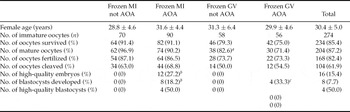
No high-quality embryos and blastocyst occurred in the controlled groups for MI and GV vitrification oocytes. In the MI vitrification group, the AOA group gave 27.2% (12/44) high-quality embryo formation rate and 18.2 (8/44) blastocyst formation rate. The high-quality embryo formation rate and blastocyst formation rate were significantly higher in the AOA group than in the controlled group (P < 0.01). The maturation rates, fertilization rates and cleavage rates had no significant difference between the two groups (P > 0.05). In GV vitrification group, the AOA group gave 33.3% (4/12) high-quality embryo formation rate. The high-quality embryo formation rate was significantly higher in the AOA group than in the controlled group (P < 0.05).The maturation rates, fertilization rates and cleavage rates had no significant difference between the two groups (P > 0.05). The maturation rate was significantly higher in the MI vitrification group without AOA than the GV vitrification group without AOA (P < 0.05) (Table II). The fertilization rates, the cleavage rates had no significant difference between the two groups (P > 0.05; Table 1)
The effect of AOA on the developmental potential of frozen–thawed immature oocytes

Note: Compared with freeze–thawed MI without AOA aP < 0.05, bP < 0.01; compared with freeze–thawed GV without AOA cP < 0.05.
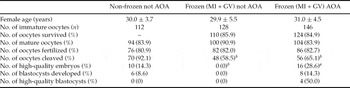
The effect of vitrification on the developmental potential of immature oocytes

Note: Compared with non-frozen without AOA aP < 0.05, bP < 0.01.
Regardless of the maturation stage (GV + MI), the vitrification group without AOA gave a significant lower cleavage rate and a higher quality embryo formation rate than the fresh group without AOA (P < 0.01). The maturation rates and fertilization rates were not significantly different between the two groups (P > 0.05). The vitrification group with AOA gave significant much lower cleavage rate than the fresh group without AOA (P < 0.01) and significant higher high-quality embryo formation rate than fresh group without AOA (P < 0.05). The maturation rates and fertilization rates were not significantly different between the two groups (P > 0.05) (Table II).
Discussion
Collected immature oocytes in this experiment were all from the failed-matured oocytes in ICSI cycles. It is generally believed that dominant ovarian follicles affect the development of other follicles and induce apoptosis of other follicles and oocytes. However, Chian et al. (Reference Chian, Buckett and Tan2004b) argued that oocyte maturation capacity is not subject to the effect of dominant follicles. It has been reported that pregnancies and live births that resulted from IVF of mature oocytes retrieved from dominant follicles in a natural cycle combined with in vitro maturation (IVM) of immature oocytes retrieved from small follicles were achieved (Chian et al., Reference Chian, Buckett, Abdul Jalil, Son, Sylvestre, Rao and Tan2004a). In this experiment, the fresh group received an 83.9% in vitro maturation rate. The fertilization rate, cleavage rate and high-quality embryo rate were 80.9, 92.1 and 14.3%, respectively. In total, six blastocysts were obtained. This result demonstrated that immature oocytes derived from controlled ovarian hyperstimulation cycles should be exploited fully to improve the cumulative pregnancy rate. This test aims to figure out how to improve the efficiency of human immature oocyte vitrification and to provide better technology platform for female fertility preservation and the establishment of an egg bank.
In our study, vitrification groups without AOA did not obtain high-quality embryos and blastocysts, cleavage rate and the rate of high-quality embryos were also reduced significantly when compared with the fresh group. This finding indicates that freezing injury reduces significantly the early developmental potential of embryos. Freezing process and prolonged in vitro culture of immature oocyte may result in thickened zona hardening and barriers to sperm-egg binding, thus, the fertilization of frozen–thawed immature oocytes by IVM may use the ICSI method. ICSI technique may change the oocyte activation process of some internal changes in parameters, causing oocyte activation failure or insufficiency (Heindryckx et al., Reference Heindryckx, Van der Elst, De Sutter and Dhont2005). Moreover, in oocyte freezing process, a variety of ion channel and protein of the membrane or mitochondrial would be subject to different degrees of damage, which would affect calcium oscillations and oocyte activation (Zeron et al., Reference Zeron, Pearl, Borochov and Arav1999; Jones et al., Reference Jones, Van Blerkom, Davis and Toledo2004). These oscillations are the key event leading to fertilization and further embryonic development (Ozil & Huneau, Reference Ozil and Huneau2001). It has been demonstrated that AOA can promote a rise in intracellular calcium concentration.
Several scholars have pointed out the potential of using AOA to improve fertilization rates and embryonic development affected by poor quality sperm or oocytes (Nasr-Esfahani et al., Reference Nasr-Esfahani, Razavi, Javdan and Tavalaee2008; Borges et al., Reference Borges, de Almeida Ferreira Braga, de Sousa Bonetti, Iaconelli and Franco2009). In the presented research, the in vitro matured oocytes from vitrification group were inseminated by ICSI and subsequently activated artificially. This helps us understand whether AOA is able to improve fertilization and embryo developmental potential of freeze–thawed immature oocytes. In our experiment, ethanol as a chemical activator achieved its active role by stimulating single pulse of calcium ions increase. In the MI vitrification group, the high-quality embryo formation rate and blastocyst formation rate were significantly higher in the AOA group than in the controlled group. In the GV vitrification group, the high-quality embryo formation rate was significantly higher in the AOA group than in the controlled group. Based on these results, we propose that AOA can significantly improve developmental potential of embryo derived from frozen–thawed immature oocytes. On the other hand, vitrification group with AOA resulted in lower cleavage rate than fresh group without AOA, but higher high-quality embryo formation rate than fresh group without AOA. We can speculate that AOA may repair freezing damage to some extent. Such speculation needs follow-up experiments to be further confirmed.
The MI vitrification group without AOA gave a significantly higher rate of in vitro maturation than the GV vitrification group without AOA, but early embryonic development was not significantly different between the two groups. Respectively, freeze–thawed MI oocytes and GV oocytes were treated with AOA, the MI oocytes gave 18.2% blastocyst rate, while the GV oocytes did not develop to the blastocyst stage. AOA seems to be more conducive to improve the embryonic development of freeze–thawed MI oocytes than GV oocytes, which still cannot be explained. It is necessary to increase the sample size of the frozen–thawed GV oocytes for further research to improve their developmental potential of embryos.
The safety of AOA has been attracting wide attention. In the literature, studies on the effect of AOA have shown that most embryos derived from activated oocytes have normal karyotype in the centre. Chromosomal analysis using FISH have shown that embryos derived through AOA have a normal chromosomal number (Lu et al., Reference Lu, Zhao, Gao, Li, Ma, Mullen, Critser and Chen2006). In addition, Kyono et al. reported that oocytes from patients who repeatedly failed ICSI fertilization were artificially activated after ICSI. As a result, five healthy children were born. Physical and mental development of the children from birth to 12 months was normal (Kyono et al., Reference Kyono, Kumagai, Nishinaka, Nakajo, Uto, Toya, Sugawara and Araki2008). However, we believe that further clinical research to improve AOA security has to be conducted, in order for the artificial activation technology to be widely used in the area of the freeze–thawed immature oocytes.
Acknowledgements
This work was supported by the National High Technology Research and Development Programme 863 (no. 2006AA02Z4A4). No potential conflicts of interest relevant to this article were reported. We thank Yang Qin at Microsoft™ for ‘polishing’ the English language in this document.