Introduction
Approximately 15–40% of community-dwelling older adults suffer from depressive symptoms (Al-Shammari and Al-Subaie, Reference Al-Shammari and Al-Subaie1999; Kraaij and De Wilde, Reference Kraaij and De Wilde2001; Harris et al., Reference Harris2003; Wada et al., Reference Wada2004). Several researchers have reported negative life events (NLEs) related to depressive symptoms in older adults, such as physical health problems (Roberts et al., Reference Roberts, Kaplan, Shema and Strawbridge1997; Schoevers et al., Reference Schoevers, Beekman, Deeg, Geerlings, Jonker and Tilburg2000), loss of close relationships (Schoevers et al., Reference Schoevers, Beekman, Deeg, Geerlings, Jonker and Tilburg2000; Maciejewski et al., Reference Maciejewski, Prigerson and Mazure2001), and financial problems (Roberts et al., Reference Roberts, Kaplan, Shema and Strawbridge1997). NLEs include normative and recurring social difficulties (e.g. loss of close relationships) and the natural aging process (e.g. physical health problems). Others have shown that NLEs are associated with increased levels of depressive symptomatology (Glass et al., Reference Glass, Kasl and Berkman1997; Kraaij et al., Reference Kraaij, Arensman and Spinhoven2002). Older adults are thus continually experiencing a number of these events throughout their lives.
While older adults experience a variety of NLEs, not all of those in stressful situations are predisposed to exhibit depressive disorders. This means that the association between NLEs and depressive symptoms could be moderated by some factors (Kraaij and Garnefski, Reference Kraaij and Garnefski2002). These moderators (Baron and Kenny, Reference Baron and Kenny1986) can alter the direction and/or strength of the association between NLEs and depressive symptoms. Social and lifestyle activities may serve as potential moderators. Indeed, older adults with experiences revolving around familial relationships have been found to be less vulnerable to depressive symptoms than those without (Kraaij and Garnefski, Reference Kraaij and Garnefski2002). Furthermore, older adults who participate in social activities and social exchanges have been observed to report fewer depressive symptoms (Okun and Keith, Reference Okun and Keith1998; Chiao et al., Reference Chiao, Weng and Botticello2011).
In this study, we examined whether social and lifestyle activities moderate the association between NLEs and depressive symptoms among older adults, and we investigated which activities are statistically significant moderators.
Methods
Participants
Older adults aged 65 years or more participated in this cross-sectional, community-based study undertaken in Minamifurano (population 3,500), a rural town in Hokkaido, Japan (Katsumata et al., Reference Katsumata, Arai, Ishida, Tomimori, Denda and Tamashiro2005). Since 1998 Minamifurano town has been conducting a program to assess the health conditions of the local older population. Mental health problems (e.g. depressive symptoms) were included as a research topic in 2004. This study discusses part of the evidence collected in 2004.
Of 822 older adults registered in the town in 2004, 731 (89%) were community dwellers or non-institutionalized persons. We mailed a self-administered questionnaire and an informed consent form to each of them. We made follow-up personal visits to those who did not return a questionnaire after the deadline, and conducted follow-up telephone interviews with participants who submitted a questionnaire with incomplete responses. Sixteen refused to participate because they were either too busy or did not want to take part, and 27 could not be contacted. A total of 688 (94%) responded. The Ethics Committee of the Hokkaido University Graduate School of Medicine approved the conduct of the study.
Measurements
We measured depressive symptoms using the Japanese version of the original 30-item Geriatric Depression Scale (jGDS30), a self-administered depression assessment scale consisting of 30 items frequently used to detect depression (Brink et al., Reference Brink, Yesavage, Lum, Heersema, Adey and Rose1982; Niino et al., Reference Niino, Imaizumi and Kawakami1991; Yesavage et al., Reference Yesavage1983). Total scores range from 0 to 30, with a higher score indicating more depressive symptoms. Compared to other screening instruments, the GDS is less focused on somatic symptoms that often confound the diagnosis of depression, has easy binary response options (yes/no), and has been validated in a broad spectrum of older populations. It is therefore suitable for screening depressive symptoms among older adults.
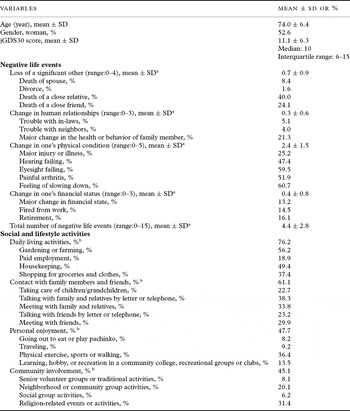
We adopted 13 of the 15 items from the Geriatric Social Readjustment Rating Scale (Amster and Krauss, Reference Amster and Krauss1974) and two items from the Social Readjustment Rating Scale (Holmes and Rahe, Reference Holmes and Rahe1967), and asked the participants whether they had experienced any of the 15 specific NLEs over the year prior to the study. We presented the 15 NLEs to participants as yes/no items. The 15 NLE items were grouped into four subscale categories, and the NLEs were counted as the sum of events reported over the previous one-year period within each relevant category. The first subscale, “loss of a significant other”, included four NLEs (score range: 0–4); the second, “change in human relationships”, included three NLEs (score range: 0–3); the third, “change in physical condition”, included five NLEs (score range: 0–5); and the last category, “change in financial status”, included three NLEs (score range: 0–3) (see Table 1).
Characteristics of the participants (n = 682)

a Mean ± SD of the total number of negative life events which the participants had in the past year prior to the study.
b The percentages of the participants who answered “often” for at least one activity in each of the categorized social and lifestyle activities.
SD = standard deviation; jGDS30 = the Japanese version of the 30-item Geriatric Depression Scale
We asked the participants about their involvement in activities that reflected their lifestyle (i.e. how they lived their everyday life) over the past year before the study. We adopted 17 specific activity items from previous studies that deal with lifestyle among older adults (Kaplan et al., Reference Kaplan, Seeman, Cohen, Knudsen and Guralnik1987; Hashimoto et al., Reference Hashimoto1997; Iwasaki et al., Reference Iwasaki, Otani, Ohta, Yosiaki, Kuroiwa and Suzuki2002). The response options for each activity were “often”, “sometimes” or “never”. These activities were grouped into four subscales: daily living activities; contact with family members and friends; personal enjoyment; and community involvement. Based on their responses, the participants were divided into two groups: high or low level activity. The high-level activity group included participants who answered “often” for at least one activity in each of the categories of social and lifestyle activities, and the low-level activity group involved participants who replied “sometimes” or “never”.
Statistical analysis
Comparisons of the jGDS30 scores according to experience and non-experience of individual NLEs were performed using t-test.
Following accepted guidelines (Baron and Kenny, Reference Baron and Kenny1986), a hierarchical linear regression was used to test the moderating effect of social and lifestyle activities on the association between NLEs and depressive symptoms. In the hierarchical regression model, the order of entry was as follows. At Step 1 and Step 2, the predictor (the categorized NLEs) and moderator (a dummy variable representing the grouped participant, according to high or low level activity) variables were entered sequentially into the models. At Step 3, the interaction between the categorized NLEs subscale and the social and lifestyle dummy was entered last. A statistically significant interaction indicates the moderating effect of social and lifestyle activities on the association between NLEs and depressive symptoms (Baron and Kenny, Reference Baron and Kenny1986), and a negative interaction indicates that older adults with high-level activity are more likely to have a lower jGDS30 score than those without. Prior to the regression analysis, Box-Cox transformation of the jGDS30 score was applied to produce a normal distribution (Box and Cox, Reference Box and Cox1964). The Box-Cox analysis resulted in λ = 0.5 and the jGDS30 score was square-root transformed to improve normality. The normality of the transformed jGDS30 scores was confirmed by visual inspection of the distributions and Q-Q plots. The moderation model is described below:

• β0 is the population average intercept.
• NLE is the continuous variable for the categorized NLEs subscale (cumulative exposure of NLEs) under four categories; β1 indicates the change in the expected value of the transformed jGDS30 with a unit increase in NLEs among the participants with LOW-level activity group.
• activity is the dummy variable for social and lifestyle activity (coded activity = 0 for the low-level activity group and activity = 1 for the high-level activity group); β2 indicates the change in the expected value of the transformed jGDS30 among the participants with non-experience of NLEs.
• β3 provides an estimate of the moderation effect of social and lifestyle activities on the associations between NLEs and depressive symptoms, and indicates the additional change in the expected value of the transformed jGDS30 with a unit increase in NLEs among the participants with HIGH-level activity group.
• X is the vector of covariates to control age and gender and β is the vector representing their beta coefficients.
A p-value of less than 0.05 was considered statistically significant. All statistical analyses were performed using SAS for Windows release 9.1.3 (SAS Institute Inc., Cary, NC).
Results
Of 688 respondents, 682 completed the jGDS30 and participated in the current analysis. The characteristics of the sample are shown in Table 1. The mean age was 74.0 (SD 6.4), and 52.6% were women. The mean jGDS30 score was 11.1 (SD 6.3). Across the four categories of NLEs, the mean total of NLEs was 4.4 ± 2.8. The most common NLEs were events related to changes in physical health conditions. Among respondents who mentioned change in their physical condition, between 47.4% and 60.7% reported having hearing and eyesight failures, painful arthritis and a feeling of slowing down. The categories of social and lifestyle activities in which there were highest percentages of respondents who answered “often” for at least one activity were daily living activities (76.2%) and contact with family members and friends (61.1%). Between 37.4% and 56.2% of respondents reported gardening/farming, housekeeping and shopping as their daily living activities. Between 22.7% and 38.3% of respondents reported having talked and/or met with family members, and having taken care of their children or grandchildren, as their way of maintaining contacts with family members and friends.
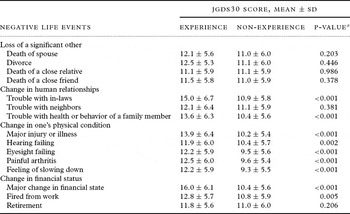
Table 2 shows the associations between NLEs (yes/no responses) and depressive symptoms (mean of the transformed jGDS30 scores). There were statistically significant differences in the mean of the transformed jGDS30 scores between having experienced and not having experienced all NLEs, except for “trouble with neighbors” and “retirement”, which could be placed into three life-event categories: “changes in human relationships”, “change in physical condition” and “change in financial status”. All five events on change in physical condition (i.e. major injury, hearing and eyesight failures, painful arthritis, and slowing down) were significantly associated with the transformed jGDS30 scores (p < 0.001 or p = 0.002).
Comparisons of mean scores of the Japanese version of the 30-item Geriatric Depression Scale according to negative life events

a Comparisons of the jGDS30 scores according to experience and non-experience of individual NLEs were performed using t-test.
SD = standard deviation; jGDS30 = the Japanese version of the 30-item Geriatric Depression Scale
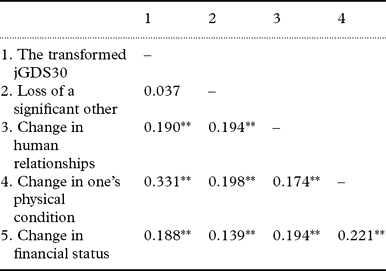
Table 3 shows the correlations between the transformed jGDS30 score and four categorized NLE subscales. There were positive significant correlations between the transformed jGDS30 score and three NLE subscales (change in human relationships, change in one's physical condition, and change in financial status), and also between all of the categorized NLEs subscales.
Correlations between the transformed Japanese version of the 30-item Geriatric Depression Scale and the categorized negative life event subscales
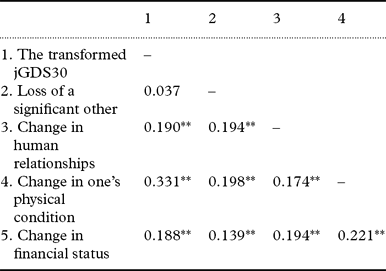
jGDS30 = the Japanese version of the 30-item Geriatric Depression Scale.
** p < 0.01.
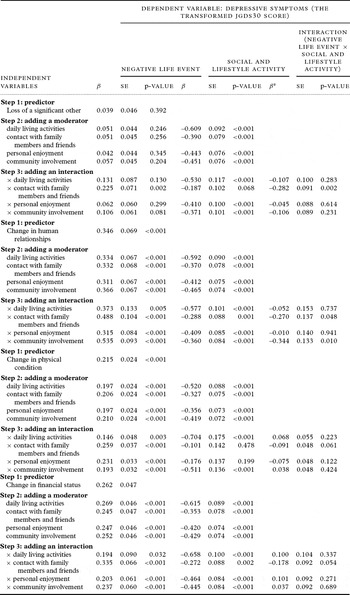
Table 4 shows the hierarchical linear regression analysis results. There were significant increases in the transformed jGDS30 scores with a unit increase in three categorized NLEs (changes in human relationships, change in physical condition, and change in financial status) among the participants from the low-level activity group for all the categorized social and lifestyle activities. The transformed jGDS30 scores increased significantly with increasing NLEs in the “loss of a significant other” category among those participants without frequent contact with family members and friends. Among the participants who had no experience of the individual categorized NLEs, most of the categorized social and lifestyle activities decreased the transformed jGDS30 scores. The significant interaction terms on depressive symptoms were observed between “loss of a significant other” and “contact with family members and friends” (β = −0.282, SE = 0.091, p = 0.002), “change in human relationships” and “contact with family members and friends” (β = −0.270, SE = 0.137, p = 0.048), and “change in human relationships” and “community involvement” (β = −0.344, SE = 0.133, p = 0.010). All interaction between the categorized NLEs and “contact with family members and friends” had negative β coefficients but showed no significant moderation of “change in physical condition” and “change in financial status”. There were no categorized social and lifestyle activities moderating the association of NLEs, specifically “change in physical condition” and “change in financial status”, with depressive symptoms.
A hierarchical regression analysis testing moderating effects of social and lifestyle activities on the association between negative life events and depressive symptoms

a A statistically significant β indicates the moderating effects of social and lifestyle activities on the associations between NLEs and depressive symptoms.
SE = standard error; jGDS30 = the Japanese version of the 30-item Geriatric Depression Scale.
Discussion
This report explores the association between NLEs and depressive symptoms by identifying the cushioning role of social and lifestyle activities among community-dwelling Japanese older adults. Evidence is important to inform community-based social interventions as a support strategy against mental health problems and their sequelae, particularly suicide. We need the strategy to redress the health infrastructure deficits in Japan's rural communities (e.g. shortage of medical doctors) (Kaneko et al., Reference Kaneko, Motohashi, Sasaki and Yamaji2007). Since older adults across rural Japan have similar experiences in these respects, our findings from this study of older adults in Minamifurano could be generalized to other local older populations.
NLEs were common among the participants (mean: 4.4 events). Strongly significant associations were observed between depressive symptoms and NLEs, particularly revolving around “trouble with in-laws”, “major change in health or behavior of family member”, “major personal injury or illness”, “eyesight failing”, “painful arthritis”, “feeling of slowing down” and “major change in financial state”. All NLEs relating to the “change in physical condition” category (i.e. major personal injury or illness, hearing and eyesight failures, painful arthritis, and feeling of slowing down) were associated with depressive symptoms. Our findings support accumulating evidence suggesting that depression in older adults could present as somatic complaints (Ruegg et al., Reference Ruegg, Zisook and Swerdlow1988).
Two different types of interaction were observed: the β-coefficients of interaction were both negative and positive. A negative β-coefficient for the interaction term indicates that the categorized social and lifestyle activities could moderate the association between NLEs and depressive symptoms. By contrast, a positive β-coefficient indicates exacerbation of the depressive symptoms. Only one social and lifestyle category (contact with family members and friends) had a consistent moderating role in the association between all the categories of NLEs and depressive symptoms (and had a non-significant moderating effect on “change in physical condition” and “change in financial status”). Having contact with family members and friends means that older adults were socially integrated and were receiving social support, which are both important shields against depression (Bosworth et al., Reference Bosworth2000; Dalgard et al., Reference Dalgard2006). In addition to frequent contact with family members and friends, community involvement moderated the association between change in human relationships and depressive symptoms. Stress arising from troublesome interpersonal relationships in their proximal network might be moderated by positive interpersonal relationships, especially kinship communication and connections outside the home. While all NLEs in the “change in physical condition” and “change in financial status” categories, with the exception of “retirement”, were signiticantly associated with the jGDS30 scores, we did not find any significant moderating role of the categorized social and lifestyle activities on depressive symptoms arising from “change in physical condition” and “change in financial status”. The social and lifestyle activities measured in this study may not play a role as a treatment for health- and income-related depressive symptoms. Rather, it is possible that some activities may increase the risk of depressive symptoms among older adults with NLEs related to change in physical condition or change in financial status (as noted above, a positive β-coefficient for interaction terms means that high social and lifestyle activities are likely to exacerbate the association between NLEs and depressive symptoms). For example, regular activities like daily living activities and community involvement may become a physical or mental burden among those with physical or financial problems. When a person's financial status changes, even personal activities that previously brought enjoyment may instead cause stress. In this study, we did not find any factors which moderated the association between health- and income-related NLEs and depressive symptoms. In our future studies in Minamifurano, we will consider factors other than the social and lifestyle activities that may help protect older adults who are experiencing NLEs.
This study has several limitations. First, the cognitive status of the participants was not examined using a proper tool. Inclusion of cognitively impaired older adults in the study may have biased the results. However, the GDS is an accurate tool even for older adults with mild to moderate cognitive impairment (Parmelee et al., Reference Parmelee, Lawton and Katz1989; McGivney et al., Reference McGivney, Mulvihill and Taylor1994). In addition, the participation of severely impaired older adults in this study was minimized because our participants comprised non-institutionalized older adults who were able to complete the self-administered questionnaire on their own or with minor assistance. Second, our measures were based on the participants’ self-reports. Depressed people tend to recall more negative events and report more negatively about their mental problems (Raphael and Cloitre, Reference Raphael and Cloitre1994). Third, our measures of NLEs are somewhat crude. We lacked specific questions related to perceptions of distress associated with NLEs. Exposure to life events may by a proxy for sociodemographic variations not well controlled for in our data.
In conclusion, our results showed that social and lifestyle activities could be protective factors among older adults who have not had any experience of NLEs over a year. Activities revolving around one's family or friends could be the most appropriate social interventions among older adults with experience of NLEs over the past year. To help reduce depression associated with NLEs that are not related to physical condition or financial status, older adults could be introduced to activities that would make them socially integrated. However, there is a compelling need to identify other factors, apart from the social and lifestyle activities examined here, which can help older adults cope with the depressive outcomes arising from their health- and income-related NLEs.
Conflict of interest
None.
Description of authors' roles
Yuriko Katsumata designed the study, collected the data, carried out the statistical analysis and wrote the paper. Asuna Arai designed the study, collected the data and assisted with writing the paper. Kozo Ishida and Masashi Tomimori designed the study and collected the data. Romeo B. Lee assisted with writing the paper. Hiko Tamashiro supervised the design of the study and the data collection, and revised the paper critically for important intellectual content.
Acknowledgments
Special thanks go to the participants and the municipal officers in Minamifurano Town who made this study feasible and successful.