


Bone and mammoth ivory rods and points have been recognized as a late Pleistocene tool type since first discovered with Pleistocene fauna at Blackwater Draw in New Mexico (Cotter Reference Cotter1937; Figgins Reference Figgins1927; Howard Reference Howard1935), Lindenmeier in Colorado (Holen and Holen Reference Holen and Holen2009; Roberts Reference Roberts1935; Wilmsen and Roberts Reference Wilmsen and Roberts1978), Goldstream near Fairbanks (Rainey Reference Rainey1939), and submerged in the Itchtucknee River in northern Florida (Jenks and Simpson Reference Jenks and Simpson1941). Today, hundreds of beveled osseous tools have been identified in late Pleistocene contexts across North America, but relatively few are made of mammoth ivory (Figure 1). Many of these points are associated with well-dated Clovis caches and kill sites (Bradley Reference Bradley, Hahn, Menu, Taborin, Walter and Widemann1995; Haynes Reference Haynes2002; Morrow and Fiedel Reference Morrow, Fiedel, Morrow and Gnecco2006; Tankersley Reference Tankersley1997, Reference Tankersley, Barton, Clark, Yesner and Pearson2004) and are reminiscent of artifacts from Upper Paleolithic Eurasia (Saunders and Daeschler Reference Saunders and Daeschler1994; Saunders et al. Reference Saunders, Haynes and Stanford1990). Here, we report on the oldest documented osseous rods from securely dated contexts in North America. Although “osseous” refers specifically to bone, throughout this article, we use this term to describe bone, antler, and ivory materials to distinguish these from the broader range of materials that the term “organic” would imply.
Osseous rods and extent of late Pleistocene glaciation in North America. Ice extent after Dalton and colleagues (Reference Dalton, Margold, Stokes, Tarasov, Dyke, Adams and Allard2020). Ancient Lake Lahontan and Bonneville after Duke and King (Reference Duke and King2014). Ancient Lake Atna after Wiedmer and colleagues (Reference Wiedmer, Montgomery, Gillespie and Greenberg2010). Ancient lakes in Beringia after Bond (Reference Bond2019). Information for sites containing osseous rods referenced in Table 1. Location key: (1) Holzman, (2) Broken Mammoth, (3) Upward Sun River, (4) Gerstle River Quarry, (5) Goldstream, (6) Trail Creek Caves, (7) Lime Hills Cave, (8) East Wenatchee, (9) Lind Coulee, (10) Marmes Rockshelter, (11) Klamath Lake, (12) Lower Klamath Lake, (13) Goose Lake, (14) Pyramid Lake, (15) Grenfell, (16) Anzick, (17) Agate Basin, (18) Crook County, (19) Sheaman, (20) Lindenmeier, (21) Blackwater Draw, (22) Sheridan Cave, (23) Itchtucknee River, and (24) Sloth Hole.

In North America, the northernmost examples of beveled rods outside of Alaska occur in Saskatchewan (Wilmeth Reference Wilmeth1968) and the Pacific Northwest (Gramly Reference Gramly1993). Florida has yielded the largest number of osseous points and rods, although most are in private collections where they remain undated. Osseous tools from Clovis contexts date to 13,000–12,900 cal BPFootnote 1—at the earliest (Lyman et al. Reference Lyman, O'Brien and Hayes1998; Pearson Reference Pearson1999; Sutton Reference Sutton2018). In Beringia, the oldest known occupations with bone and mammoth ivory rods date to 13,600–13,300 cal BP at sites along Shaw Creek (Heppner Reference Heppner2017; Lanoë and Holmes Reference Lanoë and Holmes2016), but dates on tusk acquisition and ivory working are oldest—14,100 cal BP—at Swan Point. Specific mammoth tusk reduction techniques at Swan Point CZ4b (Lanoë and Holmes Reference Lanoë and Holmes2016) are reminiscent of similar behaviors that took place at Blackwater Draw as well as in Upper Paleolithic sites in Europe (Saunders et al. Reference Saunders, Haynes and Stanford1990).
The Shaw Creek Flats region, located along the middle Tanana Valley north of Big Delta in interior Alaska, is renowned for well-preserved and deeply stratified late Pleistocene sites. Zooarchaeological remains reveal broad-spectrum hunting and gathering of migratory waterfowl (Cygnus columbianus, Anas sp.), occasional fish (Salmonid), and extinct Pleistocene megafauna including bison (Bison priscus), mammoth (Mammuthus primigenius), and at least one instance of horse (Equus sp.) hunting between 14,100 and 13,500 cal BP (Holmes Reference Holmes, Goebel and Buvit2011; Potter Reference Potter2008; Potter et al. Reference Potter, Holmes, Yesner, Graf, Ketron and Waters2013). Wapiti (Cervus sp.) and moose (Alces alces) appear during the terminal Pleistocene about the same time as humans (Krasinski and Haynes Reference Krasinski and Haynes2010).
During the late glacial period, the Shaw Creek region provided a periglacial refuge for Pleistocene megafauna, including some of the last remaining populations of woolly mammoth in continental North America (Krasinski and Haynes Reference Krasinski and Haynes2010). The area offered a rich source of fresh and subfossil ivory on the mostly treeless mammoth steppe (Holmes Reference Holmes2001; Lanoë and Holmes Reference Lanoë and Holmes2016; Lanoë et al. Reference Lanoë, Reuther, Holmes and Hodgins2017; Potter et al. Reference Potter, Holmes, Yesner, Graf, Ketron and Waters2013). Foragers spent considerable time working ivory around hearths while overlooking the Shaw Creek Flats near the northern gateway of the Ice-Free Corridor. The recently discovered Holzman tools were found in stratigraphic and spatial association alongside fragmented large mammal and avian remains scattered around hearth features dated to 13,600–13,300 cal BP (Wygal et al. Reference Wygal, Krasinski, Holmes and Crass2018). A minimum number of three individual mammoths were used at Holzman. The importance of mammoth ivory tool manufacture to Ancient Alaskans is evident at several late Pleistocene Shaw Creek sites centuries before the development of Clovis further south.
Mammoth bone and ivory have been found archaeologically throughout the Paleolithic period (Haynes et al. Reference Haynes, Krasinski and Wojtal2021), and unequivocal mammoth ivory “retoucher” tools appear first in eastern European Middle Paleolithic assemblages (Anikovich et al. Reference Anikovich, Sinitsyn, Hoffecker, Holliday, Popov, Lisitsyn and Forman2007; Hoffecker and Hoffecker Reference Hoffecker and Hoffecker2017; Hutson et al. Reference Hutson, García-Moreno, Noack, Turner, Villaluenga and Gaudzinski-Windheuser2018). The earliest ivory rods date to the early Upper Paleolithic transition in Aurignacian and Gravettian occupations at Spy in Belgium (Khlopachev Reference Khlopachev, Rougier and Semal2013), on the Russian Plain at Kostenki (Hoffecker et al. Reference Hoffecker, Holliday, Anikovich, Dudin, Platonova, Popov and Levkovskaya2015), and in Siberia at Afontova Gora (Pitulko et al. Reference Pitulko, Pavlova and Nikolskiy2015:335). From the rather extravagant bone, antler, and ivory traditions of Eurasia, the beveled ivory rod and eyed needles appear to be the few osseous tool types shared between late Pleistocene sites in Siberia and North America. Although osseous tools occur among late Pleistocene traditions in North America, items of artistic expression are more or less absent (Haynes Reference Haynes2002; Haynes and Klimowicz Reference Haynes and Klimowicz2015). Here, we describe the form and function of these tools in North America, and then we provide a brief overview of key finds in Siberia, Alaska, and midcontinent North America. Then, we provide the wider context for the archaeology of Shaw Creek in interior Alaska to situate the provenience and dating of the mammoth ivory rods from the Holzman site. We also discuss mammoth ivory acquisition pertaining to the broader implications of the Holzman finds.
Background on Bone and Ivory Rods
Form and Function
Sutton (Reference Sutton2018:183–184) categorized late Pleistocene osseous rods from North America into four variants: straight uni-beveled (Type 1), straight bi-beveled (Type 2), curved uni-beveled (Type 3), and bi-pointed (Type 4). In cross section, points and rods tend to be circular, plano-convex (split), or rectangular (Sutton Reference Sutton2018:184). Osseous rod manufacture “involved splitting, grinding, and shaping” with “a remarkable amount” of technological continuity (Pitulko et al. Reference Pitulko, Pavlova and Nikolskiy2015:124). The bi-beveled style tends to be round, oval, or cylindrical in cross section, with etched bevels on either end ranging in length from 50 to 280 mm.
Despite 90 years of analyses, the function of these tools is still debated. Form and distribution of osseous rods have been thoroughly documented, and many archaeologists consider them foreshaft components of composite hunting armatures (Bradley Reference Bradley, Hahn, Menu, Taborin, Walter and Widemann1995; Cotter Reference Cotter1937; Lyman and O'Brien Reference Lyman and O'Brien1999; Lyman et al. Reference Lyman, O'Brien and Hayes1998; O'Brien et al. Reference O'Brien, Lee Lyman, Buchanan, Collard and Langley2016; Pearson Reference Pearson1999; Rainey Reference Rainey1939; Saunders et al. Reference Saunders, Haynes and Stanford1990; Wilmeth Reference Wilmeth1968). Others propose they functioned as wedges or levers (Lanoë and Holmes Reference Lanoë and Holmes2016; Lyman et al. Reference Lyman, O'Brien and Hayes1998; Saunders and Daeschler Reference Saunders and Daeschler1994), fishing spear components (Sutton Reference Sutton2018), pressure flakers (Wilke et al. Reference Wilke, Flenniken and Ozbun1991), and sled runners (Gramly Reference Gramly1993). However, limited experimental research has been conducted to test these hypotheses (Boldurian Reference Boldurian2007a).
Discrepancies in reporting have broadened disagreements over function and cultural affiliation for many of the osseous rod specimens south of the ice sheets. For example, Lyman and O'Brien (Reference Lyman and O'Brien1999) discounted Pearson's (Reference Pearson1999) analysis of osseous rod function because he included many points not likely associated with Clovis occupations (Lyman and O'Brien Reference Lyman and O'Brien1999:350). These included tools from Lind Coulee, Washington (Daugherty Reference Daugherty1956), Goose Lake, California (Riddell Reference Riddell1973), Klamath Lake, Oregon (Cressman Reference Cressman1956), and Grenfell, Saskatchewan (Wilmeth Reference Wilmeth1968). Despite this, O'Brien and colleagues (Reference O'Brien, Lee Lyman, Buchanan, Collard and Langley2016) and Sutton (Reference Sutton2018) continued including many of these undated artifacts in subsequent studies of late Pleistocene osseous points. Therefore, so do we. Table 1 compiles information including primary references for previously reported osseous rods in North America.
Organic Rods and Points from North America.
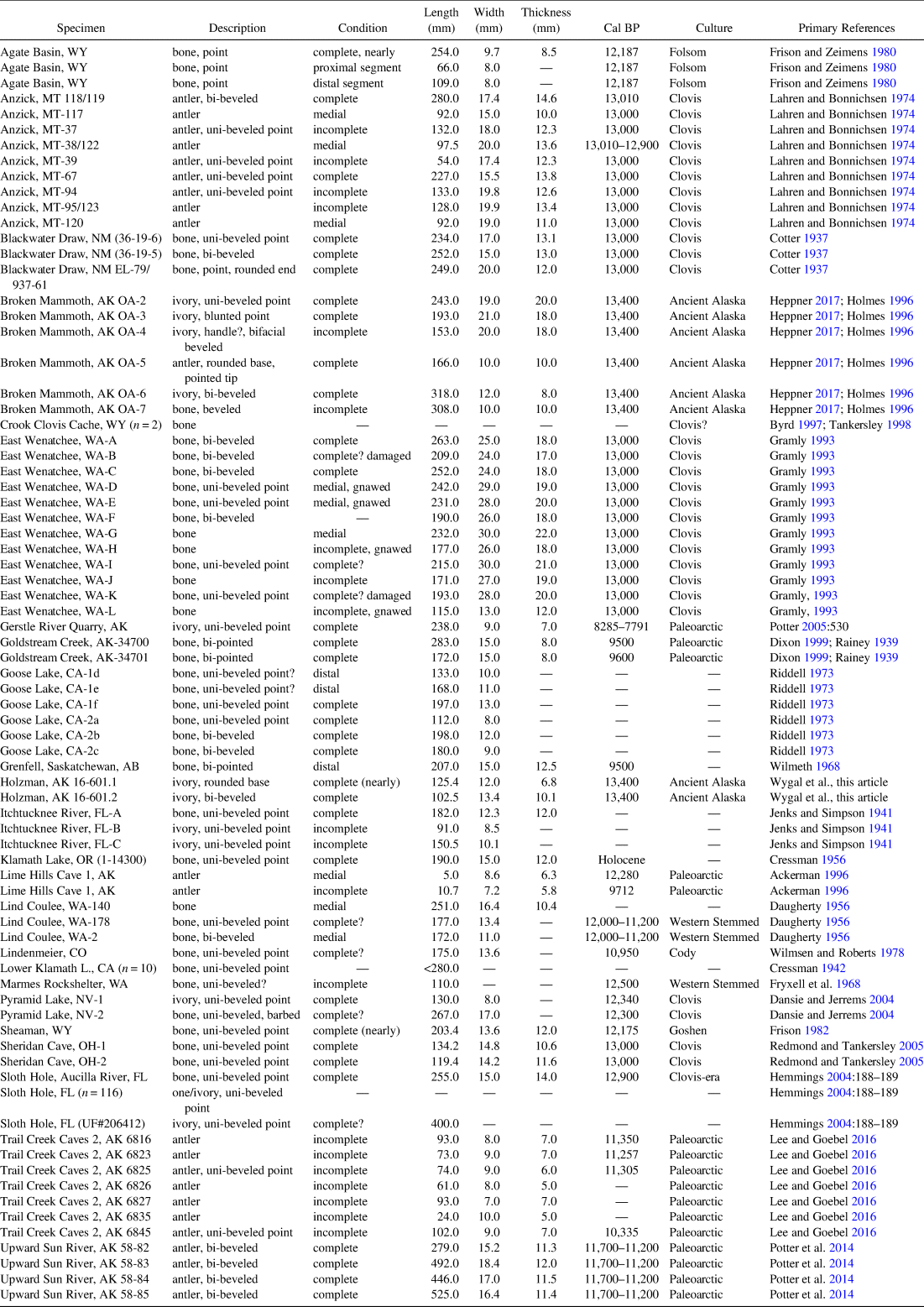
Note: In addition to primary references, the following were consulted in the collection of these data: Bradley Reference Bradley, Hahn, Menu, Taborin, Walter and Widemann1995; Ives et al. Reference Ives, Froese, Collins and Brock2014; Lyman and O'Brien Reference Lyman and O'Brien1999; Lyman et al. Reference Lyman, O'Brien and Hayes1998; Morrow and Fiedel Reference Morrow, Fiedel, Morrow and Gnecco2006; O'Brien et al. Reference O'Brien, Lee Lyman, Buchanan, Collard and Langley2016; Pearson Reference Pearson1999; Sutton Reference Sutton2018.
Siberia and Alaska
A rich osseous industry flourished during the middle Upper Paleolithic in Siberia (Derev'anko et al. Reference Derev'anko, Shimkin and Powers1998), including at Mal'ta and Buret’, where retouchers, awls, needles, ivory beads, pendants, plaques, 3D and 2D zoomorphic figurines, and Venus figurines have been reported (Graf and Buvit Reference Graf and Buvit2017:S589). Unslotted osseous rods and points have also been dated to the middle Upper Paleolithic in Siberia at the Yana RHS, Mal'ta, Buret’, and Igeteiskii Log sites (Graf and Buvit Reference Graf and Buvit2017; Pitulko et al. Reference Pitulko, Pavlova and Nikolskiy2015). The northernmost of these is Yana RHS, where several osseous tools have been recorded, including some made of mammoth ivory dated around 30,000 cal BP. Ivory technology is widespread across arctic Siberia, especially in the Yana-Indighirka lowlands, where the chaîne opératoire of ivory tool manufacture is preserved (Pitulko et al. Reference Pitulko, Pavlova and Nikolskiy2015). This wealth of bone, antler, and ivory artifacts included points and rods at Kurtak 3, Shlenka, Afontova Gora, and Mal'ta. Late Upper Paleolithic specimens in Siberia appear in a wider variety of forms and dimensions, but many are unilaterally or bilaterally slotted for microblade insets (Graf and Buvit Reference Graf and Buvit2017:S591).
Osseous rods in Alaska and Siberia are sometimes “slotted” or incised with a long groove down one or two lateral edges for the insertion of microblades, which are small and thin standardized flakes systematically produced for the purpose of creating composite tools. Microblades link Paleolithic traditions in Alaska with ancestral forms in Siberia (Coutouly Reference Coutouly and Desrosiers2012; Hirasawa and Holmes Reference Hirasawa and Holmes2017). The trend in Siberia for unslotted osseous points to occur earlier in the record than those with lateral grooves for microblade inserts is replicated in Alaska. Other rods may be incised with crosshatchings but are not slotted—an indication that microblades were not used in all situations.
The earliest late Pleistocene forms of osseous rods in Alaska are made on ivory and occasionally bone. These are unslotted and associated with assemblages lacking microblade technology at Broken Mammoth and Holzman (Heppner Reference Heppner2017; Wygal et al. Reference Wygal, Krasinski, Holmes and Crass2018). Early Holocene slotted osseous rods tend to be made of antler, at Trail Creek Caves and Lime Hills, and are associated with the Denali complex (Ackerman Reference Ackerman and West1996; Lee and Goebel Reference Lee and Goebel2016). The antler rods from Upward Sun River are much longer than other specimens found in Alaska and were associated with bifacial projectile points. Although they were incised with crosshatching, these do not appear to be slotted. The artifacts were placed alongside two child burials covered with red ochre in the Middle Tanana Valley, across the river and slightly downstream from Shaw Creek. The dates from Upward Sun River (Potter et al. Reference Potter, Irish, Reuther, Gelvin-Reymiller and Holliday2011, Reference Potter, Irish, Reuther and McKinney2014) are 2,000 years younger than the osseous tools found at Holzman and Broken Mammoth.
North America Midcontinent
Clovis is the earliest confirmed techno-complex in midcontinent North America dated broadly between 13,250 and 12,800 cal BP and more narrowly between 13,125 and 12,925 cal BP (Haynes Reference Haynes2015; Prasciunas and Surovell Reference Prasciunas, Surovell, Smallwood and Jennings2015). The oldest known osseous rods from Clovis assemblages at Anzick (Montana), Blackwater Draw (New Mexico), East Wenatchee (Washington), and Sheridan Cave (Ohio) (Figure 2) do not exceed 13,000 cal BP (Boldurian Reference Boldurian2007a, Reference Boldurian, Neusius and Gross2007b; Bradley Reference Bradley, Hahn, Menu, Taborin, Walter and Widemann1995; Gramly Reference Gramly1993; Lyman et al. Reference Lyman, O'Brien and Hayes1998; Morrow and Fiedel Reference Morrow, Fiedel, Morrow and Gnecco2006; O'Brien et al. Reference O'Brien, Lee Lyman, Buchanan, Collard and Langley2016; Redmond and Tankersley Reference Redmond and Tankersley2005). Most of these tools are constructed of mammoth or bison bone when associated with Clovis assemblages. More than 140 bone and ivory tools have been recorded in Florida, with many finds from the Aucilla and Itchtucknee Rivers (Hemmings Reference Hemmings1998, Reference Hemmings2004; Jenks and Simpson Reference Jenks and Simpson1941), but most are of unknown cultural affiliation, age, and uncertain context (Lyman and O'Brien Reference Lyman and O'Brien1999:350). Although the osseous points from Florida represent a wide diversity in tool form, at least one example from Sloth Hole along the Aucilla River yielded an “ivory point haft” dated to [11,050 ± 50 BP] 12,900 cal BP (Hemmings Reference Hemmings2004:5). Later Paleoindian groups continued the use of osseous rods and points; however, the bi-beveled style has not been found among the Folsom or later Paleoindian traditions (Sutton Reference Sutton2018:84).
Comparative Clovis bone and ivory rods: (a) Anzick Ivory Bi-Beveled Rod #118/119 (redrawn after Morrow and Fiedel Reference Morrow, Fiedel, Morrow and Gnecco2006:Figure 7.4); (b) Sheridan Cave Uni-Beveled Point (photo by Lithic Casting Lab, Peter A. Bostrom); (c) Blackwater Draw Bone Uni-Beveled Point #36-19-6 (redrawn after Boldurian Reference Boldurian2007a:Figure 1; Boldurian and Cotter Reference Boldurian and Cotter1999); (d) East Wenatchee Engraved Bi-Beveled Rod #1990.15 (photo by Brian Wygal of an artifact caste by Peter A. Bostrom [Reference Wygal2018], Lithic Castings Lab Inc.).

Archaeology of Shaw Creek
Along Shaw Creek, mammoth tusks recovered from the earliest components of the Holzman and Swan Point sites indicate that complete tusks were collected, cached, and processed. A tusk fragment recovered from Broken Mammoth CZ4 is dated 13,750–13,120 cal BP (AA-17601; Dilley Reference Dilley1998:85). The earliest component at Swan Point (CZ4b) preserved evidence of tusk acquisition with initial ivory reduction at 14,100 cal BP alongside the only known examples of Alaskan Diuktai-style microblade technology derived from Paleolithic Siberia (Coutouly Reference Coutouly and Desrosiers2012; Hirasawa and Holmes Reference Hirasawa and Holmes2017; Lanoë and Holmes Reference Lanoë and Holmes2016). The late Pleistocene components at Broken Mammoth, Mead (Potter et al. Reference Potter, Holmes, Yesner, Graf, Ketron and Waters2013), and Holzman (Wygal et al. Reference Wygal, Krasinski, Holmes and Crass2018) contained limited lithic industries dominated by core and flake technology made on local quartz immediately available along nearby outcrops. A few formal lithic tools including small triangular bifaces, some with concave bases, from Mead and Broken Mammoth date between 13,500 and 13,000 cal BP but notably lack microblade technology (Potter et al. Reference Potter, Holmes, Yesner, Graf, Ketron and Waters2013).
Descriptions of the osseous tools from Broken Mammoth CZ4 (Figure 3) are limited to brief reports (Heppner Reference Heppner2017; Holmes Reference Holmes and West1996; Yesner Reference Yesner1994). These include an incomplete bone rod with one beveled end and a uni-beveled antler point. Ivory artifacts include a bi-beveled rod, uni-beveled point, blunted point, and a “handle” described as bifacially beveled on one end and broken on the other (Heppner Reference Heppner2017:45–46). Holmes (Reference Holmes and West1996:315) reported on the oldest occupations at Broken Mammoth (CZ4b), which included an “east hearth” dated 13,450–13,160 cal BP (CAMS-5358), a swan bone dated 13,580–13,180 cal BP (CAMS-8261), and a “central hearth” dated 13,600–13,160 cal BP (WSU-4262). A bone eyed needle was found in CZ3 “in association” with a hearth feature dated 12,470–11,810 cal BP (CAMS-5357; Holmes Reference Holmes and West1996:317).
Ivory rods and tools from Broken Mammoth CZ4, Alaska. Photos by Charles E. Holmes. Artifact numbers and descriptions after Heppner (Reference Heppner2017).

Holzman Provenience and Dating
The Holzman archaeological site was discovered in 2015 on a gradual slope along the west bank overlooking Shaw Creek, 1 km north of its confluence with the Middle Tanana River. With seven stratified cultural components dated between 14,100 cal BP and the historic period (Wygal et al. Reference Wygal, Krasinski, Holmes and Crass2018), the site contains a similar cultural chronology as other sites in the area (Holmes Reference Holmes2001; Potter et al. Reference Potter, Holmes, Yesner, Graf, Ketron and Waters2013). Table 2 presents radiocarbon information from Holzman components 5a and 5b, which are the focus of this article.
Radiocarbon Data from Component 5a and 5b at the Holzman Site.

Notes: Radiocarbon dates calibrated at 2σ using OxCal v4.4.2 (Bronk Ramsey Reference Bronk Ramsey2020). Atmospheric data from IntCal20 (Reimer et al. Reference Reimer, Austin, Bard, Bayliss, Blackwell, Ramsey and Butzin2020).
Aeolian silts and sands from the glacially fed Tanana River form a deep soil sequence (>3 m) blanketing the Yukon-Tanana Uplands (Péwé Reference Péwé, Péwé, Ferrians, Karlstrom and Nichols1965), including Shaw Creek. Gneiss and schist with quartz veins form the bedrock. Calcareous soils preserve a remarkable archaeological record, including late Pleistocene faunal assemblages and well-preserved hearth features (Dilley Reference Dilley1998). At Holzman, six distinct units of sediments have no cryoturbation (Figure 4). The lower components (C3–C5) are separated from the late (C1) and middle Holocene (C2) occupations by 80–100 cm of sterile loess. From 1.0 to 1.6 m below surface, silt and very fine sandy loam (Stratum V) preserve a series of organic-rich lenses (Wygal et al. Reference Wygal, Krasinski, Holmes and Crass2018). These darker soils are distinctive, with black, brown, purple, and reddened hues. In much of the literature, these features are referred to as “stringers” or “paleosols” (Dilley Reference Dilley1998; Holmes Reference Holmes and West1996) enhanced from human activities (Gilbert Reference Gilbert2011; Kielhofer et al. Reference Kielhofer, Miller, Reuther, Holmes, Potter, Lanoë, Esdale and Crass2020). The Pleistocene light-gray sands (Stratum VI) include bedded laminations from ~1.6 m to bedrock at approximately 3.0–3.5 m. Some limited and easily identifiable small to medium rodent krotovinas occur in some areas of the upper sands.
Stratigraphic profile of the Holzman site showing organic rich stringers and general location of cultural components. Photo of 2015 test unit by Teresa Wriston (Desert Research Institute).
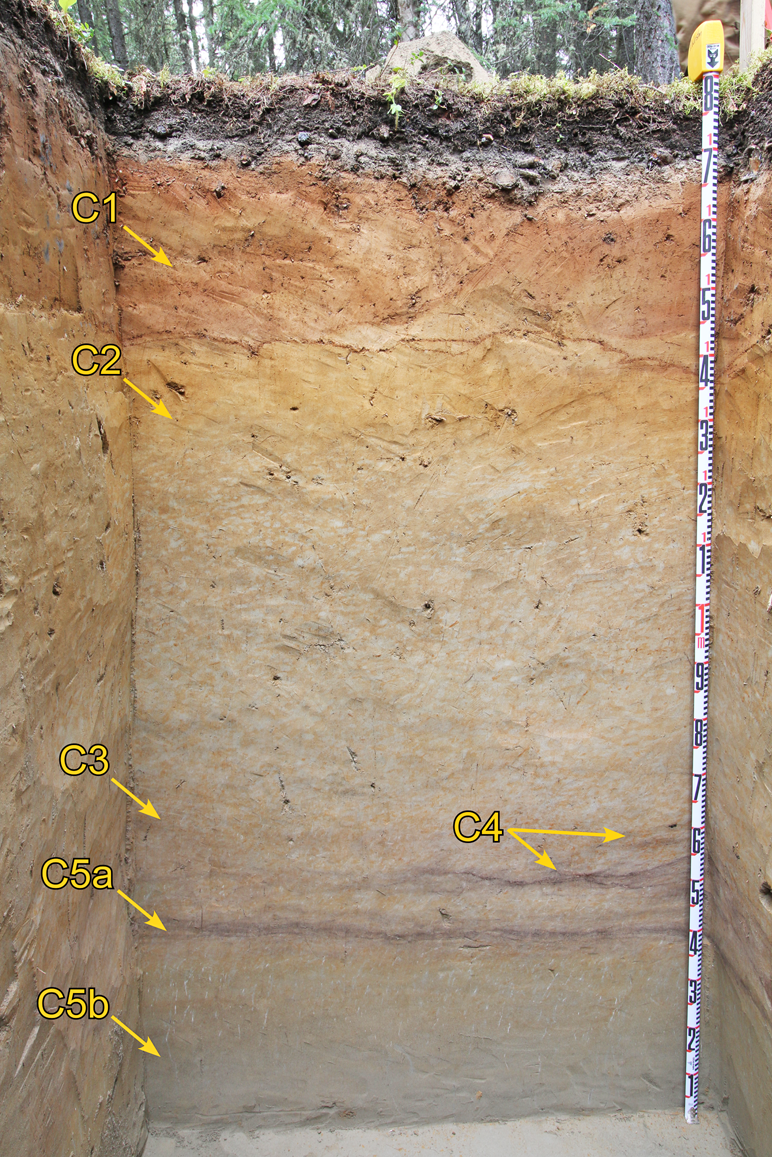
The cultural chronology of the site has been established through radiocarbon dates on hearth charcoal (Salix and Populus sp.), bone, and mammoth ivory. Lithic assemblages occur among fragmented mammalian remains—primarily bison, wapiti, and caribou—scattered among hearth and organic features sealed as distinct layers or components. Deeply buried late Pleistocene components 5a and 5b at Holzman occur within a stratified series of organic-rich anthropogenically enhanced stringers (Figure 5). Component 5a (C5a) contained fragmented long bones and an expedient lithic assemblage alongside tusk fragments associated with hearths. Hearth charcoal along with burned mammal and avian long bone fragments indicate a few repeat visits contributed to the formation of C5a at Holzman. Much of the C5a assemblage was oriented toward the working of mammoth ivory. Although formal lithic analyses are pending, we recovered a large anvil and numerous quartz flakes, scrapers, and a heavy bifacial quartz chopper associated with an extensive ivory workstation. In one example, a steep backed quartz scraper was found in situ resting on top of a section of mammoth tusk—a clear indication of ivory working at 13,500 cal BP.
Map of Component 5a and 5b from the Holzman site with calibrated radiocarbon dates from Table 2. All tools recovered at Holzman to date are lithic, with the exception of the two ivory rods found in situ lying parallel to each other. A fragment from one of the rods was dated 13,580–13,350 cal BP. The dates and locations of the ivory rods are highlighted in the left margin.

C5a contained two ivory rods associated with dated material, including a burned twig from a hearth feature dated 13,590–13,440 cal BP (BETA-531773), a mammal bone fragment dated 13,590–13,240 cal BP (D-AMS 019818), and another mammal bone fragment from a second hearth dated 13,480–13,320 cal BP (BETA-479328). A third bone fragment associated with an activity area dated to 13,080–12,830 cal BP (BETA-465551), in addition to other dates on bones that generally fall within this range (Table 2).
Component 5b (C5b) is separated from C5a by at least 10 cm of sterile bedded sand deposits and between approximately 160 and 175 cm below surface. C5b (two dates excluding ivory ranging from 14,150 to 13,520 cal BP) yielded artifacts dispersed among the Pleistocene sand deposits, including a nearly complete mammoth tusk and two small clusters of lithic artifacts, disbursed ochre, and some faunal remains. The first area, located nearest the mammoth tusk, included basalt flakes and ochre associated with a bison rib bone dated 13,770–13,520 cal BP (BETA-531771). The other artifact cluster found in the southern end of the excavation block consisted of high-quality chert flakes associated with small fragments of bone and some dispersed charcoal (Populus-Salix group). One of these flakes had affixed to its surface charcoal dated between 14,150 and 13,810 cal BP (BETA-531772). Therefore, the earliest evidence for mammoth ivory collection at Holzman is comparable in age to the earliest component at Swan Point CZ4b.
Holzman Ivory Rods
We recovered two ivory rods from C5a at the Holzman site (Figure 6). The first tool (AU-16-601.1) is fractured in five conjoining fragments, including a rounded proximal base with a slightly beveled distal tip. It weighs 7.17 g and measures 125.36 L × 12.02 W × 6.82 T mm, respectively. The artifact was originally rectangular with rounded corners forming a slightly flat cross section, but it was fractured along the longitudinal plane either intentionally or from heavy postdepositional weathering. A fragment of this tool was directly dated to 13,580–13,350 cal BP (BETA-465549), representing one of the youngest dates on mammoth ivory on the Alaska mainland and overlapping with associated dates on hearth charcoal, thereby confirming concurrent occupation of mammoth and people at Shaw Creek.
Ivory rods from the Holzman Component 5a. Photos by Brian Wygal.

The second rod (AU-16-601.2) is complete but fractured in two conjoining fragments. It is beveled on both ends with visible striations, or “hatching,” on one end, and the other bevel is less discernable due to weathering. The bevel lengths are 17.56 and 11.10 mm, respectively. It is round to oval in cross section, weighs 10.6 g, and measures 102.45 L × 13.4 W × 10.1 T mm.
Comparing North American Osseous Rods
The majority of late Pleistocene rods from North America are made of bone, with only a few examples of ivory tools from the Clovis era. This includes artifacts from northern Florida and one from Pyramid Lake in Nevada. Most rods made of ivory occur in Alaska (Table 1). A length and width comparison of complete and near-complete osseous rods and points from across North America indicates the two Holzman ivory rods plot nearest the two Clovis-era bone rods from Sheridan Cave, Ohio (Figure 7). A Kolmogorov-Smirnov test of rod lengths and widths indicated a significant deviation from normality. Therefore, we used a Kruskal-Wallis nonparametric test of means to test the null hypothesis that the distribution of rod lengths and widths were the same across cultural periods. Results indicate no significant difference between the cultural periods and rod lengths (p = 0.261), but there is a significant difference between rod widths (p = 0.005). A post-hoc Dunn test indicates a significant difference in rod widths between Clovis and rods from unknown late Pleistocene periods (p = 0.004). The post-hoc Dunn test also indicates a significant difference in the ratio of rod widths and lengths between Clovis era and post-Clovis rods (p = 0.034). The greatest variability among rod lengths and widths from the four periods analyzed occurred during the Clovis era.
Comparative scatter plot of late Pleistocene complete and near-complete osseous rods and points from North America. See Table 1 for original sources.

Ivory Acquisition
There are currently 12 dates on mammoth ivory from archaeological deposits at Shaw Creek (Dilley Reference Dilley1998; Heppner Reference Heppner2017; Holmes Reference Holmes and West1996, Reference Holmes2001; Krasinski and Yesner Reference Krasinski and Yesner2008; Lanoë and Holmes Reference Lanoë and Holmes2016; Potter et al. Reference Potter, Holmes, Yesner, Graf, Ketron and Waters2013; Wygal et al. Reference Wygal, Krasinski, Holmes and Crass2018). Dates on mammoth ivory from Broken Mammoth and Mead are millennia older than the cultural components in which they were recovered, indicating that old ivory was scavenged for tool production (Heppner Reference Heppner2017; Lanoë et al. Reference Lanoë, Reuther, Holmes and Hodgins2017; Potter et al. Reference Potter, Holmes, Yesner, Graf, Ketron and Waters2013; Yesner Reference Yesner1994, Reference Yesner2001). There is also evidence at Swan Point CZ4b that a juvenile mammoth was hunted as early as 14,000 cal BP (Lanoë and Holmes Reference Lanoë and Holmes2016; Lanoë et al. Reference Lanoë, Reuther, Holmes and Hodgins2017), but such definitive evidence for hunting is rare in Alaska.
Subfossilized ivory is easier to work than fresh ivory (Lanoë et al. Reference Lanoë, Reuther and Holmes2018) and tusk caching with the intention of drying or curing ivory for later dates back to 30,000 cal BP in northern Siberia (Pitulko et al. Reference Pitulko, Pavlova and Nikolskiy2015). Therefore, to determine if humans and mammoths were contemporaneous at Shaw Creek, it is important to date ivory directly and compare it to dates from charcoal or burned bone associated with hearth features (Figure 8). Based on four nonoverlapping radiocarbon dates on ivory artifacts from Holzman, a minimum number of three mammoths ranging in age from 14,310 to 13,350 cal BP are currently represented among the C5a and C5b assemblages (Table 2).
Earliest dates from cultural features and associated mammoth ivory at Shaw Creek sites. Data labels indicate key sites, including Mead CZ 4 (MD-CZ4), Broken Mammoth CZ4b (BM-CZ4b), Swan Point CZ4b (SP-CZ4b), and Holzman C5a and C5b (HzM-C5a/C5b), followed by the original laboratory number. Dates on ivory are indicated by *. Radiocarbon dates are calibrated at 2σ using OxCal v4.4.2 (Bronk Ramsey Reference Bronk Ramsey2020) and atmospheric data from IntCal20 (Reimer et al. Reference Reimer, Austin, Bard, Bayliss, Blackwell, Ramsey and Butzin2020).

At Holzman, bone, ivory, and some poorly preserved antlers have been recovered from Components 4–5. In the laboratory, we distinguish ivory from bone and antler by identifying Schreger lines, unique to ivory (Fisher et al. Reference Fisher, Trapani, Shoshani and Woodford1998). Detailed analyses of complete tusks can provide important metrics of individual mammoths at Shaw Creek. A nearly complete and unmodified Mammuthus primigenius tusk (AU-16-635), thought to have been collected from nearby and cached at the Holzman site for later use, was recovered from C5b (Figure 9). The tusk has yielded two radiocarbon dates. The first from the tusk exterior dated 14,150–13,810 (D-AMS 018572), and the second from the tusk core dated 14,310–14,020 cal BP (BETA-465550). The tusk fractured during recovery, but it is preserved in two major portions: a shorter distal portion is missing the very tip, and the longer proximal portion lacks some of the pulp cavity. Pieced together, the total length of the tusk is 177 cm along its curve and 134 cm measuring straight from tip to proximal end. Exterior tusk enamel is in the process of exfoliation, but the overall shape of the tusk is preserved, showing a relatively round transverse profile and a slight curvature to the left (suggestive of a right tusk). The maximum tusk diameter, located near the proximal end of the tusk, is 81.4 mm. Comparison of tusk length and diameter to previously existing data (Averaniov Reference Averaniov, Shoshani and Tassy1996; Grigoriev et al. Reference Grigoriev, Fisher, Obadă, Shirley, Rountrey, Savvinov and Garmaeva2017; Haynes Reference Haynes1991; Maschenko et al. Reference Maschenko, Gablina, Tesakov and Simakova2006; Vereshchagin and Tikhonov Reference Vereshchagin and Tikhonov1986) suggests that the Holzman tusk belongs to an adult female that was at least 30 and possibly as many as 60 years old, although a specific age at death has yet to be determined.
Mammoth tusk (#16-635) from Component 5b at the Holzman site. Photo by Brian Wygal.

A thin section made from an approximately 150 × 65 mm block of dentin shows a “V” Schreger pattern, indicating that the tusk belongs to Mammuthus sp. (Trapani and Fisher Reference Trapani and Fisher2003). The angle between Schreger bands (measured in ImageJ at seven different locations) ranged from 35.1° to 64.1° (mean = 45.5°), within the range of reported Schreger angles also associated with Mammuthus dentin (Espinoza and Mann Reference Espinoza and Mann1993; Fisher et al. Reference Fisher, Trapani, Shoshani and Woodford1998). Preliminary analysis of tusk growth indicates 70 second-order increments represented, in which each increment represents approximately one week of growth (Koch et al. Reference Koch, Fisher and Dettman1989). The average growth rate for this section of tusk is 0.09 mm per week.
At Holzman, the caching of a mammoth tusk in C5b is interesting considering the limited ivory artifacts represented in this layer, and there is no evidence (so far) in either C5b or C5a of postcranial mammoth remains. The relatively sparse distribution of artifacts in C5b is also curious when compared to the density of the overlying C5a.
Discussion
Sutton (Reference Sutton2018:194) proposed North American osseous rod technology originated with the Clovis tradition after 13,000 cal BP “perhaps with some ancestry in Beringia.” Sutton (Reference Sutton2018:184) further suggested bi-beveled and bi-pointed rods ended with Clovis, whereas uni-beveled styles continued into later Paleoindian traditions, concluding that “bi-beveled rods are Clovis markers while the other types are not.” Ivory rods from Broken Mammoth and Holzman at Shaw Creek predate the earliest Clovis forms by at least 400 years. If bi-beveled rods are diagnostic of the Clovis tradition, this suggests a connection between the earlier Alaska forms and Clovis in the midcontinent—perhaps a direct ancestral relationship. That the Holzman ivory rods are not associated with microblade technology further supports a Paleoindian connection.
Bison clades in southern Alberta arrived from the south by 13,400 cal BP, suggesting a passable southern opening of the Ice-Free Corridor by at least that time. By 12,400 cal BP, this population arrived at the Liard River in northern British Columbia, demonstrating a northward dispersal into the heart of the Ice-Free Corridor (Heintzman et al. Reference Heintzman, Froese, Ives, Soares, Zazula, Letts and Andrews2016). Studies of ice retreat suggest an earlier availability through western Alberta by 15,000 cal BP (Munyikwa et al. Reference Munyikwa, Rittenour and Feathers2017:163). Potter and colleagues (Reference Potter, Baichtal, Beaudoin, Fehren-Schmitz, Vance Haynes, Holliday and Holmes2018:4) point to taiga vole at 14,870 cal BP (Hebda et al. Reference Hebda, Burns, Geertsema and Timothy Jull2008) and poplar from Boone Lake in northwestern Alberta, indicating the presence of woody plants by 13,500 cal BP (White et al. Reference White, Mathewes and Mathews1985). Potter and colleagues (Reference Potter, Baichtal, Beaudoin, Fehren-Schmitz, Vance Haynes, Holliday and Holmes2018) further argue vegetated conditions existed in some parts of the Ice-Free Corridor “well before minimum age estimates of ecological viability derived from the presence of bison and horse at 13,100 cal BP” (Potter et al. Reference Potter, Baichtal, Beaudoin, Fehren-Schmitz, Vance Haynes, Holliday and Holmes2018:4). Based on these data, archaeologists should consider other possibilities such as migratory waterfowl as an indication of Ice-Free Corridor viability. Dalton and colleagues (Reference Dalton, Margold, Stokes, Tarasov, Dyke, Adams and Allard2020) provide the most updated analysis on North American deglaciation, with ice retreat well underway across the Canadian Prairies of Northern Alberta after 15,000 cal BP (see Figure 1).
It should also be noted that Clovis fluted point technology is widely reported to have developed in midcontinent North America, and its iconic fluting style spread north through the Ice-Free Corridor during the early Holocene (Goebel et al. Reference Goebel, Smith, DiPietro, Waters, Hockett, Graf and Gal2013; Roper and Wygal Reference Roper and Wygal2003; Smith and Goebel Reference Smith and Goebel2018; Smith et al. Reference Smith, Kuzminsky and Linderholm2020; Wormington Reference Wormington1970). The Northern Fluted Point tradition, found mostly in the Brooks Range of Alaska, postdates Clovis by millennia and has not been found in association with osseous tools.
Ancient DNA provides the timing of population splits among the roots of ancestral Native Americans during the Upper Paleolithic (Pinotti et al. Reference Pinotti, Bergström, Geppert, Bawn, Ohasi, Shi and Lacerda2019; Raghavan et al. Reference Raghavan, Skoglund, Graf, Metspalu, Albrechtsen, Moltke and Rasmussen2014). The genomes from the 11,500 cal BP Upward Sun River infants suggest the First Americans split from east Asians at 26,000–24,000 cal BP (Tackney et al. Reference Tackney, Potter, Raff, Powers, Scott Watkins, Warner, Reuther, Irish and O'Rourke2015) and subsequent divergences occurred at 22,000–18,000 and 17,500–14,500 cal BP (Moreno-Mayar et al. Reference Moreno-Mayar, Potter, Vinner, Steinrücken, Rasmussen, Terhorst and Kamm2018). A genetic bottleneck is proposed during this period, although the location of this remains unknown (Graf and Buvit Reference Graf and Buvit2017; Huang et al. Reference Huang, Xia, Bin, He, Guo, Lin and Yin2020; Scott et al. Reference Scott, Schmitz, Heim, Paul, Schomberg and Pilloud2018; Sun et al. Reference Sun, Ma, Cheng, Wang, Li, Cui and Yao2021). A major genetic expansion between 16,000 and 13,000 cal BP is associated with a migration south into the midcontinent of North America (Llamas et al. Reference Llamas, Fehren-Schmitz, Valverde, Soubrier, Mallick, Rohland and Nordenfelt2016; Skoglund and Reich Reference Skoglund and Reich2016). Potter and colleagues (Reference Potter, Baichtal, Beaudoin, Fehren-Schmitz, Vance Haynes, Holliday and Holmes2018:2) “observe a clear pattern of human expansion from Siberia to Beringia around 16,000 to 14,000 years (Potter et al. Reference Potter, Reuther, Holliday, Holmes, Shane Miller and Schmuck2017) and the first unequivocal widespread occupations south of glacial ice in the Americas after 13,500 years ago, associated with Clovis.”
The late Pleistocene sites along Shaw Creek are located near the northern gateway to the Ice-Free Corridor through Canada, and they represent the earliest evidence for technological continuity between Asia and eastern Beringia. The Shaw Creek sites offer the strongest incontrovertible evidence for people in interior Alaska before the development of the Clovis tradition. In the absence of comparable lithic assemblages bearing diagnostic traits linking Clovis with Beringia or Siberia (Haynes Reference Haynes2015), the beveled rods from Holzman provide intriguing similarities that suggest a proximal population located at the right place and time. Moreover, the earliest Alaskans are found in the interior, from where some time was taken before coastal regions were initially exlpored. Consequently, the timing of continental deglaciation, viability of the Ice-Free Corridor, and recent aDNA analyses (Huang et al. Reference Huang, Xia, Bin, He, Guo, Lin and Yin2020; Moreno-Mayar et al. Reference Moreno-Mayar, Potter, Vinner, Steinrücken, Rasmussen, Terhorst and Kamm2018; Sun et al. Reference Sun, Ma, Cheng, Wang, Li, Cui and Yao2021) are important factors to consider when working out the timing and route of the First Americans.
Conclusion
Beveled points and rods were a stable component of late Pleistocene technology and therefore offer the opportunity to discuss continuity of osseous technology relative to the continental dispersals of modern humans. The preference for ivory use over bone and antler is apparent in Eurasia and Alaska—perhaps a result of its abundance on the landscape relative to the lack of wood on the mammoth steppe—but in midcontinent North America, rods and points are more commonly made on bison or mammoth long bone. Mammoth tusk acquisition and ivory tool production is a common theme among the earliest components (14,100–13,300 cal BP) at Broken Mammoth, Mead, Swan Point, and the recently discovered Holzman site along Shaw Creek in interior Alaska.
We describe two late Pleistocene ivory rods from the Holzman site. The tools are similar in style and age to tools recovered at Broken Mammoth. The beveled ivory rods from Shaw Creek, Alaska, predate the Clovis tradition from south of the ice sheets making them the oldest known examples of rod technology in the Americas. The finds are significant when compared to the timing of late Pleistocene deglaciation of the Canadian ice sheets and within the broader contexts of recent aDNA studies into the source migrations of Native Americas.
Acknowledgments
We recognize that our research occurs at Debedee Na' (sheep horn creek) on ancestral Dene land. This research was made possible by Shaw Creek Archaeological Research LLC and funded by Adelphi University in New York. We also thank David McMahan for contributing charcoal identifications and Yan Axel Gómez Coutouly for reviewing our Spanish abstract translation. We express particular gratitude to the many field school students and field supervisors who spent considerable effort excavating the deep deposits at Holzman.
Data Availability Statement
The data and artifacts for this article are stored at the Adelphi University Archaeology Laboratory in Garden City, New York.