


Introduction
Popular species are those that are ‘liked, enjoyed, or supported by many people’ (Cambridge Online Dictionary 2022), and there are huge differences among species; not just in terms of public and media interest, but also in research and conservation support (Kellert Reference Kellert1985, Correia et al. Reference Correia, Jepson, Malhado and Ladle2016, Colléony et al. Reference Colléony, Clayton, Couvet, Saint Jalme and Prévot2017, Davies et al. Reference Davies, Cowley, Bennie, Leyshon, Inger and Carter2018, dos Santos et al. Reference Correia, Malhado, Campos-Silva, Teles, Jepson and Ladle2020, Adamo et al. Reference Adamo, Chialva, Calevo, Bertoni, Dixon and Mammola2021). The tiger (Panthera tigris) was the most googled animal and received US$44.9 million in conservation aid between 2004 and 2014 (Davies et al. Reference Davies, Cowley, Bennie, Leyshon, Inger and Carter2018), three times more than the next most funded species. The Christmas Island pipistrelle bat (Pipistrellus murrayi) was declared extinct in 2016, but this species received almost no media attention and there was limited government support for conservation action (Watson Reference Watson2016). These differences are not limited to animals; Adamo et al. (Reference Adamo, Chialva, Calevo, Bertoni, Dixon and Mammola2021) found that the number of scientific publications ranged from 0 to 571 for 113 endemic plants in a part of the relatively well-studied European Alps. These different measures of species popularity seem to be correlated (Martín-López et al. Reference Martín-López, Montes, Ramírez and Benayas2009, Troudet et al. Reference Troudet, Grandcolas, Blin, Vignes-Lebbe and Legendre2017, Jarić et al. Reference Jarić, Correia, Roberts, Gessner, Meinard and Courchamp2019, Wang et al. Reference Wang, Zeng, Meng, Lohman and Pierce2021), and multiple papers have tried to quantify what makes species popular, both to draw attention to species that are relatively unattended to (Davies et al. Reference Davies, Cowley, Bennie, Leyshon, Inger and Carter2018) and to identify species that can, for example, raise conservation awareness (Veríssimo et al. Reference Veríssimo, Pongiluppi, Santos, Develey, Fraser, Smith and Macmilan2014).
More popular species tend to be large (Smith et al. Reference Smith, Veríssimo, Isaac and Jones2012, Correia et al. Reference Correia, Jepson, Malhado and Ladle2016, Macdonald et al. Reference Macdonald, Jacobsen, Burnham, Johnson and Loveridge2016, Adamo et al. Reference Adamo, Chialva, Calevo, Bertoni, Dixon and Mammola2021) and colourful (Breuer et al. Reference Breuer, Schlegel, Kauf and Rupf2015, Garnett et al. Reference Garnett, Ainsworth and Zander2018, Adamo et al. Reference Adamo, Chialva, Calevo, Bertoni, Dixon and Mammola2021), just two of many aesthetic traits that have been associated with species popularity. Certain behaviours and population traits are also associated with species popularity. For example, Swiss children prefer insects that fly to those that crawl (Breuer et al. Reference Breuer, Schlegel, Kauf and Rupf2015), and various studies have shown that species that are more endangered receive more conservation donations than those that are not (e.g., Tisdell Reference Tisdell2006, Tisdell et al. Reference Tisdell, Nantha and Wilson2007, Curtin & Papworth Reference Curtin and Papworth2018). Many such studies search for traits that are assumed to be inherently and, to some degree, universally popular. For example, preferences for certain aesthetic traits have been associated with the baby schema concept and the ‘uncanny valley’ theory (Rádlová et al. Reference Rádlová, Landová and Frynta2018).
Whether or not there are inherent preferences for specific traits is important information to consider for choosing successful conservation flagship species. Conservation science is a crisis discipline that uses limited funds to prevent and reverse the negative impacts of human activities on biodiversity (Bottrill et al. Reference Bottrill, Joseph, Carwardine, Bode, Cook and Game2008), and flagship species represent a key tool for raising money and awareness (Veríssimo et al. Reference Veríssimo, MacMillan and Smith2011). The flagship species approach often targets individual donors, which can be important contributors to conservation non-governmental organizations (NGOs); for example, 14–89% of funding for 10 marine NGOs reviewed by Berger et al. (Reference Berger, Caruso and Peterson2019) came from individual contributions. Previous research on flagship species has shown substantial differences in the fundraising ability of different species: there was a fivefold difference in donations between the most and least successful species in an evaluation of Australian Geographic Society fundraising campaigns (Veríssimo et al. Reference Veríssimo, Campbell, Tollington, MacMillan and Smith2018). A variety of aesthetic traits have been identified that are associated with how successful species are at raising awareness and funds (Curtin & Papworth Reference Curtin and Papworth2020), and if donations are driven by inherent human preferences for specific aesthetic traits, new flagship species should by aesthetically similar to existing successful flagship species, as suggested by Smith et al. (Reference Smith, Veríssimo, Isaac and Jones2012). If certain aesthetic traits drive successful flagship species, this could suggest that conservation organizations should not invest time in campaigns that feature species with traits that are less ‘attractive’, even if these species are threatened and need conservation attention. Therefore, understanding whether preferences for specific traits represent an inherent part of the human psyche is crucial for the selection and use of flagship species.
There is substantial evidence of cultural differences in species preferences, which is not consistent with inherent preferences for certain species traits. For example, lions (Panthera leo) are popular with schoolchildren in the UK but disliked by schoolchildren living around a National Park in Tanzania where lions live (Entwistle & Stephenson Reference Entwistle, Stephenson, Entwistle and Dunstone2000). If preferences for specific traits are an inherent part of the human psyche, we would expect to find preferences for species that have those traits regardless of cultural frame. The ubiquity of cultural preconceptions about the natural world makes it difficult to untangle the role of inherent preferences and cultural frames (Montgomery Reference Montgomery2002, Garnett et al. Reference Garnett, Ainsworth and Zander2018, Curtin & Papworth Reference Curtin and Papworth2020), particularly when investigating preferences for multiple species. Furthermore, identifying preferences for specific traits in real animals is complicated by the covariance of many traits. Big cats are popular, but this could be because they are physically large, or because they have forward-facing eyes, or because they are mammals; these are all traits that are correlated with species popularity (Macdonald et al. Reference Macdonald, Burnham, Hinks, Dickman, Malhi and Macdonald2015).
One way to overcome these issues is through the use of hypothetical species. Each trait of a hypothetical species can be varied individually and presented without contexts that might trigger associations with existing, real species. This approach was first used by Montgomery (Reference Montgomery2002) through written descriptions of hypothetical species, finding that ecological functions that benefitted humans were more important to 417 US participants than other species traits (including aesthetics). This suggests that appearance and preferences for specific aesthetic traits might be less important in the absence of existing cultural frames for a species (e.g., if a species is unknown or poorly known). Garnett et al. (Reference Garnett, Ainsworth and Zander2018) conducted the only prior study that compared preferences for real and imaginary animals in a conservation context. Based on written descriptions, they found that 638 Australians preferred endangered, smaller, more colourful hypothetical birds that are less confiding and have melodious songs. However, when asked to name the Australian birds that they thought most attractive, species with these traits were not selected by the participants as often as expected – many of them named larger, less colourful birds with harsh-sounding calls.
One drawback of using hypothetical species descriptions is that they are open to interpretation by participants; for example, Montgomery (Reference Montgomery2002) described one species as having ‘beautiful colours and unique shape’. This problem is solved by using images of imaginary animals. A study of 407 participants using this approach showed that participants preferred to donate money to large, multicoloured and cool-toned imaginary animals (Curtin & Papworth Reference Curtin and Papworth2020), and these preferences for imaginary animals could be used to predict donations to real, species-focused conservation charities. However, this study only investigated preferences for aesthetic traits, not the role of other traits such as population status, nor did it compare preferences for real and imaginary animals within the same group of participants to establish whether the findings on imaginary animals also applied to real animals. The present study addresses these gaps by investigating and contrasting preferences for imaginary and real animals in a US online community. We assume that if preferences for certain species traits are inherent human preferences, then the same preferences will be found in both real and imaginary animals. Specifically, this study was designed to address the following questions:
-
(1) Are preferences for unknown species affected by the provision of information regarding conservation status, attention and benefits for humans?
-
(2) Are preferences for real animals guided by the same aesthetic and informational traits as preferences for imaginary animals?
-
(3) Can stated preferences for real and imaginary animals predict revealed preferences for species donation?
Methods
Survey 1: the role of imaginary animal appearance and information provision in participant choices
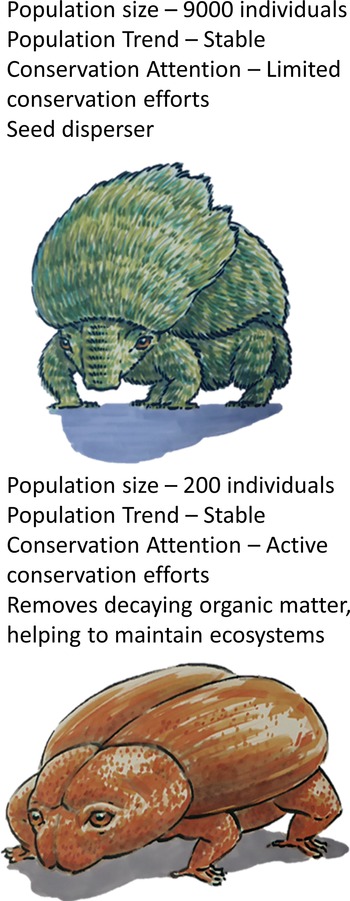
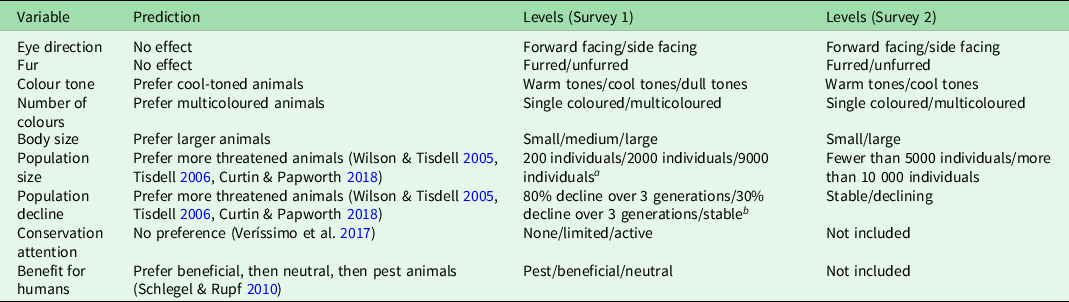
A survey was designed to investigate whether preferences for unknown species could be affected by the provision of information regarding conservation status, conservation attention and benefits for humans. The survey started with demographic questions (gender, age, education, location), questions about past donations to and volunteering for conservation organizations and participation in wildlife-orientated activities. This was followed by a discrete-choice experiment (DCE) in which participants were presented with choices between two imaginary animals in an unlabelled, unforced stated-choice DCE with a mix-and-match factorial design (Rose & Bliemer Reference Rose and Bliemer2009). DCEs are widely used to understand participants’ stated and revealed preferences (Rose & Blieme, Reference Rose and Bliemer2009) and have previously been used to understand conservation donation and species preferences (e.g., Garnett et al. Reference Garnett, Ainsworth and Zander2018). Individuals are presented with a series of choices between two or more options that are designed to investigate preferences for specific choice characteristics. In this experiment, two imaginary animals of different appearances were presented in each choice pair, with invented information regarding their population size and trend, level of conservation attention and species benefits for humans (e.g., whether the species provides ecosystem services or is a crop pest; Fig. 1 & Table 1). The aesthetic traits that varied were selected based on a previous study using the same imaginary animals (Curtin & Papworth Reference Curtin and Papworth2020). These animals were designed by mural design artist Rory McCann (https://rorymccannmurals.com/) in three ‘morphs’ and varied in their eye direction, colouring (number of colours and tone), body size and whether they had fur. Additional information on the design and appearance of the imaginary animals is provided in Curtin and Papworth (Reference Curtin and Papworth2020). Quantitative information on invented population size and trend was based on International Union for Conservation of Nature (IUCN) Red List criteria. Qualitative information on conservation attention and species benefits for humans was also included (see Table 1). For each choice pair, participants were asked ‘which of these animals would you rather conserve?’. An opt-out choice (‘neither of these’) was included. Four blocks of nine choices between pairs were generated using the ‘rotation.design’ function in the R package ‘support.CEs’ (Aizaki Reference Aizaki2012). Participants were randomly assigned to one block.
Example presentation of two options in the imaginary animal discrete-choice experiment of Survey 1. The two animals are both large and single-coloured, but the upper imaginary animal is cool-toned animal type C and the lower imaginary animal is warm-toned animal type A. The two animals also have differences in non-aesthetic traits, as communicated in the main text. An opt-out (‘neither of these’) option was also included.

Explanatory variables included in the discrete-choice experiments. Predictions for aesthetic traits follow the results of Curtin and Papworth (Reference Curtin and Papworth2020).

a International Union for Conservation of Nature (IUCN) critically endangered criteria C.
b IUCN critically endangered criteria A.
After choosing between the pairs, participants were invited to explain why they had made the choices that they did. These qualitative data were analysed to identify themes and provide context for the quantitative analyses presented here (see Supplementary Materials, available online). To assess participants’ revealed choices, at the end of the survey participants were informed that the project would donate US$0.50 on their behalf to the Zoological Society of London’s EDGE of Existence programme, which targets taxonomically diverse species that are globally endangered and evolutionarily distinct (Isaac et al. Reference Isaac, Turvey, Collen, Waterman and Bailie2007). Giving participants choices between animals but directing all donations to the same organization (rather than asking participants to select between organizations with different focal species; see Curtin & Papworth Reference Curtin and Papworth2020) ensured that participants made their selections based on the species rather than the organization. Participants were asked which of 17 EDGE species (see Supplementary Materials) shown in photographs they would most like to see conserved, with an option to request no donation be made on their behalf.
Survey 2: the role of appearance and information provision on participant choices for imaginary and real animals
A second survey was designed after the first survey was completed and analysed to investigate whether preferences for real animals were influenced by the same factors associated with preferences for imaginary animals. Therefore, participants were presented with choices between animals in two DCEs, one with imaginary animals and the other with real animals. These two DCEs were designed simultaneously to ensure congruence between the variables investigated. To reduce the number of choice options we limited population sizes and trends to two categories (see Table 1). Benefits for humans were excluded, as for real animals these can vary with cultures and different individual experiences; thus, it was difficult to identify appropriate real animals for this choice option (e.g., some consider beavers beneficial for flood prevention, while others view them as pests; McKinstry & Anderson Reference McKinstry and Anderson1999). Conservation attention was also excluded as it was not identified as being important in Survey 1 and it is difficult to classify the differing types of conservation attention received by real animals into meaningful ordinal levels.
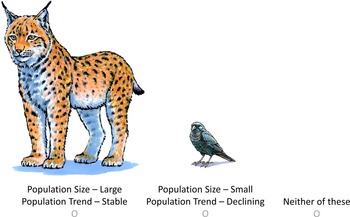
For the real animals, we contrasted mammals and birds rather than furred and unfurred animals. Birds of prey, primates, felids and a limited number of other species groups (e.g., Didelphis species) were considered to have forward-facing eyes (Heesy Reference Heesy2004). We identified species population sizes and trends from the IUCN Red List and considered species with populations over 10 000 individuals to have large populations and those with fewer than 5000 individuals to have small populations. These changes from the values used in Survey 1 were necessary as few species have very small populations. Colours and patterns were classified visually, but there are few animals that are truly ‘single coloured’. Therefore, when selecting animals, we ensured contrasts were evident between each pair (Fig. 2). The large differences in body mass between birds and mammals meant that we needed to use different definitions for ‘small’ (<1.0 kg for birds and <12.0 kg for mammals) and ‘large’ (>1.2 kg for birds and >19.0 kg for mammals) species, though as with colours the contrast between species in a pair was considered in the design (e.g., the largest ‘small’ mammal – the Tonkin snub-nosed langur, Rhinopithecus avunculus – was contrasted with the largest ‘large’ mammal – Grevy’s zebra, Equus grevyi). There were some restrictions to the experimental design as we were unable to identify a real animal that has forward-facing eyes, is under 12 kg, has a cool-toned single colour and is assessed on the IUCN Red List as having a stable population with fewer than 5000 individuals. We therefore had to generate three study designs using the ‘rotation.design’ function (Aizaki Reference Aizaki2012) before generating a design in which we were able to identify suitable real animals for the variable combinations. Once suitable real animals were identified, Rory McCann drew images of these real animals using the same medium as he used for the imaginary animals.
Example presentation of two options in the real animal discrete-choice experiment of Survey 2. The Eurasian lynx (Lynx lynx) was classed as large, warm-toned and multicoloured when contrasted with the Jamaican blackbird (Nesopsar nigerrimus), which was classed as smaller, cool-toned and single coloured. An opt-out (‘neither of these’) option was also included.

For the imaginary animal DCE, four blocks of six choice sets were generated using the ‘rotation.design’ function (Aizaki Reference Aizaki2012). Participants were randomly assigned to one block. For the real animal DCE, a single block with eight choice sets was completed by all participants. In the final section in which participants were asked to select an EDGE species, information regarding the species population size and trend (where available) was included as well as pictures of the species. All other aspects of the survey were identical to those of Survey 1.
Distribution and data quality
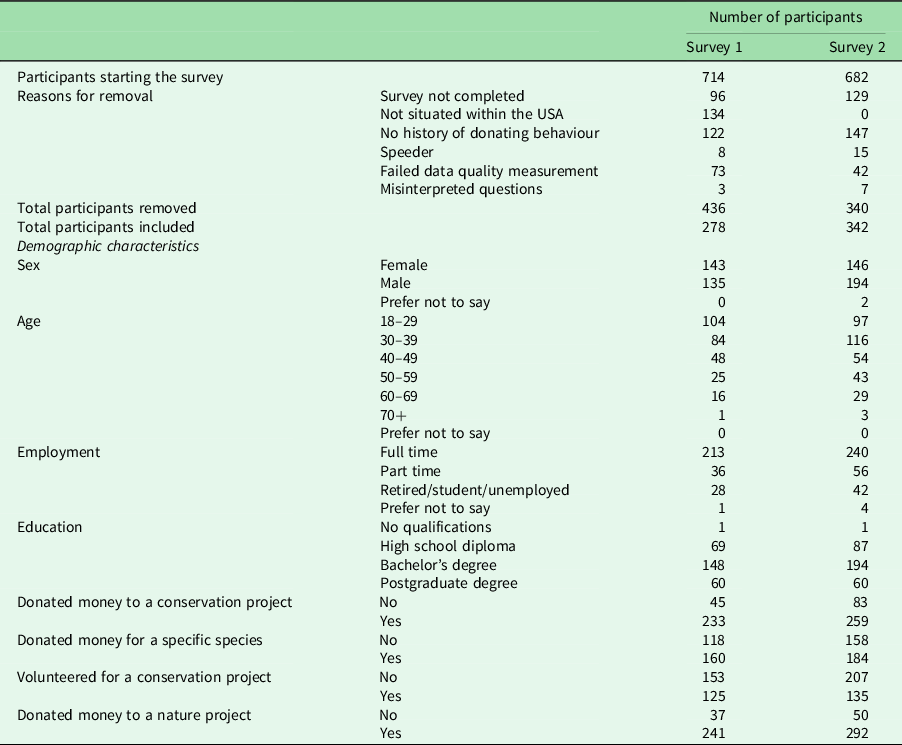
Both surveys were designed in the online survey tool ‘Qualtrics’ (Qualtrics, Provo, UT, USA). Survey populations were recruited from Amazon Mechanical Turk (MTurk) and paid US$0.35 – the amount recommended by MTurk for the survey length. In the first survey, participants from any country could participate, but analyses were restricted to those from the USA after data collection. In the second survey, only those from the USA were invited to participate. All participants were over 18 years of age and only those who reported engaging in conservation-related donation or volunteering behaviours were considered for inclusion. MTurk has a diverse participant pool and allows rapid, cost-effective data collection that outperforms panel data (Kees et al. Reference Kees, Berry, Burton and Sheehan2017) and has been used in various previous conservation papers (e.g., Thomas-Walters & Raihani Reference Thomas-Walters and Raihani2017). Nevertheless, there are documented concerns surrounding the reliability of data from MTurk (Chmielewski & Kucker Reference Chmielewski and Kucker2020). Therefore, measures were employed to minimize the inclusion of fake participants or ‘bots’. Surveys completed in less than a third of the median time (‘speeders’ in Table 2; Macdonald et al. Reference Macdonald, Burnham, Hinks, Dickman, Malhi and Macdonald2015) were excluded. Three multiple-choice questions with randomized answer orders were included: one question on self-reported involvement, one attention check and one instructional manipulation check (Kees et al. Reference Kees, Berry, Burton and Sheehan2017). Only participants who passed at least two of these three data quality checks were included in the analyses (‘Data quality measurement’ in Table 2). A final check was applied to the ‘free-text’ questions, with participants removed if their answers suggested that the question had not been understood (‘Misinterpreted questions’ in Table 2; Chmielewski & Kucker Reference Chmielewski and Kucker2020).
Reasons for the removal of participants who started Surveys 1 and 2 and demographic characteristics for participants included in the analyses. Note that in Survey 2, only Amazon Mechanical Turk workers from the USA were permitted to start the survey.

Analyses
Analyses were conducted in R 3.6.3 (R Core Team 2020). The DCE was analysed using mixed logit models (Aizaki Reference Aizaki2012). Estimates from the DCE models were used to predict preferences for the EDGE species shown at the end of each survey. As the EDGE species were presented without accompanying information in Survey 1, only aesthetic traits were used to predict preferences from the Survey 1 DCE. In Survey 2, participants were presented with information on the population size and trend (when available), so all variables were used to predict preferences from the DCEs in Survey 2. For species where information on population size or trend was unavailable (thus stated as ‘unknown’ for participants), predictions were made for both variable levels (e.g., both large and small populations) and the mean value was used in the analyses. For EDGE species that were neither a bird nor a mammal (e.g., Round Island boa, Casarea dussumieri), predictions were made for both categories and averaged. For predictions from the imaginary animal DCEs, the probability of selecting animal type ‘C’ with the same aesthetic traits was calculated. Generalized linear models were used to determine whether the predicted preferences could predict the number of participants who chose each EDGE species, with Gaussian, Poisson and negative binomial errors distributions (from the package ‘MASS’; Venables & Ripley Reference Venables and Ripley2002) compared for model fit using the package ‘performance’ (Lüdecke et al. Reference Lüdecke, Ben-Shachar, Patil, Waggoner and Makowski2021).
Results
Participants
In total, 278 and 342 participants completed Surveys 1 and 2, respectively. These participants were based in the USA and had a previous history of donation to or volunteering for conservation or nature organizations (Table 2). In both surveys, most participants were under 39 years of age (68% in Survey 1 and 62% in Survey 2), in full-time employment (77% and 70%, respectively) and had a bachelor’s degree or higher qualification (75% and 74%, respectively).
Discrete-choice experiment results
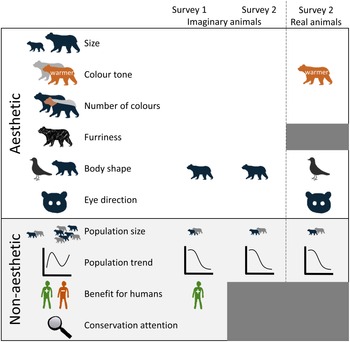
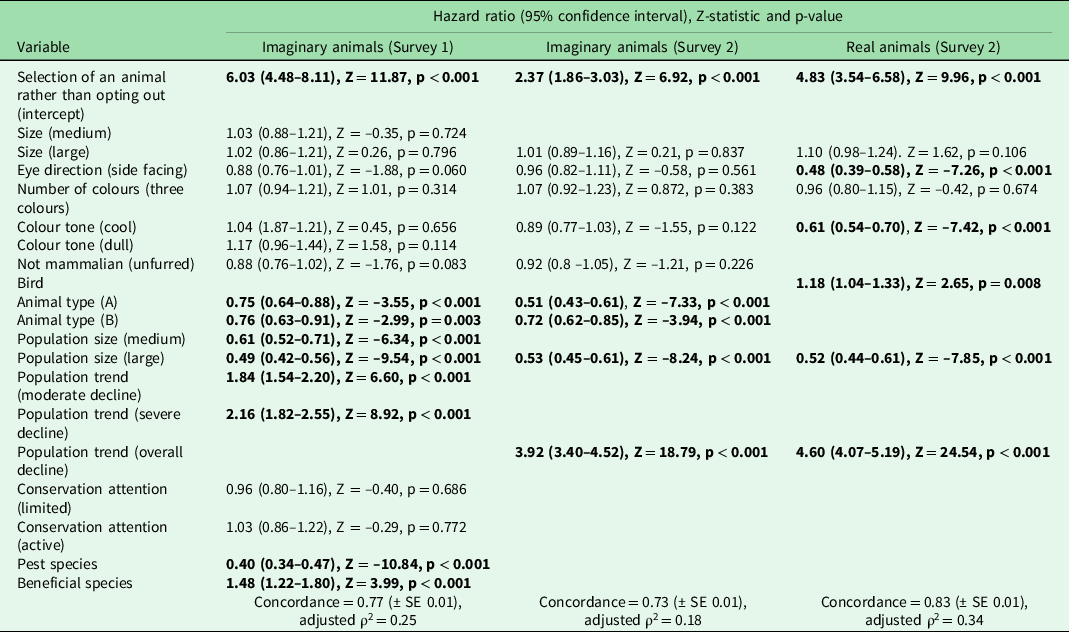
Compared to animals with reported population sizes of 200 individuals, the 278 participants in Survey 1 were less likely to select animals with population sizes of 2000 individuals and about half as likely to select animals with population sizes of 9000 individuals (Fig. 3 & Table 3). Participants were more likely to select animals with reported declining population trends compared to animals with reported stable population trends, demonstrating more than twice the likelihood to select animals with reported 80% population declines and an intermediate value for those with 30% population declines. Compared to neutrally described species, participants were more likely to select animals that were described as beneficial and less likely to select animals that were described as pests. There was no effect of the level of conservation attention received or the experimentally manipulated aesthetic traits, though participants were less likely to select animals of type A and B than animal type C (Table 3). In total, 235 participants provided free-text explanations of why they chose the animals that they did (Table S1), with ecological role (mentioning the relationship between the animal and the wider environment) being the most common theme (n = 86). Participants also mentioned population trend (n = 57), population size (n = 53) and conservation effort (n = 32), but fewer mentioned the animals’ appearances (n = 14).
Study design of the three discrete-choice experiments, with icons showing which traits participants preferred in each study. Across all three experiments, participants preferred animals with small and declining populations. In Survey 1, participants preferred animals that benefitted humans, but neither this nor conservation attention was included as a variable in Survey 2. No preferences for aesthetic traits were found for imaginary animals, but participants preferred real animals that were birds, warm-toned and with forward-facing eyes.

Model estimates from three discrete-choice experiments across the two surveys. Hazard ratios greater than 1 suggest an animal with this trait is more likely to be selected and hazard ratios below 1 suggest an animal with this trait is less likely to be selected. Variables where p < 0.05 are shown in bold.

When presented with imaginary animals, the 342 participants in Survey 2 demonstrated comparable results to those found in Survey 1 (Fig. 3 & Table 3); participants were half as likely to choose a species with a large population and almost four times as likely to choose a species with a declining population. No significant effect of appearance was found, except participants were less likely to select animals of type A and B compared to animal type C. In total, 285 participants provided free-text explanations of their choices, and population trend was most commonly cited (n = 157), although appearance (n = 72) and population size (n = 60) were also often mentioned (Table S1).
When these same 342 participants chose between real animals, specific aesthetic traits did affect their choices (Fig. 3 & Table 3). Participants were half as likely to select animals with sideways-facing eyes and less likely to select cool-toned animals. Contrary to expectations, participants were more likely to select bird than mammal species, but they remained approximately half as likely to select species with larger populations and more than four times as likely to select those with declining populations. In total, 266 participants provided free-text explanations of their choices for real animals, with most mentioning population trend (n = 167) and some mentioning population size (n = 56). References to appearance (n = 31) were fewer, although 16 participants reported choosing a particular type of animal (Table S1).
Revealed choices
Across both surveys, the red panda was most often selected by participants and the West African dwarf crocodile was least often selected (Table S2). The number of donors for each species was positively correlated between Surveys 1 and 2 (Spearman’s ρ = 0.65, S statistic = 338.4, p = 0.003). Predicted preferences for the 17 species from Survey 1 were positively correlated with the number of participants selecting each species (negative binomial regression, n = 17, χ2 = 11.56, Nagelkerke’s R2 = 0.36, p = 0.003). The black rhino was excluded as an influential outlier from both analyses using predictions from Survey 2 (Cook’s distance > 0.5). This was the only species with a stable population, and the large effect size of population trend meant that the predicted preferences were 2.9 and 3.3 standard deviations below the mean for the real and imaginary animal predictions, respectively. For the 16 remaining species, the number of donations was positively correlated with both predictions from the imaginary animal DCE (negative binomial regression, n = 16, χ2 = 9.88, Nagelkerke’s R2 = 0.27, p = 0.007) and real animal DCE (negative binomial regression, n = 16, χ2 = 13.11, Nagelkerke’s R2 = 0.49, p = 0.001).
Discussion
Conservation status and benefits for humans affected preferences for imaginary animals in the predicted directions, with potential conservation donors preferring animals with small, declining populations that were beneficial for humans. These results demonstrate that information provision can affect preferences for unknown species, supporting prior research that shows that these traits can affect preferences for real species (Wilson & Tisdell Reference Wilson and Tisdell2005, Tisdell Reference Tisdell2006, Schlegel & Rupf Reference Schlegel and Rupf2010, Curtin & Papworth Reference Curtin and Papworth2018). Although there were differences in preferences for the three imaginary animal morphs, no effect of specific aesthetic traits was found. This contrasts with preferences for larger, cool-toned and multicoloured animals found by Curtin and Papworth (Reference Curtin and Papworth2020) using the same methodology and imaginary animals. Combined, this suggests that specific aesthetic traits may influence choices in the absence of other information (Curtin & Papworth Reference Curtin and Papworth2020), but these effects are eclipsed by information provision, specifically information regarding conservation status and benefits for humans. This is supported by participants’ post hoc justifications – very few mentioned animal appearance and the most common themes referenced ecological roles or population size and trend. Previous studies that have investigated preferences for hypothetical animals have found effects of both aesthetic and non-aesthetic traits (e.g., colour and conservation status; Garnett et al. Reference Garnett, Ainsworth and Zander2018). However, like the present study, Montgomery (Reference Montgomery2002) found aesthetic traits to be less important than other traits measured in that study (e.g., ecological benefits). Thus, using non-aesthetic traits (e.g., conservation status) to select potential conservation flagship species might be more successful than basing this selection on aesthetic traits.
In this study, we found that the effects of population size and trend were of a similar magnitude and had overlapping confidence intervals for real and imaginary animals. Prior research on real animals has demonstrated that providing information about IUCN threat status can change donor preferences, leading them to prefer more threatened species (Veríssimo et al. Reference Veríssimo, Vaughan, Ridout, Waterman, MacMillan and Smith2017, Curtin & Papworth Reference Curtin and Papworth2018). Garnett et al. (Reference Garnett, Ainsworth and Zander2018) found that participants stated preferences for more threatened species, but very few participants selected threatened species as their named preferred species. Unlike aesthetic traits, which a participant can identify from a picture, informational traits such as conservation status can only be used to guide preferences if a participant is aware them. This could be either because a participant has prior knowledge of the species or because others provide this information (as was the case in this and other studies mentioned above). This may explain why few participants named threatened species in the study by Garnett et al. (Reference Garnett, Ainsworth and Zander2018) – they may have been unaware of the relative conservation status of the animals that they know.
When participants participated in matched DCEs on imaginary and real animals, there was evidence to support the role of specific aesthetic traits in decision-making for real but not imaginary animals. When choosing between real animals, participants preferred warm-toned birds with forward-facing eyes, which contrasts with the lack of effect found in this study and the preference for large, cool-toned and multicoloured imaginary animals in Curtin and Papworth (Reference Curtin and Papworth2020). We argue that this suggests that the preferences for certain aesthetic traits found across various studies are not inherent. One explanation for these previous findings is the correlation between seemingly preferred aesthetic traits and other traits that are actually preferred. For example, in some species groups, animals with greater body mass tend to be at greater risk of extinction (Chichorro et al. Reference Chichorro, Juslén and Cardoso2019). The potential for these correlations was highlighted in this study by the difficulty in identifying real animals with certain trait combinations; there are very few species with some traits, and other traits are only found in closely related species. For example, most animals with forward-facing eyes are either primates or felids, but it may not be this trait that makes these groups popular. For example, primates may be popular due to their similarity with humans, and felids may be popular for their predatory behaviour; both traits were suggested by Kellert (Reference Kellert1985) as important in influencing preferences for animals in the USA.
This study demonstrated that stated preferences for real and imaginary animals can predict revealed preferences for species donation. All three experiments were able to predict the number of donations received by real EDGE species, although the variance explained by the model (described using Nagelkerke’s R2) was greatest when predicting from preferences for real animals. Therefore, even though the underlying mechanism for species preferences remains unknown, the preferences found in this study were able to predict participant behaviour. Regardless of the mechanism, consistent preferences for poor conservation status in this and other studies suggest that the conservation of both well-known and little-known species could be encouraged if organizations communicate information regarding their population sizes and trends. However, there are probably differences between individuals in terms of which species appeal to them and how much they are willing to donate, as has been found by Lundberg et al. (Reference Lundberg, Veríssimo, Vainio and Arponen2020) in their study of US and UK conservation donors. Further research that identifies similar groups of donors and tests possible mechanisms of species preferences would provide guidance regarding which traits to investigate as predictors of conservation philanthropy and improve the accuracy of predictions. Investigations of more diverse and less easily quantified species traits, such as intelligence (Kellert Reference Kellert1985), may identify other traits that are more important than species appearance and improve predictions of conservation philanthropy. However, for these less physically tangible traits, the perceptions of traits are probably more important than the traits themselves and will be mediated by cultural knowledge, consistent with the theory of flagship species action (Jepson & Barua Reference Jepson and Barua2015). For example, even though recent research demonstrates that chickens are more cognitively complex than previously believed (Marino Reference Marino2017), public perceptions of chicken intelligence will not necessarily reflect this research. Future research that identifies cultural perceptions associated with successful flagship species and popular species and then tests whether lesser-known, less popular species can be relocated within these frames using conservation marketing techniques may be a fruitful area of investigation.
Supplementary material
To view supplementary material for this article, please visit https://doi.org/10.1017/S037689292200025X.
Acknowledgements
This study was made possible by the work of Rory McCann and the research participants. The authors thank them and the many people who discussed the imaginary animal project over its development. Data are available from Figshare, DOI: 10.17637/rh.16838008.
Financial support
This work and the salary of Polly Curtin were supported by a National Geographic Society grant ‘Preventing biodiversity loss depends on understanding how people choose what to conserve’ (NGS-53291R-18).
Competing interests
The authors declare none.
Ethical standards
The study was approved by the Royal Holloway Ethical Approval Process.