Introduction
The burden of disease due to trauma and non-communicable diseases (NCDs) is increasing worldwide, including India. Emergency Medical Services (EMS) and first responder interventions have been shown to improve outcomes, if correctly and efficiently employed.Reference Wijesekera, Reed, Chastain, Biggs, Clark, Kole, Chakrapani, Ashish, Rajhans, Breaud and Jacquet 1 - Reference Prekker, Delgado and Shin 3 Proper skills and training of EMS providers are necessary in order to deliver care effectively. However, without a universal EMS system in India, data on the epidemiology of patients who utilize EMS are limited. This retrospective chart review aimed to quantify and describe the burden of disease presenting via EMS to Indian emergency departments (EDs) in order to inform a national EMS curriculum.
Trauma is the leading cause of mortality for individuals younger than 65 years of age in the United States, and in the top 10 causes of mortality in India.Reference Seamon, Fisher and Gaughan 4 , 5 Not surprisingly, trauma also causes an increasing burden on EDs around the world, particularly in India where 56% of the population is 15 to 59 years of age. 6 India has a Gross Domestic Product/GDP per capita of US $1581.50 and a population density of 436 people per km2 land area. 7 The country has a particularly increased burden of road traffic accidents (RTAs), despite having only one percent of the total motor vehicles in the world. It is estimated that six percent of the global burden of RTAs occur in India. 8 In 2013, one death occurred approximately every four minutes in India, resulting in 377 fatalities a day caused by RTAs. Approximately 25% of these accidents were on motorcycles. Additionally, there were 1,287 unintentional injuries per day from RTAs.Reference Joshipura, Shah and Patel 9 Despite global advancements in road safety and injury prevention, the proportion of fatal accidents in total RTAs consistently has increased, from 18.1% in 2002 to 24.4% in 2011. Additionally, the severity of RTAs, measured in terms of persons killed per 100 accidents, has increased from 20.8 in 2002 to 28.6 in 2011. 10
Complications from NCDs also are on the rise worldwide. In India, the three leading causes of death are ischemic heart disease, chronic obstructive pulmonary disease, and cerebrovascular accident (stroke). 5 Patients with these conditions have been shown to benefit from timely and appropriate emergency care. Patient outcomes from emergency complications of NCDs also have been shown to improve with timely EMS intervention. 11 - Reference Fujii, Masuda and Suzuki 13
The present EMS are restricted primarily to cities where trauma services are available, and great variation in available services exists for paying versus non-paying patients. Indian EMS is currently in development and still is fragmented in most places. Many efforts from the private sector and nongovernmental organizations have attempted to fill this gap; however, a centralized system across all of the Indian states has not yet been accomplished. As a result, there is no coordinated, centralized body to organize and dispatch EMS, nor is there a single telephone number people can call to request services in all states. Dial 108 services exist in 16 states; however, there is still extreme variability in Indian EMS educational standards, service delivery, and outcomes.Reference Malta Hansen, Kragholm and Pearson 14 Availability of EMS in India varies according to state, village, and hospital, due to topography, financial constraints, and availability of infrastructure to support an EMS system. While urban and peri-urban areas usually have better infrastructure to support EMS, access to services often is varied and is influenced by ability to pay as well as awareness of patients and their families that life-saving services such as EMS are available. 8 , Reference Sharma and Brandler 15 On the other hand, in urban and peri-urban India, trauma specialty units, critical care services, and specialists of all types can be made available on a round-the-clock basis. In addition, dedicated centers for trauma or stroke care are quite rare in India.Reference Joshipura 16 , Reference Mishra and Khadilkar 17
In India, there are currently no national guidelines or legislation regarding the type of equipment, training, or services EMS should provide. An Ambulance Code exists but is not enforced. The State of Gujarat is currently the only state with laws specific for EMS. Implementing robust EMS guidelines could be beneficial to supporting national health and development goals, as it would help create access to acute health services. Emergency Medical Services use in India is becoming increasingly important to the health and wellbeing of the population. However, little data exist on EMS use and the epidemiology of patients utilizing these services. This study aimed to address this knowledge gap by examining EMS utilization at multiple sites in India.
Methods
Study Design
The study was a retrospective chart review of medical records from patients that reported to the EDs via EMS over a three-month period in 2014 at four private hospitals in India: Kerala Institute of Medical Sciences (KIMS) in Trivandrum, Kerala; Deenanath Mangeshkar Hospital (DMH) in Pune, Maharashtra; Fortis Hospital in Kolkata, West Bengal; and Max Super Specialty Healthcare in New Delhi. Three distinct months were chosen (January, May, and September) in order to minimize seasonal variation. All ED patient records for the study time period were reviewed; data were extracted from patients recorded as having arrived by EMS. Internal hospital transfers were excluded, but hospital-to-hospital transfers were included. Data were extracted anonymously from medical records and recorded into a password-protected Excel (Microsoft Corp; Redmond, Washington USA) template.
All records were treated equally and included in the data collection process; records with low data quality or missing information were included to minimize selection bias. Individual records were not excluded due to missing data. Missing data were managed on an individual variable basis in order to preserve as much data as possible. The Boston University Institutional Review Board (Boston, Massachusetts USA) and the ethical committees at all four participating hospitals approved this study.
Study Setting and Population
This study took place at four private hospitals in the four geographic zones of India: North, South, East, and West. Kerala Institute of Medical Sciences is a 600-bed hospital in Trivandrum, Kerala. Patients at KIMS were triaged upon arrival to the ED by a triage nurse and records were obtained from the KIMS electronic medical record (EMR) system, Yasasii (Kameda Infologics Pvt Ltd; Tokyo, Japan). Deenanath Mangeshkar Hospital is a 1000-bed hospital in Pune, Maharashtra. The DMH ED records a register of calls that use the DMH ambulance as well as collect a trip report from the ambulance. Records from patients who arrived to the DMH ED, cardiology catheterization lab, and labor and delivery were recorded. Patients transferred out of DMH, death declarations, and those who skipped these three departments were excluded. To ensure the accuracy of the call register, the physical ED patient logbooks for the three-month period also were reviewed. Fortis is a 400-bed hospital in Kolkata, West Bengal. Fortis patients were triaged upon arrival to the ED by a triage nurse. Patients arriving to the hospital by EMS were recorded in one of two logbooks, dependent on whether it was a Fortis ambulance or a non-Fortis ambulance. Patient information extracted from the logbooks was used to find hospital identification numbers using the Fortis EMRs. Max Super Specialty Hospital is a 525-bed hospital in New Delhi. The Max EMS Call Center records a register for calls that use the Max ambulance, as well as collects travel information from the ambulance. Records from this register and the ED log of all patients who used the service were reviewed.
Study Protocol
At each site, data were collected, de-identified from the EMR, and then entered into a password protected Excel template. Due to the varied nature of data collection at each site, the results are presented individually at each site and not in aggregate. The results represent a snapshot of the given timeframe at each hospital. In order to protect the confidentiality of specific sites, their identities have been concealed in Tables 1–4.
EMS Utilization

Abbreviations: ED, emergency department; EMS, Emergency Medical Services.
EMS Utilization Demographics
Abbreviation: EMS, Emergency Medical Services.
EMS Utilization by Chief Complaint and ED Diagnosis Group

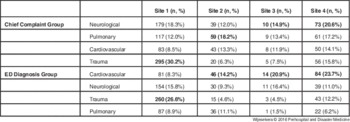
Note: The most common chief complaints and ED diagnosis groups of patients who utilized EMS at each site are highlighted in bold.
Abbreviations: ED, emergency department; EMS, Emergency Medical Services.
Hospital Outcomes by Site

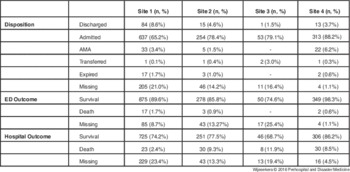
Abbreviations: AMA, against medical advice; ED, emergency department.
Measures
A standardized form was used to obtain the following variables from each patient record: study site, age, gender, month of presentation, triage score, chief complaint, ED diagnosis, disposition, ED outcome, and hospital outcome.
Data Analysis
Analysis was performed using SAS 9.3 (SAS Institute, Inc.; Cary, North Carolina USA).
Results
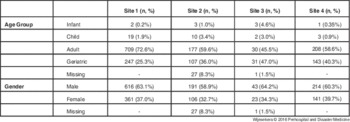
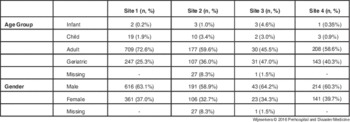
A total of 17,541 patient records were sampled from the four sites over the study period. Of these records, 1,723 arrived by EMS and so were included for further review. A range of 1.4%-19.4% of ED patients utilized EMS to travel to the ED (Table 1). The majority of EMS patients were male (59%-64%) and adult or geriatric (93%-99%) (Table 2).
The most common chief complaints were neurological (12.0%-20.6%), pulmonary (12.0%-18.2%), cardiovascular (8.5%-14.1%), and trauma (6.3%-30.2%). Neurological complaints were the most common chief complaint at two sites, whereas trauma and pulmonary complaints were the most common complaints at the other two individual sites. The most common ED diagnoses were cardiovascular (8.3%-23.7%), neurological (9.3%-16.4%), trauma (4.5%-26.6%), and pulmonary (1.5%-11.1%). Cardiovascular diagnoses were the most common ED diagnoses at three sites, whereas trauma was the most common ED diagnosis at one site (Table 3).
The vast majority of patients were admitted to the hospital (65.2%-88.2%). Emergency department survival rates ranged from 74.6% to 98.3%, and hospital outcomes ranged from 68.7% to 86.2% (Table 4).
Discussion
The epidemiology and utilization of EMS in India has not been described fully. This study was the first multi-regional, retrospective study to describe the most common demographics, chief complaints, and diagnoses of patients presenting to Indian EDs via EMS. Although Sharma et al. found maternal emergencies to be the leading chief complaint of patients transported by ambulances in Rajasthan, India, this study found the leading chief complaints by patients included pulmonary, trauma, and neurological issues.
Respiratory complaints highlight a critical increase in the burden of both cardiovascular and respiratory disease in India.Reference Pal, Agarwal and Galwankar 18 In a 2014 study, the primary diagnosis made in the ED in three of four sites was cardiovascular.Reference Malta Hansen, Kragholm and Pearson 14 In 2015, Mercer et al. examined prehospital care and outcomes of EMS patients in Andhra Pradesh, India in those complaining of shortness of breath and found high mortality rates partially due to underutilization of prehospital therapeutics.Reference Pal, Agarwal and Galwankar 18 In addition to the recent rise of cardiovascular disease and other NCDs, India has a significant and unique high rate of RTAs. At one site in this study, trauma-related medical emergencies accounted for approximately 30% of EMS utilization. These results suggest the highly critical status of patients utilizing Indian EMS and the need for increased critical care training and preparedness of EMS personnel.
In all four regions, adult and geriatric males accounted for more than one-half of patients arriving to the ED by EMS. While this finding certainly encourages more geriatric training for EMS personnel, further research needs to be conducted to better understand the specific barriers that women, infants, and children face when accessing EMS. There was difficulty ascertaining EMS usage by children due to limited and various documentation protocols in the ED. Additional benefits to prehospital services can be identified with improvements in the detail of data gathered, such as mode of arrival and transportation time/distance, medical record keeping, and standardized documentation practices.
Limitations/Recommendations
Study limitations include variability in method of recording of patient information at each site, incomplete and missing patient data in patient records, and lack of generalizability of results.
Variability between sites in record keeping methodology and quality affected the data collected. For example, patients who were carried in by family members from an ambulance were often recorded as having arrived “carried in” and not as “EMS” and therefore not always included in the study. The authors recommend creating a uniform method of record keeping and a standardized terminology so that this important information can be obtained more accurately in future studies. Additionally, with the exception of DMH—a medical trust—the other three hospitals surveyed are private institutions; therefore, these results cannot be generalized to public hospitals or settings.
This is the first multi-regional, retrospective study of its kind, to the authors’ knowledge, to provide an initial assessment of EMS utilization and patient characteristics in urban India. The variation of chief complaints, ED diagnosis, and hospital outcomes is multifactorial. Although this study sampled data from various months of the year and hospitals in four different regions, the current EMS organization, accessibility, and public awareness have significant effects on patient utilization of EMS.
The authors recommend that this study be continued prospectively with hospitals recording EMS arrival upon triage, standardized record keeping protocols, as well as the inclusion of public hospitals from around the country due to the varying caseloads, geographic location, and patient ability to pay out-of-pocket expenses. In order to create and improve a centralized, regulated prehospital care system in India, further studies of data from EMS agencies, public hospitals, public opinion, and knowledge of EMS are needed.
Conclusion
Neurological, pulmonary, cardiovascular, gastrointestinal, trauma, and infectious disease are the most common problems in patients transported by EMS in India. Adult and geriatric male patients are the most common EMS utilizers. Indian EMS curricula should emphasize these knowledge areas and skills. Future work includes expanding the study to include government hospitals, more private hospitals, medical trusts, and charity hospitals.