


Introduction
Threatened by skyrocketing inequality, racial and other intergroup tensions, and a looming climate disaster, liberal democracies face an unprecedented erosion of the consensus on the values and institutions that sustain them (Diamond, Reference Diamond2015; Freedom House, 2022; but see Little and Meng, Reference Little and Meng2024).Footnote 1 At the same time, authoritarian governments around the world are experiencing a resurgence grounded on a combination of military might, economic success, and legal legitimacy (Guriev and Treisman, Reference Guriev and Treisman2022; Wang, Reference Wang2014).Footnote 2
To rebuild democracy on sounder bases, theorists and practitioners alike emphasize the value of inclusive and participatory institutions (theory: Allen, Reference Allen2023; Beramendi et al., Reference Beramendi, Besley and Levi2022; Farrell et al., Reference Farrell, Mercier and Schwartzberg2023; contra Brennan, Reference Brennan2016; Downs, Reference Downs1957; Somin, Reference Somin2013; practice: OECD, 2020; Sgueo, Reference Sgueo2020). But how should these institutions be built? Who should be in the room when decisions are made? What methods of choice and selection can or should citizens use? And what is the contribution – or perhaps the jurisdiction – of participatory institutions to representative government?
Whereas theory falls short of tackling such microfoundational questions, the limited social scientific literature on democratic innovations does not provide clear answers. With a few exceptions (e.g. Hendriks, Reference Hendriks2023; Pogrebinschi, Reference Pogrebinschi2023),Footnote 3 existing contributions tend to focus on one specific case (or group of cases), such as deliberative mini-publics (which include participatory budgeting, deliberative polling, and online deliberative town-halls: Fishkin, Reference Fishkin2018; Goodin, Reference Goodin2008; Neblo et al., Reference Neblo, Esterling and Lazer2018; see Fung and Warren, Reference Fung and Warren2011 for a compendium) or citizen assemblies (on issues such as data sharing, climate change, assisted dying, abortion, and gay rights in France, Ireland, and the UK: Landemore, Reference Landemore2020; Farrell et al., Reference Farrell2021; see OECD, 2020 for a compendium). Only in rare cases do these experiments carry, or lead to, policy consequences.
Contemporary experiments with participatory democracy are not the only source of empirical evidence for how inclusive and participatory institutions can be built and how they might function. In fact, political inclusion and participation are not recent phenomena. But exploring their past instantiations requires loosening some definitions, particularly definitions of – and expectations about what counts as – ‘democracy’. Our goal is not to challenge common definitions of democracy as they apply to contemporary settings, but to show that those definitions – particularly those that equate democracy with representative institutions (Ahmed and Stasavage, Reference Ahmed and Stasavage2020; Angelucci et al., Reference Angelucci, Meraglia and Voigtländer2022; North and Weingast, Reference North and Weingast1989; Stasavage, Reference Stasavage2010, Reference Stasavage2020) or with mechanisms such as elections (Dahl, Reference Dahl1989; Diamond, Reference Diamond2008) – themselves depend on the forms that ‘democracy’ has taken over the centuries, especially following the tradition that developed in Europe since the early modern period.
Once we loosen those definitions, we can fruitfully study a much larger historical tradition of what we term here ‘collective governance’ that spans the globe across several millennia. In many cases, the institutions of collective governance we study do not feature universal inclusion motivated by normative commitments, as is the case in (some) contemporary democracies. Searching for such a form in history would be anachronistic and ultimately self-defeating. Yet, the cases we discuss in this paper feature a range of non-hierarchical, participatory mechanisms that included, for example, men, women, and even children in decision-making. These cases put pressure on much of what we know about the possibilities and limits of collective governance today and can productively contribute to the conversation about democratic innovations – but they are understudied.
In political science and political economy, mainstream scholarship on historical democracy focuses on the West from the early modern period onward (Acemoglu and Robinson, Reference Acemoglu and Robinson2012; Reference Acemoglu and Robinson2019; Fukuyama, Reference Fukuyama2011, Reference Fukuyama2014 Moore, Reference Moore1966; North and Thomas, Reference North and Thomas1973; North et al., Reference North, Wallis and Weingast2009). In this scholarship, non-western cases typically describe instantiations of authoritarianism or failed governance. There are some notable exceptions: Elinor Ostrom (Reference Ostrom1990) extensively documented the use of collective governance arrangements among communities managing common pool resources (CPRs). Similarly, James Scott studied the behaviours and motivations of peoples who defy hierarchical state institutions (Reference Scott1985, Reference Scott2009). More recently – and partly in response to the failures of building democratic institutions outside the West in the second half of the 20th century – development scholars have begun to study the impact of traditional forms of collective governance on contemporary outcomes, such as public goods provisions, political accountability, and well-being (Diaz-Cayeros et al., Reference Diaz-Cayeros, Magaloni and Euler2014; Magaloni et al., Reference Magaloni, Díaz-Cayeros and Ruiz Euler2019).Footnote 4
By contrast, disciplines such as anthropology and archaeology have extensively focused on governance outside the West (e.g., Goody, Reference Goody2006): if earlier scholarship, including the influential work of scholars such as Fortes and Evans-Pritchard in Africa (e.g., Fortes and Evans-Pritchard Reference Fortes and Evans-Pritchard1940), tended to ignore or stylize political structures, the latter part of the 20th century saw a burst of research in comparative ethnography and archaeology aimed at understanding, among other things, the dynamics of long-term political change (Blanton and Fargher, Reference Blanton and Fargher2008, Reference Blanton and Fargher2016; Feinman, Reference Feinman2023; Graeber and Wengrow, Reference Graeber and Wengrow2021; Scott, Reference Scott2017).Footnote 5 Drawing on this research, David Stasavage (Reference Stasavage2020; Ahmed and Stasavage, Reference Ahmed and Stasavage2020) has recently put forth what is perhaps the most comprehensive account of the origins of what he terms ‘early democracy’.
The project we present in this paper integrates and builds on these efforts. We present a new dataset featuring over 90 communities across the world and throughout history (from the 4th millennium BCE to the 20th century CE) that developed some form of collective governance. Compared to existing ethnographic and archaeological datasets used in the social sciences, especially the Standard Cross-Cultural Sample (Murdoch and White, Reference Murdock and White2024), our data present a much longer time span, a coverage of western and non-western cases, and – perhaps more crucially – a much more in-depth view of the mechanisms used to make and enforce decisions collectively.
We present three findings: first, contrary to the tradition equating democracy with the institutions of the early modern and contemporary West, including but not limited to (free and fair) elections, councils, majority voting, or lotteries (Cirone and Van Coppenolle, Reference Cirone and van Coppenolle2025; Dahl, Reference Dahl1989; Diamond, Reference Diamond2008; Schwartzberg, Reference Schwartzberg2013; Stasavage, Reference Stasavage2010, Reference Stasavage2011), we observe that these institutions are only one way among many to organize collective decision-making. Outside of Europe, other configurations prevail. Second, against the view that scale is the enemy of collective arrangements (Hardin, Reference Hardin1968; Olson, Reference Olson1965), our data reveal that collective governance at different scales functioned through different mechanisms. Third, the picture of collective governance we derive from global history reveals a level of institutional diversity and complexity that puts pressure on well-known dichotomies: for example, participation vs. representation (Acemoglu and Robinson, Reference Acemoglu and Robinson2005, Reference Acemoglu and Robinson2012, Reference Acemoglu and Robinson2019) and democracy vs. autocracy (Stasavage, Reference Stasavage2020). We find instead that collective governance is always representative, no matter the size of the community and the range of participants. Moreover, collective governance rarely characterizes entire societies and it is more often found mingled with other, often more hierarchical, institutions. Putting pressure on these classifications, the historical record reveals a multiplicity of functions and roles that collective governance institutions have performed through the ages.
Our findings specify and expand on existing scholarship. As discussed above, prior work has already suggested, for example, that democracy can function without elections, that some large-scale societies sustained collective governance, and that collective governance existed outside the West. Our work adds new cases and greater precision to an understanding of the alternative forms that collective governance took throughout history. In particular, we present a more fine-grained picture of the specific rules and mechanisms that different societies used to determine (a) access to institutions of collective governance, (b) how decisions were carried out, and (c) how they were enforced.
Taken together, our findings put pressure on standard accounts that have shaped how we study collective governance, and where. In doing so, they contribute to the literature on institutional diversity: whereas prior scholarship focused on specific forms of collective governance (Stasavage, Reference Stasavage2020: councils; Ostrom, Reference Ostrom1990, Reference Ostrom2005: CPRs) or particular historical periods and regions (Greif, Reference Greif2006; North, Reference North1990, Reference North2005 – Europe), our paper vastly expands the geographic and temporal scope. Although in this paper, we limit ourselves to describing the data and focusing on three important baseline results, future work will enable us – and hopefully others – to articulate what different models of collective governance looked like across the world, and understand how these different models arose, failed, and, perhaps most importantly, how they shaped developmental outcomes. The payoff of this analysis is thus potentially large as it provides the basis for a much broader investigation into understudied structures that can sharpen our theories and help us build better institutions.
The paper proceeds as follows: Section ‘methodology’ describes the methodology employed for the data collection. Section ‘collective governance in global history’ presents our findings. Section ‘conclusion’ concludes.
Methodology
The database covers 91 discrete communities and 100 mechanisms employed in over 460 distinct institutions.Footnote 6 In this section, we discuss sources, case selection, coding practices, and data limitations.
Sources
To identify the communities, we approached the sources in a manner that was both exploratory and inductive: we wanted to cover all regions of the globe and assume no outcome in terms of where, or in what shape, we would encounter collective governance institutions. For these reasons, we initially avoided both standard ethnographic datasets – which do not focus on historical cases, provide limited coverage of Europe, and pay little attention to political institutions – and mainstream political economy – which would have overrepresented the European canon.
We thus started by looking into recent scholarship that was both strongly comparative and close to our primary fields of expertise (political science, ancient history, and archaeology), such as Stasavage (Reference Stasavage2020), Graeber and Wengrow (Reference Graeber and Wengrow2021), Scott (Reference Scott2009, Reference Scott2017), and Mogens Hansen’s (Reference Hansen2000) project on city-state cultures. From these main texts, we derived lists of communities – some of which met our criteria for entry, some of which didn’t – and followed additional sources to better understand the institutions and institutional mechanisms present in each community. Following footnotes and bibliographies took us to explore particular parts of the world (North America: Jorgensen, Reference Jorgensen1980) or particular forms of collective governance (matriarchies: Goettner-Abendroth, Reference Goettner-Abendroth2012). We also took advantage of a close network of experts on specific parts of the world where the evidence was either too extensive or too complex for us to wade through on our own (these include ancient Egypt and Mesopotamia, as well as early modern Russia). Eventually, we returned to standard ethnographic datasets (including Seshat, the Standard Cross-Cultural Sample, and the Human Relations Area Files) and incorporated the limited evidence for historical communities.
Assuming no scope conditions forced us to pay attention to the sources, and it allowed us to study a wide range of mechanisms and institutional links that our Eurocentric training and perspective might have otherwise led us to overlook. For example, we code aspects of collective governance that include female participation, dual sex political systems, or open political units – features of collective governance unknown or extremely rare in the European tradition.
The evidence collected, however, remains uneven.Footnote 7 Much of the best and more readily available data come from the West. When we considered non-Western cases, we systematically faced empirical and ethical problems: in fact, the evidence is not just, overall, more limited and of poorer quality; it is also at times filtered through the lens of those who engaged in practices of overt domination of the cultures and peoples they described. Appropriating these experiences and jamming them in as ‘data’, then, comes with the perils of misrepresentation and co-optation (see Carugati and Schneider, Reference Carugati and Schneider2023). In building the database, we sought to avoid these pitfalls through several strategies.
First, we filter the source material for evidence that our sources have considered the origins of their own sources. Take, for example, Fargher’s et al. (Reference Fargher, Blanton and Heredia Espinoza2010: 233) reflections on using Hernan Cortez as a source for institutions in Tlaxcallan, Mexico, which is worth quoting in full: ‘the earliest Spanish accounts, while valuable, must be viewed critically because Tlaxcaltecan organization was so far outside the experience of the conquistadors and other early Spanish imperial authorities. Cortes […] upon encountering Tlaxcallan, did make the useful and important observation that it did not have an “over-all ruler,” and he […] took note of a governing system that reminded him of an Italian republic such as Venice. However, right from the beginning, Cortes attempted to bend Tlaxcallan into the kind of centralized government that he would be more comfortable with, e.g., he focused primarily on one leader, Maxixcatzin, for counsel […]. This tendency to allocate power primarily to one or a few leading families continued as a main theme of Spanish imperial policy during the sixteenth-century reorganization […] but was a distortion of what had been a more decentralized aboriginal political regime’. In this passage, the authors clearly reflected on the origins of their sources and are aware of their potential bias.
Second, whenever possible, we checked literary accounts against other accounts, or against archaeological findings. This practice, common in the field of ancient history, aims at limiting the biases of writers whose description, or analysis, of institutional arrangements might be skewed by their experience or ideology (Morris, Reference Morris2004).
Case selection
The cases included in the dataset are all historical political communities that developed at least one collective governance institution (henceforth, CGI).Footnote 8 By ‘historical’, we mean that the evidence dates back to before the middle of the 20th century.Footnote 9 A ‘political community’ is understood as the group under the jurisdiction of the CGI(s) and of the institutions connected with the CGI(s) within a single political unit as described in the sources. Our definition of political community makes our search consistent with the practices employed by mainstream anthropological and archaeological research, enabling us to compare our results with the societies featured in datasets such as Seshat, the Ethnographic Atlas, or Human Relations Area Files.Footnote 10
The primary criterion for inclusion in the dataset is whether the community featured or not at least one CGI – that is, a structure in which a group of more than one person gathers to make decisions on behalf of the community; ‘decisions’ can be legislative or judicial in nature. The second criterion for inclusion is whether, within the CGI, participants were independent from a higher authority (if one exists), or not. This definition follows from Stasavage’s (Reference Stasavage2020: 4) distinction between ‘early democracy’ and ‘early autocracy’. Early democracy is a system in which ‘a ruler governed jointly with a council or assembly composed of members of society who were themselves independent from the ruler and not subject to his or her whim (emphasis added)’. In early autocracies, by contrast, the sovereign rules with the aid of dependent bureaucracies. Our database, then, catalogs communities that had at least one such independent CGI. Importantly, the CGI need not take the form of a council or assembly, but can be any collective choice arrangement that respects the independence criterion used by Stasavage.
These criteria mean that the communities that we excluded were (1) not historical or political according to the definitions provided above, (2) communities where no CGI developed, or (3) communities where CGI’s participants were not meaningfully independent from a higher authority. We come back to discuss these exclusions further in section ‘data limitations’.
Coding practices
For each historical political community that meets the two entry criteria, we coded not just the CGI, but all the institutions present in the community (this may include other institutions for collective governance, or institutions that did not feature collective governance arrangements, like kings, or magistrates). We also recorded the institutional links connecting the various institutions.
For example, for Egypt (27th–11th century BCE), we coded 14 institutions, of which 2 are CGIs. The CGIs – the Qenbet and Djadjat councils – operated at two separate local levels (the level of the Nome, or the main regional administrative unit, and the level of the village) and were populated by local notables. In the Qenbet, however, the scribe ‘elite’ worked alongside community representatives. In the evidence from Deir-Al-Medina, these representatives spoke for a population largely made up of workers building royal tombs. All these administrative layers existed below the central pharaonic administration, but they enjoyed the autonomy to make decisions and resolve disputes within their jurisdiction. In Tlaxcala (12–16th century AD), the independent city state was surrounded by dependencies of the Aztec empire, but managed to preserve autonomy. Tlaxcallan autonomy was exercised through a council whose members were selected based on merit. Merit, in turn, depended on people’s ability to provide military as well as administrative services to the polity. Our coding practices seek to capture these complex relations.
For each institution that we coded, CGI or not, we recorded all the mechanisms that govern its operations. Mechanisms are specific practices or rules governing access to the institution, decision-making, as well as enforcement: access mechanisms include rules regulating entry to office and membership, such as heredity or meritocracy, and co-optation or lotteries; decision-making mechanisms include the bodies within which decisions are made, such as councils or assemblies, as well as the rules regulating how decisions are made, such as various types of voting mechanisms; finally, enforcement mechanisms include, for example, forms of redress for rule-breaking, such as ostracism or fines, as well as judicial processes, such as appeal or judicial review.
This tripartite classification of access, decision-making, and enforcement was devised by the authors to capture, as economically as possible, relevant distinctions among the mechanisms’ functions. The three categories were drawn inductively from the list of 100 mechanisms and reflected existing accounts of the core functions in CGIs (Carugati and Levi, Reference Carugati and Levi2021; Ostrom, Reference Ostrom1990).
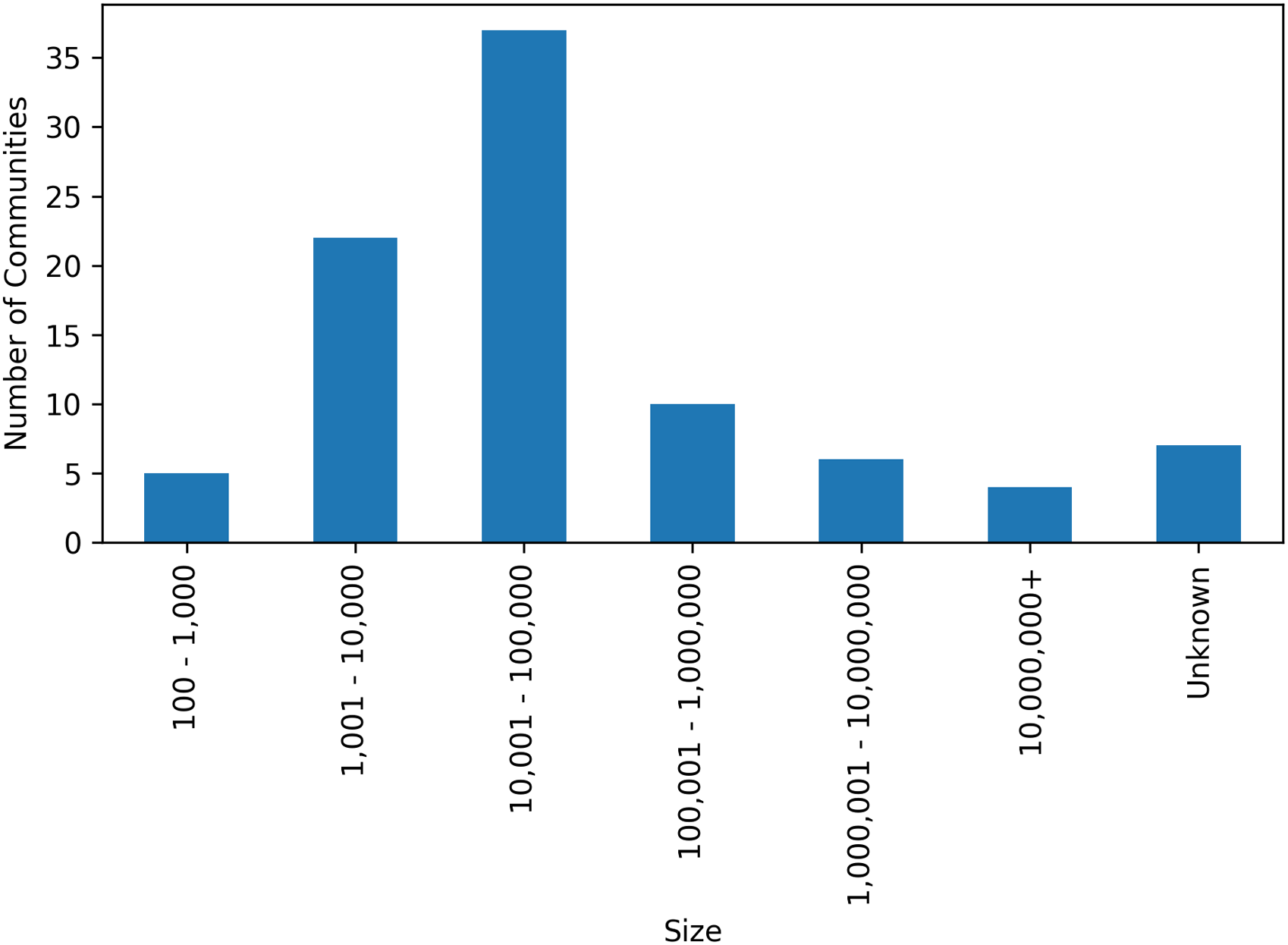
Finally, for each community, we also coded region, time, and size (see Figures 1–3).
Communities by region.

Timeline of communities in database, with negative years representing BCE and positive years representing CE.

Histogram of communities in the database, grouped by size.

Data limitations
Region, time, and size
Whereas it has proven quite straightforward to code the communities’ geographic locations, identifying precise times and sizes has been more challenging. We could not find reliable information about size for a handful of communities (see Figure 3). The most problematic variable, however, is time. This is due to a series of challenges: first, institutions might persist but with different functions, and it is not always obvious from the sources when or why the shift occurs; second, as discussed, in many non-Western cases, information about institutions becomes available upon contact with European observers. This is particularly problematic in Africa and Latin America where, in the absence of institutional histories, many communities have been coded at the time in which western ethnographers began to study them in the 20th century. Because information about time is unreliable, our analysis does not present results based on this variable.
Ambiguous cases
Independent CGIs: evaluating CGIs’ relations with other institutions within a given community has been easy to do for most of the cases included in the database. However, in four cases, it has proven difficult to discern whether the CGI(s) were independent from a higher authority. These cases (Aztec city-states; Mixtec city-states; Natchez; and Nebelivka) are coded as ‘boundary cases’. In the case of Nebelivka, the difficulty arises from the fact that we rely entirely on archaeological evidence; the decision to include the case rests on the evaluation and considerations of secondary sources. For the other three cases, CGIs exist, but it is difficult to judge whether their position within a larger hierarchy indicates meaningful independence in decision-making. The decision to include these cases rested on the evaluation of the PI, based on the available sources. Any causal analysis conducted on this data will have to consider these difficulties and drop the cases whenever necessary.
Mechanisms’ labels: The mechanisms found to be governing the CGIs in the database emerged from the sources and were not selected ex-ante. On the one hand, this approach enabled us to unearth new and sometimes unexpected structures for collective governance; on the other hand, this approach exposed us to the risk of misinterpreting labels as found in the sources. For example, structures labelled as ‘balance of power’ in the sources appeared more akin to the label ‘checks and balances’ as used among coders – the difference being that the latter label covers formal institutions while the former encompasses informal ones. While these cases were relatively rare, and many of them easy to code based on the definitions established for each mechanism, all of them were subject to further scrutiny by the PI who was alone responsible to judge ambiguities. When no ambiguities arose, we followed descriptions, definitions, and labels as found in the sources.
Reliability across coders
As mentioned previously, the PI was involved in resolving all cases in which there were ambiguities about a case or a mechanism. The PI also reviewed all sources and classifications from all coders for all cases.
Collective governance in global history
The view of collective governance we derive from analyzing the data put pressure on two widespread social scientific assumptions: that collective governance is difficult or impossible at large scale (Hardin, Reference Hardin1968; Olson, Reference Olson1965), and that effective collective governance at scale must (because it has) take the forms we are familiar with from the early modern and contemporary European tradition (Acemoglu and Robinson, Reference Acemoglu and Robinson2012, Reference Acemoglu and Robinson2019; Fukuyama, Reference Fukuyama2011, Reference Fukuyama2014; Moore, Reference Moore1966; North and Thomas, Reference North and Thomas1973; North et al., Reference North, Wallis and Weingast2009). We find, instead, that collective governance developed in polities of various scales, from small to very large ones; more specifically, we see variation in the mechanisms of collective governance depending on the size of the community. Second, collective governance is not a uniquely European phenomenon; in fact, collective governance outside of Europe not only exists but it also looks different from collective governance within Europe.
A third finding – drawn from a more qualitative analysis of the data – relates to, and expand on, the first two: rather than following dichotomous classifications that have shaped the evolution of democratic theory and practice in the West – such as those uncoupling representative and participatory models, or democracy and autocracy – the historical record reveals great diversity and complexity. More specifically, historical collective governance appears to be always representative – or, better, delegative – no matter the size of the community, and in many of the places where it developed, it was nested within more hierarchical structures. Indeed, we see a multiplicity of functions and roles that collective governance institutions and mechanisms have performed through the ages. In what follows, we begin to provide a clearer picture of such diversity.
Collective governance by regionFootnote 11
European collective governance is distinctive (see Figure 4). CGIs located in Europe employ a number of mechanisms that do not appear to play significant roles in other regions. Outside of Europe, different mechanisms prevail instead. The distribution of these mechanisms across non-European regions reveals a great deal of regional heterogeneity.Footnote 12
Correlation matrix of statistically significant CGI mechanisms by region.Footnote 13

Mechanisms for collective governance in Europe include some familiar examples, such as elections, majority voting, lotteries, as well as central assemblies. Indeed, these mechanisms are so well known that they have shaped our definitions and proxies for early and modern democracy (early democracy qua the presence of a council or assembly: Stasavage, Reference Stasavage2020; modern democracy qua elections: Dahl, Reference Dahl1989; Diamond, Reference Diamond2008).
But collective governance, it turns out, may also operate otherwise. In North America, for example, community members – including children – gathered in local councils to make decisions through deliberation and by consensus. These two mechanisms were also popular in Oceania, where access to decision-making tended to follow blood lines. In South America, by contrast, consent and voting in more informal gathering prevailed. Finally, in Africa, matrilinear communities required pay for occupying office and relied on reputational mechanisms to keep decision-makers in check.Footnote 14
These patterns of regional variation and the distinctiveness of Europe suggest that our knowledge of collective governance may be quite limited and that we can learn a great deal by studying collective governance in a more global perspective. Follow-up work will focus on identifying regional patterns outside of Europe with greater accuracy.
Collective governance at (various) scale
Collective governance mechanisms appear in communities of different size, from the smaller (whose members number in the hundreds) to the larger (whose members number in the millions).Footnote 15 While our analysis in this paper does not directly address whether different sizes are correlated with different outcomes (e.g., survival, stability, development, or well-being), we found no indication in the sources that larger communities were necessarily or systematically worse off than smaller ones – and certainly no indication that such a result may have depended on the use or type of CGIs and their mechanisms.
More interestingly, as displayed in Figure 5, we see variation in mechanisms across different community sizes.Footnote 16 In large communities, CGIs rely on patronage and heredity to determine access. CGIs in middling sizes employ a number of mechanisms to keep decision-makers in check, including term limits and turnover, and they regulate access through mechanisms such as age boundaries. CGIs in small communities, instead, seem to favour public meetings where access is granted to categories of participants usually excluded from decision-making, such as children and women. Perhaps more surprisingly, contrary to the notion that smaller size is associated with more direct political participation, CGIs in small communities seem to look favourably upon representation.
Correlation matrix of statistically significant CGI mechanisms by size.

The results of this analysis put pressure on the simplistic conclusions we derive from social scientific accounts based on the tradition of positive political theory, which consider scale as an enemy of collective action. By contrast, our results echo the conclusions of contemporary ethnography and archaeology. As Gary Feinman put it (Reference Feinman2023: 352), although it is clear that there exists a ‘general relationship ‘between scale and hierarchy‘, no finite demographic thresholds or precise hinge points at which changes in hierarchical complexity inevitably occur have been identified. What is evident is that larger aggregations and higher densities of human interaction have implications for the nature of social relations’. In other words, as scale increases, institutions - including those for collective governance - change. Whether there are distinctive patterns associated with different sizes, and how these might interact with regional variation, however, is the subject of future work.
Diversity and complexity in historical collective governance
Familiar typologies of democracy drawn from western theory and practice predict either strictly representative or participatory forms of collective governance to emerge based on the size of the community. Familiar typologies also often contrast democracy with its opposite – autocracy – as two distinct and incompatible structures. The information we have collected about historical collective governance in a global perspective points to different conclusions.
First, we observe that historical collective governance was, in a sense, always delegative – meaning that, no matter how small the community, those who participated in governance were a subset. Indeed, even in the fora we code as ‘gatherings’, it is clear that not every member of the community participated in decision-making. Sometimes, the governing subset is broad, as when popular assemblies represent a polity; but sometimes it is narrow, as in most occurrences of council governance. Sometimes delegation is ‘representative’ in the sense that specific rules ensure that smaller and larger units within the polity resemble one another. But sometimes representation simply means that a subset of the community is in charge: that subset may not reflect the composition of the larger community, and it may change over time. Finally, different rules governing representation may exist within the same community. For example, the Athenian assembly in the fifth and fourth century BCE operated on a first-come, first-served basis, and membership changed in each meeting (of which there were roughly forty per year); yet, during the same period, the law-courts featured complex access mechanisms aimed at crafting each jury panel as a microcosm of the whole eligible citizenry.
Second, historical collective governance coexisted with a range of hierarchical institutions. In our data, collective governance appears at both central and local levels. Regardless of the level of jurisdiction, collective governance institutions are often nested within, or exist alongside, other CGIs, as well as more hierarchical structures. For example, in Egypt or Babylon, local collective governance coexisted with divine kingship. But in other communities, collective arrangements went all the way to the top: for example, among the Wendat of North America, local collective governance by chiefs at the level of the village was replicated at the level of the nation and of the confederacy. Yet, when multiple layers of governance exist, their scope may also vary: the Wendat left their CGIs in the hands of chiefs selected by both merit and heredity; whereas in Babylon, godlike kingship coexisted with assemblies attended by the whole citizen body, including but not limited to the elders. This observation complicates a dichotomous understanding of governance structures as either ‘autocratic’ or ‘democratic’, as much work in the social sciences assumes.
Putting pressure on commonly employed classifications, the historical record reveals a profusion of functions in the mechanisms we study. Communities have used collective governance mechanisms to resolve disputes, to check powerful kings, and to govern localities. Among the Pathan Hill tribes, the Jirga council acted primarily as an arbitrator in local disputes. In Ebla, in Mesopotamia, collective governance by elites (nobles and elders) developed only at the village level, but beyond the unit of the village, kings aided by a dependent bureaucracy (of Lugals, or governors) were in charge. By contrast, in Tlaxcala, autonomy from the Aztec empire was exercised through councils made up of community members selected through meritocracy (a variation of an otherwise patrilineal and hierarchical selection system in other Aztec city-states) and whose mandate was to provide military as well as administrative services to the polity. In other Aztec city-states, as in the neighboring Mixtec city-states, instead, councils seem to have developed in a tight relation with kings. They did not constitute a dependent bureaucracy, but their specific jurisdiction is not clear.
Relatedly, our data reveal great diversity and complexity not just in the structure of communities or in the types of institutions, but also in the role that specific mechanisms played in governance, especially when viewed in combination with other mechanisms. Some mechanisms do recur within and across our cases, but apparent similarities may accompany variation stemming from: (a) how the mechanism is employed; (b) what other mechanisms are employed alongside it to govern a given institution; and (c) how that institution is related to other institutions (CGIs or non-CGIs) in the community. The distinctions are most apparent in cases where a number of different city-states or governance units inhabit the same territory, as in ancient Greece or India. For example, among Indian Republics, Sharma (Reference Sharma1968) identified four separate systems of governance: a King, appointed for life by vis (likely the elders/heads of families); government by a sabha (council) in the form of an aristocratic oligarchy; government by a sabha (council) and a samiti (assembly); and finally, government by an assembly and an unspecified number of kings (rajanah). This case well illustrates how the same institutions can perform different tasks, or occupy different roles within a community, depending on the context.
Finally, cases from outside the West often problematize titles and relations of power that mainstream political theory or practice tend to keep separate. For example, in China, during the Spring and Autumn period, a hereditary nobility exercised power through instruments such as consultation, consensus-building, and informal checks. Similarly, words such as ‘king’ or ‘chief’ appear under a new light when one begins to consider the mechanisms regulating their power or sphere of influence. In many African (e.g., Central African Communities) and Asian (e.g., Akha) communities, we find single leaders in charge of community affairs. However, often these chiefs are elected or approved by a larger group, their mandate is subject to term limits, and their power regulated through checks and balances. Leader selection is rarely left to hereditary rule, and more often combines elements of merit that may depend on several traits, including physical prowess, rhetorical skill, or generosity. In many Asian and North American communities (including Minangkabau, Hmong, Negara Ubud, Khasi, Wendat, and Pomo), chiefs or kings are figureheads with no decision-making or enforcement power. While these forms of powerless or consensus-based leadership are extremely widespread, we also find that sometimes hierarchical politics – de jure or de facto – coexist with egalitarian economics (e.g., in Akha or Japan).
Conclusion
In this paper, we have presented the results of a deep dive into the forms that collective governance – the historical analogue of what we term today political inclusion and participation – have taken across history and the globe. Our findings put pressure on standard definitions and conceptualizations that have shaped how we study these institutions and where.
In particular, we presented three separate findings. First, contrary to the tradition equating democracy with a specific set of institutions – such as elections, councils, or lotteries – we showed that these institutions are only one way among many to organize collective decision-making. While they play a prominent role in the European tradition, this does not appear to be the case elsewhere. Second, against the view that scale is the enemy of collective arrangements, our data reveal that collective governance at different scales may rely on different mechanisms. Finally, putting pressure on the accuracy and value of strict classifications that have shaped the trajectory of western democracy, the historical record reveals great diversity and complexity in the functions and roles that collective governance institutions and mechanisms have performed through the ages.
More data and different methodologies will be needed to get a more precise view of distinct models of collective governance across community size, region, and time, as well as a more precise view of how and why they arise, or of their effects on indicators of human and planetary well-being. As we continue this work, we hope this initial contribution will spur more interest into global collective governance and urge other researchers to delve into our data and gather more.
Acknowledgements
We are grateful for the support we received from many collaborators, including the co-PI on this project, Nathan Schneider, colleagues in the Metagovernance Project, and five wonderful research assistants: Jonas Nepozitek, Elizaveta Sharabok, Fabio Carolla, Aashka Tank, and Mikayla Lorini. Our sincere thanks also to the experts we consulted on some of the communities we studied – these include Giacomo Benati, Dmitry Ismagilov, James Kierstead, and Alexandre Loktionov – and our mentors, who provided encouragement and advice along the way: Margaret Levi, David Stasavage, Gillian Hadfield, and especially Emily Sellars. Finally, we thank several audiences at the CASBS Summer Institute ‘Organizations and their Effectiveness’, the Society for Institutional and Organizational Economics annual meeting in Frankfurt, The New Institute’s ‘Rethinking Capitalism Expert Workshop’ in Hamburg, the conference ‘Democracy After Athens, Theoretical Approaches in Antiquity’ at the University of Durham, the conference on ‘Lotteries and Democracy’ at Yale, the PPE workshop at Brown, the Institutional and Organizational Economics Academy in Cargese, Corsica, the brownbag workshop in the Department of Political Economy at King’s College London, and the Center for Competition Politics lecture series at the University of East Anglia. We have been fortunate to receive financial support from the Ethereum and Eutopia Foundations, the Center for the Study of Governance and Society, the British Academy/Leverhulme Trust, and King’s College KURF program.




 Open access

