Introduction
(a) The development of the denarius and the increasing use of additional legends
Following the introduction of a new system of coinage by the Romans during the Second Punic War (218–201),Footnote 1 the silver denarius became the principal coin, and it remained in use for the next 450 years until the middle of the 3rd century AD. For some time after its introduction, the images on denarii were consistently conservative: on the obverse was a helmeted head of Roma, and the Dioscuri were on the reverse. The use of the head of Roma continued until the end of the second century, while the image of the Dioscuri on the reverse gave way sooner.Footnote 2
Originally the only legend on the denarius was the word ROMA. Subsequently there were some additions, commonly on the reverse: simple signs, such as a corn ear, or a dolphin, or a prawn, and monograms, and occasionally groups of 1–4 letters (but it is difficult to identify the moneyer from these, if that is what was intended). Later, from the 190s onwards, the names of moneyers, in long or short abbreviations, appeared, making it easier to identify them. These various sorts of additions were not a linear development: symbols, monograms, letters, and abbreviated names appeared variously and in combination in successive mintages.Footnote 3
Realising the possibility of using coinage for self-advertisement, the tresviri monetales (the annual board of three young officials supervising the mint) began placing on their coins not only their names, but also images which represented the achievements of their forebears, as a way for the moneyers to point to the worth of their families – and therefore of themselves as potential candidates for office.Footnote 4 These deeds were illustrated on the coin reverse, while the head of Roma continued on the obverse. As the possibilities for advertising developed, the conservatism of standard obverse and reverse was abandoned, and a great multiplicity of types appeared, reflecting the individual concerns of the annually changing moneyers.Footnote 5 Moneyers were presumably advised of the amount of coinage to be produced each year, by the Roman senate on the advice of the consuls (mainly for the purpose of funding military campaigns), but they seem to have been free to work out their own designs, allowing them to take advantage of these advertising possibilities.Footnote 6
In addition to the usual legends like ROMA and the moneyer's name (mostly abbreviated), there are some coins, particularly denarii, of the late Roman republic which have on them an additional legend. Such coins were not common, just a handful down to the 50s.Footnote 7 This additional legend may simply be a ‘label’, because it is occasionally difficult to determine whether the word inscribed is simply identifying the image on the coin.Footnote 8 Clark uses the term ‘divine qualities’ to describe the female figures shown on such coins which ‘personified’ the quality; Cornwell uses the term ‘identifying legend’.Footnote 9 One suggestion is that these additional legends or ‘labels’ were included to make the personification clear: the qualities personified were female and a number of the images look similar.Footnote 10
(b) The increasing variety of political discourse – slogans
Towards the end of the Republic various forms of political discourse, such as pamphleteering, graffiti, placards, ribald songs and verses, sloganeering, etc., expanded and increased in use, as power rivalries and civil conflicts escalated. The overall aim, of course, was to influence public opinion.Footnote 11 Pamphlets (libelli), as one would expect, circulated mainly among the upper socio-economic classes, because of the level of literacy required. A good example in this period is the issue of pamphlets relating to the younger Cato, particularly after his suicide in Utica: Cicero and Brutus wrote eulogies, while Caesar and Hirtius each wrote an Anticato.Footnote 12 Graffiti, on the other hand, if they were related to the current political circumstances, seem to have been more an expression of popular opinion. They were usually autonomous and generally put up surreptitiously at night.Footnote 13
We can extrapolate from literary evidence the likelihood for the existence of slogans as well. Chanting, jeering, and audience reactions at games, in the theatre, and at public meetings were common and reflected popular feelings,Footnote 14 and one can imagine that placards and slogans played a part in these sorts of situations, as happens universally when crowds assemble, just as orchestrated chants and prepared placards do today in demonstrations and protest marches. In the early 50s, when the political alliance of Pompeius, Crassus, and Caesar had fallen into disfavour, there were occasions of popular political protest. On one of these occasions the chanting was led by a prominent organiser, Clodius, and it was clearly orchestrated.Footnote 15 So it is likely that other forms of ‘political literature’, like graffiti, placards, and slogans too, were orchestrated. We know from literary and material evidence that placards were carried in triumphs to indicate aspects of the conquest; it is not too much of a leap to infer that placards with slogans, prepared in advance, were carried where and when crowds gathered.Footnote 16
There is some material evidence for slogans on small objects: for example, sling shots during the Perusine war carried either single scatalogical terms or the names of units from one side or the other.Footnote 17 Coins also had limited space for additional legends of only a word or two, but it is argued here that awareness was growing of the possibility of using this space to ‘spread a message’. The intent of such ‘slogans’, of course, was to provide ‘propaganda’ for one side or another,Footnote 18 attempting to advertise an action or an event, or to justify an action which had been undertaken, or to proclaim a theme or quality which a protagonist wished to promote. The rivalries and conflicts at the end of the late Republic ‘produced a rapidly expanding repertoire of virtues or ideals, exemplified on the coinage, as part of a political language of crisis’.Footnote 19
After he had crossed the Rubicon and launched a civil war, Julius Caesar picked up on this trend of using additional legends on coinage for promoting political themes – and developed the opportunities presented by coins for emphasising the qualities he wished to advertise and for fitting into the new and expanding forms of political discourse. The coins of Caesar's dictatorship years, issued in very large numbers (in some cases in the millions), took advantage of this medium for widespread publicising of his ideological program to influence public opinion. We might conclude therefore that the additional legends on these coins were intended as political ‘slogans’.
As will be seen, a wider variety of these additional legends appeared, and more frequently, on coins issued during the period of Caesar's dictatorships from 49 onwards. The ‘qualities’ presented certainly show the political themes he wished to advertise – Libertas, Pietas, Concordia, Clementia, Pax – exactly the sort of terms which one would expect to be used in such a time of civil conflict. Clearly, they comprise ‘political messages’ or ‘slogans’ aimed at ‘target audiences’ (i.e., his own troops and the general population) for Caesar's political position and aims.
It is the intention here to examine eight denarii and two quinarii minted during Julius Caesar's dictatorship years (49–44) which had on them one of these additional or identifying legends, and to suggest that they were now used to circulate political ‘slogans’ (as well as their basic use for financial transactions). As already noted, these legends represent ‘divine qualities’: in all except two cases the additional legends refer to qualities which had received public cult and temples in Rome,Footnote 20 and intrinsic to the discussion is an examination of the relevant temples and cults, since the qualities represented in them were those which the Roman community recognised and understood.
The moneyers themselves will also be examined to assess the strength of their connection to Caesar and to consider whether they were promoting qualities the dictator wished to emphasise and the political agenda he wished to pursue. Examining these links may help in deciphering the intent and motivation behind the choices made for both the images and the legends on their coins. As noted above, some themes were more particularly mentioned and constitute therefore his ‘slogans’. They fit with Caesar's programmatic ideology, but, as so often, they indicate the absence of these ideals or qualities and the desire to instil them.
1. SALVS and VALETVDO
Denarius of M’. Acilius (Glabrio?) – 49
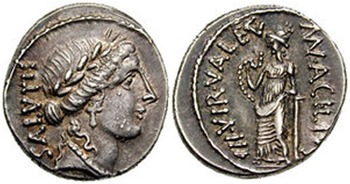
The first coin in this period to carry a slogan was a denarius (Fig. 1, RRC 442/1a and b) issued in 49 by M’. Acilius (Glabrio?).Footnote 21 The obverse of this denarius has a personified head of Salus (‘Safety’), with SALVTIS on the left downwards behind the head; the reverse shows a personified Valetudo (‘Health’) holding a snake, with VALETV and the moneyer's name and his office (IIIVIR). It carries the two additional legends, Salus and Valetudo. Crawford suggests two possible interpretations: one, that the terms may be a reference to Archagathus, the first Greek doctor to come to Rome, who practised in the compitum Acili (Plin. HN 39.12),Footnote 22 and so the coin may be a family commemoration; and two, that expectations of – or hopes for – a Caesarian victory may have influenced the types. There is no evidence that Glabrio was a Caesarian supporter. What little we know of him may suggest rather that he was a Pompeian: he is mentioned in the long list of those who defended Scaurus in 54 at his trial for extortion, and many on the list were pro-Pompeian.Footnote 23 It is difficult, however, to draw any conclusions about the political attitudes of such a miscellany of defence supporters, complicated by familial relationships and by past and present political affiliations.
denarius of M’. Acilius (Glabrio?), RRC 442/1a and b, 49 BC
[Triton XXI, Lot 648, January 2018, courtesy of CNG]

A temple to Salus had long been established in Rome, vowed by C. Iunius Bubulcus Brutus when he was consul in the Samnite Wars (either 317, or 313, or 311), contracted by him as censor in 307, and dedicated by him in 302 as dictator (Livy 9.43.25, 10.1.9).Footnote 24 Whether there was a temple and cult of Valetudo is more problematic. This is the only Republican coin in Crawford's index to carry this identifying legend. Those who argue for the existence of such a cult in the city do so therefore on the basis of this coin alone, because of its association with Salus on the obverse. But, as Clark points out, it would be a circular argument to use the coin itself as evidence for a temple and cult, and so there is little independent evidence that Valetudo received public cult in the city.Footnote 25
Clark also comments that one aspect of Salus in play here and clearly marked by the connection with Valetudo is the healing capacity of these particular divine qualities.Footnote 26 This might celebrate a connection between the Acilii (Glabriones) and the medical practice of Archagathus. His original connection with the gens may, however, have been no more than topographical and arbitrary. The particular aspect of the divine quality relevant to the commemoration of forebears may perhaps be marked by the additional legends,Footnote 27 but a contemporary viewer could also have ‘read’ another meaning into the legends Salus and Valetudo in terms of a currently expected Caesarian victory. Given that Caesar was fighting the first stages of the civil war when the coin was issued, it might have been intended that the ‘slogans’ of ‘Safety’ and ‘Health’ were part of Caesar's program – promises that he would restore the state's safety and health.Footnote 28
This coin was minted in very large numbers: Crawford calculates 651 obverse and 723 reverse dies.Footnote 29 Another coin produced in 49–48 was the famous ‘elephant’ denarius (RRC 443/1);Footnote 30 Crawford calculates 750 obverse and 833 reverse dies for it. Together these two types injected a massive amount of coinage into the state. In the second half of the 50s there was an economic/credit crisis, and on the outbreak of the civil war the state was facing a severe shortage of coin, possibly because people were hoarding due to the crisis.Footnote 31 Caesar also had a large army to pay: something like 10 legions, with more troops being recruited.Footnote 32 By authorising the minting of very large numbers, Caesar, with his ability to deal with economic matters, handled the two requirements – increasing the amount of coin available, and having money to pay his troops. The two coin types would have been more than needed to pay the soldiers, and many will have likely circulated directly into the hands of ordinary citizens.
In the case of Acilius’ coin the additional legends made the slogan clear: Caesar was spreading a message that he was promoting the ‘health’ and ‘safety’ of the state. Such an interpretation might support a conclusion that Acilius as moneyer was producing coins to suit Caesar's program, and thus was a Caesarian adherent. The ease with which the images and additional legends would be recognised and the very large number put into circulation leads to the conclusion that these coins were political in intent and decidedly contained ‘slogans’.
2. LIBERTAS
Denarius of C. Vibius Pansa Caetronianus – 48
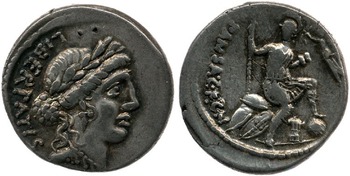
The political intent of the next coin is easier to establish. It was a denarius issued in 48 by C. Vibius Pansa Caetronianus (Fig. 2, RRC 449/4), containing the additional legend, Libertas. This was not the only coin in the late Republic which had allusions to libertas on it. They were relatively numerous,Footnote 33 reflecting the frequency with which libertas was used to convey a political theme.Footnote 34 The obverse of Pansa's denarius has a personified head of Libertas, with LIBERTATIS on the left downwards behind the head; the reverse shows Roma seated on a pile of shields, holding a sceptre in her right hand and placing her left foot on a globe, with a flying Victory offering her a crown. Other denarii issued by Pansa and his colleague, Albinus Brutus, were minted in very large numbers, according to Crawford's die calculations (RRC 2, p. 660).
denarius of C. Vibius Pansa Caetronianus, RRC 449/4, 48 BC
[British Museum: 2002,0102.4449]

Pansa was a loyal supporter of Caesar,Footnote 35 and had served under him throughout his career: as tribune in 51 he had vetoed several anti-Caesarian resolutions in the senate (Cic. fam. 8.8.6–8), and he was one of the moneyers in 48, unusually after previously holding a tribunate,Footnote 36 minting the coin described here and several other denarii. He must have held a praetorship soon after, for he was made governor of Bithynia and Pontus in 47–46 and of Cisalpine Gaul in 45–44. He became consul in 43 as a colleague of A. Hirtius but died as a result of wounds incurred in the fighting against M. Antonius around Mutina that year.
Pansa's coin, issued when it was, and trying to suggest with its reverse images that conflict was over, was presumably intended to carry the message justifying Caesar's attack on the state. He claimed that initially he was forced to defend himself against his enemies, to re-instate the tribunes of the people who had been forced out of the city and fled to him, and to assert the freedom (libertas) of himself and of the Roman people who had been oppressed by a small faction.Footnote 37 But as Syme noted long ago, libertas is the commonest term of propaganda in Roman factional politics: ‘a vague and negative notion . . . a convenient term of political fraud,’ used by one side against another or to claim that one side was defending the freedom of the Roman people.Footnote 38 Sallust (Cat. 38.3) refers to the ‘fair-sounding pretexts’ (honestis nominibus) used by those ‘who agitated against the state, some maintaining that they were defending the rights of the Roman people, others upholding the prestige of the senate, while in actual fact each was working for his own power.’Footnote 39 Caesar was no different, using his defence of the people's libertas to claim that he had freed the state, when what he was really claiming was the aristocratic notion of freedom to pursue his own dignitas and preserve his own position. Are there hints, however, of his ambitious claims to wider power already in 48, with Roma's foot resting on a globe?Footnote 40 He was subsequently given the title Liberator by the Senate in 45 (after his victory over the remaining Pompeians at Munda), and a temple was voted (Dio Cass. 43.44.1), though it is probable that the temple was never built.Footnote 41
There was an early temple to Libertas, linked to Iuppiter, on the Aventine, said to have been vowed in 246 by Ti. Sempronius Gracchus as plebeian aedile (Livy 24.16.19).Footnote 42 There was also the small shrine which Clodius had built on the site of Cicero's house, but which Cicero had persuaded the senate to demolish when he returned from exile and regained possession of his property.Footnote 43
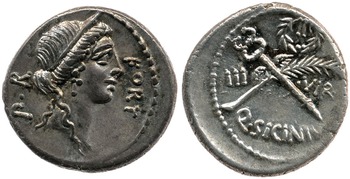
A coin minted on behalf of the other side in the civil war has on it an additional legend, which can be seen as a ‘slogan’: a denarius of Q. Sicinius issued in 49 (Fig. 3, RRC 440/1). On the obverse is a head of Fortuna, wearing a diadem, with FORT downwards in front and P R (= P[opuli] R[omani]) upwards behind; on the reverse there is a palm branch tied with a fillet, a winged caduceus, with a wreath above, and the moneyer's name and office. This coin too was issued in very large numbers: 129 obverse and 143 reverse dies, according to Crawford's calculations (RRC 2, p. 660). Weinstock states that Sicinius was aligned with Pompeius; his role as a moneyer with C. Coponius at this time suggests that link.Footnote 44 Crawford comments: ‘The association of the symbols of felicitas and victory with the head of Fortuna populi Romani allude to the hopes of the Republican side at the beginning of the Civil War.’Footnote 45
denarius of Q Sicinius, RRC 440/1, 49 BC
[British Museum: 2002,0102.4396]

3. PIETAS
Denarius of D. Iunius Brutus Albinus – 48
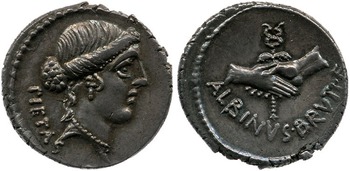
Pietas was another additional legend placed on a Caesarian coin in 48 BC: a denarius issued by D. Iunius Brutus Albinus, a fellow moneyer of Pansa (Fig. 4, RRC 450/2). The obverse has a female head, with PIETAS on the left; the reverse has two clasped hands in front of a caduceus, and the moneyer's name below. Throughout his career (until 44) Brutus Albinus had served under Caesar: he was prefect of the fleet against the Veneti in 56, commanded a Caesarian fleet at Massilia in 49, and was made governor of Transalpine Gaul by Caesar (48–46). In 44, however, he turned against Caesar and joined the conspirators, even though he had been named as an heir of the second rank in Caesar's will and had been designated consul for 42.Footnote 46 He too was caught up in the constantly changing allegiances and fighting associated with M. Antonius, M. Aemilius Lepidus, and the young Caesar; he fled to join Brutus (the assassin) in his province of Macedonia but was captured on the way by a Gallic chief and put to death on Antonius’ orders. His support for Caesar can also be seen in some of the images on another denarius issued by him (RRC 450/1): the obverse has a helmeted head of Mars, and the reverse has two carnyces (Gallic war trumpets) and two shields, recalling Caesar's successful campaigns in Gaul.Footnote 47
denarius of D. Iunius Brutus Albinus, RRC 450/2, 48 BC
[British Museum: R.8893]

What would be the political message intended by the legend Pietas on Albinus’ coin in 48? Pietas had three aspects: duty towards the gods, duty to the family, especially parents, and duty towards the state (pietas erga patriam).Footnote 48 In the case of Albinus’ coin, it was the latter aspect which was being emphasised, Caesar's duty to the state at a time when he was still trying to justify his starting of the civil war.Footnote 49 The earliest temple to Pietas was vowed by M’. Acilius Glabrio in 191 at the battle of Thermopylae against Antiochus and dedicated ten years later by his son (Livy 40.34.4).Footnote 50 Weinstock suggests that another aspect of pietas was its equivalence to fides, that is, duty and loyalty, especially of the troops towards Caesar as their leader, and reciprocally of Caesar towards his troops and supporters.Footnote 51 Weinstock also speculates that the award of the title parens patriae in 45 (after victory at Munda) may have lent a particular significance to this bond of political pietas.Footnote 52
The images on the reverse of the coin illustrate some other themes – and it is an example of the need to look at both sides of a coin to see the totality of its messages. As Crawford suggests in his comment on the coin, the clasped hands on the reverse represent concordia, while the caduceus is a symbol associated with felicitas, the two symbols ‘presumably reflecting the Caesarian propaganda of moderation and reconciliation.’Footnote 53 Caesar would certainly have wanted to suggest that he was trying to achieve concordia while he was still fighting against the Pompeians across the Mediterranean, and that he was aiming at concordia in his pursuit of libertas. Felicitas was also considered a desirable asset for a military commander, and if Albinus’ coin is referencing this quality, it could be hinting at Caesar's military successes.Footnote 54
There were a number of temples of Concordia in Rome.Footnote 55 The earliest was traditionally vowed by Camillus in 367 (Ov. Fast. 1.641–4, Plut. Cam. 42.4) to mark the end of ‘the Struggle of the Orders’ with the passage of the Licinian laws; it seems never to have been built, though the designated site was retained, and other shrines connected to Concordia were later built on it. A second was supposedly founded by Cn. Flavius marking the reconciliation of the ordines in 304 (Livy 9.46); it was unusual, if it was actually built, in being founded by an aedile. In 121 the senate ordered L. Opimius to construct a Temple of Concord on the site (App. B Civ. 1.26, August. De civ. D. 3.25), which was near the Forum, because (ironically) concordia had been established by his killing of C. Gracchus and many of his supporters. There was a strong connection of concordia with the libertas of the people, both metaphorically and physically (because the Temple was very close to the Rostra, from which tribunes of the people presided over contiones),Footnote 56 and perhaps these Caesarian ideological themes are hinted at in this coin.
4. FIDES
Denarius of A. Licinius Nerva – 47
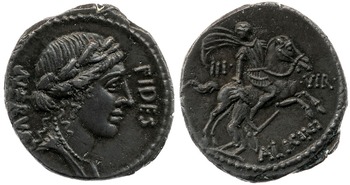
A denarius issued in the next year by A. Licinius Nerva is inscribed with the slogan Fides (Fig. 5, RRC 454/1). On the obverse is a wreathed head of a personified Fides, with FIDES downwards on the right in front of the head and NERVA downwards behind the head; on the reverse is a horseman dragging a naked warrior who is holding a shield and a sword. The moneyer is otherwise unknown, so there is no evidence of activity to connect him with Caesar.
denarius of A. Licinius Nerva, RRC 454/1, 47 BC
[British Museum: 1843,0116.718]

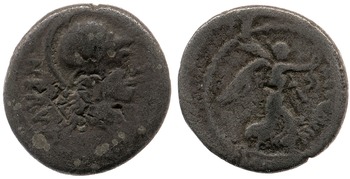
The image from warfare on the reverse of the denarius, and the images on a quinarius (Fig. 6, RRC 454/3) also issued by Nerva (on the obverse a head of Minerva wearing a Corinthian helmet, and on the reverse Victory holding a wreath and palm branch) might suggest connection with Caesar's victories, but the types are really of uncertain significance. Nor is there anything much in the imagery used on the coins of Nerva's fellow triumviri monetales, L. Plautius Plancus and C. Antius Restio, except perhaps a hint on the reverse of Plancus’ denarius types, which have the popular image of the head of Medusa and which may ‘reflect a desire to be associated with the victory of a great individual, perhaps Caesar’.Footnote 57 But it may be too long a stretch in all of this to conclude that Nerva was a Caesarian supporter.
quinarius of A. Licinius Nerva, RRC 454/3, 47 BC
[British Museum: 1950,1006.391]

So, is it possible to make anything of the term fides (‘loyalty’ or ‘trust’)? There is nothing to suggest that fides was a theme emphasised by Caesar,Footnote 58 though the concept might well be one that someone in his position would want to emphasise. On the principle that slogans often emphasise an ideal precisely because it is not in place but is something which is desired or aimed at (e.g., concordia – see above on Brutus Albinus’ denarius, Fig. 4),Footnote 59 one might consider suggesting that fides was a Caesarian slogan in this period. In the absence, however, of anything to connect Nerva with Caesar, one cannot be definitive in drawing such a conclusion about the appearance of fides on this coin.
5. LIBERTAS, HONOS, and FELICITAS
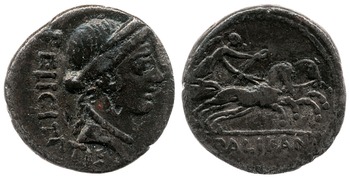
Denarii and Quinarius of M. Lollius Palicanus – 45
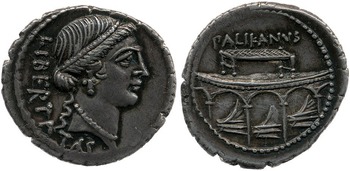
The theme of libertas is taken up again on a denarius issued in 45 by M. Lollius Palicanus (Fig. 7, RRC 473/1). On the obverse is a head of Libertas with the legend downwards on the left behind the head, while the reverse depicts the Rostra on which stands a tribunes’ bench (subsellium). The images refer primarily to the actions of the moneyer's father who as tribune in 71 agitated for the restoration of the tribunes’ powers, associated with the people's freedom, after Sulla had removed them ten years earlier.Footnote 60 The father was more likely connected with Pompeius: following a praetorship (69?) he stood as a consular candidate at the elections in 67, but was blocked by C. Calpurnius Piso, the consul that year presiding over the elections,Footnote 61 who was bitterly opposed to Pompeius and the popular bill of A. Gabinius giving him the pirate command. Palicanus’ daughter was married to Gabinius, so it would seem that all three were linked politically at that time.Footnote 62
denarius of M. Lollius Palicanus, RRC 473/1, 45 BC
[British Museum: 1843,0116.738]

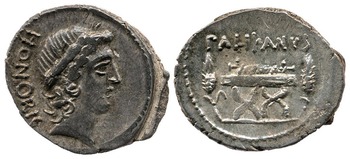
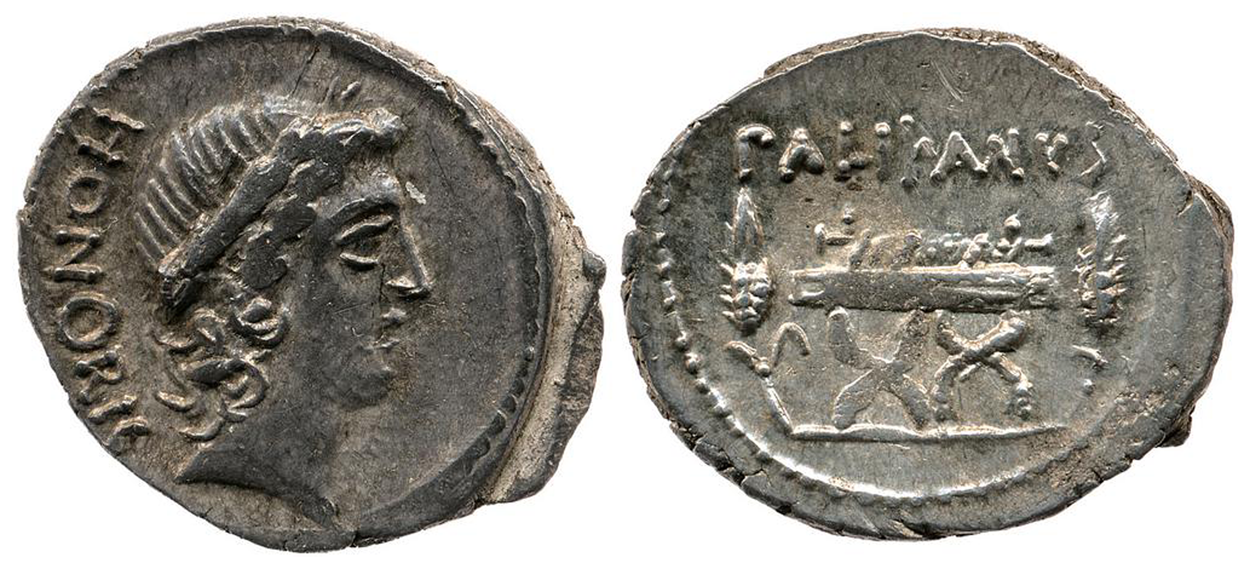
Two other qualities are inscribed on coins issued by this moneyer. A denarius (Fig. 8, RRC 473/2a) has a head of Honos on the obverse, with HONORIS downwards behind the head, and on the reverse a curule chair with a corn-ear on either side. Crawford takes this to refer to the honores (offices) of Palicanus’ father, as tribune and praetor. Felicitas appears on a quinarius (Fig. 9, RRC 473/3); the obverse has a personification of Felicitas wearing a diadem, with FELICITATIS downwards on the left behind the head, and on the reverse Victory in a biga. Felicitas often refers to success in war, and presumably this coin refers to Caesar's successes in the civil war, the younger Palicanus now siding with Caesar.Footnote 63
denarius of M. Lollius Palicanus, RRC 473/2a, 45 BC
[British Museum: 2002,0102.4649]
quinarius of M. Lollius Palicanus, RRC 473/3, 45 BC
[British Museum: 1896,0308.2]

There were several temples in Rome for Honos and Virtus. The earliest may go back to one to Honos said to have been established by Q. Fabius Maximus Verrucosus in 234 during the Ligurian war, and subsequently refurbished by M. Claudius Marcellus in 222, following a vow made at Clastidium, when a separate cella for Virtus was added (Cic. Nat. D. 2.61). A second temple for Honos and Virtus jointly was built by Marius from the spoils obtained from the defeat of the Cimbri and Teutones.Footnote 64 At the top of the cavea of the stone theatre built by Pompeius out of manubiae gained from his Eastern campaigns and dedicated in 55 were five shrines, the main one to Venus Victrix, and the others to Honos, Virtus, Felicitas, and V(ictoria?).Footnote 65 The military associations of these ‘qualities’ are obvious.
6. PAXS
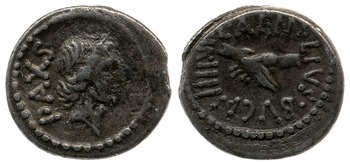
Quinarius of L. Aemilius Buca – 44
There are two more coins which have additional legends, but are exceptions, in that the divine qualities mentioned on them did not have a temple in Rome. The first is a quinarius issued in 44 by L. Aemilius Buca (Fig. 10, RRC 480/24), with a female head on the obverse and the legend PAXS behind, and two clasped hands on the reverse, surrounded by the moneyer's name and position. The clasped hands represent the familiar idea of concordia, which links with the ‘slogan’ on the obverse of a desire for ‘peace’. This year Caesar had increased the number of monetales from three to four; Aemilius Buca was one of this new board, along with M. Mettius, P. Sepullius Macer, and C. Cossutius Maridianus. Little is known of them, but given they were serving on this new board, we can assume that they were approved by Caesar. Between them they issued a large number of 28 different types, including the head of a living person, Caesar himself, for the first time.Footnote 66
quinarius of L. Aemilius Buca, RRC 480/24, 44 BC
[British Museum: 1897,0202.1]

Cornwell gives a full analysis of this coin and its political implications, and concludes that the ‘introduction of Peace onto the coinage in a period of internal stability is part of a much wider programmatic statement made by Julius Caesar in 44’.Footnote 67 She adds that the additional legend paxs is indicative of the increased use over the 40s of a range of ideals or ‘divine qualities’ on coinage, but suggests that the large number of types minted by the increased board of monetales in 44, with the various images and symbols depicted on them, ‘emphasised the security of the state as contingent on Caesar's successes, victories, and the perpetuation of his memory’.Footnote 68
While these conclusions fit with the premise of this article, the large number of other types including Buca's quinarius were not confined to Caesar's programmatic statements put forward just in 44. The quinarius better belongs to the string of precedents already set by the coins minted from 49 on with an identifying legend referring to a ‘divine quality’. The clasped hands on the reverse of this coin reference concordia; Cornwell suggests that it represents fides as well. Both of these qualities had already appeared as additional legends on earlier coins in this period (Figs. 4 and 5 above), suggesting that the references here fit with Caesar's ideology.
In this case there was not yet a temple to Pax, but the legend paxs aligns with the idea of a ‘slogan’ aiming at something which Caesar wished to promote, but which was not yet achieved. There may have been plans for a temple to Pax. As Clark comments, temples to a number of new, or newly interpreted, ‘qualities’ were being planned in the 40s, such as a temple to Concordia Nova in honour of Caesar, and particularly a temple to Clementia Caesaris (see next coin). A temple to Pax might conceivably fit into a similar context, although no literary evidence records any plan for such a temple.Footnote 69
7. CLEMENTIA CAESARIS
Denarius of P. Sepullius Macer – 44
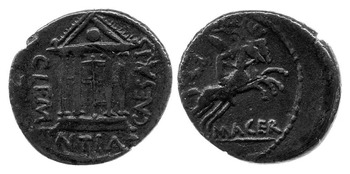
The second exception: a denarius (Fig. 11, RRC 480.21) issued in 44 by P. Sepullius Macer. On the obverse is a tetrastyle temple with a globe (a symbol noted before) in the pediment of the temple and the legend Clementia Caesaris, and on the reverse is Victory in a biga, with the moneyer's name. The question: is the inscription a ‘slogan’, or simply a ‘label’ for the building? The two possibilities are really the same thing, in my view. Caesar made much of his clementia, the pardoning of his opponents, though he did not use the term himself, preferring other words for it.Footnote 70 The claim goes back to the siege of Corfinium in February 49, when Caesar captured L. Domitius Ahenobarbus and some troops whom the latter was assembling for his command in Transalpine Gaul. Cicero himself remarked that, since Caesar was deliberately putting no one to death or confiscating any property, public opinion was turning in Caesar's favour.Footnote 71
denarius of P. Sepullius Macer, RRC 480/21, 44 BC
[British Museum: 2002,0102.4682]

Now in 44 to mark that quality of ‘clemency’ which Caesar had long stressed, a temple of Clementia Caesaris was decreed by the senate (App. B Civ. 2.106, Dio Cass. 44.6.4), not long before Caesar's assassination. To what extent was the decree encouraged by Caesar himself?Footnote 72 He wished to emphasise this quality, and so the coin might serve both to designate the actual temple and to circulate the slogan of his clementia.
Conclusion
During the period of Caesar's dictatorships, there were several new initiatives in coinage. By capturing Rome, he seized control of state bullion, which he was able to use to issue large amounts of coinage, more than he needed to pay his troops, meaning that the coins and their ‘slogans’ got into general circulation more quickly – ‘propaganda’ for his programmatic ideology. He resumed the use of gold as a metal for coinage,Footnote 73 which had not been used since towards the end of the Second Punic War. There had been small but unusual issues of aurei by Sulla and by Pompeius, but they had been what Woytek calls Gelegungheitsprägungen, ‘occasional issues’.Footnote 74 The board of moneyers was increased from three to four, possibly because there was a great deal more production of coinage required (the number was reversed by Augustus). There was an increase in designs showing multiple religious implements, not just because of Caesar's position as pontifex maximus, but with other religious themes in mind.Footnote 75 Above all, the appearance of Caesar's own portrait on coinage set a precedent which was immediately followed by many other issues after his assassination.
In the case of the coins with additional legends, however, Caesar and his moneyers were not innovating. Rather, and not unusually for developments in coin designs which had been rapidly expanding since the 130s, they built on precedents which had already been appearing and by which these additional legends were definitely taking on the nature of political ‘slogans’, spreading a particular message aimed at a target audience. What the Caesarian coins did was to use these ‘slogans’ more specifically, more frequently, and more extensively.
In addition, the increasing use of ‘divine qualities’ set a precedent for the coinage produced by those who came after Caesar – portraits of leaders, extensive use of gold, and emphasis on specific qualities. The assassins, Brutus and Cassius, put libertas on their coins; Antonius and the young Caesar put pietas and concordia; and Sextus Pompeius put pietas – all to be expected in the specific circumstances. The precedents were set and the personification of ‘divine qualities’ led to the proliferation of ‘qualities’ mentioned on imperial coins.Footnote 76 Clark summarises: ‘By the time of the emperors, of course, “personifications” of a large number of qualities were a common feature on the coinage of Rome, some receiving cult in the city, others not.’Footnote 77
As suggested earlier, sloganeering became more frequent towards the end of the Republic, as rivalries and civil conflict escalated. The ‘slogans’ on late Republican coins seem designed to reinforce the message contained in the other images on them, as well as to push a particular ‘message’. This can be seen most particularly on the coins issued under Caesar, with a much-increased number of ‘slogans’ emphasising his political themes. They set a trend which was more fully developed on imperial coinage, where slogans and personifications of ‘divine qualities’ became even more common.
Acknowledgements
I would like to thank Hannah Cornwell from the University of Birmingham, John Melville Jones from the University of Western Australia, Clare Rowan from the University of Warwick, Kathryn Welch from the University of Sydney, and Liv Yarrow from City University New York for their helpful advice on some numismatic matters, and their prompt and kind comments on some of the points I have raised. I also thank the anonymous readers for the journal for suggestions which have improved my argumentation.