

In Latin America, despite governmental efforts to promote gender parity as a pillar of democracy and sustainable development (Medina-Hernández et al. Reference Medina-Hernández, Fernández-Gómez and Barrera-Mellado2021), gender inequality remains deeply entrenched in the scientific community. Although public policy advances have increased the representation of women in leadership roles (Varea Reference Varea2020), progress has been uneven across disciplines (Bareiro and Soto Reference Bareiro and Soto2016), and persistent structural barriers continue to limit their full institutional integration and influence (Schwindt-Bayer and Senk Reference Schwindt-Bayer and Senk2020). The geosciences and glaciology in particular show persistent gender disparities. In this regard, the first paper in the Journal of Glaciology, written and authored by a woman, appeared in 1948. Thirty-two years later, the percentage of papers authored or coauthored by women in Journal of Glaciology and Annals of Glaciology began to increase (Hulbe et al. Reference Hulbe, Wang and Ommanney2011). Several international studies have documented the underrepresentation of women compared with men in science and glaciology, suggesting that this gender disparity is associated with broader economic and sociopolitical contexts. Experiences of women pioneers in glaciology are directly related to the experiences of these women in higher education and the sciences (Hulbe et al. Reference Hulbe, Wang and Ommanney2011). Empirical studies highlight the underrepresentation and marginalization of women in geoscientific research (Holmes Reference Holmes, Holmes, O’Connell and Dutt2015; Popp et al. Reference Popp, Lutz, Khatami, van Emmerik and Knoben2019; Mosuro et al. Reference Mosuro2023). Historically shaped as masculine domains, these disciplines have excluded women both structurally and symbolically (Turner and Kölbl-Ebert Reference Turner, Kölbl-Ebert and Barbara2017).
Science and technology studies (STS) have critically examined how authority, legitimacy, and hierarchies are constructed within scientific fields. Foundational works such as those by Latour and Woolgar (Reference Latour and Woolgar1979) revealed the social mechanisms behind the production of scientific facts and the consolidation of authority. Knorr Cetina (Reference Knorr Cetina1999) further emphasized how distinct epistemic cultures define who is recognized as a legitimate knowledge producer. UNESCO Institute for Statistics (2019) indicates that less than 30 percent of the world’s researchers are women and that, to reduce the gender gap, it is essential to determine the factors contributing to women’s low participation in careers in science, technology, engineering, and mathematics (STEM). In response to this challenge, UNESCO Institute for Statistics (UIS 2019) has developed indicators to determine the main factors that motivate women to pursue STEM careers. These data are systematized in the SAGA (STEM and Gender Advancement) project with the aim of informing policies at the national, regional, and global levels to reduce inequalities in the participation of women in STEM, as well as in the salaries received by researchers and the disparate progress in the careers of men and women.
Gender equality in science, technology, knowledge, and innovation (STKI)
The United Nations Development Programme (or Programa de las Naciones Unidas para el Desarrollo PNUD, by its Spanish acronym) developed a Gender Inequality Index (IDG, Spanish acronym), which is an indicator that summarizes gender inequality. The indicator presents annual data focused on three dimensions: reproductive health, empowerment, and labor market. The values of the index range from 0 to 1, where 0 indicates total equality and 1, total gender inequality. For the period 2017–2022, IDG values worldwide reached 0.46; in Latin America, 0.39. In Organisation for Economic Co-operation and Development (OECD) member countries, IDG values are 0.19 and below. Chile is the only Latin American country within this range, with an IDG value of 0.19.
At the global scale, in the period 2017–2022, gender inequality has been observed to be stable, presenting a variation of IDG between 0.47 and 0.46 for the periods 2017–2019 and 2020–2022, respectively. For Latin American countries, the index ranged from 0.39 and 0.40 over the same period.
Despite increasing their presence in STEM and STKI (science, technology, knowledge, and information) areas, women continue to be a minority in the areas of greatest scientific impact and relevance (MinCiencia 2023). According to the World Economic Forum (2024), global gender parity across economic, political, educational, and health dimensions would be achieved in 134 years, despite the implementation of policies, initiatives, and strategies aimed at reducing gender inequalities at national and international levels. However, according to the World Economic Forum (2024), gender gaps and, consequently, inequalities persist and are reflected at multiple levels of the system, from initial training to leadership positions and scientific production, responding to a framework of a gender order that is reluctant to change.
Good practices and instruments with a gender approach in science
The first programs and initiatives on STEM education in Latin America were developed in the late 1990s; however, measures focused on the progressive incorporation of gender and STEM policies in the region have only begun to be applied in the past fifteen years (ONU Mujeres 2020).
During this period, most Latin American countries implemented policies related to women and science. For the purposes of this study, we grouped these interventions into different areas according to their objectives and intended beneficiaries. The main areas of intervention are as follows: actions to raise awareness and eradicate gender stereotypes, actions to attract girls and young women to the STEM field, development of STEM potential, support for women in STEM careers, specific programs and interinstitutional committees on gender and STEM, and training and empowerment of women entrepreneurs in innovation and STEM (ONU Mujeres 2020).
Efforts to reduce the gender gap in STEM have not been sufficient, and gender inequalities persist across different stages of women’s educational and professional trajectories, from primary and secondary education to higher education, entry into STEM careers, career advancement, and access to leadership positions. These persistent inequalities have been associated with interacting social, cultural, institutional, and policy factors operating across multiple levels, including government policies, funding agencies, higher education institutions, and research centers. Their persistence is also linked to the limited long-term continuity of many initiatives designed to promote gender equality in STEM (UN Women 2020).
Although the number of women entering geoscience programs has increased globally (Gill and Smith Reference Gill and Smith2021), these demographic shifts have not been sufficient to dismantle entrenched gender inequities. Geosciences remain among the least gender-diverse scientific fields (UNDP 2019; Nature Geoscience 2016; Dutt et al. Reference Dutt, Pfaff, Bernstein, Dillard and Block2016). Feminist epistemologists have long argued that scientific knowledge is not neutral or universal, but situated, shaped by the social, geographic, and embodied positionalities of researchers (Haraway Reference Haraway1988; Harding Reference Harding1991). Consequently, the structural underrepresentation of women in glaciology influences not only who participates in research, but also what questions are asked, which epistemological frameworks are prioritized, and how scientific narratives are constructed (Schiebinger Reference Schiebinger1999; Merchant Reference Merchant1980; Criado Perez Reference Criado Perez and Harry2019).
Recent studies further show that gender biases affect not only team composition but also methodologies and the visibility of women’s contributions in polar and high-mountain research contexts (Verlie Reference Verlie2022). These biases manifest in the invisibilization of women’s fieldwork, unequal access to funding and leadership positions, and the persistence of stereotypes depicting the “polar scientist” as an idealized male figure. To address these disparities, Popp et al. (Reference Popp, Lutz, Khatami, van Emmerik and Knoben2019) propose structural reforms in mentorship practices, work-family balance, and gender equity in academic appointments to foster the sustained participation of women in geosciences. Acknowledging these dimensions is essential for building a more inclusive, critical, and epistemologically diverse glaciology.
Existing strategies to promote gender equality in geosciences
Various studies in geoscience have identified specific strategies to address gender inequalities that shape academic trajectories. Barnes et al. (Reference Barnes, Marín-Spiotta, Morris and Johnson2018) and Hernández et al. (Reference Hernandez, Adams, Barnes, Bloodhart, Burt, Clinton, Du, Henderson, Pollack and Fischer2020) highlight the importance of structured and sustained mentoring programs, particularly in the early stages of a scientific career, while Popp et al. (Reference Popp, Lutz, Khatami, van Emmerik and Knoben2019) emphasize the need for more transparent evaluation and funding allocation criteria that can reduce gender bias in competition for resources. In addition to these measures, gender equity committees with effective influence on scientific governance should be created. Even more necessary, although less commonly used, are institutional policies aimed at reconciling academic work and care responsibilities, as well as strategies designed to reduce the private/family burden of care through institutional strengthening (Zheng et al. Reference Zheng, Yuan and Ni2022).
In glaciology and polar sciences, experiences documented by Lodes (Reference Lodes2022) and Dance et al. (Reference Dance, Duncan, Gevers, Honan, Runge, Schalamon and Walch2024) show that field training programs led by women, peer mentoring networks, and the implementation of codes of conduct for fieldwork contribute to strengthening retention, professional confidence, and leadership development for researchers in the early stages of their careers. These initiatives are particularly relevant in disciplines characterized by work in remote and demanding environments, where gender inequalities tend to intensify.
Although most of these experiences have taken place in Europe and North America, Yáñez-Serrano et al. (Reference Yáñez-Serrano, Aguilos, Barbosa, Rafael Bolaño-Ortiz, Carbone, Stephanie Díaz-López, Dominutti, Engelhardt, Alves, Pedraza, Saturno and Tzompa-Sosa2022) highlight the emergence of scientific networks in Latin America, such as LAECESS, which seek to address structural inequalities associated with access to funding, scientific infrastructure, and language barriers. These experiences (science networks) underscore the importance of contextualized strategies that are sensitive to the territorial and institutional conditions of the Global South.
Taken together, the contributions of Robel et al. (Reference Robel, Ultee, Ranganathan and Nash2024) and Seag et al. (Reference Seag, Nielsen, Nash and Badhe2023) suggest that strategies aimed at gender equity are most effective when they transcend formal or symbolic inclusion and are oriented toward transforming the structural conditions that shape academic trajectories, including evaluation systems, recognition of care work, and equitable access to international research networks. From this perspective, moving toward a more equitable Andean glaciology is not only a demand for academic justice but also a necessary condition for strengthening the quality, epistemological diversity, and social relevance of knowledge produced in contexts of rapid climate change.
Historically, geosciences have been perceived as masculine disciplines. Research shows that, despite systemic disadvantages, including limited or no access to higher education, women have played active and often overlooked roles in scientific advancement (Turner and Kölbl-Ebert Reference Turner, Kölbl-Ebert and Barbara2017). While enrollment of women in geoscience programs has increased globally (Gill and Smith Reference Gill and Smith2021), it has not eliminated gender inequity in the field (UNDP 2019; Nature Geoscience 2016; Dutt et al. Reference Dutt, Pfaff, Bernstein, Dillard and Block2016). To address these gaps, Popp et al. (Reference Popp, Lutz, Khatami, van Emmerik and Knoben2019) advocate for reforms in mentorship, family support policies, and equitable academic hiring to promote long-term career development for women in geosciences.
In the context of global climate change, glaciers are no longer viewed solely as physical masses of ice, but also as entities embedded in society (Carey et al. Reference Carey, Jackson, Antonello and Rushing2016; Sörlin Reference Sörlin, Evengård, Nymand Larsen and Paasche2015). It is estimated that glaciers provide freshwater resources to 1.9 billion people, and their disappearance threatens local ecosystems, cultures, and economies (Rounce et al. Reference Rounce, Hock, Maussion, Hugonnet, Kochtitzky, Huss, Berthier, Brinkerhoff, Compagno, Copland, Farinotti, Menounos and McNabb2023). In South America, the Andes host vast snowfields and glaciers that serve as natural laboratories for cryospheric research (Masiokas et al. Reference Masiokas, Rabatel, Rivera, Ruiz, Pitte, Ceballos, Barcaza, Soruco, Bown, Berthier, Dussaillant and MacDonell2020). As a key branch of the geosciences, glaciology focuses on the study of glaciers, ice sheets, snow, and other components of the cryosphere, including their formation, dynamics, evolution, and interactions with the climate system and the surrounding environment (Galbán Rodríguez Reference Galbán Rodríguez2012). Today, the contributions of geosciences are essential for interdisciplinary collaboration and informed decision-making (Gill and Smith Reference Gill and Smith2021). For example, Andean glaciers are estimated to be among the highest contributors to sea level rise per unit area (Masiokas et al. Reference Masiokas, Rabatel, Rivera, Ruiz, Pitte, Ceballos, Barcaza, Soruco, Bown, Berthier, Dussaillant and MacDonell2020).
In cryosphere research, especially in glaciology, fieldwork in extreme environments and traditions of heroic exploration have historically reinforced masculinized imaginaries of science, marginalizing women (Carey et al. Reference Carey, Jackson, Antonello and Rushing2016).
This article considers publications related to the cryosphere, which refers to all manifestations of solid water at the surface. It is composed of glaciers, snow cover, ice sheets, ice shelves, ice caps, permafrost and seasonally frozen ground, sea ice, lake and river ice, icebergs, and solid precipitation (IPCC 2013; Ding et al. Reference Ding, Zhang, Chen, Han, Han, Wu, Li, Zhao, Shangguan, Yang, Liu, Wang, Qin and Chang2020; Key et al. Reference Key, Liu, Wang, Letterly, Painter, Steven, Timothy, Daniels and Robert2020). The main objective of the work is to describe and analyze the specific contributions, trajectories, and challenges of women who lead research with an emphasis on glaciology in the Andes.
Methodology
This study focuses on characterizing scholarly publications authored by women between 2018 and 2022 in high-impact journals indexed in the Web of Science (WoS), with particular attention to glaciers in the Andes. We analyze articles where women appear as first or corresponding authors, recognizing that coauthors’ contributions, especially those of female collaborators, remain an important yet underexplored area for future research. Additionally, we explore the perceptions of women geoscientists regarding gender inequity in their field. This perspective is essential for developing community-informed strategies that promote gender equity in glaciological research.
We acknowledge that in attributing gender to author names, we operated within a binary framework, using only the categories “male” and “female.” This approach was chosen not only because of the inherent challenges in identifying nonbinary or gender-diverse identities solely on the basis of names, but also because our research question specifically addresses the position of women within cryosphere science. Our aim is to interrogate gender dynamics in the context of the hegemonic sex-gender system, which is itself binary and hierarchical. While we recognize that this framing excludes other forms of gender identity and expression, we consider it a limitation of our study and emphasize the need for future research to fully engage with gender plurality and complexity beyond the binary.
This study employed a mixed-methods approach, beginning with a literature review conducted using the Web of Science (WoS), a globally recognized English-language database known for its rigorous indexing criteria and high academic standards. Review articles, book chapters, and editorials were excluded to maintain analytical focus and quality. The primary search used the terms glacier and Andes, restricted to the period between January 1983 and December 2022. Abstracts, keywords, and highlights of 1,092 articles were screened to confirm study areas within the Andes Mountains and to identify the first author’s gender, based on pronouns such as she and her. Nonbinary pronouns were not encountered. We also recorded the country of institutional affiliation of each female first author. The purpose of this quantitative analysis is to situate the historical participation of women in the field, alongside that of men, offering contextual background.
Our analysis focused exclusively on first authors as a consistent criterion for identifying and comparing authorship patterns across publications included in the study, regardless of corresponding author status. As an initial step, we categorized all publications by the inferred gender of the first author, verified through institutional websites and academic platforms, to observe temporal trends in publication output. We then conducted a detailed analysis for the period 2018–2022, as shorter time frames allow for better detection of recent developments (Chen et al. Reference Chen, Mehra, Tasselli and Borgatti2022).
We further categorized each article by its disciplinary focus, whether addressing areas like glaciology, geo-chronology, or others linked with the cryosphere. This filtering process yielded a dataset of 204 articles, of which only 52 (25.5 percent) were authored by women as first authors.
From this dataset, we conducted a two-step analytical approach. First, we examined the overall distribution of research topics across the full sample (n = 204) to characterize general disciplinary trends in Andean cryosphere research. Second, we isolated the subset of articles with female first authors (n = 52) to analyze in greater detail their thematic distribution, methodological approaches, and geographical focus. This comparative strategy allows for identifying both structural patterns of the field and specific contributions associated with women-led research.
To determine the geographical context of the studies, we identified the countries in which the glaciers are located and classified them by climatic zones, focusing exclusively on the subset of fifty-two articles with female first authors. When glaciers extended across multiple countries, we conducted disaggregated analyses by territory. Studies that focused on global or continental scales (e.g., all South America) were not assigned to a specific country. Following Dussaillant et al. (Reference Dussaillant, Berthier, Brun, Masiokas, Hugonnet, Favier, Rabatel, Pitte and Ruiz2019), we classified climatic zones into three categories: tropical, subtropical, and extratropical.
Workflow for disciplinary, methodological, and technical classification of publications
The methodological workflow consisted of three main analytical levels: discipline, method, and technique, which were applied sequentially to classify the selected publications.
Disciplinary classification
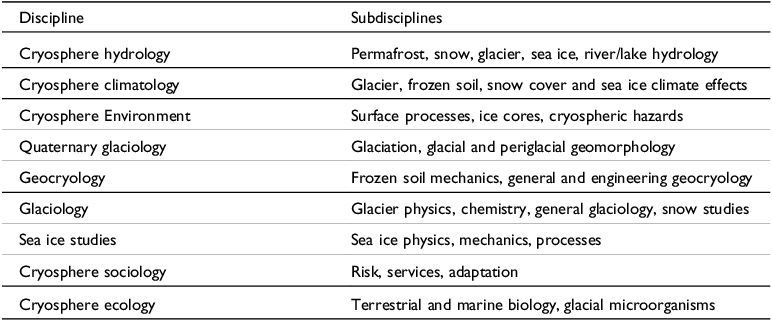
As a first analytical step, each article was classified according to its primary disciplinary focus. For this purpose, we adopted the disciplinary framework proposed by Qin et al. (Reference Qin, Ding, Xiao, Kang, Ren, Yang and Zhang2018), which organizes cryospheric science into nine main disciplines and twenty-eight subdisciplines. Each article was assigned to one main discipline and, where appropriate, to one or more subdisciplines (Table 2; Figure 1).
Comparative distribution of female first-authored articles and total publications by country focus and research topics (n = 204)

Table 1. Long description
A table comparing female first-authored articles and total publications by country focus and research topics. The table has 22 rows and 4 columns. The columns are labeled ‘Category’, ‘Female first-authored articles (n = 52)’, ‘Total articles (n = 204)’, and ‘Percentage (%)’. The ‘Category’ column is further divided into ‘Country focus’ and ‘Research topics’. Under ‘Country focus’, the table lists countries such as Argentina, United Kingdom, USA, Germany, Chile, and others, along with the number of female first-authored articles, total articles, and percentage. Under ‘Research topics’, the table lists topics such as Cryosphere environment, Remote sensing/modeling, Hydrology, Cryosphere climatology, Glacer dynamics/mass balance, Geomorphology/glacial geology, and Glacer hazards, along with corresponding numbers and percentages. Notable trends include high female authorship in Peru and remote sensing/modeling, and low or zero representation in countries like Colombia and Bolivia, and topics like glacier dynamics/mass balance.
Note: Countries and research topics are ordered in descending order according to the total number of articles.
Disciplines of cryospheric science (Qin et al. Reference Qin, Ding, Xiao, Kang, Ren, Yang and Zhang2018).

Table 2. Long description
A table with two columns and nine rows. The first column is labeled ‘Discipline’ and the second column is labeled ‘Subdisciplines’. The table lists the main disciplines of cryospheric science and their corresponding subdisciplines. Row 1: Cryosphere hydrology, Permafrost, snow, glacier, sea ice, river/lake hydrology. Row 2: Cryosphere climatology, Glacier, frozen soil, snow cover and sea ice climate effects. Row 3: Cryosphere Environment, Surface processes, ice cores, cryospheric hazards. Row 4: Quaternary glaciology, Glaciation, glacial and periglacial geomorphology. Row 5: Geocryology, Frozen soil mechanics, general and engineering geocryology. Row 6: Glaciology, Glacier physics, chemistry, general glaciology, snow studies. Row 7: Sea ice studies, Sea ice physics, mechanics, processes. Row 8: Cryosphere sociology, Risk, services, adaptation. Row 9: Cryosphere ecology, Terrestrial and marine biology, glacial microorganisms.
Methodological diagram.

Identification of methods and techniques
While the disciplinary classification was based on an established framework, no integrated or standardized taxonomy of methods and techniques applicable across all cryospheric disciplines was identified in the literature. Therefore, an inductive and literature-driven approach was applied to define these categories.
We conducted an extensive review of representative articles within each discipline to identify the methodological approaches and specific techniques most frequently employed. Based on this review, we first identified a set of methods, defined here as general methodological approaches used to address research questions (e.g., field-based research, remote sensing, numerical modeling). Subsequently, we identified and classified techniques, understood as specific tools or procedures applied within each method (e.g., ice core drilling, passive satellite imagery, stable isotope analysis).
Through an iterative process of synthesis and reduction, conceptually similar methods were grouped, and techniques were assigned to their corresponding methods. This process resulted in five main method categories: (1) field methods, (2) isotopic and elemental chemistry, (3) physicochemical and biological analysis, (4) remote sensing, and (5) physical and numerical modeling.
Due to the absence of a category related to statistical analyses, we proposed a sixth category that would include it. These categories are further divided into fourteen techniques that were identified and are detailed in Appendix A (Table A1).
Classification of the analyzed articles
Finally, each of the fifty-two selected articles was classified according to the three analytical levels: discipline, method(s), and technique(s). Multiple methods and techniques could be assigned to the same article when necessary.
Survey
To complement the bibliometric analysis, we conducted a survey titled “Women, Glaciers and Geoscience in the Andes Mountains,” which was administered via SurveyMonkey from November 27, 2023, to January 1, 2024 (Appendix B). The survey used a self-selected sample: Participants voluntarily responded after receiving personal invitations via email or direct messages on ResearchGate. The target population consisted of all identified female first authors of cryosphere-related articles published between 2018 and 2022. After reviewing fifty-two manuscripts, we identified forty-seven unique authors (some had published multiple articles). The bibliometric analysis is limited by potential bias introduced by search terms (glacier, Andes); however, our search identified articles spanning several disciplines, although with a clear emphasis on glaciology.
The survey employed a mixed qualitative and quantitative design to capture the experiences and perceptions of women researchers in cryosphere science, especially in Andean glaciology. Based on the literature, four key thematic areas were addressed: (1) leadership and motivation, (2) challenges and opportunities, (3) caring responsibilities, and (4) strategies to address gender-related challenges. The survey included both closed and open-ended questions. Open-ended questions allowed participants to elaborate on their experiences (e.g., challenges encountered in Andean glaciology), and responses were analyzed thematically using QDA Miner Lite. Keywords were coded to assess frequency and identify recurring ideas, following Young et al. (Reference Young, Carstensen-Conner and Pettit2020).
Closed questions aimed to gather descriptive data on professional and personal trajectories, contract types, access to funding, perceptions of gender bias, lack of role models and mentors, and barriers to academic advancement.
Results and discussion
In this study, the reference to “patriarchal norms” does not refer to explicit forms of discrimination, but rather to the persistence of implicit organizational cultures and evaluation criteria historically aligned with male-dominated academic trajectories. Buquet et al. (Reference Buquet, Mingo and Moreno2018) point out that university culture, from its monastic roots, associates masculinity with the creation and preservation of knowledge. These historical cultures manifest themselves through expectations of permanent availability, uninterrupted productivity, and physical endurance in extreme fieldwork contexts, standards that tend to systematically disadvantage women and those who assume caregiving responsibilities (Carey et al. Reference Carey, Jackson, Antonello and Rushing2016; Dance et al. Reference Dance, Duncan, Gevers, Honan, Runge, Schalamon and Walch2024).
This comparative perspective shows that the overall proportion of female first authorship (25.5 percent) masks important internal disparities (Table 1). At the country level, female participation is uneven, with some regions showing relatively high representation, while others exhibit a complete absence. More importantly, the analysis by research topics reveals a clear disciplinary segmentation: female authorship is considerably lower in core physical subfields such as glacier dynamics and mass balance, and higher in areas such as environmental research and applied or methodological studies. These findings suggest that gender disparities in Andean cryosphere research are not only quantitative but structurally embedded within the organization of knowledge production.
Resistance to female leadership in glaciology tends to operate through subtle mechanisms rather than through overt forms of exclusion. These mechanisms include questioning the authority of women in leadership roles in the field, undervaluing their scientific contributions, fewer nominations for principal investigator positions, and reduced visibility in international collaborations (Dutt et al. Reference Dutt, Pfaff, Bernstein, Dillard and Block2016; Robel et al. Reference Robel, Ultee, Ranganathan and Nash2024). These dynamics tend to become normalized within academic cultures, which contributes to them going unnoticed by those who do not experience them directly. Taken together, these mechanisms generate cumulative disadvantages over time, influencing which researchers are recognized as legitimate leaders in cryospheric science and what types of knowledge are amplified within global scientific agendas.
Evolution and trends in women’s participation in Andean glaciology (1983–2022)
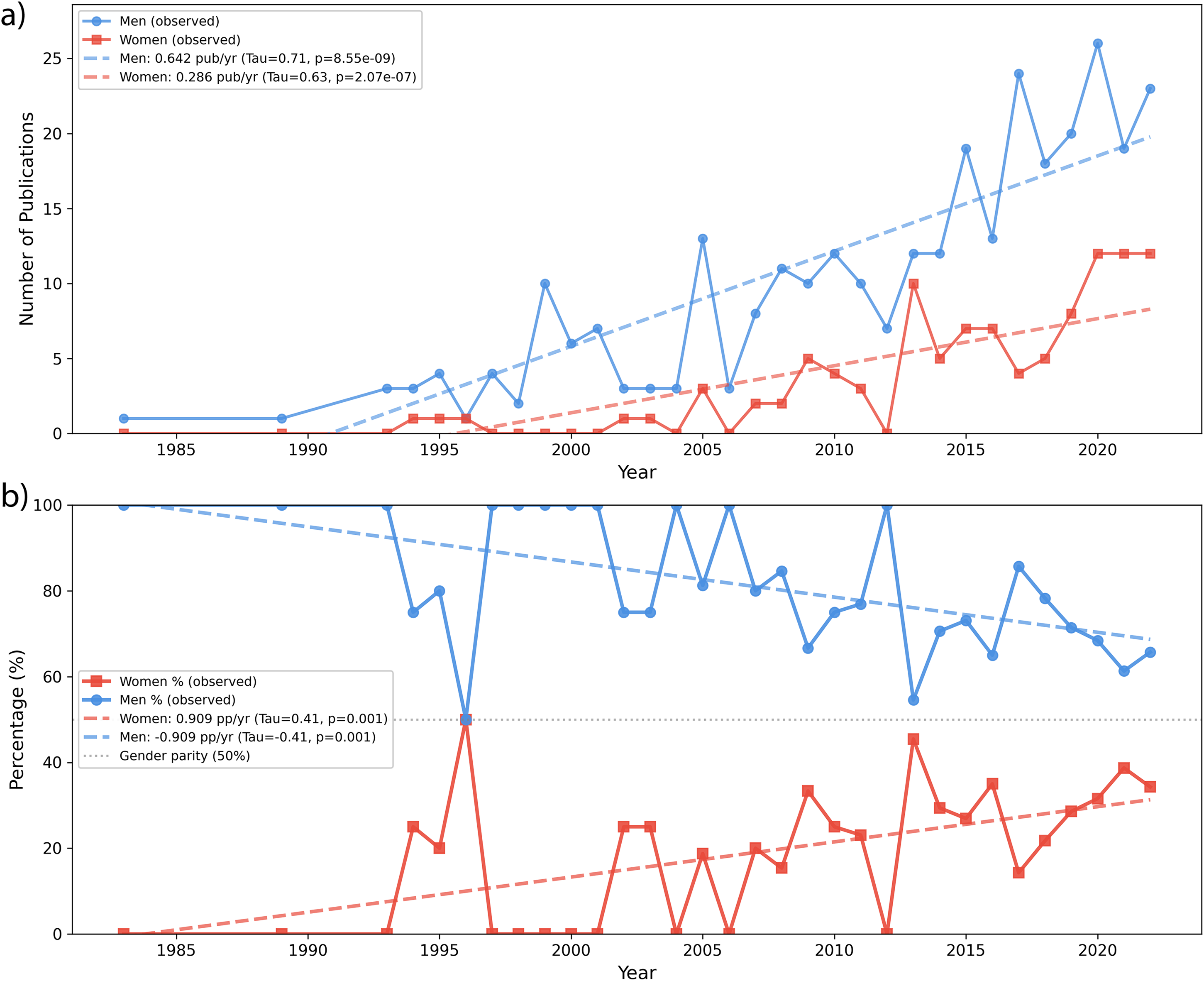
These findings are aligned with global trends in female representation in geosciences, such as those documented in Italy and the United States (Agnini et al. Reference Agnini, Pamato, Giuseppe Salviulo and Nestola2020; Ranganathan et al. Reference Ranganathan, Lalk, Freese, Freilich, Wilcots, Duffy and Shivamoggi2021). However, persistent structural barriers in Latin America continue to hinder progress in women’s development (Yáñez-Serrano et al. Reference Yáñez-Serrano, Aguilos, Barbosa, Rafael Bolaño-Ortiz, Carbone, Stephanie Díaz-López, Dominutti, Engelhardt, Alves, Pedraza, Saturno and Tzompa-Sosa2022). While Figure 2 presents a contextual comparison of publication trends by gender between 1983 and 2022, this analysis served only to situate the historical evolution of women’s authorship in relation to overall production in the field. Beyond this contextual element, our study did not include a systematic comparison group of male- or mixed-gender-led publications.
Temporal trends in publications on Andean glaciology by sex (1983–2022). (a) Number of publications per year for men (blue circles) and women (red squares). (b) Percentage of publications by sex: men (blue circles) showing a decreasing trend, women (red squares) showing an increasing trend. The dashed lines indicate linear regression trends with Mann-Kendall statistics (Tau and p-value) in the legends. The gray dashed line in panel (b) indicates 50 percent gender parity. Both panels show statistically significant trends (p < 0.001) demonstrating convergence toward gender equality, albeit at a slow pace.

Figure 2 presents two complementary perspectives on gender participation in Andean glaciology (1983–2022). Panel (a) shows the absolute number of publications by gender, while panel (b) presents the percentage distribution over time. Statistical analysis confirms highly significant increasing trends for both sexes in absolute numbers (panel a). For men, the Mann-Kendall test indicates a strong increasing trend (Kendall’s tau = 0.714, p = 8.55 × 10⁻⁹), with a Sen slope of 0.642 publications/year. Publications led by women have also shown a significant increasing trend (tau = 0.631, p = 2.07 × 10⁻⁷), although at a markedly slower rate, with a Sen slope of 0.286 publications/year, approximately 2.25 times lower than that of men. Panel (b) reveals significant convergence toward gender parity. The percentage of publications led by women shows a significant upward trend (Tau = 0.407, p = 0.0008), increasing at a rate of 0.909 percentage points per year. In contrast, the percentage led by men decreases symmetrically at the same rate (Tau = –0.407, p = 0.0008). Women’s participation increased from 8.51 percent in 1993–2002 to 20.00 percent in 2003–2012, and averaged 30.60 percent during 2013–2022 (hereafter, “the past decade”). Despite this measurable progress, gender parity (50 percent) remains distant. At the current rate of convergence, and considering the average of the past decade, it would take approximately twenty-one additional years to reach it (projected year, 2043). This projection should be interpreted with caution, as it assumes a constant linear trend and does not consider year-on-year variability or potential changes in other factors, such as gender equality policies. On the other hand, although men are growing more than twice as fast in absolute numbers (widening the gap), there is proportional convergence because women started from almost no representation (0 percent) and are “recovering ground” in percentage terms.
The results indicate that women-led research does not occupy a marginal position within Andean cryosphere science but is instead strongly embedded in core areas of the discipline, particularly in glaciology and Quaternary glaciology. Nevertheless, relevant differences emerge in the thematic distribution, with a notable underrepresentation of women in cryosphere climatology compared to the overall body of publications.
Geographical distribution of female-led studies
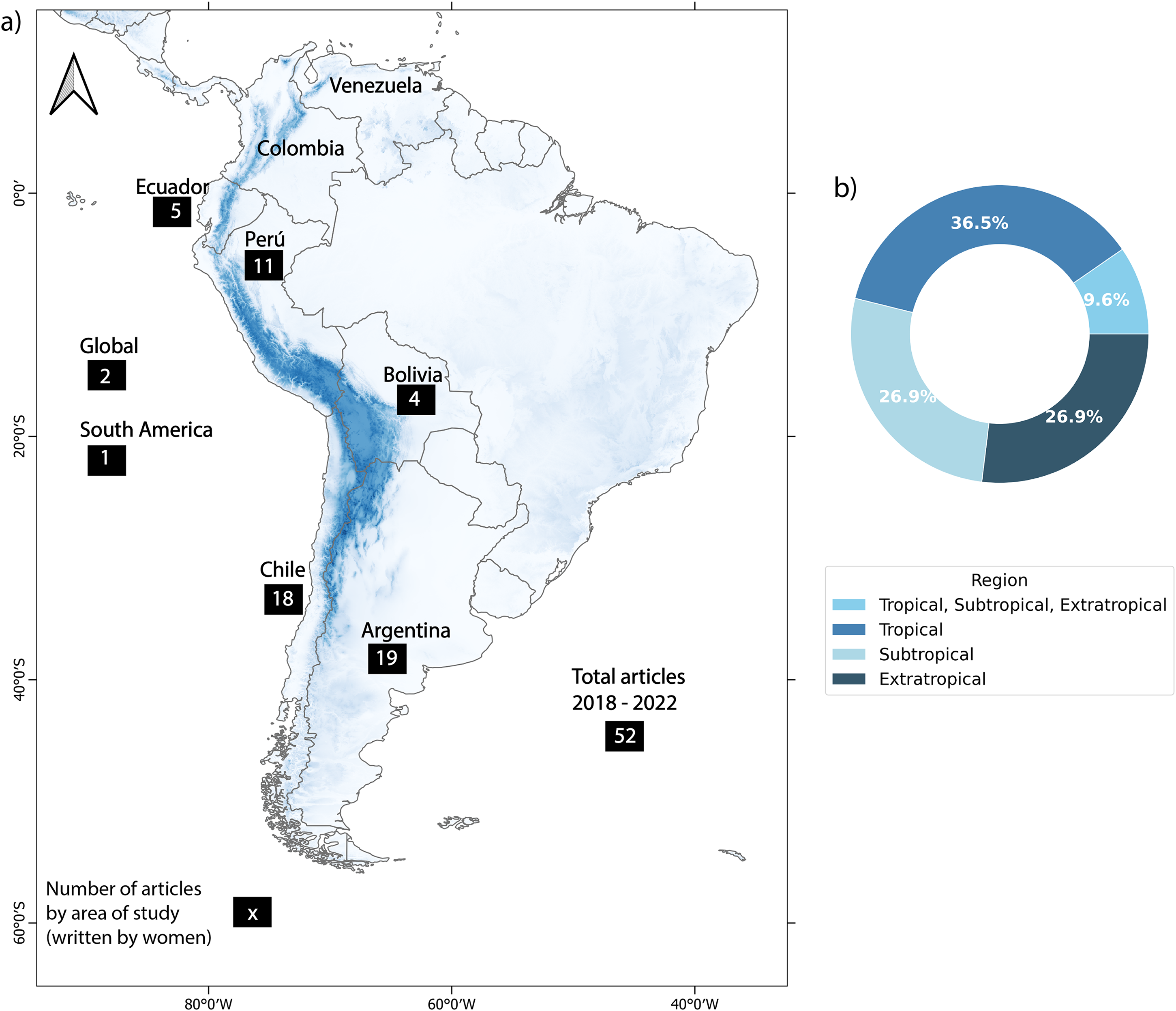
The geographic focus of articles led by female researchers reveals a strong concentration in Argentina (nineteen articles) and Chile (eighteen articles). Peru follows with eleven publications, while Ecuador and Bolivia account for five and four, respectively (Figure 3). Notably, no female-led studies were identified for Colombia or Venezuela. A small number of articles (n = 3) focus on broader regional or global perspectives, analyzing glaciers across the entire Andean range. This geographic pattern should be interpreted with caution, as the absolute number of publications may partly reflect differences among countries in glacier extent, the spatial distribution of glacierized areas, and the scale of glaciological research activity. Therefore, these figures describe the geographic distribution of publications with female first authors rather than the relative representation of women in glaciological research within each country.
Number of articles by region of study.

In terms of climatic zones (study area), nineteen articles were located in the tropical Andes, followed by fourteen in subtropical and extratropical regions, and five that spanned all three zones. The concentration of studies in certain countries likely reflects a combination of factors: the availability of research infrastructure, the presence of robust academic institutions, better funding opportunities, and denser glaciated terrain. Previous studies emphasize the importance of institutional support and resource availability in determining women’s participation in polar and cryospheric research (Figuerola et al. Reference Figuerola, Valiente, Barbosa, Brasier, Roger Colominas-Ciuró, Liggett, Fernández-Martínez, Gonzalez, Griffiths, Jawak, Merican, Noll, Prudencio, Quaglio and Pertierra2021; Starkweather et al. Reference Starkweather, Seag, Lee and Pope2018).
Research topics and methods in female-led cryospheric studies
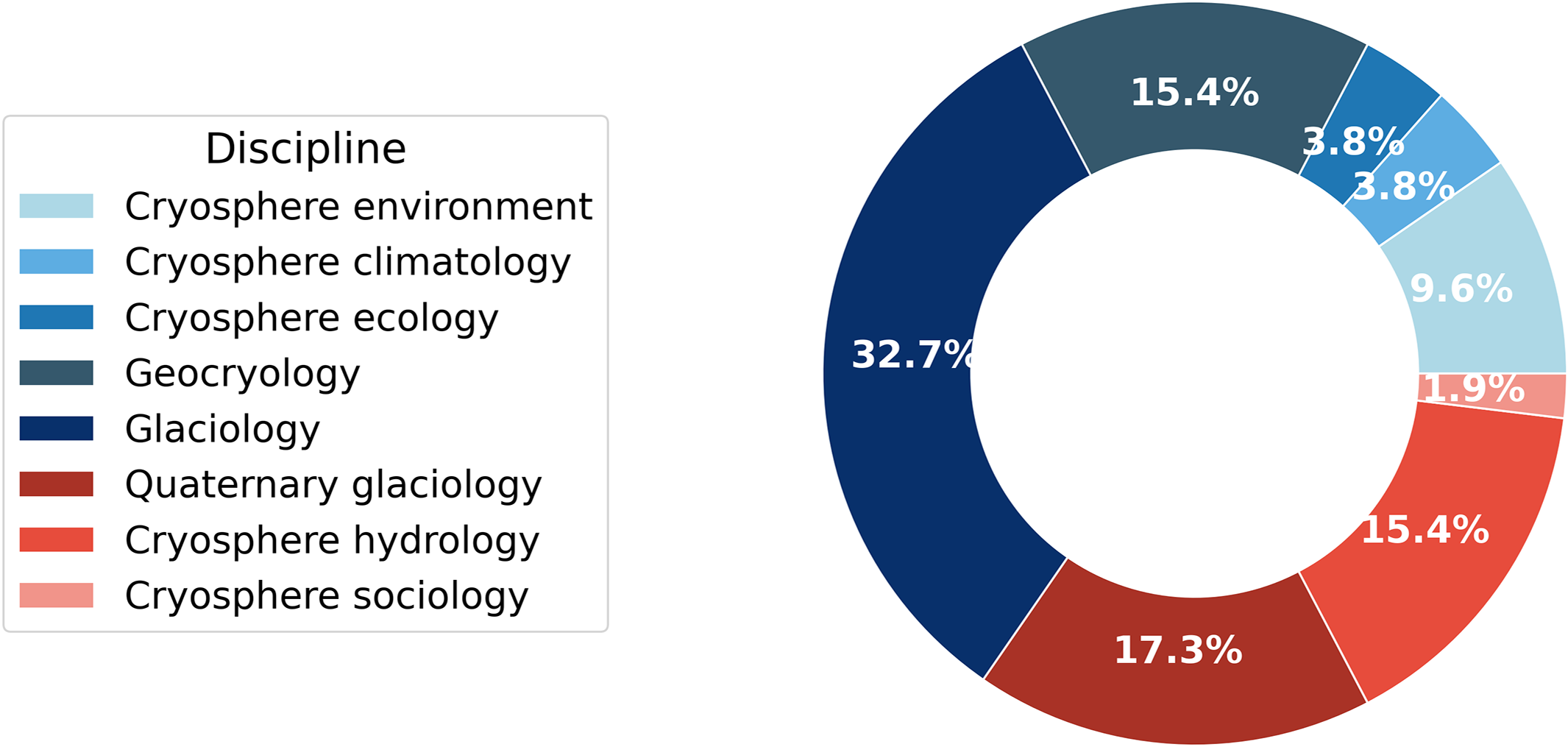
The thematic distribution of the fifty-two selected articles shows a predominance of general glaciology (32.7 percent), including subdisciplines such as glacier mass balance, dynamics, and surface area (Figure 4). This is followed by Quaternary glaciology (17.3 percent), geocryology (15.4 percent), and cryosphere hydrology (15.4 percent). Less represented are fields such as cryosphere ecology, environment, and climate (Figure 4).
Percentage of predominant disciplines in cryosphere studies conducted by women.

Regarding methodologies, field-based techniques were the most frequently employed (31 percent), particularly in situ data collection (21 articles) and sample collection (13 articles). Remote sensing methods were also widely used (22 percent), with passive sensors being the most common (twenty-three articles), followed by active sensors (five articles). Other methods included numerical and physical modeling (15 percent), isotopic analyses (12 percent), statistical and mixed techniques (11 percent), and physicochemical analyses (8 percent) (Figure 5).
Description of the research methods and techniques most used by female researchers. (a) the most frequently used research methods, expressed as percentages; (b) glaciological techniques and number of articles that used them; (c) number of techniques used in each article. PRS: passive remote sensing; IM: in situ measurement; PNM: physical and numerical modeling; SC: sample collection; SI: stable isotope analysis; EC: elemental chemistry analysis; G: geophysics; ARS: active remote sensing; ARD: absolute radiometric dating; ID: ice drilling; PPA: physicochemical properties analysis; ICC: ice crystallography; BA: biological analysis; RD: relative dating.

The prevalence of fieldwork and remote sensing reflects both the accessibility of these techniques and the logistic realities of working in mountainous regions. Conversely, the limited use of laboratory-based methods such as isotopic or physicochemical analyses suggests structural constraints, including lack of access to specialized equipment and local analytical facilities. These limitations may also explain the underrepresentation of research on cryosphere ecology and climate. As in other global studies, improving access to advanced technologies and infrastructure is essential to expand the methodological scope of women-led research (Allison et al. Reference Allison, Fierz, Hock, Mackintosh, Kaser and Nussbaumer2019; Brugger et al. Reference Brugger, Jimenez, Ponsoni and Todd2022).
This comparative analysis allows us to distinguish more clearly between patterns associated with gender dynamics and those reflecting structural characteristics of the field. For instance, the low representation of socio-environmental approaches is observed both in female-led publications and in the overall dataset, indicating that this gap constitutes a broader limitation of Andean cryosphere research rather than a gender-specific disparity. This finding underscores the importance of situating gender-based analyses within the wider epistemic and disciplinary configuration of the field.
Survey results: Profiles and perceptions of female researchers
Among the forty-seven identified women leading publications between 2018 and 2022, twenty-three responded to the survey (49 percent response rate). Most respondents were between thirty-four and thirty-eight years old, and 50 percent had completed postdoctoral training. Additionally, 45 percent held assistant professor positions (Figure 6), and 23 percent reported serving as principal investigators or research directors.
Demographic data from responses to key survey questions.

The respondents’ time allocation reflected a strong focus on research, with 57 percent dedicating over 50 percent of their workday to scientific activities, while administrative responsibilities accounted for less than 20 percent of their time. In terms of scientific output, 59 percent had authored between one and five first-authored articles, while 9 percent had published more than eleven. This profile suggests a cohort of early-career researchers actively contributing to the field.
Geographically, 48 percent of participants were Latin American, 39 percent were from Europe or North America, and 4.3 percent held dual citizenship. This diversity enriches the field but also raises concerns about the continued underrepresentation of local women scientists. Studies have noted that externally led research can risk being disconnected from local contexts and communities (Carey and Moulton Reference Carey and Moulton2023; Robel et al. Reference Robel, Ultee, Ranganathan and Nash2024), highlighting the importance of fostering collaboration and equitable leadership opportunities for Latin American women in glaciology.
Motivations and gender-based challenges
Respondents cited a range of motivations for engaging in glacier research: scientific interest in mountain systems (56.4 percent), glacier management and protection (18.9 percent), environmental concerns (12.6 percent), and appreciation of landscape beauty (12.5 percent). These motivations indicate an intersection between scientific rigor and environmental values, offering opportunities for interdisciplinary and transdisciplinary research (Schirpke et al. Reference Schirpke, Wang and Padoa-Schioppa2021; Stibal et al. Reference Stibal, Bradley, Edwards, Hotaling, Zawierucha, Rosvold, Lutz, Cameron, Mikucki, Kohler, Šabacká and Anesio2020).
However, participants also reported numerous barriers to their academic development (Figure 7): limited funding (72 percent), lack of recognition (50 percent), difficulties establishing professional collaborations (40.9 percent), gender bias in leadership (36.4 percent), and caregiving responsibilities (31.8 percent). Notably, 82 percent of respondents reported feeling marginalized in academic environments due to their gender, a finding that echoes previous studies (Carey and Moulton Reference Carey and Moulton2023; Bernstein Reference Bernstein2024). Many women reported delaying or sacrificing personal milestones such as motherhood and self-care to meet professional expectations (Williams and Ceci Reference Williams and Ceci2012; Marín-Spiotta et al. Reference Marín-Spiotta, Barnes, Berhe, Hastings, Mattheis, Schneider and Williams2020).
Distribution of replies to key questions of the survey (n = 23).

While the survey responses reflect perceptions of the challenges experienced by women in Andean glaciology, these perceptions are consistent with a robust body of international literature documenting the existence of structural gender inequalities in the geosciences. Limited access to research funding, for example, has been shown to disproportionately affect women because of cumulative disadvantages associated with interruptions in academic trajectories, shorter institutional tenure, and gender biases in evaluation processes (Dutt et al. Reference Dutt, Pfaff, Bernstein, Dillard and Block2016; Popp et al. Reference Popp, Lutz, Khatami, van Emmerik and Knoben2019; Brito Peña and Casanova Cruz Reference Brito Peña and Casanova Cruz2024). While male researchers in the early stages of their careers also report a shortage of funding, evidence indicates that women more frequently face systemic penalties linked to motherhood, caregiving responsibilities, and restricted access to informal academic networks, where key funding opportunities often circulate (Marín-Spiotta et al. Reference Marín-Spiotta, Barnes, Berhe, Hastings, Mattheis, Schneider and Williams2020; Dance et al. Reference Dance, Duncan, Gevers, Honan, Runge, Schalamon and Walch2024). Also relevant is women’s greater dedication to university administrative work, which is highly gendered and analogous to caring for an “extended academic family” (Docka-Filipek and Stone Reference Docka-Filipek and Stone2021; Guarino and Borden Reference Guarino and Borden2017).
Similarly, the lack of mentoring reported by respondents is consistent with studies showing that women in the geosciences are less likely to join research groups led by senior academics or to establish long-term mentoring relationships, especially in disciplines that are heavily fieldwork-based and historically shaped by masculinized cultures of expertise, physical endurance, and total availability (Carey et al. Reference Carey, Jackson, Antonello and Rushing2016; Barnes et al. Reference Barnes, Marín-Spiotta, Morris and Johnson2018). These gaps in mentoring have direct consequences for leadership trajectories, international visibility, and access to large-scale collaborative projects. Work-life balance, along with caregiving responsibilities, is another critical axis of inequality. Feminist literature has shown that academic systems continue to operate under implicit norms of uninterrupted productivity, which systematically disadvantage women, who disproportionately take on unpaid care work (Williams and Ceci Reference Williams and Ceci2012; Criado Perez Reference Criado Perez and Harry2019). In the case of glaciology, where extended field campaigns and international mobility are often central requirements for professional advancement, these dynamics take on a particularly exclusionary character.
Strategies to navigate academic life
To address these challenges, researchers reported deploying several coping strategies: increasing efforts to demonstrate expertise and leadership, prioritizing professional development over personal goals, and relying on support from mentors and scientific networks. The importance of mentorship and peer support is well established in the literature and was reiterated by 85 percent of the survey participants (Lodes Reference Lodes2022; Hernandez et al. Reference Hernandez, Adams, Barnes, Bloodhart, Burt, Clinton, Du, Henderson, Pollack and Fischer2020; Barnes et al. Reference Barnes, Marín-Spiotta, Morris and Johnson2018).
Equal access to resources such as funding and equipment was identified as a priority by 72 percent of respondents. Additionally, participants emphasized the need for inclusive institutional policies that recognize and support the dual roles of women as scientists and caregivers. Suggested measures include greater inclusion in research projects, leadership positions, gender equity initiatives, and programs that facilitate work-life balance.
Demands for greater inclusion and equity
A substantial majority (75 percent) of respondents agreed that enhancing inclusion and diversity in glaciology is critical to advancing scientific knowledge and addressing complex challenges. This aligns with literature emphasizing the benefits of diversity in research teams (Robel et al. Reference Robel, Ultee, Ranganathan and Nash2024) and the importance of incorporating intersectional perspectives (Seag et al. Reference Seag, Nielsen, Nash and Badhe2023).
Survey participants proposed three priority areas to improve gender equity in glaciology: (1) actively promoting female participation and leadership, (2) implementing gender-sensitive resource allocation policies, and (3) supporting work-life balance through family-friendly policies. Additional recommendations included improving training opportunities, fostering international exchange, addressing language barriers, and creating women-led networks to amplify visibility and voice in the discipline.
Beyond inclusion: Feminist epistemologies and situated knowledge in Andean glaciology
Gender equity cannot be reduced to the fairer inclusion of women in science. From the perspective of feminist epistemology, a broader agenda must question the dominant epistemic hierarchies that have historically marginalized women and researchers from the Global South and excluded local and indigenous knowledge from scientific practice. This calls for broadening participation in science and promoting the coproduction of glaciological knowledge with local communities. Feminist and situated knowledge approaches emphasize that diversifying who produces knowledge and with whom can contribute to a more inclusive, socially relevant, and ethically grounded science of the cryosphere (Haraway Reference Haraway1988; Carey and Moulton, Reference Carey and Moulton2023).
Limitations and scope of the study
This study provides valuable insight into women’s participation in Andean glaciology, but several limitations must be acknowledged. The sample includes only first-author articles and is constrained to the 2018–2022 period, which coincides with the COVID-19 pandemic and may have impacted scientific output. Excluding coauthors or contributors in other roles may underrepresent women’s actual involvement. Moreover, disparities in research infrastructure, funding, and academic networks across countries introduce uncontrolled variables that may affect the findings. Nonetheless, the analysis offers a robust foundation for future studies and for advancing gender equity in cryospheric sciences, not only in the Andes, but also in other regions facing similar challenges.
A key challenge in assessing gender participation in scientific research lies in the absence of systematic comparison frameworks, which limits the ability to distinguish between general disciplinary trends and gender-specific patterns. To address this, this study incorporates a comparative analysis between female first-authored articles (n = 52) and the full dataset (n = 204). This approach allows female participation to be interpreted within the overall structure of Andean cryosphere research, rather than in isolation. The findings reveal that female authorship is unevenly distributed across both countries and research topics, pointing to structural imbalances that are not evident from aggregate participation rates alone.
Conclusions
Female participation in Andean glaciology has increased over the past four decades, with the proportion of publications with female first authors rising from 8 percent in the 1980s and 1990s to 30 percent in the past decade. Although the total number of publications increased for both female and male first authors, with considerable interannual variability, the growing proportion of publications with female first authors indicates increased participation of women in Andean glaciological research. Nevertheless, the number of publications with female first authors grew more slowly than those with male first authors, suggesting that gender disparities in first authorship persist.
The geography of women-led glaciological research also reflects profound regional inequalities. Most publications led by female researchers are concentrated in Argentina and Chile, countries that have relatively stronger research infrastructures and institutional support. In contrast, countries such as Colombia, Bolivia, and Peru remain underrepresented. This uneven spatial distribution raises critical questions not only about where glacier research is being conducted, but also about who defines scientific priorities, how national policies facilitate or constrain participation, and which voices are amplified in shaping the knowledge base of climate-vulnerable mountain regions. The concentration of female-led studies in Argentina and Chile must be interpreted with caution. Because our analysis does not include a systematic comparison group of male-led studies, we cannot determine whether these regional patterns are unique to women or reflect general trends in Andean glaciology. The absence of women-led publications in Colombia or Venezuela, for instance, does not imply a lack of glaciological research in those countries, but rather the absence of female first authorship within our dataset.
Moreover, the continued predominance of Global North researchers, particularly from European institutions, further exposes enduring epistemic asymmetries in the governance of science in Latin America. Although international collaboration can enrich glaciological research, it also runs the risk of reproducing extractive or colonial dynamics if local scientists, especially women, are not equitably included in agenda-setting, data interpretation, and authorship. Scientific cooperation that fails to engage meaningfully with local knowledge systems and social contexts may inadvertently contribute to the marginalization of the very communities most impacted by climate change.
For scholars and policymakers working at the intersection of geography, gender, and science in Latin America, this study offers a call to critically examine how inequalities in knowledge production are shaped by territorial, institutional, and epistemological dimensions. In the case of glaciology—a field that is central to understanding and responding to climate change, water governance, and socio-environmental justice—the underrepresentation of women and Latin American researchers risks disconnecting scientific inquiry from the realities it seeks to address.
From a science policy perspective, especially in countries such as Mexico, Argentina, or Chile, these findings underscore the urgent need to move beyond formal inclusion policies toward substantive structural reforms. This includes ensuring equitable access to research funding, creating pathways for women to assume leadership roles, recognizing and supporting caregiving responsibilities, and transforming academic cultures that perpetuate gender exclusions.
Ultimately, addressing these challenges is not only a matter of fairness in academic careers. It is about ensuring that scientific knowledge, particularly on urgent issues like glacial retreat and water security, is coproduced with the people, territories, and epistemologies most affected. A more inclusive and locally grounded Andean glaciology is not only better science: it is more just, more relevant, and more capable of informing equitable and resilient socio-environmental transitions in the region.
While this study offers valuable insight into the contributions and experiences of women leading glaciological research in the Andes, its scope is necessarily constrained by the absence of a systematic comparison group and by the descriptive nature of the dataset. As a result, some of the patterns we identify may be shaped by broader structural features of Andean glaciology research rather than gender-specific mechanisms. Building on this foundation, future research that incorporates explicit comparisons between women- and men-led publications would help disentangle these influences and provide a more robust understanding of how gender shapes scientific trajectories and opportunities in glaciology.
Supplementary material
To view supplementary material for this article, please visit https://doi.org/10.1017/lar.2026.10172




 Open access

