The Fontan operation was introduced in 1971 as a palliative procedure for patients with tricuspid atresia. The Fontan circulation is nowadays created in patients with various complex cardiac malformations, most frequently for those having functionally univentricular hearts.Reference Fontan and Baudet1, Reference Kreutzer, Galindez, Bono, De Palma and Laura2 In the current era, such children usually have completion of their Fontan circulation between the ages of 2 and 4 years. After beginning this procedure at our institution, however, many patients did not undergo completion of the Fontan circulation until adulthood. Advances in creating a haemodynamically improved pathway for the circulation, and better selection of patients, have led to extended survival. The patterns in flow in the Fontan circuit have been examined in various studies.Reference Klimes, Abdul-Khaliq and Ovroutski3–Reference Fogel, Weinberg and Rychik7
Despite a satisfactory functional state in most patients, many studies have shown an impairment of ventricular function and exercise performance.Reference Eicken, Fratz and Gutfried8–Reference Gewillig, Lundstrom, Bull, Wyse and Deanfield15 So far, long-term follow-up data in these patients is sparse, especially in respect to age of the patients, and their age at conversion to the Fontan circuit. In this study, therefore, we assessed and compared ventricular function and maximal exercise capacity, taking note of the influence of the age of the patients, and their age when changed to the Fontan circulation.
Methods
Cardiac magnetic resonance imaging
All patients were examined with a 1.5 Tesla system manufactured by Philips Medical Systems, Best, The Netherlands. Imaging was performed with patients in supine position using a five-element phased-array coil with breath-holding in expiration and electrocardiographic gating. Localizing scans were followed by breath-hold multiple-slice multiple-phase data sets, parallel to the mitral valve, covering the whole ventricle in short axis slices with retrospective electrocardiographic gating using a steady state free precession pulse sequence with parameters of echo time 1.8 ms, repetition time 3.6 ms, flip angle 60°, 25 phases, matrix size 176 × 256, slice thickness 6 millimetres, interslice gap 0 millimetres, and field of view range 300 to 400 millimetres.
Quantification of end-diastolic and end-systolic volumes, as well as ventricular mass, was performed using dedicated software, specifically the ViewForum provided by Philips Medical Systems. Ventricular volume and mass were defined as the sum of the volumes and masses of the dominant systemic ventricle and the hypoplastic second ventricle, if present. For calculation of ventricular volumes and masses in control subjects, we used only the left ventricular volume and mass, including the ventricular. We studied 29 healthy age-matched subjects to provide the control values for ventricular function.
Cardiopulmonary exercise testing
All patients underwent a symptom-limited cycle exercise. After a 3 minute resting period, a graded exercise test was performed with work increments of 16 Watt per minute until exhaustion. Heart rate and rhythm were continuously monitored using a 12 lead electrocardiogram. Blood pressure was measured manually at rest and at maximal exercise. Breathing through a mask permitted continuous measurement of ventilation, uptake of oxygen, and production of carbon dioxide. All variables for cardiopulmonary exercise were compared to normal values established at our institution from 105 healthy subjects of different ages.
Statistical analysis
All data were analyzed using Statview®, Version 5.0, as provided by the SAS Institute Inc., Cary, North Carolina, United States of America. The patients with the Fontan circulation and their controls were compared using a paired or unpaired Student’s t test as appropriate. Data is expressed as mean ± standard deviation. A p value of less than 0.05 was considered statistically significant.
Results
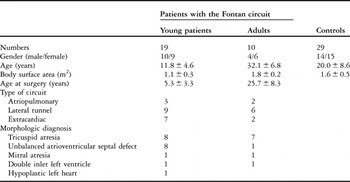
All patients were referred for exercise testing and cardiac magnetic resonance imaging as part of routine clinical follow-up protocols used at our institution. Informed consent was obtained from all patients or their parents, as appropriate. All patients underwent exercise testing and cardiac magnetic resonance imaging on the same day. We studied 29 patients, of whom 14 were male, at a median of 6.9 years, and with a range from 1 to 13 years, after creation of the Fontan circulation (Table 1). According to the age at creation of the Fontan circuit, we divided the patients into a group of 19 who were under 18 years of age, and a group of 10 patients older than 18 years when converted to the Fontan circuit. In 5 patients, the Fontan circuit was created by means of an atriopulmonary anastomosis, while in 15 an intra-atrial lateral tunnel was used, with an extracardiac conduit inserted in the remaining 9 patients. Patients in the younger group were studied at a median age of 10.9 years, with a range from 5 to 17 years, and at a median time after creation of the Fontan circuit of 6.5 ± 3.3 years. The older patients were studied at a median age of 31.3 years, with a range from 21 to 44 years, and at a median time after creation of the Fontan circuit of 6.3 ± 6.8 years. Median age at creation of the circuit was 5.3 ± 3.3 years for the younger patients, and 25.7 ± 8.3 years for the older ones. The dominant ventricle was morphologically left in 26 patients, and morphologically right in 3 patients. All patients were in either the first or second class of the system devised by the New York Heart Association.
Characteristics of the patients with the Fontan circulation and their controls.

Ventricular volume, function and mass
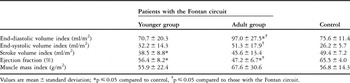
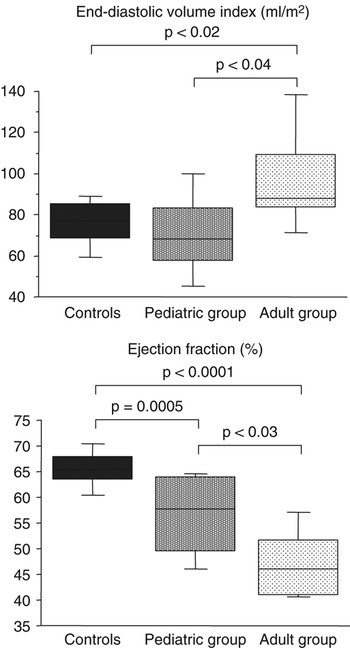
End-diastolic volume indexed to body surface area in the younger patients was comparable to that of controls (Table 2, Fig. 1). This parameter was significantly greater in the older patients than in the younger ones (p < 0.04). Both groups with the Fontan circuit had significantly impaired ejection fractions compared to controls, which was further attenuated in the older patients, at 47.2 ± 6.7% compared to 56.4 ± 8.2% in the younger ones, and 65.5 ± 4.0% in the controls (p < 0.03). There was a greater muscle mass indexed to body surface area of the functionally single ventricle in the older patients compared to both the younger patients and the control subjects (p not significant).
Cardiac magnetic resonance variables of the functionally single ventricle in patients with the Fontan circuit and The morphologically left ventricle in controls indexed to body surface area.

Values are mean ± standard deviation; *p ⩽ 0.05 compared to control, †p ⩽ 0.05 compared to those with the Fontan circuit.
End-diastolic volume index and ejection fraction of the morphologically left ventricle in normal subjects, and the functionally univentricular mass in patients with the Fontan circuit. The older patients have a dilated ventricle, with the poorest ejection fraction.

Exercise capacity
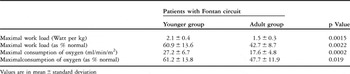
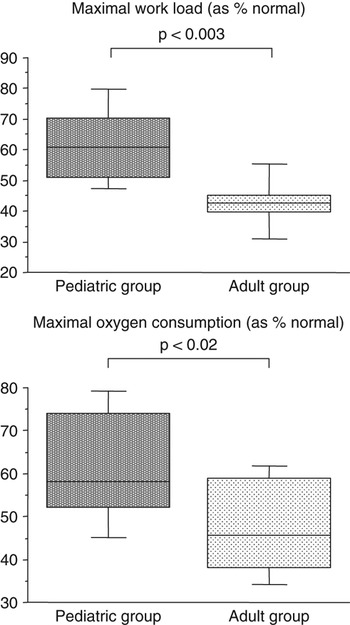
The maximal work load attained by the patients with the Fontan circuit was only 54.6 ± 14.9% of the maximal work load of the age-matched controls (p < 0.0001; Table 3, Fig. 2).
Comparison of exercise variables among the patients with the Fontan circulation.

Values are in mean ± standard deviation
Maximal work load and oxygen uptake in patients with the Fontan circulation as a percentage of normal. All patients have a lower maximal work load and consumption of oxygen than controls, with the older patients having a significantly lower maximal work load and consumption of oxygen than the younger patients.

The older patients had significantly lower maximal work loads when compared to the younger patients, at 1.5 ± 0.3 versus 2.1 ± 0.4, expressed as Watt per kilogram (p = 0.002), with a maximal work load accomplished of 42.7 ± 8.7% of normal in the older patients and 60.9 ± 13.6% of normal in the younger ones (p = 0.002).
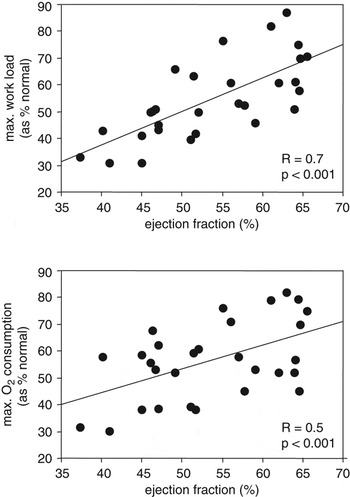
Maximal uptake of oxygen was markedly lower in both groups, with a significantly lower uptake in the older patients, at 47.7 ± 11.9% of normal, and 61.2 ± 13.8% of normal in the younger ones (p < 0.02). There was a good correlation between ejection fraction and maximal work load (R = 0.7, Fig. 3), albeit that the correlation between ejection fraction and maximal uptake of oxygen was not as strong (R = 0.5).
Good linear correlation between ejection fraction and maximal work load. The correlation between ejection fraction and maximal consumption of oxygen is less strong but significant.

Discussion
To the best of our knowledge, ours is the first study describing ventricular function and exercise performance in patients having the Fontan circuit created at a relatively old age, and comparing them to patients converted to the Fontan circuit at an earlier age. There is some controversy in the literature regarding the interplay of ventricular function and exercise performance in patients with a functionally single ventricle after creation of the Fontan circulation. We report here the results of detailed cardiopulmonary testing in such patients after relatively early and late creation of the Fontan circuit.
Ventricular function
Ventricular volume and function in patients with the Fontan circuit depends on their age, and their age at the time of creation of the circuit. Those having the circuit created in childhood have a normal ventricular volume and mildly impaired ventricular function. A previous studyReference Eicken, Fratz and Gutfried8 found normal ventricular sizes, and impaired systolic function, in a population having creation of the circuit under the age of 30 years, findings endorsed by the results for our younger patients.
Patients having the Fontan circuit created in adulthood have a dilated ventricle and further impaired ventricular function, which was more pronounced in patients over 30 years old. This is in keeping with the reported average durability of a functionally single ventricle after the Fontan operation of 30 to 40 years as described by others, and may be the result of prolonged myocardial cyanosis, longstanding volume overload, and a non-physiological arrangement of the ventricular myocytes.Reference Cook and Anderson16, Reference Yeh, Williams and McCrindle17
It has been suggested that creation of the Fontan circulation leads to a mismatch between mass and volume of the dominant ventricle, which in turn may influence ventricular function, and thus exercise capacity.Reference Gutberlet, Hosten and Abdul-Khaliq4, Reference Niepage, Schulze-Neick and Rechter18 In our study, we found a greater ventricular mass in the patients who had the Fontan circuit created in adulthood compared to those patients having the circuit created at a younger age, albeit that the difference did not reach statistical significance, since values were widely scattered. It is believed that early reduction of volume overload and cyanosis may preserve ventricular function in the long term. Whether this is true has yet to be proven, as patients having creation of the Fontan circuit between the ages of 2 and 4 years have not yet reached their third decade of life, this being the time at which ventricular function starts to deteriorate significantly.
Exercise capacity
Maximal exercise performance in patients with the Fontan circuit depends on both their age, and the age at which they are converted to the univentricular circulation. Our patients in whom the Fontan circuit was created during childhood performed better than our older patients. Since the postoperative interval was no different in the two groups, patients having the circuit created at a later age were also older, most aged between 25 and 40 years. These older patients had a significantly poorer maximal exercise performance, and lower maximal uptake of oxygen than our younger patients. The lower ejection fraction correlated well with a lower maximal work load and, to a lesser degree, with maximal uptake of oxygen.
Others have found a subnormal maximal exercise performance with no effect of age at surgery, age at study, or time since surgery.Reference Rosenthal, Bush, Deanfield and Redington14 We believe that the younger population studied by these investigators,Reference Rosenthal, Bush, Deanfield and Redington14 being aged less than 16 years at the time of creation of the Fontan circuit, is comparable to our group of younger patients, which explains the significant differences we found in our older group. The other investigatorsReference Rosenthal, Bush, Deanfield and Redington14 also showed a significantly lower maximal uptake of oxygen in their patients with the Fontan circuit, a finding supported by our data.
A significant reduction in maximal work load, maximal consumption of oxygen, and ejection fraction, has been shown in a population of adults.Reference Harrison, Liu and Walters13 Those studying these adults, however, did not find a significant correlation with age at study, or age at operation. Their group of patients is not comparable to ours, as none of their patients had a total cavopulmonary connection to create the Fontan circuit, the procedure undertaken in four-fifths of our patients, with three-fifths of their group having an atriopulmonary anastomosis, compared to less than one-fifth of our patients. In their group, one-third had the right ventricle included in the circuit. The reasons for impaired exercise capacity despite good ventricular function are different after creation of the Fontan cirtcuit so as to include the right atrium. These include atrial dilation with impaired forward flow and progressive venous congestion, increased likelihood of formation of thrombus and pulmonary arterial embolism, and increased risk for atrial arrhythmias.
In another study, exercise capacity could not be related to assessment of ventricular contractility, as a number of patients with normal ventricular function performed poorly during exercise testing.Reference Gewillig, Lundstrom, Bull, Wyse and Deanfield15 A comparison to our findings cannot be made, since most of the patients had creation of the Fontan circuit using different surgical approaches, with only one-seventh undergoing a total cavopulmonary connection, and one-sixth having the right ventricle included in the circulation. In another study of younger patients comparable to our own younger group,Reference Ohuchi, Hamamichi and Hayashi11 a similar ejection fraction was shown using cineventriculography, along with an impaired peak uptake of oxygen, findings endorsed by our study. All the patients in this study,Reference Ohuchi, Hamamichi and Hayashi11 however, had the Fontan circuit created during childhood.
Limitations
Our study is limited by its cross-sectional and non-longitudinal character. The number of patients we studied is still small, but higher than in other comparable studies with different underlying cardiac anatomy. This may lead, nonetheless, to a loss of homogeneity and an increase in standard deviation. In addition, simultaneous determination of other haemodynamic parameters, such as mean arterial, ventricular and pulmonary arterial pressures and pulmonary vascular resistances, might have increased the diagnostic value.
Conclusion
All patients with the Fontan circulation have an impaired systolic function which correlates with maximal exercise capacity and uptake of oxygen. Such patients having the Fontan circuit created as children have a significantly better ventricular function and exercise performance late after operation compared to patients who had the circuit created during adulthood. Long-standing cardiac cyanosis and volume overload may be the reason for deterioration of ventricular and exercise function in such patients having the circuit created at an older age. Whether an early creation of the Fontan circuit leads to extension of the durability of the functionally single ventricle has yet to be determined.
Acknowledgements
We thank the Competence Network for Congenital Heart Disease for partial support of this study (grant from the Federal Ministry of Education and Research, grant number 01GI0210). We are grateful to Anne M. Gale, Editor in the Life Sciences, for editorial assistance.