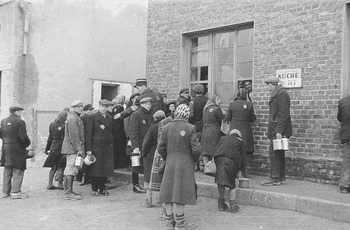
The striking image in Figure 1 shows a group of Jews gathered in front of a communal kitchen, waiting for soup to be handed out to them. The viewer immediately registers the Star of David badges on their clothes and the pots they are clutching in their hands, the so-called Menazkas, which became a symbol for the ghetto dwellers' constant hunger and search for food. In the center of the image, a Jewish policeman, a member of the “Order Service” (Ordnungsdienst), watches over the proceedings and maintains order, in accordance with the resolve of the ghetto's Jewish authority to prevent chaos among the members of the confined population. And, indeed, the scene does not suggest that chaos is about to break out, but evokes instead a degree of calm patience on the part of those waiting. This photo, taken by Henryk Ross, one of the photographers who documented life and death in the Lodz (Litzmannstadt) Ghetto (hereafter Lodz Ghetto), combines a number of prominent features of the ghetto's history in a single image. The photograph's very existence testifies to the efforts by ghetto inhabitants to document their own history at the time. It also offers clues about the relationship between the photographer and those being photographed. Some of the Jews waiting for food are aware of being photographed and appear not to mind. On the contrary, they look directly into the camera, abetting the photographer's desire to document the scene.
Soup line in the Lodz (Litzmannstadt) Ghetto. Source: Art Gallery of Ontario, Toronto.

This article will argue that Ross's photograph is characteristic of a general desire among Jews in Nazi-occupied Europe to create an archive documenting what was happening to them. To that end, especially in the ghettos, they wrote diaries, poems, short stories, and chronicles; they painted and they took photographs. The urge to create such records, under often unspeakably difficult circumstances, demonstrated a resolve not to let the perpetrators determine how their fate and their suffering would be remembered. Emanuel Ringelblum, who initiated the famous Underground Archive of the Warsaw Ghetto, wrote the following in a 1944 letter to his friend Adolf Berman about the documents they were collecting and also producing themselves: “If none of us survives, at least let that remain.”Footnote 1 Jakub Poznański recorded a similar thought in a diary entry written in the Lodz Ghetto in July 1943: “I am writing, above all, so that a future chronicler will be able to make use not only of official documents, but also of private sources.”Footnote 2 Jews founded an archive in Lodz as well. In contrast to the Underground Archive in Warsaw, this one operated within the framework of the Jewish administration and was, at least to some degree, official. But the motivation behind it was similar: the activists wanted to document Jewish life under Nazi occupation and tell future generations their own story.
Of the many different genres of documentation preserved in the Lodz archive, photography was particularly crucial, and a remarkable number of photographs of the ghetto have survived. It is true that some of these, including some of the best known, were taken by Germans. Among those that have attracted particular attention are the color photographs by Walter Genewein, the head of the finance department of the German civilian administration, the so-called Gettoverwaltung.Footnote 3 Others were taken by members of the Wehrmacht, the Schutzstaffel (SS), or civilians. A very large number of photographs was also taken, however, by Jewish ghetto inhabitants themselves.
Photographs from ghettos have long been used only to illustrate historical writings. But these photographs do not speak for themselves, and knowledge of their context is essential in order to interpret them as sources.Footnote 4 This article focuses on the photographs taken by Jews who wanted to document life in the Lodz Ghetto from their own perspective. It also discusses why the photographs were taken in the first place, and asks why Jews risked their lives trying to document what was happening. How did they carry out this work? What motifs predominate in their photographs? By situating the work of the most famous ghetto photographers, Henryk Ross and Mendel Grosman, in the history of the ghetto and its archive, the article sheds new light both on official documentary photographs and on photographs that were taken illicitly at enormous risk. It also considers what ghetto-dwellers wanted to have recorded as visual documentation at the time, and what images survivors preferred as visual reminders of the ghetto after the war. A short history of the ghetto and its archive serves as an introduction that provides the necessary context for discussing the photographs in more detail.
The Lodz Ghetto and Its Archive
The ghetto in Litzmannstadt, the name assigned to Lodz by the Germans in April 1940, was established in the spring of 1940. It was the second largest ghetto—after Warsaw—in occupied Europe. In February 1940, the Chief of Police ordered all the Jews in Lodz to move to run-down areas in the northern part of town: the Old City, Bałuty, and Marysin. From then on, the Jewish population had to live within the bounds of the poorest part of the city. Many of the houses were dilapidated; in many cases they were simple and basic constructions made of wood. There was no sewage system, and, for the most part, running water was only available in the courtyards. Some 160,000 people had to live within an area of only 4.13 square kilometers (1.6 square miles) fenced in with barbed wire. The ghetto was completely closed off on April 30, 1940, and from that point on, no one was able to leave it. Whoever tried escaping risked being shot by German police guards (the so-called Schupos), making the Lodz Ghetto the most strictly isolated ghetto in occupied Europe.Footnote 5
From the outset, people in the ghetto were clearly determined to create a new life amid atrocious conditions. Mordechai Chaim Rumkowski, appointed by the Germans in October 1939 as “Eldest of the Jews,” frequently took the initiative in organizing this new and unprecedented form of existence. Arguably no other head of a Jewish Council concentrated as much power in his own hands as Rumkowski, and, in retrospect, it seems certain that Rumkowski, under the illusion that the ghetto was autonomous, overestimated his own role and influence. He failed to recognize that the ghetto boundaries were the limits of his power and that his capacity to shape events extended only as far as the German administration deemed appropriate at any given moment. At the same time, efforts to organize life and improve conditions did not all originate with Rumkowski: initiatives also came from the ghetto population itself, and many Jews were active in this field.
Rumkowski established numerous organizations and departments that dealt with food supplies, health, welfare, justice, and education—as well as with a vast complex of ghetto industry. He believed that if the ghetto could deliver indispensable goods to the Germans, the latter would supply its inhabitants with food and spare them from deportation—which, later on, meant a possible way of avoiding being sent off to certain death. Hans Biebow, a former coffee merchant from Bremen and now head of the German ghetto administration in Litzmannstadt, supported Rumkowski's reasoning, which seemed to be driven by economic concerns—not only in the interest of keeping the ghetto dwellers calm, but also because, as long as ghetto factories continued running, Biebow could avoid joining the Wehrmacht and thus accumulate vast personal wealth. By the end of 1940, nineteen labor departments were employing about 7,000 workers within the ghetto, and, in 1943, more than 60,000 Jews were working in ninety-six departments.
Living conditions in the ghetto worsened rapidly and food became scarce, making hunger a dominant topic in all the extant diaries and memoirs from the Lodz Ghetto. The situation continued to deteriorate despite the Jewish administration's efforts to strengthen the health of the inhabitants through a variety of public welfare measures, and by 1944, more than 45,000 people would die there of hunger and disease. In October and November 1941, nearly 20,000 Jews were deported to the already overcrowded ghetto from the “Altreich” (i.e., the pre-1938 German Reich), Austria, the “Protectorate” of Bohemia and Moravia, and Luxemburg. Subsequent deportations to the Kulmhof (Chełmno) extermination camp began in January 1942, and many western Jews were among the more than 70,000 men, women, and children killed there in gas vans only thirty miles northwest of Lodz. The deportations culminated in the infamous “Sperre” (curfew) in September 1942, when the Germans deported the sick, elderly, and—worst for all ghetto dwellers—children under the age of ten. Rumkowski, his Ordnungsdienst, and his administration organized the deportations between January and May 1942, but German forces entered the ghetto in September and conducted the selection and deportation with such brutality that many ghetto inhabitants, already nervous because of rumors about killings, now became aware of their own fate, as well as that of earlier deportees.Footnote 6
The ghetto changed dramatically after these deportations in the fall of 1942. It became a huge labor camp in which nearly 90 percent of the population worked in the ghetto factories or in the administration. Very few children and elderly people remained, and the streets were almost empty during the day because only those able to work were allowed to live in the ghetto. Germany's war economy as a whole benefited from the ghetto, as did several German companies and the German administration in Litzmannstadt: that was why it continued to exist longer than any other ghetto–even if it was clear in the end that the SS would not abandon the ideological goal of getting rid of the Jews. Deportations nevertheless stopped for some time after the “Sperre” of September 1942, and the year 1943 was relatively calm in Lodz. It was only in the summer of 1944 that the Germans liquidated the ghetto and deported most of the remaining inhabitants (nearly 70,000) to Auschwitz-Birkenau. Some Jews managed to go into hiding and avoid deportation, while another group stayed in Lodz as part of the so-called Aufräumkommando, a detachment officially left behind to “clean up” the area and prepare goods for shipping to Germany. The German administration had planned to kill the members of the clean-up commando as well, but they managed to hide themselves until the liberation of the city in January 1945. As we shall see, this proved to be important for the subsequent history of the photographs from the ghetto.Footnote 7
The photographic record of the ghetto has to be seen not only in the context of the ghetto's development, but also in relation to the systematic efforts to document its history at the time. The Jewish administration set up an archive early on with the sole purpose of preserving a record for posterity. The first step towards this was the creation of a department whose task was to prepare statistical material for the German authorities, but which also stored documents and, above all, photos that were not meant for the Nazis but rather for internal documentation. Rumkowski ordered the establishment of an archive within this department in November 1940 to create a record of the history of the ghetto and, most important, of his own achievements. The employees began by collecting announcements and other ghetto documents, but soon started creating sources themselves. Józef Zelkowicz wrote reports, for instance, on various aspects of ghetto life, among which a number of texts about factories and workshops has survived.Footnote 8
The archive's central undertaking was its daily chronicle, which was kept between January 12, 1941, and mid-1944, i.e., almost until the final liquidation of the ghetto. Each day the employees noted down details of daily life, but unlike private records, these notes were created in the offices of the Jewish administration and could therefore be easily discovered by the Germans. Not surprisingly, the tone of these texts was extremely careful, and the chronicle focused more on the life of the ghetto inhabitants than on the crimes of the perpetrators. The less its authors were able to report on those who were committing the crimes, the more they wrote about the people in the ghetto. It is precisely this detailed account of those incarcerated in the ghetto that makes the chronicle a unique source, shedding light on the fate of individuals while recording their names and reactions.
Besides recording various aspects of ghetto life, starting with the weather and daily temperature, the size of the ghetto population, and the number of births and deaths, the authors recorded at the beginning of each day's entry any shootings at the fence or suicide attempts. They also noted the delivery of food stocks and black market prices, as well as figures on factory productivity and medical provisioning in the ghetto. There were reports on cultural life and on the problems faced by ghetto dwellers and how they tried to deal with them.Footnote 9 In the spring of 1944, the archivists began to supplement their chronicle with a ghetto encyclopedia, which used filing cards to profile important personalities and institutions, as well as to explain terms that had been newly coined or whose meaning had changed under ghetto conditions. The chronicle served as a record of events, whereas the encyclopedia represented an initial evaluation of the ghetto's inner life.Footnote 10 Photographs were a fundamental part of the Statistical Department's efforts to document life and death in the ghetto, but were maintained as a separate form of documentation and thus not incorporated into the chronicle. The photographers, their motivation, the work they produced, and how it was received by the population are the subject of the next section.
The Ghetto Photographers: Mendel Grosman and Henryk Ross
As one of the Jews allowed to stay in the deserted area as part of the Aufräumkommando, Nachman Zonabend, who had earlier worked as a mailman in the ghetto, managed to hide the documents of the archive after the ghetto's liquidation. “I will never be able to describe the destitution, starvation, sickness, despair, injustice and loneliness which I saw there,” Zonabend commented on the immense value of the photographs taken in the ghetto: “Fortunately, there were others who have done it, such as the photographers Mendel Grosman and Henryk Rozencwajg-Ross, who preserved images of the ghetto on film.”Footnote 11 The production and preservation of this remarkable record is closely connected to the archive and to the Statistical Department of which it was a part and where at least three photographers—Grosman, Ross, and the lesser-known Lejb Maliniak—were employed.Footnote 12
A photographic office functioned within this institutional framework from August 1940 to April 1944. The photographers' official tasks included taking photographs for the identity cards that every ghetto resident had to carry with them, as well as documenting work in the ghetto factories and workshops. As mentioned earlier, both Rumkowski and the German civilian administration had an interest in demonstrating the ghetto's economic productivity and in encouraging the flow of orders from German companies.Footnote 13 For the “Eldest of the Jews,” ghetto production was the Jewish population's best means of survival; for members of the German Gettoverwaltung, it was a means of enriching themselves and escaping conscription. This mutual interest in demonstrating the ghetto's productivity resulted in a vast output of pictures of workers and workplaces. The largest part of the whole collection comprises photographs from the workshops, ranging from long shots to close-ups of individual workers. The priority given to work as a subject matter reflected the interests of both Jewish officials and the German administration; at the same time, it accorded with the outlook and perceptions of the mass of ghetto inhabitants. Since work was an important part of their daily life, structuring their days and bringing an element of routine into the chaotic life of the ghetto, it likely made sense to them as well that most of the photographs taken in the ghetto documented their working life.
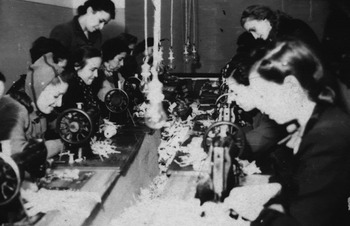
Figure 2 shows women working in a tailoring workshop. They are concentrating on their work, but the viewer can tell that they are also aware of being photographed. Some of them are smiling and thus clearly cooperating with the photographer to create an image full of meaning in a senseless world. The fact that the photograph shows their faces indicates that, besides demonstrating productivity, the photographer clearly wanted to show the workers' individuality and pride in their work. This photo offers vivid confirmation of a point that emerges from many written testimonies as well: the central importance of work for the ghetto dwellers.
Ghetto women at work. Source: State Archive, Łódź.

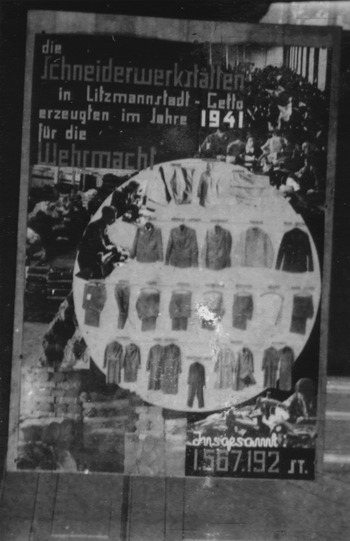
The Statistical Department produced albums using these photographs, which were accompanied by various graphics, including handwritten texts and photomontage. These albums documented the activities of either single workplaces or entire departments of the Jewish administration, such as the school system, the medical-care system, or the children's “colonies” located in the northern part of the ghetto. The creators of the albums that focused on the ghetto factories employed strikingly artistic and innovative designs—as can be seen in Figure 3, a page taken from one of these albums: it outlined the production by one of the tailoring factories of 1,567,192 items for the Wehrmacht in 1941. The page layout incorporated photographs of the products and of the workplace itself, as well as of its employees.Footnote 14
Album by the Statistical Department of the Jewish administration. Source: State Archive, Łódź.

The photographs that were taken to present a positive impression of work and orderly life in the ghetto ultimately had their meaning fixed by the context in which they were presented—for instance, in such official ghetto albums. They could also be put to other uses, however. Arie Ben-Menachem, then known as Arie Printz, was a factory worker active in the “Jewish Youth Front,” a Zionist youth organization. Many years after the war, he became one of the editors of the Hebrew edition of the Chronicle of the Lodz Ghetto. Using the same photographs by Mendel Grosman found in the official albums, Ben-Menachem created an alternative album in which the photos were not chosen to convey an official message about the success of ghetto life and work but rather just the opposite: sharply critical of the Jewish administration, he subverted the original purpose of the pictures by adding ironic commentary.Footnote 15
The photographers who worked for the Jewish administration's archive and were involved in its documentation initiatives were the key figures who produced ghetto photography. There were other photographers also working in the ghetto, but little is known about them and their output apart from scattered clues. For example, an entry in the Daily Chronicle from January 1942 mentions the creation of a “Photographers' Collective”:
The Eldest of the Jews has granted a license for photographers who are union members to form a cooperative. Eleven photographers have joined as co-partners; photographers employed in the Community's institutions are not allowed to join. The cooperative has two photography shops: one at 11 Brzezińska Street and one at 34 Lutomierska Street. The cooperative will supposedly be taken over by the Community at some point in the future.Footnote 16
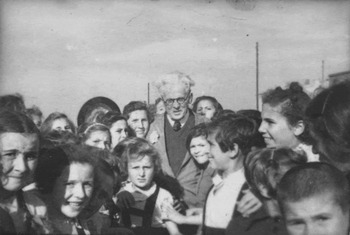
About 12,000 contact prints (in a 24 by 36 millimeter format) were produced by the official photographers and are held today by the State Archive in Lodz. They are contained in twenty-seven contemporary albums that, in some cases, are captioned. Photographs of workplaces and workers abound, as do photographs of orphanages and old people's homes, hospitals and public kitchens, schools and theaters. Many of the photographs show Rumkowski giving a speech, visiting a certain locale, or standing among crowds of people—as in the photograph in Figure 4, where he is standing among a group of children. Rumkowski's urge to document his own achievements focused in particular on promoting an image of himself as someone who cared for the ghetto dwellers and especially for the children: this photograph typically shows children standing around and close to him, many of them smiling.Footnote 17
Mordechai Chaim Rumkowski, the “Eldest of the Jews.” Source: State Archive, Łódź.

The ghetto's photograph collection contains an enormous profusion of images of groups of people and of individuals, and a small sample cannot do justice to its range. The photographs themselves often lack detailed information about their provenance, and it is not possible in most cases to determine who took the photograph or to date the image exactly. The pictures of schools, orphanages, and old people's homes must have nevertheless been taken before September 1942, when most of the elderly and children were deported to Chełmno.
The fact that photography was officially commissioned in the ghetto reveals a great deal about the purpose and content of a large number of the photographs that were produced as a result of this documentation effort. But to understand the wider photographic record of the ghetto, including those photographs taken unofficially, it is important to look more closely at the photographers and examine their motives. The former were all official employees of the administration—something that had certain advantages: a non-physical form of work, regular income, and a daily bowl of soup. But these advantages were obviously not the only reason for doing what the photographers did. Documenting what was happening in the ghetto seems to have been a vital mission that they felt driven to accomplish—regardless of the dangers.
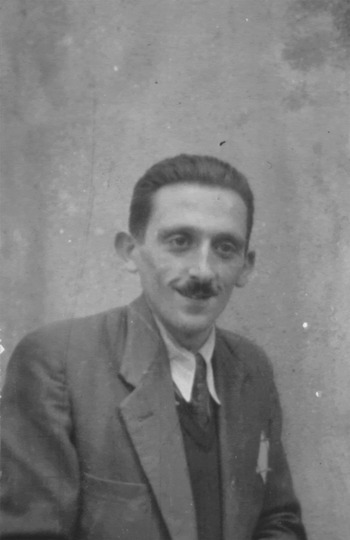
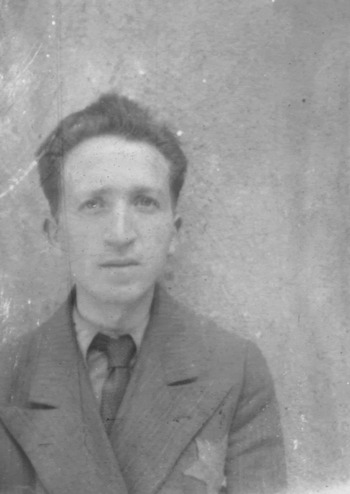
The two main photographers who worked for the Jewish administration—and about whom the most is known—were Henryk Ross, who was born in 1910 (Figure 5) and Mendel Grosman, who was born in 1913 (Figure 6). They had both been established photographers before the war, though they had worked in different fields. Whereas Ross was a news and sports photographer for various Polish newspapers, which meant that he was used to photographing groups of people, Grosman saw himself as more of an art photographer and preferred to take photographs of people who were unaware of his camera. Their way of working was, as Arie Ben-Menachem recalled after the war, very different as a result.Footnote 18 But their motivations were very similar. Besides the photographs they were supposed to take for official reasons, both secretly used their equipment to document the ghetto population's complex and diverse reality: the suffering but also the efforts to create some kind of tolerable everyday life under such abnormal conditions. Pinchas Shaar, who also worked in the Statistical Department, recounted the following about Grosman, who had set up a photographic laboratory in the cramped single room he shared with his family: “Documenting was his passion and obsession in the ghetto from the very beginning. To him it was imperative that a record be made to teach future generations about the horrors that had taken place in the ghetto.”Footnote 19
Henryk Ross. Source: State Archive, Łódź.

Mendel Grosman. Source: State Archive, Łódź.

Rumkowski strictly prohibited such private activities, for fear of reprisals if the Germans found out about efforts to document the realities of ghetto life.Footnote 20 Ross and Grosman nevertheless continued to pursue their mission, and thanks to the Statistical Department for which they were working, each had access to a fully equipped laboratory and an official permit to possess a camera. Grosman ordered film material repeatedly, telling the officials that the material he had previously received was faulty. Arie Ben-Menachem's father helped Grosman by producing an additional lens for his camera, a primitive one that permitted long-range shots and thus made it easier for him to take photographs from afar without being detected. As Ross later recalled, they also had surreptitiously procured additional photographic material, which “was smuggled to me in exchange for bread, of which I had far too little.” He summarized the situation: “Having an official camera, I was able to capture all the tragic period in the Lodz (Litzmannstadt) Ghetto. I did it knowing that if I were caught my family and I would be tortured and killed. The conditions for taking photographs were extremely difficult.”Footnote 21
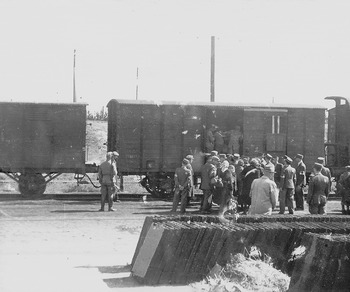
Their official position as photographers minimized their risk, of course, but they still put themselves in jeopardy when taking illicit photographs. As his friend Arie Ben-Menachem recalled after the war, Grosman walked through the streets of the ghetto with the camera beneath his coat, taking pictures without anybody noticing. Keeping his hands in his coat pockets, which were cut open inside, Grosman could press the shutter with his hands concealed, carefully opening his coat and turning in the right direction in order to angle the shot. These precautions were especially important when Grosman or Ross took pictures of public executions and deportations, German crimes they clearly wanted to document for posterity. This is the reason we have photographs of the 1942 and 1944 deportations from the ghetto to the Chełmno extermination camp, which show large processions of people heading to the Radegast station where the trains departed, as well as Jews boarding a train guarded by Germans and Jewish policemen (Figure 7). The children, women, and men shown in such photographs were murdered only hours after the pictures were taken.
Deportation of Jews. Source: Art Gallery of Ontario, Toronto.

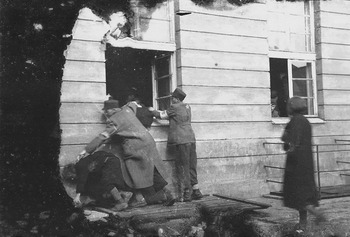
Ross and Grosman also took pictures of people trying to escape during the deportations. Figure 8 is a photograph most likely taken during the infamous “Sperre” of September 1942: it shows Jewish police trying to stop people attempting to escape from a house. Such scenes were described in emotional and very moving terms in many diaries and memoirs, but the photograph adds and captures with great accuracy a particularly vivid and authentic impression of the fear and desperation of the moment.Footnote 22 As Jewish policemen catch a fellow Jew trying to escape, a woman looks on, not knowing what to do. Józef Zelkowicz described a scene like this in notes he made about the “curfew”:
The Jewish police come with a whole entourage: policemen wearing caps, firefighters and porters. The house that you have tenanted and treated as your own has become a prison in one stroke. Everyone must stay in their apartment. That way, they lead people along like mice into a trap. The room becomes too narrow for the eyes, the eyes too narrow for their sockets, the heart too narrow for the chest cavity. Dread rips the eyes apart and makes them bulge. Agony makes the throat swell to the point of bursting. It is encircled not by a thin wire that would slice it, but by a thick rope that asphyxiates you, leaving you neither alive nor dead …
The Jewish police are equipped with addresses. Every house has a concierge who has a list of tenants. … A doctor enters each flat, examines the tenants, and decides who is healthy and who wishes to be considered healthy. He has accrued enough experience in the ghetto to distinguish between the healthy and the dangerously ill by a mere glance.
It is of no use for a boy to clutch his mother's neck with his two tiny hands. It is of no use for his father to throw himself at the threshold and roar, like a bull being butchered, “You'll take my boy over my dead body.” It is of no use for an old man to paw the walls with arthritic hands and beg “Let me die here quietly.” It is of no use for an old woman to throw herself at the policeman's feet, kiss his boots, and plead “Look, I have grandchildren older than you.”Footnote 23
Jewish police preventing escape. Source: Art Gallery of Ontario, Toronto.

This example shows how the two genres—the written and the visual—complement each other as forms of documentation. Neither is more “authentic” than the other, but in each case authenticity derives from different qualities. The written text provides crucial contextual information and conveys the author's internal thought processes. It deploys literary devices (metaphor, or the repetition of a particular phrase for additional rhetorical impact) that heighten the sense of a dramatic narrative with shifting perspectives and foci, and it conveys sounds as well as sights. The photograph, by contrast, offers a seemingly more unmediated, direct view—though only of a fleeting moment. At the same time, it conveys gestures and spatial positioning, e.g., showing the proximity of the woman onlooker. But above all, it gives the viewer the impression of “being there,” of being an eyewitness to the scene.
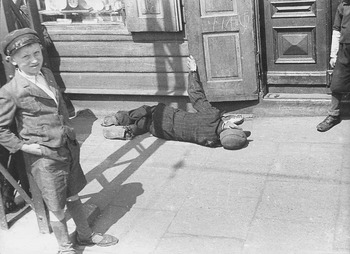
Almost one quarter of the population was never deported, but instead died in the ghetto as a result of the hunger, suffering, and death documented in images such as Figure 9: in the center is a man or a boy lying on the pavement, too weak to get up again (the gesture of his hand reaching out to the door suggests that this is what he is trying to do), apparently dying from weakness and starvation. One person stands next to the dying man; on the other side of the photograph, a young boy looks directly toward the photographer, his hands in the pockets of his trousers, standing there in an almost casual way, not running away from the dying person or trying to help—reactions one usually expects in more “normal” times. In short, this photograph powerfully captured the ubiquity of death in the ghettos.
Prone man suffering. Source: Art Gallery of Ontario, Toronto.

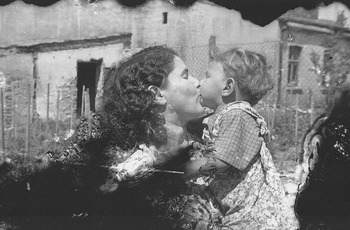
Hunger, suffering, and death are motifs that one would expect, of course, to find in a photographic record of the ghettos. But the photographers also documented other aspects of private and everyday life in the ghetto that are often overlooked in historical research—perhaps because these photographs are often extremely unsettling. Photographs of mothers with their babies, or of lovers kissing each other, may seem too “pretty” or too “normal” because of the irritating contrast with the overall reality of the ghetto—seen in other photographs showing children who are hungry and sick. In Figure 10, a loving mother kisses her child, apparently unaware that a photograph is being taken. It is an intimate and happy moment of privacy that seems to stand outside the reality of the ghetto, that contrasts sharply with the run-down houses seen in the background, as well as with our knowledge of life in the ghetto.
Mother and child. Source: Art Gallery of Ontario, Toronto.

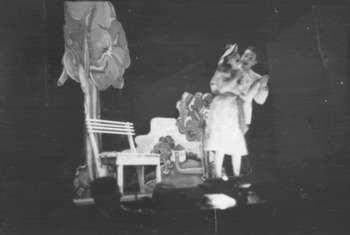
By capturing the timelessness and beauty of such everyday moments, the photographers documented people's will to live and to preserve their dignity. Ghetto dwellers must have longed for normality and for moments in which they could forget the reality of their prison. The photographers also captured the struggle for a world based on moral standards, as well as determined efforts to maintain some semblance of cultural life—as seen in Figure 11, a scene from a theatrical performance that connected them to their lives before the ghetto.
Theatrical performance. Source: State Archive, Łódź.

Henryk Ross's photographs in particular suggest that he clearly saw the beauty in some moments in ghetto life.Footnote 24 The extant diaries and memoirs make it clear as well that there were indeed moments of joy in the ghettos: there may have been quarrels and social conflicts, but friendship and love flourished as well. The documentation of this dimension of life in the ghetto—including the inhabitants' efforts to forge some kind of everyday normality under extreme conditions—brings them more sharply into focus as individuals with some degree of agency, serving as a counterpoint to their usual portrayal as merely passive victims. And this was clearly one of the aims of those who produced these documents.Footnote 25
While documenting the complexity and diversity of ghetto life, the photographers also exposed social tensions. Some of the photographs taken by Henryk Ross showed the well-fed children of members of the ghetto elite, as well as the social gatherings and celebrations of those few still able to hold such events, who were consequently the target of harsh criticism by the suffering majority. In his introduction to an edition of previously unpublished photographs by Henryk Ross, Thomas Weber asks whether Ross himself may have been “more involved with the ghetto elite than he was willing to admit,” for his “pictures of ghetto ‘dignitaries’ often depict their private and domestic lives, rather than showing them at official occasions.” Whether this was true is difficult to say—and if it was the case, what, if any, are the historiographical or the moral implications? In most cases survival was not possible without at least some connections, or protekcja, the term used in the special language of the ghetto. And whatever Ross's connections may have been, this would not, as Weber rightly points out, necessarily change our perception of his activities and achievements.Footnote 26
Both Ross and Grosman regularly took pictures of children, and not just those of the ghetto elite. Looking after children, educating them, and imparting to them the values they would need for a life after the ghetto was a high priority for ghetto dwellers. The Jewish administration created a school system soon after the ghetto was established, and there were orphanages and “colonies” in Marysin, the northern, less overcrowded part of the ghetto. These efforts to care for children were a crucial act of cultural resistance, a remarkable assertion of cultural and intellectual agency in a world determined by a constant fight for physical survival. Schools and orphanages—places where children and youths were allowed to play and learn—conveyed an impression of normality in the completely abnormal world of the ghetto, thereby constituting a distinctively alternative world to that of the ghetto. Figure 12, for example, shows a group of children with their kindergarten teacher in a happy and peaceful moment that could have been taken anywhere.
Kindergarten children with their teacher. Source: State Archive, Łódź.

Grosman and Ross portrayed people as individuals with their own biographies, even though they now shared a collective fate sealed inside the ghetto. In fact, there are hundreds of portraits in the official photograph collection. “With their unique perspective, which always saw the people first,” Ingo Loose comments, “the photographers in the ghetto clearly distinguished themselves from the non-Jewish photographers on the perpetrator side” and from their stigmatizing pictures of orthodox Jews.Footnote 27 The most well-known and most frequently reproduced pictures from ghettos are still those taken by perpetrators: photographs that connote the stereotypical antisemitic image of dirty “Ostjuden.” Many of these show old men with pejes and a beard, or begging children, or photographs such as the famous one of the small boy with a peaked cap and uplifted arms in the Warsaw Ghetto (part of Jürgen Stroop's report on the liquidation of the ghetto)—in short, images in which Jews appear only as passive victims.Footnote 28 By contrast, Jews appear in many of the photographs—both in official ones as employees of the Jewish administration, and in ones they took clandestinely—as individuals with agency who are trying to deal with their fate. This was as true of “normal” and poor people as of members of the administration and the elite, all of whom were shown with their families or friends, at work or in other everyday situations.
Even in those cases where German photographers did not expressly attempt to humiliate their Jewish subjects, certain features of these photographs suggest that they were taken from a different standpoint from that of the Jewish photographers. One particular set of such photographs already mentioned—those taken by Walter Genewein of the German ghetto administration—frequently shows the ghetto inhabitants in the factories, just like the ones by Grosman and Ross. All attempt to document the ghetto's productivity, but those taken by Grosman and Ross are somehow distinctive. For one thing, their photographs of workshops suggest a stronger sense of interaction between the workers and the photographer. More to the point, Grosman and Ross “capture[d] both more horror but also more joy” in their overall output.Footnote 29 Genewein's photographs, by contrast, tend to trivialize the situation in the ghetto by presenting it as a clean and almost normal place where workers were simply doing what they were supposed to be doing in the factories. Arnold Mostowicz, a survivor of the Lodz Ghetto, reacted with shock when confronted with these images in a 1998 film made by Dariusz Jabłoński using Genewein's photographs: “The slides picture the ghetto in Lodz, but it was not the ghetto from my memory even though they showed the same people, the same buildings, the same streets. Where is the truth to be found? Is it in my memory or in the pictures taken by Walter Genewein?”Footnote 30 This example makes one thing very clear: “Photographs do not represent a single reality,” as Janina Struk has observed, “They exclude, include, distort and misrepresent.”Footnote 31
The Jews in the Lodz ghetto apparently felt understood by the Jewish photographers and consequently cooperated with them. As Arieh Ben-Menachem recalled, “The desire to record, to record at all cost, had become part of the consciousness of the inhabitants of the ghetto. All parts of the community had become permeated by this desire, and Mendel with his camera was received with open arms and with full understanding in workshops, in hospitals, in orphanages, in offices, in the streets.” He also described how Grosman sometimes hesitated, unsure whether to take a picture of a certain situation. But people would encourage him, saying: “Let it remain for the future, let others know how humiliated we were.”Footnote 32 These testimonies are anecdotal, of course, but they still shed light on the interactions between the Jewish photographers and their subjects in the photographs. The latter did not always notice, of course, that they were being photographed because Grosman and Ross often had to act clandestinely. The photographs of the resettlement actions, for example, clearly suggest that nobody was aware of the fact that photographs were being taken: unlike those taken under vastly different circumstances, there is no interaction between the photographer and the photographed. This was one instance in which the latter clearly had no agency.
The Fate of the Photographers and the Photographs
Mendel Grosman survived the ghetto, but died after the evacuation of the camp in Königs Wusterhausen during one of the death marches just days before liberation. He had taken steps while still in the ghetto to ensure that his photographs would be preserved—for example, by frequently distributing them among his friends. Arieh Ben-Menachem recalled after the war that he had taken and hid photographs from Grosman on several occasions, ending up with 417 prints in his possession. Grosman kept the negatives and hid them before his deportation in October 1944 (he had been part of the “cleanup commando” after the liquidation of the ghetto). Pinchas Shaar and Grosman's sister were able to find them after the war. The latter brought most of them to Israel, where they disappeared during the Arab-Israeli war of 1948.
Henryk Ross and his wife Stefania, who got married in the ghetto, also stayed there as part of the Aufräumkommando. Ross buried his photographs and negatives and was able to retrieve them after liberation. He and his wife stayed in Lodz, where they had two sons, and Ross continued working as a photographer; in 1950, they all emigrated to Israel. Some of the photographs did not survive, but the majority were sent to him via the Israeli Consulate. Ross, who worked as a photographer and as a zincographer in Israel, died in 1991. Most of his photographs are now held by the Art Gallery of Ontario in Toronto; most of the surviving photographs secretly taken by Grosman are held by the Ghetto Fighters' House in Israel. In addition, more than 12,000 contact prints are also preserved in the State Archive in Lodz.
Some of the photographs were published after World War II, but, for many years, they were only selectively used to create a specific picture of the ghetto that survivors wanted to show.Footnote 33 This was also the case for written memoirs: people adopted a particular narrative in an attempt to influence how their experiences were remembered. That was the reason why, for many years, hardly any photographs were published showing carefree or cheerful moments in the ghetto. This was not the ghetto reality people wanted to talk about and have remembered, and it seems that there was a sense among many survivors that their experiences in the ghetto could appear banal or trivial if moments of happiness were described or shown visually. Another possible reason for the selective use of Ross's photographs might be the way in which they demonstrated his relative closeness to the ghetto elite—something that might have attracted criticism in the postwar period. It took some time before historians and survivors started writing about everyday life in the ghettos in a more expansive way, and it now seems possible to accept the idea that writing about happiness in the ghetto–or presenting photographs that reveal a happy moment there—do not negate the overwhelming fact that conditions in the ghettos were largely unbearable.Footnote 34
The photographs were not only vital elements in sustaining survivors' memories of the ghetto, but also acted as evidence for the crimes committed—for instance, in the trial of Adolf Eichmann in 1961, where Henryk Ross appeared as a witness in Israel. He explained in his testimony the purpose and importance of these photographs: “I hid them in the ground in the presence of several of my friends, so that if we died and one of us survived, the photographs would remain for the sake of history.”Footnote 35 Bearing witness—documenting what was happening to them and preserving it for posterity—obviously became an existential need for many Jews in the ghettos in Lodz and elsewhere, including for the Jewish photographers themselves. It is possible that they believed that photographs were stronger proof than “just words” of what the Polish Jews suffered. Words might not be believed—something many Jews feared after the war, which was a reason many did not write their memoirs—but photographs represented a form of evidence whose veracity was less easy to deny.
Most of the written documents from the ghetto's archive were also saved. Nachman Zonabend knew about the archive because it was housed in the same building as the post office where he worked. Zonabend also remained in the ghetto area in the summer of 1944 as part of the Aufräumkommando charged with removing all traces of the ghetto's existence. Zonabend did the opposite, however: he sneaked into the building and found almost the entire archive collection packed up, mostly in suitcases, some of it in bundles. He hid the documents in the courtyard of the building in a disused well and was able to recover them after the liberation. Most of the sources are now kept in the Lodz State Archive and in the Institute for Jewish Research (YIVO) in New York; some copies are available at Yad Vashem in Israel and at the United States Holocaust Memorial Museum in Washington, DC.
Thanks to the authors of these various texts, as well as to the photographs of Mendel Grosman, Henryk Ross, and others, our memory and view of the Lodz Ghetto is not determined solely by the perspective of the perpetrators. The great majority of pictures from the ghetto was taken by Jewish photographers who were sealed in the ghetto and thus part of its society. They portrayed the suffering, the miserable conditions, the hunger, disease, and destruction—but they also depicted the daily struggle to preserve humanity in the inhuman world of the ghetto. To that end, they portrayed individuals and showed their faces in an effort to preserve their dignity. Most of the Jewish children, women, and men of the Lodz Ghetto were killed in Chełmno or Auschwitz, or died in the ghetto from hunger and disease. These photographs depict their suffering, as well as their struggle for survival and dignity. In so doing—and in a different way from that of written records—they have helped prevent the Nazis from achieving their aim: to murder the Jews of Europe and eliminate their memory in the process.