Implications
Polyphenol oxidase (PPO) is an enzyme that has been found to be active in red clover. There is a whole range of recent studies exploring possibilities of using this enzyme to protect membrane lipids against degradation in the forage during storage and in the rumen of ruminants. Protection of lipids against degradation is of importance as it could help to improve the fatty acid profile of ruminant products, with respect to consumer health. This review aims to summarize studies of red clover PPO and its effect on lipid metabolism to facilitate further work in this area.
Background
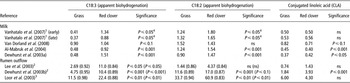
The feeding of red clover (Trifolium pratense) silage as opposed to ryegrass (Lolium spp.) silage to dairy cows generally results in a higher level of polyunsaturated fatty acids (PUFA) in milk per unit of PUFA intake (Table 1), which was attributed to a protective effect of red clover against rumen lipid metabolism (Lee et al., Reference Lee, Harris, Dewhurst, Merry and Scollan2003). This is strongly supported by the higher outflows of PUFA to the duodenum in fistulated animals (Dewhurst et al., Reference Dewhurst, Evans, Scollan, Moorby, Merry and Wilkins2003b; Lee et al., Reference Lee, Harris, Dewhurst, Merry and Scollan2003) and from continuous culture fermenters (Loor et al., Reference Loor, Hoover, Miller-Webster, Herbein and Polan2003;Table 1). Consequently, a lower apparent biohydrogenation (the microbial saturation of dietary PUFA to more saturated products) was reported for linolenic acid (C18:3n-3) and in some cases also for linoleic acid (C18:2n-6) when offered red clover silage compared with ryegrass silage. There are strong indications that there is a chemical mechanism at the basis of this observed reduction in biohydrogenation when red clover silages are offered compared with ryegrass silages. In this respect, phenolic compounds resulting from the enzymatic reaction of polyphenol oxidase (PPO), specifically active in red clover, have been hypothesized to be able to reduce lipid degradation in silage and further in the rumen (Lee et al., Reference Lee, Harris, Dewhurst, Merry and Scollan2003).
Comparison of feeding ryegrass or red clover silages on fatty acid composition of milk (g/100g of total fatty acid) or outflow from the rumen (g/day, in vivo or mg/day, in vitro) and apparent biohydrogenation

1Vanhatalo et al. (Reference Vanhatalo, Kuoppala, Toivonen and Shingfield2007) compared grass and red clover in an early and a late cut.
2Results represent fatty acid outflow to the duodenum in g/day.
3Results represent fatty acid outflow in mg/day from continuous culture fermenters fed; forages fed to fermenters were frozen fresh, ground while kept frozen and thawed the day before feeding.
4Interaction with early/late cut treatment occurred; ns = non-significant at P > 0.05.
This review cumulates the latest findings on red clover PPO with regard to the factors influencing its activity, analytical/methodological aspects, activation and its effects on lipid metabolism in silo, in vitro and in vivo in the rumen.
Introduction
Polyphenol oxidases (PPO) are a widespread group of enzymes that include tyrosinases and catechol oxidase and are found in animals, plants and fungi (Mayer, Reference Mayer2006). All PPO have a dinuclear copper centre, and catalyse the insertion of molecular oxygen in the ortho-position to an existing hydroxyl group in phenols, resulting in an ortho-diphenol and its further oxidation to a quinone, although a group also shows para-diphenol activity. The resultant quinones will readily react with cellular nucleophiles such as certain amino acids and phenolic structures. When binding with other phenols, a melanin-like polyphenolic structure in and between proteins can be formed. This results in a brown colour, which is undesirable in fruit and vegetables (Yoruk and Marshall, Reference Yoruk and Marshall2003).
The physiological function of PPO in plants has yet to be elucidated; for example, plant defence against pathogens (Thipyapong and Steffens, Reference Thipyapong and Steffens1997), the biosynthesis of floral pigments (Nakayama et al., Reference Nakayama, Sato, Fukui, Yonekura-Sakakibara, Hayashi, Tanaka, Kusumi and Nishino2001) or detoxifying oxygen species in the chloroplast (Sherman et al., Reference Sherman, Le Gardeur and Lax1995).
Measuring PPO activity
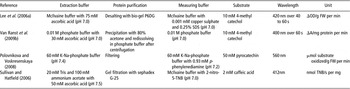
Generally, PPO activity in plant material is measured spectrophotometrically in a protein extract. Tissue is extracted, mostly with an ascorbic acid containing buffer around pH 7.0. The ascorbic acid in the extraction buffer is used to prevent PPO activity during extraction. Next, a protein purification step is performed (e.g. use of desalting column or protein precipitation using acetone) and finally activity is measured in a buffer using a synthetic substrate (4-methyl catechol is most commonly used). Increase in absorbance per unit time is a measure for the PPO activity in the protein extract and is reported as a change in optical density or unit (U) of enzyme activity. More recently, the SI unit of enzymatic activity the katal (mol/s) has been proposed and should be universally adopted when reporting PPO activity (Sullivan and Hatfield, Reference Sullivan and Hatfield2006; Schmitz et al., Reference Schmitz, Sullivan and Hatfield2008; Lee et al., Reference Lee, Tweed, Cookson and Sullivan2010). There is a wide range of studies with regard to PPO in red clover; yet, no uniform protocol is used for PPO activity measurement, with regard to the extraction solutions or buffers and procedure, protein purification, measuring buffer, substrate and wavelength (Table 2). It should be clear that activities measured with different methods are not comparable. Although this mainly concerns comparison across laboratories/experiments using different procedures, it is clear that research on this topic would benefit from a standardized methodology. Often, not the same PPO activity is measured as activation and degradation of the enzyme can vary over extraction and measuring methods. Differences in procedure could, for instance, explain the lack of activity in ryegrass when measured as described by Van Ranst et al. (Reference Van Ranst, Fievez, De Riek and Van Bockstaele2009a), contrary to Lee et al. (Reference Lee, Colmenero, Winters, Scollan and Minchin2006b), who reported a significant activity.
Extraction buffer, protein purification, measuring buffer, substrate, wavelength and unit used to measure PPO activity in four studies

PPO = polyphenol oxidase; OD = optical density; SDS = sodium dodecyl sulphate; FW = fresh weight; A = absorbance; TNB = thiobenzoic acid.
McIlvaine buffer is a citrate/phosphate buffer.
PPO activity in red clover
Differences in PPO activity between red clover cultivars has been reported (Fothergill and Rees, Reference Fothergill and Rees2006) and was supported by our own unpublished analysis on 14 red clover cultivars that showed a 3-fold difference between minimum and maximum activities. However, PPO activity is affected to a greater extent by (generally unknown) external factors, as indicated in several studies: (i) in unpublished results of Van Ranst et al. the average PPO activity measured in 14 red clover cultivars after re-growth in the greenhouse was found to be about 2-fold higher compared with the PPO activity measured in the same red clover cultivars grown in the field. Furthermore, the effect of the environment (greenhouse v. field) differed between cultivars; (ii) Winters et al. (Reference Winters, Minchin, Michaelson-Yeates, Lee and Morris2008) found an effect of growing season as a 4-fold difference in PPO activity in red clover leaves that was measured between June and July; (iii) Fothergill and Rees (Reference Fothergill and Rees2006) also measured a seasonal effect, but in addition, they found a 5-fold higher activity in September 2005 compared with September 2004 and a 2-fold lower activity in May 2005 compared with May 2006; (iv) PPO activity was shown to be up to 5-fold higher when red clover was grown in a polluted city area compared with a relatively unpolluted area (Polovnikova and Voskresenskaya, Reference Polovnikova and Voskresenskaya2008). An effect of growth stage (Polovnikova and Voskresenskaya, Reference Polovnikova and Voskresenskaya2008) and re-growth duration (Lee et al., Reference Lee, Tweed, Minchin and Winters2009a) was also reported. Nevertheless, Lee et al. (Reference Lee, Winters, Scollan, Dewhurst, Theodorou and Minchin2004) selected red clover plants (cv. Milvus) with consistently high or low PPO activity, in which the low PPO activity subgroup was reported to be a genotypic mutant (Winters et al., Reference Winters, Minchin, Michaelson-Yeates, Lee and Morris2008). This suggests that despite demonstrated effects of the environment, breeding for PPO activity in red clover is feasible.
Red clover PPO activity has been further unravelled using molecular techniques. Genetic coding for the protein in plants ranges from a single gene in the moss, Physcomitrella patens (Richter et al., Reference Richter, Lieberei and von Schwartzenberg2005) to seven genes in tomato (Solanum lycopersicum). Following nuclear transcription and translation the protein is translocated to the thylakoid lumen of plastid organelles (e.g. eoplasts, chloroplasts and leucoplasts). In red clover at least three genes are encoding three different PPO enzymes, namely PPO1, PPO2 and PPO3 (Sullivan et al., Reference Sullivan, Hatfield, Thoma and Samac2004). They were found to be 87% to 90% identical on the nucleotide level. PPO1 was found to be expressed mainly in young leaves, PPO2 in flowers and petioles and PPO3 in leaves and possibly in flowers. Further studies showed that they can also differ in activity (990, 10 and 330 nkatal mg/protein), pH optimum, stability at high temperatures and substrate specificity (Schmitz et al., Reference Schmitz, Sullivan and Hatfield2008). In a more recent study, a cluster of six PPO genes was found in red clover, comprising three variants of PPO1 (PPO1/2, PPO 1/4 and PPO1/5) and two other single-copy genes, PPO4 and PPO5, aside from the earlier detected PPO2 and PPO3 (Winters et al., Reference Winters, Heywood, Farrar, Donnison, Thomas and Webb2009). In-depth genetic studies of red clover PPO can not only help to establish the function of PPO in the plant, but also provide genetic markers, which could facilitate breeding.
PPO activation in red clover
In several plant species, PPO is present in a form that exhibits only low or undetectable activity, that is, a latent version. This latent PPO has been hypothesized to be due to the presence of a terminal peptide, which acts as a shield over the active site (Jimenez and Garcia-Carmona, Reference Jimenez and Garcia-Carmona1996), a theory which was further supported by the work of Gerdemann et al. (Reference Gerdemann, Eicken, Galla and Krebs2002). Indeed, latent and active PPO protein have been reported to differ by approximately 15 kDa in broad bean leaves (Robinson and Dry, Reference Robinson and Dry1992), indicating that PPO can be activated by proteolytic cleaving. Therefore, PPO can be considered to exist as a latent or pre-enzymatic form that has to be activated to elicit its full enzymatic potential, that is, the active form.
The active and total (latent + active) PPO activity present in red clover can be determined by assaying PPO activity in the absence and presence of sodium dodecyl sulphate (SDS; 0.5 to 8.75 mM) in the measuring buffer, respectively (Mazzafera and Robinson, Reference Mazzafera and Robinson2000; Lee et al., Reference Lee, Parfitt and Minchin2006a). SDS is a protein unfolding detergent, which has been shown in low concentrations to activate latent PPO to the active form. The action of SDS has been hypothesized to induce limited protein unfolding, which exposes the active site of the latent form (Moore and Flurkey, Reference Moore and Flurkey1990).
Winters et al. (Reference Winters, Minchin, Michaelson-Yeates, Lee and Morris2008) showed that, on average, over the growing season about 20% of the red clover PPO was present in the active form. However, Lee et al. (Reference Lee, Tweed, Minchin and Winters2009a) reported that in red clover at 4 and 8 weeks of re-growth, active PPO represented 29.0% and 81.2% of total PPO present, respectively. This large variation was stated to be due to maturity of the crop and the proportion of senescent material, which significantly increased the proportion of the active enzyme. However, total PPO activity (active + latent) was 4-fold lower in the more mature forage. A higher proportion of active PPO can also be expected when red clover is exposed to pathogens and abiotic stress. This might explain the 1.5-fold higher proportion of active PPO in spongy mesophyll cells compared with palisade mesophyll cells (Lee et al., Reference Lee, Tweed, Cookson and Sullivan2010); as the spongy mesophyll cells are associated with the stomata, which are more likely to be subject to pathogenic attack (e.g. fungus, viral or bacteria). Hence, these cells may require higher levels of PPO as a defence response than cells that are located under the upper epidermis layer away from the stomata. Lee et al. (Reference Lee, Tweed, Cookson and Sullivan2010) also showed a 2.4-fold increase in PPO activity in both cell types when the cells were stressed through wilting and crushing the leaf.
Many induction factors of PPO have been confirmed across many different species, such as pathogen invasion (Li and Steffens, Reference Li and Steffens2002), attack of herbivorous insects (Steinite et al., Reference Steinite, Gailite and Ievinsh2004), influence of wounding (Stewart et al., Reference Stewart, Sawyer, Bucheli and Robinson2001) and stress-induced signalling compounds such as jasmonic acid (Constabel and Ryan, Reference Constabel and Ryan1998; Gowda and Paul, Reference Gowda and Paul2002). The manner of induction and activation of latent PPO comprise: (i) activating the PPO genes, enhancing expression or de novo synthesis and (ii) changing original PPO activity through the activation of latent PPO enzyme. Activation in plastids has been shown to occur due to solubilization, inter-conversion (Veltman et al., Reference Veltman, Larrigaudiere, Wichers, Van Schaik, Van der Plas and Oosterhaven1999), chemical modification such as intermolecular disulphide bridge formation, glycosylation, phenolic glucosides (Mayer and Harel, Reference Mayer and Harel1979), proteolytic cleavage of a pre-peptide region (Jimenez and Garcia-Carmona, Reference Jimenez and Garcia-Carmona1996) and dissociation of an enzyme–inhibitor complex (Dogan et al., Reference Dogan, Arslan and Dogan2002).
For red clover PPO, specifically, Lee et al. (Reference Lee, Tweed, Minchin and Winters2009a) correlated degree of cell damage with activation, suggested that the loss of cellular integrity further induced activation and PPO activity. Quinones, the product of oxidation of the diphenolic substrate, were also suggested to initiate PPO activation. In the presence of diphenol substrate and ascorbic acid, which prevents oxidation of diphenols to quinones, no activation of PPO was induced. However, under the same conditions, but without ascorbic acid, PPO activation occurred. Binding of quinones to the PPO enzyme was suggested to cause this effect through modifications in enzyme conformation, exposing the substrate binding site (Winters et al., Reference Winters, Minchin, Michaelson-Yeates, Lee and Morris2008). Activation in situ by the oxidized substrate is found to be a relatively fast process (<3 min), which can even occur during extraction (Winters et al., Reference Winters, Minchin and Morris2005), whereas proteolytic cleavage is a rather slow process (>30 min; Lee et al., Reference Lee, Tweed, Minchin and Winters2009a). In healthy red clover tissue activation is prevented by sub-cellular compartmentalization of PPO, present in the chloroplast (Mayer, Reference Mayer2006), and its diphenolic substrates, phaselic acid and clovamide, which are thought to reside in the vacuoles (Lee et al., Reference Lee, Tweed, Minchin and Winters2009a). This explains the correlation between the degree of cell damage and PPO activation through intercellular mixing of the enzyme and substrate. In vitro activation by temperature treatment (>3 h at 65°C) has also been reported (Schmitz et al., Reference Schmitz, Sullivan and Hatfield2008) and acid/base activation was suggested by Lee et al. (Reference Lee, Tweed, Minchin and Winters2009a), as they measured a higher PPO activity in an extract of fresh red clover at pH lower than 5 and higher than 7.
PPO and lipid protection
PPO in red clover has been found to play a role in the reduced degradation of proteins in red clover silages (Jones et al., Reference Jones, Muck and Hatfield1995; Sullivan and Hatfield, Reference Sullivan and Hatfield2006). It has also been linked with lower rates of plant lipolysis as tested in vitro (Lee et al., Reference Lee, Winters, Scollan, Dewhurst, Theodorou and Minchin2004). This suggests that proteolysis as well as lipolysis can be inhibited by PPO activity. This review will focus on the lipid-protecting role of PPO. There are three hypotheses of how PPO would protect lipids from lipolysis in the silage. First, quinones formed due to PPO-mediated diphenol oxidation, which can bind to amino acids and other phenols; as such, they can polymerize in and between proteins, consequently denaturing them. As enzymes, for example, lipases, are also proteins; they can be inhibited. Owing to inhibited plant lipases, a reduction in plant-mediated lipolysis can occur (Lee et al., Reference Lee, Winters, Scollan, Dewhurst, Theodorou and Minchin2004; Van Ranst et al., Reference Van Ranst, Fievez, Vandewalle, De Riek and Van Bockstaele2009b). Second, lipids and proteins are in close proximity embedded in a cell/organelle membrane (e.g. in the chloroplast) when quinones polymerize in and between membrane proteins, they could form a protecting envelope, protecting lipids from degradation (Lee et al., Reference Lee, Scott, Tweed, Minchin and Davies2008b; Lourenço et al., Reference Lourenço, Van Ranst, Vlaeminck, De Smet and Fievez2008). Third, some polar lipids have potential nucleophilic binding sites, thus direct binding of quinones to lipids protects the lipids from enzymatic degradation.
Which of these three mechanisms is the most important in silages has not yet been studied directly, as protocols to measure the degree of protection through protein and lipid complexes are lacking. However, some distinction of the role of either of the mechanisms can be made based on (i) direct assessment of lipase activity and (ii) time series of fatty acid release in silo. Further distinction of the mechanism of lipid protection may be deemed from enzyme activation measurements, in vitro buffer experiments, experiments in silo and in the rumen, which are discussed in this section.
In vitro studies
Plant lipase inhibition
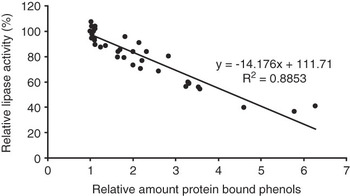
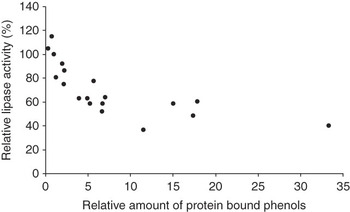
A first indication of the inhibition of lipases due to protein-bound phenols was reported by Van Ranst et al. (Reference Van Ranst, Fievez, De Riek and Van Bockstaele2009a). They showed a decrease in measured lipase activity (from 13 ± 1.4 to 7.7 ± 0.97 μmol PNPB min/g per dry matter (DM)) in association with an increase in protein-bound phenols (from 1.2 ± 0.06 to 1.8 ± 0.07 nmol tyrosine equivalent/mg protein) during wilting from ca. 300 to 500 g kg/DM. A second indication was a higher lipase activity in a protein extract of red clover after incubation for 24 h when phenols were scavenged (using polyvinylpyrrolidone) compared with the incubation in which phenols were still present (between 56.7 ± 4.24 and 19.8 ± 1.03 nmol methylumbelliferyl oleate (MBF)/min per mg DM, respectively; Van Ranst et al., Reference Van Ranst, Lourenço, De Riek, Fievez and Van Bockstaele2006b). In a more elaborate study (Van Ranst et al., Reference Van Ranst, Fievez, Vandewalle, De Riek and Van Bockstaele2009c), in which a synthetic diphenol was added to a purified protein extract of red clover and incubated for 120 s, there was a clear correlation between measured lipase activity and the amount of protein-bound phenols (Figure 1). Furthermore, the increase in protein-bound phenols during these incubations was lower when PPO was partially inhibited using NaCN and no increase was found when PPO was almost entirely inhibited at the highest NaCN concentration. Further evidence of the inhibition of the PPO of lipase was shown with the correlation of lipase activity and protein-bound phenols in red clover that was wilted for 4 or 24 h following one of three tissue damage regimes: no damage, crushed or freezing followed by thawing (frozen/thawed (FT)). Although at higher amounts of protein-bound phenols, the link became less clear, possibly indicating that due to cell compartmentalization in the plant, the lipases that are not in contact with oxidized phenols are safe guarded from inhibition (Figure 2). Indeed, within the range of protein-bound phenols as presented in Figure 1, a negative relation between the amount of protein-bound phenols and lipase activity was observed. Although these four experiments demonstrate a link between PPO activity, protein-bound phenols and direct lipase inhibition, they do not exclude lipid protection due to protein–phenol and/or lipid–phenol complexes.
Relation between relative amount of bound phenols and relative lipase activity in a protein extract of red clover after incubation (120 s) with 4-methyl catechol, both were calculated as the amount or activity divided by the amount or activity present in the corresponding fresh forage (adapted from data presented in Van Ranst et al., Reference Van Ranst, Fievez, Vandewalle, De Riek and Van Bockstaele2009b).

Relation between relative amount of bound phenols and relative lipase activity in a protein extract of undamaged, crushed or frozen/thawed red clover which was wilted for 4 or 24 h, both were calculated as the amount or activity divided by the amount or activity present in the corresponding fresh forage (adapted from data presented in Van Ranst et al., Reference Van Ranst, Fievez, Vandewalle, De Riek and Van Bockstaele2009b).

Plant-mediated lipolysis inhibition
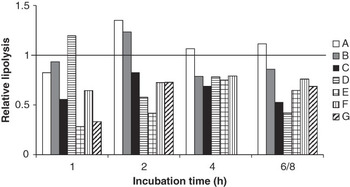
In vitro lipolysis of forage mixed in a phosphate buffer demonstrated that a high and/or activated PPO activity results in a lower plant lipase-mediated lipolysis (Lee et al., Reference Lee, Winters, Scollan, Dewhurst, Theodorou and Minchin2004; Van Ranst et al., Reference Van Ranst, De Riek, Fievez and Van Bockstaele2006a; Lee et al., Reference Lee, Parfitt, Scollan and Minchin2007; Van Ranst et al., Reference Van Ranst, Fievez, Vandewalle, De Riek and Van Bockstaele2009c). In all studies a control (non-activated, low or inhibited PPO activity) was compared with treatments in which PPO activity was promoted (activation) or was high (compared with the control). In Figure 3, lipolysis of the two treatment types (control v. active PPO) is presented for five studies. A, B and C show lipolysis during incubation in the presence of ascorbic acid over 24 h in which the wilted red clover was prepared under three damage regimes: not damaged (A), crushed (B) and (FT; C) (Van Ranst et al., Reference Van Ranst, Fievez, Vandewalle, De Riek and Van Bockstaele2009c). Owing to the presence of ascorbic acid, no PPO activity was possible during incubation. Therefore, only the effect of damage preparation regime on PPO activity and wilting on lipolysis was tested. Induction of PPO activity (measured as an increase in protein-bound phenols), which was FT, led to a lower lipolysis throughout the incubation. A lower degree of damaging (crushed) or wilting without damaging did not affect lipolysis, indicating the need for a high induction of PPO activity, which will include activation from latent to active PPO, to lower lipolysis.
Lipolysis during incubation expressed relative to a lipolysis in a control during incubation for 6 to 8 h, depending on the study. A, B and C represent undamaged, crushed or frozen/thawed red clover, respectively, after 24 h wilting incubated in a buffer with ascorbic acid with fresh red clover as a control; D (Van Ranst, Reference Van Ranst2009) and E (Lee et al., Reference Lee, Winters, Scollan, Dewhurst, Theodorou and Minchin2004) are red clover mixed in a buffer without ascorbic acid, with ryegrass and low polyphenol oxidase red clover as a control, respectively; F (Lee et al., Reference Lee, Parfitt, Scollan and Minchin2007) and G (Lee et al., Reference Lee, Colmenero, Winters, Scollan and Minchin2006b) correspond with red clover and cocksfoot without ascorbic acid compared with ascorbic acid as a control.

Lipolysis has been studied during incubation of red clover compared with ryegrass (which only had a low-to-undetectable PPO activity with the analytical method of Van Ranst et al. (Reference Van Ranst, Fievez, Vandewalle, De Riek and Van Bockstaele2009b) mixed in a buffer without ascorbic acid, allowing PPO activity during the incubation (D) or compared with red clover, which exhibits a low PPO activity (E) as a control. This showed that the presence of PPO activity resulted in a 25% lower lipolysis during a 6 to 8 h incubation (Figure 3). Furthermore, lipolysis during incubation of red clover with normal PPO activity (F) and cocksfoot (high PPO activity grass; Dactylis glomerata; G), both with and without ascorbic acid (control) demonstrated that active PPO resulted in a 25% reduction of lipolysis (Figure 3). However, from these results it cannot be concluded whether this was due to lipase inhibition or lipid protection due to protein–phenol and/or lipid–phenol complexes.
In silo studies
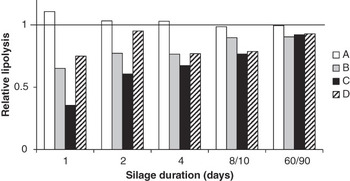
In Figure 4, it is demonstrated using data of two studies (Lee et al., Reference Lee, Scott, Tweed, Minchin and Davies2008b; Van Ranst et al., Reference Van Ranst, Fievez, Vandewalle, Van Waes, De Riek and Van Bockstaele2010) that in silo lipolysis of glycerol-based cell and organelle membrane lipids can be reduced when high PPO activity or activated PPO is present. In Van Ranst et al. (Reference Van Ranst, Fievez, Vandewalle, Van Waes, De Riek and Van Bockstaele2010), the control silage was undamaged; red clover wilted 4 h before ensiling. In this treatment, the lack of increase in protein-bound phenols after wilting suggests that PPO activation was only minor. However, longer wilting (24 h) without damaging or damaging by crushing did not have an effect on lipolysis in silo, as relative lipolysis did not differ from 1. Yet, when the forage was damaged by freezing and thawing, lipolysis was lower throughout ensiling. In the study by Lee et al. (Reference Lee, Scott, Tweed, Minchin and Davies2008b) red clover with normal and low PPO activity were ensiled after passing through a shredder.
Relative lipolysis during ensiling of red clover; A represents lipolysis as a mean of three treatments, which did not significantly differ red clover crushed and wilted for 4 h and crushed or undamaged and wilted for 24 h (A); red clover frozen/thawed and wilted for 4 (B) or 24 h (C), expressed relative to not damaged 4 h wilted red clover (Van Ranst et al., Reference Van Ranst, Fievez, Vandewalle, Van Waes, De Riek and Van Bockstaele2010). D represents lipolysis in silage of red clover with normal Polyphenol oxidase (PPO) activity, expressed relative lipolysis in red clover with very low PPO activity (Lee et al., Reference Lee, Scott, Tweed, Minchin and Davies2008b).

From Figure 4, it can also be concluded that microbial lipases as opposed to plant lipases are not affected by PPO. Relative lipolysis in the study by Van Ranst et al. (Reference Van Ranst, Fievez, Vandewalle, Van Waes, De Riek and Van Bockstaele2010) was lowest in the first days after ensiling (0.652, 0.355 and 0.750 for FT 4 h wilted, FT 24 h wilted and high v. low PPO activity, respectively), whereas the difference in the control largely disappeared after 60 to 90 days of ensiling (0.905, 0.921 and 0.929 for FT 4 h wilted, FT 24 h wilted and high v. low PPO activity, respectively). It can be assumed that during the early stages of ensiling, when silage fermentation is still at a low rate, the vast majority of lipolysis will be mediated through plant lipases. Hence, the difference in lipolysis during these first days of ensiling can be attributed to (PPO-mediated) plant lipase inhibition. However, when the fermentation rate and also bacterial activity increase, the increase in relative lipolysis can be attributed to the increasing importance of microbial lipases.
The hypothesis that PPO does not affect microbial lipases can support the observations of Van Ranst et al. (Reference Van Ranst, Fievez, De Riek and Van Bockstaele2009a). They ensiled red clover and ryegrass without additive, with formic acid additive (3.3 ml/g fresh) or a bicarbonate buffer additive (66.6 ml/g fresh; 0.2 M; pH 7.0). Formic acid addition restricted microbial fermentation, whereas the bicarbonate buffer extended microbial fermentation. Lipolysis in red clover, expressed relative to lipolysis in ryegrass silages, was 81.2%, 75.8% or 90.6%, for wilted undamaged silage prepared without an additive, formic acid additive or bicarbonate buffer additive, respectively. Thus, lipolysis was reduced to a higher extent when bacterial activity was inhibited by formic acid addition and higher when fermentation was extended by the addition of a bicarbonate buffer.
Due to this lack of effect on microbial lipases, in silo lipolysis is only slightly decreased when PPO activity is present.
Effect on rumen metabolism
Table 3 summarizes four studies investigating the effect of PPO on lipid metabolism in a simulated in vitro rumen environment. Lee et al. (Reference Lee, Parfitt, Scollan and Minchin2007 and Reference Lee, Tweed, Scollan and Sullivan2008a) and Loor et al. (Reference Loor, Hoover, Miller-Webster, Herbein and Polan2003) studied the biohydrogenation in incubation of red clover with high v. low PPO activity and red clover v. cocksfoot, respectively. Van Ranst et al. (Reference Van Ranst, Fievez, Vandewalle, Van Waes, De Riek and Van Bockstaele2010) reported biohydrogenation in the incubation of fresh red clover, wilted red clover (24 h) either undamaged, FT or ensiled red clover after wilting (24 h) without and with (FT) prior damage. All the results indicate a biohydrogenation inhibiting role of PPO, as after 24 h incubation (or continuous culture incubations in the study by Loor et al. (Reference Loor, Hoover, Miller-Webster, Herbein and Polan2003)), biohydrogenation was consistently lower for red clover with a high v. a low PPO activity or red clover compared with cocksfoot. Damaging red clover by means of FT and ensiling also resulted in a decrease in ruminal biohydrogenation after 24 h incubation (Van Ranst et al., Reference Van Ranst, Fievez, Vandewalle, Van Waes, De Riek and Van Bockstaele2010), indicating that damaging and ensiling red clover could also result in the protection of plant lipids.
Apparent biohydrogenation of C18:3 and C18:2 in red clover with high v. low PPO activity, red clover v. cocksfoot or fresh red clover v. FT red clover ensiled for 4 days (FT, 4 days) or 60 days (FT, 60 days) during 24 h incubation in rumen fluid

PPO = polyphenol oxidase; FT = frozen/thawed.
1Continuous culture incubation with mean retention time of solid phase of 14.3 h.
*Indicated significant (P < 0.05) difference from low PPO, cocksfoot and fresh, respectively.
It seems that large differences in in silo lipolysis, of the magnitude of fresh v. ensiled, are needed to generate an important difference in ruminal biohydrogenation. Indeed, the lower lipolysis in 4-day silages of the FT (50.5% ± 6.13%) compared with undamaged (70.2% ± 5.58%) red clover, assumingly due to the plant lipase-inhibiting role of protein-bound phenols, did not result in a change in biohydrogenation (87.9% ± 1.24% and 87.8% ± 0.35% of C18:3, respectively). Therefore, it can be concluded that the protection of lipids due to direct inhibition of plant lipases, can most probably not explain the higher outflow of PUFA from the rumen when red clover silages are fed. It can be assumed that PPO is inactive in the anaerobic rumen environment, as it needs oxygen to oxidize diphenols to quinones. Therefore, it is unlikely that PPO-mediated oxidation of diphenols is responsible for the inhibition of microbial lipases. Nevertheless, it has been previously demonstrated that PPO also protects plant membrane lipids from ruminal microbial lipase activity (Lee et al., Reference Lee, Parfitt, Scollan and Minchin2007), suggesting either the protection of lipids due to encapsulation or an alternative/additional mechanism to deactivated plant lipases.
Encapsulation in protein–phenol matrices could result in an effective (lasting) direct protection mechanism of the membrane lipids. Greater insight into the protective mechanism of PPO was highlighted in the study by Lee et al. (Reference Lee, Tweed, Cookson and Sullivan2010) who showed that membrane lipid protection incubated in rumen inoculum was apparent in macerated red clover tissue, but no protection was observed if the lipid was extracted from its cellular matrix and then incubated. This observation is consistent with a mechanism for protection of membrane lipid by PPO through entrapment of lipid within a protein–phenol complex rather than by covalent modification of lipids by PPO-generated quinones.
PPO activation rate and lipid protection
There is evidence that the mode of activation has an effect on the degree of protection of proteins and lipids. Moderate damaging (e.g. light crushing) is hypothesized to result in a moderate activation of PPO, preferably leading to binding of quinones to proteins followed by an extensive cross-linking of these quinone–protein complexes, which are (partially) undegradable by rumen microbes. Severe damaging, such as freezing and thawing, results in very rapid PPO activation, leading to binding of quinones to proteins with only limited cross-linking (Grabber, Reference Grabber2008).
Originally, this hypothesis was postulated by Grabber (Reference Grabber2008) to explain the effect of the degree of damaging red clover before ensiling on the proportion of rumen undegradable protein and insoluble rumen degradable protein. They found a higher rumen undegradable protein proportion in moderately damaged red clover compared with severely damaged red clover. However, the insoluble rumen degradable protein fraction was only half that of the moderately damaged compared to the severely damaged red clover. Therefore, they hypothesized that the higher rumen undegradable protein in moderately damaged red clover silages was due to a severe complexing of phenols with proteins and further cross-linking in and between protein, and that the higher insoluble rumen degradable fraction in severely damaged red clover silages was due to the binding of quinones with proteins, without further complexing.
Applying this theory to the results of the FT and wilted red clover in the study by Van Ranst et al. (Reference Van Ranst, Fievez, Vandewalle, De Riek and Van Bockstaele2009c) would suggest an inhibition of plant lipases due to the multiple binding of quinones to proteins, which leads to lower in silo lipolysis. However, lipids were not encapsulated due to the lack of major cross-linking in and between proteins, explaining the lack of difference in biohydrogenation between fresh and wilted red clover. Similarly, the hypothesis could also partially explain the lack of effect of pre-conditioned red clover (FT) compared to cut red clover on the fatty acid composition of milk when offered to dairy cows (Lee et al., Reference Lee, Theobald, Tweed, Winters and Scollan2009b). In this study, they also concluded that the activation procedure may have altered the way PPO protected the protein and lipid as postulated by Grabber (Reference Grabber2008). Further research is required to confirm this finding, as this could be key to fully utilizing PPO activity.
Alternative theories for a higher duodenal flow of PUFA from red clover compared with other forages
In addition, two alternative mechanisms for the protection of PUFA in the rumen during red clover feeding to those postulated for the effect of PPO should be considered, namely (i) changes in rumen microbial ecology and (ii) changes in digestion kinetics.
First, Huws et al. (Reference Huws, Lee, Muetzel, Scott, Wallace and Scollan2010) indicated that red clover silage feeding as opposed to grass silage feeding resulted in a significant change in the rumen microbial ecosystem within a 2-week period. These shifts possibly are a microbial response to compounds specific for red clover (e.g. PPO-induced protein–phenol complexes), which could affect biohydrogenating bacterial communities. Changes in the microbial population (e.g. fish oil) have already been linked with reduction and/or modification of lipolysis and biohydrogenation in some cases (Kim et al., Reference Kim, Huws, Lee, Wood, Muetzel, Wallace and Scollan2008; Huws et al., Reference Huws, Lee, Muetzel, Scott, Wallace and Scollan2010). However, this would not explain the lower lipolysis, which has been reported in vitro as well as in silo. Furthermore, it has been shown that these shifts did not result in an increase in the utilization of PPO-protected protein- or glycerol-based lipid (Lee et al., Reference Lee, Tweed, Scollan and Sullivan2008a).
Second, the difference in rumen digestion kinetics between red clover and other forages could reduce residence time in the rumen and thus indirectly reduce biohydrogenation. Vanhatalo et al. (Reference Vanhatalo, Kuoppala, Toivonen and Shingfield2007) postulated that protection of PUFA in red clover diets was a result of a combined effect of PPO protection and altered digestion kinetics with a higher rate of ruminal digestion of fibre for red clover as opposed to grass silage. This would suggest a reduction in ruminal retention time resulting in a higher proportion of dietary lipids escaping metabolism in the rumen. A similar mechanism was suggested for the elevated level of PUFA in milk observed from white clover (Trifolium repens) silage compared with grass silage (Dewhurst et al., Reference Dewhurst, Evans, Scollan, Moorby, Merry and Wilkins2003b; Van Dorland et al., Reference Van Dorland, Kreuzer, Leuenberger and Wettstein2008). It may also explain the lack of difference in milk PUFA, when conditioned red clover (cut/crushed and frozen and thawed), which fully activated the PPO and the cut fresh red clover with PPO activation of 29%, were fed to dairy cows, as both these treatments would likely have similar digestion kinetics (Lee et al., Reference Lee, Theobald, Tweed, Winters and Scollan2009b). However, a previous study has reported that the fibre content and rates of passage of red clover and grass silage were comparable (Dewhurst et al., Reference Dewhurst, Evans, Scollan, Moorby, Merry and Wilkins2003b) and so questions the postulation of the effect being solely related to digestion kinetics. As there are only a limited number of studies with regard to red clover digestion kinetics and they have contradictory outcomes, care should be taken when addressing this point. Nevertheless, reduced biohydrogenation has also been observed during batch in vitro incubations (see above) in which the outflow rate may not contribute to the observed differences.
Research needs
As the majority of the studies with regard to the effect of PPO on lipid metabolism are in vitro studies, it should be clear that more in vivo studies are needed to further confirm the link between the higher PUFA output and red clover PPO.
Fundamental research with regard to PPO’s function in the plant cell, genetic expression and gene sequencing could aid in the goal of breeding for red clover with a high PPO activity. This paper focuses on PPO activity, nevertheless phenolic content and their composition can also be of importance and should be addressed in future studies.
Some creative research is still needed to further unravel the mechanism of lipid protection. Microscopic techniques to visually confirm lipid encapsulation and studying protection with and without proteins are just two examples of recent approaches (Lee et al., Reference Lee, Tweed, Cookson and Sullivan2010). Finding conclusive evidence of this protection mechanism is crucial to further optimize and apply protection mechanisms.
Once the protection mechanism is clear, focus should be on factors influencing lipid protection through the PPO mechanism. This could be done by developing appropriate damaging and wilting regimes for red clover, but also by optimization of protection through technological treatments and industrialization (e.g. use of PPO as a natural lipid protector).
Conclusions
This review provides evidence that in silo lipolysis as well as ruminal lipid metabolism can be reduced when PPO activity is enhanced or high. We discussed that red clover PPO can play a direct role in the inhibition of plant lipases, through the oxidation of diphenols that bind to the lipases. However, the importance of this mechanism in the inhibition of lipolysis in the silage and further in the rumen is questionable, as this mechanism fails to protect lipids against microbial lipases, which become important during later stages of ensiling and in the rumen. Furthermore, it was also demonstrated that in vitro ruminal biohydrogenation is lower with silages of red clover with high PPO activity or high amounts of protein-bound phenols. Therefore, with regard to the PUFA protecting role of PPO, this led to the conclusion that lipids could be effectively protected against pre-ruminal and ruminal lipid metabolism as a consequence of the formation of protein-bound phenols and subsequent encapsulation in protein–phenol complexes.
Acknowledgements
This review paper was prepared as part of the PhD of Gijs van Ranst, which was supported by the Institute for Agriculture and Fisheries Research (ILVO), the EU-community (project Food-CT-23006-36241, Prosafebeef) and by IWT – Institute for the Promotion of Innovation by Science and Technology in Flanders. Post-doctoral research of Gijs Van Ranst is currently supported by Flanders Food (Belgium). The authors would also like to thank all the co-workers working in the field of PPO and lipid metabolism over the last decade and all the funding streams that made this work possible, particularly BBSRC, DEFRA, ILVO and IWT.